研究ノート 研究紀要 第 66 集
イランの医療ソーシャルワーカーに関する研究:役割強化の諸要因
アブリ サレ ・ 小 原 眞知子
和 気 純 子 ・ ザヘディアスル.モハンマド
Medical social workers in Iran: role-enhancing factors
Sareh Abri ・ Machiko Ohara
Junko Wake ・ Mohammad Zahedi Asl
Abstract:
The goal of this study was to uncover the factors that aid the social workers’ ability to perform their role and to improve their professional position in hospitals. Researchers interviewed 20 medical social workers using a probing interview method and results were analysed through a qualitative content analysis. Purposive sampling was initiated. The number of initial codes was 17. After combining some of the codes, they were finally classified into four categories falling under two major themes: “Social work profession-related factors” and “Environmental factors”. The “Social work profession-related factors” included two categories, namely, “Profession development” and “Redefining and revealing specialized roles”. The “Environmental factors” also included two categories, namely, “Maturity of the social environment of the hospital” and “Maturity of the social environment of the Ministry of Health”.Introduction
The role of a social worker in Iranian hospitals varies from providing support to patients and families, and improving communication among the medical providers, patients, and families, to advocating for the wishes of patients and families. However, performing these tasks becomes difficult when the role of the social worker is misunderstood, undervalued or simply unknown. Medical social workers in the hospital setting have a consistently uncomfortable sense that their role is misunderstood and misinterpreted by other health care professionals. The perceived lack of understanding about the role of medical social workers is their most serious problem.
Non-social work professionals expect medical social workers to provide concrete services, while medical social workers themselves are more likely to define their role as serving psycho-social care functions. There are many greatly conflicting expectations about the appropriate role of medical social workers between medical social workers and non-social work health care professionals. As a result, the role of medical social workers in Iran has eroded, leading to professional stagnation.
Medical social workers in hospitals have limited control over their jobs. Other health care professionals, particularly physicians, are usually the first and certainly the most important persons to determine the problem of a patient, how the problem should be treated, and what other health care professionals need to become involved. Although other disciplines in the hospital have been successful in establishing their professional status, social workers have yet to accomplish this. If social workers are taking an active role in providing care, what factors help them to provide this care? In Iran, very few studies have been done to investigate the opportunities for ongoing professional development in the field of medical social work. A qualitative study has allowed researchers to gain a broad understanding of what factors may help medical social workers to improve their role.
What is Medical social work?
Medical social work is a sub-discipline of social work and is also known as hospital social work or healthcare social work. Medical social workers typically work in hospitals, outpatient clinics, community health agencies, long-term care facilities or hospices. Medical social workers are specialists who work with patients and their families who are facing certain psychosocial barriers. Some selected definitions are mentioned below for the better understanding of the term “Medical Social Work”.
According to Dr, Cabot: “Medical Social Work is a process which serves to assist the physician in diagnosis and treatment of patient through study of the patient in his social situation and by interpreting the patient and his environment to the physician. In addition, the medical social work is to assist by organized sources in making medical treatment more effective” (Ali & Rafi, 2013)
recovery as a whole person” (Cannon, 1913).
The Medical Social Worker (MSW) is part of the multidisciplinary healthcare team that provides interventions to support patients and their families during recovery from and/or adjustments to illnesses. “A Medical Social Worker provides psychosocial support, case management, psychoeducation, counseling, referrals for other services and links to resources” (Hepworth, et al., 2000).
Some of the functions of social workers include psychosocial assessments, family education, crisis intervention, counseling for individuals, couples, and families, risk assessments, financial assessments, care coordination and discharge planning, information and referral services (linking patients and caregivers to community resources and healthcare systems), and interventions in policy making and planning (Gehlert & Browne, 2012).
Historical background of medical social work in the world with special look
on Iran
Britain and Ireland were the first nations to acknowledge the need for medical social workers to extend the clinical care in administrative and support aspects. Medical social workers in Britain and Ireland were previously known as Almoners or Hospital Almoners. They were competent, well-educated, and refined personnel who could consider and screen the positions and circumstances of the patients. In Ireland, the origins of medical social workers go back to Dr. Ella Webb who, in 1918, established a dispensary for sick children in Adelaide Hospital in Dublin, and to Winifred Alcock, who trained as an Almoner and worked with Dr. Webb in her dispensary (Gehlert & Brown, 2012).
In 1945, the Institute of Almoners in Britain was formed which, in 1964, was renamed the Institute of Medical Social Workers. The institute was one of the founding organizations of the British Association of Social Workers, which was formed in 1970. In Britain, medical social workers were transferred from the National Health Service (NHS) into local authority Social Services Departments in 1974, and generally became known as hospital social workers.
In the United States, Richard Clarke Cabot created the position of Hospital Social Worker or Medical Social Worker at Massachusetts General Hospital in the early 1900s. This was important from an epidemiological point of view, as it made it easier to control and prevent outbreaks of syphilis and tuberculosis (Beder, 2006).
treatment of physically and mentally ill patients.
Among all health care institutes in Iran who use social workers effectively, social insurance agencies, the Ministry of Health, health care institutions related to Tehran University, charities, and NGO’s can be mentioned as the most outstanding pioneers. The Social Security Agency was one of the first institutions that accepted social workers since the very beginning of their activities in Iran. It was during the academic year of 1958-1959 that social workers were accepted for an internship at Sorkhehesar Hospital of Tehran. Later, in September 1960, a group of five social workers were hired to work in hospitals of “Sorkhe Hesar” and “Children” in Tehran. In 1965, the Bureau of Social Works started an independent operation in the Agency of Social Security as its headquarters.
By 1969, twenty social workers had jobs at the Social Security Agency to address social, mental, and physical health issues of the covered patients. The lack of recognition as professionals and the nonexistence of accommodations were among the initial challenges of the social workers in the Social Security Agency.
These social workers would sometimes be expected by the chiefs of hospitals to serve as medical team members. However, giving injections and guidance to patients was not what the social workers had been trained for or had seen themselves ending up doing when they began their jobs in hospitals.
While lacking basic office space at the hospitals, they would be expected by the medical staff to interview all the patients. Understanding the need for privacy and confidentiality, one Iranian hospital finally agreed to provide the social workers with a small room to conduct their interviews. This change was followed by a better recognition of the role of social workers by hospitals, and gradually the workers were provided with the required work space in more and more hospitals. In 1969, twenty-five hospitals asked for social work services (College of Social Services, Iran; Record of a decade; 1969:33).
Work challenges of medical social workers
Medical social work is a demanding job that is vulnerable to detrimental impact. Medical social workers often have large case-loads and must meet tight deadlines for arranging necessary services. The job frequently requires tolerance due to its lacklustre reality of an unsupportive and hostile environment and cross-departmental nature with Nursing and Public Relations which diminishes the visibility (authority gradient) of the profession within hospitals (Margolin, L., 1997).
structured communication, policies, and economic restraints could also cause this delay (Carniol, B., 2000).
Method
Qualitative approach
Lincoln (2000) claimed that qualitative research involves an interpretive and naturalistic approach. This means that qualitative researchers study things in their natural settings, attempting to make sense of, or to interpret, phenomena in terms of the meaning people bring to them. Shank (2002) defined qualitative research as a form of systematic empirical inquiry into the meaning of things (Ospina, 2004). We chose the qualitative research approach for the following reasons: 1) to understand the role-enhancing factors in detail; 2) to explore some factors that have not been studied before in Iran; 3) to add rich detail and nuance in order to illustrate or document the existing knowledge related to medical social work; and 4) to try to understand the factors from the perspective of the actors involved, rather than explaining them from the outside.
Recruitment/ Data collection
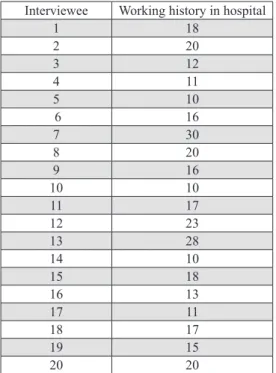
This study focused on the reasons for the weakening role of medical social workers in hospitals in Iran. Interviews were conducted with 20 medical social workers working in 20 public hospitals in Tehran, Hamedan, Semnan, Fars, Alborz, and Isfahan Provinces (the provinces where there is a social worker with the following three inclusion criteria).
Interviewee Working history in hospital 1 18 2 20 3 12 4 11 5 10 6 16 7 30 8 20 9 16 10 10 11 17 12 23 13 28 14 10 15 18 16 13 17 11 18 17 19 15 20 20
Table 1: working history of the interviewees
Data collection lasted from February 2017 to June 2017. The interviews were conducted in Persian. The interviewer was a Ph.D. student of social work with 11 years of work experience in the social work unit of a hospital in Iran and qualified to do qualitative research. The interview with each person was conducted in her/his hospital during working hours. The interview guide included a short checklist of questions to begin the interview, such as “How do you perceive your role in providing psychosocial care?” and “What factors help you to perform your professional role in hospitals?” The questions asked during the interview were designed to guide and encourage the participants to speak.
Data analysis
similarities and differences; and finally, the subcategories are classified into abstract categories and themes (Priest H, Roberts B & Woods L, 2002).
Immediately after the interviews, the researchers transcribed the text of each interview, verbatim in Persian, and the content was analysed by means of a qualitative content analysis using the MAXQDA12 software program. Using this method, the text of the interviews, the units of the analysis, and the initial codes were extracted based on the meaning units derived from the participants' descriptions. Then, the classification was done by considering the similarities and differences in the initial codes. Finally, based on the accurate interpretation of the researchers and the continuous comparison of the data, categories and themes were extracted.
Trustworthiness
In this study, the credibility, confirmability, dependability, and transferability were used to ensure the trustworthiness of the data.
To confirm the validity and the credibility of the data, a lengthy time was spent on collecting and analysing the data and on integrating the information sources. Multiple methods were employed to collect the data, such as interviews, notes in the field, observations, and member checks. Three of the participants, participants three, ten, and eleven, were contacted to confirm the accuracy of the transcription. One by one, all three confirmed that the interviews had been transcribed accurately. Member checking aids in the process of reflexivity by the monitoring of self and by being rigorously subjective (Morrow, 2005).To verify the confirmability and compliance of the interviews and the results of the data analysis, such as basic codes and categories, we used a peer check with the assistance of two Ph.D. students in social work with work experience in the field of health care. No large differences were found in the results.
Results
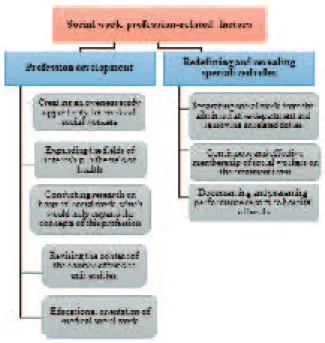
By continually comparing the basic codes and data, and by considering the similarities and differences, similar codes were placed in the same class and an initial classification of codes was obtained. The number of initial codes was 19. After combining some of them, they were classified into four categories falling under two major themes. According to the data analysis and code extraction, the two main themes that emerged were “Social work profession-related factors” and “Environmental factors”, each of which included two subcategories.
Social work profession-related factors
Profession development
Participants in the present study stated that the factors that made social workers in a hospital able to perform their main professional role were the growth and development of this profession. The growth and development of the profession can be realized by “Creating an overseas study opportunity for medical social workers”, “Expanding the fields of internship in the field of health”, “Conducting research on hospital social work which helps to expand the concepts of this profession”, “Revising the content of the courses offered at universities”, and “Educational orientation of medical social work”.
Participant 5:
“Many of the undergraduate courses at my university didn`t help prepare me for working in the hospital. When I started to work, what they had told us in classes about social work activities was different from what we saw in the workplace”. Quantitative and qualitative studies both help to recognize the obstacles as well as the enhancing factors of the role of social workers and help to develop content and current knowledge of this profession.
Participant 12:
“Although medical social workers have good statistical samples that can be used for reference, unfortunately, it seems that many are not interested in conducting scientific studies, even though the hospital environment is one of the richest in terms of the diversity of target groups”.
Redefining and revealing specialized roles
Another concept extracted from the data is redefining and revealing of specialized roles. This category implies the need to redefine roles, eliminate ambiguity from roles, revive neglected roles, and eliminate unrelated roles. It includes the following categories of “Separating social work from the administrative department and removing unrelated duties”, “Continuous and effective membership of social workers on the treatment team”, and “Documenting and presenting performance reports to hospital officials”.
Participant 1:
“Sometimes, I`m not sure who is the social worker in this hospital because our tasks and those of the financial personnel often overlap and they do our social worker-related tasks”.
Participant 7:
“As a social worker, I need to assess the patient's social and financial situation and visit their home, but this is impossible. There is neither a vehicle nor permission to leave the hospital”.
According to some participants, separating social work from the hospital's administrative unit and defining it as part of the treatment team, in addition to defining the roles of social work and the scope of its duties, helps to remove some unrelated roles and tasks.
Participant 15:
Figure 1 shows the first theme, its categories, and related codes.
Figure 1: First theme, its categories, and related codes
Environmental factors
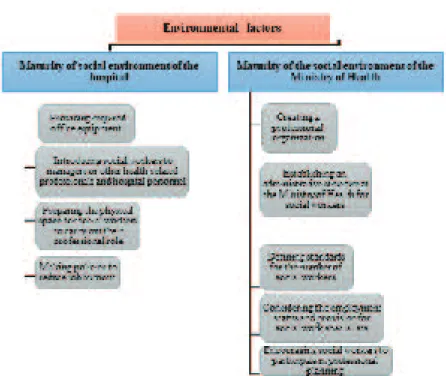
This concept includes issues that help medical social workers to develop their role and responsibilities which are related to the environment of medical social workers. This concept includes the subcategories of “Maturity of social environment of the hospital” and “Maturity of the social environment of the Ministry of Health”, which will be described in detail.
Maturity of social environment of the hospital
Preparing the hospital environment for accepting and introducing the profession to other hospital professionals and clients is another concept that has been extracted from the interviews. This concept includes the following subcategories: “Providing required office equipment”, “Introducing social workers to managers or other health-related professionals and hospital personnel”, “Preparing the physical space for social workers to carry out their professional role”, and “Making policies to reduce job burnout”. As participants said, playing new roles requires the organizing and preparing of the organization and the clients.
Participant 4:
“As long as the hospital director and his/her colleagues do not acknowledge just what a social worker does in the hospital, the claim for doing specialized social work is useless”.
Something participants pointed out was the need for a standard definition of the number of social workers employed at a hospital and their employment status. The definition of the standard number of required social workers is based on the number of hospital beds. Currently, only one social worker has been defined for every 50 beds, causing public hospitals to suffer from a lack of social workers to cover the provisions of community services to patients in need.
Participant 9:
“We have 265 beds in the hospital, but just three social workers are working with a high volume of work. We have asked for more social workers, but the hospital said the employment status of social workers is not clear”.
Maturity of social environment of the Ministry of Health
This concept refers to the readiness of the Ministry of Health to accept the medical social work profession, to actualize its potential for career development, and to improve its specialized roles.
This concept includes the following subcategories: “Creating a professional organization”, “Establishing an administrative structure at the Ministry of Health for social workers”, “Defining standards for the number of social workers”, “Considering the employment status and provision for social work specialists”, and “Encouraging social workers to participate in professional planning”. According to the participants, the creation of professional organizations in defense of the rights of professionals is very useful.
Participant 13:
“In the social work profession, we really need an organization to defend us. We see how the nursing association supports nurses and how other associations support physicians or engineers…”
Participants believe that the lack of an administrative structure in the Ministry of Health for social work has been a huge disadvantage for professional development. Therefore, the creation of such a structure would be helpful for improving the status of social work. In the context of this structure, professional standards could also be defined, and the employment status of social workers could be regulated.
Participant 2:
“The fact that we do not have a structure in the Ministry of Health is very damaging to the social work profession. It does not make anyone aware of our recruitment status and there are no standards for entering the profession”.
Participants believe that the presence of social workers in policy-making in the health field has been neglected, even though the presence of this profession in the area of macro planning and policy is highly necessary. Social workers must be involved in the preparation of their own plans and guidelines.
Figure 2: Second theme, its categories, and related codes
Discussion
The purpose of this study was to gain an understanding of what factors aid medical social workers` ability to perform their role. According to Table 1 and Figures 1 & 2, the factors which would help medical social workers to improve their professional position in hospitals - as mentioned in the findings - are as follows: profession development, redefining and revealing specialized roles, maturity of social environment of the hospital, and maturity of the social environment of the Ministry of Health.
The medical social work profession needs boosting up and revitalization, particularly among health planners and hospital managers. While this survey did not inquire as to the respondents’ job satisfaction, or the current level of burnout or morale, the respondents indicated that they anticipated being in their current position as a social worker who is employed in the hospital setting, and that formal ongoing professional development is intermittent. As Pockett (2003) said: “Remaining in hospital social work has been linked to a “tolerance” for the environment and not necessarily tied with a positive experience, which may have a potential for undermining patient outcomes” (Judd & Sheffield, 2010). The findings point to a number of perceived limitations for the effective performance of practicing social workers that included difficulties related to the updating of job skills, followed by a perceived deficiency in current supervisory support in the workplace. These issues were mainly linked to the current organizational conditions of social workers in Iranian hospitals.
education will academically improve social work. Moreover, developments in the field of social work education in hospitals could help to improve the situation. There should be uniformity regarding syllabi and curricula offered by social work departments in Iranian universities.
Medical social workers must assert their professional status and expand their role, with emphasis on those areas of professional practice that are directly relevant to the needs of the patients and, at the same time, applicable to achieving organizational objectives. Further, medical social workers must initiate, facilitate, and maintain an ongoing dialogue with other professional disciplines and with hospital administrators and managers in order to: 1) instil and reinforce a greater awareness, understanding, acceptance, and appreciation of the role of the medical social worker as an important and valuable member of the treatment team, 2) promote and project a positive image of the medical social worker as a dynamic and proactive leader, and 3) actively refute and categorically reject the stereotypical impression of the medical social worker as a mere bureaucratic functionary with nothing to offer clinically or substantively except to process forms, and thereby, make the physician’s job easier.
Recommendations for research and practice
Based on the findings of this research, one of the most important factors for enhancing the role and place of social workers in hospitals has been found to be the maturity of the social environment of the Ministry of Health. Therefore, the following practical recommendations are respectfully directed at the Ministry of Health:
Ethical considerations
As qualitative research involves inquiry and investigation into people`s lives, experiences, behaviors (Lincoln & Denzin, 2000), the values and principles were maintained as below:
- Informed consent of all participants based on a voluntary choice, sufficient information, adequate understanding of both proposed research and the implications of participation. - Anonymity
- Confidentiality
- Avoidance of harming to the participants by the researchers. This included avoiding invasion of their privacy and their deception about the purpose of the research.
The authors report no declarations of interest.
References
- Ali, M., & Rafi, S. (2013). Medical social work in Pakistan: A multi-model approach to collaborative practice in health care settings. Academic Research International, 4(4), 355.
- Beder, J. (2006). Hospital Social Work: The Interface of Medicine and Caring. New York, NY: Routledge, Taylor & Frances Group.
- Beddoe, L. (2013). Health social work: Professional identity and knowledge. Qualitative Social Work, 12(1), 24-40.
- Bhattacharya, S. (2003). Social work: An integrated approach. Deep and Deep Publications. - Cannon, I.M. (1913). Social Work in Hospitals: A Contribution to Progressive
Medicine. New York, NY: Survey Associates, Inc.
- Carniol, B. (2000). Case critical: Challenging social services in Canada. Between the Lines. Chicago
- Gehlert, S., & Browne, T. (2011). Handbook of Health Social Work. John Wiley & Sons.
- Graneheim, U. H., & Lundman, B. (2004). Qualitative content analysis in nursing research: concepts, procedures and measures to achieve trustworthiness. Nurse Education Today, 24(2), 105-112. - Hepworth, D. H., Rooney, R., & Larsen, J. (2000). Direct social work practice: Theory and skills. Pacific Grove, CA.: Brooks.
- Hsieh, H. F., & Shannon, S. E. (2005). Three approaches to qualitative content analysis. Qualitative Health Research, 15(9), 1277-1288.
- Judd, R. G., & Sheffield, S. (2010). Hospital social work: Contemporary roles and professional activities. Social Work in Health Care, 49(9), 856-871
- Lincoln, Y. S., & Denzin, N. K. (Eds.). (2000). The handbook of qualitative research. Sage.
- Morrow, S. L. (2005). Quality and trustworthiness in qualitative research in counseling psychology. Journal of Counseling Psychology, 52(2), 250.
- Ospina, S. (2004). Qualitative research. In Encyclopedia of Leadership (pp. 1279-1284). Sage. - Priest, H., Roberts, P., & Woods, L. (2002). An overview of three different approaches to the interpretation of qualitative data. Part 1: Theoretical issues. Nurse Researcher, 10(1), 30-42.
- Record of a decade (1969).College of Social Services, Iran