厚生労働科学研究費補助金 【エイズ対策政策研究事業】
HIV
検査受検勧奨に関する研究(
総合)
研究報告書新規 +,9 診断試薬である *HHQLXV+,9&RQILUPDWRU\DVVD\ と ダイナスクリーン・+,9&RPER の検討
研究分担者 加藤 真吾(慶應義塾大学医学部)
研究協力者 佐野 貴子、近藤 真規子(神奈川県衛生研究所)
須藤 弘二(慶應義塾大学医学部)
小谷 宙、西松 直美(慶應義塾大学病院 薬剤部)
藤原 宏、長谷川直樹(慶應義塾大学病院 感染制御センター)
A.研究目的
+,9
診断試薬は年々改良が進んでおり、近年で は、迅速スクリーニング検査試薬の抗原抗体同時 検査法の開発や+,9
抗体確認検査試薬としてのイ ムノクロマト法の開発が行われている。+,9 抗体 確認検査については、我が国では現在、測定時間 の長いウェスタンブロット法が用いられている が、米国ではすでに短時間で測定が可能なイムノ クロマト法が認可され、実際に検査アルゴリズム に組み込まれ使用されている。また、迅速スクリ ーニング検査試薬については、我が国において+,9
即日検査で広く使用されており、ウインドウ期の短縮が可能な抗原抗体同時検査法の使用拡 大は検査の質の向上に繋がると考える。
今回、我が国に導入される可能性のある新規
+,9
確認検査試薬および新規迅速スクリーニング 検査試薬について性能検討を行ったので報告す る。B.研究方法
.新規 +,9
確認検査試薬である*HHQLXV+,9
&RQILUPDWRU\DVVD\
の検討使用試薬
検討品:
*HHQLXV+,9&RQILUPDWRU\DVVD\
(バ 研究要旨新規
+,9
診断試薬である*HHQLXV+,9&RQILUPDWRU\DVVD\
およびダイナスクリーン・+,9&RPER
の検討を行った。新規
+,9
確認検査試薬の*HHQLXV
において+,9
陽性例を測定したところ、:%法よりも感度の向 上が見られた。また、:%
と:%
が両方とも陽性となった検体では、*HHQLXV
で全例が+,9326,7,9(
と判定されたことから、結果解釈の個人差が低減すると考えた。
+,9
陰性検体では、例のうち非特 異バンドが出現したものが:%
法で例、*HHQLXVでは例であり、特異性の向上が見られた。新規
+,9
迅速スクリーニング検査試薬であるダイナスクリーン・+,9 &RPERでは、実際の感染初期 検体において、従来品で陰性となったが、&RPER
では抗原を検出することが可能であった。一方、陰性 検体の検討では、血漿検体において、従来品ではすべて陰性であったが、&RPER では 例の抗原陽性 が見られた。この検体の全血検体では抗原ラインの出現は見られなかった。特異性についてはさらに 検討を進める予定である。今年度、検討を行った
*HHQLXV+,9&RQILUPDWRU\DVVD\
およびダイナスクリーン・+,9&RPER は、ともに従来品よりも性能に優れ、+,9診断試薬として非常に有用であることが示唆された。
イオ・ラッド ラボラトリーズ株式会社、以下、
*HHQLXV と略)
(使用可能検体)血漿、血清、全血
(検体量)血漿と血清は μ/、全血は μ/
(操作時間) 分
測定方法と結果判定については図 、図 に記 した。
対照品:ラブブロット 、ラブブロット
(バイオ・ラッドラボラトリーズ株式会社、以下、
:%、:% と略)
(使用可能検体)血清
(検体量)μ/
(操作時間)約 時間
測定は添付文書に従い実施した。
使用検体
保健所あるいは医療機関で +,9 検査を希望し、
スクリーニング検査で陰性と判定された +,9 陰性 検体 例および :% 法あるいは 3&5 法で陽性と 判定された +,9 陽性検体 例について測定を 行った。今回の検討に当たっては、受検者に研究 使用の同意を得た。
(倫理面への配慮)本研究は、慶應義塾大学医学 部の倫理委員会に倫理審査を申請し、承認を得た
(承認番号 ) 。また、神奈川県衛生研究 所倫理審査委員会に申請し、承認を得た(平成 年 月 日) 。
.新規迅速スクリーニング検査試薬であるダイ ナスクリーン・+,9&RPER の検討
使用試薬
検討品:ダイナスクリーン・+,9&RPER
(アリーアメディカル株式会社、以下、 &RPER と 略)
(使用可能検体)血漿、血清、全血
(検体量)μ/
(操作時間) 分
対照品:ダイナスクリーン・+,9
(アリーアメディカル株式会社、以下、従来品と 略)
(使用可能検体)血漿、血清、全血
(検体量)μ/
(操作時間) 分
測定方法と結果判定については図 ~ にまと めた。
使用検体
保健所あるいは医療機関において +,9 検査を希 望しスクリーニング検査で陰性と判定された +,9 陰性検体 例、 :% 法あるいは 3&5 法で陽性と判 定された +,9 陽性検体 例およびダイナスク リーンで偽陽性と判定された 例について測定を 行った。
(倫理面への配慮)神奈川県衛生研究所倫理審査 委員会に申請し、承認を得た(平成 年 月 日) 。
C.
研究結果
.新規 +,9 確認検査試薬である *HHQLXV+,9
&RQILUPDWRU\DVVD\ の検討
+,9陽性検体例について*HHQLXVで測定し たところ、+,9326,7,9(と判定されたものが 例、+,9,1'(7(50,1$7(となったものが 例、+,91(*$7,9(となったものが例であった
(図)。*HHQLXVで+,9326,7,9(と判定され た例の:%法の結果は、:%では陽性が 例、判定保留が例であり、:%では陽性が 例、判定保留が例、陰性が例であった。
*HHQLXVの+,9,1'(7(50,1$7(と判定された例 では、:%は判定保留例、:%では判定保留 例、陰性例であった。*HHQLXVでの+,9
1(*$7,9(の例では、:%と:%どちらも陰性で あった。
:%および:%で陽性となった例の*HHQLXV の結果はすべて+,9326,7,9(と判定された
(図)。:%での判定保留例の*HHQLXVの結果 は、例が+,9326,7,9(、例が+,9
,1'(7(50,1$7(となった(図)。:%の陰性例 では*HHQLXVでも+,91(*$7,9(と判定された。
+,9陰性検体例について*HHQLXVで測定し
たところ、例が+,91(*$7,9(、例が+,9 ,1'(7(50,1$7(、例が+,9,1'(7(50,1$7(と なった(図)。*HHQLXVで+,91(*$7,9(となっ た例では、:%と:%がどちらも判定保留と なったものは例、:%のみ判定保留となったも のは例、:%のみ判定保留となったものは例 であった。:%での非特異の出現バンドは、
3が例、3が例、33が例、3 が例、3が例であった。:%での非特異 出現バンドは3が例、3が例であった。
*HHQLXVで+,9,1'(7(50,1$7(と判定された例 は、*HHQLXVで3のバンドの出現が見られ、:%
、:%
とも陰性であった。また+,9,1'(7(50,1$7(と 判定された例は、*HHQLXVで*3のバンドの出 現が見られ、:%では陰性、:%では3の非特 異バンドが見られた。
.新規迅速スクリーニング検査試薬であるダイ ナスクリーン・+,9&RPER の検討
血漿検体と一部全血検体について&RPERと従来 品との検討を行った。血漿では、+,9陽性検体 例を測定したところ、従来品では陽性が例、
陰性が例となり、&RPERでは抗原のみ陽性が 例、抗原・抗体陽性が例、抗体のみ陽性が例 と全例が陽性となった(図)。+,9陰性検体 例では、従来品ではすべて陰性(特異性
%)、&RPERでは例が陰性、例が抗原陽 性となった(特異性%)。また、従来品で 偽陽性となった例について&RPERで測定したと ころ、例は陰性、例は抗体のみ陽性となっ た。&RPERで偽陽性となった例について従来品 で測定したところ陰性となった。
全血検体については、+,9陽性検体例を測定 したところ、従来品、&RPERともにすべて陽性と なった。+,9陰性検体例でも従来品、&RPERと もにすべて陰性となった。従来品で偽陽性とな った例については&RPERで測定したところ陰性 となった(図)。
D.
考察
今年度は新規 +,9 診断試薬である *HHQLXV+,9 &RQILUPDWRU\ DVVD\ およびダイナスクリー ン・+,9&RPER の検討を行った。
新規 +,9 確認検査試薬である *HHQLXV +,9
&RQILUPDWRU\DVVD\ の検討では、+,9 陽性検体 において *HHQLXV では 例が +,9 326,7,9(
と判定されたが、:% 法では、:% 陽性は 例 であり、*HHQLXV の感度向上が示唆された。また、
:% および :% で陽性となった 例の *HHQLXV の結果では、全例が +,9 326,7,9( と判定され た。これまで :% と :% がともに陽性であった 場合、+,9 と +,9 の重複感染なのか +,9 の交 差反応なのか、その判定に苦慮することがあった が、*HHQLXV の判定基準に基づき機械的に判定し てくれることから、結果の解釈に個人差が生じる ことは減少すると考えた。+,9 陰性検体では、
例のうち、:% 法で非特異バンドが出現したものが 例あったが、*HHQLXV では 例であり、特異性 の向上が見られた。今後、+,9 陽性検体、治療 中の +,9 抗体力価低下例、感染初期例等の検体に ついて検討を行っていく予定である。
新規 +,9 迅速スクリーニング検査試薬であるダ イナスクリーン・+,9&RPER は +,9S 抗原が 検出できることから、ウインドウ期の短縮が可能 である。実際に陽性検体の測定では、感染初期検 体 例において、従来品では陰性であったが、
&RPER では抗原を検出することが可能であった。
一方、陰性検体の検討では、血漿検体において、
従来品ではすべて陰性であったが、&RPER では 例の抗原陽性例が見られた。この検体は全血検体 では抗原ラインの出現が見られなかった。従来品 および &RPER の偽陽性例を双方で測定したところ、
お互いの偽陽性はほぼ一致しないことが分かっ た。特異性の検討については、もう少し例数を増 やして測定する必要があると考える。
今回、検討を行った *HHQLXV および &RPER は、
ともに従来品よりも性能に優れ、+,9 診断試薬と
して非常に有用であることが示唆された。
E.
結論
今年度は新規 +,9 診断試薬である *HHQLXV+,9 &RQILUPDWRU\ DVVD\ およびダイナスクリー ン・+,9 &RPER の検討を行った。どちらの試薬も 従来品よりも性能に優れ、+,9 診断試薬として非 常に有用であることが示唆された。
F.
研究発表
1.
論文発表
<DPD]DNL6.RQGR06XGR.8HGD7 )XMLZDUD++DVHJDZD1.DWR6$
4XDOLWDWLYH5HDOWLPH3&5DVVD\IRU+,9 DQG+,951$-DSDQHVH-RXUQDORI ,QIHFWLRXV'LVHDVHV'2,
\RNHQ--,'
.RWDQL+6XGR.1DRNL+)XMLZDUD+
+D\DNDZD7,NHWDQL2<DPDJXFKL0 0RFKL]XNL0,ZDWD6.DWR6 3RVVLEOHLQYROYHPHQWRIGLVWLQFW
SK\ORJHQHWLFFOXVWHUVRI+,9YDULDQWV LQWKHGLVFUHSDQFLHVEHWZHHQFRUHFHSWRU WURSLVPSUHGLFWLRQVEDVHGRQYLUDO51$
-RXUQDORI3KDUPDFHXWLFDO+HDOWK&DUH DQG6FLHQFHV'2,V
,NHQR5<DPDGD(<DPD]DNL68HGD7 1DJDWD07DNDJL5.DWR6 )DFWRUVFRQWULEXWLQJWRVDOLYDU\KXPDQ LPPXQRGHILFLHQF\YLUXVW\SHOHYHOV PHDVXUHGE\D3RLVVRQGLVWULEXWLRQEDVHG 3&5PHWKRG-RXUQDORI,QWHUQDWLRQDO 0HGLFDO5HVHDUFK
'2,HSXE 1RYHPEHU
加藤真吾免疫の特徴免
疫担当細胞と器官.臨床免疫検査技術教 本
<DPDGD(7DNDJL57DQDEH<)XMLZDUD +1DRNL+.DWR63ODVPDDQG
VDOLYDFRQFHQWUDWLRQVRIDEDFDYLU WHQRIRYLUGDUXQDYLUDQGUDOWHJUDYLULQ +,9LQIHFWHGSDWLHQWV,QWHUQDWLRQDO -RXUQDORI&OLQLFDO3KDUPDFRORJ\DQG 7KHUDSHXWLFV'2,&3H SXE$SULO
0DNLNR.RQGR.RML6XGR7DNDNR6DQR 7DNX\D.DZDKDWD,FKLUR,WRGD6KLQ\D ,ZDPXUR<XNLKLUR<RVKLPXUD1DWVXR 7DFKLNDZD<RNR.RMLPD+DUX\R0RUL +LURVKL)XMLZDUD1DRNL+DVHJDZD6KLQJR .DWR&RPSDUDWLYHHYDOXDWLRQRI WKH*HHQLXV70+,9&RQILUPDWRU\$VVD\
DQGWKH+,9DQG+,9:HVWHUQEORWVLQ WKH-DSDQHVHSRSXODWLRQ3/R62QH HGRLMRXUQDOSRQH H&ROOHFWLRQ2FW
学会発表
岡崎玲子,加藤真吾,吉村和久ら.国内新規 +,9$,'6 診断症例における薬剤耐性 +,9 の 動向.第 回日本エイズ学会学術集会・総 会,鹿児島, 年 月.
小谷宙,加藤真吾,長谷川直樹ら. 157, にラ ルテグラビルおよびダルナビルを含む強化 療法を導入した2症例.第 回日本エイズ 学会学術集会・総会,鹿児島, 年 月.
丸山理恵,加藤真吾ら.乾燥濾紙血を用いた +,951$ 検出法.第 回日本エイズ学会学 術集会・総会,鹿児島, 年 月.
矢永由里子,加藤真吾ら. 「病院に +,9 検査実 施ガイドライン」作成と評価分析について.
第 回日本エイズ学会学術集会・総会,鹿児 島, 年 月.
近藤真規子,加藤真吾ら.中国の 060 間で大 流行している +,9&5)B$(YDULDQWの日 本国内への拡散.第 回日本エイズ学会学 術集会・総会,鹿児島, 年 月.
星野慎二,加藤真吾ら.全国保健所における
梅毒検査体制のアンケート調査.第 回日 本エイズ学会学術集会・総会,鹿児島,
年 月.
須藤弘二,加藤真吾ら.+,9 郵送検査に関す る実態調査と検査精度調査.第 回 日本エイズ学会学術集会・総会,鹿児島,
年 月.
加藤真吾,長谷川直樹ら. &'& が推奨する +,9 検査手順の検討と +,9 鑑別検査キット
*HHQLXV の検討.第 回日本エイズ学会学術 集会・総会,鹿児島, 年 月.
佐野貴子,加藤真吾,市川誠一ら. +,9 検査・
相談マップを用いた +,9 検査相談施設の情報 提供およびサイト利用状況の解析.第 回 日本エイズ学会学術集会・総会,鹿児島,
年 月.
佐野貴子,近藤真規子,加藤真吾ら.新規 +,9 抗 体 確 認 検 査 試 薬 で あ る *HHQLXV +,9
&RQILUPDWRU\ $VVD\ の検討.第 回日本エ イズ学会学術集会・総会,東京都, 年 月.
川畑拓也,小島洋子,加藤真吾ら.新しい +,9 確認検査試薬 *HHQLXV™の性能評価.第 回 日本エイズ学会学術集会・総会,東京都,
年 月.
吉田繁,加藤真吾,吉村和久ら. 年度 +,9 薬剤耐性検査外部精度評価の報告.第 回 日本エイズ学会学術集会・総会,東京都,
年 月.
岡崎玲子,加藤真吾,吉村和久ら.国内新規 +,9$,'6 診断症例における薬剤耐性 +,9 の 動向.第 回日本エイズ学会学術集会・総 会,東京都, 年 月.
近藤真規子,加藤真吾,吉村和久ら.日本で 流行する +,9 &5)B$( と周辺アジア諸国 における流行株との関連.第 回日本エイ ズ学会学術集会・総会,東京都, 年 月.
佐野貴子,加藤真吾,今井光信ら.保健所等
公的検査機関を対象とした +,9 検査相談体制 に関するアンケート調査.第 回日本エイ ズ学会学術集会・総会,東京都, 年 月.
丸山理恵,須藤弘二,加藤真吾ら.乾燥濾紙 血を用いた +,951$ および '1$ 検査法.第 回日本エイズ学会学術集会・総会,東京都,
年 月.
須藤弘二,佐野貴子,加藤真吾ら.+,9 郵送 検 査 に 関 す る 実 態 調 査 と 検 査 精 度 調 査
.第 回日本エイズ学会学術集会・総 会,東京都, 年 月.
.6XGR76DQR0.RQGR7.DZDKDWD 6 .DWR HW DO &RPSDUDWLYH (YDOXDWLRQ RI WKH %LR5DG *HHQLXV
70+,9
&RQILUPDWRU\$VVD\DQGWKH1HZ/$9%ORW DQGLQWKH-DSDQHVH3RSXODWLRQWK 5HJLRQDO &RQJUHVV RI WKH ,QWHUQDWLRQDO 6RFLHW\ RI %ORRG 7UDQVIXVLRQ ,6%7
*XDQJ]KRX広州&KLQD
須藤弘二,佐野貴子,近藤真規子,今井光信,
今村顕史,加藤真吾.+,9 郵送検査に関する 実態調査と検査精度調査.第 回日 本エイズ学会学術集会・総会,大阪府,
年 月.
近藤真規子,佐野貴子,長島真美,貞升健志,
川畑拓也,加藤真吾,今村顕史.全国地方衛 生研究所における +,9 検査実施状況. 第 回 日本エイズ学会学術集会・総会,大阪府,
年 月.
土屋菜歩,佐野貴子,近藤真規子,堅多敦子,
石丸雄二,城所敏英,カエベタ亜矢,川畑拓 也,貞升健志,須藤弘二,加藤真吾,大木幸 子,今井光信,今村顕史.保健所・検査所に おける梅毒検査実施状況および陽性率に関 するアンケート調査.第 回日本エイズ学 会学術集会・総会,大阪府, 年 月.
小谷宙,加藤真吾,親泊あいみ,須藤弘二,
丸山理恵,西松直美,宇野俊介,上蓑義典,
藤原宏,長谷川直樹.準完全長プロウイルス による治療効果の新しい評価.第 回日本 エイズ学会学術集会・総会,大阪府, 年 月.
岡崎玲子,蜂谷敦子,佐藤かおり,豊嶋崇徳,
佐々木悟,伊藤俊広,林田庸総,岡慎一,潟 永博之,古賀道子,長島真美,貞升健志,近 藤真規子,椎野禎一郎,須藤弘二,加藤真吾,
谷口俊文,猪狩英俊,寒川整,加藤英明,石 ヶ坪良明,中島秀明,吉野友祐,太田康男,
茂呂寛,渡邉珠代,松田昌和,重見麗,岩谷 靖雅,横幕能行,渡邉大,小島洋子,森治代,
藤井輝久,高田清式,南留美,山本政弘,松 下修三,健山正男,藤田次郎,杉浦亙,吉村 和久,菊池正.国内新規
+,9$,'6診断症例に おける薬剤耐性
+,9の動向.第 回日本 エイズ学会学術集会・総会,大阪府, 年 月.
丸山理恵,加藤真吾.+,951$
と
'1$の混合 物から
51$を選択的に増幅する
573&5法の 開発.第 回日本エイズ学会学術集会・総 会,大阪府, 年 月.
本田徹郎,久慈直昭,丸山理恵,須藤弘二,
加藤真吾.健康な
+,9陽性男性が陰性女性と の間に子供を持つために:洗浄精子を用いた 顕微授精について.第 回日本エイズ学会 学術集会・総会,大阪府, 年 月.
土屋菜歩,佐野貴子,近藤真規子,堅多敦子,
石丸雄二,城所敏英,カエベタ亜矢,川畑拓 也,貞升健志,須藤弘二,加藤真吾,大木幸 子,今井光信,今村顕史.保健所・検査所に おける
+,9検査・相談実施状況および陽性率 に関するアンケート調査.第 回日本エイ ズ学会学術集会・総会,大阪府, 年 月.
佐野貴子,近藤真規子,須藤弘二,今井光信,
加藤真吾,今村顕史.民間検査センターにお ける
+,9検査実施状況に関するアンケート調 査.第 回日本エイズ学会学術集会・総会,
大阪府, 年 月.
川畑拓也,井戸田一朗,小島洋子,近藤真規
子,貞升健志,佐野貴子,須藤弘二,高田昇,
長島真美,森治代,加藤真吾,今村顕史.エ ビデンスに基づいた専門職向け
+,9検査
4 $集の作成.第 回日本エイズ学会学術集会・
総会,大阪府, 年 月.
G.
知的所有権の取得状況
なし
HIV-2 HIV-1
1 2 3 4 5 6 C
Geenius HIV1/2 Confirmatory assay: 結果判定
判定 判定基準
測定系の 確認
コントロールバンドが出現しなければならない
HIV陰性 HIV-1とHIV-2のバンドが出現しない
HIV-1 陽性
少なくとも1本のENVバンド(GP160またはgp41)を 含んだ、少なくとも2つのHIV-1バンドが出現するHIV-2 陽性 GP140とGP36のHIV-2バンドが両方出現する
判定保留HIV-1またはHIV-2陽性基準と一致しないHIV-1
またはHIV-2バンドの存在
GP36 GP140 P31 GP160 P24 GP41
図2
line Band 1 HIV-2 GP36: env 2 HIV-2 GP140: env
3 HIV-1 P31: pol ( integrase ) 4 HIV-1 GP160: env
5 HIV-1 P24: gag
6 HIV-1 GP41(group M & O) C control Protein A
HIV-2 HIV-1
1 2 3 4 5 6 C
GP36 GP140 P31 GP160 P24 GP41
Negative Control
Positive Control
① Serum/Plasma : 5μ l into well 1
Buffer : 2 Drop into well 1
② Buffer : 5 Drop into well 2 Wait 5 minutes Wait 20 minutes Whole Blood : 15μ l into well 1
Geenius HIV1/2 Confirmatory assay: 操作方法
図1
①
② [Geenius reader and Notebook]
[Geenius cassette]
sample PA HIV-1RNA
WB-1 WB-2
Geenius
HIV-2 HIV-1
HIV-1 HIV-2 HIV-1/2 copies/ml gp36 gp140 p31 gp160 p24 gp41 判定
GM4364 102400 ― 102400 4900 + + ― ― + + +w + HIV-1
POSITIVE
GM4366 51200 ― 51200 200 + + ― ― + + + + HIV-1
POSITIVE
GM4369 51200 10 25600 20000 + + ― ― + + +w + HIV-1
POSITIVE
GM4351 204800 ― 51200 17000 + + ― ― +w + +w + HIV-1
POSITIVE
GM4348 25600 10 51200 1100 + + ― ― + + +w + HIV-1
POSITIVE
GM4349 409600 ― 204800 30000 + + ― ― + + ― + HIV-1
POSITIVE
GM4370 51200 10 51200 4500 + + ― ― + + ― + HIV-1
POSITIVE
GM4322 51200 ― 51200 590 + + ― ― + + + + HIV-1
POSITIVE
GM4324 25600 ― 25600 4300 + + ― ― +w + +w + HIV-1
POSITIVE
GM4372 51200 ― 51200 12000 + + ― ― + + ― + HIV-1
POSITIVE
GM4384 204800 ― 204800 30000 + + ― ― + + +w + HIV-1
POSITIVE
Y242-3 256000 6400 128000 2900 + + + ― + + + + HIV-1
POSITIVE
WB-1陽性,WB-2陽性 12例
図4
Geenius測定結果(HIV-1陽性)
陽性 判定
保留 陰性 陽性 判定
保留 陰性 HIV-1
POSITIVE 107 104 3 0 12 92 3
HIV-1
INDET ERM INAT E 4 0 4 0 0 2 2
HIV-2
INDET ERM INAT E 0 0 0 0 0 0 0
HIV
NEGATIVE 2 0 0 2 0 0 2
WB-2 WB-1
Geenius
<HIV-1陽性検体例>
図3
Geenius測定結果(HIV陰性)
陽性 判定
保留 陰性 陽性 判定
保留 陰性 HIV
POSITIVE 0 0 0 0 0 0 0
HIV-1
INDET ERM INAT E 1 0 0 1 0 0 1
HIV-2
INDET ERM INAT E 1 0 0 1 0 1 0
HIV
NEGATIVE 128 0 24 104 0 12 116
WB-2 WB-1
Geenius
<HIV陰性検体130例>
図6
sample PA HIV-1RNA WB-1 WB-2
Geenius
HIV-2 HIV-1 判定
HIV-1 HIV-2 HIV-1/2 copies/ml gp36 gp140 p31 gp160 p24 gp41
GM4346 1280 ― 640 1200 ± ± ― ― ― + + + HIV-1
POSITIVE
GM4334 64 ― 1024 3.3×10⁶ ± ± ― ― ― +w ― +w HIV-1
POSITIVE
GM4386 80 ― 1280 1200 ± ± ― ― ― +w ― +w HIV-1
POSITIVE
GM4327 ― ― 64 2300 ± ― ― ― ― ― ― +w HIV-1
INDETERM INATE
GM4336 128 ― 256 3.3×10⁵ ± ― ― ― ― ― ― +w HIV-1
INDETERM INATE
GM4373-1 ― ― 512 7.5×10⁵ ± ± ― ― ― +w ― +w HIV-1
INDETERM INATE
PP034 ND ND ND ND ± ± ― ― ― ― ― + HIV-1
INDETERM INATE
GM4373-0 ― ― ― 2.8×10⁷ ― ― ― ― ― ― ― ― HIV
NEGATIVE
Y824 ― ― ― 1.7×10⁶ ― ― ― ― ― ― ― ― HIV
NEGATIVE
WB-1判定保留7例、陰性2例
図5
ダイナスクリーン・HIV-1/2
反応時間 検体
15分(~1時間)
血清、血漿、全血
ダイナスクリーン試薬
20分 (~40分)
血清、血漿、全血 血液検体量
50μL 50μL
検出項目
HIV-1
抗体、HIV-2
抗体HIV-1
抗体、HIV-2
抗体、判定ライン 赤色 赤色
抗体検査法 抗原抗体 同時検査法 HIV-1 p24
抗原ダイナスクリーン・HIV Combo
図8HIV迅速スクリーニング検査試薬
エスプライン HIV Ag/Ab (富士レビオ 承認2008年)
抗体検査試薬
ダイナスクリーン・HIV-1/2
(アリーアメディカル 承認1998年)
抗原抗体検査試薬
ダイナスクリーン・HIV Combo
(アリーアメディカル 承認2015年)
図7
ダイナスクリーン・HIV Combo 判定法
コントロールライン
→
抗原判定ライン→
抗体判定ライン
→
陽性
陰性 無効
抗原 陽性 抗体 陽性
抗原 抗体 陽性
図10
ダイナスクリーン・HIV Combo 操作法
血清・血漿 全 血
50μL
を検体滴下部に滴下 後、20
分間静置し判定50μL
を検体滴下部に滴下し染み込むまで
1
分間静置1
分後、全血展開液を1
滴滴下し、19
分間静置 図9ダイナスクリーン測定結果(全血)
陽性 陰性 Agのみ 陽性
Ag/Ab 陽性
Abのみ
陽性 陰性 HIV陽性検体
21例 21 0 0 1 * 20 0
HIV陰性検体
204例 0 204 0 0 0 204
DS・HIV-1/2
偽陽性 1例 1 0 0 0 0 1
全血
ダイナスクリー ン・HIV-1/2
ダイナスクリーン・
HIV Combo
(2017年2月28日現在)
*HIV-1 RNA 150, 000 c/mL
図12
ダイナスクリーン測定結果(血漿)
陽性 陰性 Agのみ 陽性
Ag/Ab 陽性
Abのみ
陽性 陰性 HIV陽性検体
30例 29 1 1 * 2 ** 27 0
HIV陰性検体
229例 0 229 1 0 0 228
DS・HIV-1/2
偽陽性 6例 6 0 0 0 1 5
DS・Combo
偽陽性 1例 0 1 0 0 1 0
血漿
ダイナスクリー ン・HIV-1/2
ダイナスクリーン・
HIV Combo
(2017年2月28日現在)
* HIV-1 RNA 1,700, 000 c/mL ** 350, 000 c/mL
** 30, 000 c/mL
図11
RESEARCH ARTICLE
Comparative evaluation of the Geenius HIV 1/
2 Confirmatory Assay and the HIV-1 and HIV-2 Western blots in the Japanese population
Makiko Kondo1, Koji Sudo2, Takako Sano1, Takuya KawahataID3, Ichiro Itoda4,
Shinya Iwamuro5, Yukihiro Yoshimura6, Natsuo Tachikawa6, Yoko Kojima3, Haruyo Mori3, Hiroshi Fujiwara7, Naoki Hasegawa7, Shingo KatoID2
1Division of Microbiology, Kanagawa Prefectural Institute of Public Health, Chigasaki, Kanagawa, Japan, 2Department of Microbiology and Immunology, Keio University School of Medicine, Shinjuku-ku, Tokyo, Japan,3Virology Section, Division of Microbiology, Osaka Institute of Public Health, Osaka, Osaka, Japan, 4Shirakaba Clinic, Shinjuku-ku, Tokyo, Japan,5Atsugi City Hospital, Atsugi, Kanagawa, Japan,
6Department of Infectious Diseases, Yokohama Municipal Citizen’s Hospital, Yokohama, Kanagawa, Japan, 7Center for Infectious Diseases and Infection Control, Keio University Hospital, Shinjuku-ku, Tokyo, Japan
Abstract
Accurate diagnosis of earlier HIV infection is essential for treatment and prevention. Cur- rently, confirmation tests of HIV infection in Japan are performed using Western blot (WB), but WB has several limitations including low sensitivity and cross-reactivity between HIV-1 and HIV-2 antibodies. To address these problems, a new HIV testing algorithm and a more reliable confirmation and HIV-1/2 differentiation assay are required. The Bio-Rad Geenius HIV-1/2 Confirmatory Assay (Geenius) has recently been approved and recommended for use in the revised guidelines for diagnosis of HIV infection by the Center for Disease Control and Prevention (USA). We made comprehensive comparison of the performance of Gee- nius and the Bio-Rad NEW LAV BLOT 1 and 2 (NLB 1 and 2) which are WB kits for HIV-1 and HIV-2, respectively, to examine if Geenius is a suitable alternative to these WB assays which are now being used in HIV testing in Japan. A total of 166 HIV-1 positive samples (146 from patients with established HIV-1 infection and 20 from patients with acute infec- tion), five HIV-1 seroconversion panels containing 21 samples and 30 HIV-2 positive sam- ples were used. In addition, a total of 140 HIV negative samples containing 10 false- positives on screening tests were examined. The sensitivity of Geenius and NLB 1 for HIV-1 positive samples was 99.3% and 98.6%, respectively. Geenius provided more positive results in the samples from acute infections and detected positivity 0 to 32 days earlier in seroconversion panels than NLB 1. NLB 2 gave positive results in 12.3% of HIV-1 positive samples. The sensitivity of both Geenius and NLB 2 for HIV-2 positive samples was 100%.
The specificity of Geenius, NLB 1 and NLB 2 was 98.5%, 81.5% and 90.0%, respectively.
Geenius is an attractive alternative to WB for confirmation and differentiation of HIV-1 and HIV-2 infections. The adaptation of Geenius to the HIV testing algorithm may be advanta- geous for rapid diagnosis and the reduction of testing costs.
PLOS ONE |https://doi.org/10.1371/journal.pone.0198924 October 31, 2018 1 / 10
a1111111111 a1111111111 a1111111111 a1111111111 a1111111111
23(1 $&&(66
Citation: Kondo M, Sudo K, Sano T, Kawahata T, Itoda I, Iwamuro S, et al. (2018) Comparative evaluation of the Geenius HIV 1/2 Confirmatory Assay and the HIV-1 and HIV-2 Western blots in the Japanese population. PLoS ONE 13(10):
e0198924.https://doi.org/10.1371/journal.
pone.0198924
Editor: Hiroshi Nishiura, Hokkaido University Graduate School of Medicine, JAPAN Received: May 26, 2018
Accepted: October 17, 2018 Published: October 31, 2018
Copyright:2018 Kondo et al. This is an open access article distributed under the terms of the Creative Commons Attribution License, which permits unrestricted use, distribution, and reproduction in any medium, provided the original author and source are credited.
Data Availability Statement: All relevant data are within the paper.
Funding: This research was supported by a Grant- in-Aid for AIDS research from the Ministry of Health, Labour and Welfare of Japan (H28-AIDS- 001), (http://www.mhlw.go.jp/stf/seisakunitsuite/
bunya/0000103641.html). The funder had no role in study design, data collection and analysis, decision to publish, or preparation of the manuscript.
Introduction
The risk of HIV transmission during acute and early infection is much higher than that during established infection [1]. Furthermore, early initiation of antiretroviral therapy (ART) substan- tially reduces the risk of transmission to sexual partners [2] and improves clinical outcomes, compared with delayed ART [3]. Accurate diagnosis of earlier HIV infection is important for treatment and prevention strategies.
Currently, diagnosis of HIV infection in Japan is carried out mainly in two different algo- rithms: (i) a sample tested positive on HIV-1/2 antigen/antibody assay is retested with HIV-1 Western blot (WB-1) and HIV-2 Western blot (WB-2) simultaneously, and then, if the results on both assays are negative, applied to nucleic acid test (NAT) of HIV-1 plasma RNA; this algorithm is recommended by the National Institute of Infectious Diseases (Japan) [4]; (ii) a sample that tested positive on HIV-1/2 antigen/antibody assay is then retested with WB-1 and NAT at the same time, and then, if the results on both assays are negative, applied to WB-2;
this is recommended by the Japanese Society for AIDS Research [5]. These algorithms, how- ever, have several limitations associated with Western blot that include false negative or inde- terminate results in the early phase, cross-reactivity between HIV-1 and HIV-2 [6], and a labor-intensive and time-consuming protocol.
In 2014, the Center for Disease Control and Prevention (CDC) in the US published revised guidelines for diagnosis of HIV infection in which the use of an HIV-1 and HIV-2 antibody differentiation assay is recommended after a repeatedly reactive HIV-1/2 anti- gen/antibody test [7]. The FDA-approved Multispot HIV-1/HIV-2 Rapid Test (Bio-Rad Laboratories) was initially validated for this purpose. Thereafter, Bio-Rad developed a new confirmatory and differentiation test, the Geenius HIV-1/2 Confirmatory Assay (hereafter called Geenius). Geenius received a CE mark in February 2013 and clearance from the Food and Drug Administration in October 2014. Although Geenius has been evaluated in many studies [8–17], there have been few studies on comparison between Geenius and WB. Moon et al. compared the performance of Geenius and WB-1 [16] but did not tested WB-2, and thus they did not comparatively evaluate the HIV-1/2 differenti- ation ability of Geenius and WB-1/WB-2.
In Japan, while Geenius has not been approved yet, there is a growing interest in the CDC- recommended HIV diagnostic algorithm because it is expected to decrease the number of indeterminate results, allow earlier identification of HIV infections, and reduce the number of NAT to resolve the ambiguity of WB results.
The aims of this study are to compare the confirmation and differentiation performance of Geenius and NEW LAV BLOT 1 and 2 (Bio-Rad Laboratories, Tokyo, Japan, hereafter called NLB 1 and 2), which are WB-1 and WB-2 kits, respectively, and to examine if Geenius is a suit- able alternative to WB in the HIV testing algorithm in Japan.
Material and methods
Approval was obtained from the Ethics Committee of the Keio University School of Medicine (20150176)
Samples and patients
A total of 166 HIV-1 positive samples were used: 146 were obtained from patients with estab- lished HIV-1 infection and 20 from patients with acute infection. Among the patients with established infection, 73 were obtained from patients receiving ART at the Keio University Hospital or Atsugi City Hospital and had been diagnosed with HIV-1 infection by either of Dainascreen HIV Combo (an HIV-1 p24 Ag/HIV-1/2 Ab immunochromatographic test,
Comparison between the Geenius HIV 1/2 Confirmatory Assay and the HIV-1 and HIV-2 Western blots
Competing interests: The authors have declared that no competing interests exist.
Alere Medical, Tokyo, Japan) or the Architect HIV Ag/Ab Combo Assay (an automated HIV- 1 p24 Ag/HIV-1/2 Ab test, Abbott Japan, Chiba, Tokyo), followed by NLB 1 and 2 and, if nec- essary, the Cobas AmpliPrep/Cobas TaqMan HIV-1 Test (an automated qualitative HIV-1 RNA test, Roche Diagnostics, Tokyo, Japan, hereafter called Cobas). The other 93 samples were obtained from individuals seeking HIV testing in public health centers located in Kana- gawa and Osaka: 85 were positive on Dainascreen HIV Combo and 8 were positive on the Architect HIV Ag/Ab Combo Assay. Their infections were confirmed by NLB 1 and 2 or Cobas. Established HIV-1 infection was defined by positive results on both NLB 1 and Cobas;
acute HIV-1 infection was defined by an indeterminate or negative result on NLB 1 but a posi- tive Cobas result.
Five HIV-1 seroconversion panels comprised of seven, five, four, three and two samples, respectively, were obtained from patients attending the Shirakaba Clinic in Tokyo, Japan.
Thirty samples of two commercially obtained HIV-2 panels were used: five from HIV-2 Mixed Titer AccuSet Performance Panel (PRE301B, SeraCare Life Sciences, Millford, MA) and 25 from Plasma-CPD-A Anti HIV-2 (HemaCare, Los Angeles, CA).
A total of 140 HIV negative samples were obtained from individuals seeking HIV testing in the public health centers, which were tested as mentioned above; 10 of them were false-positive on screening tests using Dainascreen HIV Combo, which were negative or indeterminate on NLB 1 and 2, and negative on Cobas.
Comparative testing by Geenius and NLB 1 and 2 was conducted between May 2016 and April 2017 in Kanagawa Prefectural Institute of Public Health, Osaka Institute of Pub- lic Health, and Keio University School of Medicine according to the manufacturer’s instructions.
The donors at Keio University, Atsugi City Hospital, and the Shirakaba Clinic provided written informed consent; the donors in the public health centers provided verbal informed consent. All data were fully anonymized during the analysis.
Geenius
Geenius is a single-use immunochromatographic test for the confirmation and differenti- ation of individual antibodies to HIV-1 and HIV-2 in whole blood, serum or plasma sam- ples using HIV synthetic peptides or recombinant proteins for HIV-1 (p31 [POL], gp160 [ENV], p24 [GAG] and gp41 [ENV]) and HIV-2 (gp36 [ENV] and gp140[ENV]). Geenius is aimed at confirming the presence of antibodies to HIV-1 and HIV-2 in samples reactive by screening tests. Banding patterns and intensities on a Geenius cassette were read by an automated reader connected to a personal computer and interpreted using the Geenius algorithm. This cartridge assay allows rapid evaluation within 30 min. Interpretive results involve HIV negative, HIV-2 indeterminate, HIV-1 indeterminate, HIV indeterminate, HIV-1 positive, HIV-2 positive, HIV-2 positive (with HIV-1 cross-reactivity), and HIV positive untypable.
NLB 1 and 2
NLB 1 and 2 are the only WB kits approved by The Pharmaceuticals and Medical Devices Agency (PMDA) of Japan for confirmation of HIV-1 and HIV-2 infection, respectively. Bands were observed visually. Interpretation of banding patterns is performed as follows: for HIV-1, the presence of at least two of three ENV bands (GP160, GP120 and GP41) is considered posi- tive, no HIV-1 specific band negative, and other patterns indeterminate; for HIV-2, the pres- ence of one ENV, one GAG and one POL band is considered positive, no HIV-2 specific band negative, other patterns indeterminate.
Comparison between the Geenius HIV 1/2 Confirmatory Assay and the HIV-1 and HIV-2 Western blots
PLOS ONE |https://doi.org/10.1371/journal.pone.0198924 October 31, 2018 3 / 10
Statistics
Sensitivity and specificity were determined by considering indeterminate results as not posi- tive and not negative, respectively, with 95% confidence interval [95% CI]. Cohen’s kappa (Ĕ) was calculated to assess agreement between Geenius and NLB 1.
Results
Samples in established HIV-1 infection
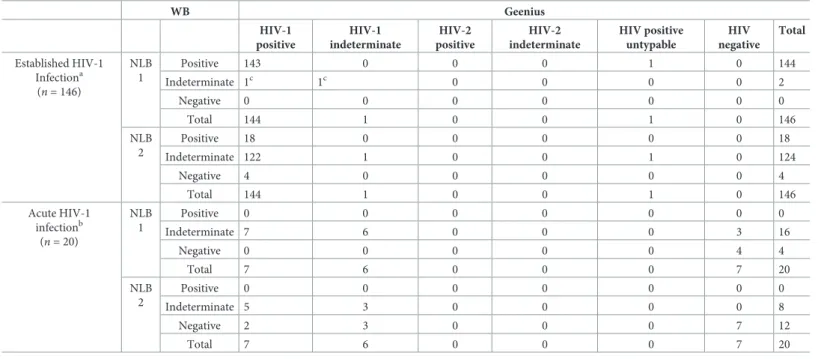
Geenius, NLB 1, and NLB 2 results on 146 samples from patients with established HIV-1 infection are compared in
Table 1. Geenius provided 145 HIV-1 positive results including one HIV positiveuntypable (sensitivity, 99.3% [95% CI, 96.2–100.0]) and one HIV-1 indeterminate result. NLB 1C showed 144 positive result (sensitivity, 98.6% [95% CI, 95.1–99.8]) and two indeterminate results:
the indeterminate results were observed on samples from patients receiving ART. It is notable that only four samples were negative by NLB 2, which may be due to high cross-reactivity.
Samples in acute HIV-1 infection
Geenius, NLB 1, and NLB 2 results on 20 samples from patients with acute HIV-1 infection are compared in
Table 1. Geenius reclassified seven of the NLB 1 indeterminate samples aspositive, showing that Geenius has a higher detection sensitivity than NLB 1.
Seroconversion panels
Five HIV-1 seroconversion panels were used to compare the detection ability of identifying positive samples during the early phase of infection between Geenius and NLB 1 (Table 2).
Table 1. Comparison of Geenius with NLB 1 and 2 results for established and acute HIV-1 infection samples.
WB Geenius
HIV-1 positive
HIV-1 indeterminate
HIV-2 positive
HIV-2 indeterminate
HIV positive untypable
HIV negative
Total
Established HIV-1 Infectiona
(n= 146)
NLB 1
Positive 143 0 0 0 1 0 144
Indeterminate 1c 1c 0 0 0 0 2
Negative 0 0 0 0 0 0 0
Total 144 1 0 0 1 0 146
NLB 2
Positive 18 0 0 0 0 0 18
Indeterminate 122 1 0 0 1 0 124
Negative 4 0 0 0 0 0 4
Total 144 1 0 0 1 0 146
Acute HIV-1 infectionb
(n= 20)
NLB 1
Positive 0 0 0 0 0 0 0
Indeterminate 7 6 0 0 0 3 16
Negative 0 0 0 0 0 4 4
Total 7 6 0 0 0 7 20
NLB 2
Positive 0 0 0 0 0 0 0
Indeterminate 5 3 0 0 0 0 8
Negative 2 3 0 0 0 7 12
Total 7 6 0 0 0 7 20
aFourth-generation enzyme immunoassay positive, NLB 1 positive and NAT positive at the time of initial diagnosis.
bFourth-generation enzyme immunoassay positive, NLB 1 negative and NAT positive at the time of sample collection
cOn ART at the time of sample collection.
https://doi.org/10.1371/journal.pone.0198924.t001
Comparison between the Geenius HIV 1/2 Confirmatory Assay and the HIV-1 and HIV-2 Western blots
Geenius gave positive results 0 to 32 days earlier than NLB 1. Cross-reactive p26 bands appeared in NLB 2 as the specific HIV-1 antibody titer increased, while no HIV-2-related band was observed in Geenius.
HIV-2 panels
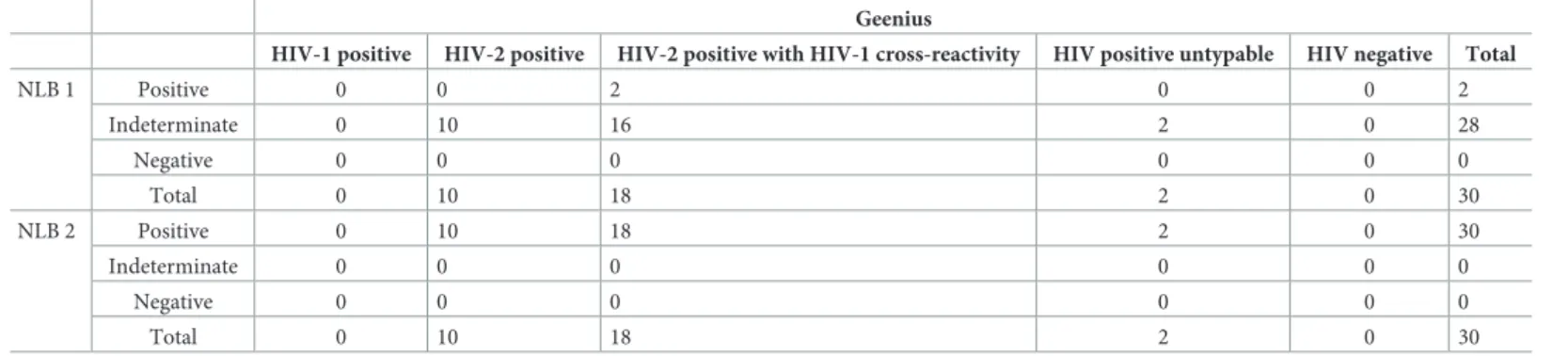
Thirty samples of two commercial HIV-2 panels were used to compare Geenius, NLB 1, and NLB 2 (Table 3). All samples were positive with NLB 2 (sensitivity, 100% [95% CI, 88.4–
100.0]); two samples were positive and 28 were indeterminate with NLB 1 (false-positive rate,
Table 2. Comparison of Geenius with NLB 1 and 2 results for HIV-1.seroconversion panelsa.
Patient Sample Daysb Geenius NLB 1d NLB 2d
HIV-1c HIV-2
A 1 0 Neg Neg Neg Neg
2 9 Pos (gp160, p24, gp41) Neg Ind (gp160, p68, p55, p24) Ind (p26)
3 16 Pos (gp160, p24, gp41) Neg Ind (gp160, p68, p55, p40, p31, p24, p18) Ind (p26)
4 36 Pos (gp160, p24, gp41) Neg Pos Ind (p26)
5 42 Pos (gp160, p24, gp41) Neg Pos Ind (p26)
6 65 Pos (p31, gp160, p24, gp41) Neg Pos Ind (p26)
7 107 Pos (p31, gp160, p24, gp41) Neg Pos Ind (p26)
B 1 0 Neg Neg Neg Neg
2 7 Neg Neg Neg Neg
3 40 Pos (gp160, p24, gp41) Neg Pos Ind (p26)
4 47 Pos (p31, gp160, p24, gp41) Neg Pos Ind (p26)
5 85 Pos (p31, gP160, p24, gp41) Neg Pos Ind (p26)
C 1 0 Neg Neg Neg Neg
2 7 Pos (gp160, gp41) Neg Ind (gp160, p24) Neg
3 39 Pos (gp160, p24, gp41) Neg Pos Ind (p26)
4 126 Pos (gp160, p24, gp41) Neg Pos Ind (p26)
D 1 0 Neg Neg Neg Neg
2 7 Ind (gp41) Neg Ind (p52, p40, p24, p18) Ind (p26)
3 33 Pos (gp160, p24, gp41) Neg Pos Ind (p26)
E 1 0 Pos (gp160, p24, gp41) Neg Pos Ind (p26, p16)
2 8 Pos (gp160, p24, gp41) Neg Pos Ind (p26, p16)
aResults are shown by Pos (positive), Ind (indeterminate) or Neg (negative).
bTime from collecting the first sample.
cWhen a result was positive, reactive antigens are shown in parenthesis.
dWhen a result was indeterminate, reactive antigens are shown in parenthesis.
https://doi.org/10.1371/journal.pone.0198924.t002
Table 3. Comparison of Geenius with NLB 1 and 2 results for HIV-2 panel samples.
Geenius
HIV-1 positive HIV-2 positive HIV-2 positive with HIV-1 cross-reactivity HIV positive untypable HIV negative Total
NLB 1 Positive 0 0 2 0 0 2
Indeterminate 0 10 16 2 0 28
Negative 0 0 0 0 0 0
Total 0 10 18 2 0 30
NLB 2 Positive 0 10 18 2 0 30
Indeterminate 0 0 0 0 0 0
Negative 0 0 0 0 0 0
Total 0 10 18 2 0 30
https://doi.org/10.1371/journal.pone.0198924.t003
Comparison between the Geenius HIV 1/2 Confirmatory Assay and the HIV-1 and HIV-2 Western blots
PLOS ONE |https://doi.org/10.1371/journal.pone.0198924 October 31, 2018 5 / 10
6.7% [95% CI, 0.8–22.1]). Geenius gave 28 HIV-2 positive and two HIV positive untypable results (sensitivity, 100% [95% CI, 88.4–100.0]).
Seronegative samples
A total of 130 screening negative samples were used to determine the specificity of three assays (Table 4). Concordant negative results between Geenius and NLB 1 were obtained for 104 samples; those between Geenius and NLB 2 for 116 samples. The specificity of Geenius, NLB 1, and NLB 2 were 98.5% (128/130) [95% CI, 94.6–99.8], 81.5% (106/130) [95% CI, 73.8–87.8]
and 90.0% (117/130) [95% CI, 83.5–94.6], respectively.
False-positive samples
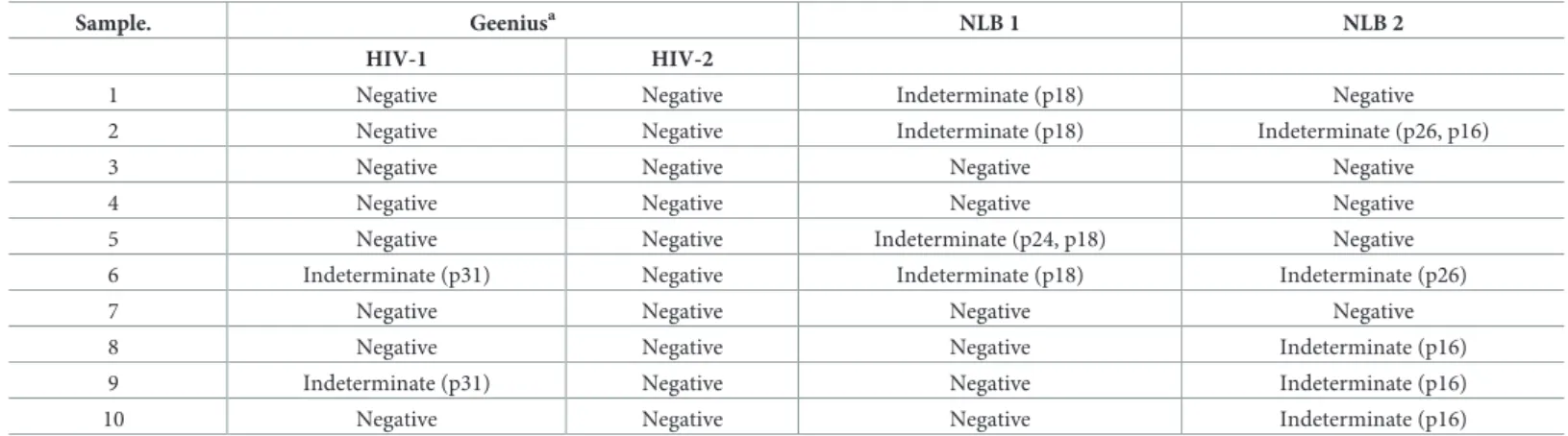
It is important for a confirmatory assay to discriminate between acute HIV-1 infections and false positive screening results. Ten Dainascreen HIV Combo positive but Cobas negative sam- ples were tested with the three assays (Table 5): eight were negative and two were indetermi- nate (positive p31 bands) with Geenius; six were negative and four were indeterminate with NLB 1; five were negative and five were indeterminate with NLB 2, suggesting Geenius is the most specific for HIV-1 false-positive screening samples among the three kits.
Concordance
The overall concordance (Ĕ) between Geenius and NLB 1 was 0.78 if positive, indeterminate, and negative results were considered separately, and 0.95 if indeterminate results were consid- ered as negative.
Table 4. Comparison of Geenius with NLB 1 and 2 results for negative samples by fourth-generation immunoassay (n= 130).
Geenius
HIV-1 positive HIV-1 indeterminate HIV-2 positive HIV-2 indeterminate HIV positive untypable HIV negative Total
NLB 1 Positive 0 0 0 0 0 0 0
Indeterminate 0 0 0 0 0 24 24
Negative 0 1 0 1 0 104 106
Total 0 1 0 1 0 128 130
NLB 2 Positive 0 0 0 0 0 0 0
Indeterminate 0 0 0 1 0 12 13
Negative 0 1 0 0 0 116 117
Total 0 1 0 1 0 128 130
https://doi.org/10.1371/journal.pone.0198924.t004
Table 5. Comparison of Geenius with NLB 1 and 2 results for HIV-1 Combo positive but NAT negative samples (n= 10)a.
Sample. Geeniusa NLB 1 NLB 2
HIV-1 HIV-2
1 Negative Negative Indeterminate (p18) Negative
2 Negative Negative Indeterminate (p18) Indeterminate (p26, p16)
3 Negative Negative Negative Negative
4 Negative Negative Negative Negative
5 Negative Negative Indeterminate (p24, p18) Negative
6 Indeterminate (p31) Negative Indeterminate (p18) Indeterminate (p26)
7 Negative Negative Negative Negative
8 Negative Negative Negative Indeterminate (p16)
9 Indeterminate (p31) Negative Negative Indeterminate (p16)
10 Negative Negative Negative Indeterminate (p16)
https://doi.org/10.1371/journal.pone.0198924.t005
Comparison between the Geenius HIV 1/2 Confirmatory Assay and the HIV-1 and HIV-2 Western blots
Discussion
Japan is a country with low-level HIV epidemics. The cumulative reported incidence of HIV infection through the end of 2016 was 27,443 [18]. Among them, the number of persons with HIV-2 infection was eight [19–22], and there has been no report of HIV-1 and HIV-2 dual infection. According to PMDA, the confirmation of HIV-1 and HIV-2 infections should be performed using WB-1 and WB-2, respectively. However, discrimination between HIV-1 and HIV-2 infections is sometimes very difficult due to cross-reactivity of antibodies against the two viruses. In such cases, it is recommended that the samples are retested from a screening test after several weeks or tested with SERODIA-HIV-1/2 (a particle agglutination assay to detect antibodies to HIV-1 and/or HIV-2, Fujirebio, Tokyo, Japan) or Pepti-LAV 1/2 Assay (an enzyme immunoassay for differentiation of HIV-1 and HIV-2 antibodies, Bio-Rad, Tokyo, Japan) to distinguish HIV-1 and HIV-2 infections, while these differentiation assays also have a high cross-reactivity. A test having a higher HIV-1/2 discrimination ability is required, espe- cially in countries such as Japan where the prevalence of HIV-2 infection is extremely low. In this study, we aimed to assess whether a new rapid test Geenius is an effective alternative to WB-1 and WB-2 for confirmation and discrimination of HIV-1 and HIV-2 infections.
Although the sensitivity of Geenius and NLB 1 was not significantly different (99.3% vs 98.6%) for samples from established HIV-1 infections, Geenius gave seven positive results in 20 NLB 1 negative or indeterminate samples from acute HIV-1 infections and provided posi- tive results earlier than NLB 1 in two of five seroconversion panels, showing that Geenius is more sensitive than NLB 1. For 140 HIV-1 negative samples including 10 false-positive sam- ples, Geenius gave 136 negative and NLB 1 gave 112 negative results, showing that Geenius is more specific than NLB 1.
Cross-reactivity of HIV-1 and HIV-2 antibodies between NLB 1 and NLB 2 was remarkable compared with Geenius. When HIV-1 positive samples were examined, 18 of 144 NLB 1 posi- tive samples were also positive with NLB 2. Geenius, however, resolved all of these double-pos- itive samples as HIV-1 positive. An overall discrimination rate of Geenius was 97.7% (172/
176) [95% CI, 94.3–99.4] and that of a combinational use of NLB 1 and NLB 2 was 87.5% (154/
176) [95% CI, 81.7–92.0], showing that Geenius has a higher discrimination ability than NLB 1/NLB 2. Geenius still gave three HIV positive untypable results: one in 146 HIV-1 positive samples and two in 20 HIV-2 positive samples. It is practically impossible to determine if these results reflect HIV-1/2 dual infection or cross-reactivity at present because the application of HIV-2 NAT for confirmation of HIV-2 infection has not yet been established.
According to the HIV diagnostic algorithm recommended by CDC, samples that are posi- tive on screening tests but negative or indeterminate on HIV-1/HIV-2 antibody differentiation immunoassay should be tested with an HIV-1 NAT [7]. Because Geenius gave fewer negative or indeterminate results for HIV-1 positive samples and fewer indeterminate results for HIV-1 false-positive samples than NLB 1/NLB 2 (Tables
1,2and
5), the use of Geenius will decreasethe number of HIV-1 NAT tests (5,200 yen per test) required for unresolved results as com- pared to the use of NLB 1/NLB 2, which may lead to the reduction of testing costs.
Geenius is characterized by the cassette involving immunochromatographic components to detect HIV-1/2 antibodies and the automated reader using the proprietary interpretive soft- ware. These devices make Geenius have several advantages over WB: a protocol of Geenius is simple, easy, and rapid because it consists of dispensing 15
μL of whole blood to the well of the cassette followed by adding two drops of the provided buffer and takes 30 minutes, while WB has technically demanding multiple steps including antigen-antibody binding, binding with the horseradish peroxidase conjugated secondary antibody, and color development and required several hours; the automated reader allows for the objective evaluation of results,
Comparison between the Geenius HIV 1/2 Confirmatory Assay and the HIV-1 and HIV-2 Western blots
PLOS ONE |https://doi.org/10.1371/journal.pone.0198924 October 31, 2018 7 / 10