Agent‑based Simulation of Impact of
Environmental Policies on Greenhouse Gas Emissions
著者 ? 卓
著者別表示 Liu Zhuo
journal or
publication title
博士論文要旨Abstract 学位授与番号 13301甲第4631号
学位名 博士(学術)
学位授与年月日 2017‑09‑26
URL http://hdl.handle.net/2297/00049554
Creative Commons : 表示 ‑ 非営利 ‑ 改変禁止 http://creativecommons.org/licenses/by‑nc‑nd/3.0/deed.ja
Dissertation Abstract
Agent-based Simulation of Impact of Environmental Policies on Greenhouse Gas Emissions
Division of Environmental Design Graduate School of Natural Science and Technology Kanazawa University
Name:
刘卓(LIU Zhuo)
i
Abstract
This PhD research aims to prove the hypotheses that agent-based simulation (ABS) approach can be used for supporting the planning of environmental policies by simu- lating the impact of these policies on greenhouse gas (GHG) emissions. The simulation systems are developed to simulate the behavior of agents and their GHG emissions un- der the impact of environmental policy, which are respectively developed for the planning support of GHG total amount control and release standard policies in a rubber city project, a policy of electricity sharing, and an environmental tax policy.
The environmental policies mainly focus on the industrial sector and residential sec- tor in urban area. Regarding to industrial sector, this research firstly introduced an ABS system called Rubber City Simulation (RCS), the impact of environmental policies in rubber city project is simulated by designing agent’s individual behaviors. As to resi- dential sector, another ABS named Electricity-Sharing Simulation (ESS) is then introduced in this research, which can simulate the impact of an electricity sharing pol- icy by creating interaction. Furthermore, this research finally introduced an ABS system named Environmental Tax Simulation (ETS) which combined individual behavior with interactions to simulate the impact of an environmental tax policy.
As conclusion, ABS systems introduced in this PhD research are able to forecast the potential impact of environmental policies on GHG emissions, and thereby can be uti- lized to planning support of urban environmental policy.
Keywords: Agent Behavior Design, Total GHG Amount Control, GHG Release
Standard, Environmental Tax Policy, Residential Gas Consumption, Elec-
tricity Sharing Policy, Efficiency of PV Generated Electricity Use
1
Chapter 1 Introduction
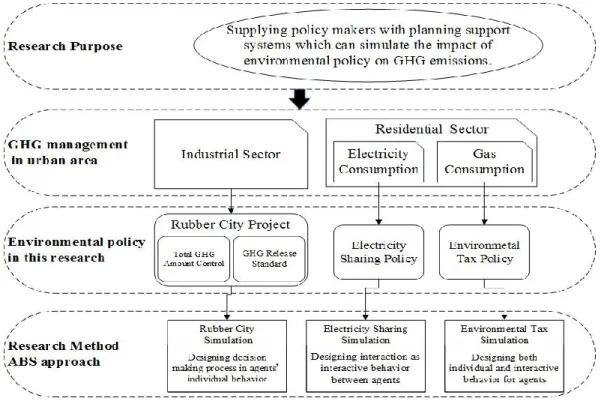
This PhD research targets to supply environmental policy makers with planning sup- port systems which can simulate the impact of environmental policy on GHG emissions.
We designed the agent’s behavior and interactions under the impact of environmental policies and simulate the effect of these policies on GHG emissions based on agent- based approach. In this PhD research, 3 ABS systems are proposed to support the plan- ning of environmental policy. Virtual cities and communities which can reflect the urban operation and developing process were implied as simulating environment.
Meanwhile, we designed agent’s behavior and interactions based on environmental pol- icies successively including total amount control and release standard policy in “rubber city project” of Thailand, a policy for electricity sharing in Japanese smart community and an “environment tax policy” in Japan. By simulating the impact of these policies on households’ behavior, the results should be able to show change in value and general trend of GHG emissions or energy consumption during urban operation or developing process. Moreover, by adjusting the parameters and observe the corresponding simula- tion result, planners would be able to more easily understand the effect of these policies on GHG emissions.
Figure 1-1.Structure of Research
2
Chapter 2 Agent-based Simulation of Total Amount Control and Release Standard Policy for GHG in “Rubber City” Project
2.1 Introduction
In 2013, the government of Thailand has agreed to cooperate with Malaysia on a Rubber City project which means building primary rubber industry in the city with good foundation of rubber plantation. Although the policies related with GHG emissions in the project are quite rough, they can be summarized as strategic policy and technical policy. In strategic level, the policy is set for total amount control. Meanwhile, in the technical level, government set standards of the GHG emissions discharge
Table 2-1. Standard for rubber factory (kg CO2-eq/ton)
This chapter aims to predict the GHG emissions of Nathawi district in the first 10 years after “Rubber City” project implemented. The Rubber City Simulation (RCS) system is developed for simulating the process of rubber city development and GHG emissions.
2.2 System Design for Rubber City Simulation 2.2.1 System Interface and Framework
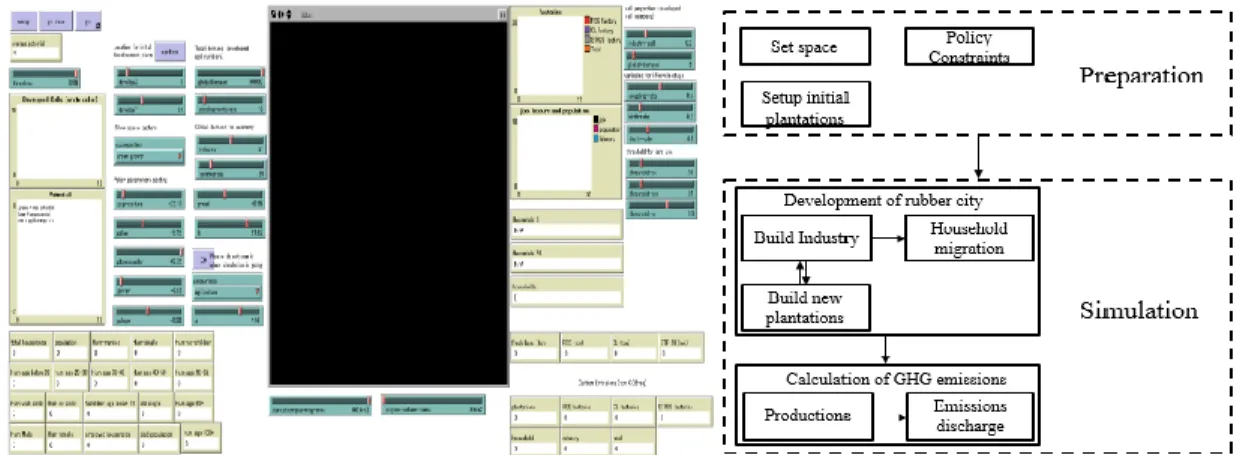
The system interface contains 3 functional part: parameter controlling part, urban status monitoring part and GHG emissions monitoring part. While the system frame- work can be divide into 2 parts: preparation and simulation.
Figure 2-1. System interface & Framework
3
2.2.2 Environment, Agent and Interactions
In this research, a virtual city which is a typical job-oriented one is defined as the environment in the system. Four kinds of agent including plantation, factory, govern- ment and household were designed in RCS system. They have their own attributes and behaviors in the simulation system.Interactions are used to define how all kinds of agents and environment affect each other. The interactions of this research include interactions between agents along with interactions between agents and environment.
2.2.3 Estimation of GHG emissions
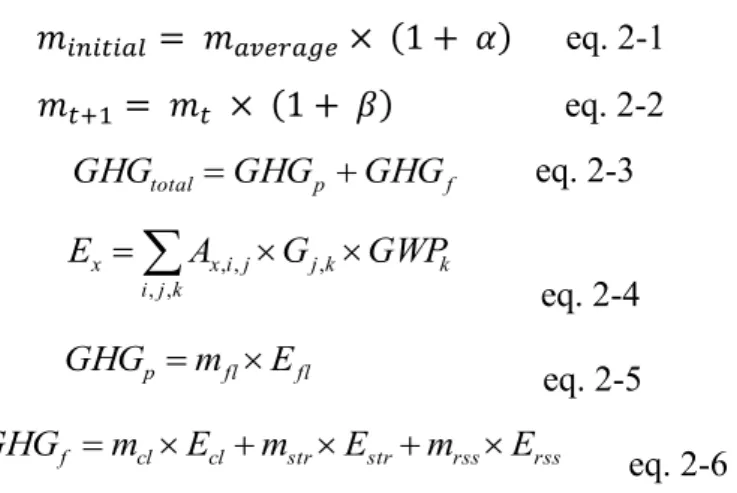
In this research, we assume that the output of different factories follow a random uniform distribution and the growth rate of production outputs follows a random normal distribution. Thus the GHG emissions are estimated by following equations:
𝑚
𝑖𝑛𝑖𝑡𝑖𝑎𝑙= 𝑚
𝑎𝑣𝑒𝑟𝑎𝑔𝑒× (1 + 𝛼) eq. 2-1 𝑚
𝑡+1= 𝑚
𝑡× (1 + 𝛽) eq. 2-2
f p
total
GHG GHG
GHG eq. 2-3
k j i
k k
j j i x
x
A G GWP
E
, ,
, ,
,
eq. 2-4
fl fl
p
m E
GHG eq. 2-5
rss rss str str cl cl
f
m E m E m E
GHG
eq. 2-6
2.3 Behavior Design for Simulating the Impact of Environmental policy
The total amount control policy is set to be the behavior of government agent, while the release standard is designed as factory behavior.
Figure 2-2. Behavior of Agent
4
2.4 Prediction of GHG Emissions for Rubber City Project
The first 10 year’s developing process of Nathawi district as a rubber city with the environmental policy impact is simulated in this research. The simulation was repeated 50 times, and the values used in this research as result are the average values of 50 times’ simulation. The results are as shown in figure 2-3.
Figure 2-3. Total GHG and GHG released from factories (ton/year)
2.5 Conclusions for this Chapter
Under the premise of developing local economy, the release standard policy totally reduced 2553.47 ton CO
2-eq GHG emissions. The policy of total amount control worked to keep the total GHG emissions under the control value. However, in the RCS system, the interaction of agent was not considered for policy impact simulation.
Chapter 3 Agent-based Simulation of an Policy for Household Electricity Sharing in Smart Community
3.1 Introduction
Electricity sharing is defined as renewable electricity transferring between house-
holds inside a community with the target of using solar power effectively and reducing
electricity generation from general grid at community level. In this chapter, we pro-
posed an agent-based model designed for simulating the effect of energy-sharing policy
and attempt to investigate the effectiveness of electricity sharing concept for improving
the energy use efficiency of PV generated electricity in a virtual smart community. We
firstly simulated the demand side energy consumption of household. Then, we set the
ratio of households for the virtual community and designed the interactions based on
5
the description of electricity sharing policy in the related literature. Moreover, we pre- dicted that this agent-based model could also assist planners in building knowledge for the implement of electricity-sharing concept.
3.2 Simulation of Energy Consumption for Households as a Prerequisite
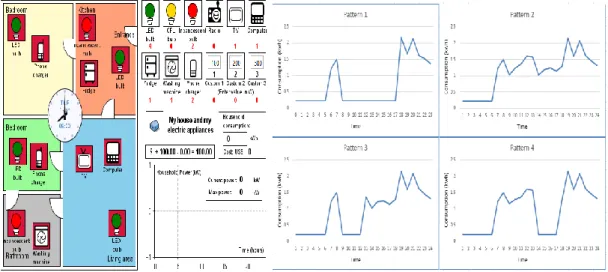
Without an accurate simulation for the electricity consumption of households, it is even impossible to simulate the energy demand or can be supply of households. Thus, it is obvious that the simulation of energy consumption of household is a prerequisite for simulating the electricity process. In this research, we use a model developed based on computational hybrid method and ABS approach to make a primary simulation of household energy consumption. The model is developed on the AnyLogic platform, a simple simulation of household energy consumption was conducted and we tried to make an exposition to the preliminary result. Further, by comparing with actual meas- ured data, the simulation result was validated.
Figure 3-1. System interface & Electricity consumption curves
We simulate the energy consumption of the households with four different patterns, the consumption curves will be set as the parameters of household agent in the ESS.
3.3 System Design for Simulating the Electricity Sharing Policy
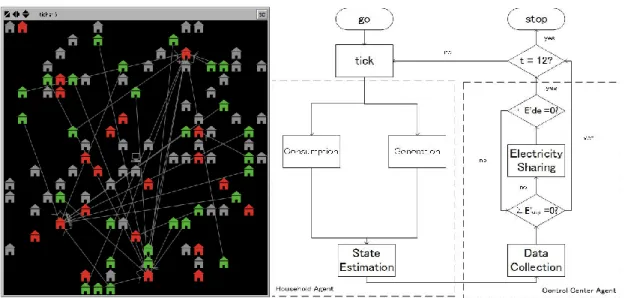
In this research, a virtual community is defined based on the conditions of smart
community in Japan. The electricity sharing is defined as a new interaction between
household, and conducted via the behavior of household and government. The whole
simulating process is showed as following figure.
6
Figure 3-2. Virtual community & Flow chart of sharing process
In every ticks, the household agent will start the consumption behavior at the same time with PV electricity generation. After that, the household agent will start a state estimation module to judge whether it can supply electricity or it demand electricity.
Then, the control center agent always ask household with max supply transport elec- tricity to household with max demand until there is no more supply or demand.
3.4 Simulation Result
We repeated the simulation 30 times and calculated the average value as the sim- ulation results of this research. The following figure shows the result.
Figure 3-3. Virtual community & Flow chart of sharing process
3.5 Conclusions for this Chapter
In this chapter, we introduced a policy concept named electricity sharing that tar-
gets to improve the efficiency of using PV generated electricity by let households share
surplus PV generated electricity with others. We developed an ABS system named ESS,
in which electricity sharing is set to be an interactions between household agents. As
7
result, the electricity sharing policy improve 6.81% using efficiency of PV generated electricity for the virtual community, which means that the electricity generated from general grid reduced 64.87kWh, That equals to around 32.43kg CO
2reduction.
Chapter 4 Agent-based Simulation of the Effects of an
Environmental Tax Policy on Residential Gas Use and CO2 Emissions
4.1 Introduction
Kanazawa water and energy center added the environmental tax to the gas price as a respond to the global warming countermeasure from the aspect of fossil fuel. The environmental tax policy on residential gas in Kanazawa city implements with three steps: The first step is from the April in 2013, and the second step is from the April in 2014, the third step started from the October of 2014. In each step the gas price was increased by 0.21 yen per cubic meter of gas consumption.
The objective of this research is to develop an agent-based model with heterogamous gas consuming behaviors to access the Environmental Tax Policy in Kanazawa city. As an agent-based model, it will pay more attention on household energy consuming be- haviors comparing with other researches. In addition, to make the model closer to the real case, the interactions between agents is also a key point, which is rarely seen in the simulation of environmental policy effects. The simulation in different scenario is con- ducted to compare the environmental tax policy with other possible policy for reducing residential gas consumption and GHG emissions.
4.2 System Design for Environmental Tax Simulation
The environment of the ETS is a virtual city that follows basic characters of Kana-
zawa City. There are two kinds of agents in the ETS: the government agent and the
house-hold agent. The government agent supposed to set the price of the gas and also
it is the agent conduct the Environment Tax policy. There are only one government
agent in the system. The household agent is divided into three groups by income, dif-
ferent income group will have different behavior of gas consuming. 1500 household
agents are set in ETS with their own attributes.
8
.
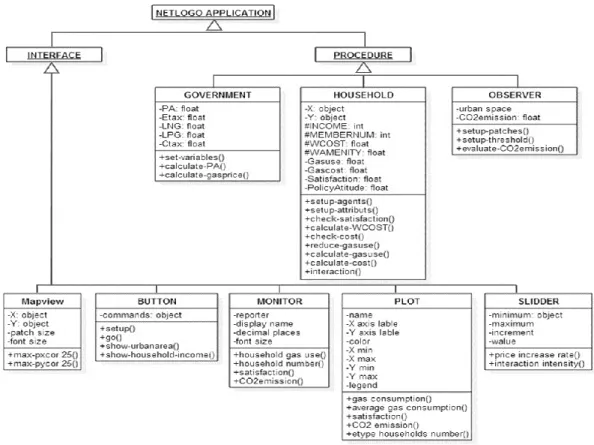
Figure 4-1. UML class of ETS
4.3 Behavior and Interactions Design for simulating the Effect of Environmental Tax Policy
The households’ behavior is designed according to the literatures about house-
holds’ gas consuming behavior. Because of limited research condition, surveys like
questionnaire survey hasn’t been conducted in this research. To remedy this limitation,
a literature review on households’ energy consuming behavior has been done. The re-
sults of some other researches are used as the theoretical support for the design of gas
consumption behavior. As the existing researches suggested, there are interactions be-
tween households that affect the gas use for each other. Meanwhile, according to
description of environmental tax policy, it mentioned the tax will be used for improving
the environmental education which can be considered as enhance such interactions be-
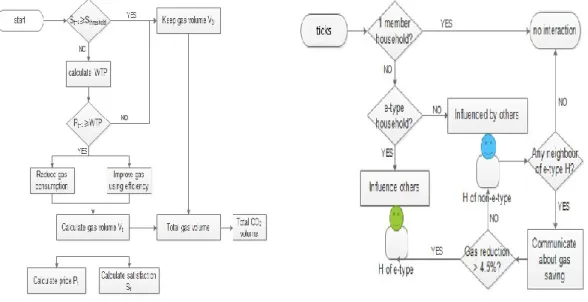
tween agents. Thus, we designed the interactive behavior of household agent in the ETS
by creating interactions between household agent of communicating gas price and gas
saving tips
9
Figure 4-2. individual and interactive behavior of household agent
4.4 Simulation of the effect of Environmental Tax Policy
In this research, 4 scenarios were designed to make the simulation. The first one is the scenario with the Environmental Tax policy interruption as the real case. The second one is the scenario without any policy interruption. The third is the scenario with a stronger “Environmental Tax policy” interruption. The fourth one is the scenario with a stronger interaction among household agents. The households’ gas consumption is analyzed from three aspects: the analysis of policy effects on average gas consump- tion, the analysis of average household gas consumption in each income group, the analysis of overall households’ gas consumption in each income group.
Figure 4-3. Simulation result of gas consumption and CO2 emission
10