Agent‑based Simulation of Impact of
Environmental Policies on Greenhouse Gas Emissions
著者 ? 卓
著者別表示 Liu Zhuo journal or
publication title
博士論文本文Full 学位授与番号 13301甲第4631号
学位名 博士(学術)
学位授与年月日 2017‑09‑26
URL http://hdl.handle.net/2297/00054258
Creative Commons : 表示 ‑ 非営利 ‑ 改変禁止 http://creativecommons.org/licenses/by‑nc‑nd/3.0/deed.ja
Agent-based Simulation of Impact of Environmental Policies on Greenhouse Gas Emissions
LIU Zhuo September, 2017
Dissertation
Agent-based Simulation of Impact of Environmental Policies on Greenhouse Gas Emissions
Graduate School of
Natural Science and Technology Kanazawa University
Division of Environmental Design
School ID No.: 1424052012 Name: 刘 卓 (LIU Zhuo)
Chief advisor: Prof. Zhenjiang Shen September, 2017
i
Abstract
This PhD research aims to prove the hypotheses that agent-based simulation (ABS) approach can be used for supporting the planning of environmental policies by simu- lating the impact of these policies on greenhouse gas (GHG) emissions. The simulation systems are developed to simulate the behavior of agents and their GHG emissions un- der the impact of environmental policy, which are respectively developed for the simulation of GHG total amount control and release standard policies in a rubber city project, a policy of electricity sharing, and an environmental tax policy.
Under the pressure of global warming, GHG emissions reduction became a very hot issue in recent years following by a growing number of environmental policies which target to manage the discharge of GHG emissions. These environmental policies mainly focus on the industrial sector and residential sector in urban area. Regarding to indus- trial sector, the environmental policy for GHG emissions can be divided into two perspective which are total amount control policy in strategic level and release standard policy in technical level. Thus, this research firstly introduced an ABS system named Rubber City Simulation (RCS) developed for visualizing the developing process of a rubber city followed the “rubber city” project. The impact of environmental policies in this project including total GHG amount control and release standard is simulated by designing agent’s individual behavior related with GHG emissions. The result was used for predicting the potential GHG emissions discharge resulted from developing process of the rubber city.
As to residential sector, the environmental policy focus on the residential consump- tion of GHG related energy which include electricity and gas. Thus, another planning support system based on agent-based approach named Electricity-Sharing Simulation (ESS) is then introduced in this research, which aims to simulate the effect of an elec- tricity sharing policy on improving the using efficiency of PV generated electricity inside smart communities. To reflect the difference of life routine, an energy consump- tion model is used for the simulation of household electricity consumption curve which is set as agent’s parameter in the ESS. Electricity sharing is then created as an interac- tion between households, the simulation result is used for evaluating the effectiveness of the policy.
ii
Furthermore, besides electricity, another major perspective of GHG related energy in residential sector is gas. Therefore, this research also focus on the simulation of pol- icy impact on household gas consumption. We finally introduced an ABS system named Environmental Tax Simulation (ETS) which combined individual consumption behavior with interactive behavior to simulate the impact of an environmental tax pol- icy on residential gas consumption. Through the simulation under different scenarios, the ETS is able to evaluate the effect of the environmental tax policy from different perspectives.
As proved by published research papers consisting in this dissertation, the ABS sys- tems can be used to reflect the impact of environmental policies by designing agents’
individual behavior and interactions. Further, the simulation result can present the change in value of GHG emissions corresponding to the change of agent’s behavior and interactions. Thus, the ABS systems we introduced in this PhD research are able to forecast or evaluate the effects of environmental policies on GHG emissions, and thereby can be utilized to planning support of urban environmental policy.
Keywords: Agent Behavior Design, Total GHG Amount Control, GHG Release Standard, Environmental Tax Policy, Residential Gas Consumption, Elec- tricity Sharing Policy, Efficiency of PV Generated Electricity Use
iii
Acknowledgment
The five year’s life in Urban Planning Laboratory of Kanazawa University is not only wonderful but also meaningful for me. At same time with learning knowledge, I met a lot of honorable teachers who did not only teach me scientific knowledge but also make examples to be integrity researchers.
Firstly, The most heartfelt thanks go to my supervisor Prof. Shen Zhenjiang. As my supervisor, He always tried to make me understand what the real research is.
Although I didn’t achieve the requirements sometimes, he never lost patience for me.
Without professor Shen, this dissertation cannot be finished.
Then, I would like to thank Prof. Nishino Tatsuya and Prof. Kobayashi Fumihiko for being members of my dissertation review panel. In my past academic years in Kan- azawa University, their valuable comment and advice improved my research very much.
Without their great help, I would not be able to publish the research works smoothly.
I am also very grateful to Prof. Furuuchi Masami, Prof. Hata Mitsuhiko and all of the teachers of Japan-China-Korea Environment & Eco-Technical Special course. It was you that gave me the chance to come to Kanazawa University and learned so much here. I’ve broaden my horizon and promoted my abilities of all aspects while it was impossible without the chance given from you.
What’s more, I sincerely thank all of my friends in Kanazawa University especially the students of urban planning laboratory and students of Japan-China-Korea Environment & Eco-Technical Special course. We had a lot of communications in such a fantastic international environment which significantly opened my mind. I treat our friendship as most precious treasure in my life.
Last, but not least, I am particularly grateful to my parents who made my strong backing. My father passed away when I was studying in the PhD course, I believe that you are watching me all the time in heaven. May your faith be with me forever. The largest pride of my life is, and will always be being your son.
iv
Table of Contents
Abstract………...i
Acknowledgment ... iii
Chapter 1 Introduction ... 1
1.1 Research Background and Research Purpose ... 1
1.2 Literature Review ... 2
1.2.1 Analyzing Environmental Policies ... 2
1.2.2 Agent-Based Simulation of Policy Impact ... 4
1.2.3 Conclusion for Literature Review ... 4
1.3 Research Method and Thesis Organization ... 5
Chapter 2 Agent-based Simulation of Total Amount Control and Release Standard Policy for GHG in “Rubber City” Project ... 8
2.1 Introduction ... 8
2.2 System Design for Rubber City Simulation ... 11
2.2.1 System Interface and Framework ... 11
2.2.2 Environment, Agent and Interactions ... 13
2.2.3 Estimation of GHG emissions ... 16
2.3 Behavior Design for Simulating the Impact of Environmental policy ... 19
2.4 Prediction of GHG Emissions for Rubber City Project ... 21
2.4.1 Study Case and Data Preparation ... 21
2.4.2 Simulation Result and Discussion ... 22
2.5 Conclusions for this Chapter ... 25
Chapter 3 Agent-based Simulation of an Policy for Household Electricity Sharing in Smart Community ... 28
3.1 Introduction ... 28
3.2 Simulation of Energy Consumption for Households as a Prerequisite ... 30
3.2.1 Modeling Considerations for Simulating Energy Consumption for Household ... 30
3.2.2 Simulation of Household Electricity Consumption ... 32
v
3.2.3 Energy Consumption Curve of Household with Different Life Routine
... 36
3.3 System Design for Simulating the Electricity Sharing Policy ... 37
3.3.1 Description of Electricity Sharing Policy ... 37
3.3.2 Simulation of Electricity Sharing Process ... 38
3.4 Simulation Result ... 42
3.4.1 Initial Parameters ... 42
3.4.2 Result and Discussion ... 43
3.5 Conclusions for this Chapter ... 45
Chapter 4 Agent-Based Simulation of the Effects of an Environmental Tax Policy on Residential Gas Use and CO2 Emissions ... 47
4.1 Introduction ... 47
4.2 System Design for Environmental Tax Simulation ... 49
4.2.1 System Framework ... 49
4.2.2 Environment, Agent and Interaction ... 49
4.3 Behavior and Interactions Design for simulating the Effect of Environmental Tax Policy ... 51
4.3.1 Government Behavior ... 51
4.3.2 Gas Consumption Behavior of Household Agent ... 52
4.3.3 Interactive Behavior of Household Agent ... 56
4.4 Simulation of the effect of Environmental Tax Policy... 57
4.4.1 Simulation Scenarios and Initial parameters ... 57
4.4.2 Model Verification ... 59
4.4.3 Result and Discussion ... 60
4.5 Conclusion of this Chapter ... 71
Chapter 5 Conclusion ... 72
Publications………..74
References………75
1
Chapter 1 Introduction
1.1 Research Background and Research Purpose
Nowadays, urban areas keep suffering the threat of energy crisis coupled with the climate change. Ironically, although the proven reserves of fossil fuels increased over past two decades, it is still unable to keep pace with the increasing energy demands which are expected to increase by 60 to 85 percent by 2030(Peter Droege, 2011). The increasing energy demands result in the growing greenhouse gas (GHG) emissions re- lease, which is the most significant driver of observed climate change since the mid- 20th century especially in urban area (Frolkis, et al, 2002). 76 percent of the global consumption of coal occurs in cities, even though they cover less than 1 percent of the earth’s surface (Sullivan, 2010). Therefore, the reduction of GHG emissions from urban systems is crucial to global GHG emissions reduction and low-carbon development (Zhang, et al, 2014).
There is no doubt that the development and normal operation of urban areas nec- essarily go with the GHG emissions release under the existing technical conditions, because it is closely related to individual’s production and living activities. Thus, the major issue should be balance the GHG emissions with the requirement of developing and living by policy, which makes environmental policy for GHG emissions a very hot topic. In recent years, a growing number of new environmental policies which target to reduce energy consumption and GHG emissions have been proposed. These policy here refers broadly to government actions in GHG emissions management and mainly focus on industrial sector and residential sector in urban area. For industrial sector, there are two major policy perspective: total amount control in the strategic level and release standard in technical level. While, the policy for residential sector works on residential electricity and gas consumption. The environmental policy usually aim to affect peo- ple’s individual and interactive behavior related with GHG emissions. Thus, the simulation of impact of environmental policies on people’s behavior is helpful for plan- ners to predict or evaluate the effect of the policies for reducing GHG. Among the simulation approaches, Agent-based Simulation has been widely considered to be a
2
powerful approach to simulate the agent’s behavior and interactions during urban de- veloping and operating process.
Therefore, This PhD research targets to supply environmental policy makers with planning support systems which can simulate the impact of environmental policy on GHG emissions. We designed the agent’s behavior and interactions under the impact of public environmental policies and simulate the effect of these policies on GHG emis- sions based on agent-based approach. In this PhD research, 3 agent-based simulation systems are proposed to support the planning of environmental policy. Virtual cities and communities which can reflect the urban operation and developing process were implied as simulating environment. Meanwhile, we designed agent’s behavior and the interactions based on environmental policies successively including total amount con- trol and release standard policy in “rubber city project” of Thailand, a policy for electricity sharing in Japanese smart community and an “environment tax policy” in Japan. By simulating the impact of these policies on households’ behavior, the results should be able to show change in value and general trend of GHG emissions or energy consumption during urban operation or developing process. Moreover, by adjusting the parameters and observe the corresponding simulation result, planners would be able to more easily understand the impact of these policies on GHG emissions.
1.2 Literature Review
1.2.1 Policy Analysis for Planning Support
As showed by existing researches, there are kinds of environmental policies sup- porting government to manage on different urban environmental issues. These policies cover a very wide range of aspects and take effect in several way such as total amount control, tax for discharge, improving development of new technology and so on (Almer et al, 2017). Regarding the research of analyzing the effect of environmental policies, the related literatures are vast, while can be generally classified in to three perspectives according to the methods: statistical analysis, survey, and simulation.
The statistical analysis has been proved as an effective approach in describing the impact of the environmental policies. Most researches based on statistical analysis are conducted by applying the data to some mathematic models. For example, Ghosh et.al compared the efficiency, distributional and emission leakage effects of border tax ad- justments as port of unilateral climate policies by CGE model with statistic data (Ghosh
3
et.al, 2012). Moreover, Rocchi et.al analyzed the potential economic impacts of the reform of European energy tax directive using statistic data of 27 counties in Europe (Rocchi et.al, 2014). Through statistical analysis, researches could be done in a large scale. However, the limitations of researches based on statistical analysis includes the hidden of individuals’ heterogeneous and limitations on variable control, which may lead to the deviation while explaining the result. This approach is hereby weak to un- cover the underlying process that affect individuals’ behavior and also hardly to forecast the potential effect for new policies.
Researches on effect of environmental policy based on survey usually explore the influence of policy on individual’s behavior. Schaffrin et al conducted an investigation of energy practices of different social groups to verify the effectiveness of policies tar- geting household energy conservation based on the survey data of Denmark, Austria and UK (Schaffrin et al, 2015). Mats Bladh and Helena Krantz studied the energy sav- ing behaviors in residential sectors using metered data of a large sample and interview data with a small sample (Mats Bladh and Helena Krantz, 2008). Such kind of method focus on link of policy-behavior-result which make it possible to analyze the effect of policies on individual’s behavior and further forecast the effect on pollution and emis- sions discharge or energy saving. Researchers analyzed the relationships between policies, the location and intensity of urban activities and urban environmental prob- lems (Alberti,1999; Chin, 2002; Ewing, 1994, 1997; Neuman, 2005). However, these researches were mainly qualitative and quantitative analysis that cannot reflect individ- uals’ decisions flexible.
In recent years, researches on simulation of environmental policy models have sprung up, there have been researchers using the various models to forecast or evaluate the impact of environmental policies. For example, Galinato et.al simulated an inte- grated tax-subsidy policy for carbon emission reduction in the electric power and motor fuel industries (Galinato et.al, 2010). However, with an overview of the model for en- vironmental policies, little attention has been paid to model the impacts on households’
behavior (Motawa I and Oladokun M, 2014). Moreover, considering the complexities of the urban system, equilibrium conditions are not easily reached. And relationship identified using these models does not readily revealed the dynamic process leading to the relationship which weaken the effectiveness of these models for planning support.
4
1.2.2 Agent-Based Simulation of Policy Impact
As reported previously (Jager, 2007), agent-based approach is expected to contrib- ute to the exploration of the effectiveness of public policy measures in complex environments through the simulation of heterogeneous behavior and interactions. A number of studies have used ABS to assess future socio-ecological consequences re- sulting from public policies (Lee, 2010), meanwhile some other studies have focused on the use of multi-agent simulation for policy development (Berger, 2006). For exam- ple, Chen Ping et al simulated the decision making process of household choosing a shop considering the distance, the price, the shop facility conditions (Chen Ping et al, 2006). Yan Ma et al simulated a residential promoting policy effects on downtown re- vitalization using an agent-based household residential relocation model (Yan Ma et al, 2013). Jordan R et al created an agent-based model of residential mobility and simu- lated the impacts of a specific urban regeneration intervention (Jordan R et al, 2014).
As a bottom up approach, ABS has been proved to be a useful simulation method to mimic the activity of whom have ability to do their own decisions, this method has been widely utilized to reflect the flexible actions of human beings (Fontaine and Roun- sevell, 2009;Brown et al., 2008; Torrens, 2007). Meanwhile, it has the function of creating interactions between agents, which made it possible to model the decision mak- ing process with many variables especially for the individuals in a complex environment. Thus, some researchers use it researching on public policy of pollutants control and energy management. While regarding to the possible effectiveness of such policy, we referenced some researches of policy effectiveness evaluation. Ma tried to use agent-based approach supporting government decision-making of total amount con- trol for household water consumption (Ma et al, 2010). There are also researches that concentrate on simulating the dynamic interactions between household behavior, policy making and environmental influences (Vlek, 2000; Jager and Janssen, 2003). These simulations significantly contribute to the study of behavior-environment interactions, and provided a valuable tool for exploring the effectiveness of environmental policy in complex environments (Jager and Mosler, 2007).
1.2.3 Conclusion for Literature Review
The literature review of this research includes different methods for supporting policy analysis. The result indicates that while traditional approaches have been exten- sively and successfully used in the planning of environmental policies, they have limits
5
in studying the underlying process that reflect the heterogeneous behavior of individu- als in situations where decision-making are made under conditions of deep uncertainty.
Nevertheless, the heterogeneous behavior under the influence of environmental policy is assignable for simulate the effect on GHG emissions particularly when they are to be employed as planning support system (Torrens 2002).
Comparing with these traditional approaches, agent-based approach is capable to better serve these situations. By accurate design of agent’s behavior, it can be very suit- able for simulation on effect of policies and individual activities in virtual environment.
Because ABS can evaluate the impacts of policy at the level of decision making units such as plantations, factories and households rather than focusing on the aggregate in- formation of groups of individuals to predict policy impacts, while at the same time estimates of aggregate outcomes can still be derived by summing up individual predic- tions. Flexibility in designing new action rules and environment constraints in a simulation allows planners to test new policy concepts.
Despite the well-documented ABS for modeling, surprisingly there are few re- search has addressed effects of urban environmental policy on GHG emissions and energy management. For filling up this gap in the existing researches, this PhD research seeks to explore ABS to simulate the possible effect of different environmental policies on GHG emissions with different impact on agent behavior.
1.3 Research Method and Thesis Organization
This PhD research postulates that it is possible to formulate simulation models for supporting the planning of environmental policy based on agent-based simulation ap- proach. For confirming the hypothesis above, three ABS systems for simulating the impact of environmental policies on GHG emissions were constructed. The whole pro- cess of model formulating in this research includes extracting the policies, designing agents’ behavior and interaction, selecting parameters, and simulation experiment. This research focused on the GHG amount control and release standard policy in a rubber city project, a policy of electricity sharing for energy management in smart community and an environmental tax policy, meanwhile the most important point is how to reflect the influence of these policies on agent’s individual and interactive behaviors related with GHG emissions discharge or energy consumption. This research explored a way
6
to reflect the policy impact in the simulation which is setting new decision making pro- cess in agent’s individual behavior and create new brand of interactions between agents according to the descriptions of target policy. The output of this research are simulation systems that can show the value of GHG emissions discharge and energy consumptions under the impact of environmental policies during urban development or operation.
Figure 1-1.Structure of Research
The Dissertation is organized by five Chapters. After the introduction of research background, research purpose, literature review and research method in Chapter 1, we start from an agent-based simulation for environmental policies including GHG total amount control and release standard in rubber city project in Chapter 2. An ABS system named Rubber City Simulation (RCS) was developed for visualizing the developing process of a rubber city. The behavior of agents in the system followed decision making processes which designed based on real situation of government and factories in rubber city. Therefore the impact of environmental policy in this model is represented by individual behaviors of factory and government agent. The simulation results consists of change in value of GHG emissions released from different agents and total emissions during the developing process of the rubber city.
7
The systems above simulate the impact of environmental policy mainly by designing decision making process for agents’ individual behaviors. Subsequently in chapter 3, an ABS system named Electricity Sharing Simulation (ESS) is introduced.
The system combines 2 parts that make it not only be able to simulate the energy consumption of individual household but also be able to simulate the effect of an electricity-sharing policy on improving the using efficiency of PV generated electricity in smart community. Comparing with the system introduced in previous chapter, we simulate the electricity policy by creating new interactions based on the description of the rule suggested by electricity-sharing policy. The results can be used for the evaluation of the effectiveness of electricity sharing policy for smart communities.
Following Chapter 3, Chapter 4 is about agent-based simulation of the effects of an environmental tax policy in Japan. Another planning support system named Environmental Tax Simulation (ETS) is introduced in this chapter. The influence of environmental tax is simulated by not only inserting it as an parameter into the gas consumption behavior of household agents, but also considered the interactive behaviors for saving gas consumption between household agents. In this way, the promotion of residential environmental awareness and technology improve by the environmental tax policy are also considered in the system by simulation under different scenarios. The comparison of simulation results and statistic data provided the verification for the model. Meanwhile, results of residential gas consumption and CO2
emissions were addressed under different scenarios of the environmental tax policy.
Finally, we will make a conclusion for this PhD research in Chapter 5.
8
Chapter 2 Agent-based Simulation of Total Amount Control and Release Standard Policy for GHG in “Rubber City” Project
2.1 Introduction
Thailand has been the world’s largest natural rubber producer since 2003, and has a share of about 35% of the latex produced worldwide. In 2011, Thailand produced about 3.4 million tons of fresh latex with an average yield of 1.6 ton fresh latex per hectare. The fresh latex is tapped and collected as a liquid, and then processed to pri- mary rubber products. The primary rubber products are then processed into various final rubber products. Important primary rubber products include concentrated latex, block rubber, and ribbed smoked sheet rubber.
The economic lifetime of rubber plantations in Thailand is around 20–25 years.
During the first seven years the trees grow without possibilities to tap latex. This period is followed by 13–18 productive years. Fresh latex is extracted by tapping from the rubber trees. The fresh latex is collected as a liquid. The fresh latex can then be pro- cessed to primary rubber products, which are subsequently processed to different final rubber products. The most important primary (intermediate) rubber products include concentrated latex (raw material for dipped products such as medical gloves and con- doms, represented by CL further below), block rubber (raw material for high viscosity products such as soles and belts, represented by STR further below), and rubber ribbed smoked sheet (raw material for vehicle tires and industrial rubber parts, represented by RSS further below).
Concentrated latex is the primary rubber product used as the raw material for dipped rubber products such as condoms, gloves, balloons, and infant pacifiers. Most of concentrated latex (about 70%) produced in Thailand is exported, mainly to Euro- pean countries, China, India and Malaysia. In 2011, Thailand exported about 880,000 tons of concentrated latex, with a value of 77,000 million baht.
The ability to measure and control the various physical aspects and characteristics of the baled Standard Rubber has brought about a major change in the rubber industry.
There is a drastically increasing demand for these rubber bales as they provide ease in
9
quality control at both reception and processing of the end-user for raw materials. In the case of Thailand, STR comprises of 4 main groups-- STR10, STR20, STRxL and STR CV- depending on the specific control variables.
Ribbed Smoked Sheet Rubber is commonly known as RSS. It is made directly from fresh latex which is treated and then made to coagulate. The coagulated latex sheets are then air dried or smoked in ovens. The smoked sheets are visually graded on the basis of certain parameters and then packed in bales. The size and weight of the bales differs according to country. In Thailand the standard packing for RSS is large bales of 111.11 kg.
Figure 2-1.Industrial Structure Sketch of Rubber Industry in Thailand
Global warming has been gaining attention from the industrial sector during the last decade for Thai government especially after suffered the rainstorm disaster in 2010.
The rubber industry is identified as high-emission industry because both agricultural activities in plantations and producing activities in factories release considerable quan- tities of greenhouse gas (GHG) emissions into the air.
Since natural rubber products are being exported to the international market, it has been challenging for Thai rubber entrepreneurs to seek for appropriate environmental measures to produce environmentally friendly rubber products. Traditionally, environ- mental management in rubber mills focused on pollution reduction, especially through wastewater treatment and air pollution control. Thailand has signed the Kyoto protocol in 1998, and is currently implementing a strategic climate plan for the period 2008–
10
2012. This plan consists of six important strategies, including building capacity to adapt to climate impact, promoting greenhouse gas mitigation, and creating awareness. Ac- cording to Thailand’s initial national communication, Total GHG emission were 286 Tg CO2-equivalents in the mid-1990s, of which about 75 Tg are from land use change and forestry, about 60 Tg from agriculture, and about 15 Tg from industry.
In 2013, the government of Thailand has agreed to cooperate with Malaysia on a Rubber City project which means building primary rubber industry in the city with good foundation of rubber plantation. Thailand and Malaysia have agreed to create a Rubber City along their border to raise the rubber prices. The two sides agreed to strengthen their cooperation in trade and investment, particularly in the areas that they share strength like Halal food and rubber. Malaysia proposed the establishment of the Rubber City along the Kedah-Thai border for the mutual benefits. Under the proposed project, the city will be created in the border area linking Dan Prakob in Songkhla's Nathawi district and Kota Putra in the Malaysian state of Kedah. Thailand is currently a major source of rubber for Malaysia, while the country wants to learn about the latest tech- nology for rubber production from its southern neighbor. The Rubber City project should be mutually beneficial, as Thailand has the greater supply of rubber while Ma- laysia has several industries making products from it. The project will also help increase the price of rubber and create sustainable incomes for Thai farmers.
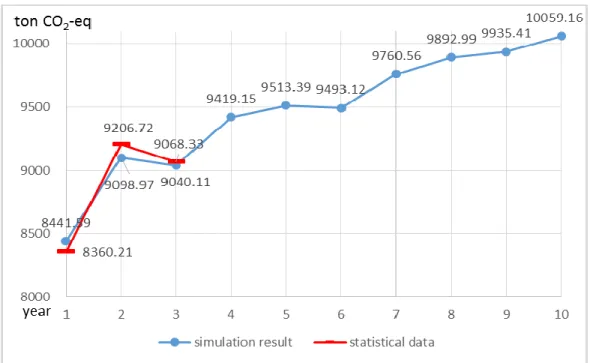
Although the main purpose of rubber city project is to develop local rubber industry, the government also considered the environmental impact of the project. Some envi- ronmental policies are mentioned in the statement for the rubber city, including several issues such as waste water, soil pollution and so on. Although the policies related with GHG emissions are quite rough, they can be summarized as strategic policy and tech- nical policy. In strategic level, the policy is set for total amount control, it can be described as: the whole rubber industry including plantations and factories should con- trol the GHG emissions and keep the total emissions under 10000 ton CO2-eq per year.
If the value beyond 10000 ton, the approval process of creating new factories will be- come austerity that only if there are plantations closed, it is possible to create new factories.
Meanwhile, in the technical level, government set standards of the GHG emissions discharge with unit production with the purpose of requiring rubber factories improving their GHG reduction technology. The details are listed in table 2-1. The factories whose annual output ranked within top 20% of whole industry should achieve the requirement
11
of level 1; the factories whose annual output ranked within top 50% of whole industry should achieve the requirement of level 2; besides, all factories should achieve level 3 which is the minimum standard.
Table 2-1. Standard for rubber factory (kg CO2-eq/ton)
Production CL STR RSS
Level 1 20 150 11
Level 2 23 155 13
Level 3 25 160 15
This chapter aims to predict the GHG emissions of Nathawi district in first 10 years after the “Rubber City” project implemented in local area. A planning support system for simulating the process of urban development and GHG emissions of the rubber city was developed. During system design, we focus on the simulation of the effect of envi- ronmental policy in “Rubber City” project by designing the decision making process for agent behavior. The simulation result showed the annual value and changing trend of GHG emissions discharge in rubber city. Based on the result, effectiveness of the environmental policy for total GHG amount control and technology updating are eval- uated. Furthermore, some suggestions are given for the planning of environmental policy in “Rubber City” project in the aspect of GHG emissions reduction. Meanwhile, the future developing directions of the simulation system are summarized based on the performance of the RCS in the simulation
2.2 System Design for Rubber City Simulation
2.2.1 System Interface and Framework
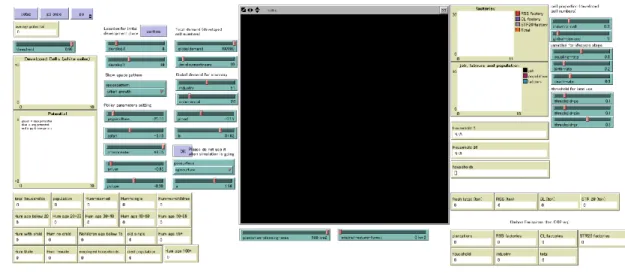
The system interface consists of display, monitors, plots, buttons and sliders. And it contains 3 functional part including controlling part for setting the parameter for the simulation, urban status monitoring part for showing the situation of urban development and GHG emissions monitoring part for showing the simulating result of GHG emis- sions.
12
Figure 2-2. System interface
While the “setup” button is clicked, the system will read the programming code and set the initial conditions for the simulation. Clicking “go” button means starting the simulation, the function of “go once” button is totally same with “go” button, but the simulation will just last 1 tick while it is clicked. Sliders are used to set the initial pa- rameters for the simulation. Both monitors and plots are for making the simulating result visible. Monitors show numerical results and the results are more intuitive in the plots. The set of sliders, monitors and plots in left side constitute the urban status mon- itoring and controlling part of the system. And the right side is GHG emissions monitoring part. The simulating result which is used for predicting in this research are obtained from here.
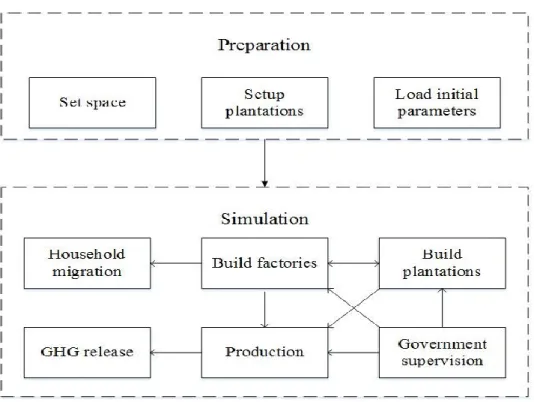
The system framework can be divide into 2 parts: preparation and simulation. Dur- ing preparation, the system load the virtual city as simulating environment and set the initial plantations in the city. Those plantations represent existing plantations of rubber city. Then policy constraints are input as initial parameters in order to simulate the pol- icy impact of developing rubber city.
13
Figure 2-3 System Framework of RCS
Following the preparation is simulation. At the beginning of every tick which is the time unit of the simulation, the system firstly check whether it is possible to create new factories, if the results is “yes”, new factories will be created. Then the system will judge whether the total amount of FL is enough for industrial production, in other word, is it necessary to create new plantations. If it is necessary, new plantations will be built to supply more FL. Then, because of the job chances in new factories and plantations households will be attracted and decide whether migrate to local area and later start their life cycles. The processes above form the development of rubber city, the system base calculation of GHG on the productions of agents. The amount of GHG Basically calculated with the output of rubber products produced by agents.
2.2.2 Environment, Agent and Interactions
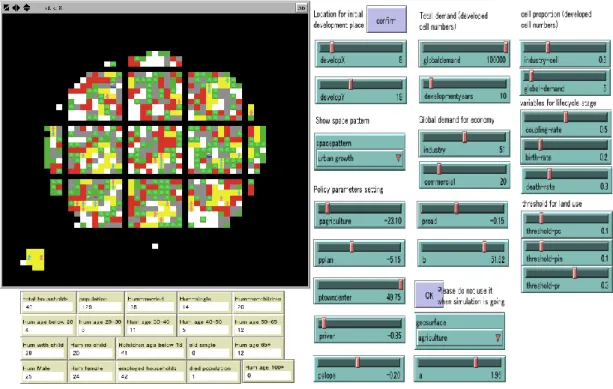
In this research, a virtual city which is a typical job-oriented one is defined based on the conditions of Nathawi district in the system. In this virtual city, it is assumed that the driving power of urban development is job, moreover, the job chances are provided while factories are being created and the job in plantations are occupied with native of Nathawi. The land use development of the virtual city is based on Cellular Automata theory. For initial stage, this city has a downtown area, several road and a river, with simulation progress processing, each parcel (represent urban area) will calculate the develop potential by the correlation of river, road, slope, agriculture, plan, distance to
14
downtown, and neighborhood effect, if the develop potential is bigger than threshold, this parcel will decide to be developed. If one parcel decides to be developed, then it will calculate the potentials to be developed to 4 kinds of land-use type, which are in- dustrial land-use, commercial land-use, agricultural land-use and residential land-use.
If the biggest one of the potential is higher than the threshold, this parcel will decided to be developed as corresponding land-use type. Among the 4 land-use types, only ag- ricultural land-use relate to the simulation of this research, so one patch with agricultural land-use takes area of 2.38 km2. Based on this, total area of agricultural land in the virtual city is about 560km2 consist of approximately 235 patches in the system while patches with other land-use type are not defined specific area. The devel- oping conditions of the virtual city can be controlled via changing parameters by sliders and button in the system. While the developing situations also can be observed directly in the display or by the data monitors in the system.
Figure 2-4. Controlling parameters of urban growth for virtual city
Four kinds of agent were designed in RCS system. They have their own attributes and behaviors in the simulation system. Behaviors which are operating principle of agents decide how agents would change during the simulating process and will be in- troduced in the following section. Attributes partly set as parameters by users and also come from the simulation. They directly affect the numerical calculation in the simula- tion and the final result of greenhouse gas emissions. Plantation means long, artificially-
15
established forest, farm or estate, where crops are grown for sale, often in distant mar- kets rather than for local on-site consumption. Plantations are grown on a large scale as the crops grown are for commercial purpose. So the produce of plantations often be machined into the form which is easy to be transported by processing factories. In this research, Plantations refer in particular to rubber plantations. The attributes of planta- tion agent are listed in table 2-2
Table 2-2 Attributes of Plantation Agent Attribute Explanation
Location The place where plantation locate in (express by coordinate x,y) Area Area of plantation
Unit output Annual yield of fresh latex of unit area in plantation
Factories of rubber city work for making fresh latex into final consumption goods or the intermediate products which are easily transported. According to the “rubber city”
project, the factories that produce primary rubber products will be built in Nathawi.
Three different types of factory agents are set in the system according to the 3 most important primary products of rubber industry which are ribbed smoked sheet (RSS), concentrated latex (CL) and block rubber (STR 20). 3 types of factories have same categories of attributes while the value of some attributes maybe different based on the characteristics of factories. For example, the annual output of a RSS factory is likely to be different with a CL factories. The attributes of factory agent are listed in table 2-3.
Table 2-3. Attributes of Factory Agent Attribute Explanation
Location The place where factory locate in (express by coordinate x,y) Type Products of factory (RSS, CL or STR 20)
Job chance The number of workers that the factory need Output Output of products of the factory
Household agents represent the human population, people correspond not to indi- vidual agents in the system, but rather members of households. A household is an agent, which is a coherent unit of simulating process, and can make decisions as a single entity.
This single entity is assumed to be composed of a family consisting of one or more people. The household agents in the system consist of 2 part, one part is native of Nathawi district, and the other is households being attracted by job chance of new fac- tories then migrate to Nathawi district.
Table 2-4. Attributes of Household Agent Attribute Explanation
Location The place where household locate in (express by coordinate x,y) Work place Where do individuals work (plantation or factory)
Government agent is invisible in the system, it takes charge of the approval of creating new plantation and factories.
16
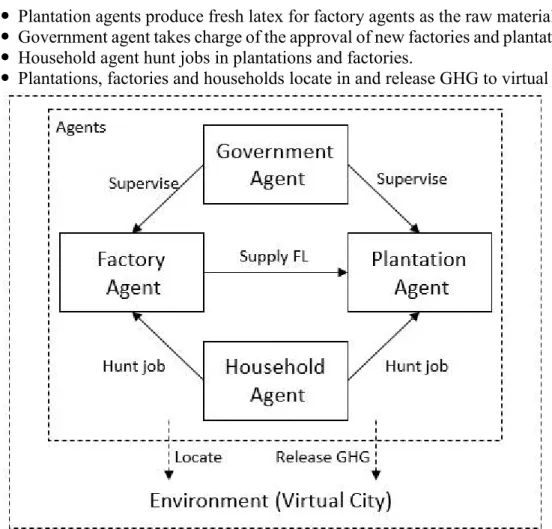
Interactions are used to define how all kinds of agents and environment affect each other. The interactions of this research include interactions between agents along with interactions between agents and environment. There are 4 main interactions which may affect results, they are:
Plantation agents produce fresh latex for factory agents as the raw material.
Government agent takes charge of the approval of new factories and plantations.
Household agent hunt jobs in plantations and factories.
Plantations, factories and households locate in and release GHG to virtual city.
Figure 2-5. Interactions among the agents and between agents and environment
2.2.3 Estimation of GHG emissions
GHG emissions are released from agents as GHG source in the system. A GHG source is any process or activity that releases GHGs into the atmosphere. This research is focus on rubber city, the process or activity related to rubber industry will be taken into account. The GHG sources discussed in this study are agricultural production in rubber plantations, and industrial production in rubber factories. Therefore, the total GHG emissions are divided into 2 parts: GHG emissions from rubber plantations, and GHG emissions from rubber factories. GHG emissions of the 2 parts are summed up to get the total GHG emissions as the equation shows:
f p
total GHG GHG
GHG eq. 2-1
17
The GHG emissions of each part are calculated by output of productions multiply the emissions factors of corresponding production. The emission factors are estimated based on the number of GHG used in activates during producing process of productions.
All of results are converted to CO2 equivalent value. Equation 2 is the calculating method of emission factors:
k j
i xi j jk k
x A G GWP
E
,
, ,, ,
eq. 2-2
Where Ex is GHG emission factor of product x (kg CO2-eq/ton). Ax,i,j means the consumption of material j in the activity i in order to produce 1 ton product x (kg/ton).
Gj,k means the emission of GHG k while using 1kg material j (kg/kg). GWPk is the global warming potential of GHG k which is able to convert GHG into CO2-eq (kg CO2-eq/kg)
GHG emissions from rubber plantations (I) due to land conversion, (II) from the production of raw materials used in rubber plantations, and (III) from the production of fresh latex in plantations. Emissions from land conversion are for the case that tropical forest is converted to rubber plantations. As to the Nathawi district, there are plenty of rubber plantations so that new plantations are not likely to be built during the simulation.
The production of raw materials used in rubber plantations are not take place in Nathawi district, which means this part of emissions don’t released to local area. So, the system only calculate the GHG emissions from the production of fresh latex in plantations dur- ing the simulation.
The activities happened in rubber plantations which release GHG emissions in- clude: N2O direct emission from N-fertilizer use, N2O indirect emission after N leaching and runoff, N2O indirect emission after emission of fertilizer N as NOx and NH3, Diesel use in tractor for tillage and Diesel use in latex transportation by pick-up car. Considering the GHG emission from all activities above, we can get the result that the GHG emission factor of fresh latex is 85 kg CO2-eq/ton fresh latex (table 2-5).
Table 2-5. GHG emissions from fresh latex production in rubber plantations (kg/ton)
Activities Emission (kg/ton fresh latex)
CO2 CH4 N2O CO2-eq
N2O direct emission from
N-fertilizer use 0 0 0.19 59
N2O indirect emission after
N leaching and runoff 0 0 0.04 13
N2O indirect emission after emission of fertilizer N as NOx and NH3
0 0 0.02 6
Diesel use in tractor for till-
age 0.4 <0.001 <0.001 0.4
18
Activities Emission (kg/ton fresh latex)
CO2 CH4 N2O CO2-eq
Diesel use in latex transpor-
tation by pick-up car 7 <0.001 <0.001 7
Total 7.4 <0.001 0.25 85
The GHG emission released from plantations is calculated by output of FL multi- ply emission factors of FL as equation 3:
fl fl
p m E
GHG eq. 2-3
Where GHGp denotes the total GHG emission from plantations (kg CO2-eq). mfl
is total output of fresh latex (ton). Efl is the emission factor of fresh latex (kg CO2- eq/ton). Usually after 20 year from being planted, the rubber tree start producing fresh latex, thus the production output of plantations can be predicted, in this research, we referenced the prediction value in the 2012 report of Bangkok rubber manufacturers.
GHG emissions from rubber factories are presented in table 5. Emissions are from the industrial production of the three primary rubber products: CL, STR and RSS. For all these 3 kind of products, diesel is necessary for production (Warit Jawjit, Carolien Kroeze, et al. 2010). LPG giving rise to lower GHG emissions than diesel is used in the drying process of STR production. It has been introduced in STR production in Thai- land a few years ago, in response to rising diesel prices. In the RSS factories, some wood are burned for smoking rubber sheet in order to get RSS. The wood used for drying and smoking the rubber sheet is from trees that are likely replanted in plantation, so emissions from burning wood are not included in total emissions of rubber factories.
We calculate the emissions factors of CL, STR and RSS separately, and multiply output values of corresponding products respectively. Finally, sum GHG emissions of the 3 parts up to get the total value of GHG emissions from factories. Equation 2-4 shows the calculating process.
rss rss str str cl cl
f m E m E m E
GHG eq. 2-4
Where GHGf denotes the total GHG emission from factories (kg CO2-eq). mcl, mstr
and mrss respectively mean total output of CL, STR and RSS (ton). Efl, Estr and Erss
represent emission factor of CL, STR and RSS (kg CO2-eq/ton).
In this research, we assume that the output of different factories follow a random uniform distribution and set the initial average production output of factories and changing range according to “Annual Statistical Report 2012 of Thai Hua Rubber Pub- lic Company” which can be presented by following equation:
𝑚𝑖𝑛𝑖𝑡𝑖𝑎𝑙 = 𝑚𝑎𝑣𝑒𝑟𝑎𝑔𝑒× (1 + 𝛼) eq. 2-5
19
Where α follow a random uniform distribution, the changing range and average initial output is different according to the different products.
Meanwhile, for individual factories, its yearly output should be fluctuant. Thus, for describing the yearly change, it is assumed that the growth rate of production outputs follows a random normal distribution. The output every year can be calculated as following equation:
𝑚𝑡+1 = 𝑚𝑡 × (1 + 𝛽) eq. 2-6
Where βfollows a random normal distribution with mean 0 and SD 0.1.
2.3 Behavior Design for Simulating the Impact of Environmental policy
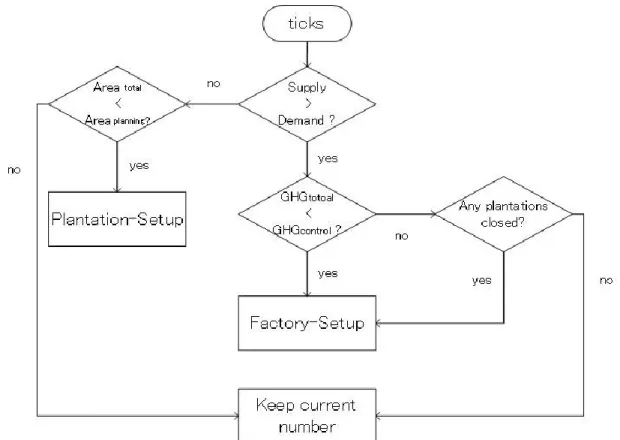
As the introduction of environmental policies in rubber city project in previous section, at strategic level, the policy is set for total amount control. Thus in the RCS, we designed the behavior of government agent to simulate the effect of the policy.
Figure 2-6. Behavior of Government Agent
At every ticks during the simulation, the government firstly summary the total sup- ply and demand of FL. Than it compares these 2 values to check whether the FL produced in plantations is enough for local industrial rubber production. If it is enough,
20
that means it is possible to create new factories, while in opposite situation, new plan- tations may be created. As the description of the policy, in the case that FL is enough, the government agent will summary the total GHG emissions and compare with the control value, if the total GHG emissions beyond control, only if there are plantations closed in this tick, new factories are possible to be created. After the deterministic pro- cess above, the type of new factories is decided by potential of each type. The potential is calculated by the number of different types of factories, in another word, the type of factories with least number have the most potential to create new factory. After that, factory agents will be set and located in the virtual city and starting their behavior in- cluding production and GHG discharge. As to the approval process of new plantations, because government of Nathawi district made the limitation on proportion of the rubber plantation among total agricultural land, the government agent manly focus on the total are of rubber plantations. If the actual total area is smaller than planning area that means there are still space for creating new plantation agent.
Figure 2-7. Behavior of factory agents
21
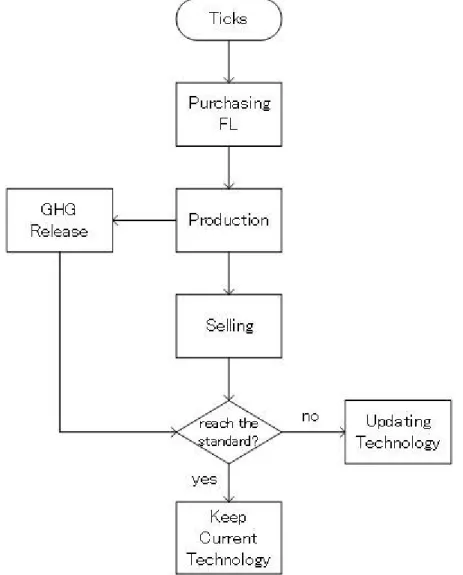
We also designed a decision making process in factory agents’ behavior to simulate the effect of environmental policy at technical level in rubber city project. It reflects a judge process of factory agent for determining the necessity of updating its environ- mental technology. As showed in the figure, at every tick in the simulation, the factory agent purchase FL, then produce productions meanwhile discharge GHG emissions.
After selling the products, the factory agent check whether it appropriate to correspond- ing standard level according to the profit of GHG emissions. The technical updating happens depend on the result.
2.4 Prediction of GHG Emissions for Rubber City Project
2.4.1 Study Case and Data Preparation
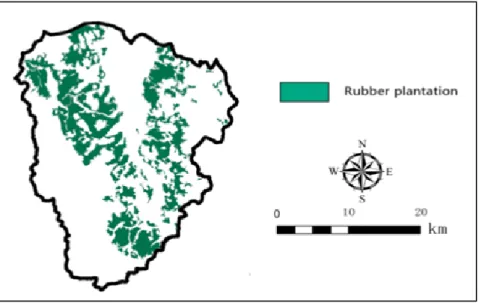
Nathawi district is located at the south of Songkhla province in the south of Thai- land, and has a total area of approximately 747 km2 and a population of 65721 according to the government website of songkhla province. Nathawi district has been chosen to be pilot city of rubber city by Thai government cause its large area of rubber plantation and undeveloped rubber industries. In 2012, the area of rubber plantations in Nathawi is approximately 491 km2 which occupied about 87% of its agricultural land use and 66% of its total area as showed in figure 12. 10436 households with more than 30000 people work in local rubber plantations, result in the achievement that 89154ton fresh latex was produced with the average yield of 227 kg/km2 in 2012.
Figure 2-8. Plantation covered are in Nathawi District
22
In consequence of the undeveloped rubber industry, most of the fresh latex produced in Nathawi is export to other place for further processing, which makes local economy being quite sensitive to price of nature rubber. The dropping rubber price hit local economy very much, hence, Nathawi district suffered with sluggish development and local residence became very anxious. In this case, Thai government planned to stabilize the price of nature rubber and create more job chance by building Nathawi into a rubber city. According to “rubber city project” set by Thailand and Malaysia, rubber processing industries will be built in Nathawi.
Data used for this research including household number, population, agricultural land use area, and total area of rubber plantations are obtained from official website of songkhla agriculture department. The corresponding data on average yield of rubber plantations, output of rubber processing factories and emission factors are searched from existing research and will be used as parameter in the simulating process.
According to the actual situation of Nathawi district, one patch with agricultural land-use type is set taking area of 2.38 km2, total area of agricultural land in the virtual city is about 560km2 consist of approximately 235 patches in the system. The existed plantations take 391 km2 with the actual planting area about 405 km2 in Nathawi district, so the initial number of plantation is set to 164 with total area of 390.32 km2.
Agents have different value of products output, they are random but change near the average value which is referenced in existed research. What’s more, the volume of one agent is changing in a reasonable range yearly.
The initial average output of RSS, STR and CL are obtained from “Annual Statis- tical Report 2012 of Thai Hua Rubber Public Company” as listed in table 2-6.
Table 2-6 Initial parameters of agents
Parameter value unit
Initial plantation 164
Annual output of FL 227.5(±5%) ton
Annual output of CL 2500
(±20%)
ton
Annual output of STR 3000
(±16%)
ton
Annual output of RSS 3500
(±14%)
ton
2.4.2 Simulation Result and Discussion
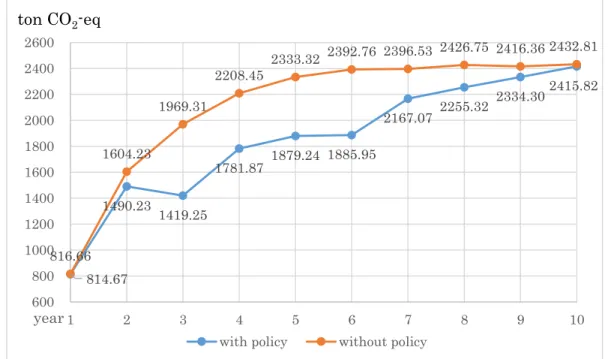
The first 10 year’s developing process of Nathawi district as a rubber city with the environmental policy impact is simulated in this research. The simulation was repeated