著者名(英) Damian J. Rivers journal or
publication title
言語教育研究
volume 21
page range 101‑122
year 2010‑11
URL http://id.nii.ac.jp/1092/00000500/
Implicating the Role of
Japanese National Identification:
National Vitality, Community Appeal, and Attitudes toward English Language Learning in Context
Damian J. Rivers
“identity is a relationship and not only an individual qualification, as everyday language has it. Therefore, the true identity question is not ‘Who am I?’ but
‘Who am I with regards to others, who are the others in relation to me?”
Jean–François Gossiaux in the name of ‘Revue d’ethnologie française’
(cited in Ruano–Borbalan 1998, p.2)
With a strong focus on the social-psychological processes associated with individual and collective identity formation and fabrication, and on the premise that English language learning within the Japanese context is heavily implicated into the realm of nationhood and national attachment, this context-specific presentation will share the findings of a project which sought to explore the relationships between four specific attitudinal facets of Japanese national identification (internationalism, patriotism, nationalism and commitment to national heritage), the perceived vitality of English speaking nations, the intercultural appeal of English speaking people, and attitudes toward learning English within a sample of 279 female freshmen students.
Based primarily on theoretical principles set forth by the author, a process of structural equation modeling was undertaken in order to test a proposed model of the various interactions and relationships. A number of important relationships were identified and are discussed with a specific emphasis on the implications created by native-English speaker teacher roles and what they mean in terms of maintaining certain attitudinal facets of Japanese national identity among students.
Introduction
This short paper concerns the role of components of Japanese national identification within the situated context of Kanda University of International Studies (KUIS) and the affiliated English Language Institute (ELI). Due to limitations in space and a desire to focus on the most widely accessible issues, a detailed exploration of the literature related to national identification, as a sociological domain, will not be included in this article (see Rivers 2010a, 2010b for a discussion of national identification in the Japanese context). Furthermore, at this juncture I would like to distinguish further the specific genre of research which I am engaging in. More specifically, I wish to highlight the difference between the terms ‘national identification’ and ‘national character’. Although discussions concerning attitudes on a collective level are often met with accusations of neglect on an individual level, the concept of national identification is one which only exists within the mental representations created and shared amongst individuals. Therefore, the concept can be conceptually distinguished from the notion of national character which often represents the practice of assigning collective labels such as ‘the Japanese are….’
which are often embroiled in essentialised stereotypical appraisals of both the national self (‘we Japanese are all polite’) and the inter-national other (‘Americans are so loud’). Although falsified representations of national character are prevalent within the current research context, holding a number of direct and indirect implications for the study of national identification, national character alone does not constitute a distinct or measurable component of national identification. Based upon such a foundation, within the following exploration I wish to offer my support to the views of Edensor (2002) who contends that
“the dichotomy between social and individual identities is not helpful, and rather than being understood as distinctive entities should be conceived as utterly entangled” (p.24). One could further this belief and reason that identity, whether exclusively collective, individual or somewhat entangled can only be formed, reg- ulated and maintained through relational processes of social interaction and social comparison. That is, the knowing of oneself is only possible when given the oppor- tunity to compare oneself to, and differentiate oneself from others. In terms of applying such a dynamic to the current exploration of components of national- identification in relation to the English language teaching practices employed at KUIS and within the ELI, the views of Shin and Schwartz (2003) may be appropriate:
Identity inevitably requires a dialectically conjoined ‘enemy’, whose contrary identity highlights the defining characteristics of the patriotic ‘self’. We can only fully conceptualize ‘our’ collective identity by contrasting the cultural characteristics andcamaraderie that unite ‘us’ with the contrary character- istics of an identified outsider. That is collective identity in all forms….requires the constant fabrication of concepts of ‘self’ and ‘other’. (p.420)
Evidence of the above practices of fabrication can be readily found within many English language learning environments within Japan and can be argued to be representative of practices first employed during the Meiji-period (1868-1912).
As Aso and Amano (1978) stress, in 1868 the Meiji government “was very eager to invite foreign teachers to Japan as a means of promoting the policy of introducing western culture” (p.14). Subsequently, the first wave of oyatoi gaikokujin (hired
foreigners) included British and American instructors who taught English, Western technology, and culture all through the medium of English. More modern day reflections of such practices also exist within English conversation schools such as NOVA and the JET Programme which all focus on temporal importation of, limited exposure to, and subsequent deportation of native-English speaker teachers rather than periods of extended intercultural integration. With reference to the Japanese university context, Hall (1998) suggests that many Japanese universities prefer to employ native-English speakers who are most representative of “pure and unacclimated aliens” (p.105) and are unable to converse fluently in Japanese. However, embodying a sense of hope for the future, and with direct reference to Hall (1998), McCrostie (2010) notes that “thankfully, today that way of thinking has mostly died out, and any places where it survives you would not want to teach at for very long anyway” (p.33).
Stimulated by both actual and imagined increases in globalization and internationalisation, the past couple of decades have seen a rise to prominence in the perspective that the English language is no longer tied to a particular locality or community that is able to assert linguistic ownership. Despite this, the ideological and symbolic power which the language affords is still very much resident with the traditional inner-circle countries identified by Kachru (1985).
The English language teaching industry within Japan (rather ironically controlled by Japanese administrators) has played a significant role in maintaining this position through practices which overwhelmingly favour the employment of narrowly defined native-English speaker teachers (see Houghton & Rivers, forthcoming), thus succumbing to and reinforcing an entirely fabricated
‘native-speaker myth’ which can be conceived as - “the idealization of a native speaker as someone who has perfect, innate knowledge of the language and culture and this is the best teacher” (Kubota, 2002, p.21). Sharing a similar focus, and drawing specifically on the case of the British Hills complex in Fukushima, Seargeant (2009) discusses how essentialised cultural specimens (i.e.
native-English speakers) are often used as tools in the process of simulating authenticity for the purpose of creating distinctly superficial and unrepresentative realities via the conformity to cultural/national stereotypes, often borne from a desire to avoid the infinite diversity and complexity of reality. With implications for the study of national identification, McVeigh (2002) also argues, through comprehensive discussions of ‘otherness’ in English language teaching in Japan, that studying English “builds national identity among students” (p.148) through showing students what they are not via over-exposure to largely unculturalised (maintained by recruitment direct from their country of origin and terminal short-term contracts) and monolingual (often enforced through restrictive language policies - see Rivers, in press[a]) native-English speaker teachers. This certainly assists in furthering our understanding of why the tuition of English as a foreign language within Japanese universities, despite being controlled by Japanese administrator, is still excessively reliant on the native-English speaker – for the purpose of strengthening Japanese students’ emotional and symbolic ties to their home nation. With a slightly broader focus, Befu (1983, cited in McVeigh, 2002) suggests that “it is as if ineptitude of foreign language instruction and learning is maintained (though, needless to say, unconsciously) for the purpose of convincing millions of Japanese of their separateness from foreigners” (p.148).
McVeigh (2002) expands on such an assertion by claiming that:
For many (but not of course all), the ‘internationalisation’ of Japanese society is actually a form of nationalization and is intimately bound up with issues of being Japanese/we/inside versus being non-Japanese/other/
outside. Consequently, ‘being Japanese’ and being a kokusai-jin (international person) are often contrasted and seem to define each other, thus education on matters ‘international’ and second language acquisition more often than not reinforce an ‘us/them’ mode of thinking…If explicit nationalism and dividing people into essentialist groups is not fashionable (especially on the world stage where one should talk about ‘world peace’ and ‘cross cultural- understanding’), then ‘internationalism’ is. Thus, the best method to downplay nationalism is to incessantly speak of and simulate its opposite – internationalism. (p.149)
Such beliefs, although perceived as being rather controversial when discussed within a “nice field like TESOL” (Kubota, 2002, p.84), have contributed to the solidification of a self-defeating power imbalance in which many English language students and teachers hold the view that one can only be taught ‘authentic’ or ‘real’
English by a native-English speaker, and that one can only be a member of an international society if equipped with English language proficiency. Indeed, within the Japanese education system, especially at the university level, the terms ‘international’ and ‘English’ are discussed rather excessively adding support to the views of Ljosland (2005) who summarizes that there exists a widely accepted “tendency to regard ‘international’ and ‘English-speaking’ as synonyms”
(p.1).
With a focus on the current research context, KUIS and the ELI have also succumbed to the questionable association between English language proficiency and the notion of global citizenship without making clear how the two are related, nor how those individuals who do not speak English are therefore unable to
‘participate’ as global citizens - “the official mandate of the ELI is to raise the English language proficiency level of KUIS students at the university in order to allow them to participate as global citizens” (extract from the online ELI Handbook 2010-2011). More recent examples of this can be found within the literature on the government’s ‘Global 30 Project’ (see Rivers, 2010c, in press[b]) which aims to internationalize a select band of Japanese universities by 2020 through the importation of foreign students, to be taught in English by imported native-English speaker teachers on terminal contracts. Such acts represent superficial and highly conditional forms of internationalisation which ironically function to minimise human contact between Japanese and non-Japanese students and faculty. As Wright and Lander (2003) warn - “universities are deluding themselves if they believe that the presence of international students on campus contributes to the internationalisation of higher education” (p.250).
Perhaps the single most conditional criterion which English language education in Japan must meet, and one which many foreign teachers fail to acknowledge, is that a positive and distinct sense of Japaneseness must be retained. For example, with reference to perhaps the single biggest MEXT mandate with regard to the teaching of English (the July 12th 2002 document entitled ‘Developing a Strategic Plan to Cultivate “Japanese with English Abilities” – Plan to Improve English and Japanese Abilities’ referred to in section 2.6.1), Hashimoto (2009) identifies a
rather peculiar aspect to the title of this mandate as the main title and the subtitle do not seem to be consistent – “this seems to indicate that the focus of the plan is the improvement of the English used by Japanese people, but for some reason the importance of the national language must also be addressed” (p.28). Befu (1983, cited in McConnell 2000) also notes that “a foreigner’s wishful thinking is that internationalisation obliterates the line between him and the Japanese, whereas for the Japanese internationalisation compels them to draw a sharper line than ever before between themselves and outsiders” (p.226).
Rationale
As a justification for my move away from the more traditional language learning variables discussed within the field of Applied Linguistics and TESOL, Ushioda (2009) contends that "we should not position the central participants in our research simply as language learners, since this is just one aspect of their identity" (p.216). In identifying the most salient aspects of the KUIS student identity profile one can argue that the most significant feature, shared amongst the vast majority of the students, is Japanese nationality. Indeed, national identification is one of the most prominent forms of social comparison, and one of the most readily accessible foundations for value judgments and appraisals of self and of others.
Within the context of KUIS, it is possible to propose that one of the first and most common questions arising during intercultural contact encounters inclusive of a native-English speaker is - Where are you from? For instance, within the ELI there exist passport-sized, colour photographs of all 63 teachers which present their
physical appearance, their name, and their country of origin expressed through a mini-national flag. In many cases, these flags gloss over certain diversities such as dual-nationality and mixed-heritage, often favouring the most prototypical nation of an idealized native-English speaker. In examining why the showing of national flags is deemed so fundamental, one could argue that they immediately bind teachers to student representations of a particular nation and create linguistic, cultural, behavioural, and attitudinal expectations and assumptions based upon an assumed linearity between the nation, the individual, and the language spoken.
That is, ELI teachers are presented as cultural specimens (as discussed in Seargeant, 2009) of a particular nation rather than as individuals.
On the basis of such beliefs, I will seek to answer the following research question - How do student relationships with different aspects of their own nation impact upon attitudes toward foreign language study at KUIS? From a theoretical perspective, I will attempt to answer this question by positioning the ELI native-English speaker teacher as an ideological mediator between components of Japanese national identification and attitudes toward English language study in context.
Methodology
Across a 14 month period throughout 2008-2009, 279 female English language majors at KUIS were surveyed through a Japanese online survey instrument. The instrument was multifaceted and featured a wide range of items pertaining to language learning attitudes and components of national identification. The decision to only focus upon female students was based upon a desire to obtain
results which were most reflective of the typical KUIS student (i.e. a female of Japanese nationality). For the purpose of this paper, only 21 of the original survey items representing seven latent constructs will be discussed. The 21 items and their respective latent construct reliabilities are shown below in Table 1.
TABLE 1: the 21 items and their respective latent constructs and reliabilities
COMMITMENT TO NATIONAL HERITAGE (COM) [α .74]“interpreted to represent a considerably distinct component of Japanese national identity” (Karasawa, 2002, p.653).
It deals with the symbolization of Japanese nationhood and the historical, traditional, and cultural aspects of the nation.
V10 - Every time I hear kimigayo, I feel strongly moved.
V30 - When I see the hinomaru waving in the streets on national holidays, I feel great.
V62 - I think that all students and teachers should sing kimigayo at school /university ceremonies.
PATRIOTISM (PAT) [α .76]“one’s feelings toward one’s country…it asserts the degree of love for and pride in one’s nation – in essence, the degree of attachment to the nation”
(Kosterman & Feshbach, 1989, p.271).
V16 - I am proud to be Japanese.
V64 - Japan is the best country in the world.
V89 - I love this country of Japan.
NATIONALISM (NAT) [α .75]“a perception of national superiority and an orientation toward national dominance” (Kosterman & Feshbach, 1989, p.271).
V37 - I hope that in the future Japan becomes the strongest country in the world.
V66 - Japan’s strong economy is due to the excellence of the Japanese people.
V74 - The Japanese people are among the finest in the world.
INTERNATIONALISM (INT) [α.65] “focuses on international sharing and welfare, and reflects empathy for the people of other countries” (Kosterman & Feshbach, 1989, p.271).
V61 - It can help Japan to learn from other countries.
It should be noted that due to the limitations of this article, mean, standard deviation, skew, kurtosis, and multivariate normality values are not shown but were consulted throughout the following process of analysis to ensure the statistical integrity of the results produced.
Data Analysis
As a loosely definable family of inter-related techniques, the structural equation modeling (SEM) approach to data analysis essentially builds upon factor analysis, multiple regression and path analysis in a manner which resolves the problem of individually observed variables and their related measurement errors. It can be V70 - Japan should be more willing to share wealth and knowledge with other countries.
V72 - Japan has many things to learn from other countries.
L2 NATIONAL VITALITY (L2NV) [α .75] “the perceived strength and importance of English speaking countries.”
V51 - Do you think that English speaking countries are advanced and developed nations?
V52 - Do you think that English speaking countries have an important role in the world?
L2 COMMUNITY APPEAL (L2CA) [α .77] “attitudes toward people from English speaking countries / ELI community.”
V43 - Would you like to know more about ELI teachers from English speaking countries?
V44 - Based on your ELI experiences, do you like the people from English speaking countries?
V49 - Do you like meeting people from English speaking countries within the ELI?
ATTITUDES TOWARDS ENGLISH LEARNING AT KUIS (ATEK) [α .77] “context specific study attitudes.”
V14 - I want to speak English as much as possible at KUIS.
V60 - I want to seek out English speaking opportunities at KUIS.
V75 - It is extremely important for me to learn English during my time at KUIS.
V81 - During my time at KUIS, I really want to become a fluent English speaker.
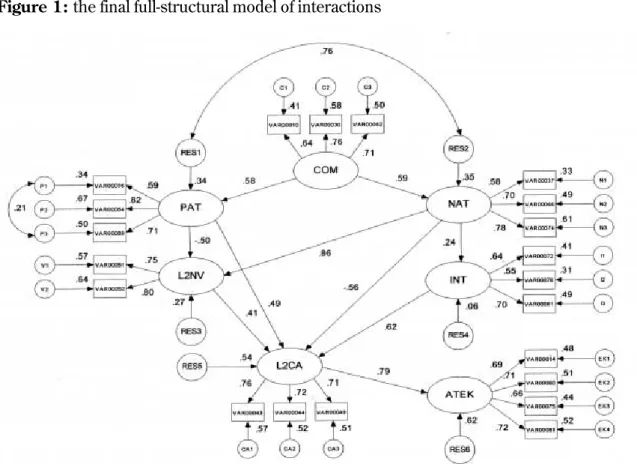
defined as “a multivariate analytic procedure for representing and testing (a) inter- relationships between observed variables and constructs, and (b) inter-relation- ships among constructs” (Purpura, 1997, p.300). As it is a theoretically driven technique, the researcher is first required to create a theoretical model of latent interactions. Therefore, based upon a wide body of research literature, experience and personal beliefs, a theoretical model of interaction among the seven latent con- structs was created. This schematic was subsequently refined into a more complex model of latent interactions taking into consideration the literature concerning components of national identification within the Japanese context. The newly developed model was then tested and modified in a principled manner after con- sultation with the modification indices. The final full-structural model is shown below in Figure 1.
Discussion
Due to the context-specific nature of the current exploration, I will begin my discussion with a focus on how the different components of national identification impacted upon student perceptions of L2 national vitality and L2 community appeal. Although the component of commitment to national heritage is fundamental within the Japanese context it will not be included in the following discussion (see Karasawa, 2002; Rivers, 2010a, 2010b).
The finding that patriotism has a negative relationship with L2 national vitality [-.50] could be explained via the argument that patriotism perhaps only concerns the position of the home nation rather than any interest in exerting superiority over others. That is, patriotism is one trait which theoretically does not require a
dialectically conjoined other to be defined or expressed. The finding of a negative relationship in the current study may illustrate a reaction against perceptions of domestic westernization and the spread of English within Japan’s domestic board- ers, something which often arouses feelings of anxiety and anger (as discussed in Rivers, 2010d). Those holding patriotic feelings may sense such processes as a threat to what they love about Japan in terms of tradition and culture and therefore react negatively in their perceptions of L2 national vitality. On the other hand, the finding that nationalism has a positive relationship with L2 national vitality [.86]
Figure 1: the final full-structural model of interactions
(n= 279 [χ2=271.513, df=177, CMIN = 1.534, p<0.001] [GFI=.916, AGFI=.900, CFI=.951, RMSEA=.044]. All paths shown are significant at the p<0.001 level except for the NAT →INT path which is significant at the p<0.01 level and the PAT→L2 VIT path, the NAT → CAP path and the PAT→CAP path which are significant at the p<0.05 level [all estimations shown are standardized].
could suggest that because nationalism (and those holding nationalistic attitudes) is/are concerned with international competition and superiority, English speaking nations may be viewed as being superior to Japan in terms of global positioning, thus creating a kind of positively focused envy of their elevated global status.
Indeed, Japan has a long history of comparing itself to, and identifying itself with the Western world (i.e. America) whilst at the same time adopting a Western- driven inferior view of other Asian nations.
Based upon the finding that patriotism has a positive relationship with L2 community appeal [.49], it could be argued that face-to-face intercultural contact encounters may symbolize the most neutral or non-threatening form of intercultural contact. Coming together with a culturally and linguistically different person as someone who has a strong affection for the home country (a patriot) would present a good opportunity for the identification of similarities and, more importantly, differences which could then act to reaffirm a sense of attachment and affection toward the home nation. However, the finding that nationalism has a negative relationship with L2 community appeal [-.56] could suggest that face- to-face grassroots contact appears to do little to advance Japan’s superiority over other nations and communities. It may however further stimulate insecurities and anxieties, prompting a desire to exert influence over others on a larger scale.
In other words, the domestic presence or general appraisal of the L2 intercultural other may stimulate an increased nationalistic response. As shown in Figure 1, internationalism has a positive relationship with L2 community appeal [.62] which may offer support for the viewpoint that internationalism and the L2 community, as represented at KUIS within the ELI are synonymous with each other. The very
presence of an English speaking community is unconsciously noted as a sign that the campus or the school is international in its outlook and that it has achieved internationalisation (despite the aforementioned warning of Wright &
Lander, 2003). The finding that internationalism indicates a positive L2 communi- ty appeal may be reflective of this strongly promoted perspective at KUIS and throughout Japan - to be international and to be considered competent in matters international one must speak English and have relations with native-English speaking people. Such a perspective, although powerful within the local context in which students and teachers have been socialised into accepting its credibility, is hugely out-of-sync with the realities presented by the diverse cultural and linguistics landscapes of the twenty-first century.`
The final direct relationship which is of contextual interest is the finding that L2 community appeal has a positive relationship with attitudes toward study at KUIS [.79]. The finding that L2 community appeal strongly and positively indicated attitudes toward learning English at KUIS is not surprising as many students report being attracted to KUIS because of the large numbers of ELI teachers. In terms of providing a positive foundation for the continuation of the ELI this is a positive outcome. However, it is not entirely based upon pedagogical principles of English language learning. In order for this dynamic to continue (i.e. in order for students to remain attracted to the ELI by the teachers within it), the ELI teachers need to be kept within a kind of ‘forever young’ time-lock in order to retain their market- value to the university (the short-term terminal contracts, and the previous policy of targeting ‘young’ teachers ‘under 35’, allows this to be achieved). As Houghton (cited in Johnston, 2004) reasons “the problem arising is that the universities
become afflicted with a kind of Peter Pan syndrome when it comes to foreign teachers…those who are hired are often initially young and are replaced a few years later with another young teacher, so that all the university sees is a succession of younger faces” (para.13). In short, and of practical relevance to the teachers currently at KUIS, the manner in which students perceive us directly impacts upon their attitudes toward English language study. However, the relationship which the student has with different components of national identification direct impacts upon how they perceive ELI teachers. Whether student perceptions are enhanced by ELI teachers conformation to certain stereotypes and prejudices is an area for further research, but the links between teacher ↔student, teacher ↔nation, as well as between student ↔nation and the impact of these relationships upon language learning attitudes cannot be under- estimated, especially within such an ideologically constructed environment in which processes of essentialism cast a long shadow over individual cultural and linguistic realities.
Conclusion
In a country which shares an equal passion for and obsession with defining its own national identity and engaging in English language conversations with foreigners under the loose banner of internationalisation, the issue of how one relates to the other (in terms of cultural and linguistic difference) represents an exciting research field. KUIS, and more specifically the ELI provide an ideal environment conducive to this kind of investigation due to the obvious and well-established lines drawn between ‘us and them’, ‘the in-group and the out-group’, ‘Japanese and non-Japanese’. Reflecting on the outcome of the current research project, one
could ask whether the ELI through the nature of its being and the practices it maintains, promotes internationalism among students or whether it functions more to sustain nationalism. For example, one could question why the environment which teachers and students are socialized into makes it so difficult to imagine a situation in which Japanese faculty actively participate in the ELI conversation lounge activities, or where an integrated community exists in which ELI members share workspaces with Japanese faculty, despite the fact that these steps would provide students with more realistic role-models in terms of both linguistic and intercultural competencies. However, true integration which overcomes salient boundaries of identity and the actual realisation of an international university would destroy the firmly established lines of exclusivity leading to a situation in which new and unfamiliar identities would need to be created. Therefore, as previously mentioned, one can argue that the subversive systems practiced within KUIS and the ELI, both in relation to teacher interactions, institutional positioning and pedagogical encounters with students, demand nothing less than “the constant fabrication of concepts of ‘self’ and ‘other’” (Shin &
Schwartz, 2003).
In order to progress beyond the legacy created by colonial ideologies of ignorance, I would argue that the lines of distinction which isolate ELI teachers need to be broken down to reflect the true diversity of the intercultural workplace. One way in which this may be achieved is via a critical analysis of the multiple layers of motives and relationships underlying certain claims of best practice and the ideologies which such practices support or maintain. Foucault (1984) provides grounds for such action whilst highlighting the important distinction between
being critical of things which are ‘bad’ and being critical of things which are ‘dan- gerous’:
My point is that not everything is bad, but that everything is dangerous, which is not exactly the same as bad. If everything is dangerous, then we always have something to do. So my position leads not to apathy but to a hyper- and pessimistic activism. (p.343)
However, overcoming essentialism requires a kind of anti-group-think which goes against human nature, meaning that we are often fighting against practices which people, especially those with the power to initiate change, deny even exist (Rivers
& Houghton, 2010). This denial serves as an active protector against challenges to established groups and the terms upon which such groups were formulated.
Stressing the importance of group boundary protection, Stephan, Ybarra & Rios Morrison (2009) contend that - “because of the needs they fill, groups are as dear to us as life itself, and we fear their destruction almost as much as we fear our own”
(p.43). Consequently, creating an agenda for positive change within the current taken-for-granted scheme of doing things is a sizeable challenge as all of the KUIS/ELI practices and policies are ultimately regulated by Japanese administrators. With a focus on self-empowerment and the professional development of the profession, ELI teachers as essentialised instruments of alleged internationalisation need to help university administrators, managers and students scrutinize their own beliefs and practices by undermining their unconscious assumptions about what internationalisation is, and how different ideologies of nationhood and national attachment, combined with cultural and
linguistic misunderstandings, are central to English language learning and teaching processes on a multitude of affective and subversive levels.
Acknowledgement
My sincere gratitude is extended to the ‘Research Institute of Language Studies and Language Education (RILS)’ for the funding provided in support of this research. I am also indebted to my colleague, Kristjan Bondesson, for providing academic stimulation, support, and critical commentary on the ongoing evolution of the ideas discussed within this paper.
References
Aso, M. & Amano, I. (1978). Education and Japan’s modernization.Tokyo: Ministry of Foreign Affairs.
Befu, H. (1983). Internationalisation of Japan and Nihon Bunkaron. In H. Mannari
& H. Befu(Eds.), The Challenges of Japan’s Internationalisation:
Organization and Culture (pp. 232-266). Tokyo: Kwansei Gakuin and Kodansha International.
Edensor, T. (2002). National identity, popular culture and everyday life. Oxford:
Berg.
Foucault, M. (1984). On the genealogy of ethics: An overview of work in progress.
In P. Rainbow (Ed.), The Foucault Reader(pp.340-373). New York: Patheon Books.
Hall, I. (1998). Cartels of the Mind: Japan's Intellectual Closed Shop. New York:
W.W. Norton & Company.
Hashimoto, K. (2009). Cultivating “Japanese who can use English”: Problems and contradictions in government policy. Asian Studies Review, 33(1), 21-42.
Houghton, S. & Rivers, D.J. (Eds.) (forthcoming). The native-speaker English
language teacher: From exclusion to inclusion.Bristol: Multilingual Matters.
Johnston, E. (2004). Limited-term foreign professors seen cornering workload but not benefits. Retrieved from
http://search.japantimes.co.jp/cgi-bin/nn20041208f1.html
Kachru, B.B. (1985). Standards, codification and sociolinguistic realism: The English language in the outer circle. In R. Quirk and H. Widdowson (Eds.), English in the World: Teaching and Learning the Language and Literatures (pp. 11-36). Cambridge: Cambridge University Press.
Karasawa, M. (2002). Patriotism, Nationalism, and Internationalism among Japanese citizens: An Etic-Emic approach. Political Psychology, 23(4), 645- 665.
Kosterman, R. & Feshbach, S. (1989). Toward a measure of patriotic and national- istic attitudes. Political Psychology, 10, 257-274.
Kubota, R. (2002). The impact of globalization on language teaching in Japan. In D.
Block & D. Cameron (Eds.), Globalization and Language Teaching (pp.
13–28). New York: Routledge.
Kubota, R. (2002). (Un)ravelling racism in a nice field like TESOL. TESOL Quarterly, 36(1), 84-92.
Ljosland, R. (2005, September). Norway’s misunderstanding of the Bologna Process: When internationalisation becomes Anglicization. Paper presented at the conference Bi- and Multilingual Universities: Challenges and Future Prospects, Helsinki University.
McConnell, D.L. (2000). Importing diversity: Inside Japan’s JET Program. Los Angeles: University of California Press.
McCrostie, J. (2010). The right stuff: Hiring trends for tenured university positions in Japan. The Language Teacher, 34(5), 31-35.
McVeigh, B. (2002). Japanese higher education as myth.Armonk, NY: ME Sharpe.
Ministry of Education, Culture, Sports, Science and Technology (MEXT). (2002).
Developing a strategic plan to cultivate “Japanese With English Abilities”.
Retrieved from
http://www.mext.go.jp/english/news/2002/07/020901.htm
Purpura, J.E. (1997). An analysis of the relationships between test-takers’ cognitive and metacognitive strategy use and second language test performance.
Language Learning, 47(2), 289-325.
Rivers, D.J. (in press[a]). Strategies and struggles in the ELT classroom:
Language policy, learner autonomy and innovative practice. Language Awareness.
Rivers, D.J. (in press[b]). The internationalisation of Japanese higher education institutions: Implications for 2012 and beyond. In. C. Ward (Ed.), Language Education: An Essential for a Global Economy: Anthology Series 51.Singapore: SEAMEO Regional Language Centre.
Rivers, D.J. (2010a). National identification and intercultural relations in foreign language learning. Language and Intercultural Communication, 10(4), 318-336.
Rivers, D.J. (2010b). Japanese national identification and English language learning processes. International Journal of Intercultural Relations. 35(1), 111-123.
Rivers, D.J. (2010c). Ideologies of internationalisation and the treatment of diversity within Japanese higher education. The Journal of Higher Education Policy and Management, 32(5), 441-454.
Rivers, D.J. (2010d). Politics without pedagogy: questioning linguistic exclusion.
ELT Journal.doi:10.1093/elt/ccq044.
Rivers, D.J. & Houghton, S. (2010, June). Defending against English linguistic imperialism in the international university: Contradictions between theory and practice. Paper presented at the 16th International Conference of the International Association for Intercultural Communication Studies, South
China University of Technology, Guangzhou, P.R. China.
Rouano–Borbalan, J.C. (1998). L’identité – l’individu, le groupe, la société [The identity - the individual, the group, the society]. Auxerre: Sciences Humaines Editions.
Seargeant, P. (2009). The idea of English in Japan: ideology and the evolution of a global language.Bristol: Multilingual Matters.
Shin, H.J. & Schwartz, M. (2003). The duality of patriotism. Peace Review, 15(4), 419-426.
Stephan, W. Ybarra, O. & Rios Morrison, K. (2009). Intergroup Threat Theory. In T.D. Nelson (Ed.), Handbook of Prejudice, Stereotyping, and Discrimination (pp. 43-60). New York: Psychology Press.
Ushioda, E. (2009). A person-in-context relational view of emergent motivation, self and identity. In Z. Dörnyei & E. Ushioda (Eds.), Motivation, Language Identity and the L2 Self (pp. 215-228). Bristol: Multilingual Matters.
Wright, D. & Lander, D. (2003). Collaborative group interactions of students from two ethnic backgrounds. Higher Education Research & Development, 22(3), 237-252.
Correspondence
The author can be contacted at: [email protected]