A Preliminary Study of Developing Extensive Reading Materials for an EFL Program in Japan
著者 Yoko Ichiyama
journal or
publication title
The Kyoritsu journal of international studies
volume 37
page range 27‑35
year 2020‑03
URL http://id.nii.ac.jp/1087/00003334/
1.Introduction
Reading in English as a foreign language (EFL) has always been one of the most import- ant aspects of teaching and learning in Japan. National curriculum as well as entrance exam- inations to universities often adopt reading as the most important criteria to evaluate students’
English ability (MEXT, 2010, 2011). Extensive reading (ER) refers to the idea that learners read many texts without the help of dictionaries or translating them into their own language
(Day and Bamford, 2002). While the major concern of ER studies focuses on its effectiveness, little has been said about the possibilities of developing in-house reading materials that corre- spond with the needs of learners and institutions (Chen, Chen, Chen, & Wey, 2013; Lee & Hsu, 2009; Yamashita; Robb & Kano, 2013; Ishizawa, Yoshida, & Fukuda, 2010). In this article, the writer will first review the relevant literature concerning ER studies in the EFL environment, and then discuss an issue that has not been addressed
―the possible pros and cons of develop- ing in-house reading materials. The paper will then report the linguistic features of authentic and graded readers to use the results as a source for the development of in-house reading ma- terials for ER.
Day and Bamford (2002) proposed the ten principles of ER:
A Preliminary Study of Developing Extensive Reading Materials for an EFL Program in Japan
Yoko Ichiyama
Abstract
The development of reading skills is viewed as one of the most important aspects of EFL lan- guage programs. While numerous studies have explored the effectiveness of extensive reading in EFL language programs, few have focused on developing reading materials that meet the target readers’ needs (Kirin, 2010; Lyutaya, 2011; Fujita & Noro, 2009; Stoeckel, Reagan & Hann, 2012). The paper reports a preliminary study of developing extensive reading materials for an EFL program in Japan, where limited budget and resources are hindering the successful implementation of extensive reading programs. The study indicates the need to develop reading materials that match the levels and interests of target readers, in this case, undergraduate English-major students who are studying international studies in Japan.
Keywords: Extensive reading, In-house reading material, EFL.
1.The reading material is easy.
2.A variety of reading material on a wide range of topics is available.
3.Learners choose what they want to read.
4.Learners read as much as possible.
5. The purpose of reading is usually related to pleasure, information and general understand- ing.
6.Reading is its own reward.
7.Reading speed is usually faster rather than slower.
8.Reading is individual and silent.
9.Teachers orient and guide their students.
10.The teacher is a role model of a reader.
(p. 137 - 141)
Day (2015) claims that a “pure” ER program uses all ten ER principles, while a “modified”
program uses “many” ER principles, and a “light” program only uses some of the ER princi- ples. Numerous studies have implemented ER programs using the principles, some strictly ad- hering to the ten principles (Mermelstein, 2015), and others partially adopting them (Arnold, 2009). Mermelstein (2015) conducted a study regarding the effectiveness of ER on writing abilities using 211 undergraduate EFL learners in Taiwan. The study revealed that the treat- ment group with a “pure” ER program showed significant gains in writing. Arnold (2009) re- ports that while materials were unselected and thus some learners intentionally “challenged”
themselves to read difficult texts, many learners showed gains in motivation and self-confi- dence. Day (2015) analyzed 44 articles that describe ER programs and found that the three most frequently practiced principles are: learners read as much as possible; learners choose what they want to read; and a variety of reading materials on a wide range of topics is avail- able. Based on the findings, he arranged six core principles of ER in the following order:
1.Learners read as much as possible.
2.Learners choose what they want to read.
3.A variety of reading material on a wide range of topics is available.
4.The reading material is easy.
5. The purpose of reading is usually related to pleasure, information and general understand- ing.
6.Reading is individual and silent.
The ultimate goals of our ER program, therefore, aim to utilize these six principles.
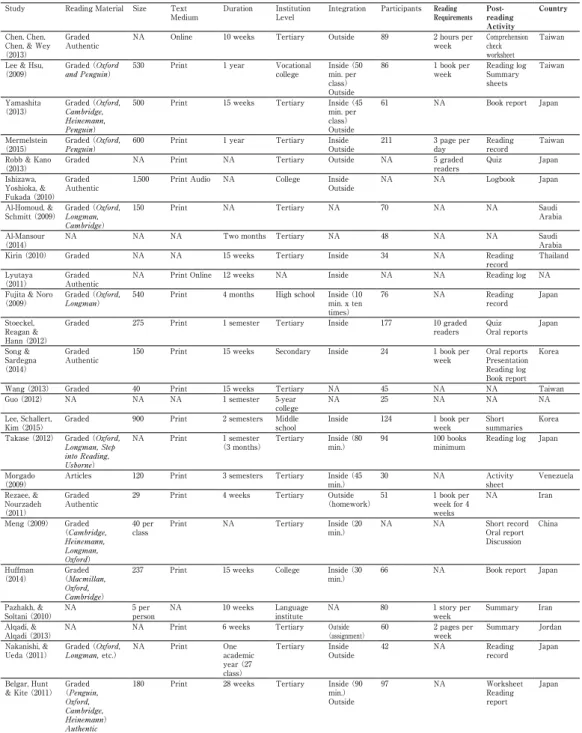
The studies listed below are relevant to the current study. Table 1 lists a number of re-
cent studies that have implemented ER into EFL contexts. The researcher searched ER arti-
cles in the EFL setting by using the keywords “extensive reading,” and “EFL” on Google
Scholar search, and received 34,000 articles. It was narrowed down to 20,300 articles when lim-
ited to articles published within the last decade. The researcher then read the 50 most cited
articles and chose 25 articles that correspond to the present research. The researcher read
共立 国際研究 第 37 号(2020)
the full text of the 25 articles to identify ten features: a) the type of reading material, b) mate- rial size, c) text medium, d) duration of the program, e) institution where the program was held, f) the level of integration into the classroom hours, g) number of participants in the study, h) reading requirements (if any), i) post-reading activity, and j) country.
Table 1 Studies on the ER programs in EFL contexts
Study Reading Material Size Text
Medium Duration Institution
Level Integration Participants Reading Requirements Post-
reading Activity
Country Chen, Chen,
Chen, & Wey
(2013)
Graded
Authentic NA Online 10 weeks Tertiary Outside 89 2 hours per
week Comprehension check worksheet
Taiwan
Lee & Hsu,
(2009) Graded (Oxford
and Penguin) 530 Print 1 year Vocational
college Inside (50 min. per class)
Outside
86 1 book per
week Reading log Summary sheets
Taiwan
Yamashita
(2013) Graded (Oxford, Cambridge, Heinemann, Penguin)
500 Print 15 weeks Tertiary Inside (45 min. per class)
Outside
61 NA Book report Japan
Mermelstein
(2015) Graded (Oxford,
Penguin) 600 Print 1 year Tertiary Inside
Outside 211 3 page per
day Reading
record Taiwan Robb & Kano
(2013) Graded NA Print NA Tertiary Outside NA 5 graded
readers Quiz Japan
Ishizawa, Yoshioka, &
Fukada (2010)
Graded
Authentic 1,500 Print Audio NA College Inside
Outside NA NA Logbook Japan
Al-Homoud, &
Schmitt (2009)Graded (Oxford, Longman, Cambridge)
150 Print NA Tertiary NA 70 NA NA Saudi
Arabia Al-Mansour
(2014) NA NA NA Two months Tertiary NA 48 NA NA Saudi
Arabia
Kirin (2010) Graded NA NA 15 weeks Tertiary Inside 34 NA Reading
record Thailand Lyutaya
(2011) Graded
Authentic NA Print Online 12 weeks NA Inside NA NA Reading log NA
Fujita & Noro
(2009) Graded (Oxford,
Longman) 540 Print 4 months High school Inside (10 min. x ten times)
76 NA Reading
record Japan Stoeckel,
Reagan &
Hann (2012)
Graded 275 Print 1 semester Tertiary Inside 177 10 graded
readers Quiz
Oral reports Japan Song &
Sardegna
(2014)
Graded
Authentic 150 Print 15 weeks Secondary Inside 24 1 book per
week Oral reports Presentation Reading log Book report
Korea
Wang (2013) Graded 40 Print 15 weeks Tertiary NA 45 NA NA Taiwan
Guo (2012) NA NA NA 1 semester 5-year
college NA 25 NA NA NA
Lee, Schallert,
Kim (2015) Graded 900 Print 2 semesters Middle
school Inside 124 1 book per
week Short
summaries Korea Takase (2012) Graded (Oxford,
Longman, Step into Reading, Usborne)
NA Print 1 semester
(3 months) Tertiary Inside (80
min.) 94 100 books
minimum Reading log Japan
Morgado
(2009) Articles 120 Print 3 semesters Tertiary Inside (45
min.) 30 NA Activity
sheet Venezuela Rezaee, &
Nourzadeh
(2011)
Graded
Authentic 29 Print 4 weeks Tertiary Outside
(homework) 51 1 book per
week for 4 weeks
NA Iran
Meng (2009) Graded
(Cambridge, Heinemann, Longman, Oxford)
40 per
class Print NA Tertiary Inside (20
min.) NA NA Short record
Oral report Discussion
China
Huffman
(2014) Graded
(Macmillan, Oxford, Cambridge)
237 Print 15 weeks College Inside (30
min.) 66 NA Book report Japan
Pazhakh, &
Soltani (2010) NA 5 per
person NA 10 weeks Language
institute NA 80 1 story per
week Summary Iran
Alqadi, &
Alqadi (2013) NA NA Print 6 weeks Tertiary Outside
(assignment) 60 2 pages per
week Summary Jordan
Nakanishi, &
Ueda (2011) Graded (Oxford,
Longman, etc.) NA Print One
academic year (27 class)
Tertiary Inside
Outside 42 NA Reading
record Japan
Belgar, Hunt
& Kite (2011) Graded
(Penguin, Oxford, Cambridge, Heinemann)
Authentic
180 Print 28 weeks Tertiary Inside (90 min.)
Outside
97 NA Worksheet
Reading report
Japan
Regarding the types of materials used in ER programs, nearly 60% of the programs used graded readers only, while 20% used both authentic texts and graded readers (Chen, Chen, Chen, & Wey, 2013; Lyutaya, 2011). Apart from the four studies that have not provided infor- mation about the types of reading materials, none of the programs used authentic books solely.
The majority used print materials, while two programs adapted online materials. Most ER programs were implemented at university-level institutions, although several secondary-level, vocational colleges, and a language institution were included. For example, the program by Fujita and Noro (2009) reported that early exposure to ER was beneficial for increasing moti- vation to read extensively. Many programs encouraged the participants to read outside the classroom while instituting approximately 30 - 60 minutes of reading in the classroom. Yamashi- ta (2013), for example, reported that, after participating in group activities for 45 minutes, stu- dents read books silently at their own pace for the latter half of the 90-minute class. Partici- pants of the study ranged in number from 24 to more than 177, and program duration was usually a semester, ranging from 10 to 15 weeks, although four programs lasted for a year.
Nearly half of the programs (44%) established reading requirements, ranging from one book per week to two hours of reading per week. In the program reported by Mermelstein (2015), for example, participants were required to read at least three pages per day outside the class- room. Many programs also adopted post-reading activities for monitoring students’ amounts of reading and their comprehension. The most popular post-reading activities was keeping a reading log; for this, participants maintained a record of the number of pages they read at one time, with the title of the work they read and short comments about its content (Lee & Hsu, 2009; Fujita & Noro, 2009).
Apart from two studies, one for which students were required to bring in their favorite articles to build a reading library (Morgado, 2009) and another where students were encour- aged to buy books (Lyutaya, 2011), all the programs purchased books or used donated books;
these collections ranged from 150 - 1,500 books in different programs. A major problem of com- mercially produced reading materials is their cost; as is the case at the institution where the researcher works, there are no individual budgets for classroom materials or a place to keep books. In these cases, no matter how much an individual practitioner strives to implement ER programs in his or her classroom, the issues of cost and storage for books tend to hinder the successful implementation of an ER program. In-house reading materials can be produced at relatively low costs and, therefore, appear to be the most applicable solution; however, it is dif- ficult to produce readable and usable texts for several reasons. First, authentic texts are al- ways favored for their content. Since these texts are produced to entertain readers or provide information, their use corresponds with ER principle 5, which states that the purpose of read- ing is usually related to pleasure, information, and general understanding. That is, the material has to be informative and a pleasure to read. Second, an ER library should stock books with a
“wide range of topics” so learners can “choose what they want to read (ER principles 2 and
3).” As the listed studies suggest, no fewer than 100 books are a prerequisite even for a small-
共立 国際研究 第 37 号(2020)
sized class. Finally, and presumably most important for English language classes, in accor- dance with ER principle 4, reading materials have to be easy to read. Many graded readers are advantageous in this aspect since the levels of the books are included and information is provided about how easy or difficult the text is to read. For example, Macmillan has divided its graded readers into 12 levels, and gives approximate headwords and total numbers of words included in the text. The present paper, therefore, aims to identify the linguistic fea- tures of both authentic and graded readers in order to use the information for the develop- ment of in-house ER materials.
2.Materials and Methods
The researcher chose 26 authentic texts based on three criteria: a) no more than 100 pag- es per book, b) priced affordable for students to purchase, and c) available to buy within a week. For comparison with authentic texts, 12 graded readers from Cengage Publisher and Macmillan were chosen. (See appendix for a list of authentic materials and graded readers.)
Three pages without illustrations or extensive blank space were randomly selected from each book. The researcher transcribed the pages into a Microsoft Word file. The transcribed texts were then copied and pasted into the software program VocabProfile by Lextutor and submitted for analysis. VocabProfile was adopted to measure the level of vocabulary of au- thentic materials and graded readers. This online program sorts the vocabulary data into four categories: the 1,000 most frequently used words (referred to as “K1”), the next 1,000 most frequently used words (K2), the 570 most frequently used academic words (AW) (as pro- posed by Coxhead, 1998), and other words (OFF). VocabProfile also provides lexical density
(LD), which indicates the ratio of content words used (e.g., nouns, verbs, adjectives, and ad- verbs) to function words (e.g., articles and prepositions).
3.Results & Discussion
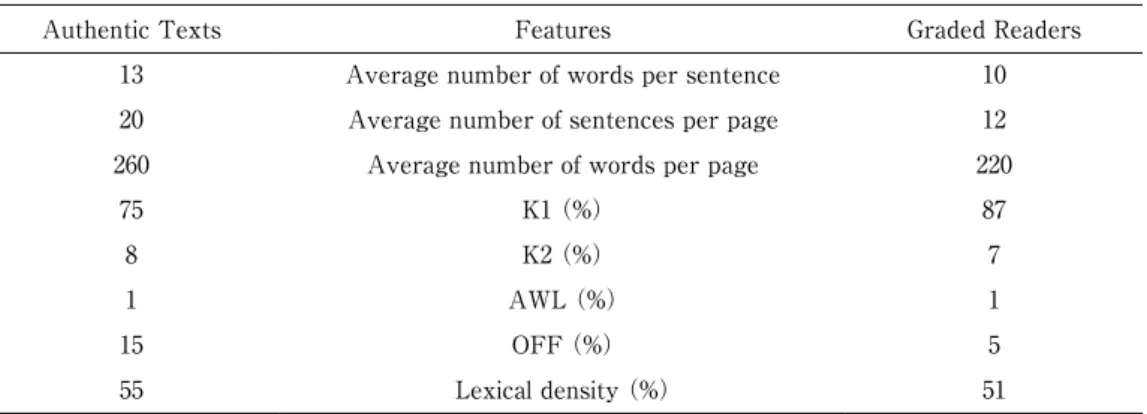
As shown in Table 2, approximately 90% of authentic texts contained more than 5% OFF and AW, while only 60% of graded readers contained more than 5% OFF and AW words.
Moreover, the lexical density of authentic texts was higher than for graded readers. The
mean number of words per sentence was 13 for authentic texts, while graded readers had
only 10 words per sentence on average. Among all of them, many of the authentic texts were
a collection of short cases (See the Encyclopedia Brown series, for example), where each case
contained no more than 10 pages with fewer than 1,000 words. Examples of words listed as
OFF include Oliver, Carol, Karenina, and carnival.
Table 2. Linguistic features of graded readers and authentic texts
Authentic Texts Features Graded Readers
13 Average number of words per sentence 10
20 Average number of sentences per page 12
260 Average number of words per page 220
75 K1 (%) 87
8 K2 (%) 7
1 AWL (%) 1
15 OFF (%) 5
55 Lexical density (%) 51
Nation (2009) stated that many non-native speakers of English and some native speakers read at a speed of fewer than 300 words per minute (wmp). Carver (1982) claimed that read- ing at a rate of 250 - 350 wpm is most efficient for comprehending text, and EFL reading text- books encourage EFL readers to read at a rate of 300 wpm (Takeuchi, Sasaki, & Yamaoka, 2018). Many ER programs integrate individual reading periods into their classroom hours, ap- proximately 20 - 30 minutes per lesson. If a typical EFL reader reads a text at 100 - 200 wpm, then he or she can read 3,000 - 6,000 words per lesson, allowing the reader to read at least one book that contains fewer than 3,000 words.
The results appear to indicate that there are three major linguistic elements that should be considered in developing in-house reading materials. First, a book should not exceed 2,000 words in total so that students can finish reading it in one reading activity that lasts 20 min- utes. Second, the lexical density should not exceed 50%. Finally, proper nouns, especially place names and surnames, should be used judiciously, since many OFF listed words include place names and personal names.
4. Conclusion
Although the development of in-house reading materials for the successful implementation of an ER program is a prerequisite, especially for low-funded, small-sized classes, several fac- tors should be considered. This small-scale study highlights the need to provide reading texts that are affordable and appropriate in regard to levels of reading difficulty. The study has sev- eral limitations, especially its small sample size. In future studies, there is a need to explore the content of existing materials to meet EFL readers’ needs.
References
Al-Homoud, F., & Schmitt, N. (2009). Extensive reading in a challenging environment: A comparison of extensive and intensive reading approaches in Saudi Arabia. Language Teaching Research, 13(4), 383
-401.
Al-Mansour, N. S. (2014). The effect of an extensive reading program on the writing performance of Sau-
共立 国際研究 第 37 号(2020)
di EFL university students. International Journal of Linguistics, 6(2), 247.
Alqadi, K. R., & Alqadi, H. (2013). The effect of extensive reading on developing the grammatical accura- cy of the EFL freshmen at Al Al-Bayt University. Journal of Education and Practice, 4(6), 106
-113.
Arnold, N. (2009). Online extensive reading for advanced foreign language learners: An evaluation study.
Foreign Language Annals, 42(2), 340
-366.
Beglar, D., Hunt, A., & Kite, Y. (2012). The effect of pleasure reading on Japanese university EFL learn- ers’ reading rates. Language Learning, 62(3), 665
-703.
Carver, R. (1982). Optimal rate of reading prose. Reading Research Quarterly,18, 56–58
Chen, C. N., Chen, S. C., Chen, S. H. E., & Wey, S. C. (2013). The Effects of Extensive Reading via E-Books on Tertiary Level EFL Students’ Reading Attitude, Reading Comprehension, and Vocabulary. Turk- ish Online Journal of Educational Technology-TOJET, 12(2), 303
-312.
Cobb, T. (2002). Web VocabProfile. Retrieved from https://www.lextutor.ca/
Day, R. R. (2015). Extending extensive reading. Reading in a Foreign Language, 27(2), 294
-301.
Day, R & Bamford, J. (2002). Top ten principles for teaching extensive reading. Reading in a Foreign Language,14(2), 136
-141.
Fujita, K., & Noro, T. (2009). The effects of 10-minute extensive reading on the reading speed, compre- hension and motivation of Japanese high school EFL learners. ARELE: Annual Review of English Language Education in Japan, 20, 21
-30.
Guo, S. C. (2012). Using Authentic Materials for Extensive Reading to Promote English Proficiency. En- glish Language Teaching, 5(8), 196
-206.
Huffman, J. (2014). Reading Rate Gains during a One-Semester Extensive Reading Course. Reading in a Foreign Language, 26(2), 17
-33.
Lee, S. Y., & Hsu, Y. Y. (2009). Determining the crucial characteristics of extensive reading programs:
The impact of extensive reading on EFL writing. The International Journal of Foreign Language Teaching, 5(1), 12
-20.
Kirin, W. (2010). Effects of extensive reading on students’ writing ability in an EFL class. Journal of Asia TEFL, 7(1).
Lee, J., Schallert, D. L., & Kim, E. (2015). Effects of extensive reading and translation activities on gram- mar knowledge and attitudes for EFL adolescents. System, 52, 38
-50.
Lyutaya, T. (2011). Reading Logs: Integrating Extensive Reading with Writing Tasks. In English Teach- ing Forum (Vol. 49, No. 1, pp. 26
-34). US Department of State. Bureau of Educational and Cultural Affairs, Office of English Language Programs, SA
-5, 2200 C Street NW 4th Floor, Washington, DC 20037.
Meng, F. (2009). Developing Students’ Reading Ability through Extensive Reading. English Language Teaching, 2(2), 132
-137.
Mermelstein, A. D. (2015). Improving EFL Learners’ Writing through Enhanced Extensive Reading.
Reading in a Foreign Language, 27(2), 182
-198.
Ministry of Education, Culture, Sports, Science and Technology (MEXT). (2010). Kotogakko gakushu shi- do yoryo kaisetsu. [Explanation of the senior high school curriculum guidelines. Foreign language and English version].
Ministry of Education, Culture, Sports, Science and Technology (MEXT). (2011). Ko-togakko gakushu shido yoryo [The Course of Study for Foreign Languages—Up-per secondary school].
Morgado, N. F. (2009). Extensive reading: Students’ performance and perception. Reading, 9(1).
Nakanishi, T., & Ueda, A. (2011). Extensive Reading and the Effect of Shadowing. Reading in a Foreign Language, 23(1), 1
-16.
Nation, P. (2009). Reading faster. International Journal of English Studies, 9(2).
Nishizawa, H., Yoshioka, T., & Fukada, M. (2010). The impact of a 4-year extensive reading program. In
JALT2009 Conference Proceedings (pp. 632
-640).
Pazhakh, A., & Soltani, R. (2010). The effect of extensive reading on vocabulary development in EFL learners in Dehdasht Language Institute. Practice and Theory in Systems of Education, 5(4), 387
-398.
Rezaee, A. A., & Nourzadeh, S. (2011). Does extensive reading improve EFL learners’ processing ability.
Theory and Practice in Language Studies, 1(9), 1167
-1175.
Robb, T., & Kano, M. (2013). Effective extensive reading outside the classroom: A large-scale experiment.
Reading in a Foreign Language, 25(2), 234
-247.
Song, J., & Sardegna, V. G. (2014). EFL learners’ incidental acquisition of English prepositions through enhanced extensive reading instruction. RELC Journal, 45(1), 67
-84.
Stoeckel, T., Reagan, N., & Hann, F. (2012). Extensive reading quizzes and reading attitudes. TESOL Quarterly, 46(1), 187
-198.
Takase, A. (2012). The impact of extensive reading on reluctant Japanese EFL learners. The European Journal of Applied Linguistics and TEFL, 1(1), 97
-113.
Takeuchi, O., Sasaki, A., and Yamaoka, K. (2018). A Good Read: Developing Strategies for Effective Read- ing 3. Tokyo: Shohakusha
Wang, Y. (2013). Incidental vocabulary learning through extensive reading: A case of lower-level EFL Taiwanese learners. The Journal of Asia TEFL, 10(3), 59
-80.
Yamashita, J. (2013). Effects of extensive reading on reading attitudes in a foreign language. Reading in a Foreign Language, 25(2), 248
-263.
Appendix A list of authentic materials and graded readers
Authentic Materials
Encyclopedia Brown, Boy Detective Encyclopedia Brown Cracks the Case
Encyclopedia Brown and the Case of the Secret Pitch Encyclopedia Brown Keeps the Peace
Encyclopedia Brown, Super Sleuth Encyclopedia Brown Finds the Clues Encyclopedia Brown Gets His Man Encyclopedia Brown Takes the Case Encyclopedia Brown Shows the Way Encyclopedia Brown Tracks Them Down
Encyclopedia Brown and the Case of the Soccer Scheme Encyclopedia Brown and the Case of the Carnival Crime Encyclopedia Brown Saves the Day
Encyclopedia Brown and the Case of the Secret UFOs Encyclopedia Brown Solves Them All
Encyclopedia Brown Leads a Hand
Nancy Drew and the Clue Crew 13: Chick-napped Nancy Drew and the Clue Crew 11: Ski School Sneak Nancy Drew and the Clue Crew 10: Ticket Trouble Nancy Drew and the Clue Crew 9: The Halloween Hoax Nancy Drew and the Clue Crew 8: Lights, Camera… Cats!
Nancy Drew and the Clue Crew 25: Buggy Breakout
共立 国際研究 第 37 号(2020)