A Collection of Tantric Ritual Texts from an Ancient Tibetan Scroll Kept at the Institute of Oriental Manuscripts
of the Russian Academy of Sciences
Alexander Zorin
国際仏教学大学院大学研究紀要
第 17 号(平成 25 年) for Postgraduate Buddhist Studies Vol. XVII, 2013
A Collection of Tantric Ritual Texts from an Ancient Tibetan Scroll Kept at the Institute of Oriental Manuscripts of the Russian Academy
of Sciences
*Alexander Zorin
One of the most valuable Tibetan manuscripts kept at the Institute of Oriental Manuscripts of the Russian Academy of Sciences (hereafter, IOM RAS) is the scroll
Дх-178, included in the collection of Tibetan manuscriptsfrom Dunhuang, where a library of Buddhist texts dated from the 5th to the first years of the 11th century was found in early 20th century. This is a clear mistake since at least two texts of the scroll were composed by the famous 12th century Tibetan yogi and translator Dpal rga lo, or Rgwa lotsawa. He spread some Tantric teachings such as those on Kālacakra and Mahākāla in Tibet. The texts on the cult of Mahākāla comprise the larger part of the scroll and is further evidence of the later dating of the scroll, since the cult of Mahākāla was brought to and established in Tibet from the mid-11th century when the famous Tibetan lotsawa Rin chen bzang po translated an important sādhana
1of Mahākāla by the great Indian yogi
Śābaripāda. During the 13th to 14th century, this cult was finallyestablished by the Yuan Mongol dynasty of Chinese emperors who worshipped Mahākāla as their divine protector, and later this conception
* The study was supported by the Russian Foundation for the Humanities, project No. 08-04-00128a. I would like to thank Dr. Simon Wickham-Smith for his English proofreading.
1 Sādhana is a genre of Tantric literature describing the stages of the yogic practices of various Tantric deities to be visualized and invoked to perform the divine actions.
was borrowed by the emperors of the Qing Manchu dynasty. The greatest collection of Tantric texts in Tibetan from Dunhuang kept at the British Library has no single text on Mahākāla
2. The codicological features of the scroll are also rather different from those of the Dunhuang manuscripts.
Nevertheless, our predecessors had some reasons to include the scroll into the Dunhuang collection. It is quite probable that it was sent to St Petersburg along with Dunhuang scrolls. This issue remains somewhat obscure. In 1913, a pile of Tibetan manuscripts from Dunhuang sent to the St Petersburg Academy of Sciences by the Russian consul in Ürümqi N.N.
Krotkovwas passed to the Asiatic Museum (now the IOM RAS) following the suggestion by academician S.F. Oldenburg. Up to present, these manuscripts are kept in the boxes marked with the date of the meeting at the Academy of Sciences when the decision was taken, viz. March 13, 1913.
The scroll
Д х-178 is kept in the same box but without the inscription.Hence, it is not quite clear if this text was also sent to St Petersburg by N.N.
Krotkovor if it was simply processed by the staff of the Asiatic Museum around the same time as the Dunhuang scrolls
3.
The scroll could be brought by Colonel P.K. Kozlovfrom his famous Mongol Sychuan expedition, 1907-1909, during which he explored the dead city of Khara Khoto and its library of Tangut texts and texts in some other languages including Tibetan. In the collection of Tibetan manuscripts from Khara Khoto kept at the British Library, there are some texts that vividly reminds our scroll from the paleographic point of view (e.g. IOL Tib M 50
2 Dalton J., van Schaik S. Catalogue of the Tibetan Tantric Manuscripts from Dunhuang in the Stein Collection. Second electronic edition. [London:] IDP, 2007:
http://idp.bl.uk/database/oo_cat.a4d?shortref=Dalton_vanSchaik_2005 [31.01.2013].
3 The history of the IOMʼs collection of Tibetan texts from Dunhuang is scrutinized in my paper - Zorin A.The Collection of Dunhuang Tibetan Texts Kept at the IOM RAS, in -Dunhuang Studies: Prospects and Problems for the Coming Second Century of Research. Ed. by I. Popova and Liu Yi. St. Petersburg, Slavia Publishers 2012. Pp. 365-367.
or Tib M 60
4). This may be an oblique indication of its Khara Khoto origin.
The fact that Dpal rga loʼs teacher at Bodh Gaya, Rtsa mi lotsawa, was an ethnic Tangut and that Dpal rga lo himself could relate to the Tanguts may link the scroll to the Tangut area, too
5.
Most of the Khara Khoto texts are dated from the 12th through 14th century
6but, since Dpal rga lo died at the very end of the 12th century or during the first years of the 13th century, we can assume that the scroll could not have been produced earlier than the latter part of the 12th century. On the other hand, its use of old Tibetan orthography indicates that it must have been made no later than the 14th century. Hence, I suppose it is most probable that the scroll
Дх-178 should be dated from thelate 12th to 13th century.
1. Codicology and paleography
By 2008, the scroll
Дх-178 appeared as eight separate long leaves, with4 Dr. Sam van Schaik kindly drew my attention to these texts. Moreover, he was the first one to doubt the Dunhuang origin of the scrollДх-178 and helped me with some difficult issues connected with this study for which I am extremely grateful.
5 More details on this issue are contained in the papers - Sperling E.Rtsa-mi Lo- tsā-ba Sangs-rgyas grags and the Tangut Background to Early Mongol-Tibetan Relations, in -Tibetan Studies: Proceedings of the 6th Seminar of the International Association of Tibetan Studies. Fagernes 1992 Volume 2, edited by Per Kvarene.
Oslo: Institute for Comparative Research in Human Culture, 1994. P. 801-824; Vitali R.In the Presence of the “Diamond Throne”: Tibetans at rDo rje gdan(Last Quarter of the 12th Century to Year 1300)// The Tibet Journal, 34(3) - 35(2), 2009-2010 (2010). Pp. 161-208.
6 MenshikovL.N.Opisanie kitaiskoy chasti collektsii iz Khara-Khoto(fond P.K.
Kozlova). Moscow, Nauka Publishers, 1984. P. 61-62. It is worth mentioning that, according to L. Menshikov, among the Chinese texts dated from the 14th century, there are numerous manuscript booklets containing, basically, texts of Tantric Buddhism, mostly ritualistic in their contents(ibid.).
some cursive Tibetan text on both sides. It was initially impossible to understand what text was written there because of the wrong order of the leaves. Nevertheless, after some shuffling, it proved possible to unite the leaves in the right order and so assemble the original scroll, the leaves of which had been attached one below the other. On the recto side of the eighth folio the text was interrupted to continue on the verso side of the same folio. Consequently, the end of the entire manuscript is found on the verso side of the first folio. In fact, each folio consists of two thin leaves which are just put one on the other, there are no traces of glue. The size of the folia is as follows:
1) f. 1: 65.7/58.5 x 26,6 cm (the folio is defective, there is a deep semicircular cut at the top); 2) f. 2: 66.0 x 26.8 cm; 3) f. 3: 65.8 x 27.0 cm; 4) f.
4: 64.5 x 27.0 cm; 5) f. 5: 66.1 x 26.8 cm; 6) f. 6: 65.2 x 27.0 cm; 7) f. 7: 65.6 x 27.2 cm; 8) f. 8: 66.0 x 27.1 sm.
The left and right sides were probably even but now they are more or less damaged with small cuts, the first folio being especially damaged since it had to be left outside when the scroll was rolled down, hence it is rather fragile at the top. There are some old brown spots indicating water damage, which are found at the edges of the manuscript, first of all the right sides of ff. 1-2. Fortunately, no traces of mildew are found.
According to analysis carried out by Dr. A. Helman-Ważny, paper of the scroll is composed of paper mulberry fibres (Broussonetia sp.). Her conclusion runs as follows - Paper is handmade, very thin and good quality, and soft (not sized) what suggest purpose selection of this type for a particular manuscript. Yellow dye and very good quality of materials used suggest importance of this manuscript. Laid regular structure characterized by 7 laid lines in 1cm indicates that paper was made with movable type of papermaking mould equipped with bamboo sieve
7.
7 Helman-Ważny A.Fibre analysis of paper in Tibetan manuscript Dx178(e-
Each folio has vertical sidelines put on both the left and right sides: on the recto sides - 4.5 to 4.8 cm on the left one, 2.5 to 2.7 cm on the right one, on the verso sides of ff. 1-7 - 2 to 3 cm and 4.8-5.2 cm, f. 8 - 2.8 to 3 cm and 5.1 cm. It indicates that the scroll was intended to be unwrapped horizontally, probably for some Chinese or Tangut text but the Tibetan text was written in the opposite direction without any attention paid to the sidelines so that it covers the entire space of the folia. The text is written with black ink, a little bit darker than that of the sidelines. The space between the lines is as follows: f. 1 recto - about 1 cm on, all the others - basically about 0.5 cm, sometimes more. The lines are usually rather even. There are a number of glosses between some lines.
The manuscript was probably written by three scribes - but writings by two of them are only found on the first four pages of the verso side of the scroll and they alternate with that of the main scribe. The semicursive dbu med script is used, the writing is legible, there are not so many blots and orthographic mistakes in the first and third parts of the scroll (concerning the structure see below) but the texts of the second part are corrupted to a greater extent, especially those of the mantras which can hardly be reconstructed. Abridged forms of some words such as rdo rje, ye shes, thams cad, yi ge are used. There is no colophon in the end of the scroll hence we have no data on the names of the scribes, nor the time and circumstances of its production.
document). I would like to thank Dr. A. Helman-Ważny for her contribution to my study.
Fig. 1. The ways the three scribes wrote the syllable ‘go’ - at left the main one
The following features of old orthography used in the scroll should be noted: 1) the use of the subjoined letter ya btags in some syllables such as myi, myed, etc., written now as mi, med, etc.)
8; 2) the use of the follower ’a in the end of many syllables that do not have it now, e.g. in the particle pa’
instead of pa; 3) the use of the diverted form of the gi gu diacritical mark
9. The secondary follower da btags found in more archaic texts such as those from Dunhuang is not attested in the scroll.
2. The structure
The texts of the scroll can be clearly divided into three parts although the scribes did not mark them at all -
1) 13 texts on the cult of Mahākāla represented in two forms such as the Raven Faced One and the Four Handed One;
2) 8 texts on the cult of Narasin ̇ ha, or the Man-Lion, one of the ten avataras of Vis
̇ n
̇ u;
3) the last but rather long versified text on the man
̇ d
̇ ala of Vajrapān
̇ i and the eight Nāga Kings
10.
8 Occasionally, however, it is omitted either due to the scribesʼ mistakes or the fact that the scroll might have been produced at the time when the gradual transition to the new orthography was occurring.
9 Some other features can be added such as the use of the prefix letterba, e.g.
bsnyug gu; joined up writing of the wordlasogsor, if written separately, with the prefix letterba-la bsogs; the double use of the subjoinedrain the wordgri gug-gri grug; the writing of the genitive particle’iseparately from the word it relates to (=
yiin modern orthography); the use of Tibetan ciphers for numerals, etc., sometimes the followersais added to 2 thus meaninggnyis(two), or the Tibetan cipher for 1 can be used as the Imperative particle cig; the prefix letter or followerma can be replaced with a special diacritical mark; etc.
10The nāgas are serpent-liked sentient beings in Indian mythology; in Buddhism they are treated ambiguously - on the one hand, they are thought to have kept many esoteric Buddhist texts preached by the Buddha and later brought back to the
Three texts of twenty two presented are found in Bstan ’gyur, the second part of the Tibetan Buddhist Canon, four (including the first of the former ones) in the collection of texts on the cult of Mahākāla and his retinue preserved by the Phag mo gru pa subschool of Bka’ rgyud pa school of Tibetan Buddhism
11. In the following list these cases are indicated.
I. Mahākāla
1) Dpal nag po chen po’i bsgrub pa’i thabs /
Śrīmahākālasādhana(The Sādhana of
Śrī Mahākāla), byĀrya Nāgārjuna; in Bstan ’gyur - Beijing ed., P.2628, rgyud ʼgrel, la, ff. 275b3-276a8; Derge ed., D.1759, rgyud, sha, ff.
250b4-251a7; in the Phag mo gru pa edition - Vol. 2, pp. 763-767.
2) A brief commentary on The Sādhana of
Śrī Mahākāla; in thePhag mo gru pa edition - Vol. 5, pp. 409-410.
3) Dpal nag po chen po’i las kyi cho ga (The Pūjā of
Śrī Mahākāla’sRite); in the Phag mo gru pa edition - Vol. 5, pp. 359-361)
12.
4) A description of the wrathful rite.
5) A group of fragments of ritualistic texts on the practice of Mahākāla and an invocation to him to perform divine actions.
humans by some great teachers and yogis such as Nāgārjuna, etc., on the other hand, the nāgas can cause bad diseases and harm people.
11Bya rog ma bstan sruṅ bcas kyi chos skor. Collected Tantras and Related Texts Concerned with the Propitiation of Mahakala and His Retinue. Arranged according to the traditions transmitted by Phag-mo-gru-pa. Reproduced from the manuscript collection formerly preserved in the Khams-sprul Bla-braṅ at Khams-pa-sgar Phun- tshogs-chos-ʼkhor-gliṅ by the 8th Khams-sprul Don-brgyud-ñi-ma. Vol. 1-7. India:
Sungrab nyamso gyunphel parkhang, Tibetan Craft Community, 1973-1979.
Unfortunately, in the copy of this edition, kindly given to me by the representatives of the TBRC electronic library, the sixth volume is omitted, hence I cannot ascertain if there are some other texts from the scroll.Дх-178 presented in this volume.
12Edited and translated in - Zorin A.Texts on Tantric Fierce Rites from an Ancient Tibetan Scroll Kept at the IOM RAS, in -Budhism and Society. Papers for the International Conference on Buddhism and Society, 13-15 January 2013. Sarnath, Varanasi: Central University of Tibetan Studies, 2013. Pp. 118-132.
6) A series of five texts, two of which are directly attributed to Dpal rga lo; the texts are marked with Tibetan letters, from ka to ca, but the fourth one, nga, is put ahead (probably by mistake) and the text located between ka and ga is not marked with the relevant letter kha (presumably a defect of the scribe). The contents of the texts listed in the right order are as follows:
1 (ka) - The Hymn to the Raven Faced Mahākāla by Dpal rga lo (see the Appendix);
2 (kha?) - a hymn or a prayer to Mahākāla;
3 (ga) - an instruction on the practice of Mahākāla aimed at the oppression of the enemy, by Dpal rga lo (see the Appendix);
4 (nga) - an instruction on the oppression of the enemyʼs speech;
5 (ca) - a description of the fierce rite aimed at killing the enemy and an instruction on pleasing Mahākāla (may be two different texts); in the Phag mo gru pa edition - Vol. 5, pp. 333-336.
7) Dpal nag po chen po’i bstod pa rkang pa brgyad pa zhes bya ba /
Śrīmahākālastotra-padāṡ t
̇ aka-nāma (The Hymn to
Śrī Mahākāla in EightStanzas), by Ārya Nāgārjuna; in Bstan ’gyur - Beijing ed., P.2644, 2645
13, rgyud ʼgrel, la, ff. 298a4-299a6, 299a6-300b1; Derge ed., D.1778, 1779, rgyud, sha, ff. 272a7-273a6, 273a6-274a6.
8) Rje btsun dpal rje nag po chen po la bstod pa /
Śrībhaṫ t
̇ ārakamahākā- lastotra (The Hymn to the Venerable
Śrī Mahākāla), by Buddhakīrti; inBstan ’gyur - Beijing ed., P.2642, rgyud ʼgrel, la, ff. 295b8-297a6; Derge ed., D.1776, rgyud, sha, ff. 270b2-271b4.
9) An instruction on the practice with a black skull and visualization of Mahākāla.
10) A description of the wrathful rite.
13The text is represented in two versions, that of the scroll corresponds with the second of them.
11) An instruction on the killing of the enemy via the fire offering.
12) A description of the fierce rite, a hymn to the Raven Faced Mahākāla, an instruction on Mahākālaʼs invocation (may be different texts).
13) Bya rog gi sgrub thabs (The Sādhana of the Raven Faced [Mahākāla]).
II. Vis
̇ n
̇ u Narasin ̇ ha
14) Khyab ’jug myi ’i seng ’ge dad pa’i lha (Vis
̇ n
̇ u Narasiṅha as the Personal Deity), on the expulsion of a demon out of a diseased person.
15) A group of ritualistic fragments (may be different texts) such as 1. the invocation of Vis
̇ n
̇ u Narasin ̇ ha to perform the divine actions via torma offering and a hymn (see the Appendix); 2. a rite aimed at the protection of oneʼs son; 3. a rite aimed at the protection against a hail- storm (see the Appendix); 4. an instruction on the production of an amulet;
5. an instruction on the curing of a disease; 6. on the protection against epidemic diseases.
16) A narrative about the killing of the asura Hiran
̇ yakaśipu by Vis
̇ n
̇ u Narasin ̇ ha to save the formerʼs son Prahlāda named here Thub rgyal nag po in Tibetan
14.
17) Khyab ’jug myi’i ’og gtor gyi cho ga (The Rite of Torma Offering to Vis
̇ n
̇ u with the Human Body [and the Lion’s Head])
15.
18) Khyab ’jug gi dgra ’o gsod pa’i thabs (The Method of the Killing of an Enemy by means of Vis
̇ n
̇ u)
16.
14Edited and translated in - Zorin A.Hindu-Buddhist Syncretism in the Trans- Himalaya and Southeast Asia: An Attempt of Comparative Study of Religious Literature of Tibet and Bali(forthcoming).
15Edited and translated in - Zorin A.On an Unique Tibetan Manuscript Mistakenly Included into the Dunhuang Collection, in -Talking about Dunhuang on the Riverside of the Neva. Ed. by TAKATA Tokio. Institute for Research in Humanities, Kyoto University, 2012. P. 39-51.
16See note 12 above.
19) Khyab ’jug myi ’i seng ’ge’i ser khrir dbab thabs kyi cho ga (The Rite of Imposing of Vis
̇ n
̇ u Narasiṅha on the Golden Throne); a description of the wrathful rite.
20) A description of the wrathful rite.
21) The fire offering aimed at killing the enemy.
III. Vajrapān
̇ i and the eight Nāga Kings
22) A verse text primarily aimed at curing diseases and averting poisons caused by the nāgas; probably incomplete (for fragments see the Appendix)
17.
3. The deities worshipped
Mahākāla was probably borrowed by the Buddhists from the Shivaite Tantras and reinterpreted as an emanation of the Bodhisattva Avalo- kiteśvara. He belongs to the class of the Dharma Protectors, those of the supramundane type. His functions are to eliminate both outer and inner obstacles for life and practice of the Buddhists such as enemies, diseases, personal afflictions, etc. Sometimes (and in our scroll, too), the deities of this type can be treated as yidams, personal deities, with whose divine mind the yogis try to substitute their own ordinary consciousness so as to attain the Enlightenment.
R. de Nebesky-Wojkowitz mentions 72 or 75 forms of Mahākāla. Some of them were introduced by the Tibetans such as the Protector Trakshad
17In my previous paper on the scroll [Zorin A.On an Unique Tibetan Manuscript Mistakenly Included into the Dunhuang Collection…], 24 texts were mentioned. After the subsequent study of the texts I had to rearrange some of them so as to include Nos. 6, 8, 9 into No.7, hence these four Nos. would constitute No. 6 in the new list, while No. 15 would be divided into two Nos. such as No. 12 of the new list, containing a group of ritualistic fragments, and No. 13, entitledThe Sādhana of the Raven Faced One.
with the head of the wild yak
18but the major forms were brought from India along with the relevant texts including The Tantra of Mahākāla
19. Two of them are represented in the scroll
Дх-178 but most texts are on oneof them, the Raven Faced One, which is described by de Nebesky- Wojkowitz as follows:
Las mgon bya rog gdong can… “The mGon po of karma, who has the face of a raven”; he is occasionally included among the more prominent dharmapālas, depicted on the tshogs shing and his worship is supposed to have been introduced by the Sa skya sect. The sadhana describes him as possessing a fierce, terrifying body of a dark-blue colour, with one face and two hands, his limbs being short and thick. He has the face of a raven, three- eyed and with a beak of meteoric iron. His right hand lifts a sacrificial knife with a thunderbolt-hilt, and with his left hand he leads towards his mouth a skull-cup filled with blood. His eyebrows and the hair of his face and head are radiant and stand on end. His sharp, blood-dripping beak is widely open and horrible shrieks as well as a fire-storm issue from it...
20.
The iconography of the other form, the Four-Handed One, is represented in the sādhana by Nāgārjuna, No. 1 of the scroll, -
[Mahākāla] whose name is Raven [Has] one face, four hands, at right
[He holds] a red coconut with the first hand, A sword with the second one,
At left [he] holds a skull
Full of blood with the first [hand],
18de Nebesky-Wojkowitz R. Oracles and Demons of Tibet. The Cult and Iconography of the Tibetan Protective Deities. Delhi, 1998. (Classics Indian Publications.) P. 38.
19Stablein W.G.The Mahākālatantra: A Theory of Ritual Blessings and Tantric Medicine. Columbia University, Ph. D., 1976.
20de Nebesky-Wojkowitz R.Oracles and Demons of Tibet… Pp. 48-49.
A khat
̇ vāṅga
21with the second one.
[He is] wrapped with a tiger skin, [His] hair, beard and brows are yellow, [He has] three eyes, terrible fangs,
[He is] adorned with skulls, jewels, and a snake, Upon the moon and lotus with variegated [petals]
[He] resides in heroic posture.
The same description is given for an icon of the Four-Handed Mahākāla published at the most representative electronic resource of Tibetan arts - http://www.himalayanart.org
22. According the description by R. de Nebesky-Wojkowitz, though, the Four-Handed Mahākāla holds a chopper instead of a coconut
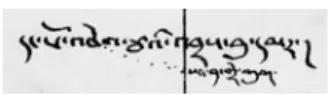
23. This contradiction is eliminated by the author of a gloss to the main text of the scroll running as Or else a chopper (see fig. 2). The retinue of the Four-Handed Mahākāla includes, curiously enough, the Raven Faced Mahākāla. Can it be the reason for Mahākāla of Nāgārjunaʼs text to be named Raven?
Vis ̇ n
̇ u Narasin ̇ ha
24, the deity with the human body and the lionʼs head, is the fourth of the ten avataras of the great Hindu God Vis
̇ n
̇ u. This
21Khat
̇vāṅgais a long club sometimes with a trident on the end, an attribute of some deities.
22http://www.himalayanart.org/image.cfm/517.html [10.12.2012].
23de Nebesky-Wojkowitz R.Oracles and Demons of Tibet… P. 46.
24The standard Sanskrit form of this name is Narasim
̇ha. The form Narasiṅha, as used in the scroll, is more widespread in Nepal, and this might hint at the initial origin of spread of the cult in Tibet.
Fig. 2. The fragment of the text with the gloss
wrathful emanation came to the world to kill the malevolent asura Hiran
̇ yakaśipu
25. In iconography, Narasin ̇ ha is often depicted holding the asura with the lower pair of hands (of 2 or 6 pairs) and exploding his belly.
According to No. 14 of the scroll that Vis
̇ n
̇ u is with the body of white color, one-faced, four-handed, with the orange rampant mane, [he] shakes his hair, has three eyes, and bared fangs, holds an iron stick in his right hand, grasps the enemy with his left hand and points his forefinger, presses the demon merrily with his two lower hands, eats the bowels that come from the [demon’s] belly, stands on the throne of the sun, moon and lotus in the heroic ālīd
̇ ha posture with his right leg extended and left leg bent, he is decorated with a serpent and bone ornaments. This description is at least not controversial with the Hindu tradition.
Functionally, Narasin ̇ ha is treated as a Dharmapāla, a Protector of Dharma, who helps the Buddhists, fulfills their wishes and repels hindrances and enemies. Texts of the scroll depict various rites aimed at the use of Narasin ̇ ha for these purposes. His use in magical rituals is attested in the vernacular Hindu tradition
26.
The data on the cult of Vis
̇ n
̇ u Narasin ̇ ha which was spread in Tibet to some extent, are rare. It is possible that our scroll is the only extent source containing any information about this. Of course, it is not surprising that the cult of Vis
̇ n
̇ u Narasin ̇ ha might have come to Tibet. Buddhist-Hindu syncretism is a common phenomenon in the regions influenced by Indian culture. Thus, in the hymns to the Buddha,
Śiva and Viṡ n
̇ u found in Bali all three deities are treated almost the same way
27. The Newari people of
25Narasiṅha Purān
̇a(Text with English Translation). Edited & Translated by Joshi K.L. Shastri & Dr. Bindiya Trivedi. India, Parimal Publishers 2003.
26Sontheimer G.-D. Folk Deities in the Vijayanagara Empire: Narasim
̇ ha and Mallan
̇n
̇a/Mailār, in - Sontheimer G.-D.Essays on Religion, Literature and Law. New Delhi: Indira Gandhi National Centre for the Arts, Mahonar, 2004. Pp. 327-351.
27Goudrian T., Hooykaas C.Stuti and Stava(Bauddha,Śaiva and Vais
̇n
̇ava)of
Nepal worship both the Buddha and Gan
̇ eśa and sometimes even
Śiva. Inthe Tibetan canon there are some hymns and sādhanas dedicated to Gan ̇ apati, one of the forms of Gan
̇ eśa, considered also by Buddhists as an emanation of Avalokiteśvara. Moreover, the Bstan ’gyur contains five short sādhanas of Avalokiteśvara riding the lion, bird and Vis
̇ n
̇ u
28. The role of Vis
̇ n
̇ u as a vāhana here hints rather at the Buddhist myths on the subjugation of Hindu gods
29. The absence of canonic texts with him as a central figure is eloquent enough. Buddhist texts relating to Narasin ̇ ha could well exist in Sanskrit and then be translated into Tibetan. However, since they were not included into the Tibetan Buddhist canon they were forgotten (although we cannot rule out totally a possibility that some local tradition might also bring such texts up to the present).
The iconographic group of Vajrapān
̇ i and the eight Nāga Kings is so far scarcely studied. As is well-known, Mahāyāna considers Vajrapān
̇ i as one of the eight great bodhisattvas, disciples of the Buddha and the major auditor
Balinese Brahman Priests. Verhandelingen der Koninklijke Nederlandse Akademie van Wetenschappen, afd. Letterkunde. Amsterdam, London: North-Holland Pub- lishing Company, 1971.281) Seng ge dang bya khyung dang khyab ’jug la bzhugs pa’i sgrub thabs / Harihariharivāhanasādhana. Peking ed.: P. 3983, rgyud ʼgrel, thu, ff. 223b3-223b8;
Derge ed.: No. 3162, rgyud, phu, ff. 181a7-181b4; Narthang ed.: rgyud, thu, ff.
211b6-212a4. 2)Seng ge dang bya khyung dang khyab ’jug la bzhugs pa’i sgrub thabs / Harihariharivāhanasādhana. Peking ed.: No. 3984, rgyud ʼgrel, thu, ff. 223b8-224b8;
Derge ed.: No. 3163, rgyud, phu, ff. 181b4-182b2; Narthang ed.: rgyud, thu, ff.
212a4-213a4. Etc.
29On this subject - Davidson R.Reflections on the Mahesvara Subjugation Myth (Indic materials, Sa-skya-pa apologetics, and the birth of Heruka), in - Journal of the International Association of Buddhist Studies, 14, 2, 1991. Pp. 197-235; Isaacson H.
Tantric Buddhism in India(from c. A.D. 800 to c. A.D. 1200), in -Buddhismus in Geschichte und Gegenwart: Band II, Hamburg, 1998. Pp. 23-49. (Internal publication of Hamburg University.); Sanderson A. Vajrayāna: Origin and Function, in - Buddhism into the Year 2000. International Conference Proceedings, Bangkok and Los Angeles: Dhammakāya Foundation, 1995. Pp. 89-102.
and protector of Tantric texts received from the Buddha in the form of Vajradhāra. It is no surprise then that his image obtained an important place in the Vajrayāna tradition. The image of the Two-Handed Wrathful Vajrapān
̇ i is among the most wide-spread and familiar in Tibetan Buddhist arts. It is hard to say in which text exactly he appears along with the eight Nāga Kings. Probably, it was in The Sarvadurgatipariśodhana Tantra belonging to the class of yoga-tantra
30. The iconographic composition of the Man ̇ d
̇ ala of Vajrapān
̇ i and the eight Nāga Kings fixed in a Sa skya pa icon of Nepalese style from the 15th century refers to this tantra. Vajrapān
̇ i is depicted there as an one-faced, two-handed deity of white color and peaceful appearance, the eight Nāga Kings located in petals of a lotus surrounding the central figure. The joint use of their images in one man
̇ d
̇ ala can be connected with a legend on the taming of a gigantic serpent by the Buddha in Uddayana when he appointed Vajrapān
̇ i the protector of the nāgas against their enemies garud
̇ as. At the same time, Vajrapān
̇ i is a commander of the nāgas and can be depicted in the wrathful form - as in our scroll. The remarkable features of the text are that it does not mention at all the important function of the group as the givers of rain and that it implies another figure of a serpent nature named Sngags bdag (the Master of Mantras) who is actually addressed mainly for the aim of the rite described. Moreover, if he does not obey the invocation to avert poisons from a person Vajrapān
̇ i threatens him with a severe punishment. The text is not found in the Tibetan Buddhist canon being probably composed by a Tibetan author since some specific local objects are mentioned such as the Tibetan gnyan demons.
30Skorupsky T.The Sarvadurgatipariśodhana Tantra. Elimination of All Evil Destinies. Sanskrit and Tibetan texts with introduction, English translation and notes. India: Motilal Banarsidass, 1983.
4. Textology
There are not so many Tibetan manuscripts belonging to the period of the formation of the Tibetan Buddhist canon, especially Tantric texts.
Hence, our knowledge of this process is primarily based on the later editions and rather fragmentary. Therefore any new manuscript of this kind has a great significance for Tibetology. The scroll
Д х-178 surely belongs to this group of the Tibetan writings.
The three texts of the scroll having counterparts in the Bstan ’gyur allow a comparison of the ancient scroll with the major later editions made in Beijing and Derge. The ancient edition is sometimes quite different from the canonical ones in respect of both separate words and entire passages.
There are 46 cases of orthographic (including mistakes) and semantic
Дх‑178 Beijing ed. Derge ed. Correspondence bla ma la smod
bstan la sdang| |
bla ma la dmod bstan la sdang| |
bla ma la smod bstan la sdang| |
Derge (orth.)
gdug pa ma lus zhi byas ste| |
gdug pa ma lus byi byas te| |
gdug pa ma lus zhi byas te| |
Derge (sem.)
thod pa rin chen sbrul gyis brgyan| |
thod pa rin chen sprul gyis brgyan| |
thod pa rin chen sbrul gyis brgyan| |
Derge (orth.)
de nas rang gis thugs kaʼi| |
de nas rang gis thugs yi| |
de nas rang gi thugs ka yi| |
Derge (orth.)
zhi rgyas dbang dang mngon spyod kyis| |
zhi rgyas dbang dang mngon spyod kyis| |
zhi rgyas dbang dang mngon spyod kyi| |
Beijing (orth.)
las rnams gang yin de bcol bya| |
las rnams gang yin de bcol bya| |
las rnams gang yin de rtsol bya| |
Beijing (sem.)
bsod nams gang thob des ni ʼgro ba ma lus paʼi| |
bris paʼi bsod nams gang thob pa des ||
bris paʼi bsod nams thob pa des ||
different from both but closer to Beijing(sem.)
divergence. Just to show what kinds of divergence are attested I am supplying the table of them drawn for the first text (No. 1)
In 24 of 46 cases, the ancient scroll is closer to the Derge edition (9 orthographic and 15 semantic cases), in 22 to the Beijing edition (10 and 12 cases respectively). Hence, the scroll is closer to the Derge ed. in comparison with the Beijing edition but, in fact, it is rather far from both of them, which are basically closer to each other than to the former one. It suffices to mention that the last stanza of No. 1 in the scroll is marked with a change of poetic meter from the 7-syllabled one to the 11-syllabled one, while its counterparts keep the same meter. On the contrary, comparison of the four texts of the scroll with their counterparts in the Phag mo gru pa edition shows clearly that they belong to the same tradition. It is of a special significance that one of the texts is the same No. 1 that was compared with the canonical editions. There are also some divergences between the scroll and the Phag mo gru pa edition but they more often help to reconstruct the correct text of No. 1 than show the principal textual difference between the two editions. It is probably no surprise since translations and own writings by Dpal rga lo and his teacher Rtsa mi lotsawa are widely present in the Phag mo gru pa edition.
The texts of the second part, those on Vis
̇ n
̇ u Narasin ̇ ha, were probably translated from Sanskrit into Tibetan, at least two of them have the traditional heading, rgya gar skad du (in Sanskrit), although in one case it is just Narasiṅha, in the other it is totally corrupted. Anyway, these texts could not be included into the Tibetan Buddhist canon since they are of manifestly syncretic nature. All the other texts were probably composed by the Tibetan authors but it is clear only in respect of two texts attributed to Dpal rga lo and the other one (No. 10) that mentions his poem.
Some fragments of the scroll (mostly the recto sides of ff. 1-7) use a
number of interlinear glosses (see fig. 2). They are almost absent in the
second part indicating that the commentator(s) did not have much to say
about the cult of Vis
̇ n
̇ u Narasin ̇ ha. Sometimes, the glosses can deepen the understanding of the text. Thus, the main text of No. 3 states that an effigy figure should be made of earth and, according to the commentator, that it must be the earth from the place where the enemy walked; the fifth part of No. 5 mentions the reciting of a mantra (to invite Mahākāla as stated in a gloss) and the consequent appearance of the emanation the Protector, and the commentary describes the process in more details, viz. while reciting the mantra one shines a ray of light from oneʼs mouth which arrives in the Protectorʼs heart (and invites him to come); the text of No. 13 lists four mantras which are labeled by the commentator as the life mantra of the Wisdom Protector, the invocation and union mantra of the Karma Protector, the mantra of taking life and liberating the enemy, and the mantra of separation from a deity and liberating.
Some texts or fragments end up with the expression at
̇ i which is written as one ligature in most of the cases but in three cases the two syllables are given separately. It is hard to say what it actually refers to, there are two well-known similar expressions, ati (attested in the ancient atiyoga texts) and iti (Sanskrit mark for quotations, etc.), but the first would be rather strange as a final particle, while the other one is too different from at
̇ i; moreover, neither of them use the cerebral letter t
̇ a. I can only suppose that this at
̇ i was meant to convey the idea of sacredness of the texts.
A comparison of some texts of the scroll with later editions of Tantric texts shows that the ancient edition is rather corrupted in many respects and that their adequate translation would be quite hard without the more
Fig. 3. The expression at
̇i’ written in two different ways
carefully prepared editions. The remaining texts are not found anywhere else so far, hence their translation is often based on the translatorʼs intuition and can be but tentative.
5. Stylistics
Though the majority of the texts of the scroll are ritualistic in character and do not use any poetic devices some texts and fragments are nonetheless interesting from this point of view. Thus, there are several hymnal compositions such as parts ka and [kha] of No. 6, Nos. 7 and 8, fragments of Nos. 12, 15, 21 and 22; functionally, the hymns combine salutations and evocations so that even a simple description of divine deeds carried out by the deities is in fact an implicit call for them to go on performing their deeds
31. The versified sādhana, No. 1, is stylistically plain but the abovementioned change of meter in the last stanza, that of dedication of the merits, reminds us of classical Indian poetics, in which such a device is used to mark a new subject of discourse. Finally, there is a narrative which is quite simple, although interesting as a rare piece of prose writing in Tibetan Tantric literature.
The two canonical hymns, by Nāgārjuna and Buddhakīrti, were translated into Tibetan with rather complicated 19-syllabled and 25- syllabled meters corresponding to the 21-syllabled sragdharā meter and 25- syllabled krauñcapadā or 26-syllabled bhujaṅga-vijr
̇ mbhita meters, although I am not quite sure in the case of the second text, since this was, quite unusually, translated from a Prākrit as is stated at the colophon.
Both texts were, most probably, rather elaborate poetical compositions enriched with alliteration, word play, and sound symbolism. The Tibetan
31More details on the Buddhist hymns are presented in my monograph (in Russian) - Zorin A.U istokov tibetskoy poezii. Buddiyskie gimny v tibetskoy literature VIII-XIV vv. St Petersburg, Peterburgskoe Vostokovedenie Publishers 2010. 332 p.
translation could not keep all phonetic richness of Indian verses but incorporated some elements of sound symbolism important for structuring of the text, viz. Mahākālaʼs exclamations conveying the description of his actions for the protection of the Doctrine or some features of his iconography. They are found in 20 of 32 lines of the main part of the first text such as in the first stanza -
HŪM ̇ HŪM
̇ PHAT
̇ ! - with these fierce exclamations [you are]
able to cover the three realms entirely,
HA HA TA TA! - with these exclamations [you are] constantly terrifying,
KĀM ̇ KĀM
̇ KĀM
̇ ! - [you are] adorned with a garland of skulls on the head, [you have] the body black as a raven’s beak,
BRUM ̇ BRUM
̇ BRUM
̇ ! - [you] frown in an utterly fierce way, terrifying, your mouth gaping, devouring flesh,
Using your brown hair and whiskers to [horrify], the Protector of the [Buddha’s] Field, you guard [me]!
Sound symbolism is also used in Buddhakīrtiʼs hymn and that by Dpal rga lo, but in a more specific way in the latter which deserves a special consideration.
This text is preceded with an initial sentence stating that Dpal rga lo composed the hymn spontaneously when he personally saw Mahākāla during his practice. It reminds us about the probably most famous Buddhist text on Mahākāla, a short praise of the Six Handed Wise Protector, by the great Indian yogi
Śābaripāda who saw Mahākāla when practicing in a cavenear modern-day Rajgir, in Bihar, and he praised him, raising his eyes gradually from the feet to the face of the deity who could not be looked upon in his entirety
32. This order of praise is however rather unique. Dpal
32Here is my English translation of this short hymn made from a small pamphlet
rga lo starts with the general description of Mahākālaʼs figure (the name of the location, his standing amid a great fire, his being raven faced, big and black) and then focuses on some details (the bulging belly, snake decoration, ferocious three-eyed face, attributes held in the two hands, yellow plaits, garland of blood-soaked heads, mouth with grinning tusks, tigerʼs skin as a skirt, etc.). Lexically, this part, consisting of 24 lines, is rather plain and standard. The next line indicates that Mahākāla is followed by a host of spiteful serpent demons (klu gdon) and after four lines of an invocation a rather long passage consisting of seven lines follows that describes another kind of Mahākālaʼs retinue such as an horde of yaks
̇ as whose horrible appearance conveys the idea of their extreme ferocity
33. The four lines in between contain a short description of Mahākālaʼs activities. As was stated, the plain description of divine deeds is internally an invocation to continue making them. In this case, his ability to trample
published in India:To Him who wears bracelets on his feet and tramples on Vināyaka, / To Mahākāla with the tiger skin on the girdle, / To the Six-Armed One ornamented with the snake necklace, / To Him who holds the chopper with the top right hand, the rosary with the middle one, / And beats the d
̇amaru fiercely with the low one, / While in his left [hands] he holds the skull, three-pointed khat
̇vāṅga / And the hook with which he catches [violators of the vows], / To Him whose face is fierce and grinning, / Who has three fierce eyes and rampant fiery hair, / Whose forehead is covered with sindhūra powder, / Whose crown is ornamented with the image of Buddha Aks
̇obhya, / To Him who wears the necklace of fifty bleeding human heads, / Who is ornamented with the crown of five dry skulls, / To Him who appeared out from the tree and who received the torma, / To the Glorious Six-Armed One I bow down! / I pray [you], the Wrathful One, to protect the Doctrine of the Buddha, / Glorify, the Wrathful One, the high status of the Jewels, / Pacify all obscurations, bad circumstances / Of us, the teacher and retinue of disciples, / Bestow [us] with all the siddhis desired!
33Both kinds of the retinue are mentioned by de Nebesky-Wojkowitz in the relevant fragment on the Raven Faced Mahakala of hisOracles and Demons in Tibet (p. 49).
the earth, to ʻliberateʼ (i.e. cut off somebody from his evil karma), or even to erase, is an essential quality of a Protector of the Doctrine who is invoked by the yogi to accomplish his rite. So the composition of the properly hymnal part consists of an iconographic depiction of the main figure, the brief characteristics of his protective activity, ending with an invocation (accomplish the rite) and a brief description of his retinue, which is strangely split into two parts.
The second part of the text, a prayer, consists of 21 lines that start with an invocation to Mahākāla to follow his own vow and protect the Doctrine. Then the most peculiar part of the text follows where wrathful activities of Mahākāla are compared with the severe forces of nature such as thunderstorm, hailstorm, and blizzard.
Do not dally, do not dally, take the kila, Drain the sea of blazing fire of sins
[With the sounds] UR UR CHEM CHEM, gather the clouds And with every terrible thunder
Shine the intolerable light of lightning again and again, From thunders above to blizzards below,
Strike down vajra all-embracing hail, Pour rain of blood [from] the forehead, Reduce to dust the violators of the vows!
The stylistics of this part seem to be inspired with original Tibetan
lore of the magical and spiritual tradition that is so brilliantly reflected in
the songs of Tibetan yogis such as Mi la ras pa. At the same time, the use of
sound symbolism such as UR UR CHEM CHEM for the sound of great fire,
etc. is a common feature of Indian Tantric hymns, too. In the first part of
the hymn, there also are two cases of sound symbolism, reflecting the
sounds with which Mahākāla frightens the violators of vows and enemies of
the Doctrine. The text ends with a passage that repeats the invocations to
Mahākāla to serve the Buddhist Doctrine and accomplish the rite according
to his own vow. There is no dedication of merits.
It is worth mentioning that except for the title bearing the term bstod pa, hymn, the text does not have any lexical marker of this genre such as phyag ’tshal lo (homage), ’dud ([I] bow down) , phyag ’tshal bstod (homage and praise), etc. It is no way an unique case with the Indo-Tibetan hymnal literature. Tantric hymns can consist of two major parts such as an iconographic description, even without the expression of worship or devotion at the end of it, and a prayer. Initially, Buddhist hymns in Sanskrit consisted of stanzas of praise containing names and epithets of the Buddha or other divine figures without special parts for direct prayers.
Consequently, the texts of this genre started to include prayers getting transformed into a synthetic cultic kind of literature even though hymns and prayers remained functionally different aspects of Buddhist rituals. It is interesting enough that the Tibetan Buddhist canon has very few prayers as separate texts though in the sūtras typological distinction between hymnal stanzas (bstod pa) and short prayers (gsol ba) addressed to the Buddha is always clear.
The function of the hymn is to please Mahākāla and invoke him to accomplish the rite that may mean the fierce action against the inner or outer hindrances preventing the yogi from getting a desired result. The mentioning of severe aspects of his figure only may indicate that the hymn was composed specifically for subjugating or fierce rites. It is even more probable if we take into consideration that most of other texts of the scroll describe ʻblackʼ magic rituals such as those directed to kill or harm the enemy.
Thus, the text by Dpal rga lo is an interesting piece of Tibetan
religious poetry from the early stage of its history. It is one of the first
hymnal texts composed by a Tibetan author. We can see how he followed
the patterns of Indian literary canons using traditional composition and
rather plain stylistics in describing the appearance and abilities of the deity.
At the same time, a passage of severe imagination imports a specifically Tibetan poetic sense of divine power represented in terms of formidable natural phenomena. It seems that later Tibetan religious mainstream poetry lost this touch of originality being preoccupied with developing refined stylistics borrowed from Indian poetics.
While the three texts considered above do not use lexical markers of the genre the scroll presents some examples of more standard hymns, e.g. a hymn to Vis
̇ n
̇ u Narasin ̇ ha (a fragment of No. 15) consists of several stanzas each of them ending with either phyag ’tshal bstod or just bstod, e.g.
To the one who has rampant orange hair, Three eyes and grinning mouth,
The white body and bone ornaments,
Who is seated on the throne of the sun, moon, lotus and corpse, To you, Vis
̇ n
̇ u, the great god, - [I pay] homage and raise the praise!
No. 22 has a series of seven stanzas of praise to the eight Nāga Kings (the eighth one is missed) each of them ending with phyag ’tshal bstod, too. This is a good example of a hymn to a group of objects worshipped. The first stanza runs as follows -
To the great Nāga King Vāsuki, Whose white body has no single spot, Who rules over the nāgas of the East,
The serpent-headed one, - [I pay] homage and raise the praise!
The ornate style of classical Sanskrit poetry borrowed by the Tibetans is reflected in several passages of the same text, although not in a particularly elaborate way -
…In the land of the crooked lakes of the nāgas In the land of the crooked dark blue [of waters]
There are shores of four substances such as
Sand in the east, gold in the south, Copper in the west, iron in the north;
In the land of such [a beauty]
Golden lotuses with eight petals [grow];
In the middle of such an abode
[There is] the throne of four precious substances;
Onto such a throne,
Please, Master of Mantras, descend!
A narrative fragment rendering the main myth of Vis
̇ n
̇ u Narasin ̇ ha is a rare piece of prose literature among the Tantric texts. Though rather simple in style, it combines narration, poetry and iconography of the deity -
…Having failed to compose [a salutation], [a youth] wondered everywhere in great sadness and met Vis
̇ n
̇ u Narasiṅha. “Who are you and where are you going?” - [Vishnu] scared him suddenly. “I am a son of the asura Hiran
̇ yakaśipu named Thupgyel Nakpo
34. My father told me - ‘If you don’t homage and praise me variously I will kill you and eat’. I failed to compose verses of unexhausted praise to the father and am wondering now being assured that I am going to be killed”. Vis
̇ n
̇ u Narasiṅha said: “If I kill your father can it displease you?”. Thupgyel replied: “Nobody can kill him.
The thing is that he has eight kinds of attributes and eight siddhis”. When answered by [Vis
̇ n
̇ u] “What are they like? ” - [he said:] “The eight attributes are never shown. The eight siddhis are as follows: [he] can be killed during the day, can’t be killed at night, [can’t be killed inside the doors], can’t be killed outside the doors, a human can’t kill [him], a non- human can’t kill [him], [he] can’t be killed with a weapon, can’t be killed with something that is not a weapon“. Vis
̇ n
̇ u uttered: “I know a way [to
34Thub rgyal nag po; it can hardly be equivalent to the Indian name of Hiran
̇yakaśipuʼs son, Prahlāda.
avoid them all]“, - and taught him the words of a salutation such as The gods, the gods abide in the purity of the heaven, The sages abide in the mountains, in the mountains, The nāgas live in the streams, in the streams, All, all abodes are Vis
̇ n
̇ u.
[The youth came to his father] and paid homage and praised not him but he praised Vishnu. “Well then, is here an abode of Vis
̇ n
̇ u, either?” - [the father] asked shutting the precious door frame with an iron door. “Of course, here too” - [the son] replied and in the frame the Protector [Narasiṅha] appeared having a white human body and the lion’s head, three eyes, rampant orange mane ablaze, one face, four hands, holding with the first right hand an iron stick, with the left one grasping the demon’s neck, with the lower two hands holding a garland of corpses at his waist, devouring the bowels, adorned with the bone ornaments, trampling on a corpse. “Of course, here too” - [he] said and killed [Hiran
̇ yakaśipu], took his eight attributes and obtained his eight siddhis and passed them all to the son Thupgyel Nakpo.
The story is followed with a final passage which can be interpreted as a colophon. It states that Thupgyel Nakpo (obviously the character of the text) composed a sādhana of Vis
̇ n
̇ u Narasin ̇ ha (it is not clear if the text is supposed to be this sādhana, if so it may be due to the presence of the iconographic description) and then claims that some Buddhist authors composed texts on Vis
̇ n
̇ u Narasin ̇ ha and this is the only reason for the clearly Hindu story to be included into the Buddhist context.
6. The cult aspect
Rituals constitute the core of Tibetan religious culture, as was
brilliantly shown in the classical monograph by S. Beyer Magic and Ritual
in Tibet. The Cult of Tārā . Monks start mastering the science of rituals
from their childhood, first learning sacred texts by heart, then training in the visualization of various deities so that they can finally imagine them in the fullness of their iconography along with their retinue, sometimes rather numerous, and other details of their man
̇ d
̇ ala. The most highly qualified monks can see this picture at one moment. Visualization serves as an important instrument for attaining the various goals of Buddhism, from the very concrete aims of particular rituals such as curing of diseases or obtaining wealth up to the final realization of Enlightenment, in which a yogi visualizes himself as his personal deity, yidam, substituting his own consciousness with the divine mind, the so-called ʻprideʼ.
Very roughly, the structure of any ritual consists of the following main stages - 1) preparatory practices, 2) visualization of a deity; 3) making offerings, making hymns and prayers and invocations to perform divine actions by means of mantras; 4) torma offering and final purifying and benevolent practices.
Preparatory practices reflect some fundamental ideological principles
which all the monks learn and engage in from their first steps in monastic
life. Great compassion to the uncountable sentient beings of the universe
serves, in Mahāyāna Buddhism, as the method for attaining their ultimate
goal, complete Enlightenment. Starting their Tantric practices, the monks
take refuge in the Three Jewels, arouse bodhicitta, the consciousness
striving for the Enlightenment for the sake of all beings, they realize the
emptiness of both themselves and all the phenomena, and meditate on the
four immeasurable, which are love, compassion, joy and equanimity. This is
the obligatory basis for making any rite successful. As Beyer states, any
society that regards magic as a real and potent force would certainly desire
its magicians to possess the attitudes of renunciation and benevolence
outlined above. Tibetan culture has erected a system wherein the very
exercises that allow the acquisition of magical powers guarantee their proper
use
35. Since the preparatory practices are implied for any ritual they are
either briefly mentioned or missed completely in the ritualistic texts. It is also true to the scroll
Дх-178 though one text does contain some details, viz.part ga of No. 6 (see the Appendix)..
Visualization consists of four main stages - first the yogis produce a symbolic image of their deity, then they ʻvitalizeʼ its body, speech and mind by locating the syllables OM
̇ ĀH
̇ HŪM
̇ at the head, neck and heart, then invite the real deity, jñānasattva, from the Pure Land and place them into the symbolic deity with the mantra JAH
̇ HŪM
̇ BAM
̇ HOH
̇ (each of the four syllables corresponds with invitation, immersing, absorption and transmis- sion acts respectively), and finally ʻsealʼ the deity in a virtually created vessel. The visualization is outlined in The Sādhana of Mahākāla by Nāgārjuna (No. 1) as follows -
One has to produce one’s yidam this way - Having seen in front of oneself
The black syllable HŪM
̇ placed on the lotus and sun, [One sees] the shining [eradiating] from it,
Taming any evil
And ascertaining happiness for all the migrators, After which dissolving [again in] HŪM
̇ , And this syllable HŪM
̇ gets transformed immediately Into Mahākāla whose name is Raven…
Then, with the light coming from a seed At one’s own heart
[One has to] invite the jñānasattva,
One has to invite, immerse, absorb and delight
36[him]
With the offering of JAH
̇ HŪM
̇ BAM
̇ HOH
̇ .
35Beyer S.Magic and Ritual in Tibet. The Cult of Tārā. Delhi: Motilal Banarsidass Publishers, 2001. P. 29.
36= to transmit here.
The role of offerings, hymns and prayers in ritual practices is extensively explored by Beyer, so I will not write on this here. It suffices to mention that the hymns are an essential means to establish contact with a deity, as is explicitly stated in No. 10 of our scroll, which claims that for the invocation of Mahākāla one has to use the abovementioned hymn by Dpal rga lo, part ka of No. 6.
In case of fierce rites which are widely represented in our scroll special mantras and offerings are used. Thus, ritual cakes, called in Tibetan torma, are made of certain specific substances including blood, flesh (even human flesh), urine, etc. They are considered to be pure from the standpoint of Ultimate Reality to which the yidams belong. Mantras used for these rites contain some wrathful imperatives such as MARA MARA, kill-kill!, or BANDHA BANDHA, bind-bind!, etc.
Moreover, the fierce rites use skulls
37and effigies, or linga figures. The latter ones represent the enemies against whom the rites are performed
38. They may be both drawn images and figures made of clay or other materials. Thus, No. 4 instructs - If it is needed that Mahākāla would perform a fierce action, draw the [enemy’s] figure on paper, write the mantra OM
̇ MAHĀKĀLA such-and-such MĀRAYA HŪM
̇ PHAT
̇
39in his heart, insert [the paper] into the torma, after which perform the invitation
37On this subject - Gray D.Skull Imagery and Skull Magic in the Yoginī Tantras, in -Pacific World, 3 (8). Pp. 21-39.
38The origins oflingafigures in Tibetan Buddhism are studied in - Cuevas B. J.
Illustrations of Human Effigies in Tibetan Ritual Texts: With Remarks on Specific Anatomical Figures and Their Possible Iconographic Source, in -Journal of the Royal Asiatic Society. Third series, Vol. 21, Pt. 1, January 2011. Pp. 73-97.
39OM
̇ ! Mahākāla, kill such-and-such! HŪM
̇ PHAT
̇ !
A special study of the mantras used in fierce rites is carried out in - Verhagen P. C.
Expressions of violence in Buddhist Tantric mantras, in -Violence denied: violence, non-violence and the rationalization of violence in South Asian cultural history. Ed. by J. E. M. Houben and K. R. Van Kooij. Pp. 275-286.
and immersing [of the Protector]. Then one has to recite the mantra of the invited [deity] and offer the torma. This fragment describes rather a simple way to produce the linga. Some other texts suggest more complicated methods using skulls, blood, poisons, etc., in which the effigy is often oppressed physically: it can be cut into pieces and then burnt and the ash scattered in the direction of the enemyʼs place.
The fire offering is a special ritual performed for the same aims. It is described in Nos. 11 and 21. According to the second one, the fire is lit with use of special sticks made of sandalwood or juniper. The substances to be burnt include butter, white sesame, wooden sticks, milk, curds, rice, kuśa grass, a pen from the charnel ground, barley, wheat, rough barley, peas, boiled rice, medicines; they are burnt in the fire along with special mantras uttered and the god of fire is pleased with a hymn; the text ends up with a mantra invoking the deity to kill the enemy
40.
It would be a mistake to consider the texts describing fierce rites found in many scriptural collections including the Tibetan Buddhist canon, as indicating some hidden aggression of Buddhism. First, these texts belong to the group of secret instructions, which resumes their unavailability to the unauthorized. Second, it is claimed that mechanic performance of a rite, without suitable preparation of the mind, is ineffective. Third, the conception of the enemy may be interpreted in at least three different ways, such as a Mara causing afflictions, i.e. oneʼs own inner obstacles, an evil demon harming the Buddhist Teaching, and corporeal people who threaten the Dharma, or even its citadel of Tibet.
40The fire offering is scrutinized by S. Beyer - Beyer S.Magic and Ritual in Tibet.
Pp. 264-274. Its comparative study in Tibetan and Japanese traditions is found in - Payne R. K.A Comparison of the Tibetan and Shingon Homas, in -Pacific World.
Journal of the Institute of Buddhist Studies. Third Series Number 11. Fall 2009.
(Special Issue Celebrating the Sixtieth Anniversary of the Institute of Buddhist Studies 1949-2009.) Pp. 417-450.
According to the Buddhist belief, harmful beings, both spirits and humans, especially violators of vows, collect bad karma with their evil actions so their killing can be interpreted as a benevolent deed, even ʻliberatingʼ them from their next migration to the lower realms. This idea is manifestly expressed in the lines of No. 10 -
During the fierce rite, the practitioner Must think about defending the Doctrine, Must think about liberating the violators of vows.
It means that any fierce action must be performed with the totally pure intentions. Anyway, its aim cannot be fulfilled, according to the Buddhist view, if the practitioner is stimulated with egoistic passions which can only put them in a dangerous state themselves
41.
*
* *
Thus, the scroll
Дх-178 belonging to the early stage of development ofthe Tibetan Buddhist canon and dated, probably, from the late 12th through 13th century is an unique edition of various ritualistic texts of Tibetan Buddhism such as hymns, prayers, sādhanas, descriptions of rites, including those not to be found in the canon and, perhaps, represented in this manuscript only. I hope my attempt of its comprehensive study, though far from being perfect, will contribute to the understanding of the period when Tibetan Buddhism and its literature were in the state of constant and dynamic development. It is thanks to the scroll that we can revive at least one of the forgotten aspects of this process, viz. the spread of the cult of Vis ̇ n
̇ u Narasin ̇ ha in Tibet. The facsimile edition of the manuscript and its thorough transliteration are to follow soon along with the entire translation of the texts into Russian. Several texts of the scroll in my edition and
41Some more details on the place of fierce rites in Tantric Buddhism are offered in my paper - Zorin A.Texts on Tantric Fierce Rites from an Ancient Tibetan Scroll Kept at the IOM RAS…
tentative English translation are included into the Appendix to this paper and in some previous papers specified above.
APPENDIX.
Texts and Translations
1. Text No. 6 (two parts)
KA. The Hymn to Mahākāla by Dpal rga lo
42Orig.pa’i. The corrections of this text specified in the notes are made according to thePhag mo gru paedition.
43Orig.skul.
Dur khrod chen po bsil ba yi ʼtshal zhes bya ba na袞dpal chen po rga lo bzhugs paʼi tshe袞{rdo rje} nag po chen po zhal mngon sum du gzigs nas袞de nyid kyi tshe bstod paʼi brgyal po ʼdis bstod do袞
1 hum
̇ dur khrod chen po bsil baʼi mtshal袞[袞]
ʼjigs su rung baʼi bskal pa yi42袞[袞]
me ltar ʼbar baʼi klong dkyil na袞[袞]
ma ha ka la bya rog gdong袞[袞] huṁ la byung baʼi nag po che袞[袞]
thung la sbrom baʼi gsus po che袞[袞]
ha ha zhes sgrogs ʼjigs par byed袞[袞]
dug sbrul gdug pas sku la43 brgyan袞[袞]
gtum po spyan gsum ʼbar ba ste袞[袞]
10 phyag g.yas ʼbar baʼi gri gug phyar袞[袞]
When the great Dpal rga lo abided at the great charnel ground Sītavana, he saw manifestly Vajra Mahākāla and at the same moment praised him with this king of hymns:
HŪṀ! At the charnel ground Sītavana, [Covered with] terrible fire like [that]
Of the end of the kalpa, you stay at its center,
[Oh] Raven Faced Mahākāla, Appearing at HŪM
̇, black and big, Short and with a huge bulging belly, Frightening with the HA HA sounds, [Having] the body decorated with a poisonous snake,
Ferocious, three-eyed, blazing, Hoisting a blazing chopper with the right hand,