INVITED PAPER
Special Section on Electronic DisplaysMethod for Evaluating Performance of Wipers Based on Visibility
Takashi KITAYAMA†a),Student Member, Mikiko KAWASUMI†,Nonmember, Hatsuo YAMASAKI†, Tomoaki NAKANO†, Shin YAMAMOTO†, Muneo YAMADA†,Members,andYuta DOI††,Nonmember
SUMMARY There is no clear criterion yet for evaluating wipers based on performances of wiping raindrops and visibility in forward view. In the visibility evaluation in rainy driving, it is important to examine spatial frequency and contrast of objects in forward view. Spatial frequency and contrast of image which were affected by raindrops are calculated based on them of background board which were printed stripe patterns. Variations with time of power of analysed frequency and decreased contrast are syn- chronized with motion of the wiper for the all experimental cases. More- over, we executed questionnaire, and evaluated the view of the background board. These results show that the proposed methods have been validated in evaluation with wiping performance.
key words: wiper, visibility, wiping performance, frequency analysis, con- trast
1. Introduction
It is essential to ensure visibility in forward view while driv- ing a vehicle safely, especially in a bad weather such as rain, snow and fog. Automobile wipers (also called windshield wipers) and washer with various improvements have been widely used in the past 100 years as a way to get clear for- ward view [1], [2]. There have been improvements not only in performance of wiping raindrops but also in decrease of chatter vibrations [3], [4], noise reduction [5], prevention of wiper blade reversal [6], and better wiper blade designs [7].
CAE was also introduced to improve wiper and washer per- formances [8]. These research results are utilized in many automobiles today for their front and rear windows, even for wiping headlamps. When we consider ensuring clear forward view, however, there is no established criterion yet to evaluate visibility. It follows that there has been no eval- uation of wiper performance based on visibility. The only testing method at present is a visual check of the physically wiped area of the front window glass, which is a qualitative evaluation with human eyes. No method can be found to evaluate visibility in rain.
This is a study on evaluation of performance of auto- mobile wipers in terms of visibility in rain, among several bad weather conditions for driving.
This method aims at quantitative evaluation of wiping Manuscript received February 24, 2012.
Manuscript revised June 8, 2012.
†The authors are with Meijo Univ., Nagoya-shi, 468-8502 Japan.
††The author is with ASMO Co., Ltd., Kosai-shi, 431-0493 Japan.
a) E-mail: [email protected] DOI: 10.1587/transele.E95.C.1716
performance with consideration to the driver’s visual func- tion to improve forward visibility. By adding this method to the traditional qualitative evaluation, wipers can be im- proved to be more suitable to the driver’s visual function with better visibility and a new wiping system can be de- veloped. Section 2 will discuss the current status and is- sues on visibility in rain. Section 3 will explain the eval- uation method of wiper performance in this study. Sec- tion 4 will discuss the experiments to examine the validity of this method. Moreover, in Sect. 4, the effectiveness of this method will be shown by comparison between verification experiment and questionnaire of visibility.
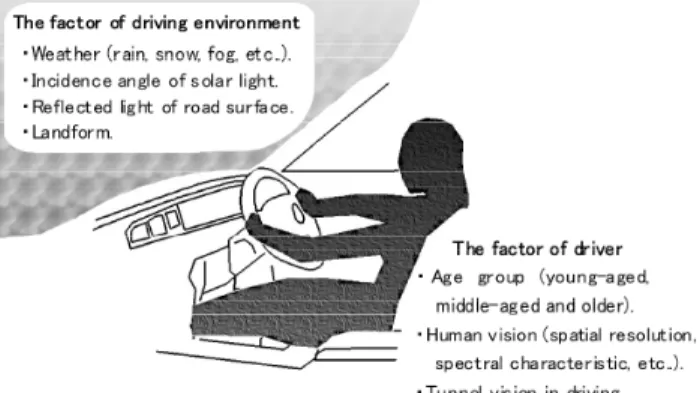
2. Current Status and Issues of Visibility in Rain When driving a car, it is essential to ensure clear forward view and check driving environment for safety. Visibil- ity factors can be divided into “driving environment” and
“driver’s visual functions” as shown in Fig. 1. Generally, in any driving environment, basic functions such as the driver’s eyesight and focusing among others greatly affect accurate understanding of objects in sight. When driving at night, night vision (inferior to static vision, significantly deterio- rated in the elderly) instead of static vision in normal day- time should be considered. In backlit driving environment, sensitivity to “brightness (called glare)” should be taken into account along with eyesight. It is also necessary to consider age variation of drivers because visual functions change with aging. The target driving environment of this study is visibility in rain. Raindrops (amount of rainfall) and wipers (wiping speed) need to be considered in evaluating
Fig. 1 Main factor of visibility in driving.
Copyright c2012 The Institute of Electronics, Information and Communication Engineers
the glass surface does not bring a clear view. While sweep- ing drops of water, wiper blades form a thin and smooth water sheet on the glass surface and ensure vision. If wiper blades form an uneven water sheet failing to sweep water drops, refraction of light hinders clear view.
The representative testing of wiper performance is de- scribed in JIS R 3212 “Testing method of safe windshield for automobiles” [9]. In this method, two forward view ar- eas, area A and area B, are set to evaluate forward view vis- ibility. In each area, wiping area ratio to satisfy the perfor- mance test is determined. Wipers are operated on a dirty windshield at their slowest speed and the wiped area is mea- sured by visual observation. In order to pass this test, over 98% of area A and over 80% of area B must be cleared. In high-speed driving, a similar test is done and over 98% of area A is required. It is obvious, therefore, that traditional wiping performance tests are done by visual observation and they are not quantitative. In addition, in such a test, only a physically wiped area can be confirmed and it is hardly an evaluation of visibility concerning rainfall amount and wip- ing motion. Establishing a quantitative evaluation method of visibility in rain will lead to improvement of wipers and development of a new wiper system. Moreover, because el- derly drivers are increasing in number today, it will bring about a wiper system that gives good visibility to both young and old people. It is beneficial to include the driver’s visual functions in visibility evaluation.
3. Proposed Method for Evaluation of Wiper
3.1 Basic Concept
In a laboratory equipped with a raining simulation system, a single-frequency rectangular-wave background board is set in front of the test vehicle and wipers are operated in falling rain. A camera set at the driver’s eyesight position takes movies of the forward view. The movie is analyzed with image processing and a system to evaluate wiping perfor- mance will be proposed. This system can evaluate visibility considering the amount of rainfall and wiping motion as ex- plained in earlier section.
Note that driver’s visual functions in this study do not include difference in how objects appear depending on age.
Figure 2 shows outline of the system.
Of the basic visual functions of the driver in examin- ing visibility, the function related to “eyesight” is the most important. That is because it is the base of safe driving to recognize traffic lights and signs from a distance and under- stand their content while driving. The easiness of recog-
Fig. 2 Outline of system for evaluating wiping performance.
Fig. 3 Sample of spatial frequency and contrast (Contrast Sensitivity Function chart).
nizing traffic lights and signs (visibility) largely depend on
“resolution (detail-ness)” and “grades of light (luminance),”
which correspond to “spatial frequency” and “contrast” in images taken by a camera. By considering these two factors, easiness of seeing objects (visibility) can be quantitatively measured. Figure 3 shows samples of spatial frequency and contrast in an image. Spatial frequency in an image refers to the interval of luminance variation. Smaller intervals and finer waves mean higher spatial frequency. Contrast in an image refers to the width of luminance variation. More clearly light and dark waves with larger difference in lumi- nance mean higher contrast.
In order to evaluate wiper performance with these im- portant visual features, a background board with a regular simple frequency pattern is placed in front of the test ve- hicle in the wiper performance evaluation system in Fig. 2.
When images of the forward view are taken while wipers are in motion in raining environment, the spatial frequency and contrast of the board change because they are affected by raindrops on the windshield. Based on the original spatial frequency and contrast of the background board, variations are measured and analyzed through image processing. In this way, quantitative evaluation of wiper performance from
Fig. 4 Samples of 2D-DFT.
the aspect of visibility can be achieved. One factor to note is that the forward view visibility is also affected by rain- drops that exist between the windshield and the background board. In this study, wiper performance is defined as the im- provement rate of forward view visibility by wiping motion in raining environment. Therefore, the focus is on the visi- bility change caused by wipers sweeping away raindrops on the windshield.
3.2 Analysis on Spatial Frequency
In an analysis by spatial frequency, we pay attention to am- plitude (power) of each spatial frequency of an image, and examine those changes caused by attached raindrops. When the pixel luminance level in each image position (x, y) is de- fined as f(x, y), amplitude componentsF(kx,ky) and power of each spatial frequencyPs(kx,ky) can be calculated by the following formulas.
F(kx,ky)=
f(x, y) exp{−j2π(kxx+kyy)}dxdy (1) Ps(kx,ky)=F(kx,ky)F(kx,ky)=|F(kx,ky)|2 (2) These are two-dimensional Fourier transformation formulas for an image. Power of each spatial frequency in an image can be obtained by carrying out one-dimensional Fourier transformation for the horizontal direction (x) and the verti- cal direction (y) respectively.
Figure 4 shows samples of two dimensional Fourier transform. Center of the output image is power of zero- spatial frequency. By looking at the relative location of each pixel with luminance from the center, wave direction and frequency of the input image can be obtained, and the lumi- nance value tells the amplitude. Then, a quantitative evalua- tion of the wiping performance becomes possible by catch- ing disorder of the wave generated by attached raindrops as a change in the power of each spatial frequency.
3.3 Analysis on Contrast
In an analysis by contrast, we pay attention to local contrasts in the overall image, and examine those changes caused by
Fig. 5 Sample of local area contrast.
attached raindrops. When the maximum luminance in a lo- cal domain is defined asLmax, minimum luminance asLmin, contrast in the local domainC(x, y) can be obtained by the following formula.
C(x, y)= Lmax−Lmin Lmax+Lmin
(3) Figure 5 shows sample of calculated local contrast. Input image is a horizontal sine-wave image with contrast decreas- ing towards the top. Based on the frequency of the input image, a local area is determined as 3 pixels ony and 15 pixels on xneighborhood. The local area was moved by one pixel, and the local contrast in each area was calculated in the whole area of the input image. The local contrasts in the whole input image were made into an output image.
In the output image, the contrast beautifully decreases from bottom to top.
When the background board has a striped pattern, the local area contrast indicates a value high in the whole area.
Therefore, a quantitative evaluation of the wiping perfor- mance becomes possible by catching decreased contrast caused by attached raindrops.
4. Verification Experiment
4.1 Experimental Method
We experimented to verify a quantitative evaluation of the wiping performance by the proposal method based on visi- bility. The visibility changes responding at amount of rain- fall and speed of the wiper, then we tried analyzing under various conditions to assume them to be a parameter.
A camera was set in the position of the driver’s view- point in a test vehicle in a laboratory with simulated rain- ing environment. The background board was set 3 meters from the camera as in Fig. 6. The background board had mono-color simple short wave of 1.3 cycle/degree spatial frequency. Images of the forward view under the following experimental conditions were taken and analyzed.
1) amount of rainfall: 0 mm/h, 7.9 mm/h (drizzle), 30 mm/h
Fig. 6 Configuration of our experiment, a car and a background board in a laboratory.
Table 1 Subject’s data.
(medium), 55 mm/h (heavy)
2) speed of wiper: 0 Hz, 0.43 Hz (Int), 0.86 Hz (Low), 1.2 Hz (High)
horizontal illuminance in the room: 300 lux average luminance of background board: 43 cd/m2
Intermittent wiping is equal in the motion speed to low- speed wiping but with half the wiping frequency.
Moreover we questioned about visibility of images of the forward view, and compared the results with the results of the analysis. Images used to question are 17 images of drizzle rain, 15 images of medium rain, and 10 images of heavy rain. They are different between of the amount of raindrops in each condition, and we presented them to sub- jects at random. Subjects of the questionnaire are shown in Table 1. Subjects saw them, and evaluated each image by 13 stages, from minus 6(when wiper is unnecessary) to plus 6(when wiper is surely necessary).
4.2 Experimental Results
4.2.1 Analysis on Spatial Frequency
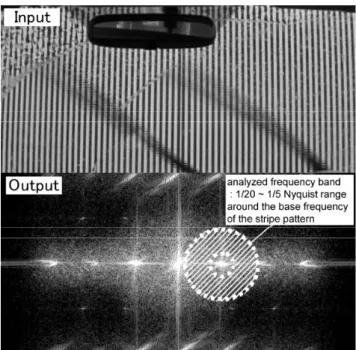
Figure 7 shows the sample of analytical image. Spatial fre- quency to be analysed was in range from 1/20 to 1/5 Nyquist around the base frequency of the stripe pattern marked with the circles on Fig. 7. We integrated the power of each spa- tial frequency in this analysed frequency, and examined its chronological change. The power of the analysed frequency is large when raindrops adhere to windshield and the striped pattern of the background board is distorted, and visibility on spatial frequency is bad.
Figure 8 shows variations with time (10 sec) of power of the analysed frequency of intermittent wiper. The result such as an increase in power of the analysed frequency by attached raindrops and decrease in power of the analysed frequency by wiping was confirmed.
Fig. 7 Pair of images of forward view from driver’s seat and its 2D Fourier space image.
Fig. 8 Variation with time of the power of analysed frequency of intermittent wiper.
Here, power of the analysed frequency in each condi- tion and time is defined as Ps(t). Power of the analysed frequency with the best view in each precipitation amount as Psmin, and power of the analysed frequency with the worst view when the front glass is covered with raindrops asPsmax. Wiping rateWP(t) affected by spatial frequency is defined as in the following formula.
WP(t)= Psmax−Ps(t) Psmax−Psmin
(4) We calculated wiping rate by the spatial frequency of all experimental conditions by this formula. Figure 9 shows average of the wiping rate by spatial frequency under all ex- perimental conditions. It indicates general decrease of wip- ing rate as precipitation amount increases.
However, in medium rain, there was not much change in time. Moreover, wiping rates of the drizzle rain and the medium rain did not have a big difference, though the amount of rainfall of the medium rain was larger than that of the drizzle rain. The reason seems to be that very fine raindrops in medium rain clouded the whole view as in a
Fig. 9 Average of wiping rate under all experimental conditions (spatial frequency).
Fig. 10 Pair of images of forward view from driver’s seat and its contrast image.
fog, which caused little change in the spatial frequency of the background board.
4.2.2 Analysis on Contrast
Figure 10 shows the sample of analytical image. Because the background board has a continuous rectangular wave with horizontal high contrast in a good viewing condition, 3 pixels onyand 7 pixels onxneighborhood was taken for calculation of local contrast. The local area was moved by one pixel, and the contrast of the local area was calculated in the whole area. When raindrops don’t adhere, the con- trast of the local area has a high value in the whole area be- cause of the striped pattern of the background board. Based on this high contrast when raindrops don’t adhere, we inte- grated amounts of a decrease in contrast of the local area in the whole area caused by adhesion of raindrops. We calcu- lated average of the decreased contrast per pixel, and exam- ined its time transition. The decreased contrast is large when
Fig. 11 Variation with time of the decreased contrast of intermittent wiper.
Fig. 12 Average of wiping rate under all experimental conditions (contrast).
raindrops adhere to windshield and the windshield becomes cloudy, and visibility on contrast is bad.
Figure 11 shows variations with time (10 sec) of de- creased contrast of intermittent wiper. This result shows de- crease of contrast caused by attached raindrops and recovery of high contrast due to wiping.
As in the evaluation by spatial frequency, wiping rate WC(t) by contrast is defined as in the following formula.
Average contrast in each condition and time frame is rep- resented byC(t), average contrast in the best viewing con- dition in each precipitation amount byCmax, and average contrast in the worst viewing condition byCmin.
WC(t)= C(t)−Cmin
Cmax−Cmin
(5) We calculated wiping rate by the contrast under all ex- perimental conditions by this formula. Figure 12 shows av- erage of the wiping rate by contrast under all experimen- tal conditions. The result of the wiping rate’s greatly de- creasing in medium rain was shown unlike the result by the spatial frequency. Small raindrops like the fog in medium rain apparently clouded the whole view to equalize bright- ness more than big raindrops in the heavy rain. As a result, it is thought that the contrast of medium rain decreased as greatly as the heavy rain, though the amount of rainfall of the heavy rain was larger than that of medium rain.
Fig. 13 Average of wiping rate under all experimental conditions (spatial frequency and contrast).
Fig. 14 Average of evaluation value in each image of all subjects (Comparison between youths and seniors).
4.2.3 Overall Evaluation of Visibility
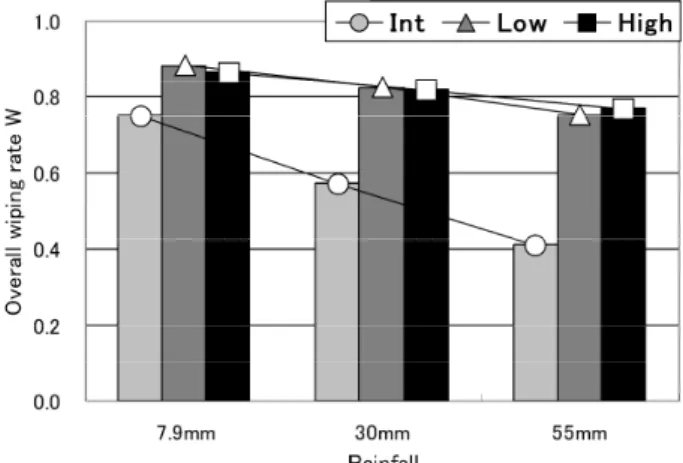
When wiping rate by spatial frequency is compared with that by contrast, different results were obtained because of dif- ferent raindrop conditions. This suggests that it is necessary to examine visibility in terms of both spatial frequency and contrast. If either ofWPorWCbecomes “0”, overall wiping rateWbecomes “0”, which means the “unable to see”.
Therefore,W is defined as in the following formula of multiplication, using wiping rates by both spatial frequency and contrast.
W =WP×WC (6)
Figure 13 is a graph of overall wiping rate under all conditions. The result showed that visibility decreased as precipitation amount increased.
4.2.4 Comparison with Result of Questionnaire
Figure 14 shows average of evaluation value in each image of all subjects. Image numbers of X axis of the graph were assigned to each image used to questionnaire. The larger the image number is, the more raindrops are included in the image. All subjects wanted to move the wiper as the amount
Fig. 15 Comparison between result of analysis and result of questionnaire.
of raindrops increases. And, there was a great divergence in the result among seniors and youths. In all conditions, seniors wanted to wipe raindrops at a stage that was earlier than young people.
Figure 15 shows a result of comparing the result of evaluation by questionnaire with the result of analysis by proposed method. In the graph, the result of questionnaire was normalized so that “−6” and “+6”of the result of ques- tionnaire may become “1” and “0” respectively. This result shows that wiping performance can be evaluated with a fair degree of precision by the proposed method in respect of visibility. However, in the situation in which raindrops had began to adhere, there were slightly different between result of the analysis and result of the questionnaire. It is thought to be due to the differences between subject impression and adherence position of raindrops.
Moreover, some difference was always seen in the re- sult of medium rain. It is considered that the decrease in the contrast by misty rain is perceived as a bigger decrease in visibility on human’s sense.
4.3 Discussion
Spatial frequency and contrast variation of forward visibility due to influence of raindrops and wipers were analyzed and wiping rate in each precipitation amount and wiping speed was calculated and compared. Visibility decreased as pre- cipitation amount increased, and higher visibility was main- tained with low and high speed wipers than with intermit- tent wiping. Therefore, it was confirmed that this method enables quantitative evaluation of wiper performance.
No significant difference was observed between the analysis results of low speed wipers and high speed wipers in this experiment. There is a possibility in high speed wiping that the wiping rate may greatly change with much more rain such as typhoons. Under normal rain, however, it is assumed that attached raindrops and high speed wiping equally disturb visibility, which means that it is highly pos- sible that enough visibility can be maintained by low speed wiping.
In order to find the best wiping speed for good visibil- ity, it is necessary to include decrease in visibility by motion
of wipers in the evaluation. In this study, high frequency fac- tor of wipers when they momentarily stop in repeating mo- tion appeared as instantaneous rise in output and it affected the evaluation result. On the other hand, there was no big difference caused by motion of wipers in contrast. The main reason for this was that it was an evaluation of the whole view. The decrease in visibility by the motion of wipers is partial. Therefore, evaluation of location-dependent partial visibility is needed for the evaluation of visibility including the motion of wipers. Quantitative evaluation including vis- ibility decrease by motion of wipers, as well as evaluation method of location-dependent partial visibility, is worth fur- ther research.
5. Conclusion
This study proposed a quantitative evaluation method of wiper performance under raining condition based on visi- bility. The method focuses on such two visual features as spatial frequency and contrast. In the proposed evaluation system of wiper performance, a background board was set in front of a test vehicle in the laboratory, movies of forward views while operating wipers in rain were taken, and they were analyzed by image processing. Precipitation amount and wiping speed in the laboratory were used as parameters when movies were taken. Variations in spatial frequency and contrast of the obtained images were analyzed and wip- ing rate was defined and calculated. We questioned con- cerning visibility, and compared the result with the defined wiping rate. As a result, it was confirmed that quantifica- tion of visibility that changes with precipitation amount and wiping speed is possible and that the proposed evaluation method in addition to the traditional qualitative method was useful.
Some further research issues are to find the best wip- ing speed, development of an evaluation method to examine different wiper performance due to kinds and deterioration level of wipers, and so on. In addition, we would like to propose an evaluation method considering visual functions of not only general but also elderly drivers. We hope to find solutions for these issues and to establish a practical evalua- tion system of wiper performance.
References
[1] JSAE: Handbook of Automotive Engineers, chapter of design and body, pp.157–161, 2004. (in Japanese)
[2] T. Yano and T. Sakurai, “Testing and measurement method of visibil- ity performance,” J. JSAE, vol.48, no.3, pp.37–42, 1994. (in Japanese) [3] R. Suzuki and K. Yasuda, “Chatter vibrations of an automotive wiper:
1st report, modeling of a one arm wiper and the vibration character- istics,” Trans. Jpn. Soc. Mech. Eng., vol.66, no.641, pp.31–37, 2000.
(in Japanese)
[4] R. Suzuki and K. Yasuda, “Chatter vibrations of an automotive wiper:
2nd report, quenching of chatter vibrations by harmonic excitation normal to sliding surface,” Trans. Jpn. Soc. Mech. Eng., vol.66, no.644, pp.1110–1115, 2000. (in Japanese)
[5] Y. Yukiho, Y. Ohashi, M. Ishikawa, I. Teshirogi, M. Sakakibara, and A. Aoki, “Windshield wiper motor noise reduction,” J. JSAE, vol.51,
no.2, pp.24–29, 1997. (in Japanese)
[6] S. Okura, T. Oya, and S. Shimizu, “Complete 3D dynamic analysis of blade reversal behavior in a windshield wiper system,” Trans. JSAE, vol.34, no.4, pp.131–138, 2003. (in Japanese)
[7] S. Okura, T. Oya, and S. Shimizu, “Optimum design of windshield wiper blade for vehicle using nonlinear programing,” Trans. JSAE, vol.35, no.2, pp.159–165, 2004. (in Japanese)
[8] K. Kaminaga, Y. Hurukori, T. Komoriya, and K. Takada, “Study of CAE application for developments of wiper and washer performance,”
Subaru Technical Review, no.30, pp.205–209, 2003. (in Japanese) [9] JIS R 3212, “Testing method of safety windshield of vehicle,” 1998.
(in Japanese)
Takashi Kitayama received the B.E. and M.E. degrees in Department of Information Engineering from Meijo University, Nagoya, Japan, in 2008 and 2010, and he has now en- gaged in the research on the performance evalu- ation of the wiper in the postgraduate course in the postgraduate course of Science and Technol- ogy in Meijo University, Nagoya, Japan.
Mikiko Kawasumi received the B.S. degree in Mathematics from Tsuda College in 1988 and Ph.D. degree from Interdisciplinary Grad- uate School of Science and Engineering, Tokyo Institute of Technology in 2008. She joined Toy- ota Central Research and Development Labo- ratories, Inc. in 1988 and has been engaged in the research and development of color vision for industrial inspection and design of the vehicle.
She became a full-time lecturer at the Faculty of Culture and Creativity, Aichi Shukutoku Uni- versity in 2000, an associate professor in 2002 and a professor in 2009. In 2011 she was transferred to Faculty of Science and Technology, Meijo Uni- versity as an associate professor. Currently, she is studying on information design methods based on human feeling.
Hatsuo Yamasaki received the B.E. de- gree in electrical engineering from Meijo Uni- versity, in 1971, and the Dr. Eng. degree in In- formation System Engineering from Meijo Uni- versity, in 2006. Since 1971, he worked with the computer room. Since 1984, he has been with Graduate School of Science and Technol- ogy from Meijo University, as an Assistant, and a Lecturer. Since 2003, he has been with the Center for Computers and Information Technol- ogy, Meijo university, as an Associate Professor, and Professor. His research interests and activities include the human in- terface of the vehicle (Display Method of In-vehicle Display System Based on Reduction in aged Visual or Auditory Function), Information Education and e-Learning. He is a member of IEEJ, JSAE, JSiSE, JSET and etc.
interface on the vehicle. He became an Profes- sor of Meijo University, Nagoya, Japan. Cur- rently, he is working on a display method and a warning method for elder while driving.
Shin Yamamoto received the B.E. degree in Electrical Engineering from Gifu University, Gifu, Japan, in 1965 and the D.E. degree in Electrical Engineering from Nagoya University, Nagoya, Japan in 1984, respectively. He joined Toyota Central Research and Development Lab- oratories, Inc., Aichi-ken, Japan, in 1965. Since then, he has been engaged in research and devel- opment of machine vision for FA and ITS sys- tem. Since 1998, he has been a Professor in the Information Science Department, Meijo Univer- sity, Nagoya, Japan. His current interests include human-machine interface in automobiles.
Muneo Yamada received the B.E. degree and the M.E. degree from Meijo University, Na- goya, Japan in 1989 and 1997 respectively, and the Ph.D. degree from the Aichi Prifectural Uni- versity, Japan in 2006. From 1990 to 2007 he joined Nagoya Electric Works Co., Ltd. Since 2008, he has been an Associate Professor of the Department of Information Engineering, Fac- ulty of Science and Technology, Meijo Univer- sity, Nagoya, Japan. His research interest in- cludes image processing and image understand- ing on intelligent transportation system. He is a member of IPSJ, IEEJ, JNNS and JSAP.
Yuta Doi ASMO Co., Ltd. engineer of de- velopment dept from 2006. He has researched and developed wiper-system products for auto- motive. He is a member of JSAE.