INVITED PAPER Special Section on Challenged Networking Technologies and Its Service Quality
Towards Practical Store-Carry-Forward Networking: Examples and Issues
Masato TSURU†a),Member, Mineo TAKAI††,Nonmember, Shigeru KANEDA††,Member, Agussalim†,Student Member,andRabenirina AINA TSIORY†,Nonmember
SUMMARY In the evolution of wireless networks such as wireless sensor networks, mobile ad-hoc networks, and delay/disruption tolerant networks, the Store-Carry-Forward (SCF) message relaying paradigm has been commonly featured and studied with much attention. SCF network- ing is essential for offsetting the deficiencies of intermittent and range limited communication environments because it allows moving wireless communication nodes to act as “mobile relay nodes”. Such relay nodes can store/carry/process messages, wait for a better opportunity for transmission, and finally forward the messages to other nodes. This paper starts with a short overview of SCF routing and then examines two SCF networking scenarios. The first one deals with large content delivery across multiple islands using existing infrastructural transportation networks (e.g., cars and ferries) in which mobility is uncontrollable from an SCF viewpoint. Sim- ulations show how a simple coding technique can improve flooding-based SCF. The other scenario looks at a prototype system of unmanned aerial vehicle (UAV) for high-quality video surveillance from the sky in which mobility is partially controllable from an SCF viewpoint. Three requisite techniques in this scenario are highlighted – fast link setup, millimeter wave communications, and use of multiple links. Through these examples, we discuss the benefits and issues of the practical use of SCF networking-based systems.
key words: store-carry-forward, vehicular ad-hoc networks, wireless sen- sor networks, UAV, delay tolerant networks
1. Introduction
To support the growing and diversified application require- ments for computer and communications networks, wire- less networking technologies have evolved from different aspects such as wireless sensor networks (WSN), mobile ad-hoc networks (MANET) in general (Vehicular ad-hoc networks (VANET) in particular), Inter Planetary networks (IPN), and delay/disruption tolerant networks (DTN) over recent decades. With this evolution, the store-carry-forward (SCF) message relaying paradigm has been commonly fea- tured and studied with much attention. SCF networking allows moving wireless communication nodes to act as “mo- bile relay nodes” that can store/carry/process messages, wait for a better opportunity for transmission, and forward the messages to other nodes; this is of practical and/or essential use in intermittent and range limited communication envi-
Manuscript received June 3, 2016.
Manuscript revised August 26, 2016.
†The authors are with Graduate School of Computer Science and System Engineering, Kyushu Institute of Technology, Iizuka- shi, 820-8502 Japan.
††The authors are with Space-Time Engineering, LLC (STE), Rolling Hills Estates, CA 90274, USA.
a) E-mail: [email protected] DOI: 10.1587/transcom.2016CQI0001
ronments.
Rapidly growing mobile telecommunications networks based on 3G and Long Term Evolution (LTE) attempt to cover a large part of all terrestrial residential areas. How- ever, by taking into account the continuous growth of mobile data traffic demands and the continuous expansion of service areas demands, accommodating all areas and all applications via stationary base stations is generally inefficient in terms of economical cost, energy consumption, and the use of wire- less frequency bands. This is because the demands will significantly change over time, e.g., hour by hour in a day, day by day in a week, or at a longer scale. In addition, we need independent alternative solutions for information net- working when stationary base stations are unavailable, e.g., in disaster situations. Therefore, simply relying on those infrastructural telecom networks in all possible scenarios can be inefficient, fragile, or sometimes infeasible. It can be seen that SCF networking is not only a useful tool in extreme environments but also a common complementary tool for making systems efficient and robust in usual envi- ronments, towards the upcoming internet of things and 5G wireless networks. For example, since the moving speed of relay nodes is generally lower than the propagation speed of wired or wireless communications, SCF networking may not be expected to help real-time communications. How- ever, a hybrid approach that integrates and simultaneously uses multiple types of networking allows SCF networking to be useful even with real-time communications.
SCF networking is one of the fundamentals of DTN technology that is for data communications in the presence of long delays and/or the lack of end-to-end connectivity not only due to disrupted and intermittent links but also in global networking over completely heterogeneous net- works[6]. The issues of DTN are ranging from naming and addressing, message formats, data encoding methods, rout- ing, congestion management, and security. The new DTN standardization activities in DTN WG/IETF has started to examine the following six use-cases to evolve the existing DTN specifications such as Bundle Protocol and DTN secu- rity related standards[33]: Space Systems Communications;
Unmanned Air Systems (UAS) in Integrated Air Space; Ve- hicular Delay Tolerant Networks; Disaster Response and Humanitarian Aid; Unmanned Underwater Vehicles (UUV);
and Civil Aviation.
In this paper, we introduce and examine two SCF net- working scenarios. The first one deals with large content Copyright©2017 The Institute of Electronics, Information and Communication Engineers
delivery across multiple islands using cars and ferries, as an example of SCF networking over existing infrastructural transportation networks, in which the mobility is uncontrol- lable from an SCF networking viewpoint. We show how simple coding techniques (erasure coding at source and net- work coding at relay nodes) can improve a flooding-based SCF through simulations with realistic Wi-Fi communica- tions and map-based mobility. The other scenario considers high-quality aerial video surveillance using UAV in which the mobility is partially controllable and intentionally col- laborative from an SCF networking viewpoint. We experi- mentally discuss three requisite techniques – fast link setup, millimeter wave communications, and use of multiple links.
The rest of this paper is structured as follows. Section 2 overviews the relation among VANET, WSN, and SCF net- working. Section 3 briefly explains the technical challenges in SCF networking. Section 4 discusses large content de- livery across multiple islands through simulation. Section 5 introduces a UAV prototype system in field experiments. The concluding remarks are given in Section 6.
2. VANET, WSN, and SCF Networking
VANET and WSN are two active technology areas to which SCF networking has been applied. VANET is a type of MANET but more specifically focusing on moving vehicle- based information networking. VANET comprises Vehicle- to-Vehicle (V2V), Vehicle-to-Roadside (V2R), and Vehicle- to-Infrastructure (V2I) communications, and was originally developed to benefit the drivers, passengers, and pedestrians in terms of safety applications and in-vehicle entertainments, for example. Because of its great potential, however, VANET is now being considered for different purposes. Although the infrastructural facilities for vehicles were deployed with their own purpose, we can borrow those resources and add some functions to provide WSN applications (e.g., weather monitoring and roadway surveillance by in-car cameras[9]) and message relaying for general-purpose use in new appli- cations leveraging information caching/processing on vehi- cles (e.g., data offloading[29], floating contents [14], and storage infrastructure[5]). All those can be considered as VANET-based cloud/edge computing. A recent survey paper on Vehicular cloud computing (VCC) technology introduced not only the applications for Intelligent Transport Systems such as safe- and eco-driving, efficient V2V communica- tions, traffic congestion control, and parking resource man- agement, but also other applications ranging from shopping mall data center to VCC technology in developing countries perspective[30]. Another report also classified the emerging VANET applications and provided a list of recent industrial and academic projects[18].
In VANET, in addition to MANET-based conventional instant routing schemes, SCF networking is needed when communication is disconnected as a result of vehicular move- ment. Vehicles (e.g., cars, buses, trains, and ferries) nor- mally have sufficient resources such as batteries, storage, computing power, and high-speed wireless communications
interfaces, with a good level of reliability and manageability.
Vehicle movements are controlled to achieve some purposes but not to optimally benefit information networking; thus the mobility of each vehicle is generally uncontrollable in terms of SCF networking. However, it is possible to pre- dict vehicular behaviors partially and statistically, e.g., the average number of cars travelling from an intersection to an- other intersection per hour as vehicular mobility is related to social activities that follow common patterns and rules.
In some cases, other travel schedules, e.g., the route and timing of a ferry, are also predictable. Therefore they have desirable properties to be a good relay node for SCF network- ing. In general, creating an SCF-based information network using existing infrastructural transportation facilities is ex- pected to be quick to deploy and low in cost compared with constructing a new wired/wireless network infrastructure, particularly in cases involving a sparse population, remote islands, developing countries, and disaster situations. A spe- cific example of the combination of a conventional VANET routing and SCF has been studied [25], in which a hybrid cooperative routing using Fountain coding was developed and experimentally evaluated in an emergency response sce- nario. SCF networking in VANET can also be integrated with infrastructural telecom networks in an effective manner (e.g.,[3],[31]).
In a smart-city setting, the mutual dependency or in- tegration of vehicle networks and urban Internet infrastruc- tures was described and discussed [8], which leads to the recent Internet of Vehicles concept. Emerging next gener- ation technologies such as connected autonomous cars and self-driving cars will require reliable V2V intra-group com- munications (e.g., among cars in a car platoon/swarm for mobility control), V2V inter-group communications (e.g., among cars or car platoons approaching an intersection for intersection safety), V2R location-dependent communica- tions (e.g., among cars and a roadside system for locally col- laborative control), and V2I global communications (e.g., among cars and a central system for centralized data collec- tion and globally optimized control), in which SCF network- ing will definitely play a collaborative role.
On the other hand, WSN is a networked system that monitors or senses distributed entities or areas. The name WSN represents not the type of node/environment but the purpose of the system, thus a VANET can be a WSN. Gener- ally, nodes in a WSN are collaborative because they usually have the same purpose and are under the same management.
In WSN, a looser concept of Store-Wait-Forward (SWF) was introduced for data relaying with intentional sleep and inci- dental down of neighbor nodes, in which data is stored for a longer time compared with conventional packet switching.
Data processing at a node during relaying (e.g., filtering, aggregation, or compression) can also significantly improve the efficiency of WSN.
By combining SWF and node mobility, SCF network- ing has been naturally introduced to WSN with diverse use- cases. The ZebraNet[15]project, for tracking a large num- ber of African zebras across a large region, constructed a
mobile ad-hoc WSN using SCF networking among zebras with global positioning system (GPS) sensors and stationary data collectors. Even when the sensing nodes are station- ary, using mobile data collector or mobile sink is useful;
DataMule[26]is an example of a mobile data collector that collects data from stationary sensor nodes. DistressNet[7]
is another example that supports disaster response via dis- tributed collaborative sensing for resource localization. In addition to terrestrial vehicle-based sensing (e.g., by cars), as mentioned previously, other new types of mobile sensing systems, such as those involving humans with smartphone, unmanned aerial vehicles (UAV), and field robots have at- tracted attention in recent years. For example, a recent study considered a WSN created by a group of mobile robots in the wild and highlighted some prospective applications[19].
3. Store-Carry-Forward Message Relaying
SCF networking is realized by forwarding messages among encountered mobile relay nodes by wireless communica- tions. This meeting is called “contact”. In SCF, although diverse performance metrics can be targeted (e.g., average delay, worst-case delay, success probability of delivery meet- ing a deadline, or time-averaged throughput), a common goal is how to relay messages from its source node to destination node(s) via multiple hops in a fast and reliable manner. In this process, the following major difficulties emerge; (i) a limited and uncontrollable/unpredictable chance of contacts between nodes because of node mobility; (ii) a limited num- ber of messages that can be forwarded in one contact, i.e., a limited time of one contact and a limited data rate of the wire- less communication link between contacted nodes, depend- ing on moving speed and wireless communication range/data rate; and (iii) little or no global network status information being available in a timely manner to optimize end-to-end delivery. Replication (copy) of each original message is a simple but needed mechanism in response to (i). However, it inherently wastes resources, and thus if the number of copies of original messages in the network becomes large, a bottleneck appears in (ii) and/or a “congestion” happens in terms of buffer storage. This leads to useless forwarding and carrying of copies of messages that will be deleted on the way, which is a distinct problem of SCF networking.
A decision on storing, replicating, forwarding, or delet- ing messages at each node is called “routing” in a wide sense;
a relay node is an SCF router. When considering the hurdles discussed in (i), (ii), and (iii), purely non-deterministic SCF routing is the most challenging and has attracted the most attention to date. However, from practical viewpoint, a type of determinism or predictability may help SCF routing.
As shown in Fig. 1, there are seven factors affecting per- formance of SCF. The message generation rate (1) and the copy policy (2) — such as single (no copy), limited (deter- ministic and probabilistic), and unlimited — directly impact the intensity of the message traffic in the network. A packet- level coding can be an intelligent copy instead of simple replication. The buffer size (3) determines how many mes-
Fig. 1 SCF routing performance factors.
sages can be temporally stored in a relay node, and this affects the number of messages that can be received and/or be sent in a contact with another node. The forwarding policy (4) includes the selection of messages stored in the buffer to be sent to a contacted node and the sending order of those messages such as first-in-first-out (FIFO) and random order- ing. Messages in the buffer are deleted according to the drop policy (5) in place for giving free space to new messages;
time-to-live (TTL) expiration, an acknowledgement from the message destination, and other buffer management rules such as drop-oldest are used. The wireless link properties (6) such as the data rate and the communication range in conjunction with the node mobility (7) determine the contact interval, the contact duration of one contact, and thus the number of messages to be exchanged in one contact.
Epidemic routing (EP) is the simplest flooding-based SCF routing protocol[28]. EP simply replicates and sends a message to any newly encountered node that does not have a copy of the message. It is known that EP performs best both in terms of delay and reliability in the case of unlimited resources. However, EP does not perform well in the case of limited resources because too many nodes will have the same messages, subsequently resulting in a long delivery delay. If storage congestion occurs, limited replication with aggres- sive deletion of messages should be performed. Limited replication can be realized deterministically (e.g., [27]) or probabilistically (e.g.,[22]). Packet-level coding techniques such as Network Coding (NC) are helpful to mitigate the inefficiency of duplication in storage constrained situations (e.g.,[12],[20],[32]).
If the number of messages that can be forwarded in one contact is low, an appropriate forwarding policy is impor- tant. In such cases, more intentional and intelligent routing based on collected, estimated, and/or pre-assumed informa- tion may perform well to achieve a specific objective, pro- vided the information being used is reliable, i.e., correct and updated. However, if the information is unreliable, any in- tentional optimizations may become inappropriately biased and thus perform poorly. In fact, environments in which non-deterministic SCF networking is applied are often char- acterized by uncertainty. In such cases, any estimations and pre-assumptions are not always reliable. In addition, unreli- able information may be disseminated by accidental opera- tional mistakes or even malicious intent in real-life systems.
Therefore, too much optimization does not always work well
and is not necessarily good in terms of the robustness. The use of control messages can also be expected to improve per- formance, but these messages consume limited resources.
For example, an acknowledgment from a message destina- tion can delete unnecessary copies in a network [11]. A trade-off between stateful and stateless routing in relation to route stability and link stability has been analyzed[21].
There are as many sophisticated routing schemes (protocols) for non-deterministic SCF as there are for MANET. This reflects the fact that there is no single typ- ical set of conditions, requirements, and performance pre- diction/evaluation methods. MaxProp[4], ProphetV2[10], RAPID[2], and HBSD[17]are some well-known examples.
Since social ties are expected to significantly impact on hu- man mobility, social-aware SCF routing schemes have also been studied (e.g.,[13]). A survey work[23]classified non- deterministic SCF networking into four — dissemination- based, context-based, fixed infrastructure-based, and mobile infrastructure-based. A more comprehensive classification can be found in another survey paper[16].
4. Large Content Delivery Across Multiple Islands We consider large content delivery across multiple islands, called the island scenario, in which the source and destination nodes are located in separate areas (i.e., islands) connected by limited inter-area relay nodes (i.e., ferries). The ferry periodically shuttles between the ferry terminals at both is- lands and will become a bottleneck for end-to-end delivery because it is the only way to carry messages between the islands. More specifically, the messages left behind must wait for the next ferry, which may take a substantial amount of time. For efficient use of the ferry transportation, even if cars have a small buffer, the ferry and the ferry terminals as stationary gateway should have a very large buffer. All messages generated at the source node should be carried by cars and forwarded to and accumulated at the ferry terminal where the ferry will pick them up upon arrival. Then, on the other-side island, those messages carried by the ferry will be accumulated at the other ferry terminal to wait for cars to carry and forward them to the destination.
In such situation, a simple flooding by original Epi- demic Routing (EP) has two clear drawbacks if the buffer size of cars as relay node are small. The first one (a) is frequent and inefficient message deletions during the con- tact of two relay nodes on the way. Since the buffer may likely be full in both nodes, message deletions happen un- less two nodes have the same set of messages. The other drawback (b) is an unnecessary inverse-direction forward- ing at the ferry terminal. A large number of messages stored at the ferry terminal will be forwarded to a contacted car which does not contain those messages. To solve them, we proposed a combination of hop-count-based forwarding and location-dependent remaining TTL consideration[1].
In this section, we show a quantitative and case-specific evaluation on erasure coding at source node (denoted by SC hereinafter) and network coding at relays (denoted by
NC) in response to the issue(a). In realistic simulations by Scenargie [34], we used its EP/DTN module on TCP and 802.11g (2.4 GHz) Wi-Fi with the maximum propagation range of10/100m. For issue(b), we modified the EP module so that the inverse-direction forwarding was prohibited.
4.1 Simulation Settings
As shown in Fig. 2, two separate islands are connected to each other by a ferry travelling back and forth from one island to another, delivering messages from station A to station B. On the larger island, one static source node, station A, and 9 cars as relay node (responsible of relaying messages from the source to the station) exist. On the smaller island, one static destination node, station B, and 5 cars exist. The topology used here is based on a real situation in Indonesia.
A large file is divided into 100 messages at the source and sent to the destination. Each message has a size of 50 KB.
To investigate the delivery delay of an entire file, we set the message TTL infinite. Each car has a buffer storage of30,50, or70messages dedicated to this file and runs along narrow roads on the islands at a random low velocity between 4 [m/s]
and 8 [m/s].
For both of SC case and NC case, we use Random Linear Network Coding (RLNC)[32]with systematic coding on a certain small Galois Fields, although SC can use a more strict erasure correcting coding such as Reed-Solomon Coding. In SC, the source node generates an additional coded messages and the relay nodes only replicate and forward the messages to the next nodes. In NC, the relay nodes also combine
Fig. 2 Simulation area for the island scenario.
Fig. 3 Average delivery delay performances with different buffer sizes:
Wi-Fi range is 100 m (top) and 10 m (bottom).
multiple messages in its buffer to re-encode and create a new coded message to be forwarded to the next nodes. To indicate how redundantly the source node generates coded messages, SC_1.2 and NC_1.2 represent that100 original messages and20 encoded messages are generated, and SC_1.5 and NC_1.5 represent that100original messages and50encoded messages are generated at the source. Scenargie simulator version 2.0 was used to implement EP, SC, and NC with Drop-oldest algorithm as a way of dropping messages when the buffer storage is full.
4.2 Simulation Results
Figure 3 represents the average delivery delay times with dif- ferent buffer sizes when the maximum propagation range of Wi-Fi module of a node is 100 m and 10 m, respectively. The advantage of NC to SC and EP is shown in terms of a lower average delay especially in small buffer cases, and the per- formance difference decreases as the buffer size increases.
Compared with SC_1.2, SC_1.5 is slightly better because a larger variation of messages in SC_1.5 at the source may lower the probability that relay nodes contain the same mes- sages. Comparing the top and the bottom in Fig. 3, for all cases with one exception (EP with buffer size 30), the per- formances with the longer range of100m are shown to be better than those with the shorter one of10m. That is be- cause a larger Wi-Fi range augments the probability of node contacts and thus the circulation of more messages. Figure 4 is a scatter graph representing the ratios of the delivery delay time of SC and NC to that of EP in different node mobility patterns (i.e., simulation instances), respectively. Here we use SC_1.2 and NC_1.2. This figure also indicates the ad-
Fig. 4 Delivery delay time ratios of SC/NC to EP in different node mo- bility patterns with different buffer sizes.
Fig. 5 Increase of the normalized number of messages delivered to the destination by EP, SC, and NC through time in two mobility patterns.
vantage of NC to SC and EP in terms of the delivery delay time of individual instances.
Figure 5 represents the increase of the normalized num- ber of delivered (unique) messages at the destination in two mobility patterns as time passes. The file decoding comple- tion times by SC_1.2 and NC_1.2 are indicated respectively on each graph. Note that EP had not received100messages to retrieve the original file at the end time of those graphs.
The ferry arrival times at the destination island are also plot- ted. At any-time there are more messages delivered to the destination by NC, SC, and EP in this order. However the weakness of RLNC is also seen. In one case (Fig. 5, bottom)
using NC, the first100encoded messages which arrived at the destination were linearly independent and the file was decoded immediately at that time. In the other case (Fig. 5, top) using NC, however, more than160messages were re- quired to receive the first100linearly independent messages at the destination. In addition, those figures indicate too many message exchanges in NC cases. This is because mes- sages exchanges occur even though those exchanges do not increase the rank of an encoding matrix at the receiver. A suppress method using nullspace-based stopping conditions [12]is expected to mitigate this issue.
5. Wild Surveillance Using UAV
The ability to even partially control the mobility of network nodes in the system can significantly increase the flexibility and effectiveness of configuring the communication subsys- tem. However, those mobile nodes often play multiple roles in the system, and the full controllability of node mobil- ity does not necessarily imply that they can move or stay still only for the sake of establishing communication links.
For instance, the primary function for remotely controllable vehicles such as Unmanned Ground Vehicles (UGVs) and Unmanned Aerial Vehicles (UAVs) tends to be physically carrying and forwarding logistics, or collecting various sens- ing data in the target area; relaying data in the network would likely be their secondary function. Therefore, even if their mobility can be fully controlled, extra mobility or staying still for communication purposes must be minimized. Fur- ther, as those mobile nodes are likely equipped with a GPS, an imagery sensor, or both for remote controllability, they are also data sources. In particular, the advancements of im- agery sensor technology have realized super high resolution video streaming, but they have also significantly increased the size of data necessary to transmit by the communication subsystem. For instance, a commonly used camera device mounted on our UAV platform described later in this section generates imagery data at a rate of approximately 3.6 MB/s with a typical setting, which exceeds 1.0 GB in only less than 5 minutes. This rate of data generation is more than the maximum transmission rate achievable by a commonly used IEEE 802.11a/g device. In other words, those wireless devices cannot transmit the data generated on the vehicle to the ground in a real time fashion. Therefore, storing, car- rying and forwarding data may be necessary even if mobile nodes have wireless communication links that are almost always connected to the network. Given these issues, it is highly important to maximize the utility of available commu- nication links even if the mobility of network nodes can be controllable. Several candidate techniques to address these issues are described below:
• Fast link setup
A significant amount of time is usually spent on a hand- shaking protocol when establishing a communication link before starting the actual data transmission. This is not a critical problem with a wired link whose lifetime is much
longer than the initial link setup time. However, it is highly critical for short-lived wireless links that compose an SCF based network, particularly when communication opportu- nities are highly limited. One of the attempts to reduce this initial link setup time can be found at Task Group AI of the IEEE 802.11 Working Group [35]. It is at the final stage of standardizing its fast initial link setup procedure for the IEEE 802.11 devices.
• Millimeter wave communication
Once a communication link is established, it is highly important to be able to transfer as much data as possible.
While throughputs achievable by recent IEEE 802.11 de- vices operated at 2.4 or 5 GHz are substantially better than by those on the market about a decade ago, their perfor- mance may still be suffered by various sources of interfer- ence as well as contentions with other communication links nearby. The IEEE 802.11ad [36]operated at 60 GHz may offer an alternative medium to provide a communication link that can yield over 1 Gb/s with little interference and fewer contentions. Please note, however, that their communication range is very short, and some amount of detouring by mobile nodes may become necessary to establish millimeter wave communication links.
• Use of multiple links
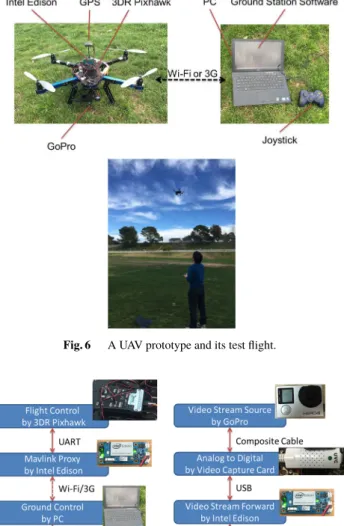
It is increasingly likely that mobile nodes have multiple communication devices to be able to utilize on board. When their capabilities (e.g., data rate and communication range) are highly disparate, one good approach would be to utilize them individually for different purposes. For instance, if a mobile node is equipped with a Wi-Fi card and a 3G cellular module, original imagery data can be transferred via high data rate but short range Wi-Fi in an SCF manner, while data transcoded to a lower resolution can be transmitted via low data rate but long range 3G. When capabilities of multiple devices are similar, they can be used together to transmit the same data to multiple destinations, or to the same destination faster by aggregating multiple links to form a single but faster communication link. In order to physically test and evaluate these techniques described above, a UAV prototype system shown in Fig. 6 has been built. As shown in the figure, the system is comprised with a UAV itself and a PC based ground control station. The UAV is built around an Intel Edison[37]
computing module, with a u-blox GPS module [38]and a 3DR Pixhawk flight controller[39]to form its flight control subsystem, and a GoPro camera device[40]with a gimbal, and a UVC video capture card to form its imagery subsystem.
Its primary communication medium is Wi-Fi included in the Edison, with a 3G cellular module optionally connected to the Edison as a secondary medium. The connectivity of these modules is shown in Fig. 7.
A test flight of the UAV has been performed in a park located in Los Angeles, California. Figure 8 shows one frame retrieved out of the original video stream, and the cor- responding frame created at the video capture card and then transmitted by the Edison to the ground station. By reducing
Fig. 6 A UAV prototype and its test flight.
Fig. 7 Flight control subsystem (left) and video streaming subsystem (right).
Fig. 8 Original imagery (left) and re-encoded imagery (right).
the resolution as well as the frame rate, the UAV is able to transmit the imagery data to the ground while it receives flight control data from the ground without interfering to each other.
6. Concluding Remarks
We have briefly reviewed the diverse domains relating to SCF networking and the difficulties on multi-hop message relaying with limited resources over uncertain environments.
While there is no one-size-fits-all solution, there are many potential applications that will benefit from a use-case ori- ented SCF networking as a tool. Our simulation study demonstrated the efficacy of network coding in storage con- strained situations. Our proto-type UAV experiment sug- gested the technologies for efficient contact – fast link setup, millimeter wave communications, and use of multiple links.
Although sophisticated SCF routing protocols have been studied to improve the performance in a wide range of uncertainty, the use of SCF networking is still hindered due to the lack of performance prediction and evaluation meth- ods before developing and deploying a system in a targeted real environment with heterogeneous conditions. Therefore realistic simulation and proto-type experiments are of prac- tical importance. Some recent studies challenge analytical performance evaluation in heterogeneous conditions (e.g., [21],[24]). The lack of software and/or hardware platforms is also a barrier for easy prototyping. Based on this situ- ation, the practical use of SCF networking will start from a variety of VANET-based applications on infrastructural transportation systems and indispensable WSN applications on autonomous mobile node such as UAV systems. The mo- bility in the former is uncontrollable but partially predictable in terms of information networking, while that in the latter is partially controllable and intentionally collaborative. Two examples we introduced in this paper fall into this category.
This work is partly supported by JSPS KAKENHI (16K00130).
References
[1] Agussalim and M. Tsuru, “Spray router with node location depen- dent remaining-TTL message scheduling in DTNs,” J. Information Processing, vol.24, no.4, pp.647–659, 2016.
[2] A. Balasubramanian, B.N. Levine, and A. Venkataramani, “Replica- tion routing in DTNs: A resource allocation approach,” IEEE/ACM Trans. Netw., vol.18, no.2, pp.596–609, 2010.
[3] N. Banerjee, M.D. Corner, D. Towsley, and B.N. Levine, “Relays, base stations, and meshes: Enhancing mobile networks with in- frastructure,” Proc. 14th ACM International Conference on Mobile Computing and Networking, MobiCom’08, pp.81–91, 2008.
[4] J. Burgess, B. Gallagher, D. Jensen, and B.N. Levine, “MaxProp:
Routing for vehicle-based disruption-tolerant networks,” Proc. 25th IEEE International Conference on Computer Communications, IEEE INFOCOM 2006, pp.1–11, 2006.
[5] F. Dressler, P. Handle, and C. Sommer, “Towards a vehicular cloud — Using parked vehicles as a temporary network and storage infras- tructure,” Proc. 2014 ACM International Workshop on Wireless and Mobile Technologies for Smart Cities, WiMobCity’14, pp.11–18, 2014.
[6] K. Fall and S. Farrell, “DTN: An architectural retrospective,” IEEE J. Sel. Areas. Commun., vol.26, no.5, pp.828–836, 2008.
[7] S. George, W. Zhou, H. Chenji, M. Won, Y. Lee, A. Pazarloglou, R.
Stoleru, and P. Barooah, “DistressNet: A wireless ad hoc and sensor network architecture for situation management in disaster response,”
IEEE Commun. Mag., vol.48, no.3, pp.128–136, 2010.
[8] M. Gerla and L. Kleinrock, “Vehicular networks and the future of the mobile Internet,” Computer Networks, vol.55, no.2, pp.457–469, 2011.
[9] A. Gorrieri, M. Martalò, S. Busanelli, and G. Ferrari, “Clustering and sensing with decentralized detection in vehicular ad hoc networks,”
Ad Hoc Networks, vol.36, pp.450–464, 2016.
[10] S. Grasic, E. Davies, A. Lindgren, and A. Doria, “The evolution of a DTN routing protocol — PRoPHETv2,” Proc. 6th ACM Workshop on Challenged Networks, CHANTS’11, pp.27–30, 2011.
[11] Z.J. Haas and T. Small, “A new networking model for biological applications of ad hoc sensor networks,” IEEE/ACM Trans. Netw., vol.14, no.1, pp.27–40, 2006.
[12] A. Hennessy, A. Gladd, and B. Walker, “Nullspace-based stopping conditions for network-coded transmissions in DTNs,”
Proc. 7th ACM International Workshop on Challenged Networks, CHANTS’12, pp.51–56, 2012.
[13] P. Hui, J. Crowcroft, and E. Yoneki, “BUBBLE rap: Social-based for- warding in delay-tolerant networks,” IEEE Trans. Mobile Comput., vol.10, no.11, pp.1576–1589, 2011.
[14] E. Hyytia, J. Virtamo, P. Lassila, J. Kangasharju, and J. Ott, “When does content float? Characterizing availability of anchored infor- mation in opportunistic content sharing,” Proc. IEEE INFOCOM, pp.3137–3145, 2011.
[15] P. Juang, H. Oki, Y. Wang, M. Martonosi, L.S. Peh, and D.
Rubenstein, “Energy-efficient computing for wildlife tracking: De- sign tradeoffs and early experiences with ZebraNet,” SIGOPS Oper.
Syst. Rev., vol.36, no.5, pp.96–107, 2002.
[16] M.J. Khabbaz, C.M. Assi, and W.F. Fawaz, “Disruption-tolerant networking: A comprehensive survey on recent developments and persisting challenges,” IEEE Commun. Surv. Tutorials, vol.14, no.2, pp.607–640, 2012.
[17] A. Krifa, C. Barakat, and T. Spyropoulos, “Message drop and scheduling in DTNs: Theory and practice,” IEEE Trans. Mobile Comput., vol.11, no.9, pp.1470–1483, 2012.
[18] M. Lebre, F. Mouel, E. Menard, J. Dillschneider, and R. Denis,
“VANET applications: Hot Use cases,”[ResearchReport]2014, 36 pages.<hal-01024271>
[19] X. Li, R. Falcon, A. Nayak, and I. Stojmenovic, “Servicing wireless sensor networks by mobile robots,” IEEE Commun. Mag., vol.50, no.7, pp.147–154, 2012.
[20] Y. Liao, K. Tan, Z. Zhang, and L. Gao, “Estimation based erasure- coding routing in delay tolerant networks,” Proc. 2006 Interna- tional Conference on Communications and Mobile Computing, IWCMC’06, pp.557–562, 2006.
[21] V. Manfredi, M. Crovella, and J. Kurose, “Understanding stateful vs stateless communication strategies for ad hoc networks,” Proc.
17th Annual International Conference on Mobile Computing and Networking, MobiCom’11, pp.313–324, 2011.
[22] T. Matsuda and T. Takine, “(p,q)-Epidemic routing for sparsely popu- lated mobile ad hoc networks,” IEEE J. Sel. Areas. Commun., vol.26, no.5, pp.783–793, 2008.
[23] L. Pelusi, A. Passarella, and M. Conti, “Opportunistic networking:
Data forwarding in disconnected mobile ad hoc networks,” IEEE Commun. Mag., vol.44, no.11, pp.134–141, 2006.
[24] A. Picu and T. Spyropoulos, “DTN-Meteo: Forecasting the perfor- mance of DTN protocols under heterogeneous mobility,” IEEE/ACM Trans. Netw., vol.23, no.2, pp.587–602, 2015.
[25] A.N. Plymoth, P. Johansson, R.L. Cruz, O. Chipara, and W.G.
Griswold, “GRAPEVINE: Hybrid cooperative opportunistic rout- ing for challenged wireless networks using fountain coding,” Proc.
1st ACM International Workshop on Practical Issues and Applica- tions in Next Generation Wireless Networks, PINGEN’12, pp.13–20, 2012.
[26] R.C. Shah, S. Roy, S. Jain, and W. Brunette, “Data MULEs: Mod- eling a three-tier architecture for sparse sensor networks,” Proc. 1st IEEE International Workshop on Sensor Network Protocols and Ap- plications, pp.30–41, 2003.
[27] T. Spyropoulos, K. Psounis, and C.S. Raghavendra, “Efficient rout- ing in intermittently connected mobile networks: The multiple-copy case,” IEEE/ACM Trans. Netw., vol.16, no.1, pp.77–90, 2008.
[28] S. Vahdat and D. Becker, “Epidemic routing for partially-connected ad hoc networks,” Tech. Rep., Duke Univ., Durham, NC, April 2000.
[29] L. Vigneri, T. Spyropoulos, and C. Barakat, “Storage on wheels:
Offloading popular contents through a vehicular cloud,” Proc. IEEE 17th International Symposium on A World of Wireless, Mobile and Multimedia Networks (WoWMoM), pp.1–9, 2016.
[30] M. Whaiduzzaman, M. Sookhak, A. Gani, and R. Buyya, “A survey on vehicular cloud computing,” J. Netw. Comput. Appl., vol.40, pp.325–344, 2014.
[31] S. Yamamura, A. Nagata, M. Tsuru, and H. Tamura, “Virtual seg- ment: Store-carry-forward relay-based support for wide-area non- real-time data exchange,” Simul. Model. Pract. Theory, vol.19, no.1, pp.30–46, 2011.
[32] X. Zhang, G. Neglia, J. Kurose, D. Towsley, and H. Wang, “Bene- fits of network coding for unicast application in disruption-tolerant networks,” IEEE/ACM Trans. Netw., vol.21, no.5, pp.1407–1420, 2013.
[33] DTNWG UseCases [online] https://trac.tools.ietf.org/wg/dtn/trac/
wiki/DtnUseCases
[34] Scenargie by Space-Time Engineering, LLC. [online] https://www.
spacetime-eng.com/
[35] IEEE 802.11 Task Group AI, [Online] http://www.ieee802.org/11/
Reports/tgai_update.html
[36] IEEE Standard for Information technology — Telecommunications and information exchange between systems — Local and metropoli- tan area networks — Specific requirements — Part 11: Wireless LAN Medium Access Control (MAC) and Physical Layer (PHY) Specifi- cations Amendment 3: Enhancements for Very High Throughput in the 60 GHz Band, IEEE 802.11ad, 2012.
[37] Intel Edison, [Online] http://www.intel.com/content/www/us/en/do- it-yourself/edison.html
[38] u-blox NEO-7 GPS module, [Online] https://www.u-blox.com/
[39] 3DR pixhawk, [Online] https://3dr.com/kb/pixhawk/
[40] GoPro Hero 4, [Online] https://gopro.com/
Masato Tsuru received B.E. and M.E. de- grees from Kyoto University, Japan in 1983 and 1985, respectively, and then received his D.E. de- gree from Kyushu Institute of Technology, Japan in 2002. He worked at Oki Electric Industry, Nagasaki University, and Japan Telecom Infor- mation Service. In 2003, he moved to Kyushu Institute of Technology as an Associate Profes- sor, and then has been a Professor there since April 2006. His research interests include per- formance measurement, modeling, and manage- ment of computer communication networks. He is a member of the ACM, IEEE, IEICE, IPSJ, and JSSST.
Mineo Takai is a Principal Development En- gineer in the Computer Science Department at University of California, Los Angeles (UCLA), and is also the Founder and President of Space- Time Engineering, LLC (STE). Dr. Takai re- ceived his Ph.D. in electrical engineering from Waseda University, Japan in 1997. At UCLA, he has been involved in several DARPA programs, under which he was a key personnel in the de- sign and implementation of several modeling and simulation tools including PARSEC, GloMoSim and QualNet. He is currently leading a development team at STE to build a new system design and evaluation framework called Scenargie. His research is focused on the design and analysis of mobile computing and communica- tion systems with his backgrounds on modeling and simulation of discrete event systems. Dr. Takai is a member of the IEEE and the ACM.
Shigeru Kaneda received his B.E. and M.E.
degrees in communications and integrated sys- tems from the Tokyo Institute of Technology, Tokyo, Japan, in 2001 and 2003, respectively, and then received his Ph.D. degree in informa- tion networking from Osaka University, Osaka, Japan, in 2014. From 2003 to 2008, he was with NTT DOCOMO as a Research Engineer. In 2008, he joined Space-Time Engineering Japan, Inc. He is currently the Director of Engineering for Space-Time Engineering, LLC. His research interests include wireless communication systems, system modeling and simulation. He is a member of the IEICE and IPSJ.
Agussalim received B.Ed. in electrical en- gineering education from State University of Makassar, Indonesia (UNM) in 2007, M.E. in electrical engineering from Hasanuddin Univer- sity, Indonesia (UNHAS) in 2012. Currently he is a doctoral student at Graduate School of Com- puter Science and System Engineering, Kyushu Institute of Technology, Japan. His research interests include delay, disruption, and discon- nection tolerant networks (DTNs) and multihop wireless networks. He is a student member of the IEICE.
Rabenirina Aina Tsiory received his B.E.
degree from Kyushu Institute of Technology, Japan in 2016, and is a master course student at Graduate School of Computer Science and System Engineering, Kyushu Institute of Tech- nology. His research interests include delay, disruption, and disconnection tolerant networks (DTNs) and information coding.