Square-Free 2-Matchings in Bipartite Graphs and Jump Systems
Yusuke KOBAYASHI∗ Kenjiro TAKAZAWA† October 2008
Abstract
For an undirected graph and a fixed integer k, a 2-matching is said to be Ck-free if it has no cycle of length kor less. In particular, aC4-free 2-matching in a bipartite graph is called a square-free 2-matching. The problem of finding a maximum Ck-free 2-matching in a bipartite graph is NP-hard when k ≥6, and polynomially solvable when k = 4. Also, the problem of finding a maximum-weight Ck-free 2-matching in a bipartite graph is NP-hard for any integer k≥4, and polynomially solvable whenk= 4 and the weight function is vertex-induced on every cycle of length four.
In this paper, we prove that the degree sequences of theCk-free 2-matchings in a bipartite graph form a jump system for k = 4, and do not always form a jump system fork ≥6. This result is consistent with the polynomial solvability of theCk-free 2-matching problem in bipartite graphs and partially proves the conjecture of Cunningham that the degree sequences ofC4-free 2-matchings form a jump system for any graph. We also show that the weighted square-free 2-matchings in a bipartite graph induce an M-concave (M-convex) function on the jump system if and only if the weight function is vertex-induced on every square. This result is also consistent with the polynomial solvability of the weighted square-free 2-matching problem.
1 Introduction
A jump system, introduced by Bouchet and Cunningham [3], is an extended concept of a matroid.
A jump system is a set of integer lattice points with an exchange property (to be described in Section 2.2); see also [18, 23]. It is a generalization of a matroid [29, 33, 36], a delta-matroid [2, 4, 9], and a base polyhedron of an integral polymatroid (or a submodular system) [14]. The concept of M-concave (M-convex) functions on constant-parity jump systems [27] is a general framework of optimization problems on jump systems, and it is a generalization of valuated matroids [10, 12], valuated delta-matroids [11], and M-convex functions on base polyhedra [25] (see [26]).
Many efficiently solvable combinatorial optimization problems closely relate to these structures.
For instance, the minsquare factor problem [1] is a special case of minimization of an M-convex function on a constant-parity jump system. The degree sequences of all matchings in an undirected graph form a delta-matroid, and the maximum-weight matchings induce a valuated delta-matroid (see [11, 27]). The even factor problem [7] (see also [6]) is NP-hard, and polynomially solvable if the given digraph has a certain property called odd-cycle-symmetric [7, 30]. This property is a necessary and sufficient condition for the degree sequences of the even factors to form a jump
∗Department of Mathematical Informatics, Graduate School of Information Science and Technology, University of Tokyo, Tokyo 113-8656, Japan. E-mail: Yusuke [email protected]
†Department of Mathematical Informatics, Graduate School of Information Science and Technology, University of Tokyo, Tokyo 113-8656, Japan, and Research Institute for Mathematical Sciences, Kyoto University, Kyoto 606-8502, Japan. E-mail:[email protected]
system [22]. A relation between weighted even factors and M-concave functions on constant-parity jump systems is also clarified in [22]. The objective of the present paper is to investigate the condition for the degree sequences of the Ck-free 2-matchings in a bipartite graph to have these matroidal structures.
LetG= (V, E) be a simple undirected graph, that is,Ghas neither parallel edges nor self-loops.
In what follows, we often omit to declare that the graph is undirected. The subset of edges incident to a vertexv∈V is denoted byδv. A 2-matching is a subset of edgesM ⊆Esuch that|M∩δv| ≤2 for every v ∈V. For a 2-matching M, we say that M is Ck-free if M contains no cycle of length k or less. For a fixed integer k, theCk-free 2-matching problem is to find a Ck-free 2-matching of maximum size in a given graph. Note that the casek≤2 is exactly the classical simple 2-matching problem, which can be solved efficiently.
Since the Ck-free 2-matching problem is a relaxation of the Hamiltonian cycle problem, it is easily seen that this problem is NP-hard when |V|/2 ≤ k ≤ |V| −1. Moreover, Papadimitriou showed that the problem is NP-hard when k≥5 (see [8]). On the other hand, for the case k= 3, an augmenting path algorithm is given by Hartvigsen [16]. TheC4-free 2-matching problem is left open.
The relation betweenCk-free 2-matchings and jump systems is studied by Cunningham [6]. For a graph G= (V, E), the degree sequence dF ∈ZV of an edge setF ⊆E is defined by
dF(v) =|F ∩δv|, v∈V.
Let Jk(G)⊆ZV denote the set of all degree sequences of Ck-free 2-matchings inG, that is, Jk(G) ={dM |M is aCk-free 2-matching in G}.
Whenk≤2,Jk(G) is the set of all degree sequences of 2-matchings, and hence it is a constant-parity jump system (see Section 2.2). Cunningham [6] showed the following theorem.
Theorem 1.1 ([6]). For any graph G, J3(G) is a constant-parity jump system. For any integer k≥5, there exists a graph Gsuch that Jk(G) is not a jump system.
Note that this result is consistent with the polynomial solvability of the Ck-free 2-matching problem. In [6], Cunningham conjectured that J4(G) is a jump system for any graph G and the C4-free 2-matching problem is polynomially solvable.
The present paper focuses on bipartite graphs and discusses whetherJk(G) is a jump system for a bipartite graphGand an integerk. Note that it suffices to consider the cases wherekis even. The C6-free 2-matching problem in bipartite graphs is known to be NP-hard [15]. On the other hand, for the C4-free 2-matching problem in bipartite graphs, a min-max formula [19] and polynomial-time algorithms [17, 30] are proposed. We remark that a cycle of length four is called a square, and a C4-free 2-matching in a bipartite graph is often referred to as a square-free 2-matching.
Our main contribution is the following theorem.
Theorem 1.2. For any bipartite graph G, J4(G) is a constant-parity jump system. For any even integer k≥6, there exists a bipartite graph Gsuch that Jk(G) is not a jump system.
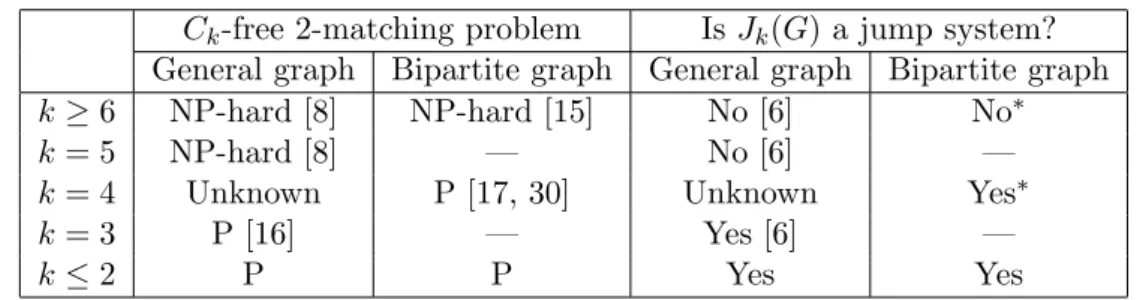
Note that this theorem agrees with the polynomial solvability of theCk-free 2-matching problem in bipartite graphs. Also, this theorem partially solves Cunningham’s conjecture [6]. Table 1 summarizes the aforementioned results.
We also discuss the weighted version. Given a bipartite graph and a weight function on the edge set, consider the problem of finding a Ck-free 2-matching maximizing the total weight of its
Table 1: Relation between theCk-free 2-matching problem and jump systems (∗: our result).
Ck-free 2-matching problem Is Jk(G) a jump system?
General graph Bipartite graph General graph Bipartite graph
k≥6 NP-hard [8] NP-hard [15] No [6] No∗
k= 5 NP-hard [8] — No [6] —
k= 4 Unknown P [17, 30] Unknown Yes∗
k= 3 P [16] — Yes [6] —
k≤2 P P Yes Yes
edges. When k≥6, this problem is NP-hard since the unweighted version is NP-hard. Moreover, Z. Kir´aly proved that the weighted square-free 2-matching problem is also NP-hard (see [13]). This problem is, however, tractable if the weight function is vertex-induced on every square.
Definition 1.3 (Vertex-induced weight). Let (G, w) be a weighted graph withG= (V, E) andw: E →R. For subgraph H ofG,wisvertex-induced onH if there exists a functionπH :V(H)→R such that w(e) =πH(u) +πH(v) for every edge e= (u, v)∈E(H). Here, V(H) and E(H) denote the vertex set and edge set of H, respectively, and (u, v) denotes an edge connecting u, v∈V(H).
Makai [24] considered weight functions that are vertex-induced on every square in G. Note that such a weight function is not necessarily induced by a single potential function on V, and the potential functions may vary from one square to another. For this class of weight functions, Makai [24] showed a linear programming description of maximum-weight square-free 2-matchings and proved its dual integrality. By applying the ellipsoid method to this description, the weighted square-free 2-matching problem for this class of weight functions can be solved in polynomial time.
Also, a combinatorial polynomial algorithm is given by Takazawa [32].
In this paper, we show a relation between the weighted square-free 2-matchings and M-concave functions on constant-parity jump systems. For a weighted bipartite graph (G, w), define a function f onJ4(G) by
f(x) = max {∑
e∈M
w(e)¯¯
¯¯M is a square-free 2-matching,dM =x }
.
Theorem 1.4. For a weighted bipartite graph(G, w), f is an M-concave function on the constant- parity jump system J4(G) if and only if w is vertex-induced on every square in G.
This theorem suggests that assuming the weight function to be vertex-induced on every square is reasonable in considering the weighted square-free 2-matching problem in bipartite graphs.
As a generalization of the square-free 2-matching problem, Frank [13] introduced theKt,t-freet- matching problem. A complete bipartite graphKt,tis a graph (V, E) such thatV can be partitioned into two sets V1 and V2 with|V1|=|V2|=t and E ={(v1, v2)|v1 ∈V1, v2 ∈ V2}. For a bipartite graph G= (V, E), an edge set M ⊆E is aKt,t-free t-matchingifM is a t-matching that contains no Kt,t as a subgraph. Note that the square-free 2-matching problem is a special caset= 2 of the Kt,t-free t-matching problem. In [13], a min-max formula for the Kt,t-free t-matching problem is given as an extension of that for the square-free 2-matchings [19]. Also, the results in [24, 30, 32]
apply to Kt,t-free t-matchings. That is, the Kt,t-free t-matching problem is polynomially solvable, and so is the weighted problem if the weight function is vertex-induced on everyKt,t. We anticipate that Theorems 1.2 and 1.4 also extend to Kt,t-free t-matchings.
This paper is organized as follows. In Section 2, we give some definitions onCk-free 2-matchings, jump systems and M-concave functions. In Sections 3 and 4, we prove Theorems 1.2 and 1.4, respectively. Finally, we discussKt,t-free t-matchings in Section 5.
2 Definitions
2.1 Ck-free 2-matchings
LetG= (V, E) be a simple undirected graph with vertex setV and edge setE. An edge connecting u, v∈V is denoted by (u, v). Recall that the set of edges incident tov∈V is denoted byδv. A cycle C is a subgraph consisting of distinct verticesv1, . . . , vl and edges (v1, v2), . . . ,(vl−1, vl),(vl, v1). A cycle C is often denoted by C= (v1, v2, . . . , vl) and the length of C is defined by l, the number of its edges. For a subgraphH ofG, the vertex set and edge set ofHare denoted byV(H) andE(H), respectively. For a positive integer t, an edge setM ⊆E is said to be a t-matchingif|M∩δv| ≤t for every v∈V. In particular, a 2-matching is a vertex-disjoint collection of paths and cycles. We denote a bipartite graph by (V1, V2;E). That is, for any edge in E, one of its end vertices is inV1 and the other in V2.
Definition 2.1 (Ck-free 2-matching). For a simple undirected graphG= (V, E) and an integerk, an edge set M ⊆E is a Ck-free 2-matchingif M is a 2-matching that contains no cycle of length k or less as a subgraph. In particular, ifGis bipartite, aC4-free 2-matching is called a square-free 2-matching.
2.2 Jump systems
Let V be a finite set. For u ∈V, we denote by χu the characteristic vectorof u, withχu(u) = 1 and χu(v) = 0 for v ∈ V \ {u}. For x, y ∈ ZV, a vector s ∈ ZV is called an (x, y)-increment if x(u)< y(u) and s=χu for someu∈V, orx(u)> y(u) and s=−χu for someu∈V.
Definition 2.2 (Jump system [3]). A nonempty set J ⊆ ZV is said to be a jump system if it satisfies an exchange axiom, called the 2-step axiom:
For anyx, y∈J and for any (x, y)-incrementswithx+s̸∈J, there exists an (x+s, y)- incrementt such thatx+s+t∈J.
A set J ⊆ ZV is a constant-parity system if ∑
v∈V(x(v)−y(v)) is even for any x, y ∈ J. For constant-parity jump systems, J. F. Geelen observed a stronger exchange property:
(EXC) For any x, y∈J and for any (x, y)-increments, there exists an (x+s, y)-incrementtsuch that x+s+t∈J and y−s−t∈J.
This property characterizes a constant-parity jump system (see [27] for details).
Theorem 2.3. A nonempty setJ is a constant-parity jump system if and only if it satisfies(EXC).
A constant-parity jump system is a generalization of the base family of a matroid, an even delta-matroid [34, 35], and a base polyhedron of an integral polymatroid. The degree sequences of all subgraphs in an undirected graph is a typical example of a constant-parity jump system. That is, for a graph G= (V, E),
JSG(G) ={dF |F ⊆E}
is a constant-parity jump system [3, 23]. The set of all degree sequences of 2-matchings, or J2(G), is the intersection ofJSG(G) and a box{0,1,2}V, and hence one can easily see thatJ2(G) is a jump system. However, Theorems 1.1 and 1.2 are not obvious since the additional condition “Ck-free”
makes the situation more complicated when k≥3. Our contribution is to show how to deal with this condition when k= 4 and the graph is bipartite.
2.3 M-concave functions
An M-concave(M-convex) function on a constant-parity jump system is a quantitative extension of a jump system, which is a generalization of valuated matroids [10, 12], valuated delta-matroids [11], and M-concave (M-convex) functions on base polyhedra [25, 26].
Definition 2.4 (M-concave function on a constant-parity jump system [27]). For J ⊆ZV, we call f : J → R an M-concave function on a constant-parity jump system if it satisfies the following exchange axiom:
(M-EXC) For any x, y ∈J and for any (x, y)-increment s, there exists an (x+s, y)-increment t such that x+s+t∈J,y−s−t∈J, and f(x) +f(y)≤f(x+s+t) +f(y−s−t).
It directly follows from (M-EXC) thatJ satisfies (EXC), and henceJ is a constant-parity jump system. We call a function f : J → R an M-convex function if −f is an M-concave function on a constant-parity jump system. M-concave functions on constant-parity jump systems appear in many combinatorial optimization problems such as the weighted matching problem, the minsquare factor problem [1], and the weighted even factor problem in odd-cycle-symmetric digraphs [6, 7, 22].
Some properties of M-concave functions are investigated in [20, 21], and efficient algorithms for maximizing an M-concave function on a constant-parity jump system are given in [28, 31].
3 C
k-free 2-matchings in bipartite graphs and jump systems
This section is devoted to the proof of Theorem 1.2. First, let us show the latter half of the theorem by presenting an example of a bipartite graph Gsuch that Jk(G) is not a jump system for k≥6.
Consider a bipartite graphCk= (Vk, Ek) consisting of a cycle (v1, v2, v3, . . . , vk). Definex, y∈ ZVk by x(v1) = x(v2) = 1, x(v) = 2 for v ∈ Vk \ {v1, v2}, y(v4) = y(v5) = 1, and y(v) = 2 for v ∈Vk\ {v4, v5}. Then, for an even integerk≥6,x, y∈Jk(Ck) ands=χv2 is an (x, y)-increment, but there exists no (x+s, y)-incrementtsuch thatx+s+t∈Jk(Ck) andy−s−t∈Jk(Ck). Thus, for an even integer k≥6,Jk(Ck) is not a jump system for this bipartite graphCk.
We now focus on the first half of Theorem 1.2:
Proposition 3.1. For any bipartite graph G, J4(G) is a constant-parity jump system.
In the rest of this section, we prove Proposition 3.1 by presenting an algorithm for finding an (x+s, y)-increment t satisfying (EXC) for given x, y ∈ J4(G) and (x, y)-increment s. In what follows, we consider the case where s=−χu withu ∈V1. The other cases can be dealt with in a similar way.
3.1 Preliminaries
In this subsection, we prepare an operation and a notion that will be used in our algorithm.
3.1.1 Shrinking cycles
Definition 3.2. LetC = (v1, v2, v3, v4) be a cycle of length four inG= (V1, V2;E) withv1, v3 ∈V1
and v2, v4∈V2. Shrinking ofC in Gconsists of the following operations:
• identify v1 with v3, and denote the corresponding vertex byu1,
• identify v2 with v4, and denote the corresponding vertex byu2, and
• identify all edges between u1 andu2.
In the obtained graph, the edge between u1 and u2 corresponding toE(C) is called asquare-edge.
LetC1, C2, . . . , Cp be edge disjoint cycles of length four, and letG◦= (V1◦, V2◦;E◦) be the graph obtained from G= (V1, V2;E) by shrinkingC1, C2, . . . , Cp. Note thatG◦ might have some parallel edges, whereasGdoes not. For F1◦, F2◦⊆E◦, letF1◦\F2◦ denote the usual difference set ofF1◦ and F2◦, and let F1◦−F2◦ denote the set of all edges e∈F1◦ such that no parallel edge ofeis inF2◦.
If an edge setL◦ ⊆E◦ is obtained from L⊆E by shrinkingC1, C2, . . . , Cp such that|E(Ci)∩ L|= 3 fori= 1,2, . . . , p, we say thatL◦ is theshrunk edge setof L, and Lis anexpanded edge set of L◦. Note that the shrunk edge setL◦ contains all square-edges inG◦.
In a shrunk graphG◦, asquareis a cycle of length four whose corresponding edges inGform a cycle of length four. In particular, a square contains no square-edges. Obviously, when we shrink no edges, that is G◦=G, a square is exactly a cycle of length four. We say that an edge set inG◦ is square-free if it contains no square.
We now define a mapϕ:ZV1∪V2 →ZV1◦∪V2◦ by (ϕ(x))(u) =∑
{x(v)|v∈V1∪V2, v corresponds tou}
−2|{square-edges incident tou}| (1) for x ∈ ZV1∪V2 and u ∈ V1◦ ∪ V2◦. One can see that for an edge set L ⊆ E satisfying that
|E(Ci) ∩L| = 3 for i = 1,2, . . . , p, ϕ(dL) is the degree sequence of the shrunk edge set of L.
Conversely, the following lemma holds.
Lemma 3.3. Let L◦ ⊆E◦ be a 2-matching in G◦ that contains all square-edges and x be a vector in {0,1,2}V1∪V2. Ifϕ(x) is the degree sequence of L◦, there exists an expanded edge set L of L◦ in G such that dL=x. Furthermore, such L is unique.
Proof. We show how to expand square-edges inL◦. Let (u1, u2) be a square-edge inL◦. Suppose that v1, v3 ∈ V1 correspond to u1 ∈V1◦, and v2, v4 ∈V2 correspond to u2 ∈ V2◦. Denote the cycle (v1, v2, v3, v4) in Gby C.
For a givenx and L◦,dL∩E(C)(v1) should satisfy the following. Note thatx(v1) is at least one, because x(v1) +x(v3)≥(ϕ(x))(u1) + 2≥3.
• If x(v1) = 1, thendL∩E(C)(v1) = 1.
• If x(v1) = 2 and (u1, u2) is the unique incident edge of u1 in L◦, thendL∩E(C)(v1) = 2.
• Suppose that x(v1) = 2 and an edge e ̸= (u1, u2) in L◦ is incident to u1. If the edge (or cycle of length four) corresponding to e in Gcontains v1, then dL∩E(C)(v1) = 1. Otherwise dL∩E(C)(v1) = 2.
For each vertex v∈V(C), dL∩E(C)(v) is uniquely determined in the same way.
Since the degree sequencedL∩E(C) defined as above satisfies that {dL∩E(C)(v1), dL∩E(C)(v3)}= {dL∩E(C)(v2), dL∩E(C)(v4)} = {1,2}, there exists a unique set of three edges L∩E(C) satisfying this degree constraint. This shows the unique existence of a desired expanded edge set.
3.1.2 Semi-2-matching triple
In this subsection, we often denote a shrunk graph by G = (V1, V2;E) to simplify the notation.
Our algorithm to find an (x+s, y)-incrementtsatisfying (EXC), which is described in Section 3.2, keeps a triple (M, N, u) of M, N ⊆E and u∈V1∪V2 satisfying a certain condition. The purpose of this subsection is to define this condition and to show some properties of the triples. Note that the definitions in this subsection make sense only for the case where s=−χv withv ∈V1.
Definition 3.4. For two edge setsM, N ⊆E and a vertexu ∈V1∪V2, we say that (M, N, u) is a semi-2-matching triple ifM and N are square-free, both of them contain all square-edges inG, and one of the following holds:
• M andN are 2-matchings.
• u∈V1,N is a 2-matching,dN(u)≤1,dM(v)≤2 for anyv∈(V1∪V2)\ {u}, anddM(u) = 3.
• u∈V2,M is a 2-matching,dM(u)≤1,dN(v)≤2 for anyv∈(V1∪V2)\ {u}, anddN(u) = 3.
Definition 3.5. Let (M, N, u) be a semi-2-matching triple inG. For two vectorsx, y∈ {0,1,2}V1∪V2, (x, y) is the semi-degreeof (M, N, u) if one of the following holds:
• u∈V1,dM −χu =x, anddN +χu =y.
• u∈V2,dM +χu =x, anddN −χu =y.
We denote by SG(x, y) the set of all semi-2-matching triples whose semi-degree is (x, y), and omit the subscript Gwhen no confusion will arise.
Definition 3.6. For (M1, N1, u1),(M2, N2, u2) ∈ S(x, y), we say that (M1, N1, u1) is adjacent to (M2, N2, u2) if they satisfy one of the following conditions:
• u1∈V1, (u1, u2)∈M1−N1,M2=M1\ {(u1, u2)}, and N2 =N1∪ {(u1, u2)}.
• u1∈V2, (u1, u2)∈N1−M1,M2=M1∪ {(u1, u2)}, and N2 =N1\ {(u1, u2)}.
It is obvious that if (M1, N1, u1) is adjacent to (M2, N2, u2), then (M2, N2, u2) is adjacent to (M1, N1, u1).
We say that (M, N, u) ∈ S(x, y) is active, if u ∈ V1 and dM(u) > dN(u), or u ∈ V2 and dM(u)< dN(u). A semi-2-matching triple (M, N, u)∈ S(x, y) isstableifM andN are 2-matchings and |dM(u)−dN(u)| ≤1. This inequality means thatχu or−χu, sayt, is an (x, y)-increment such that dM =x+tand dN =y−t(see Claim 3.18).
We now show some properties of the semi-2-matching triples, which will be used in our algo- rithm.
Lemma 3.7. If (M, N, u)∈ S(x, y), then neither M nor N has parallel edges.
Proof. Suppose that M contains parallel edgese1 and e2, whose common end vertices are u1 ∈V1 andu2 ∈V2. Then, at least one ofu1 andu2 is incident to a square-edgee, which satisfiese∈M∩N by Definition 3.4 and is distinct from e1 and e2. By the degree constraint in Definition 3.4, the only possibility is that u=u1 is incident to eand u2 is incident to no square-edge. Suppose that e corresponds to a square (v1, v2, v3, v4), u1 corresponds to v1 and v3, and e1 and e2 correspond to (v1, u2) and (v3, u2) in the original graph. Then an expanded edge set of M contains a square (u2, v1, v2, v3) or (u2, v1, v4, v3), which contradicts thatMis square-free. Similarly,N has no parallel edges.
: edges in M.
: edges in N.
u v3
v2 v1
v4
Figure 1: An illustration of Lemma 3.9.
Lemma 3.8. Suppose that (M, N, u1) is a semi-2-matching triple in S(x, y), e = (u1, u2) is an edge in M−N, and u1 ∈V1. If N ∪ {e} is square-free, then (M \ {e}, N ∪ {e}, u2) is in S(x, y) and adjacent to (M, N, u1).
Proof. Since N ∪ {e} is square-free, (M \ {e}, N ∪ {e}, u2) is a semi-2-matching triple. The semi- degree of (M \ {e}, N∪ {e}, u2) is
(dM\{e}+χu2, dN∪{e}−χu2) = (dM −χu1, dN +χu1) = (x, y),
which means (M\{e}, N∪{e}, u2)∈ S(x, y). It is obvious that (M\{e}, N∪{e}, u2) and (M, N, u1) are adjacent by the definition.
Next we show the following.
Lemma 3.9. Suppose that (M, N, u) is a semi-2-matching triple in S(x, y), u ∈V1, and dM(u)− dN(u)≥2. Then, one of the following conditions holds:
• (M, N, u) is adjacent to at least two semi-2-matching triples in S(x, y).
• (M, N, u)is adjacent to exactly one semi-2-matching triple inS(x, y)and there exists a square C = (u, v1, v2, v3) in G such that {(u, v1),(u, v3)} ⊆ M and {(u, v1),(v1, v2),(v2, v3)} ⊆ N (see Figure 1).
Proof. First, a 2-matchingN consists of some disjoint paths and cycles, and |N ∩δu| ≤1 by the assumption ofdM(u)−dN(u)≥2. Hence, for at most one edgee∈δu,N∪ {e} contains a square.
Suppose that (M, N, u) is adjacent to at most one semi-2-matching triple in S(x, y). By Lemma 3.8, there exists at most one edgee∈(M∩δu)−N such thatN∪ {e}has no square. Since
|(M ∩δu)−N| ≥dM(u)−dN(u)≥2, we have that|(M∩δu)−N|= 2 and N∪ {e}has a square for some edge e∈(M∩δu)−N.
Therefore, there exist a squareC= (u, v1, v2, v3) and an edge (u, v4) inGsuch that{(u, v3),(u, v4)} ⊆ M and{(u, v1),(v1, v2),(v2, v3)} ⊆N. To the end, sincedM(u)−dN(u)≥2 and|(M∩δu)−N|= 2, (u, v1) is contained inM.
Lemma 3.10. Suppose that (M, N, u) is a semi-2-matching triple inS(x, y),u∈V1, and dM(u)− dN(u)≥1. Then, one of the following conditions holds:
• (M, N, u) is adjacent to at least one semi-2-matching triple inS(x, y).
• (M, N, u) is adjacent to no semi-2-matching triple in S(x, y) and there exists a square C = (u, v1, v2, v3) in G such that {(u, v1),(u, v3)} ⊆M and {(u, v1),(v1, v2),(v2, v3)} ⊆N.
Proof. Almost the same as the proof of Lemma 3.9.
The next lemma is a generalization of Lemma 3.3. As the proof is almost the same as Lemma 3.3, we omit it.
Lemma 3.11. Let G◦ = (V1◦, V2◦;E◦) be a shrunk graph of the original graph G = (V1, V2;E).
Suppose that x◦, y◦ ∈ {0,1,2}V1◦∪V2◦ and (M◦, N◦, u◦) ∈ SG◦(x◦, y◦). For any vectors x, y ∈ {0,1,2}V1∪V2 with ϕ(x) = x◦ and ϕ(y) = y◦, there exists a semi-2-matching triple (M, N, u) ∈ SG(x, y)such that M andN are expanded edge sets of M◦ andN◦, respectively, anducorresponds to u◦. Furthermore, if u◦ corresponds to a unique vertex u in G, such a semi-2-matching triple (M, N, u) is unique.
3.2 Proof for Proposition 3.1
In this section, we give a constructive proof for Proposition 3.1. More precisely, we give an algorithm for finding edge sets M′, N′ and an (x+s, y)-increment t such that M′ and N′ are square-free 2- matchings, dM′ =x+s+t, and dN′ =y−s−t.
3.2.1 Updating a semi-2-matching triple
In this subsection, we consider a procedure of updating a given semi-2-matching triple in a shrunk graph G = (V1, V2;E), which is a subroutine of our main algorithm. Roughly speaking, when a semi-2-matching triple (M, N, u) is given as the input, this procedure increases|M∩N|, maintaining its semi-degree. In the procedure, the shrunk graphGand edge setsM and N satisfy the following assumption.
Assumption 3.12. Both edge setsM and N contain all square-edges in G, andG has no square C such thatE(C)⊆M∪N and |E(C)∩M|=|E(C)∩N|= 3.
The procedure is described as follows.
Procedure A
Input: A shrunk bipartite graph G = (V1, V2;E), vectors x, y ∈ {0,1,2}V1∪V2, and an active semi-2-matching triple (M, N, u)∈ S(x, y) satisfying Assumption 3.12.
Output: A stable semi-2-matching triple (M′, N′, u′) ∈ S(x, y) with |M′∩N′| ≥ |M∩N|, or a non-stable semi-2-matching triple (M′, N′, u′)∈ S(x, y) with|M′∩N′|>|M∩N|.
Step 0. Setτ := 0,M(0) :=M,N(0) :=N, andu(0):=u. Then, go to Step 1.
Step 1. If (M(τ), N(τ), u(τ)) has an adjacent semi-2-matching triple (M′, N′, u′) ∈ S(x, y) which is different from (M(τ−1), N(τ−1), u(τ−1)) (we ignore this condition if τ = 0), then set (M(τ+1), N(τ+1), u(τ+1)) := (M′, N′, u′) and τ :=τ+ 1, and go to Step 2. Otherwise, go to Step 4.
Step 2. Ifu(τ)=u(τ′)for someτ′< τ, then output a semi-2-matching triple (M(τ′), N(τ), u(τ))∈ S(x, y), which satisfies that |M(τ′)∩N(τ)| > |M∩N| (see Claim 3.14), and stop the procedure.
Otherwise, go to Step 3.
Step 3. If (M(τ), N(τ), u(τ)) is a stable semi-2-matching triple, then output (M(τ), N(τ), u(τ))∈ S(x, y) and stop the procedure. Otherwise, go to Step 1.
Step 4. Ifu(τ)∈V1, then execute Step 4-1. Otherwise, execute Step 4-2.
Step 4-1. In this case, if τ ≥1, then dM(τ)(u(τ))−dN(τ)(u(τ))≥2, because (M(τ), N(τ), u(τ)) is not stable by Step 3. On the other hand,dM(τ)(u(τ))−dN(τ)(u(τ))≥1 ifτ = 0 by the activeness
: edges inM(τ). : edges in N(τ). u(τ) v3
v2 v1
u(τ−1)
: edges inM(τ+1). : edges in N(τ+1).
u(τ) v3
v2=u(τ+1) v1
u(τ−1)
Figure 2: Definitions of M(τ+1),N(τ+1), and u(τ+1).
of the input. By Lemmas 3.9 and 3.10, there exists a square C = (u(τ), v1, v2, v3) in G such that {(u(τ), v1),(u(τ), v3)} ⊆M(τ) and {(u(τ), v1),(v1, v2),(v2, v3)} ⊆N(τ). Hence, by Assumption 3.12, E(C)∩M(τ)={(u(τ), v1),(u(τ), v3)} andE(C)∩N(τ)={(u(τ), v1),(v1, v2),(v2, v3)}.
As shown in Figure 2, defineM(τ+1),N(τ+1), and u(τ+1) by
M(τ+1):= (M(τ)\ {(u(τ), v1)})∪ {(v1, v2)}, N(τ+1):= (N(τ)\ {(v2, v3)})∪ {(u(τ), v3)},
u(τ+1):=v2.
IfM(τ+1)is square-free, then output a semi-2-matching triple (M(τ+1), N(τ+1), u(τ+1))∈ S(x, y), which satisfies that |M(τ+1)∩N(τ+1)|=|M∩N|+ 1 (see Claim 3.15), and stop the procedure.
Otherwise, there exists a square C′ = (v2, v1, v4, v5) in M(τ+1), where {u(τ), v3} ∩ {v4, v5} =∅ (see Figure 3). Then define
M(τ+2) :=M(τ+1)\ {(v2, v5)}, N(τ+2) :=N(τ+1)∪ {(v2, v5)},
u(τ+2) :=v5.
Output a semi-2-matching triple (M(τ+2), N(τ+2), u(τ+2))∈ S(x, y), which satisfies that|M(τ+2)∩ N(τ+2)|=|M ∩N|+ 1 (see Claim 3.16), and stop the procedure.
Step 4-2. Execute a similar procedure to Step 4-1 by switchingM(τ) and N(τ).
Ifu(τ1)=u(τ2)for distinctτ1 and τ2, then Procedure A stops in Step 2, which assures that each step is executed at most |V1|+|V2| times. We now show the correctness of the procedure. First, one can easily see the following claim.
Claim 3.13. In Step 1, |M(τ)∩N(τ)|=|M(τ+1)∩N(τ+1)|.
By this claim, if Procedure A outputs a stable semi-2-matching triple (M′, N′, u′) ∈ S(x, y) in Step 3, then|M′∩N′|=|M∩N|, which shows that (M′, N′, u′) is a desired output. The correctness of termination in Step 2 and Step 4 is guaranteed by the following claims.
Claim 3.14. In Step 2, (M(τ′), N(τ), u(τ)) is inS(x, y) and |M(τ′)∩N(τ)|>|M∩N|.
: edges inM(τ+1). : edges in N(τ+1).
u(τ) v3
v2 =u(τ+1) v1
u(τ−1)
v4 v5
: edges in M(τ+2). : edges in N(τ+2).
u(τ) v3
v2 =u(τ+1) v1
u(τ−1)
v4 v5 =u(τ+2)
Figure 3: Definitions of M(τ+2),N(τ+2), and u(τ+2).
Proof. Since both (M(τ), N(τ), u(τ)) and (M(τ′), N(τ′), u(τ′)) are inS(x, y), (M(τ′), N(τ), u(τ)) is also inS(x, y). On the other hand,M(τ′)\M(τ) ⊆N(τ)and (M(τ)\M(τ′))∩N(τ)=∅ by the definition of the procedure, and hence
|M(τ′)∩N(τ)|=|M(τ)∩N(τ)| − |(M(τ)\M(τ′))∩N(τ)|+|(M(τ′)\M(τ))∩N(τ)|
=|M ∩N|+|M(τ′)\M(τ)|
>|M ∩N|, which completes the proof.
Claim 3.15. In Step 4-1, N(τ+1) is square-free and |M(τ+1)∩N(τ+1)|=|M∩N|+ 1.
Proof. First, (u(τ), v1) is the unique edge in N(τ) ∩δu(τ) and N(τ)∩δv1 = {(u(τ), v1),(v1, v2)}. Thus,N(τ+1) does not have a square containing (u(τ), v3), and henceN(τ+1) is square-free because N(τ) does not have a square. Furthermore, by Claim 3.13,|M(τ+1)∩N(τ+1)|=|M(τ)∩N(τ)|+ 1 =
|M∩N|+ 1.
Claim 3.16. In Step 4-1,(M(τ+2), N(τ+2), u(τ+2))∈ S(x, y) and|M(τ+2)∩N(τ+2)|=|M∩N|+ 1.
Proof. SinceC= (v2, v1, v4, v5) is the unique square inM(τ+1),M(τ+2) is square-free. On the other hand, since N(τ+2)∩δv2 ={(v1, v2),(v2, v5)}, N(τ+2)∩δv1 ={(u(τ), v1),(v1, v2)}, and (u(τ), v5)̸∈
N(τ+2),N(τ+2) does not have a square containing (v2, v5). Thus, by Claim 3.15, N(τ+2) is square- free, and hence (M(τ+2), N(τ+2), u(τ+2))∈ S(x, y). Furthermore, by Claim 3.15,|M(τ+2)∩N(τ+2)|=
|M(τ+1)∩N(τ+1)|=|M ∩N|+ 1.
We can show the correctness of Step 4-2 in the same way. The above claims show the correctness of Procedure A.