Rules of origin and exports in developing economies
著者 Tanaka Kiyoyasu, Fukunishi Takahiro 権利 Copyrights 2021 by author(s)
journal or
publication title
IDE Discussion Paper
volume 806
year 2021‑02
URL http://hdl.handle.net/2344/00051976
INSTITUTE OF DEVELOPING ECONOMIES
IDE Discussion Papers are preliminary materials circulated to stimulate discussions and critical comments
Keywords: Rules of origin, GSP, trade, garment, developing economies JEL classification: F13, F14, O14
§ Research fellow, Economic Integration Studies Group, Institute of Developing Economies, JETRO
ζ Director, African Studies Group, Institute of Developing Economies, JETRO
IDE DISCUSSION PAPER No. 806
Rules of Origin and Exports in Developing Economies
Kiyoyasu TANAKA
§& Takahiro FUKUNISHI
ζ February 2021Abstract
Rules of origin (ROO) can be highly restrictive for developing economies to obtain preferential access, but it remains unclear whether the impacts are heterogeneous. We estimate the effect of ROO on exports in developing economies by examining European Union’s trade preferences, where origin requirements for garment products were relaxed for beneficiaries in the Interim Economic Partnership Agreements (IEPA) after 2008 and for those in the Everything But Arms (EBA) scheme after 2011, respectively. The results show that ROO liberalization has little overall effect on exports in IEPA beneficiaries, but a positive impact on those in EBA beneficiaries. Only some African and Asian beneficiaries increased their exports significantly. To explain heterogeneous responses, we discuss the initial production base, investment climate, structural transformation, and economic shocks.
The Institute of Developing Economies (IDE) is a semigovernmental, nonpartisan, nonprofit research institute, founded in 1958. The Institute merged with the Japan External Trade Organization (JETRO) on July 1, 1998. The Institute conducts basic and comprehensive studies on economic and related affairs in all developing countries and regions, including Asia, the Middle East, Africa, Latin America, Oceania, and Eastern Europe.
The views expressed in this publication are those of the author(s). Publication does not imply endorsement by the Institute of Developing Economies of any of the views expressed within.
INSTITUTE OF DEVELOPING ECONOMIES (IDE), JETRO 3-2-2, WAKABA,MIHAMA-KU,CHIBA-SHI
CHIBA 261-8545, JAPAN
©2021 by author(s)
No part of this publication may be reproduced without the prior permission of the author(s).
3
Rules of Origin and Exports in Developing Economies
†Kiyoyasu Tanaka§
(Institute of Developing Economies)
Takahiro Fukunishiζ
(Institute of Developing Economies) February 2021
Abstract
Rules of origin (ROO) can be highly restrictive for developing economies to obtain preferential access, but it remains unclear whether the impacts are heterogeneous. We estimate the effect of ROO on exports in developing economies by examining European Union’s trade preferences, where origin requirements for garment products were relaxed for beneficiaries in the Interim Economic Partnership Agreements (IEPA) after 2008 and for those in the Everything But Arms (EBA) scheme after 2011, respectively. The results show that ROO liberalization has little overall effect on exports in IEPA beneficiaries, but a positive impact on those in EBA beneficiaries. Only some African and Asian beneficiaries increased their exports significantly. To explain heterogeneous responses, we discuss the initial production base, investment climate, structural transformation, and economic shocks.
Keywords: Rules of origin, GSP, trade, garment, developing economies JEL Classification: F13, F14, O14
† We acknowledge the financial support of JSPS Grant-in-Aid for Young Scientists (B) Grant Number 16K17129 and for Scientific Research (A) 18H03637. For useful comments and suggestions, we thank seminar participants at IDE-JETRO. All remaining errors are our own.
§ Research fellow, Economic Integration Studies Group, Institute of Developing Economies, JETRO;
address: 3-2-2 Wakaba, Mihama-ku, Chiba-shi, Chiba 261-8545, Japan; e-mail:
ζ Director, African Studies Group, Institute of Developing Economies, JETRO; address: 3-2-2 Wakaba, Mihama-ku, Chiba-shi, Chiba 261-8545, Japan; e-mail: [email protected]
4 1. Introduction
Preferential trading arrangements (PTA) can promote an export industry in the developing world to promote poverty reduction and sustainable development. Since preferential treatment requires export products to satisfy rules of origin (ROO), beneficiary exporters incur administrative costs in proving origin and additional costs for restrictive input sourcing. Prior works show that stringent ROO could discourage trade flows (Anson et al., 2005; Augier and Gasiorek, 2004; Brenton and Manchin, 2003; Conconi et al., 2018; de Melo and Portugal-Perez, 2013; Estevadeordal and Suominen, 2004). However, origin-conferring criteria may be more restrictive on some beneficiary countries that rely largely on imported inputs, which may magnify their export expansion in response to the relaxation of stringent ROO in preferential treatment.
Thus, it remains unclear whether ROO have heterogeneous impacts on beneficiaries’ exports.
In this paper, we estimate the impact of ROO on exports in developing economies by examining ROO liberalization in European Union (EU) trade preferences. Specifically, the EU has long maintained a partnership with African, Caribbean, and Pacific (ACP) countries and concluded Interim Economic Partnership Agreements (IEPA) in 2007. Meanwhile, the EU introduced the Everything But Arms (EBA) initiative in 2001 as part of the Generalized System of Preferences (GSP), while a new regulation on ROO in the GSP came into effect on January 1, 2011.1 In these regimes, duty-free and quota-free access to the EU market was unchanged, whereas origin requirements for garment products were relaxed for IEPA beneficiaries after 2008 and for EBA beneficiaries after 2011.2 Consequently, the share of imports into 28 EU member countries from these beneficiaries increased from 13.7% in 2005 to 26.6% in 2015 for knitted garments and from 6.8% in 2005 to 17.7% in 2015 for woven garments, respectively (EUROSTAT).
Using these policy changes as a natural experiment, we assess the heterogeneous impacts of ROO liberalization on garment exports in developing economies. Specifically, we measure the impacts of ROO changes on exports in IEPA and EBA beneficiaries by exploiting four sources of variations in exports: (i) a difference between beneficiary and non-beneficiary exporters; (ii) a difference between EU importers and non-EU importers; (iii) a difference between garment products and non-garment products; and (ⅳ) a difference between pre- and post-periods. The specification allows us to disentangle a variety of confounding factors from the causal impact of ROO changes on garment exports in developing economies. We use trade data during the period 2005-2015 from the UN Comtrade, as quotas on global garment trade were generally removed
1 For details, see Commission Regulation (EU) No. 1063/2010 of 18 November 2010 amending Regulation (EEC) No. 2454/93 laying down provisions for the implementation of Council Regulation (EEC) No. 2913/92 establishing the Community Customs Code.
2 Stringent ROO pose a crucial issue for garment industries in developing economies, which can serve as an entry point of industrialization (Rhee, 1990; Fukunishi and Yamagata, 2014).
5
after the termination of the Multi Fibre Agreement regime in 2004. Our sample includes 199 exporters and 180 importers for products in the Harmonized System (HS) chapters 61-67.
Our key results are summarized as follows. First, ROO liberalization has little aggregate effect on garment exports in IEPA beneficiaries, but a positive impact on those in EBA beneficiaries. Specifically, simplified ROO significantly increased garment exports from EBA beneficiaries by 25% after 2011. We interpret this finding as suggesting that the previous ROO might not seriously constrain input sourcing for the IEPA beneficiaries, whereas the previous ROO might be more restrictive for the EBA beneficiaries. The difference in the previous ROO between ACP and GSP regimes may produce contrasting impacts between the IEPA and EBA beneficiaries. A key channel of positive ROO impacts is the use of competitively priced inputs imported from third markets. Second, we find that ROO impacts are significantly heterogeneous across beneficiaries. Only some African and Asian countries increased significantly garment exports to the EU market after ROO liberalization. The results of the heterogeneous supply responses are robust to the Poisson pseudo-maximum likelihood (PPML) estimation. To understand the underlying conditions of heterogeneous supply responses, we discuss the initial production base, investment climate, structural transformation, and economic shocks.
This paper contributes to three branches of related literature. The first branch estimates a relationship between ROO and trade flows. One approach is to quantify the restrictiveness of ROO as a categorical index at the product-level and examine the relationship between ROO index and trade flows (Anson et al., 2005; Conconi et al., 2018; Estevadeordal and Suominen, 2004).
Another approach is to examine the impact of cumulation rules such as the Pan-European Cumulation System on trade flows (Augier et al., 2004; Augier et al., 2005; Andersson, 2016).
Additionally, Tanaka (2021) assesses the EU’s reform in GSP ROO on a beneficiary country using a similar approach, but focuses only on Cambodia. To the best of our knowledge, this paper provides the first empirical assessment of ROO changes in both IEPA and EBA regimes in a unified empirical framework.
The second branch examines global production networks (GPN) and global value chains (GVC) in the textile and garment sectors (Gereffi, 1999; Fukunishi and Yamagata, 2014). A growing number of studies describe the production structure of garment sectors in Africa (Lall, 2005; Phelps et al., 2009; Morris and Staritz, 2014), Asia (Uchikawa, 1998; Ramaswamy and Gereffi, 2000; Curran and Nadvi, 2015), and the Middle East (Azmeh and Nadvi, 2014). As reviewed in Curran et al. (2019), GPN/GVC studies show that liberal ROO can promote garment exports through access to imported fabric from third countries (Pickles et al., 2015). Since country case studies may overlook unsuccessful cases, we use data on global garment trade to demonstrate the heterogeneous impacts of liberal ROO across garment exporters.
6
The third branch discusses the underlying reasons for export successes and economic performance in Africa (Collier and Gunning, 1999; Morrissey, 2005; Easterly and Reshef, 2011).
These explanations typically highlight trade costs, infrastructure, geography, governance, institutions, and idiosyncratic events. Prior works such as Mattoo et al. (2003), Frazer and Van Biesebroeck (2010), and Fontagné et al. (2010) discuss an important influence of PTA on African exports, but pay small attention on ROO in trade promotion. Given the complexity of ROO, Hoekman and Njinkeu (2017) suggest that existing research on ROO in Africa is mostly qualitative. In this respect, we empirically estimate the impact of ROO in EU trade preferences toward Africa and demonstrate that only some African countries responded to ROO liberalization.
The rest of this paper is organized as follows. Section 2 presents a background for EU trade regimes in examination. Section 3 describes a theoretical hypothesis and an empirical model to assess the impact of ROO on garment exports, followed by a data description. Section 4 presents the estimation results. Section 5 discusses underlying conditions for heterogeneous ROO impacts.
Finally, section 6 concludes.
2. Background
2.1. Interim economic partnership agreements
The EU had a partnership with ACP countries since the successive Lomé Conventions for the period 1975-2000 (Frisch, 2008). The Lomé system granted non-reciprocal preferences to a group of ACP countries. As the EU discriminated in favor of a particular group of developing economies against others, the Lomé system was not consistent with the international trading rules under GATT/WTO. During the Lomé Ⅳ, the EU obtained a first waiver to continue this discriminatory trading arrangement until 2007. Under the Cotonou Agreement since 2000, the EU sought to conclude a WTO-consistent trade regime in order to grant preferential access to the ACP countries.
However, a trade regime such as a free trade agreement (FTA) requires that the ACP countries also liberalize market barriers to imports from the EU. Additionally, the EU sought to negotiate a broad range of issues such as services, which led to a delay in FTA negotiations. To meet the deadline, the EU first concluded an interim EPA (IEPA) by the end of 2007, and postponed further negotiations for a comprehensive EPA thereafter.
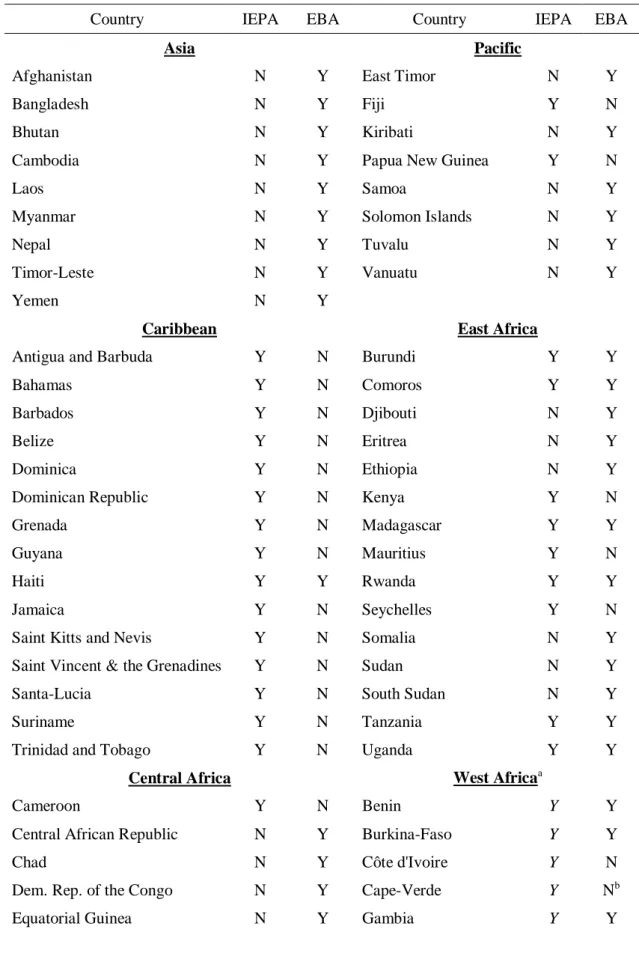
Under the trade provisions of the Cotonou Agreement, most imports from ACP countries qualified for duty-free and quota-free access to the EU market. To prevent the loss of such preferential access, the EU agreed to offer the same preferential access to all the ACP countries that had initialed IEPAs after 2008 (Bilal and Stevens, 2009, chap. 2).3 Table 1 shows a list of countries that initialed the IEPA, who could then export to the EU market under the IEPA regime
3 Sugar and rice are an exception.
7
since 2008.4 Since some ACP countries did not initial the IEPA, they might start to export under other trade regimes.
---Table 1 here---
The EU made some revision in ROO under the IEPA (Naumann, 2010). These include the origin requirements for textiles, clothing, and fish products. For clothing, ACP exporters had to perform a two-stage transformation under the Cotonou Agreement, whereas only a one-stage transformation was required under the IEPA regime. Thus, the EU liberalized the ROO for garment products from the ACP countries.
2.2. Everything But Arms
The EU introduced the EBA initiative in 2001 to grant least developing countries (LDCs) duty-free and quota-free access for all tariff lines except for arms and ammunition (European Commission [EC], 2016).5 Table 1 shows a list of EBA beneficiaries as of August 2015. There are 49 EBA beneficiary, including 34 countries in Africa, 9 countries in Asia, and 6 countries in the Pacific and Caribbean area.6 Some ACP countries also belong to EBA beneficiaries so that they can export to the EU market under the EBA regime. Even if these ACP countries did not initial the IEPA by the end of 2007, they could export to the EU market under duty-free and quota- free treatment after 2008.
The EC adopted a new regulation on the ROO for EU GSP in November 2010. The new ROO came into effective on January 1, 2011.7 For instance, a two-stage transformation requirement for garment products was relaxed into one-stage transformation only for LDCs; i.e., fabric from any third market can be used to manufacture garment products for preferential access.
2.3. Origin requirements for garment products
Since we focus on garment exports in developing economies, we summarize product-specific origin requirements for knitted and woven garment products in HS chapters 61 and 62. A key change in the new origin requirement is one-stage transformation. In the previous ROO, garment exporters must generally perform two processing stages, namely, fabric manufacture from yarn and garment manufacture from locally produced fabric. In the new ROO, exporters can use
4 The IEPA was signed in December 2014 by West African countries, except Nigeria, Mauritania, and Gambia. Mauritania later signed on September 21, 2018, and Gambia signed on August 9, 2018.
5 Liberalization came into effect immediately except for gradual reductions to zero tariffs for bananas in 2006 and for rice and sugar in 2009.
6 As the EU withdrew GSP preferences from Myanmar/Burma in 1997 and reinstated for application from June 13, 2012, we exclude Myanmar from the EBA beneficiaries.
7 For details, see Commission Regulation (EU) No. 1063/2010 of 18 November 2010 amending Regulation (EEC) No. 2454/93 laying down provisions for the implementation of Council Regulation (EEC) No. 2913/92 establishing the Community Customs Code.
8
competitively priced fabric imported from third markets. Thus, the ROO were substantially relaxed for IEPA beneficiaries after 2008 and EBA beneficiaries after 2011.8
Table 2 summarizes the origin requirements for garment products in HS chapters 61 and 62 under the EBA and IEPA regimes. In the previous ROO, exporters could use inputs from the EU as originating content under bilateral cumulation rules. Meanwhile, the EBA regime stipulates diagonal regional cumulation rules in which inputs from the regional group can be originating content, provided that (i) value added in the final stage exceeds the highest customs value of any input from other countries, and (ii) the originating inputs are manufactured in these countries. On the other hand, the Cotonou Agreement specifies full cumulation rules in which inputs from other ACP countries can be originating content. There is no requirement on the final-stage value added relative to the customs value of inputs used. The rules of partial cumulation allow for inputs from South Africa and neighboring non-ACP countries under the requirement on the final-stage value added.
---Table 2 here---
Tolerance rules allow for non-originating inputs up to a total value of 10 percent of the ex- works price of the product in the EBA regime and 15 percent of that in the Cotonou Agreement.
Taken together, the previous ROO have different scopes of cumulation and tolerance rules. By definition, the origin requirements are more liberal in the Cotonou Agreement than in the previous EU GSP.
3. Empirical framework 3.1. Theoretical background
To analyze ROO effects, a starting point is to distinguish between binding and non-binding ROO for garment manufacture in the pre-reform period. First, the previous ROO may be non- binding for garment producers in a beneficiary country to obtain duty-free access. For instance, a competitive domestic industry supplies intermediate inputs, so that garment manufacturers need not rely heavily on imported inputs. Even if the domestic input supply is limited, they may source competitively priced inputs from member countries under cumulation rules, thereby satisfying the ROO. Thus, ROO changes should have little impact on exports in beneficiary countries.
Second, the previous ROO may be binding on garment manufacturers to obtain preferential access. As explained in Krishna (2006), any restriction on the choice of inputs may prevent exporters from using the best mix of inputs. The unit cost of production may therefore increase with the restrictiveness of the origin requirements. Additionally, exporters must obtain a certificate of origin to prove the origin of their products. This procedure involves documentation
8 In HS chapter 62, some product categories such as handkerchiefs, shawls, and scarves remained to require weaving accompanied by making-up for originating status.
9
of sourcing to keep track of the origin of inputs and their usage. As the documentation tasks may necessitate the introduction of a new accounting system, certification procedures also increase production costs. Thus, simplifying ROO can promote garment exports through a better mix of inputs and a reduction in production costs.
The decision to obtain preferential treatment depends not only on the costs of meeting ROO, but on the margin of preference for export products, i.e., the absolute difference between the most- favored-nation (MFN) rate of import duty and the preferential rate of import duty.9 As analyzed in Demidova et al. (2012), exporters may choose not to use preferential access, but rather pay the MFN tariff. If the costs of meeting ROO exceed the benefit of the preferential margin, they would choose to pay the MFN tariff when exporting. Thus, simplifying ROO may induce a higher fraction of potential exporters to use preferential access and promote aggregate exports.
3.2. Empirical specification
To estimate the impact of simplifying ROO on garment exports, we specify an empirical model for export market i, import market j, export product p, and year t:
ln𝐸𝐸𝑖𝑖𝑖𝑖𝑖𝑖𝑖𝑖=𝛼𝛼1𝐼𝐼𝐸𝐸𝑖𝑖∙ 𝐸𝐸𝐸𝐸𝑖𝑖∙ 𝐺𝐺𝑖𝑖∙ 𝑌𝑌𝑖𝑖+𝛽𝛽1𝐸𝐸𝐸𝐸𝑖𝑖∙ 𝐸𝐸𝐸𝐸𝑖𝑖∙ 𝐺𝐺𝑖𝑖∙ 𝑌𝑌�𝑖𝑖+𝑓𝑓𝑖𝑖𝑖𝑖𝑖𝑖+𝑓𝑓𝑖𝑖𝑖𝑖𝑖𝑖+𝜀𝜀𝑖𝑖𝑖𝑖𝑖𝑖𝑖𝑖 (1) where ln𝐸𝐸𝑖𝑖𝑖𝑖𝑖𝑖𝑖𝑖 is the log of export values in product p from export market i to import market j in year t. This specification allows us to examine an overall change in exports at the extensive and intensive margin. 𝐼𝐼𝐸𝐸𝑖𝑖 is a set of export market i belonging to the IEPA beneficiaries. 𝐸𝐸𝐸𝐸𝑖𝑖 is a set of export market i belonging to the EBA beneficiaries. If the EBA beneficiary countries initialed the IEPA, they are classified into the set of 𝐼𝐼𝐸𝐸𝑖𝑖 and thus excluded from the set of 𝐸𝐸𝐸𝐸𝑖𝑖. 𝐸𝐸𝐸𝐸𝑖𝑖 is a set of import market j with the EU membership during the sample period. 𝐺𝐺𝑖𝑖 is a set of garment product p for which product-specific origin requirements are relaxed. 𝑌𝑌𝑖𝑖 and 𝑌𝑌�𝑖𝑖 are dummy variables that take on unity after 2008 and 2011, respectively. We include the following interactive fixed effects to control for unobserved heterogeneity in exports; 𝑓𝑓𝑖𝑖𝑖𝑖𝑖𝑖 controls for time-invariant heterogeneity in overall exports of any product from any export market to any import market, and 𝑓𝑓𝑖𝑖𝑖𝑖𝑖𝑖 controls for overall exports of any product to any import market in any year. Finally, 𝜀𝜀𝑖𝑖𝑖𝑖𝑖𝑖𝑖𝑖 is an error term.
The coefficients of interest are 𝛼𝛼1 and 𝛽𝛽1 to measure the overall net impact of ROO changes on garment exports. We hypothesize that the previous ROO constrained the optimal choice of inputs for garment exports in beneficiaries. Simplifying ROO would strengthen the competitiveness of beneficiaries’ garment production for competitively priced inputs imported from third markets. As we predict that beneficiaries should increase their garment exports to the EU market, 𝛼𝛼1 and 𝛽𝛽1 should be positive in sign. We measure the ROO impacts by exploiting
9 As the average tariff rates on clothing products in the EU are 12%, the duty-free access implies the preferential margin of 12%.
10
four sources of variations in exports; (i) a difference between beneficiary and non-beneficiary exporters; (ii) a difference between EU importers and non-EU importers; (iii) a difference between treated garment products and untreated products, and (ⅳ) a difference between pre- and post-periods.
It is useful to clarify what variations in exports are picked up by the coefficients, 𝛼𝛼1 and 𝛽𝛽1. In the regression model, these coefficients should pick up variations in garment exports across exporters over time, which reflect heterogeneity in the initial level of garment exports across exporters as well as their new supply response during the sample period. Since we include an exporter-importer-product-level fixed effect, 𝑓𝑓𝑖𝑖𝑖𝑖𝑖𝑖 , to control for the initial level of product- specific exports in any exporters, 𝛼𝛼1 and 𝛽𝛽1 should pick up the new supply response of garment exports to ROO changes. In this respect, we exploit variations in garment exports across exporters over time for identification, which makes it difficult to include time-varying exporter-level fixed effects. We check this concern by including time-varying exporter characteristics.
Finally, we discuss the choice of untreated products. Control products should be as similar to garment products as possible, but should not be affected by ROO changes in the EU trade preferences. In this respect, appropriate control products should exhibit similar labor-intensive consumption products, including footwear, headgear, umbrella, and so on. We summarize these controls in next section. Meanwhile, we exclude yarn and textiles from the control products. As analyzed in Ju and Krishna (2005), the level of ROO can affect profits for both intermediate input and final good producers, suggesting that the treatment status of garment exports in beneficiary countries may affect a trade pattern of intermediate inputs for garments. Since we implicitly assume no interference between treated and untreated exports, these interactive effects may violate the assumption and make it sensible to exclude these products from the analysis.
3.3. Data description
Export data come from the UN Comtrade Database. We use trade data reported by importers for the period 2005-2015. As the sample period starts after the termination of the Multi Fibre Agreement regime in 2004, quotas on global garment trade were generally removed. Data on Taiwan come from the Trade Statistics Search by the Taiwanese Ministry of Finance. Appendix Table 1 reports a list of sample economies. We use the aggregate value of exports at the HS chapter level because we examine the origin-rules liberalization on knitted and woven garments in HS chapter 61 and 62.
Data on untreated control products come from HS chapters 63-67. Chapter 63 includes blankets, bed line, curtains, furnishing articles, sacks, tarpaulins, worn clothing, worn textiles, and rags. Chapters 64 and 65 include footwear and headgear, respectively. Chapter 66 includes umbrellas and walking sticks. Chapter 67 covers skin of birds with feather or down, feathers,
11
artificial flowers, human hair, and wigs. Chapter rules of origin requirements for these products in the EPA and GSP regimes generally require that all the materials used in the final product are classified within a heading other than that of the final product. Thus, their chapter rules remain unchanged during the study period.
4. Estimation results 4.1. Benchmark results
Table 3 shows summary statistics for the main sample. The sample includes 199 exporters and 180 importers for products in HS chapters 61-67 during the period 2005-2015.10 Table 4 presents the benchmark results, with standard errors corrected for clustering in exporter-importer pairs. Column (1) shows that the coefficient, 𝛼𝛼1, is not statistically significant. We do not find evidence that IEPA beneficiaries would increase their garment exports to the EU market after ROO liberalization. Meanwhile, the coefficient, 𝛽𝛽1 , is significant and positive, implying that EBA beneficiaries increased their garment exports to the EU market by 25% after 2011.11 From a theoretical point of view, these varying impacts should depend partly on whether the previous ROO were binding on beneficiary exporters. Specifically, the IEPA beneficiaries might not be seriously constrained under the previous ROO because of full cumulation rules in the Cotonou Agreement. Meanwhile, diagonal regional cumulation rules in the EBA regime are generally more restrictive than full cumulation rules. If the EBA beneficiaries might be constrained by the previous ROO, simplifying ROO would help to expand garment exports.
---Tables 3 and 4 here---
In column (2), we distinguish between knitted and woven garments. The coefficient, 𝛼𝛼1, is not significant for knitted garments under the IEPA trade regime, whereas it is significant and positive for woven garments. This implies that simplifying ROO increased only woven garment exports in IEPA beneficiaries. This result is partly due to the difference of production technology between knit and woven fabric, where knit fabric production is less capital intensive (Curran and Nadvi 2015). For instance, relatively loose ROO imply that garment factories in Madagascar, an IEPA beneficiary, can use knit fabric made in Mauritius to produce knitted garments and still maintain preferential access to the EU market.12 Meanwhile, more capital-intensive production of woven fabric tends to concentrate in foreign markets such as China. Since an input choice may
10 We remove fixed effects groups with only a single observation to address a concern of artificially low standard errors due to an overstated number of clusters (Correia, 2015).
11 These results are robust to the inclusion of time-varying exporter characteristics such as GDP, GDP per capita, the days of starting a business, domestic credit index, and port infrastructure index.
Appendix Table 2 presents the estimation results.
12 The garment industry in Mauritius concentrated on knitted garment products and became a major exporter in the 1980s and early1990s (World Bank, 1992). Garment factories in Madagascar continued to source knit fabric mainly from Mauritius even after the enactment of IEPA with simple ROO.
12
be more binding for woven garments, simple ROO allow woven garment manufacturers in Madagascar to use more imported woven fabric and increase exports under preferential access.
Additionally, country-specific factors can partly explain the insignificant effect on knitted garments; for instance, most IEPA countries had a small volume of knit garment production, whereas two large garment exporters, namely Mauritius and Madagascar, suffered from macroeconomic and political conflicts during the study period. Finally, the coefficient, 𝛽𝛽1 , is significant and positive for both knitted and woven garment exports in EBA beneficiaries. There is no significant difference in the supply response between knitted and woven garments.
While the results show the positive ROO effects at least for some beneficiary exporters, the use of competitively priced inputs from third markets is a key theoretical mechanism to explain the positive response. To support this point, we briefly discuss evidence from Cambodia and Bangladesh. These countries are major garment exporters for the EU market and increased their garment exports under duty-free access.13 In the case of Cambodia, the garment industry relied importantly on imported textiles because local textile production did not provide competitive inputs for modern garment manufacture (Asuyama and Neou 2014; Natsuda et al., 2010). After the EU’s reform in ROO for 2011, Cambodia significantly increased textile imports from China, which has competitive textile industries (Tanaka, 2021).
We can find similar evidence from Bangladesh. In the previous ROO of the EU GSP, garment manufacturers could use imported textiles from third markets in the South Asian Association for Regional Cooperation (SAARC) and still maintain preferential treatment under rules of cumulation.14 However, imported textiles from China were not considered as originating content.
After the EU’s reform in ROO for 2011, Bangladesh increased textile imports from China substantially.15 Thus, competitive textile inputs from third markets play a key role in the supply response of these exporters to simplifying ROO.
4.2. The Timing of the effects
The benchmark results measure the accumulated effect of simple ROO during the post period.
To measure the timing of the effect, we include interaction terms for the variables 𝐼𝐼𝐸𝐸𝑖𝑖∙ 𝐸𝐸𝐸𝐸𝑖𝑖∙ 𝐺𝐺𝑖𝑖 and 𝐸𝐸𝐸𝐸𝑖𝑖∙ 𝐸𝐸𝐸𝐸𝑖𝑖∙ 𝐺𝐺𝑖𝑖 with year dummy variables in equation (1), respectively. In Table 5, column (1) shows that 𝛼𝛼1 is not significant for any interaction term with year dummies. The aggregate impact on garment exports was not positive for IEPA beneficiaries in any year after 2008.
Meanwhile, 𝛽𝛽1 is not significant for year 2011, but significant and positive for years 2013, 2014, and 2015; the estimated coefficients increase in size over time. The coefficients show that garment
13 Appendix Figures 1 and 2 show garment imports in the EU from Cambodia and Bangladesh, respectively.
14 They include Bangladesh, Bhutan, India, Maldives, Nepal, Pakistan, and Sri Lanka.
15 Appendix Figure 3 shows fabric imports in Bangladesh.
13
exports increased by 26% for 2013 and by 51% for 2015. This implies that the immediate impact of simplifying ROO should be small for garment exporters in EBA beneficiaries, who responded gradually to the policy change in the EBA regime.
---Table 5 here---
Column (2) reports the timing effects separately for knitted and woven garments by interacting the variables 𝐼𝐼𝐸𝐸𝑖𝑖∙ 𝐸𝐸𝐸𝐸𝑖𝑖∙ 𝐺𝐺𝑖𝑖 and 𝐸𝐸𝐸𝐸𝑖𝑖∙ 𝐸𝐸𝐸𝐸𝑖𝑖∙ 𝐺𝐺𝑖𝑖 with dummy variables for knitted and woven garment products. 𝛼𝛼1 is not significant or only weakly significant for knitted garment exports in IEPA beneficiaries, whereas it is significant and positive for woven garment exports for most years after 2008. Consistent with the benchmark results, woven garment exports tend to increase significantly at least for some years after 2008. 𝛽𝛽1 is not significant for a year immediately after simplifying ROO, but it is significant and positive in a few years after 2011.
The positive impact of ROO changes on garment exports increased gradually over time.
These results also shed light on the potential endogeneity of ROO changes in trade preferences. A concern is that the positive coefficients might be driven by political lobbying by IEPA and EBA beneficiaries to influence EU trade preferences for export promotion. For instance, a growth of garment exports during a pre-event period intensified their political influences in EU trade preferences, and the timing of ROO changes could coincide with an increasing trend in their garment exports to the EU. This interpretation predicts that the coefficients of the variables 𝐼𝐼𝐸𝐸𝑖𝑖∙ 𝐸𝐸𝐸𝐸𝑖𝑖∙ 𝐺𝐺𝑖𝑖 and 𝐸𝐸𝐸𝐸𝑖𝑖∙ 𝐸𝐸𝐸𝐸𝑖𝑖∙ 𝐺𝐺𝑖𝑖 with year dummies should be significantly positive for IEPA beneficiaries immediately after 2008 and for EBA beneficiaries immediately after 2011. However, the results in Table 5 are not consistent with this prediction. Additionally, we check whether their garment exports to the EU were increasing during a pre-event period by including 𝐼𝐼𝐸𝐸𝑖𝑖∙ 𝐸𝐸𝐸𝐸𝑖𝑖∙ 𝐺𝐺𝑖𝑖 with year dummies for 2005-2007 and 𝐸𝐸𝐸𝐸𝑖𝑖∙ 𝐸𝐸𝐸𝐸𝑖𝑖∙ 𝐺𝐺𝑖𝑖 with year dummies for 2008-2010 in the same specification. The unreported result shows that there are no significantly positive coefficients. Taken together, the endogeneity of ROO changes is not likely to drive our results.
4.3. Heterogeneous effects across exporters
To assess whether previous results may mask heterogeneous effects across exporters, we disaggregate beneficiary exporters in the interaction variables, 𝐼𝐼𝐸𝐸𝑖𝑖∙ 𝐸𝐸𝐸𝐸𝑖𝑖∙ 𝐺𝐺𝑖𝑖∙ 𝑌𝑌𝑖𝑖 and 𝐸𝐸𝐸𝐸𝑖𝑖∙ 𝐸𝐸𝐸𝐸𝑖𝑖∙ 𝐺𝐺𝑖𝑖∙ 𝑌𝑌�𝑖𝑖. Specifically, we estimate the region-specific effects for the following group: East African IEPA, South African IEPA, Caribbean IEPA, other IEPA, Asian EBA, African EBA, and Pacific EBA.16 The corresponding coefficients, 𝛼𝛼1 and 𝛽𝛽1 , measure the average impact of ROO liberalization on garment exports in each group during the post-reform period.
In Table 6, column (1) shows that the coefficient 𝛼𝛼1 is significant and positive for the East African IEPA group including Mauritius and Madagascar, but significant and negative for the
16 Other IEPA includes Côte d’Ivoire, Cameroon, Fiji, Ghana, and Papua New Guinea.
14
Southern African IEPA group. The coefficients are not significant for the Caribbean and other IEPA groups. The coefficients indicate that garment exports to the EU increased by 42% after 2008 for the East African IEPA group, and decreased by 50% for the Southern African IEPA group.
The insignificant overall effect on IEPA exporters can be due to heterogeneous impacts across IEPA exporters. Additionally, 𝛽𝛽1 is significant and positive for the Asian EBA group, implying that their garment exports to the EU increased by 90% after 2011. While the coefficient is not significant for the African EBA group, it is significant and negative for the Pacific EBA group.
Thus, the positive overall effect on EBA exporters should be due to Asian EBA countries.
---Table 6 here---
Since product heterogeneity may also mask regional effects, we distinguish between knitted and woven garments. Column (2) reports the results of separate regional effects for knitted and woven exports. In the case of knitted garments, 𝛼𝛼1 is significant and negative for the Southern African IEPA group, whereas 𝛽𝛽1 remains significant and positive for the Asian EBA group. Only Asian EBA exporters increased knitted garment exports to the EU significantly after 2011. In the case of woven garments, the coefficients are significant and positive for the East African IEPA, Caribbean IEPA, and Asian EBA groups. By contrast, the coefficients are significant and negative for the Southern African IEPA and Pacific EBA groups. Thus, the regional effects are more heterogeneous for woven garments than for knitted garments.
We turn to evaluate the ROO impacts on individual exporters by disaggregating the interaction variables, namely, 𝐼𝐼𝐸𝐸𝑖𝑖∙ 𝐸𝐸𝐸𝐸𝑖𝑖∙ 𝐺𝐺𝑖𝑖∙ 𝑌𝑌𝑖𝑖 and 𝐸𝐸𝐸𝐸𝑖𝑖∙ 𝐸𝐸𝐸𝐸𝑖𝑖∙ 𝐺𝐺𝑖𝑖∙ 𝑌𝑌�𝑖𝑖, for each beneficiary. In this specification, 𝛼𝛼1 and 𝛽𝛽1 measure the exporter-specific effects of ROO on both knitted and woven garments. Appendix Table 3 shows a large dispersion of the estimated coefficients, suggesting substantially varying supply responses to simple ROO across exporters. Among IEPA exporters, we find significantly positive impacts for countries such as Haiti, Mozambique, Kenya, Madagascar, and the Dominican Republic. In the case of EBA exporters, we find significantly positive effects for Cambodia, Bangladesh, Ethiopia, Laos, and Nepal.
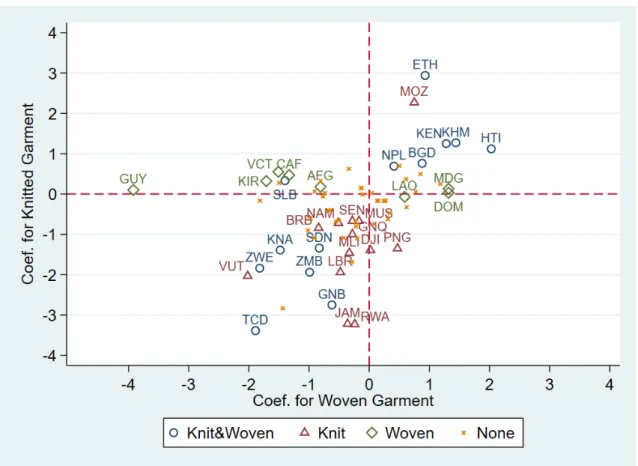
To allow for varying impacts between knitted and woven garments, we estimate the exporter- specific effects separately for knitted and woven garments. For brevity, we plot the estimated coefficients in Figure 1, with each marker indicating an exporting market. The vertical and horizontal axes show the estimated coefficients of exporter-specific effects for knitted and woven garment exports, respectively. It is evident that the positive impacts are limited to a handful of successful exporters. Taken together, we highlight that the supply response to simple ROO is heterogeneous across beneficiary exporters.
---Figure 1 here--- 4.4. Robustness check
While we demonstrate the heterogeneous impacts of ROO changes across beneficiary
15
exporters, there remains an econometric problem of heteroscedasticity and the presence of zero export flows (Santos Silva and Tenreyro, 2006). Since the standard OLS estimator may be biased in the presence of heteroscedasticity in exports, a solution is to use PPML estimation. To examine whether the heterogeneous impacts of ROO changes are robust to this issue, we implement PPML estimation of regression models in Table 6.
Table 7 presents the PPML results for the sample with zero exports.17 Column (1) shows that the coefficients remain unchanged qualitatively not only for the Southern African, the Caribbean and other IEPA groups, but for the Asian and Pacific EBA groups. The results for these groups are generally unchanged. A key difference is that the coefficients are significantly negative for the East African IEPA group and significantly positive for the African EBA group. To investigate the potential role of product heterogeneity in these results, column (2) presents the coefficients separately for knitted and woven garments. For the East Africa IEPA group, the coefficient for knitted garments becomes significantly negative, whereas the coefficient for woven garments become insignificant. For the Africa EBA group, the coefficient for knitted garments becomes significantly positive. Taken together, the PPML estimation highlights the heterogeneous impacts of ROO changes on exports across beneficiary exporters, and the estimated impacts may be sensitive for some African exporters.
---Table 7 here---
5. Discussions
Discussions up to this point have demonstrated heterogeneous supply responses to simplifying ROO across beneficiary exporters. However, there remains the key question of what underlying conditions can explain the heterogeneous responses across beneficiary exporters. This section provides alternative explanations with some country cases.
5.1. Garment Production Base
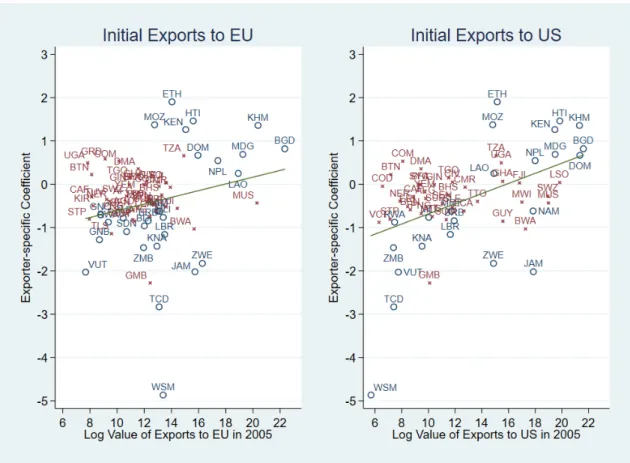
We start to highlight the initial production base for garment exports. Figure 2 presents a relationship between exporter-specific ROO impacts and the value of garment exports to the EU or U.S. markets in 2005. The estimated impacts of ROO liberalization correlate positively not only with the initial level of EU-bound exports in 2005, but with the initial level of U.S.-bound exports in 2005.18 If beneficiary countries had the substantial value of EU-bound exports in 2005, they tend to experience a large increase in their exports subsequently. Additionally, the impacts are positive for countries such as the Dominican Republic, Haiti, and Kenya, which exhibited a
17 To implement PPML estimation with high dimensional fixed effects, we adopt estimation approach by Correia et al. (2019), i.e., ppmlhdfe in STATA command.
18 Frazer and Van Biesebroeck (2010) also show a positive relationship between the export response to the African Growth and Opportunity Act (AGOA) and the country’s initial level of exports.
16
large value of U.S.-bound exports. While there are a few exceptions such as Mauritius, Lesotho and Swaziland, simplifying ROO appears to exhibit a more pronounced impact on beneficiaries with the large existing capacity of garment production during the pre-period.
---Figure 2 here---
From the supply side, a large production base suggests that agglomeration effects in export- oriented garment industry can promote export growth in low-income countries. A cluster of export-oriented firms improves industrial productivity through access to inputs, a pooling of workers, and information sharing (Murakami and Otsuka, 2020). An industrial cluster helps to improve business environments through government supports in investment and custom policies.
This observation is consistent with the growth of footwear exports in the south of Brazil, as Schmitz (1995) highlights that a cluster of shoe manufacturers strengthens the capacity to seize an export opportunity through collective efforts in industrial production.
From the demand side, a large production base reflects the existence of garment exporters that can satisfy stringent criteria by international buyers. For instance, Gereffi and Frederick (2010) suggest that buyers were likely to maintain a short-term relationship with garment factories providing only assembly services before the global financial crisis in the late 2000s. Subsequently, a relationship between buyers and garment factories became longer and more stable, so that buyers can manage garment factories to improve production efficiency, including reductions in lead times and costs, as well as higher quality. A concentration of these garment factories imply that some countries can build up an extensive buyer-supplier network and high production capability. Simplifying ROO can benefit these countries more strongly through the buyer-supplier relationship.
5.2. Investment Climate
An effective policy for investment climate can boost a supply response of beneficiary exporters. For instance, garment exports to the EU from Ethiopia increased sharply after simplifying ROO in the EU GSP.19 This is partly due to previous industrial policies to improve the investment climate for garment production. Specifically, the Ethiopian government identified the textile and garment industries as a priority sector in its industrial development strategy in 2002, and provided investors with preferential land access under government controls. Together with export incentives, the government made a large investment in skill upgrading through the establishment of a public technical institute for the garment industry and vocational training institutes in secondary and higher education. In the 2010s, the Ethiopian government established large industrial parks for the textile and garment industries to provide services in customs clearance, licensing, and immigration. Under these supportive policies, for instance, Turkish
19 Appendix Figure 4 shows garment imports in EU from Ethiopia.
17
textile firms made a first large investment in the Ethiopian garment industry in 2008, and a major European retailor opened a sourcing office in 2012 (Staritz and Whitfield, 2017).
5.3. Structural Transformation
Structural transformation in an economy can affect supply responses. For instance, Mauritius experienced high growth of garment production in the early 1980s, but EU-bound garment exports have tended to decline since the early 2000s.20 The reason is that a shortage of labor supply and a rise of wages in the small island economy posed a constraint to the expansion of domestic garment production (Subramanian and Roy, 2003). Garment manufactures had a strong incentive to locate labor-intensive garment production in a low-wage country such as Madagascar, thereby reducing garment production. Because the Mauritian economy was in the midst of structural transformation from labor-intensive manufacturing to service industries during the 2000s, Mauritius did not exhibit pronounced growth in garment exports even after simplifying ROO under the IEPA regime.
5.4. Economic Shocks
Economic shocks in beneficiary countries can suppress supply responses. In Madagascar, a political crisis occurred in 2009 when the army attacked the president and replaced him without an election. The international community including the Africa Union called the regime change anti-democratic, and many donor countries suspended aid to Madagascar. Although preferential access under the IEPA was unchanged, the Madagascar economy went into recession and garment exports to the EU decreased substantially in 2009 and 2010. However, armed conflicts under the transitional regime were infrequent, and garment exports to the EU started to recover after 2011.
Economic shocks also depress export opportunities. In the 1990s, Zimbabwe had larger and more diversified manufacturing industries than other sub-Saharan African countries, and textiles were key export products to the EU market (Hoogeveen and Mumvuma 2002). However, the economic crisis in the 2000s seriously hurt the national economy and the garment industry. Under hyperinflation, exporting firms were plagued by overvalued exchange rates, a shortage of foreign currency, an unstable power supply, and a lack of finance and materials (Dube and Chipumho 2016). When the IEPA regime started, the inflation rate was at its peak and many firms stopped operation. As garment exports to the EU continued to fall during the 2000s, ROO liberalization did not boost the supply response.
20 Appendix Figure 5 shows garment imports in EU from Mauritius.
18 6. Conclusion
Preferential market access to developed economies can promote an export industry in developing economies. Since stringent ROO may discourage trade flows from beneficiaries, liberal ROO are key to export performance. However, it remains unexplored whether ROO impacts are heterogeneous across exporters. This paper examines the impact of ROO liberalization on garment exports in developing economies. Specifically, we focus on the IEPA and EBA trade regimes in EU trade preferences. For garment products, duty-free and quota-free market access were unchanged, but origin requirements were relaxed from a two-stage transformation to a one-stage transformation. Using a dataset on global trade flows during the period 2005-2015, we estimate the impact of simplifying ROO on garment exports in IEPA and EBA beneficiaries.
We find that simplifying ROO has little overall net effect on garment exports for IEPA beneficiaries, but a significantly positive impact for EBA beneficiaries. A theoretical interpretation is that the previous ROO for IEPA beneficiaries might not seriously constrain exporters in input sourcing, whereas garment exporters in EBA beneficiaries might have faced more restrictive ROO than those in IEPA beneficiaries. Additionally, we find the heterogeneous ROO impacts across exporters. Only some beneficiaries in Africa and Asia increased garment exports to the EU significantly. As a key underlying condition for export performance, we highlight dependence on competitively priced inputs from third markets, the initial production base for garment exports, investment climate, structural transformation, and political and economic shocks. These country-specific factors help to shed light on the heterogeneous ROO impacts among EBA and IEPA beneficiaries.
We conclude by discussing unexplored questions. First, further research is needed to identify key domestic policies for successful export performance in low-income countries. This research can shed light on key bottlenecks for export promotion in unsuccessful African and Asian countries. Second, a key question is the welfare impact of simplifying ROO in trade preferences, as ROO impacts involve not only complex value chains in a globalized economy, but consumer benefits in preference-giving countries. Finally, another key question is to explore potential theoretical mechanisms through which ROO affect global value chains among beneficiary and third countries.
19 References
Andersson, A. 2016. Export performance and access to intermediate inputs: the case of rules of origin liberalisation. The World Economy, 39 (8), 1048-1079.
Anson, J., Cadot, O., Estevadeordal, A., de Melo, J., Suwa-Eisenmann, A., Tumurchudur, B. 2005.
Rules of origin in North-South preferential trading arrangements with an application to NAFTA.
Review of International Economics, 13 (3), 501-517.
Asuyama, Y., and Neou, S. 2014. Cambodia: growth with better working conditions. In: Fukunishi, T., Yamagata, T. (Eds.), The Garment Industry in Low-Income Countries: An Entry Point of Industrialization (p. 38-76). Palgrave Macmillan. Basingstoke.
Augier, P, Gasiorek, M., Lai-Tong, C. 2004. Rules of origin and the EU-Med partnership: the case of textiles. The World Economy, 27 (9), 1449-1473.
Augier, P, Gasiorek, M., Lai-Tong, C. 2005. The impact of rules of origin on trade flows. Economic Policy, 20 (43), 568-624.
Azmeh, S., Nadvi, K. 2014. ‘Greater Chinese’ global production networks in the Middle East: the rise of the Jordanian garment industry. Development and Change, 44 (6), 1317-1340.
Bilal, S., Stevens, C. 2009. The Interim Economic Partnership Agreements between the EU and African States: Contents, challenges, and prospects. European Centre for Development Policy Management (ECDPM), Maastricht.
Brenton, P., Manchin, M. 2003. Making EU trade agreements work: the role of rules of origin. The World Economy, 26 (5), 755-769.
Collier P., Gunning J. W. 1999. Explaining African economic performance. Journal of Economic Literature, 37 (1), 64-111.
Conconi, P., García-Santana, M., Puccio, L., Venturini, R. 2018. From final goods to inputs: the protectionist effect of rules of origin. American Economic Review, 108 (8), 2335-2365.
Correia, S. 2015. Singletons, cluster-robust standard errors and fixed effects: a bad mix. Manuscript, Duke University. Retrieved from http://scorreia.com/research/singletons.pdf
Correia, S. Guimarães, P., Zylkin, T. 2019. PPMLHDFE: fast Poisson estimation with high- dimensional fixed effects. Unpublished manuscript. Retrieved from https://arxiv.org/abs/1903.01690
Curran, L., Nadvi, K. 2015. Shifting trade preferences and value chain impacts in the Bangladesh textiles and garment industry. Cambridge Journal of Regions, Economy, and Society, 8 (3), 459- 474.
Curran L., Nadvi, K., Campling, L. 2019. The influence of tariff regimes on global production networks (GPNs). Journal of Economic Geography, 19 (4), 873-895.
de Melo, J., Portugal-Perez, A. 2013. Preferential market access design: evidence and lessons from African apparel exports to the United States and the European Union. The World Bank Economic Review, 28 (1), 74-98.
Demidova, S., Kee, H. L., Krishna, K. 2012. Do trade policy differences induce sorting? Theory and evidence from Bangladesh apparel exporters. Journal of International Economics, 87(2), 247- 261.
Dube, C., Chipumho, E. 2016. Response of the manufacturing sector to the Zimbabwe economic crisis.
In: Kararach, G., Otieno, R. O. (Eds.), Economic Management in a Hyperinflationary Environment: The Political Economy of Zimbabwe 1980-2008 (pp. 55-84). Oxford University Press. Oxford.
Easterly, W., Reshef, A. 2010. African export successes: surprises, stylized facts, and explanations. In:
Edwards, S., Johnson, S., and Weil, D.N. (Eds.), African Successes, Volume III: Modernization and Development (pp. 297-342). University of Chicago Press. Chicago.
Estevadeordal, A., Suominen, K. 2004. Rules of origin in FTAs in Europe and in the Americas: issues and implications for the EU-Mercosur inter-regional association agreement. INTAL-ITD Working Paper 15, Washington, D.C.
European Commission. 2016. Report on the generalized scheme of preferences covering the period 2014-2015. Brussels.
Fontagné, L., Laborde, D., Mitaritonna, C. 2010. An impact study of the economic partnership
20
agreements in the six ACP regions. Journal of African Economies, 20 (2), 179-216.
Frazer, G., Van Biesebroeck, J. 2010. Trade growth under the African growth and opportunity act.
Review of Economics and Statistics, 92 (1), 128-144.
Frisch, D. 2008. The European Union's development policy. A personal view of 50 years of Development Policy. Policy Management Report 15, ECDPM. Maastricht.
Fukunishi, T., Yamagata, T. (Eds.) 2014. The Garment Industry in Low-Income Countries: An Entry Point of Industrialization. Palgrave Macmillan. Basingstoke.
Gereffi, G. 1999. International trade and industrial upgrading in the apparel commodity chain. Journal of International Economics, 48 (1), 37-70.
Gereffi, G. Frederick, S. 2010. The Global Apparel Value Chain, Trade and the Crisis: Challenges and Opportunities for Developing Countries, Policy Research Working Paper 5281, World Bank.
Washington D.C.
Hoekman, B. Njinkeu, D. 2017. Integrating Africa: some trade policy research priorities and challenges. Journal of African Economies, 26, Issue suppl_2, ii12-ii39.
Hoogeveen, J.G.M., Mumvuma, T. 2002. Manufacturing export performance, macroeconomic adjustment and the role of networks. In: Gunning, J. W., Oostendorp, R. (Eds.), Industrial Change in Africa: Zimbabwean Firms under Structural Adjustment (pp. 232-259). Palgrave. Basingstoke.
Inama, S. 2011. The reform of the EC GSP rules of origin: per aspera ad astra? Journal of World Trade, 45 (3), 577-603.
Ju, J., Krishna, K. 2005. Firm behavior and market access in a free trade area with rules of origin. The Canadian Journal of Economics, 38 (1), 290-308.
Krishna, K. 2006. Understanding rules of origin. In: Cadot, O, Estevadeordal, A., Suwa-Eisenmann, A., Verdier, T. (Eds.), The Origin of Goods: Rules of Origin in Regional Trade Agreements (pp.
19-34). Oxford University Press. Oxford.
Lall, S. 2005. FDI, AGOA, and manufactured exports by a landlocked, least developed African economy: Lesotho. Journal of Development Studies, 41 (6), 998-1022.
Mattoo, A., Roy, D., Subramanian, A. 2003. The African Growth and Opportunity Act and its rules of origin: generosity undermined? The World Economy, 26 (6), 829-851.
Morris, M., Staritz, C. 2014. Industrialization trajectories in Madagascar’s export apparel industry:
ownership, embeddedness, markets, and upgrading. World Development, 56, 243-257.
Morrissey, O. 2005. Imports and implementation: neglected aspects of trade in the report of the commission for Africa. Journal of Development Studies, 41 (6), 1133-1153.
Murakami, Y., and Otsuka, K. 2020. Governance, information spillovers, and productivity of local firms: toward an integrated approach to foreign direct investment and global value chains. The Developing Economies, 58 (2), 134-174.
Natsuda, K., Goto, K., and Thoburn, J. 2010. Challenges to the Cambodian garment industry in the global garment value chain. European Journal of Development Research, 22 (4), 469-493.
Naumann, E. 2010. Rules of origin in EU-ACP economic partnership agreements. International Centre for Trade and Sustainable Development (ICTSD). Geneva.
Phelps, N.A., Stillwell, J.C.H., Wanjiru, R. 2009. Broken chain? AGOA and foreign direct investment in the Kenyan clothing industry. World Development, 37 (2), 314-325.
Pickles, J., Plank, L., Staritz, C., Glasmeier, A. 2015. Trade policy and regionalisms in global clothing production networks. Cambridge Journal of Regions, Economy, and Society, 8 (3), 381-402.
Ramaswamy, K.V., Gereffi, G. 2000. India’s apparel exports: the challenge of global markets.
Developing Economies, 38 (2), 186-210.
Rhee, Y. W. 1990. The catalyst model of development: lessons from Bangladesh’s success with garment exports. World Development, 18 (2), 333-346.
Santos Silva, J.M.C., Tenreyro, S. 2006. The log of gravity. Review of Economics and Statistics, 88(4), 641-658.
Schmitz, H. (1995) Collective efficiency: growth path for small-scale industry. Journal of Development Studies, 31 (4), 529-566.
Staritz, C., and Whitfield, L. 2017. Made in Ethiopia: The Emergence and Evolution of the Ethiopian Apparel Export Sector. Roskilde Universitet. Roskilde.
Subramanian, A., and Roy, D. 2003. Who can explain the Mauritian miracle? Mead, Romer, Sachs, or
21
Rodrik? In: Rodrik, D. (Eds.), In Search of Prosperity: Analytical Narratives on Economic Growth (p. 205-243). Princeton University Press. Princeton.
Tanaka, K. 2021. The EU’s reform in rules of origin and international trade: evidence from Cambodia.
The World Economy, forthcoming.
Uchikawa, S. Indian Textile Industry: State Policy, Liberalization and Growth. Manohar Publishers.
New Delhi.
United Nations Conference on Trade and Development (UNCTAD). 2013. Handbook on the Rules of Origin of the European Union. Geneva.
World Bank 1992. Mauritius: Expanding Horizons. World Bank Country Study. Washington D.C.
22
Figure 1. Exporter-specific Impacts of ROO Liberalization
Notes: The horizontal axis shows the estimated coefficients of exporter-specific effects for woven garment exports; the vertical axis indicates the estimated coefficients of exporter-specific effects for knitted garment exports; each plot shows data on exporting markets; the circle marker shows the significant coefficients for both knitted and woven garments; the triangle marker shows the significant coefficients only for knitted garments; the diamond marker shows the significant coefficients only for woven garments.
Source: Authors’ calculation based on UN Comtrade
23
Figure 2. Exporter-specific ROO Impacts and Initial Export Levels
Notes: Exporter-specific coefficients come from the estimation results in Appendix Table 3;
exports include knitted and woven garment products in HS chapters 61 and 62; circle markers indicate a p-value of less than or equal to 0.1 for the corresponding estimated coefficient; the lines represent the predicted values from a linear regression of the exporter-specific coefficients on the log export values in 2005 for the EU and US markets.
Source: Authors’ calculation based on UN Comtrade
24
Table 1. List of Interim EPA Signatory Countries and EBA Beneficiaries
Country IEPA EBA Country IEPA EBA
Asia Pacific
Afghanistan N Y East Timor N Y
Bangladesh N Y Fiji Y N
Bhutan N Y Kiribati N Y
Cambodia N Y Papua New Guinea Y N
Laos N Y Samoa N Y
Myanmar N Y Solomon Islands N Y
Nepal N Y Tuvalu N Y
Timor-Leste N Y Vanuatu N Y
Yemen N Y
Caribbean East Africa
Antigua and Barbuda Y N Burundi Y Y
Bahamas Y N Comoros Y Y
Barbados Y N Djibouti N Y
Belize Y N Eritrea N Y
Dominica Y N Ethiopia N Y
Dominican Republic Y N Kenya Y N
Grenada Y N Madagascar Y Y
Guyana Y N Mauritius Y N
Haiti Y Y Rwanda Y Y
Jamaica Y N Seychelles Y N
Saint Kitts and Nevis Y N Somalia N Y
Saint Vincent & the Grenadines Y N Sudan N Y
Santa-Lucia Y N South Sudan N Y
Suriname Y N Tanzania Y Y
Trinidad and Tobago Y N Uganda Y Y
Central Africa West Africaa
Cameroon Y N Benin Y Y
Central African Republic N Y Burkina-Faso Y Y
Chad N Y Côte d'Ivoire Y N
Dem. Rep. of the Congo N Y Cape-Verde Y Nb
Equatorial Guinea N Y Gambia Y Y
25
Sao Tome & Principe N Y Ghana Y N
Southern Africa Guinea Y Y
Angola N Y Guinea-Bissau Y Y
Botswana Y N Liberia Y Y
Lesotho Y Y Mali Y Y
Malawi N Y Mauritania Y Y
Mozambique Y Y Niger Y Y
Namibia Y N Nigeria N N
Swaziland Y N Senegal Y Y
Zambia Y Y Sierra Leone Y Y
Zimbabwe Y N Togo Y Y
Notes: IEPA (interim EPA) indicates that the IEPA signatory states except for West Africa could export to the EU under the IEPA regime since January 2008; EBA indicates the EBA beneficiary country as of August 2015; GSP preferences were withdrawn from
Myanmar/Burma in 1997 and reinstated for application from June 13, 2012; South Sudan became a beneficiary in 2013; (a) the interim EPA was signed in December 2014 by West African countries, except Nigeria, Mauritania (signed on September 21, 2018), and Gambia (signed on August 9, 2018); (b) EBA status was granted to Cape-Verde until 2011.
Source: Authors' compilation based on Bilal and Stevens (2009) and EC (2015).
26
Table 2. EU's Rules of Origin for Knitted and Woven Garments Products: HS chapters 61 and 62
Panel A: Origin Requirements under Interim EPA Regime
Old Rulesa New Rules
Periods to apply new rules 1st January 2008b
Processing stages Double transformation Single transformation Manufacture from yarn Manufacture from fabric Scope of cumulation
Bilateral cumulation Inputs from the European Union can be originating content in the ACP countries.
Full cumulation Inputs from other ACP countries can be originating content under the Cotonou Agreement; no requirement on the final- stage value added relative to the customs value of inputs used.
Partial cumulation Inputs from South Africa and neighboring non-ACP countries can be originating content, provided that the final- stage value added exceeds the value of inputs from these countries.
Tolerance rule Non-originating inputs up to a total value of 15 percent of the ex-works price of the product can be used.
Panel B: Origin Requirements under EBA Regime
Old Rules New Rules
Periods to apply new rules 1st January 2011
Processing stages Double transformation Single transformation Manufacture from yarn Manufacture from fabric Scope of cumulation
Bilateral cumulation Inputs from the European Union can be originating content in the beneficiary.
Diagonal regional cumulation
Inputs from countries in the regional grouping (ASEAN, SAARC, Andean Group, and CACM) can be originating content, provided that (i) value added in the final stage exceeds the highest customs value of any of inputs used from other countries; (ii) the originating inputs are manufactured in these countries.
Tolerance rule Non-originating inputs up to a total value of 10 percent of the ex-works price of the product can be used.
Notes: (a) “Old rules” refers to the rules of origin under the Cotonou Agreements; (b) West African countries and the EU concluded the negotiations for an EPA in February 2014.
Source: Authors' compilation based on Brenton (2003), Naumann (2010), Inama (2011), and UNCTAD (2013).
27 Table 3. Summary Statistics
Variable No. of
Obs. Mean Std.
Dev. Min Max
Log export 612,856 10.24 3.67 0 23.6
IEPA × EU × Garment × Post2008 612,856 0.008 0.088 0 1 IEPA × EU × Knitted Garment × Post2008 612,856 0.004 0.063 0 1 IEPA × EU × Woven Garment × Post2008 612,856 0.004 0.062 0 1
EBA × EU × Garment × Post2011 612,856 0.004 0.065 0 1
EBA × EU × Knitted Garment × Post2011 612,856 0.002 0.046 0 1 EBA × EU × Woven Garment × Post2011 612,856 0.002 0.046 0 1
28 Table 4. Benchmark Results
Dependent variable: log of exports
(1) (2)
IEPA × EU × Garment × Post2008 0.030
(0.086)
IEPA × EU × Knitted Garment × Post2008 -0.16
(0.10)
IEPA × EU × Woven Garment × Post2008 0.24*
(0.11)
EBA × EU × Garment × Post2011 0.22**
(0.081)
EBA × EU × Knitted Garment × Post2011 0.22*
(0.10)
EBA × EU × Woven Garment × Post2011 0.21*
(0.089)
Exporter-importer-product fixed effects Y Y
Importer-product-year fixed effects Y Y
No. of observations 612,856 612,856
R-squared 0.87 0.87
Notes: IEPA and EBA indicate that exporters are IEPA signatory and EBA beneficiary countries, respectively: garment exports include knitted and woven garment products in HS chapters 61 and 62; parentheses report standard errors corrected for clustering in exporter- importer pairs; constant is not reported; **, *, and + denote significance at the 1%, 5%, and 10% level, respectively.
29 Table 5. Results of Timing Effects
Dependent variable: log of exports
(1) (2)
Knitted & Woven Garments Knitted Garments Woven Garments
Coef. Std. Err. Coef. Std. Err. Coef. Std. Err.
IEPA × EU × Garment × Year 2008 -0.016 (0.085) 0.029 (0.12) -0.042 (0.11)
IEPA × EU × Garment × Year 2009 0.13 (0.10) 0.0041 (0.14) 0.27* (0.12)
IEPA × EU × Garment × Year 2010 -0.044 (0.10) -0.15 (0.13) 0.084 (0.14)
IEPA × EU × Garment × Year 2011 0.015 (0.11) -0.27+ (0.15) 0.32* (0.14)
IEPA × EU × Garment × Year 2012 0.023 (0.12) -0.27+ (0.14) 0.34* (0.15)
IEPA × EU × Garment × Year 2013 0.034 (0.12) -0.27+ (0.15) 0.36* (0.16)
IEPA × EU × Garment × Year 2014 -0.014 (0.14) -0.24 (0.16) 0.23 (0.18)
IEPA × EU × Garment × Year 2015 0.12 (0.13) -0.16 (0.16) 0.42* (0.17)
EBA × EU × Garment × Year 2011 -0.0061 (0.093) -0.051 (0.13) 0.039 (0.11)
EBA × EU × Garment × Year 2012 0.15 (0.095) 0.16 (0.12) 0.14 (0.12)
EBA × EU × Garment × Year 2013 0.23* (0.11) 0.21 (0.15) 0.25* (0.12)
EBA × EU × Garment × Year 2014 0.29** (0.11) 0.23+ (0.13) 0.34** (0.12)
EBA × EU × Garment × Year 2015 0.41** (0.12) 0.44** (0.14) 0.37** (0.13)
Exporter-importer-product fixed effects Y Y
Importer-product-year fixed effects Y Y
No. of observations 612,856 612,856
R-squared 0.87 0.87
Notes: IEPA and EBA indicate that exporters are IEPA signatory and EBA beneficiary countries, respectively; garment exports include knitted and woven garment products in HS chapters 61 and 62; parentheses report standard errors corrected for clustering in exporter-importer pairs;
constant is not reported; **, *, and + denote significance at the 1%, 5%, and 10% level, respectively.