相互相関型暗視野顕微計測を用いた金
bow-tie ナノ構造の応答関数計測と2光子励起場制御
Measurement of Response Function of Gold Bow-tie Nano Structure using Dark-fieldCross-correlation Microscopy and Controlling of Two-photon Excitation. 草場 美幸 (B4),大井 潤 (M1)
Miyuki Kusaba, and Oi Jun
Abstract
We report the experimental results of response functions of gold bow-tie nano structures measured by dark-field cross-correlation microscopy. The response functions varies by size of gap in the bow-tie structure. We theoretically confirmed that two-photon excitation can be shaped based on the plasmon response function at each nano-structure.
1. はじめに
ナノ構造を持つ金などの貴金属は,紫外から近赤 外 域 に お い て 局 在 プ ラ ズ モ ン 共 鳴(LSPR: Localized Surface Plasmon Resonance)という現 象を発生する。超高速光パルスで励起された局在プ ラズモンの時空間特性に関しては,PEEM を用い て複素電界計測をした例や[1],励起フェムト秒レ ーザパルスのベクトル波形整形を用いて時空間制 御する提案[2]などがこれまでに報告されている。 我々は広帯域なフェムト秒レーザパルスで励起さ れたプラズモン場の時空間特性を計測・制御するた めに,周波数応答関数を求め決定論的に制御する手 法の研究を行っている。今回,暗視野顕微鏡を電界 相 互 相 関 計 測 に 用 い , ギ ャ ッ プ 構 造 を 持 つ 金 bow-tie ナノ構造の応答関数を求めた。また,応答 関数から計算される二光子励起に対応した第2高 調波(SH)光スペクトルを計算によって求め,ナノ 構造に依存した2光子励起を実現できることを示 した。
2. シミュレーションおよび実験
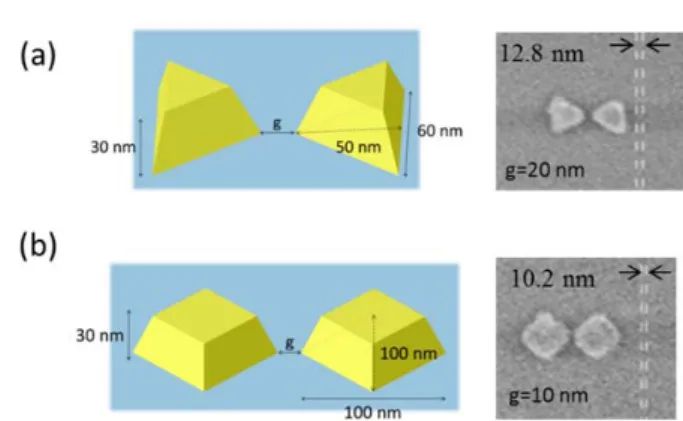
試料は NTT-AT に外注して作製したもので,厚 さ625 m のガラス基板上に高さ 30 nm の金ナノ 構造が配置されている。金ナノ構造の設計形状と実 際の形状のSEM 写真は,Fig. 1 に示したような三 角および四角のbow-tie 構造である。ギャップはそ れぞれ10~40 nm で設計を行ったが,三角 bow-tie 構造ではギャップがつぶれているとの報告があっ た。まずはじめに,富士通のPoynting for Optics と いう FDTD モデルを用いてシミュレーションを行 い,金ナノ構造の電界分布図および応答関数を取得 した。シミュレーションを行うにあたり,試料が存 在しない領域で 10 nm,試料が存在する領域で 1 nm 間隔でメッシュを設定した。励起光は波長 500
Fig. 1.Designed Au nanostructures and SEM images: (a) square structure (b) triangular structure.
~1000 nm のパルス光で,また,ガラスの屈折率 を1.45,導電率を 0,比透磁率を 1 とし,金の波長 775 nm における屈折率を 0.17,消衰係数を 4.86, 瞬間比透磁率を12 のドルーデモデルとして計算を 行った。 実験はモード同期 Ti:Sapphire レーザ(波長 650~1050 nm,パルス幅 10 fs,繰り返し周波数 150 MHz,VENTEON)を用いた相互相関型暗視野顕 微鏡による応答関数計測を行った。実験セットアッ プを Fig. 2 に示す。VENTEON を出射した光は signal 光と reference 光に分けられ,signal 光は SLM によって変調され試料に直径 150m のスポ ットサイズで集光し,試料によって発生する散乱光 を対物レンズ(×10,NA=0.25)で CCD に入射した。 一方,reference 光は,ピコモーターによって signal 光との約0.15 fs の分解能を持つ遅延差をつけて直 接 CCD に入射した。CCD 画像上の任意の点の強 度を遅延差をつけながら取得していくことにより, 相互相関波形を得た。応答関数は,相互相関スペク トルおよび励起光スペクトルを用いて以下のよう に記述できる。
1 ~ ~ , 2 ref E M r R 3. 実験結果
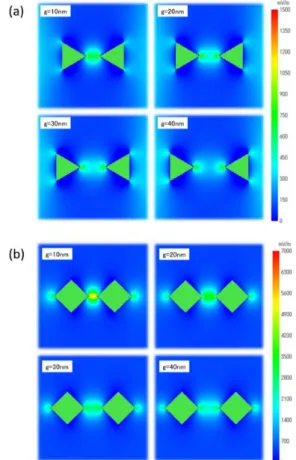
A. シミュレーション結果 三角bow-tie および四角 bow-tie 構造における電 界分布図を Fig. 3 に示す。どちらの構造において も,ギャップにおいて電界増強が最も大きく,ギャ ップが狭いほうが電界増強が大きいことが確認で きた。 また,シミュレーションによって得られた三角 bow-tie 構造および四角 bow-tie 構造の応答関数を それぞれFig. 4,Fig. 5 に示す。Fig. 2. Schematic of the experimental
Fig. 3. Electric field distribution
(a) triangular structure (b) square structure
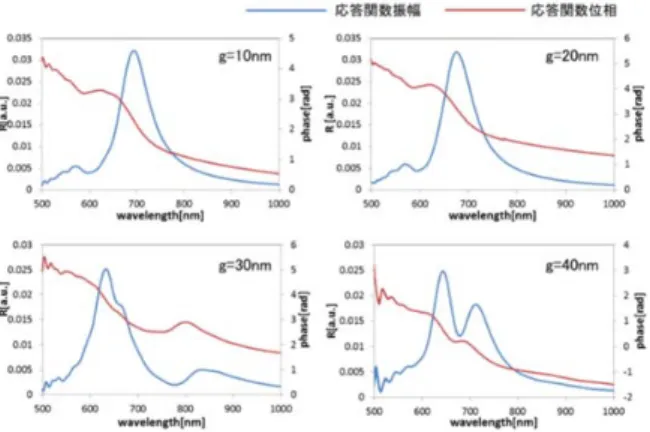
Fig. 4 では,はっきりとしたピークの移動というの は見られないが,応答関数はギャップによって異な ることがわかった。Fig. 5 では,応答関数のピーク は波長700 nm 付近にあり,ギャップが小さくなる と応答関数のピークが長波長側に移動していくの がわかった。 B. 応答関数計測 三角bow-tie 構造および四角 bow-tie 構造の相互 相関波形をそれぞれFig. 6,Fig. 7 に,三角 bow-tie 構造および四角 bow-tie 構造の周波数域応答関数 をそれぞれFig. 8 から Fig. 11 に示す。 四角bow-tie 構造の応答関数は,波長 670~760 nm においてピークが見られた。三角bow-tie 構造と同 様にギャップによってスペクトルの形状が異なり, ギャップが小さいほどピークが長波長側に移動し ており,前節で行ったシミュレーションの結果と近 い値が得られた。このことから,本研究で用いた四 角構造についても,波長 670~760 nm の帯域にお いてプラズモン共鳴があり,その共鳴波長はギャッ プの大きさによって変化することがわかった。 Fig. 5. Response functions of square structures.
Fig. 6. Cross-correlation Waveform of triangular structures.
Fig. 7. Cross-correlation waveforms of square structures.
Fig. 8. Spectal response functions of triangular structures.
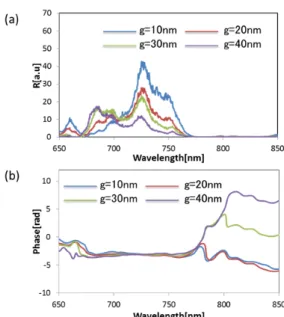
C. 二光子励起に対応した SH 光計算 ここでは応答関数の結果から得られる各金ナノ 構造での二光子励起に対応した SH 光スペクトル を考える。SH 光スペクトルはプラズモン強度,プ ラズモン位相を用いて以下の式によって与えられ る。励起光のスペクトルをFig. 10 に示す。 励 起 光 の 位 相 が 0 のとき,三角および四角の bow-tie 構造の SH 光スペクトルの計算結果を Fig. 11 に示す。また,それぞれの応答関数の位相を SLM によって補償し,さらに励起光に二次分散を190 fs, 三次分散を400 fs かけたときの SH 光スペクトル の結果をFig. 12 に示す。 四角bow-tie 構造は応答関数において 1 つのピー Fig. 9. Spectal response functions of square
structures.
Fig. 10. VENTEON spectrum (190fs2+400fs3).
Fig. 11. Second harmonic spectrum
(a) triangular structures (b) square structures
Fig. 12. Second harmonic spectrum (190fs2+400fs3) (a) triangular structures (b) square structures
クしか持たないため,位相変調によるSH スペクト ルの変化はわずかであった。 一方,三角bow-tie 構造は応答関数の中でいくつ かのピークを持つ。そのため位相変調を与えると, 任意のピーク波長間での SH 光を強くすることが でき,励起するパルスの分散によってSH スペクト ルが大きく変化することが確認できた。これによっ て,選択的二光子励起を行うことが可能であること が示された。
4. まとめ
相互相関暗視野顕微鏡を用いて広帯域パルスレ ーザの帯域における金ナノ構造の応答関数を計測 することにより,粒子の形状および2 粒子間の距離 によって応答関数が異なることが示された。また, 励起光の位相を変調することにより,二光子励起に 対応した SH 光のスペクトルが変化することが確 認できた。このことにより,選択的二光子励起が可 能であることが示された。References
[1] A. Kubo, K. Onda, H. Petek, Z. Sun, Y. S. Jung, and H. K. Kim, Nano Lett., 5, 1123 (2005)
[2] M. Aeschlimann, M. Bauer, D. Bayer, T. Brixner, F. Javier Garcia de Abajo, W. Pfeiffer, M. Rohmer, C. Spindler and F. Steeb, Nature, 446, 301 (2007)