Corresponding author: Noriya Yamaguchi, MD [email protected]
Received 2016 September 21 Accepted 2016 November 14
Abbreviations: ADT, androgen deprivation therapy; BCR, bio-chemical recurrence; BMI, body mass index; CI, confidence inter-val; cT3, clinical T3; EPE, extra-prostatic extension; GS, Gleason score; HR, hazard ratio; NCCN, National Comprehensive Cancer Network; PSA, prostate-specific antigen; PSM, positive surgical margin; RARP, robot-assisted radical prostatectomy; RT, radiation therapy
Biochemical Recurrence Prediction in High-Risk Prostate Cancer Patients,
Following Robot-Assisted Radical Prostatectomy
Noriya Yamaguchi,* Tetsuya Yumioka,* Hideto Iwamoto,* Toshihiko Masago,* Shuichi Morizane,* Masashi Honda,* Takehiro Sejima† and Atsushi Takenaka*
*Division of Urology, Department of Surgery, School of Medicine, Tottori University Faculty of Medicine, Yonago 683-8503, Japan and †Department of Urology, Matsue City Hospital, Matsue 690-8509, Japan
ABSTRACT
Background High-risk prostate cancer treatment has been controversial. Some high-risk prostate cancer patients fail to respond to radical prostatectomy only. Thus, we aimed to investigate the predictive factors for biochemical recurrence (BCR) and identify patients who could achieve sufficient therapeutic effect by radical prostatectomy only.
Methods Of 264 medical records reviewed, 141 low-intermediate-risk and 100 high-risk prostate cancer patients, excluding those who had received neoadjuvant hormone therapy, were analyzed. BCR was defined as the first increase in prostate-specific antigen levels (≥ 0.2 ng/mL), with levels not decreasing to undetectable limits, after radical prostatectomy. Log-rank test and Cox proportional hazards regression analyses were per-formed to determine the prognostic factors. We investi-gated the perioperative predictive factors for BCR and BCR-free survival rates, with the number of National Comprehensive Cancer Network (NCCN) high-risk fac-tors for high-risk prostate cancer patients who underwent robot-assisted radical prostatectomy.
Results Multivariate analyses showed that clinical T3 was significantly associated with BCR [hazard ratio (HR) = 4.052; 95% confidence interval (CI), 1.26–12.99; P = 0.019]. Of the 100 patients, 77 had 1 high-risk factor and 23 had ≥ 2 high-risk factors; the 1-year BCR-free surviv-al rate of patients with 1 high-risk factor and those with ≥ 2 high-risk factors was 94.8% and 69.6%, respectively. Patients with ≥ 2 high-risk factors were significantly associated with BCR (P = 0.002). No difference in BCR rate between patients with 1 high-risk factor and those with low- and intermediate-risk was found.
Conclusion High-risk prostate cancer patients with 1 NCCN high-risk factor can be considered for robot-as-sisted radical prostatectomy treatment only.
Key words biochemical recurrence; high-risk prostate cancer; robot-assisted radical prostatectomy
High-risk prostate cancer treatment has been contro-versial. Surgical treatment results in high biochemical recurrence (BCR) rates; thus, some studies have report-ed that a combination of hormone therapy and radiation therapy (RT; external beam radiation or brachytherapy)1
or radical prostatectomy and adjuvant RT after preoper-ative hormone therapy is effective in high-risk prostate cancer.2 The decision on whether to elect surgery as the
local therapy should be based on the best available clin-ical evidence in the European Association of Urology (EAU) guidelines.3 Although a combination of hormone
therapy and RT is one of the recommended treatments, adverse events due to RT and long-term hormone thera-py, such as radiation cystitis, rectal breeding, liver dys-function, hot flush, and glucose intolerance, pose a prob-lem for prostate cancer patients. Such adverse effects are addressed by robot-assisted radical prostatectomy (RARP) as the first-line therapy for prostate cancer pa-tients.4 Although we might perform radical
prostatecto-my as local therapy for high-risk prostate cancer patients who caused a BCR after long-term androgen deprivation therapy (ADT) and/or RT, it might be associated with increasing high complications by the adhesion of the organization. On the other hand, it is easier to add hor-mone therapy and RT for patients who underwent rad-ical prostatectomy.5 Thus, identifying the patients who
could achieve the sufficient therapeutic effect by radical prostatectomy only is essential.
We hypothesized that high-risk prostate cancer pa-tients with only 1 National Comprehensive Cancer Net-work (NCCN) high-risk factor can benefit from surgical treatment only.6 We investigated the predictive factors
for BCR and BCR-free survival rates with the number of NCCN high-risk factors for high-risk prostate cancer patients who underwent RARP.
MATERIALS AND METHODS Patients and data collection
We reviewed the medical records of 264 patients who underwent RARP between October 2010 and September 2015. The study protocol was approved by the Institu-tional Review Board of the Tottori University Faculty of Medicine (Approval No. 2008). We excluded 23 patients who had undergone neoadjuvant hormone therapy and, consequently, analyzed 141 low-intermediate-risk and 100 high-risk prostate cancer patients. The NCCN risk classification of the 241 patients was as follows: low risk, 32 (13.3%); intermediate risk, 109 (45.2%); and high risk, 100 (41.5%). Patients in the high-risk prostate cancer group had at least one of the following high-risk factors: prostate-specific antigen (PSA) ≥ 20 ng/mL, clinical T3 (cT3), and Gleason score (GS) ≥ 8 and were subsequent-ly divided into two groups, according to the number of NCCN high-risk factors, i.e., 1 high-risk factor and ≥ 2 high-risk factor groups.
Surgical technique
The operation was performed using a standard 6-port, trans-peritoneal technique, employing the da Vinci S and da Vinci Si surgical robotic system (Intuitive Sur-gery, Sunnyvale, CA). Of the 100 high-risk prostate cancer patients, 66 (66.0%) patients underwent extend-ed lymph node dissection, which includes the external iliac, obturator, and internal iliac lymph nodes, and 34 (34.0%) patients underwent limited node dissection, i.e., including the obturator lymph nodes only. Although extended lymph node dissection for high-risk prostate cancer patients has been recommended in the EAU guidelines,3 limited node dissection was performed in
the 34 patients because of initial RARP case and patient complications. Of the 141 low-intermediate-risk prostate cancer patients, 101 (71.6%) patients underwent limited node dissection; the rest have not undergone lymph node dissection.
In this study, the nerve preservation group composed of both the unilateral and bilateral nerve preservation. The clinical stage of the 241 patients was evaluated us-ing computed tomography, magnetic resonance imagus-ing, and bone radionuclide scintigraphy. BCR was defined as the first increase in PSA levels (≥ 0.2 ng/mL), with levels not decreasing to undetectable limits, after radical pros-tatectomy.
Statistical analyses
Student t-test and χ2 test were used to compare the
sig-nificance of the difference in means and proportions of the clinical characteristics and perioperative patient
to compare the BCR risk and BCR-free survival rate difference among the low-intermediate-risk, 1 high-risk factor, and ≥ 2 high-risk factors groups. Cox proportional hazards regression analysis was performed to define the prognostic factors. All statistical analyses were performed using Easy R (EZR; Saitama Medical Center, Jichi Med-ical University, Saitama, Japan).7 Significance was
con-sidered at P < 0.05. The association between BCR-free survival and perioperative factors was evaluated.
RESULTS
Patient characteristics
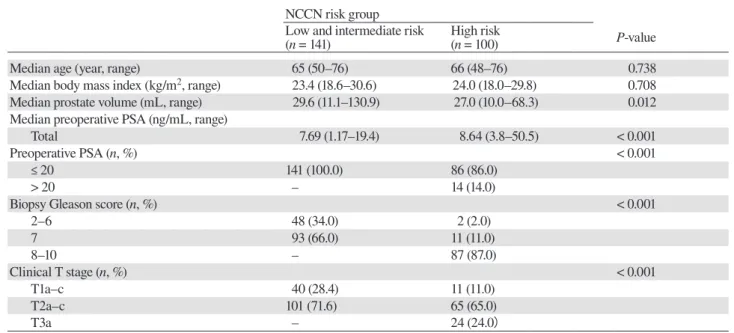
The characteristics of low-intermediate-risk and high-risk prostate cancer patients are shown in Table 1. No difference with regard to age, body mass index, and prostate volume between the low-intermediate-risk and high-risk prostate cancer patients was found. Of the 100 high-risk prostate cancer patients, 24 had ≥ cT3, 87 had GS ≥ 8, and 14 had PSA ≥ 20 ng/mL.
The pathological characteristics of the 241 patients who underwent RARP are shown in Table 2. A positive surgical margin (PSM) was identified in 44 patients (27 low-intermediate-risk and 17 high-risk patients). Extra-prostatic extension (EPE) was identified in 33 patients, but was not evaluated in 30 patients because either the prostrate was cut or EPE in the prostate apex could not be detected. Seminal vesicle invasion and lymph node metastasis occurred in 7 and 6 high-risk prostate cancer patients, respectively. The median fol-low-up period was 27 months, and BCR occurred in 19 (7.9%) patients. The 1- and 3-year BCR-free survival rates for high-risk prostate cancer patients were 89.0% and 85.5%, respectively, while those for low-intermedi-ate-risk prostate cancer patients were similar at 95.7%. Clinicopathological characteristics of the high-risk prostate cancer patients
Table 3 shows that of the 100 high-risk prostate cancer pa-tients, 77 had 1 high-risk factor (median age at surgery, 66 years; median follow-up period, 24 months) and 23 had ≥ 2 high-risk factors (median age at surgery, 63 years; median follow-up period, 12 months). The median PSA levels and the ratio of ≥ cT3 were significantly higher in the ≥ 2 high-risk factors group than in the 1 high-high-risk factor group. BCR occurred in 6 (7.8%) patients who had 1 high-risk factor and in 7 (30.4%) patients who had ≥ 2 high-risk factors. The ratio of lymph node metastasis and seminal vesicle invasion was higher in patients who had ≥ 2 high-risk factors than in those who had 1 high-risk factor. The median time to pro-gression of the two groups was 3 months. Of the 6 high-risk prostate cancer patients with lymph node metastasis, 5 had
Table 1. Clinical characteristics of the low-intermediate and high risk prostate cancer patients NCCN risk group
Low and intermediate risk
(n = 141) High risk(n = 100) P-value
Median age (year, range) 65 (50–76) 66 (48–76) 0.738
Median body mass index (kg/m2, range) 23.4 (18.6–30.6) 24.0 (18.0–29.8) 0.708
Median prostate volume (mL, range) 29.6 (11.1–130.9) 27.0 (10.0–68.3) 0.012
Median preoperative PSA (ng/mL, range)
Total 7.69 (1.17–19.4) 8.64 (3.8–50.5) < 0.001
Preoperative PSA (n, %) < 0.001
≤ 20 141 (100.0) 86 (86.0)
> 20 – 14 (14.0)
Biopsy Gleason score (n, %) < 0.001
2–6 48 (34.0) 2 (2.0) 7 93 (66.0) 11 (11.0) 8–10 – 87 (87.0) Clinical T stage (n, %) < 0.001 T1a–c 40 (28.4) 11 (11.0) T2a–c 101 (71.6) 65 (65.0) T3a – 24 (24.0)
NCCN, National Comprehensive Cancer Network; PSA, prostate-specific antigen.
Table 2. Pathological characteristics of the low-intermediate and high risk prostate cancer patients NCCN risk group
Low and Intermediate risk
(n = 141) High risk(n = 100) P-value
Pathological T Stage (n, %) 0.01 pT2a–c 127 (90.1) 80 (80.0) pT3a–b 14 (9.9) 20 (20.0) Gleason score (n, %) < 0.01 6 23 (16.3) 3 (3.0) 7 104 (73.8) 62 (62.0) 8–10 14 (9.9) 35 (35.0) Nerve sparing (n, %) 94/141 (66.7) 19 (19.0) < 0.01
Lymph node dissection (n, %) 101 (71.6) 100 (100.0)
Limited / Extended (n) 101/0 34/66
Median Nodes removed (range) 8.1 (2–23) 15.9 (3–40) < 0.01
EPE Total (n, %) 0.04
Positive 15 (10.6) 18 (18.0)
Negative 105 (74.5) 73 (73.0)
Unknown 21 (14.9) 9 (9.0)
PSM Total (n, %) 27 (19.1) 17 (17.0) 0.62
Lymph node metastasis (n, %) 1 (0.7) 6 (6.0) 0.04
Seminal vesicle invasion (n, %) 0 (0) 7 (7.0) 0.02
Follow-up time, months, median (range) 30 (3–60) 24 (0–60)
BCR free survival rates 1-year (%) 95.7 89.0 0.01
3-year (%) 95.7 85.5 0.01
BCR, biochemical recurrence; EPE, extra-prostatic extension; NCCN, National Comprehensive Cancer Network; PSM, positive surgical margin.
Table 3. Clinicopathological characteristics of the high risk prostate cancer patients
The Number of NCCN high risk factor
One factor
(n = 77) Two or more factors (n = 23) P-value
Median age (year, range) 66 (49–75) 63 (55–73) 0.187
Median prostate volume (mL, range) 28.6 (14.5–68.3) 26.0 (10–60) 0.58
Median Preoperative PSA (ng/mL, range) 8.14 (4.1–34.6) 14.98 (6.9–39.2) 0.001
Clinical T stage [≥ cT3 (n, %)] 7 (9.1) 17 (73.9) 0.001
Biopsy GS [≥ 8 (n, %)] 65 (84.4) 22 (95.7) 0.288
Extended lymph node dissection {n, %} 45 (58.4) 21 (91.3) 0.003
Pathological T stage [≥ pT3 ( n, %)] 13 (16.9) 7 (30.4) 0.232
Pathological GS [≥ 8 ( n, %)] 24 (31.2) 11 (47.8) 0.212
Median nodes removed (median, range) 11 (3–39) 20 (4–31) 0.837
EPE positive (n, %) 13 (16.9) 6 (26.1) 0.36
PSM (n, %) 10 (13.0) 7 (30.4) 0.063
Lymph node metastasis (n, %) 2 (2.6) 4 (17.4) 0.024
Seminal vesicle invasion (n, %) 1 (1.3) 5 (21.7) 0.002
Follow-up time, months, median (range) 24 (0–60) 12 (0–45) 0.001
EPE, extra-prostatic extension; GS, Gleason score; NCCN, National Comprehensive Cancer Network; PSA, prostate-specific antigen; PSM, positive surgical margin.
Table 4. Univariate and multivariate logistic regression analyses for BCR prediction in high-risk prostate cancer patients
Univariate Multivariate
Preoperative predictors P-value HR 95% CI P-value
Age (year) ≥ 65 vs < 65 0.104 0.230 BMI (kg/m2) ≥ 25 vs < 25 0.773 Prostate volume (mL) ≥ 40 vs < 40 0.320 PSA (ng/mL) ≥ 20 vs < 20 0.774 0.568 PSA density (ng/mL/mL) ≥ 0.3 vs < 0.3 0.423 Biopsy GS ≥ 8 vs < 8 0.156 0.998 Clinical T stage ≥ T3 vs ≤ T2c 0.036 4.052 1.26–12.99 0.019 Nerve sparing (+) vs (–) 0.664
Lymph node dissection Limited vs extended 0.959 postoperative predictors
Pathological T stage ≥ pT3 vs ≤ pT2c 0.077 0.573
Pathological Gleason score ≥ 8 vs < 8 0.339
EPE (+) vs (–) 0.001 0.634
PSM (+) vs (–) < 0.001 17.21 2.65–111.8 0.003
Lymph node metastasis (+) vs (–) < 0.001 18.3 1.35–248.7 0.029
Seminal vesicle invasion (+) vs (–) 0.003 0.242
BCR, biochemical recurrence; BMI, body mass index; CI, confidence interval; EPE, eextra-prostatic extension; GS, Gleason score; HR, hazard ratio; PSA, prostate-specific antigen; PSM, positive surgical margin.
Identification of perioperative predictors of BCR-free survival in high-risk prostate cancer patients Univariate and multivariate analyses showed that cT3 was significantly associated with BCR [hazard ratio (HR) = 4.052; 95% confidence interval (CI), 1.26–12.99; P = 0.019]. However, no difference in BCR rates in the 1 high-risk factor group was observed (≥ cT3 vs. GS ≥
PSA ≥ 20, P = 1). Performing nerve-sparing surgery and extended lymph node dissection showed no effects on the BCR-free rates. Additionally, multivariate analysis showed that PSM (HR = 17.21; 95% CI, 2.65–111.8; P = 0.003) and lymph node metastasis (HR = 18.3; 95% CI, 1.35–248.7; P = 0.029), as postoperative factors, were significantly associated with BCR (Table 4).
Pr op or tio n of B C R -f re e su rv iv al Time (months)
Low and intermediate risk 1 high-risk factor
≥2high-risk factors
Fig. 1. BCR-free survival rate after RARP for low-intermediate-risk and high-risk prostate cancer patients, according to the number of NCCN risk factors. Low and intermediate risk versus 1 high-risk factor, log-rank P = 0.251; low and intermediate risk versus ≥ 2 high-risk factors, log-rank P = 0.001; 1 high-risk factor versus ≥ 2 high-risk factors, log-rank P = 0.002. BCR, biochemical recurrence; NCCN, National Comprehensive Cancer Network; RARP, robot-assisted radical prostatectomy.
Table 5. Univariate and multivariate logistic regression analyses for preoperative BCR prediction in high-risk prostate cancer patients including a number of high-risk factors
Univariate Multivariate
Preoperative predictors P-value HR 95% CI P-value
Age (year) ≥ 65 vs < 65 0.104 0.320 BMI (kg/m2) ≥ 25 vs < 25 0.773 Prostate volume (mL) ≥ 40 vs < 40 0.320 PSA (ng/mL) ≥ 20 vs < 20 0.774 PSA density (ng/mL/mL) ≥ 0.3 vs < 0.3 0.423 Biopsy GS ≥ 8 vs < 8 0.156 0.998 Clinical T stage ≥ T3 vs ≤ T2c 0.036 0.792 NCCN high-risk factors ≥ 2 vs 1 0.002 4.624 1.54–13.89 0.006 Nerve sparing (+) vs (–) 0.664
Lymph node dissection Limited vs extended 0.959
BCR, biochemical recurrence; BMI, body mass index; CI, confidence interval; GS, Gleason score; HR, hazard ratio; NCCN, National Comprehensive Cancer Network; PSA, prostate-specific antigen.
BCR-free survival according to the number of NCCN risk factors
The 1-year BCR-free survival rate of patients with 1 high-risk factor and those with > 2 high-risk factors was 94.8% and 69.6%, respectively. Patients with ≥ 2
high-risk factors were significantly associated with BCR (P = 0.002). However, no difference in BCR rates between patients with 1 high-risk factor and low-intermedi-ate-risk patients was found (P = 0.251) (Fig. 1). In the multivariate analysis for preoperative BCR prediction,
≥ 2 high-risk factors were significantly associated with BCR (P = 0.006) (Table 5).
DISCUSSION
Radical prostatectomy, hormone therapy, and RT are the treatments available for prostate cancer. However, ob-taining a sufficient therapeutic effect using one therapy only for high-risk prostate cancer is difficult.8, 9
Long-term hormone therapy plus RT was considered the stan-dard treatment for localized high-risk prostate cancer.10
Hanks GE et al. reported that long-term ADT (2 years) plus RT for patients with a GS 8–10 locally advanced prostate cancer is associated with a 5-year biochemical failure rate of 33.4%, which means that one-third of patients with high-risk prostate cancer under long-term ADT plus RT have a BCR within 5 years.1 Wirth et al.
reported that adjuvant hormone therapy following radi-cal prostatectomy improves progression-free survival in some patients with advanced prostate cancer.11 Bolla et
al. reported that adjuvant RT after radical prostatecto-my in patients with high-risk prostate cancer improves 10-year BCR-free survival rates.12 Moreover, with the
recent spread of awareness regarding PSA screening and RARP, a trend has been demonstrated toward an improved pathologic stage in carefully selected patients with a high clinical stage. Such difference may suggest an expanded role of RARP in prostate cancer.13, 14
Nev-ertheless, not all high-risk prostate cancer patients bene-fit from radical prostatectomy only. Thus, we investigat-ed the prinvestigat-edictive factors for BCR and BCR-free survival rates with the number of NCCN high-risk factors for high-risk prostate cancer patients who underwent RARP.
In this study, the preoperative and postoperative factors of BCR are ≥ cT3, PSM, and lymph node metas-tasis (Table 4). In previous reports, PSM, seminal vesicle invasion, pathologic GS (GS ≥ 8), pathologic T stage (≥ pT3a), and lymph node metastasis were identified as the postoperative factors predicting BCR.15, 16 On the
other hand, Steuber et al. assessed the prognostic role of radical prostatectomy in lymph-node-positive prostate cancer patients and reported that radical prostatectomy improves progression-free and cancer-specific survival.17
Jaunarena et al. reported that radical prostatectomy has been superior in getting better local control of prostate cancer, making radiation therapy and hormone therapy as secondary therapies.18 In our study, we consider that
RARP, as a local therapy, contributed to good prognosis in high-risk prostate cancer patients.
In relation to nerve sparing, Lavery et al. reported that of 123 patients who underwent RARP at their in-stitution, 42% underwent nerve-sparing surgery, with
the efficacy of radical prostatectomy in achieving com-plete primary tumor excision while preserving erectile function in high-risk prostate cancer patients. Of 584 patients, 515 (88%) had some degree of bilateral neuro-vascular bundle preservation, of which 125 (24%) had a PSM. Of 160 patients with preoperatively functional erections and available erectile function follow-up, 75 (47%) had recovered erectile function within 2 years. Moreover, they reported that high-risk prostate cancer should not be considered an indication for complete bilateral neurovascular bundle resection.20 In our study,
performing nerve-sparing surgery or not showed no ef-fects on the BCR-free rates (graph not shown P = 0.664). Although cT3 was significantly associated with BCR, no difference in BCR rates in the 1 high-risk fac-tor group was observed. However, a significant differ-ence in BCR-free survival rates between patients with 1 high-risk factor and those with ≥ 2 high-risk factors was found (P = 0.002). The 1-year BCR-free survival rate of patients with 1 high-risk factor and those with ≥ 2 high-risk factors was 94.8% and 69.6%, respectively. No significant difference in BCR-free survival rates be-tween patients with 1 high-risk factor and low-interme-diate-risk patients was observed.
Several studies have attempted to elucidate whether a difference in postoperative outcomes according to the number and combination of high-risk factors exists.4, 21, 22 Jung Ki et al. analyzed 546 patients, classified as
high-risk according to the NCCN risk classification and who underwent radical prostatectomy between 2006 and 2013, and reported significant differences in BCR-free survival rates between patients with 1 high-risk factor and those with ≥ 2 high-risk factors. They divided the 546 high-risk prostate cancer patients into two groups: unfavorable group (biopsy GS primary pattern 5 and/ or the presence of ≥ 2 high-risk factors) and favorable group (all others). Significant differences in 5-year BCR-free survival rates between the favorable (56.35%) and unfavorable (18.75%) groups were noted.21 In addition,
Huai et al. analyzed 85 patients, classified as high-risk based on the D`Amico risk classification and who un-derwent laparoscopic radical prostatectomy between 2002 and 2009, and reported significant differences in BCR-free survival rates between patients with 1 high-risk factor and those with ≥ 2 high-high-risk factors.4 Joniau
et al. analyzed 1,360 high-risk prostate cancer patients who underwent radical prostatectomy between 1987 and 2009 at 8 European high-volume centers and divided the patients into three groups: good prognosis (1 high-risk factor), intermediate prognosis (PSA levels > 20 ng/mL and stage cT3–4), and poor prognosis (GS 8–10 in
com-ported a significant difference in cancer-specific survival rates among the groups. The good prognosis subgroup had exceptionally good 10-year prostate cancer-specific survival (95.4%). The poor prognosis subgroup needed much more multimodal treatment, and their 10-year prostate cancer-specific survival was significantly worse (79.7%).22 These findings and our study results show that
prostate cancer patients with only 1 high-risk factor may be considered for RARP only.
This study has certain limitations. First, our study was retrospective. Second, not all patients underwent ex-tended lymph node dissection. Pierro et al. and the EAU guidelines have recommended high-risk prostate cancer patients to undergo extended lymph node dissection.23
This may have influenced the BCR rates in our study. Third, the number of patients was small and the obser-vation period was short. Of 77 patients who had 1 high-risk factor, 7, 5, and 65 patients had ≥ cT3, PSA ≥ 20, and GS ≥ 8, respectively. Although cT3 was significantly associated with BCR in patients with 1 high-risk factor, 6 patients with BCR had GS ≥ 8. The verification of the combination of cT3 and other factors were not sufficient because of the small number of concerned patients. Thus, further continued observation with a larger num-ber of patients is warranted.
In conclusion, high-risk prostate cancer patients with only 1 NCCN high-risk factor can be considered for RARP only. The patients with ≥ 2 high-risk factors should be considered for a multimodal treatment strategy. The authors declare no conflict of interest.
REFERENCES
1 Hanks GE, Pajak TF, Porter A, Grignon D, Brereton H, Venkatesan V, et al. Phase III trial of long-term adjuvant an-drogen deprivation after neoadjuvant hormonal cytoreduction and radiotherapy in locally advanced carcinoma of the pros-tate: the Radiation Therapy Oncology Group Protocol 92-02. J Clin Oncol. 2003;21:3972-8. PMID: 14581419.
2 Connolly SS, Cathcart PJ, Gilmore P, Kerger M, Crowe H, Peters JS, et al. Robotic radical prostatectomy as the initial step in multimodal therapy for men with high-risk localised prostate cancer: initial experience of 160 men. BJU Int. 2012;109:752-9. PMID: 21992472.
3 Heidenreich A, Bastian PJ, Bellmunt J, Bolla M, Joniau S, van der Kwast T, et al. EAU guidelines on prostate cancer. Part II: Treatment of advanced, relapsing, and castration-re-sistant prostate cancer. Eur Urol. 2014;65:467-79. PMID: 24321502.
4 Tai HC, Lai MK, Huang CY, Wang SM, Huang KH, Chen CH, et al. Laparoscopic radical prostatectomy monotherapy, a more aggressive yet less invasive option, is oncologically ef-fective in selected men with high-risk prostate cancer having only 1 D’Amico risk factor: experience from an Asian tertiary referral center. J Endourol. 2014;28:165-71. PMID: 23987245.
5 Stephenson AJ, Scardino PT, Bianco FJ Jr, DiBlasio CJ, Fearn PA, Eastham JA. Morbidity and functional outcomes of salvage radical prostatectomy for locally recurrent pros-tate cancer after radiation therapy. J Urol. 2004;172:2239-43. PMID: 15538239.
6 National Comprehensive Cancer Network. NCCN Clini-cal Practice Guidelines in Oncology (NCCN Guideline®). Prostate cancer. Version 1.2014 [Internet]. Washington (PA): National Comprehensive Cancer Network; 2013 [cited 2016 Sep 1]. Available from: http://www.cus.cz/wp-content/up-loads/2012/10/NCCN-C61-2014.pdf
7 Kanda Y. Investigation of the freely available easy-to-use soft-ware ‘EZR’ for medical statistics. Bone Marrow Transplant. 2013;48:452-8. PMID: 23208313.
8 Pilepich MV, Winter K, Lawton CA, Krisch RE, Wolkov HB, Movsas B, et al. Androgen suppression adjuvant to definitive radiotherapy in prostate carcinoma--long-term results of phase III RTOG 85-31. Int J Radiat Oncol Biol Phys. 2005;61:1285-90. PMID: 15817329.
9 Bolla M, Collette L, Blank L, Warde P, Dubois JB, Mirimanoff RO, et al. Long-term results with immediate an-drogen suppression and external irradiation in patients with lo-cally advanced prostate cancer (an EORTC study): a phase III randomised trial. Lancet. 2002;360:103-6. PMID: 12126818. 10 Milecki T, Antczak A, Kwias Z, Milecki P. Hormone therapy
in combination with radiotherapy in the treatment of prostate cancer: why and in which group of patients? Contemp Oncol (Pozn). 2015;19:1-5. PMID: 26199563.
11 Wirth M, Tyrrell C, Delaere K, Sánchez-Chapado M, Ramon J, Wallace DM, et al. Bicalutamide (Casodex) 150 mg plus standard care in early non-metastatic prostate cancer: results from Early Prostate Cancer Trial 24 at a median 7 years’ follow-up. Prostate Cancer Prostatic Dis. 2007;10:87-93. PMID: 17102802.
12 Bolla M, van Poppel H, Tombal B, Vekemans K, Da Pozzo L, de Reijke TM, et al. Postoperative radiotherapy after radical prostatectomy for high-risk prostate cancer: long-term results of a randomised controlled trial (EORTC trial 22911). Lancet. 2012;380:2018-27. PMID: 23084481.
13 Suardi N, Dell’Oglio P, Gallina A, Gandaglia G, Buffi N, Moschini M, et al. Evaluation of positive surgical margins in patients undergoing robot-assisted and open radical prosta-tectomy according to preoperative risk groups. Urol Oncol. 2016;34:57. PMID: 26427694.
14 Seo HJ, Lee NR, Son SK, Kim DK, Rha KH, Lee SH. Com-parison of robot-assisted radical prostatectomy and open radical prostatectomy outcomes: a systematic review and me-ta-analysis. Yonsei Med J. 2016;57:1165-77. PMID: 27401648. 15 Menon M, Bhandari M, Gupta N, Lane Z, Peabody JO, Rogers
CG, et al. Biochemical recurrence following robot-assisted radical prostatectomy: analysis of 1384 patients with a median 5-year follow-up. Eur Urol. 2010;58:838-46. PMID: 20869162. 16 Liss MA, Lusch A, Morales B, Beheshti N, Skarecky D,
Narula N, et al. Robot-assisted radical prostatectomy: 5-year oncological and biochemical outcomes. J Urol. 2012;188:2205-10. PMID: 23083657.
17 Steuber T, Budäus L, Walz J, Zorn KC, Schlomm T, Chun F, et al. Radical prostatectomy improves progression-free and cancer-specific survival in men with lymph node positive prostate cancer in the prostate-specific antigen era: a confir-matory study. BJU Int. 2011;107:1755-61. PMID: 20942833. 18 Jaunarena JH, Villamil W, Martínez PF, Gueglio G, Giudice
for the treatment of high-risk prostate cancer. Actas Urol Esp. 2016;40:353-60. PMID: 26794623.
19 Lavery HJ, Nabizada-Pace F, Carlucci JR, Brajtbord JS, Samadi DB. Nerve-sparing robotic prostatectomy in preoper-atively high-risk patients is safe and efficacious. Urol Oncol. 2012;30:26-32. PMID: 20189844.
20 Recabal P, Assel M, Musser JE, Caras RJ, Sjoberg DD, Coleman JA, et al. Erectile function recovery after radi-cal prostatectomy in men with high risk features. J Urol. 2016;196:507-13. PMID: 26905018.
21 Jo JK, Kook HR, Byun SS, Lee SE, Hong SK. Stratification of contemporary patients undergoing radical prostatectomy
for high-risk prostate cancer. Ann Surg Oncol. 2015;22:2088-93. PMID: 25398277.
22 Joniau S, Briganti A, Gontero P, Gandaglia G, Tosco L, Fieuws S. Stratification of high-risk prostate cancer into prog-nostic categories: a European multi-institutional study. Eur Urol. 2015;67:157-64. PMID: 24486307.
23 Di Pierro GB, Grande P, Wirth JG, Danuser H, Mattei A. Extended pelvic lymph node dissection at the time of ro-bot-assisted radical prostatectomy: impact of surgical volume on efficacy and complications in a single-surgeon series. Can Urol Assoc J. 2015;9:107-13. PMID: 26085867.