1.は じ め に
化学物質による環境汚染が社会的注目を集める昨 今,土壌や水などの地球化学試料の分析に基づく物質 循環の解明およびその予測に対する必要性が高まって いる。地球化学試料に含まれる元素の全量については 微量元素に至るまで定量分析が可能になっている。一 方,元素はその化学状態によって挙動を異にするた め,その環境動態の解明には各元素の全量のみならず 化学状態の把握が不可欠である。しかし,特に固体試 料の状態分析は,水試料に比べて困難であり,従来用 いられてきた逐次抽出法では,抽出により試料の化学 状態が変化してしまうなどの問題点があった。このよ うな背景から,私は,メスバウアー分光法および X 線吸収微細構造(XAFS)など,試料の化学状態を非 破壊で直接的に分析できる手法を固体地球化学試料の 分析に応用してきた。その結果を以下に概説する。2007年度日本地球化学会奨励賞受賞記念論文
メスバウアー分光法および XAFS 法を用いた
化学状態分析と堆積物環境に関する地球化学的研究
久
野
章
仁
* (2009年3月10日受付,2009年6月3日受理)Geochemical studies on sedimentary environment and
chemical speciation by Mössbauer spectroscopy and XAFS
Akihito K
UNO* *Osaka Prefectural College of Technology26-12 Saiwai-cho, Neyagawa-shi, Osaka 572-8572, Japan
In this paper, various studies done by myself and my co-workers are reviewed with the re-lated works by other researchers in terms of nondestructive speciation by Mössbauer spectros-copy and X-ray absorption fine structure (XAFS) to understand various geochemical conditions. These methods were first applied to the sediments collected from the Tama River estuary in Tokyo, Japan. Prior to speciation, concentrations of 33 elements in the estuarine sediments were determined by activation analyses. The speciation of iron in the sediments was conducted by using Mössbauer spectroscopy in order to clarify the vertical change of iron species. Although XAFS can be applied to measure many elements unlike Mössbauer spectroscopy, the XAFS spectra of different species often have severe overlap in the whole spectral region. For quantify-ing the species from the whole XAFS spectra, partial least-squares (PLS) and artificial neural networks (ANN) were employed. The overlapping spectra were successfully deconvoluted, and the relative abundances of iron species determined were consistent with the results of Möss-bauer spectroscopy. Applications of the MössMöss-bauer spectroscopy to the other materials were demonstrated; e.g., the distribution of pyrite of the sediment column collected from salt lakes in China suggested the past climatic changes.
Key words: Mössbauer spectroscopy, XAFS, speciation, sedimentary environment, nonde-structive analysis, chemometrics, activation analysis
*大阪府立工業高等専門学校
〒572―8572 大阪府寝屋川市幸町26―12
2.河口域堆積物中の重金属元素の挙動
2.1 放射化分析による河口域堆積物の元素分析
近年,河口域には人口が集中し,その環境評価は重 大な関心事となっている。淡水と海水とが混ざり合う 複 雑 な 系 で あ る(Croudace and Cundy, 1995; Ravichandran et al., 1995)河口域における物質移動 や物質変換を地球化学的立場から解明することを目的 とし,東京都の多摩川河口域堆積物に含まれる33元 素の鉛直分布および鉄化合物の化学状態とその鉛直分 布を調べた。比較のため,多摩川最上流に位置する奥 多摩湖および人為的影響の少ない河口域と考えられる 大分県八坂川河口域でも堆積物を採取し,同様の分析 に供した(Kuno et al., 1997; Kuno et al., 1999a; Matsuo and Kuno, 2004)。
多摩川河口域では,2 km 離れた2つの地点(水深 約50 cm)から深さ約45 cm までの柱状堆積物を9回 にわたり採取した。奥多摩湖では,湖の中央付近(水 深約57 m)から深さ約40 cm までの柱状堆積物を採 取した。採取した堆積物は深さごとに分け,機器中性 子放射化分析法(INAA)および中性子誘起即発ガン マ線分析法(PGA)により元素分析を行い,57 Fe メ スバウアー分光法により鉄化合物の状態分析を行っ た。 INAA と PGA は非破壊多元素分析法であり,酸な どによる溶解が必要な手法に比べると,溶解処理に伴 う汚染や損失を避けることができるという,溶解の手 間が省けるだけでない本質的な利点がある。PGA は 比較的新しい手法で,S, H, B などの軽元素や Cd が 感度良く定量できる特長がある(Sakai et al., 1994; Yonezawa et al., 1995; Yonezawa, 1996)。INAA お よび PGA により,Al,As,B,Ba,Br,Ca,Cd,Ce, Cl,Co,Cr,Cs,Eu,Fe ,Gd,H,I,K,La,Lu, Mn,Na,Nd,Rb,S,Sb,Sc,Si,Sm,Ti,V,Yb, Zn の33元素の鉛直分布を明らかにした。各元素含有 量は,有機物含有量や含水率など他の成分の変動に よって相対的に変動する。その影響を除去するため, Al 含有量で規格化して実質的な分布を評価した。規 格化に Al を用いた理由は,Al が一般に風化過程で最 も移動しにくい元素の一つであるだけでなく,土壌中 に大量に含まれるため,人為的影響を受けたとして も,多くの場合,その影響が無視しうるからである (Windom et al., 1989; Schropp et al., 1990)。定量し た元素のうち,特に興味深い挙動が見られた S,Cd, Zn の鉛直分布を Fig. 1に示す。S は深層部で著しく 増大するが,これは海水などを起源とする硫酸イオン が酸素の少ない深層部で硫酸還元菌の活動により還元 され硫化物として固定されているためと考えられ,有 機物と硫酸イオンに富む河口域堆積物に特徴的な分布 と言える(Matsuo et al., 1996)。Ag,Cd,Zn の分布 は S の分布と似通っている。元素の地球化学的挙動 を考慮すれば,これらの元素は硫化物として堆積物中 に取り込まれていると考えられる。それでは,河口域 堆積物深層部には,一般にこのような有害元素が濃集 されているのかというとそうではない。人為的影響の 少ない大分県八坂川河口域では,河口域に特徴的な深
Fig. 1 Al normalized depth profiles of elements of the Tama River estuarine sediments. The shaded area shows the range of the maximum and minimum ratios in the Lake Okutama sediment, except for Cdand S, for which only their detection limits are shown (Kuno et al., 1997).
層部での S の増大は見られたにも関わらず Cd は検出 限界以下であった。このことから,多摩川河口域堆積 物深層部の Cd は人為的影響により供給されたものが 硫酸還元過程に伴い硫化物として固定されている可能 性がある。もしこのような硫化物としての固定がな かった場合,これらの有害元素が水中に溶存し生物の 生命を脅かすと推察される。この点から,硫酸還元過 程は自然浄化能ととらえることがで き る(Nieboer and Richardson, 1980)。 2.2 メスバウアー分光法による河口域堆積物中の 鉄の状態分析 Fe もまた硫化物を形成する元素であるが,その全 量は深さによる変化があまり見られなかった。そこ で,57 Fe メスバウアー分光法により,その化学種別鉛 直分布を調べた(Kuno et al., 1998)。多摩川河口域 堆積物中の鉄化合物の化学種別鉛直分布を Fig. 2に示 す。メスバウアー分光法では価数,磁性,スピン状態 などの異 な る 化 学 種 の 分 布 を 調 べ る こ と が で き る (Tominaga and Minai, 1984; Minai and Tominaga, 1979)。黄鉄鉱(pyrite, FeS2)中の Fe は反磁性低ス ピン2価である。堆積物中に存在するこのような Fe の化学種は黄鉄鉱中のもののみ考えられる(Manning and Ash, 1979)ので鉱物名で記した。複数の試料採 取と分析の結果,黄鉄鉱は20∼40 cm の深さで最大 値をとるが,それに対して常磁性高スピン2価の成分 が相補的に変動することがわかった。酸化還元電位な どは深層部ほど単調減少すると考えられるのに,常磁 性高スピン2価の成分が,中層部で減少し,深層部で 再び増大するのは不思議な現象と言える。そこで,採 取したそのままの状態で冷蔵保存した試料だけでな く,空気中で乾燥した風乾試料についても測定したと ころ,常磁性高スピン2価の成分が,風乾によって酸 化される成分と風乾後も残る成分とに分けられた。そ れらの鉛直分布を調べた結果,風乾後も残る成分は深 さに対して単調減少し,風乾によって酸化される成分 は深さに対して単調増加することがわかった。前者は 一次ケイ酸塩鉱物中の Fe,後 者 は 微 細 な 磁 硫 鉄 鉱 (pyrrhotite, Fe1−xS)と考えられる(Lipka et al.,
1993)。つまり,深度が増加するとケイ酸塩の加水分
解に伴いケイ酸塩と結びついていた Fe2+が溶出する が,この Fe2+
は中層部では黄鉄鉱として,より酸化 還元電位の低い深層部では磁硫鉄鉱として固定されて いると考えられる(Gagnon et al., 1995; Manning et
al., 1979)。干潟堆積物(Kataoka et al., 2003)や運
河堆積物(Zheng et al., 2007)についても同様の分 析に供し,鉄化合物の化学種別鉛直分布を得た。 2.3 XAFS 法による河口域堆積物中の鉄の状態分析 メスバウアー分光法は優れた非破壊状態分析法であ るが,適用できる元素が限られている。一方,XAFS は多くの元素に適用できるが,異なる化学種の示すス ペクトルが必ずしも明確に分離して現れるわけではな いので,混合物試料に対する定量的取り扱いは困難で ある(Bertsch et al., 1997)。そこで,そのような場 合でも各化学種成分の定量ができる多変量解析法であ る partial least-squares(PLS)法(Lindberg et al., 1983; Otto and Wegscheider, 1985; Kelly et al., 1989; Lavine, 1998)を XAFS の中でも感度良く測定でき る X 線吸収端近傍構造(XANES)の解析に応用した (Kuno et al., 1999b)。検量のための標準試料として は,メスバウアー分光法により存在が確認された Fe2+ を含む硫化物とケイ酸塩鉱物,Fe3+を含む酸化物・水 酸化物に対応する黄鉄鉱,かんらん石(olivine),針 鉄鉱(goethite)とそれらを様々な比率で含む混合物 を 用 い た。対 象 原 子 の 酸 化 数 と 配 位 原 子 の 種 類 が XANES スペクトルに与える影響が大きい(Bajt et al., 1994; Westre et al., 1997)。2価鉄で配位原子が硫 Fig. 2 Depth profile of iron components in the Tama River estuarine sediments deter-mined by Mössbauer spectroscopy: open cir-cle , paramagnetic Fe3+
; open square , paramagnetic Fe2+
; closed circle, pyrite; closed square, magnetic components (Kuno
黄である黄鉄鉱,2価で配位原子が酸素であるかんら ん石,3価で配位原子が酸素である針鉄鉱を標準試料 として選んだことは,スペクトル解析の点からも妥当 である。3価鉄で配位原子が硫黄である鉄化合物は天 然にはあまりないので含めなかった。これらについて XANES スペクトルの測定を行い,200点近い吸光係 数からなるスペクトルデータを説明変数とし,黄鉄 鉱,かんらん石,針鉄鉱それぞれの比率の3つを目的 変数として PLS 法による回帰を行った。13の標準混 合試料のスペクトルデータを用いて検量モデルを導 き,さらに別の6つの混合試料についてクロスヴァリ デーションを行った結果,最適な潜在変数の個数は5 と決定された。検量に用いた13の標準混合試料につ いて実際の比率と検量モデルによって計算された比率 との決定係数 R2 は0.995以上であり,良い検量モデル が得られた。テスト用の6つの混合試料についても予 測誤差は1∼2%であり,黄鉄鉱,かんらん石,針鉄 鉱の混合試料については十分な精度でそれぞれの比率 が求められることがわかった。そこで,多摩川河口域 で6つの異なる深さから採取した堆積物試料について 測定した XANES スペクトルに対し,この検量モデ ルを適用し,黄鉄鉱様成分,かんらん石様成分,針鉄 鉱様成分の比率を求めることにより,それぞれの成分 の垂直分布を求めた。堆積物深層部で,かんらん石様 成分や針鉄鉱様成分すなわち2価のケイ酸塩鉱物や3 価の酸化物・水酸化物などが減少し,黄鉄鉱様成分す なわち2価の硫化物が増大する傾向が見られた。この 結果はメスバウアー分光法による結果とよく一致して いる(Fig. 3)。2つの結果には わ ず か な 違 い は あ る が,各成分が必ずしも一対一対応しているわけではな いことを考慮すれば,よく一致していると言える。こ のことにより,PLS 法を用いた XANES の解析が混 合物試料に対する定量的取り扱いに有効であることが 示された。 さらに,ニューラルネットワーク(Gemperline et
al., 1991; Miyashita et al., 1994)を XANES の解析
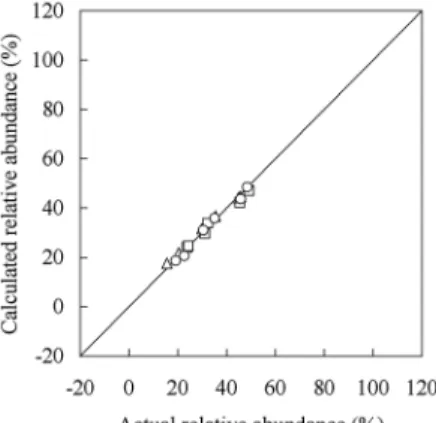
に応用した(Kuno and Matsuo, 2000)。同じく黄鉄 鉱,かんらん石,針鉄鉱の混合試料についてニューラ ルネットワークによる回帰を行った結果,実際の比率 と検量モデルによって計算された比率との相関係数は 0.999,予測誤差は1∼2%であり,十分な精度でそれ ぞれの比率が求められることがわかった(Fig. 4)。 次に,上述の混合試料について得られた検量モデル を,他の鉄化合物について測定した XANES スペク トルに適用し,黄鉄鉱様成分,かんらん石様成分,針 鉄鉱様成分の比率を求めた。Fe の酸化数や最近接原 子が互いに似た化合物のスペクトルは比較的似てい る。ニューラルネットワークはそのようなスペクトル の類似性を認識し,最も似ている化合物の比率は100 %に近い値になる。以上の結果から,ニューラルネッ トワークにより異なる化合物の定量と分類の両方が可
Fig. 3 Depth profile of iron components in the sedi-ment core determined by XANES spectros-copy combined with PLS regression (closed symbols) and by Mössbauer spectroscopy (open symbols): closed circle, pyrite-like component; closed triangle, olivine-like com-ponent; closed square, goethite-like compo-nent; open circle, diamagnetic low-spin Fe (II); open triangle, paramagnetic high-spin Fe(II); open square, paramagnetic Fe(III) & magnetically ordered Fe (Kuno et al.,
1999b).
Fig. 4 Correlation plots of the calculated vs. actual relative abundances of pyrite (circle), olivine (triangle), and goethite (square) for the test set by artificial neural networks (Kuno and Matsuo, 2000).
能であることが示された。
3.塩水湖堆積物中の鉄の状態分析
中 国 最 大 の 塩 水 湖 で あ る 青 海 湖(Kelts et al., 1989)の堆積物にメスバウアー分光法を適用し,堆 積物中の鉄の化学状態とその鉛直分布を明らかにした (Kuno et al., 2002)。先述のように,河口域堆積物 では海水などを起源とする硫酸イオンが酸素の少ない 深層部で硫酸還元菌の活動により還元され硫化物とし て固定されている。塩水湖も硫酸イオンを含み,還元 的な状況になるので,それに伴う塩水湖堆積物中の鉄 の化学状態は注目される。実際に,電子顕微鏡により 青海湖堆 積 物 中 に 黄 鉄 鉱 の 存 在 が 確 認 さ れ て い る (Lin and Chen, 1983)。青海湖堆積物中の鉄化合物 の化学種別鉛直分布を Fig. 5に示す。多摩川河口域堆 積物などと同様に常磁性3価,常磁性2価,黄鉄鉱が 検出された。常磁性2価の成分は2種類に分けられた ため,四極分裂が大きくスペクトル上で外側になる成 分を outer,四極分裂が小さくスペクトル上で内側に なる成分を inner と示した。Outer に相当する成分は 粘土鉱物であり,inner に相当する成分は炭酸塩鉱物 である(Wang and Li, 1991)。黄鉄鉱の含有量は有 機物含有量と相関が見られた。有機物含有量は暖かい 気候の時に生物生産量が増すため増大する。黄鉄鉱含 有量も暖かい気候の時に硫酸還元菌の活性が増すため 増大すると考えられる。また,有機物が増すと,より 還元的な環境になるので,これも黄鉄鉱生成に有利に 働く。以上のことから黄鉄鉱の含有量は気候が温暖な ときほど増大すると考えられるので,含有量は過去の 気候変動と関連して変動している可能性が示唆され た。長さ約350 cm の堆積物コアを分析した。推定堆 積速度が40 cm/ka である(Li et al., 1996)ことから, このコアにより過去9,000年の気候変動に関する情報が得られた。その結果は他の研究結果(Wang and
Chen, 1990; Huang and Sun, 1989)とも一致した。 さらに,青海湖の約100 km 南南西の塩水湖である苦 海湖の堆積物についても同様の分析に供した結果,同 じような傾向が見られた。したがって,これらの地域 周辺では過去の気候変動はあまり変わらないことがわ かった(Kuno et al., 2005)。
4.鉄を含む鉱物の状態分析
鉄を含む鉱物に対してもメスバウアー分光法を適用 して,詳細なキャラクタリゼーションを行った。クロ ム鉄鉱は正スピネル型構造をとり,4配位の A サイト を Fe2+が,6配 位 の B サ イ ト を Cr3+が 占 め る。Fe2+ を Mg2+が,Cr3+を Fe3+や Al3+が 置 換 す る こ と が あ る。フィリピンのオフィオライト累層群に産するクロ ム鉄鉱中の Fe の状態分析(Kuno et al., 2000)では, A サイトの Fe2+と B サイトの Fe3+の他に,Fe2+が酸 化 さ れ て 生 じ た と 考 え ら れ る A サ イ ト の Fe3+ (Suárez et al., 1990)が検出された。このことから, クロム鉄鉱は酸素分圧が高い状況で生成したと考えら れる。試料採取地点は沈み込み帯の上に位置すること が高い酸素分圧の理由である。また,A サイトの Fe2+ は,第二近接原子の一部に Fe3+を持つもの(Robbinset al., 1971)と Al3+を持つもの(Bancroft et al., 1983) とに分けることができた。Fig. 6で Fe2+(A 1)と 示 し たのが第二近接原子の一部に Fe3+を,Fe2+(A 2)と示 したのが第二近接原子の一部に Al3+を持つものであ る。Fe3+ のイオン半径は Al3+ に比べて Cr3+ に近いの で,結晶の歪みが小さいために,四極分裂が小さくな る。 中国の金川ニッケル鉱床に産する超苦鉄質岩中の Fig. 5 Depth profile of iron species in the
sedi-ments collected from Qinghai Lake: open circle, paramagnetic Fe3+
; closed square, paramagnetic Fe2+(outer); open square, paramagnetic Fe2+(inner); closed circle, py-rite (Kuno et al., 2002).
Fe の状態分析(Kuno et al., 2003)でも,クロム鉄 鉱に由来する Fe 成分が検出されたが,こちらでは A サイトの Fe3+は検出されなかった。また,同じ試料 中に磁鉄鉱に由来する Fe 成分が検出された。磁鉄鉱 は逆スピネル型構造をとり,4配位の A サイトに Fe3+ が,6配 位 の B サ イ ト に Fe2+と Fe3+が1 : 1の 比 で 入 る。Fe2+ が酸化されると B サイトの Fe3+ が定比より 増える。しかし,この磁鉄鉱の組成はほぼ定比だった (Fig. 7)。これらの結果はいずれも,この鉱床が地 下深くの酸素分圧の低い状況で生成した(Chai and Naldrett, 1992)ことを示しており,生成環境に関す る情報が得られた。
5.メスバウアー分光法の考古学への応用
メスバウアー分光法の考古学への応用として,メキ シコで発掘された壁画片中の Fe の状態分析を行った (Kuno et al., 2004)。赤い壁画片からは赤鉄鉱が, 橙色の壁画片からは微細な針鉄鉱が検出された(Fig. 8)。針鉄鉱のメスバウアースペクトルは本来,6本の ピークの組を示すが,天然に存在する針鉄鉱を含む顔 Fig. 6 Mössbauer spectrum of RS126(P), a chromite sample fromthe Palawan complex, measured at room temperature (Kuno et al., 2000).
Fig. 7 Mössbauer spectrum of N-5, an ultramafic rock sample from the Jinchuan nickel deposit, measured at room tem-perature (Kuno et al., 2003).
料(Keisch, 1973)は粒径が細かいため,超常磁性効 果 に よ り2本 ピ ー ク の 組 を 示 す(Kündig et al., 1966)。青い壁画片は鉄をほとんど含んでいなかっ た。メスバウアー分光法は通常,透過法で測定するこ とが多い。しかし,顔料のように表面に測定対象が局 在している場合は,内部転換電子や散乱 X 線を検出 する散乱法の方が効率良く測定でき,同時に,表面か らの深さ 分 布 に 関 す る 情 報 が 得 ら れ る 利 点 も あ る (Matsuo et al., 1981)。そこで,透過法と散乱法の 両方を用いて比較した。ちなみに,火星探査機に搭載 され,火星に水が存在した証拠を発見したメスバウ アー分光計は散乱法のタイプであった。内部転換電子 を検出する場合は,表面から0.4μm 程度の部分を調 べることができ,散乱 X 線を検出する場合は,表面 か ら20μm 程 度 の 部 分 を 調 べ る こ と が で き る (Wagner, 1976)。これらの手法を用いた比較により 顔料の厚さは20μm 以上であることがわかった。 謝 辞 この度の日本地球化学会奨励賞受賞にあたり,選考 にあたって下さった方々にこの場を借りて厚く感謝い たします。私のこれまでの研究生活でお世話になった 多くの方々,特に東京大学教授松尾基之先生,東京大 学名誉教授高野穆一郎先生,海洋研究開発機構鈴木勝 彦博士,その他,共同研究をさせて頂いた皆様に厚く 御礼申し上げます。ここで,お名前をすべて挙げるこ とはできませんが,さまざまな機会にご意見やご支援 を頂いた方々,そして,家族の理解に感謝いたしま す。図の転載を許可して下さった Springer Science and Business Media, International Union of Crys-tallography,日本分析化学会に感謝いたします。
引 用 文 献
Bajt, S., Sutton, S. R. and Delaney, J. S. (1994) X-Fig. 8 Transmission Mössbauer spectra of one of the red
frag-ments (top), one of the orange fragfrag-ments (middle), and the plaster (bottom) measured at room temperature (Kuno et
ray microprobe analysis of iron oxidation states in silicates and oxides using X-ray absorption near-edge structure (XANES). Geochimica et
Cosmochimica Acta 58, 5209―5214.
Bancroft, G. M., Osborne, M. D. and Fleet, M. E. (1983) Next-nearest neighbour effects in the Mössbauer spectra of Cr-spinels: an application of partial quadrupole splittings. Solid State
Communications 47, 623―625.
Bertsch, P. M., Hunter, D. B., Nuessle, P. R. and Clark, S. B. (1997) Molecular characterization of contaminants in soils by spatially resolved XRF & XANES spectroscopy. Journal de
Phy-sique IV 7, 817―818.
Chai, G. and Naldrett, A. J. (1992) The Jinchuan ul-tramafic intrusion: cumulate of a high-Mg ba-saltic magma. Journal of Petrology 33, 277―303. Croudace, I. W. and Cundy, A. B. (1995) Heavy metal and hydrocarbon pollution in recent sedi-ments from Southampton Water, southern Eng-land: a geochemical and isotopic study.
Envi-ronmental Science and Technology 29, 1288―
1296.
Gagnon, C., Mucci, A. and Pelletier, É. (1995) Anomalous accumulation of acid-volatile sul-phides (AVS) in a coastal marine sediment, Sa-guenay Fjord, Canada. Geochimica et
Cosmo-chimica Acta 59, 2663―2675.
Gemperline, P. J., Long, J. R. and Gregoriou, V. G. (1991) Nonlinear multivariate calibration using principal components regression and artificial neural networks. Analytical Chemistry 63, 2313 ―2323.
Huang, Q. and Sun, N. (1989) Preliminary study on depositing rate of Qinghai Lake and its evolu-tion of paleoclimate. Chinese Science Bulletin 34, 1457―1462.
Kataoka, M., Kuno, A. and Matsuo, M. (2003) A study on vertical distribution of elements and their chemical states in Yatsu Tideland sedi-ments. Journal of Radioanalytical and Nuclear
Chemistry 255, 283―286.
Keisch, B. (1973) Mössbauer effect studies in the fine arts. Archaeometry 15, 79―104.
Kelly, J. J., Barlow, C. H., Jinguji, T. M. and Callis, J. B. (1989) Prediction of gasoline octane num-bers from near-infrared spectral features in the range 660-1215 nm. Analytical Chemistry 61, 313―320.
Kelts, K., Zao, C. K., Lister, G., Qing, Y. J., Hong, G. Z., Niessen, F. and Bonani, G. (1989) Geological fingerprints of climate history: a cooperative study of Qinghai Lake, China. Eclogae
Geologi-cae Helvetiae 82, 167―182.
Kündig, W., Bömmel, H., Constabaris, G. and Lindquist, R. H. (1966) Some properties of sup-ported small -Fe2O3particles determined with the Mössbauer effect. Physical Review 142, 327 ―333.
Kuno, A., Matsuo, M., Takano, B., Yonezawa, C., Matsue, H. and Sawahata, H. (1997) Neutron induced prompt gamma-ray andinstrumental neutron activation analyses of urban estuarine sediments. Journal of Radioanalytical and
Nu-clear Chemistry 218, 169―176.
Kuno, A., Matsuo, M. and Takano, B. (1998) Möss-bauer spectroscopic study on vertical distribu-tion of iron components in estuarine sediments collected from Tama River in Tokyo. Hyperfine
Interactions C3, 328―331.
Kuno, A., Sampei, K., Matsuo, M., Yonezawa, C., Matsue, H. and Sawahata, H. (1999a) Vertical distribution of elements in non-polluted estu-arine sediments determined by neutron induced prompt gamma-ray and instrumental neutron activation analyses. Journal of Radioanalytical
and Nuclear Chemistry 239, 587―590.
Kuno, A., Matsuo, M. and Numako, C. (1999b) In
situ chemical speciation of iron in estuarine
sediments using XANES spectroscopy with par-tial least-squares regression. Journal of
Syn-chrotron Radiation 6, 667―669.
Kuno, A. and Matsuo, M. (2000) Nondestructive spe-ciation of solid mixtures by multivariate cali-bration of X-ray absorption near-edge structure using artificial neural networks and partial least-squares. Analytical Sciences 16, 597―602. Kuno, A., Santos, R. A., Matsuo, M. and Takano, B.
(2000) Characterization of natural chromite samples from ophiolite complexes in the Philip-pines by57
Fe Mössbauer spectroscopy. Journal
of Radioanalytical and Nuclear Chemistry 246,
79―83.
Kuno, A., Zheng, G. D., Matsuo, M., Takano, B., Shi, J. A. and Wang, Q. (2002) Mössbauer spectro-scopic study on vertical distribution of iron spe-cies in sediments from Qinghai Lake, China.
Hyperfine Interactions 141―142, 321―326.
Kuno, A., Zheng, G. D., Matsuo, M., Takano, B., Shi, J. A. and Wang, Q. (2003) Characterization of ultramafic rocks from the Jinchuan nickel de-posit in China by57
Fe Mössbauer spectroscopy.
Journal of Radioanalytical and Nuclear Chem-istry 255, 279―282.
Kuno, A., Matsuo, M., Pascual Soto, A. and Tsukamoto, K. (2004) Mössbauer spectroscopic study of a mural painting from Morgadal Grande, Mexico. Hyperfine Interactions 156― 157, 431―437.
Kuno, A., Matsuo, M., Wang, Q. and Zhang, C. J. (2005) Iron speciation of sediments from Kuhai Lake in China by Mössbauer spectroscopy.
Hy-perfine Interactions 166, 637―642.
Lavine, B. K. (1998) Chemometics. Analytical
Chemistry 70, 209R―228R.
Li, J., Philp, R. P., Pu, F. and Allen, J. (1996) Long-chain alkenones in Qinghai Lake sediments.
Geochimica et Cosmochimica Acta 60, 235.
Lin, H. and Chen, L. (1983) Significance of authigenic microspheroid pyrite by scanning electron microscope. Scientia Sinica B26, 971― 982.
Lindberg, W., Persson, J. -A. and Wold, S. (1983) Partial least-squares method for spectro-fluorimetric analysis of mixtures of humic acid and ligninsulfonate. Analytical Chemistry 55, 643―648.
Lipka, J., Miglierini, M., Sitek, J., Baláz, P. and Tkáacová, K. (1993) Influence of mechanical ac-tivation on the Mössbauer spectra of the sul-fides. Nuclear Instruments and Methods in
Physics Research B76, 183―184.
Manning, P. G. and Ash, L. A. (1979) Mössbauer spectral studies of pyrite, ferric and high-spin ferrous distributions in sulfide-rich sediments from Moira Lake, Ontario. Canadian
Mineralo-gist 17, 111―115.
Manning, P. G., Williams, J. D. H., Charlton, M. N., Ash, L. A. and Birchall, T. (1979) Mössbauer spectral studies of the diagenesis of iron in a sulphide-rich sediment core. Nature 280, 134― 136.
Matsuo, M., Sato, H. and Tominaga, T. (1981) Esti-mation of the energy distribution of Mössbauer scattered electrons with 2π gas-flow propor-tional counter. Radiochemical and
Radioana-lytical Letters 48, 253―262.
Matsuo, M., Takano, B. and Sugimori, K. (1996)57 Fe Mössbauer spectroscopic study of estuarine sediments taken from the Tama River in Tokyo.
Il Nuovo Cimento D50, 757―760.
Matsuo, M. and Kuno, A. (2004) Environmental evaluation of estuarine sediments. In:
Analyti-cal Applications of Nuclear Techniques (ed.
In-ternational Atomic Energy Agency), Interna-tional Atomic Energy Agency, 65―67.
Minai, Y. and Tominaga, T. (1979) Characterization of environmental samples by Mössbauer tech-nique. Radiochemical and Radioanalytical
Let-ters 37, 125―134.
Miyashita, Y., Yoshida, H., Yaegashi, O., Kimura, T., Nishiyama, H. and Sasaki, S. (1994) Non-linear modelling of13
C NMR chemical shift data using artificial neural networks and partial least squares method. Journal of Molecular
Structure 311, 241―245.
Nieboer, E. and Richardson, D. H. S. (1980) The re-placement of the nondescript term ‘heavy met-als’ by a biologically and chemically significant classification of metal ions. Environmental
Pol-lution B1, 3―26.
Otto, M. and Wegscheider, W. (1985) Spectropho-tometric multicomponent analysis applied to trace metal determinations. Analytical
Chemis-try 57, 63―69.
and Bianchi, T. S. (1995) History of trace metal pollution in Sabine-Neches Estuary, Beaumont, Texas. Environmental Science and Technology 29, 1495―1503.
Robbins, M., Wertheim, G. K., Sherwood, R. C. and Buchanan, D. N. E. (1971) Magnetic properties and site distributions in the system FeCr2O4-Fe3 O4 (Fe
2+ Cr2−xFex
3+
O4). Journal of Physics and
Chemistry of Solids 32, 717―729.
Sakai, Y., Yonezawa, C., Magara, M., Sawahata, H. and Ito, Y. (1994) Measurement and analysis of the line-shape of prompt gamma-rays from re-coiling7*
Li produced in the10
B (n, )7 Li.
Nu-clear Instruments and Methods in Physics Re-search A353, 699―701.
Schropp, S. J., Lewis, F. G., Windom, H. L., Ryan, J. D., Calder, F. D. and Burney, L. C. (1990) Inter-pretation of metal concentrations in estuarine sediments of Florida using aluminum as a ref-erence element. Estuaries 13, 227―235.
Suárez, N., García, S. and Díaz, C. (1990) Möss-bauer study of cation distribution and state of valence of iron in Cuban natural chromites.
Hy-perfine Interactions 57, 2295―2300.
Tominaga, T. and Minai, Y. (1984) Applications of Mössbauer spectroscopy toenvironmental and geochemical studies. Nuclear Science
Applica-tions 1, 749―791.
Wagner, F. E. (1976) Applications of Mössbauer scattering techniques. Journal de Physique 37, 673―689.
Wang, S. M. and Li, J. R. (1991) Lacustrine sedi-ments−an indicator of historical climatic
vari-ation−the case of Qinghai Lake and Daihai Lake. Chinese Science Bulletin 36, 1364―1368. Wang, W. and Chen, K. (1990) Alkaline earth
ele-mental compositions of Holocene lake deposits and environmental implication for Qinghai Lake, China. China Earth Sciences 1, 233. Westre, T. E., Kennepohl, P., DeWitt, J. G.,
Hedman, B., Hodgson, K. O. and Solomon, E. I. (1997) A multiplet analysis of Fe K -edge 1s→3d pre-edge features of iron complexes. Journal of
the American Chemical Society 119, 6297―6314.
Windom, H. L., Schropp, S. J., Calder, F. D., Ryan, J. D., Smith, R. G., Burney, L. C., Lewis, F. G. and Rawlinson, C. H. (1989) Natural trace metal concentrations in estuarine and coastal marine sediments of the southeastern United States. Environmental Science and Technology 23, 314―320.
Yonezawa, C., Magara, M., Sawahata, H., Hoshi, M., Ito, Y. and Tachikawa, E. (1995) Prompt gamma-ray analysis using cold and thermal guided neutron beams. Journal of
Radioana-lytical and Nuclear Chemistry 193, 171―178.
Yonezawa, C. (1996) Multi-element determination by cold neutron induced prompt gamma-ray analysis. Analytical Sciences 12, 605―613. Zheng, G. D., Kuno, A., Mahdi, T. A., Evans, D. J.,
Miyahara, M., Takahashi, Y., Matsuo, M. and Shimizu, H. (2007) Iron speciation and mineral characterization of contaminated sediments by coal mining drainage in Neath Canal, South Wales, United Kingdom. Geochemical Journal 41, 463―474.