博 士 論 文
STUDY ON THE ECONOMY POTENTIAL AND IMPLICATION OF HYDROGEN
ENERGY SYSTEM WITH CARBON TAX INTRODUCTION
炭素税導入に基づく水素エネルギーシステムの経済的可
能性と影響に関する研究
2020 年 07 月
钱 凡悦
FANYUE QIAN
I
Study on the Economy Potential and Implication of Hydrogen
Energy System with Carbon Tax Introduction
ABSTRACT
The development of renewable energy is one of the cores of the current global energy
transformation. Then due to the unstable supply of renewable energy, the development
of the fastest growing photovoltaic and wind power has fallen into a bottleneck. The
application and promotion of hydrogen energy can solve this problem well, but the
current development of hydrogen energy is limited by the high equipment cost.
Therefore, this study proposed the introduction of carbon tax to highlight the
characteristics of zero carbon emission of hydrogen energy, and to transfer the
environmental advantages of hydrogen energy into economic benefits. And from the
three levels of equipment, system and region, the economic benefits of hydrogen energy
system and conventional energy system are analyzed. Finally, based on Japan's
electricity and energy consumption data, a prediction study was conducted to the effect
on the energy structure and carbon emission reduction effect after considering the
promotion of carbon tax and hydrogen energy.
In chapter 1,
RESEARCH BACKGROUND AND PURPOSE OF THE STUDY.Firstly, the
significance of hydrogen energy for renewable energy and global deep decarbonization
were analyzed. Then the safety characteristics of hydrogen were compared with other
fuels. After that, the process of producing, storing, transporting and using hydrogen
energy was explained. Then, through the elaboration of the hydrogen energy
development process and goals of the United States, the European Union, China and
Japan, the importance of hydrogen energy in the energy strategies of various countries
was highlighted. Finally, the research logic and content of the article were expounded.
In chapter 2,
LITERATURE REVIEW OF HYDROGEN ENERGY SYSTEM. Firstly,
through the review of the research on the development of hydrogen energy by the
policies of various countries, the current status and trends of the cost reduction of
hydrogen energy systems were explained. Next, since the core of development based
on hydrogen energy is to combine with renewable energy, the literature and compares
the characteristics of hydrogen storage and other energy storage technologies was
reviewed. Finally, according to the research object of this article, the research and
combing of the application of fuel cell, fuel cell vehicle and hydrogen energy in regional
energy system were carried out.
In chapter 3,
MODEL ESTABLISHMENT AND FORECASTING METHOD RESEARCH.
Firstly, the research motivation and main research methods of the article were
II
expounded. Then the general load and equipment model to be used in the follow-up
study were established. At the same time, different operating strategies based on
regional energy systems were explained. Next, it was believed that load forecasting is
the basis of follow-up research, so a new forecasting method of cold and hot load based
on transfer learning was proposed and verified.
In chapter 4,
UTILIZATION POTENTIAL AND ECONOMIC ANALYSIS OF HYDROGEN ENERGY EQUIPMENT. In this part, a 5kW methanol reforming PEMFC will be
simulated based on a simulation software called TRNSYS to analyze the situation of
the residual heat. Then, through the simulation models of the two waste heat recovery
methods of refrigeration and hot water production, the comprehensive energy
utilization potential of the fuel cell was studied. After introducing carbon tax
restrictions, the economic comparison of fuel cells and fuel cell vehicles with
conventional energy systems was explored.
In chapter 5,
ECONOMIC AND POTENTIAL ANALYSIS OF FUEL CELL VEHICLE-TO-GRID SYSTEM. Firstly, this part choosed a large shopping mall in Japan as the research
scenario, after obtaining its annual electricity consumption. The Monte Carlo
simulation method was used to simulate the basic parameters such as vehicle visiting
time, running kilometers and departure time, and to analyze the impact of FCV
discharging on building energy consumption. Then, replacing part of the FCVs with
EVs was considered, as well as the discharges of vehicles to buildings and power grids,
using buildings as agents for all vehicles to provide V2G services for power grids. A
genetic algorithm (GA) was used to find the best discharge price, the choice of vehicle
discharging under the condition of the highest economic benefit, and to analyze the
change of building income under different FCV ratios and EV charging demand.
Through sensitivity analysis, the influence of six parameters on economic benefit was
analyzed, including daily electricity price for buildings, battery cost, fuel cell cost,
carbon emission price, electricity grid carbon emission and hydrogen cost.
In chapter 6,
ECONOMIC AND POTENTIAL ANALYSIS OF REGION DISTRIBUTED HYDROGEN ENERGY SYSTEM. This part firstly selected ten buildings of different
building types in the Higashida area of Kitakyushu City, Japan as the research goal, the
hydrogen distributed energy system as the research object, and the conventional
distributed energy system as the comparative reference. Secondly, based on the actual
data of building power consumption, the hourly cooling and heating load was calculated
using the index method and the hourly load sharing method. After that, a region
distributed energy system (RDES) optimization model was established, and the genetic
system was used to design and optimize the conventional system and the hydrogen
energy system respectively, and the comparison of the two systems under different
III
carbon taxes was obtained. Through the analysis of the results of different types of
buildings, the adaptability of the hydrogen RDES was studied. After the lease, through
the sensitivity analysis of electricity price, natural gas price, hydrogen price, and
hydrogen energy equipment price, the future economic benefits of the hydrogen RDES
were studied.
In chapter 7,
STUDY ON THE HYDROGEN IMPLICATION OF ENERGY STRUCTURE WITH CARBON TAX INTRODUCTION. Firstly, the three energy storage technologies of
battery, pumped storage and hydrogen storage were compared with the application in
different renewable energy sources. Then ten power companies in Japan was selected
and the weighted on-grid electricity price was used as the objective function to study
the energy structure changes under different carbon taxes. According to the
characteristics of long-distance and inter-seasonal storage, the effect of renewable
energy coordination and scheduling in Japan was studied. Then through sensitivity
analysis, the impact of price fluctuations of coal, LNG, photovoltaic equipment, wind
power generation equipment and hydrogen energy production equipment on the
research results was obtained. Finally, from the power generation field to the overall
primary energy consumption, the effects of three kinds of hydrogen energy promotion
measures for household fuel cells, fuel cell vehicles and natural gas dropped with
hydrogen on CO2 emission reduction was carried out to explore the introduction of
hydrogen energy to help Japan achieve its CO2 reduction goals.
In chapter 8,
CONCLUSION AND PROSPECT. The conclusions of whole thesis is
deduced and the future work of hydrogen energy has been discussed.
IV
钱 凡悦 博士論文の構成
Study on the Economy Potential and Implication of Hydrogen
Energy System with Carbon Tax Limitation
CHAPTER ONE
RESEARCH BACKGROUND AND PURPOSE OF THE STUDY
1.Bottleneck of world energy development 2.Advantages of hydrogen energy 3. Introduction of hydrogen energy
CHAPTER TWO
LITERATURE REVIEW OF HYDROGEN ENERGY SYSTEM 1. The promotion of the policy the cost of hydrogen energy
2. Application research of hydrogen energy 3. Combination of hydrogen energy and renewable energy
CHAPTER THREE
MODEL ESTABLISHMENT AND FORECASTING METHOD RESEARCH
1. Equipment model establishment 2. New application of load forecasting method
CHAPTER FOUR
UTILIZATION POTENTIAL AND ECONOMIC ANALYSIS OF HYDROGEN ENERGY EQUIPMENT
1. Fuel cell utilization potential analysis 2. Analysis of the impact of the introduction of carbon tax
CHAPTER FIVE
ECONOMIC AND POTENTIAL ANALYSIS OF FUEL CELL VEHICLE-TO-GRID SYSTEM
1.Vehicle condition simulation
2.Economic comparison between fuel cell and electric vehicle
CHAPTER SIX
ECONOMIC AND POTENTIAL ANALYSIS OF REGION DISTRIBUTED HYDROGEN ENERGY SYSTEM
1.Optimization of hydrogen energy system; 2.Comparison with normal distributed energy system 3. Hydrogen energy application in different buildings
CHAPTER SEVEN
STUDY ON THE HYDROGEN IMPLICATION OF ENERGY STRUCTURE WITH CARBON TAX INTRODUCTION 1.Comparison with normal energy storage technology;
2.Optimization of energy structure; 3.Discussion of the popularity of hydrogen.
CHAPTER EIGHT
V
TABLE OF CONTENTS
ABSTRACT ... I
STRUCTURE OF THIS PAPER ... IV
CHAPTER 1: RESEARCH BACKGROUND AND PURPOSE OF THE STUDY
1.1 Background... 1-1
1.1.1 Current status and bottleneck of international energy development ... 1-1 1.1.2 The significance of the development of hydrogen energy for renewable energy and energy environment ... 1-4
1.2 Hydrogen energy characteristics and application process ... 1-7
1.2.1 Characteristics of hydrogen energy ... 1-7 1.2.2 Application of hydrogen energy ... 1-8
1.3 Development status of hydrogen energy ... 1-16
1.3.1 The development and status of hydrogen energy in the world ... 1-16 1.3.2 Development and current status of hydrogen energy in Japan ... 1-22
1.4 Research structure and logical framework ... 1-28
1.4.1 Research purpose and core content ... 1-28 1.4.2 Chapter content overview and related instructions ... 1-28
Reference... 1-33
CHAPTER 2: LITERATURE REVIEW OF HYDROGEN ENERGY SYSTEM
2.1 Review of Research on Policy Promotion ... 2-1 2.2 Review of hydrogen energy Manufacturing ... 2-3 2.3 The research on hydrogen production from renewable energy ... 2-6 2.4 The research on hydrogen energy equipment application ... 2-8
2.3.1 Fuel cell ... 2-8 2.3.2 Hydrogen fuel cell electric vehicle... 2-11
2.5 Research on hydrogen energy participating in hybrid energy system ... 2-13 Reference... 2-15
CHAPTER 3: MODEL ESTABLISHMENT AND FORECASTING METHOD
RESEARCH
3.1 Motivation and main method ... 3-1
VI
3.1.2 Introduction of carbon tax ... 3-1
3.2 Model establish and energy system design strategies... 3-2
3.2.1 Energy Equipment ... 3-2 3.2.2 HVAC load model ... 3-7 3.2.3 Operational mode of combined cooling heating and power (CCHP) energy system ... 3-9
3.3 Load forecasting method research ... 3-11
3.3.1 Difficulties in HVAC load forecasting ... 3-12 3.3.2 Existing forecasting methodologies ... 3-12 3.3.3 TrAdaBoost (SVR) model ... 3-15
3.4 Case study of load forecasting application ... 3-18
3.4.1 Conventional forecasting methods——ANN ... 3-18 3.4.2 Application of load forecasting based on transfer learning ... 3-22 3.4.3 Simulation results and application of transfer learning ... 3-25 3.4.4 Sensitivity analysis ... 3-26 3.4.5 Summary ... 3-29
Reference... 3-31
CHAPTER 4: UTILIZATION POTENTIAL AND ECONOMIC ANALYSIS OF
HYDROGEN ENERGY EQUIPMENT
4.1 Content ... 4-1 4.2 Introduction to the experimental platform ... 4-2 4.3 Theoretical calculation of fuel cell residual heat ... 4-4
4.3.1 Radiator residual heat Q1 ... 4-4 4.3.2 Fuel cell stack residual heat Q2 ... 4-5 4.3.3 Residual gas combustion residual heat Q3 ... 4-6
4.4 System model building ... 4-9
4.4.1 Simplifying assumptions and building of system model ... 4-9 4.4.2 Analysis of the residual heat of each module ... 4-13
4.5 The establishment and analysis of residual heat recovery model ... 4-16
4.5.1 The establishment of residual heat recovery model ... 4-16 4.5.2 System energy saving analysis ... 4-19
4.6. Comparison between fuel cell and conventional energy system ... 4-20 4.7. Summary ... 4-24 Reference... 4-25
CHAPTER 5: ECONOMIC AND POTENTIAL ANALYSIS OF FUEL CELL
VEHICLE-TO-GRID SYSTEM
VII
5.1 Contents ... 5-1 5.2. Methodology and model ... 5-2
5.2.1 Charge-discharge model ... 5-2 5.2.2 Establishment of Profit Model ... 5-3 5.2.3 Simulation and optimization methods ... 5-5
5.3. Demand load and visiting vehicle condition simulation... 5-7
5.3.1 Base load data processing ... 5-7 5.3.2 Monte Carlo simulation of visiting vehicle condition ... 5-7 5.3.3 Discussion of the simulation results ... 5-10
5.4. Solution of the profit model ... 5-12
5.4.1 Profit type setting for electricity and carbon emissions ... 5-12 5.4.2 Solution of the model by GA ... 5-13 5.4.3 Sensitivity analysis of parameters ... 5-18
5.5. Summary ... 5-22 Appendix ... 5-23 Reference... 5-24
CHAPTER 6: ECONOMIC AND POTENTIAL ANALYSIS OF REGION
DISTRIBUTED HYDROGEN ENERGY SYSTEM
6.1 Contents ... 6-1 6.2 Methodology ... 6-2
6.2.1 Supply side model ... 6-2 6.2.2 Economic model ... 6-3 6.2.3 Objective function and constraints ... 6-4
6.3 Case study and basic data ... 6-5
6.3.1 Case study ... 6-5 6.3.2 Basic data pretreatment and analysis ... 6-6 6.3.3 Cold and heat load forecasting ... 6-8
6.4 System design and optimization after the introduction of carbon tax ... 6-11
6.4.1 Carbon tax ... 6-12 6.4.2 Optimization model establishment ... 6-12 6.4.3 Optimization results and analysis ... 6-15
6.5 Sensibility analysis and case comparison ... 6-19
6.5.1 Sensibility analysis ... 6-19 6.5.2 Case comparison ... 6-2
6.6 Conclusion ... 6-24 Appendix ... 6-26
VIII
Reference... 6-32
CHAPTER 7:
STUDY ON THE HYDROGEN IMPLICATION OF ENERGY
STRUCTURE WITH CARBON TAX INTRODUCTION
7.1 Contents ... 7-1 7.2 Methodology ... 7-3 7.3 Comparison between hydrogen storage and conventional energy storage technology 7-4 7.4 Optimization of energy structure for the purpose of feed in tariff ... 7-8
7.4.1 Economic benefit analysis of coal-fired and gas-fired power station ... 7-8 7.4.2 Optimization of energy structure ... 7-11 7.4.3 Results analysis and discussion ... 7-13
7.5 Sensitivity analysis and discussion on the promotion of hydrogen energy... 7-17
7.5.1 Sensitivity analysis of energy price ... 7-17 7.5.2 Sensitivity analysis of energy equipment cost ... 7-19 7.5.3 Discussion on the promotion of hydrogen energy ... 7-21
7.6 Conclusion ... 7-25 Reference... 7-27
CHAPTER 8:
CONCLUSION AND PROSPECT
8.1 Conclusion ... 8-1 8.2 Prospect ... 8-5
Chapter 1
RESEARCH BACKGROUND AND PURPOSE OF
THE STUDY
CHAPTER ONE: RESEARCH BACKGROUND AND PURPOSE OF THE STUDY
RESEARCH BACKGROUND AND PURPOSE OF THE STUDY ... 1
1.1 Background ... 1
1.1.1 Current status and bottleneck of international energy development ... 1
1.1.2 The significance of the development of hydrogen energy for renewable energy and energy environment ... 4
1.2 Hydrogen energy characteristics and application process ... 7
1.2.1 Characteristics of hydrogen energy ... 7
1.2.2 Application of hydrogen energy ... 8
1.3 Development status of hydrogen energy ... 16
1.3.1 The development and status of hydrogen energy in the world ... 16
1.3.2 Development and current status of hydrogen energy in Japan ... 22
1.4 Research structure and logical framework ... 28
1.4.1 Research purpose and core content ... 28
1.4.2 Chapter content overview and related instructions ... 28
CHAPTER1: RESEARCH BACKGROUND AND PURPOSE OF THE STUDY
-1-1-
1.1 Background
1.1.1 Current status and bottleneck of international energy development
(1) Renewable energy is still the focus of development
(a) By terminal industry (b) By region
Fig 1-1 Global primary energy consumption forecast by 2040 by terminal industry and region [1] In order to achieve the goals in the Paris Agreement, all countries in the world are in the gradual transformation stage of the energy system. It is predicted that world GDP will more than double by 2040, but this increase will be offset by accelerated energy efficiency. In the next 25 years, energy demand will only increase by about one-third. Among them, the industrial demand growth of energy accounts for about half of the new energy consumption, and the growth rate of the transportation field will be greatly reduced due to the promotion of new energy vehicles (Fig 1-1).
At present, the global energy economy is still largely dependent on fossil energy, but the increasingly exhausted fossil energy is difficult to meet the sustainable growth of energy demand [2]. Moreover, the excessive consumption of fossil energy leads to a series of environmental pollution problems such as air pollution, acid rain, greenhouse effect [3]. The renewable energy represented by solar energy and wind energy has the advantages of inexhaustible and widely distributed resources, which is regarded as the main method to solve the energy crisis [4]. Therefore, all countries in the world have issued relevant laws and regulations to promote the promotion and use of renewable energy [5].
According to BP's "Energy Outlook 2019" forecast for the future energy development trend, renewable energy is the fastest growing of all energy sources, accounting for 40% of the primary energy growth. At the same time, with the deepening of the transformation process of renewable
CHAPTER1: RESEARCH BACKGROUND AND PURPOSE OF THE STUDY
-1-2-
Fig 1-2 Forecast of global primary energy consumption and carbon emission in 2040 [1] energy and energy system, the growth trend of primary energy consumption and carbon emissions will gradually slow down until it finally starts to reduce (Fig1-2). It can be seen that the development of renewable energy and efficient use of energy will be the key direction of energy system development in the future.
(2) Renewable energy consumption is the key obstacle
Renewable energy can replace traditional energy in four ways: power generation, heating / cooling, transportation fuel, and energy supply in remote villages. Among them, power generation is the most important and largest use. In recent years, many countries have achieved a high proportion of renewable energy power generation, most of which are mainly hydropower. Renewable electricity accounts for more than 50% in more than 20 countries, including Iceland (100%), Norway (96%), Brazil (85%), New Zealand (73%), Colombia (70%), Austria (68%) , Venezuela (66%), Switzerland (58%), Sweden (55%), etc. Since the 1990s, the development of the global renewable energy industry has continued to accelerate. The installed capacity of renewable energy power generation increased from 812 million kilowatts in 2004 to 1.712 billion kilowatts in 2014, an average annual increase of about 8%, of which hydropower, wind power and solar photovoltaic power generation accounted for the absolute leading position.[6]
As of 2016, global renewable energy power generation accounted for 24.5% of the total power, of which hydropower generation was the highest, accounting for 16.6%, followed by wind farms 4.0%, biomass power generation 2.0% and photovoltaic power generation 1.5%. According to the data of 2017 REN21 and the previous 7 years, they are compiled in Table 1-1 below.
CHAPTER1: RESEARCH BACKGROUND AND PURPOSE OF THE STUDY
-1-3-
Table 1-1 Global Power Production Structure 2009-2016 [7]
2009 2010 2011 2012 2013 2014 2015 2016 Global power /TWh 20261 21562 22242 22797 23403 23844 24216 24816 Fossil fuel, nuclear energy
/% 82.0 80.6 79.7 78.3 77.9 77.2 76.3 75.5 Renewable energy /% 18 19.4 20.3 21.7 22.1 22.8 23.7 24.5 Hydropower /% 15.0 16.1 15.3 16.5 16.4 16.6 16.6 16.6 Wind energy/% 3.0 3.3 5.0 5.2 2.9 3.1 3.6 5.0 Biomass energy /% 1.8 1.8 2.0 2.0 Photovoltaic /% 0.7 0.9 1.2 1.5 Geothermal etc. /% 0.4 0.4 0.4 0.4
As can be seen from the above table, although the current renewable energy is still dominated by hydropower, the reason for the rapid progress of renewable energy power generation in recent years is mainly due to the acceleration of wind farms and photovoltaic power generation. Among them, wind power has grown from 6% of renewable energy in 2004 to 24.1% in 2016. Photovoltaics has grown from 0.3% renewable energy in 2004 to 15% in 2016. At the same time, the global photovoltaic industry has a large workforce, accounting for 31.5% of global renewable energy.
With the rapid development of photovoltaic and wind power, the phenomenon of abandoning wind and light is becoming more and more serious. Among them, developed countries such as Germany and the United States encountered this phenomenon earlier and took measures to deal with it earlier. Mainly include: changing the operation mode of the electricity market, constructing power transmission channels (including mutual aid with neighboring countries), improving the electricity price mechanism (such as negative electricity prices), and adding flexible units such as hydropower and gas power. Some results have been achieved, which promoted the consumption of photovoltaic and wind power, but at the same time caused the slowdown of the development of renewable energy.
Even so, after a period of development, the share of renewable energy still reaches the bottleneck, unable to make further breakthroughs. It is mainly the low-grade and intermittent characteristics of renewable energy [8]. Solar energy only produces energy when the irradiance is high, and wind energy changes with the change of outdoor wind speed; such highly volatile renewable energy, in the process of power generation and grid connection, has great impact on the power grid, and it is difficult to ensure the stability of the power grid, making it more difficult to quickly match with the urban power grid [9]. In addition to improving the stability of renewable energy in the grid connection stage, the second solution to the utilization of renewable energy is energy storage integration. However, the low energy storage efficiency and high initial investment of traditional
CHAPTER1: RESEARCH BACKGROUND AND PURPOSE OF THE STUDY
-1-4-
batteries slow the progress of this technology [10]. Hydrogen energy has the characteristics of high energy storage, convenient storage and transportation, and zero pollution. It is considered to be the most promising energy storage option in the future.
1.1.2 The significance of the development of hydrogen energy for renewable energy and energy environment
(1) Hydrogen energy will be an important way to absorb renewable energy
Since hydrogen must be produced from hydrogen-containing substances such as water and fossil fuels, it is a secondary energy source. At present, high-efficiency and low-cost hydrogen production is the focus of attention of countries around the world. Using renewable energy to produce hydrogen can both reduce production costs and achieve the purpose of protecting the environment. It is the most effective way to produce hydrogen. At the same time, this method can effectively alleviate the current consumption problems caused by the continuous development of renewable energy.
Hydrogen and electricity can be said to be complementary to each other during the transformation of the energy system. The use of electrolysis devices to achieve hydrogen production from renewable energy power is conducive to the integration of highly volatile renewable energy power (VRE) into the energy system. At the same time, large-scale use of solar energy, wind energy and other renewable energy to produce hydrogen, and the development of large-scale, low-cost VRE facilities in marginal areas with rich solar or wind energy resources, dedicated to hydrogen production, can realize the reuse of wind and light, and energy conversion, improve the utilization rate of renewable energy, reduce waste of clean energy.[11] Although batteries and demand-side measures can provide short-term flexibility, hydrogen is the only large-scale technology that can be used for long-term energy storage. It can use the existing natural gas network, salt caves and barren gas fields to store energy for a long time at a lower cost. Through the hydrogen produced from renewable energy, a large amount of renewable energy can be led from the power sector to the end-use sector. Renewable energy power can be end-used to produce hydrogen, which in turn can provide energy for sectors that are difficult to achieve decarbonization through electrification and achieve sustainable energy development.
(2) Hydrogen energy helps deep decarbonization in various industries
As a transportation medium for renewable energy, hydrogen can realize the long-distance transmission of renewable energy, promote the interconnection between electricity and construction, transportation and industry, and help in areas where electrification is difficult (transportation, industrial Construction departments that rely on existing natural gas pipeline networks, etc.) make more use of renewable energy to reduce carbon dioxide emissions.(Fig1-3)
CHAPTER1: RESEARCH BACKGROUND AND PURPOSE OF THE STUDY
-1-5-
Fig 1-3 Mind map for the definition of zero-energy hydrogen economy [12]
In terms of transportation, hydrogen is the most promising decarbonization option for trucks, buses, large cars, and commercial vehicles. Among them, lower energy density (hence lower range), higher initial cost, and slow battery charging performance are The main disadvantage. Compared with batteries and internal combustion engines, fuel cells require less raw materials. Since the transportation sector accounts for nearly a quarter of global carbon dioxide emissions, decarbonization is a key factor in achieving energy transformation. In addition, hydrogen fuel replenishment facilities have a significant advantage: compared to fast charging, it only requires about one tenth of the city and highway space. Similarly, suppliers can flexibly supply hydrogen, and large-scale deployment of fast charging facilities requires major upgrades to the grid. Finally, once the smallest scale of promotion is achieved, hydrogen provides operators with an attractive business case. In addition to road transportation, in the longer term, hydrogen may also promote decarbonization in the fields of railway transportation, shipping, and aviation. In the aviation industry, hydrogen and hydrogen-based synthetic fuels are the only options for large-scale decarbonization.
Industry can burn hydrogen to produce high-grade heat, and use the fuel as a raw material in several processes, directly or together with carbon dioxide as a synthetic fuel / electric fuel. In steelmaking, for example, hydrogen can be used as a reducing agent to replace coal-based blast furnaces. When the refinery is used as a raw material for ammonia production and hydroprocessing,
CHAPTER1: RESEARCH BACKGROUND AND PURPOSE OF THE STUDY
-1-6-
low-carbon sources can be used in the future. Along with carbon dioxide, hydrogen can also replace hydrocarbons such as natural gas in the chemical process, such as the production of olefins and hydrocarbon solvents (BTX), which form a major part of raw material uses. This provides a carbon sink, that is, an opportunity to use carbon dioxide instead of emissions. Large industrial sectors (such as oil refineries, ammonia production plants, etc.) that have more than ten years of experience in using hydrogen are expected to become the main early market for hydrogen production from electricity, because they can immediately produce scale effects, thereby quickly reducing costs.
In addition, injecting hydrogen produced from renewable energy power into the natural gas pipeline network will likely increase revenue and thus improve the economics of power generation. This measure can make the introduction of hydrogen energy smoother, and energy companies can directly use the existing pipeline to transport hydrogen or synthetic methane to natural gas power plants through electricity. Although eventually switching to 100% hydrogen requires equipment and piping upgrades, it still fits perfectly with the existing heating infrastructure in the building.
CHAPTER1: RESEARCH BACKGROUND AND PURPOSE OF THE STUDY
-1-7-
1.2 Hydrogen energy characteristics and application process 1.2.1 Characteristics of hydrogen energy
Hydrogen energy mainly appears in the form of a compound state on the earth. It is the most widely distributed substance in the universe. It constitutes 75% of the mass of the universe. The main characteristics of hydrogen are compared with other common fuels, and four coordinates are established to represent diffusion, buoyancy, lower explosion limit, and the reciprocal of combustion speed. As shown in the Fig1-4 below, the closer to the coordinate origin, the more dangerous. It can be seen that in terms of diffusion, buoyancy and lower explosion limit, hydrogen is far safer than other fuels, and it is not easy to form explosive aerosols. Therefore, as long as effective prevention and control measures are established, the safety of hydrogen is still very outstanding.
Fig 1-4 Hydrogen characteristic analysis diagram (Source: Guojin Securities Research Institute, fuel cell industry chain (4) | hydrogen: safety analysis
http://www.china-nengyuan.com/news/136577.html)
It is difficult to accumulate high concentration of hydrogen in the air. If a leak occurs, the hydrogen will diffuse quickly, especially in an open environment, it is easy to escape quickly, unlike gasoline that stays in the air after volatilization. Dr. Swain of the University of Miami in the United States did a famous experiment, as shown in Fig 1-5. The two vehicles used hydrogen and gasoline as fuel, respectively, and then conducted a leak ignition test. After 3 seconds of ignition, the flame produced by the high-pressure hydrogen directly sprayed above, and gasoline ignited from the lower part of the car; by 1 minute, only hydrogen leaked from the car using hydrogen as fuel burned, the car has no major problems, and the gasoline car has already been Become a big fireball and burn out completely. Therefore, the volatile nature of hydrogen, compared with ordinary gasoline cars,
CHAPTER1: RESEARCH BACKGROUND AND PURPOSE OF THE STUDY
-1-8-
is conducive to the safety of cars.
(a) 3 seconds (b) 60 seconds Fig1-5 Combustion comparison test of hydrogen car and petrol car [13]
1.2.2 Application of hydrogen energy
The non-polluting, zero-emission hydrogen energy is often referred to as "the most promising secondary energy in the 21st century" and is also recognized as a clean energy. The whole process of the application of hydrogen energy is shown in Fig 1-6 below, including: the preparation, storage, transportation and utilization of hydrogen energy. In the following chapters, the development status of each link will be explained.
CHAPTER1: RESEARCH BACKGROUND AND PURPOSE OF THE STUDY
-1-9-
1.2.2.1 Hydrogen production
At present, the production of hydrogen mainly has the following three more mature technical routes: (1) coal and natural gas are represented by fossil energy reforming to produce hydrogen; (2) coke oven gas, chlor-alkali tail gas and propane dehydrogenation are represented The industrial by-product gas produces hydrogen; (3) Electrolytic water produces hydrogen. At present, electrolytic hydrogen production can be produced on a small scale (<1 MW), and large-scale (up to 10 MW) demonstration projects are underway, with an annual hydrogen production ratio of about 3%. Technologies such as biomass direct hydrogen production and solar photocatalytic decomposition of water to produce hydrogen are still in the experimental and development stage, and have not yet reached the requirements for industrial-scale hydrogen production. Fig 1-7 shows various technical descriptions of hydrogen energy production
Fig 1-7 Various technical descriptions of hydrogen energy production (Source: Japan Atomic Energy Agency, HTGR Research and Development Center, Hydrogen Society in the Future
https://www.jaea.go.jp/04/o-arai/nhc/en/data/data_10.html)
It can be seen that relying solely on fossil energy and industrial by-product hydrogen production cannot meet the transformation requirements of the energy system and cannot achieve the purpose of deep decarbonization. Therefore, the hydrogen production technology of renewable energy electrolysis and other renewable energy hydrogen production technologies are currently the development path of hydrogen energy that the government and industry must pay attention to. (1) Hydrogen production from fossil fuel reforming
Hydrogen production from fossil fuel reformation is the main production path of industrial hydrogen at present due to its mature process and low cost. Currently the most used is hydrogen
CHAPTER1: RESEARCH BACKGROUND AND PURPOSE OF THE STUDY
-1-10-
production by steam methane reforming (SMR). However, the process of producing hydrogen from fossil resources will emit a large amount of carbon dioxide and pollute the environment. Hydrogen production is difficult to become the main source of hydrogen for fuel cells.
(2) Hydrogen as a By-Product or Industrial Residual Hydrogen
Hydrogen production by industry is the use of hydrogen-rich industrial tail gas as a raw material, mainly using the pressure swing adsorption method (PSA method) to recover and purify hydrogen. At present, the main sources of tail gas include chlor-alkali industrial by-product gas, coke oven gas, and light hydrocarbon cracking by-product gas. Compared with other hydrogen production methods, the biggest advantage of industrial by-product hydrogen production is that almost no additional capital investment and fossil raw material investment are required, and the obtained hydrogen has significant advantages in terms of cost and emission reduction. Therefore, this method can be used as the main form of hydrogen energy development in the early stage. In the later period, due to the limitation of industrial production capacity, it will gradually transition to electrolytic hydrogen production.
(3) Electrolytic hydrogen production
Hydrogen production from electrolyzed water dissociates water molecules into hydrogen and oxygen through an electrochemical process and separates them at the anode and cathode. According to different diaphragms, it can be divided into alkaline water electrolysis, proton exchange membrane water electrolysis, and solid oxide water electrolysis.
The industrial application of industrialized water electrolysis technology began in the 1920s. The alkaline water electrolysis cell electrolysis water technology has achieved industrial scale hydrogen production and is used in industrial needs such as ammonia production and petroleum refining. After the 1970s, energy shortages, environmental pollution, and space exploration requirements drove the development of proton exchange membrane electrolysis water technology. At the same time, the high-pressure compact alkaline electrolyzed water technology required for the development of special fields has also been developed accordingly. At present, the practically applicable hydrogen production technology of electrolytic water mainly includes alkaline liquid water electrolysis and solid polymer water electrolysis.
At the same time, there are still many problems that need to be improved due to the alkaline liquid electrolyte electrolytic cell, which promotes the rapid development of solid polymer electrolyte (SPE) water electrolysis technology. The first practical SPE is proton exchange membrane (PEM), so it is also called PEM electrolysis. The proton exchange membrane replaces the asbestos membrane, conducts protons, and isolates the gas on both sides of the electrode, which avoids the
CHAPTER1: RESEARCH BACKGROUND AND PURPOSE OF THE STUDY
-1-11-
disadvantages of using a strong alkaline liquid electrolyte in the alkaline liquid electrolyte electrolytic cell. At the same time, the PEM water electrolytic cell adopts a zero-gap structure, the volume of the electrolytic cell is more compact and streamlined, the ohmic resistance of the electrolytic cell is reduced, and the overall performance of the electrolytic cell is greatly improved. The operating current density of the PEM electrolyzer is usually higher than 1A / cm2, at least four times that of the alkaline water electrolyzer. It has high efficiency, high gas purity, green environmental protection, low energy consumption, no alkali solution, small size, safe and reliable, It can achieve higher gas production pressure and other advantages, and it is recognized as one of the most promising electrolytic hydrogen production technologies in the field of hydrogen production.
1.2.2.2 Hydrogen storage and transportation
The storage of hydrogen energy includes compressed hydrogen storage, liquid hydrogen storage, and storage using hydrogen storage media, as shown in Fig 1-8 below.
After storage, according to different storage forms, it will also be transported by the corresponding transportation method. In addition, pipeline transportation and manufacturing material transportation can also be used. As shown in Fig 1-9 is the hydrogen
transport costs with
different methods and distance.
Fig 1-8 Various storage methods of hydrogen (Source: The Hydrogen and Fuel Cell Technologies Office (HFTO), Hydrogen Storage https://www.energy.gov/eere/fuelcells/hydrogen-storage)
CHAPTER1: RESEARCH BACKGROUND AND PURPOSE OF THE STUDY
-1-12-
Fig 1-9 H2 transport costs based on distance and volume, $/kg, 2019 (Source: BloombergNEF) The transportation of compressed hydrogen is carried out after compressing the hydrogen into high-pressure gas, which is suitable for the transportation to the hydrogen station of the off-site hydrogen production type. The characteristic of this method is that there is no phase change in the process of transportation, storage and consumption, and the energy loss is small, but the amount of one-time transportation is also relatively small, so it is suitable for occasions with short distances and small transportation volume. For small-scale occasions such as laboratory use, hydrogen cylinders can generally be used to transport compressed hydrogen gas, while hydrogen refueling stations require large-scale transportation methods. For this purpose, a tractor that transfers large high-pressure containers has been developed. For tractor transportation, what is important is the amount that can be transported at one time, but the size of the tractor driving on ordinary roads is subject to the restrictions of the Road Traffic Law, especially the quality and size control. Since the steel container is too heavy to increase the loading capacity, efforts are being made to achieve lighter weight and higher pressure to increase the hydrogen loading capacity.
The principle of liquid hydrogen transportation is similar to compressed hydrogen. The main difference is that the storage tank is filled with liquid hydrogen, which requires higher thermal insulation performance. Because the liquefaction efficiency during the production of liquid hydrogen is low, the energy efficiency of the overall delivery will be reduced. In addition, when transferring liquid hydrogen from the liquid hydrogen tank to the hydrogen storage tank of the
CHAPTER1: RESEARCH BACKGROUND AND PURPOSE OF THE STUDY
-1-13-
hydrogen refueling station, the evaporation loss when cooling the piping to the liquid hydrogen temperature cannot be ignored. In addition, it is also important to prevent the entry of water vapor, nitrogen, oxygen, and other substances that may accumulate in the liquid hydrogen tank. It can be seen that when the scale of transportation is large, it is beneficial to improve energy efficiency and reduce transportation costs.
Hydrogen storage medium transportation is a method that uses hydrogen storage technology to absorb hydrogen in a carrier for transportation. However, the percentage of hydrogen storage mass of the above-mentioned hydrogen storage carriers is low, which means that the total mass of this method is greater when transporting the same quality of hydrogen. It can be seen that in order to reduce transportation costs during transportation, quality is more important than volume, so this is the main disadvantage of this method. Taking organic hydride as an example to introduce this method. Hydrogen and cyclohexane are reacted under certain conditions to produce liquid benzene, then the benzene is stored in an oil tank, and then transported to the destination by tank truck, and then dehydrogenated and separated by a certain chemical reaction Get hydrogen.
Pipeline transportation will be a very advantageous method in terms of cost and energy consumption. In large industrial complexes, the pipeline transportation of hydrogen has been put into practical use. People are studying new combinations that take advantage of the characteristics of pipelines. For example, the idea of using existing city gas pipelines to transport a mixture of natural gas and hydrogen, and extracting purified hydrogen in hydrogen refueling stations as needed is under discussion. If the pressure of the pipeline itself is increased, no compressor is needed in the hydrogen refueling station. Because the storage and transportation of hydrogen has more or less technical or economic problems, it is possible to directly transport the raw materials for hydrogen production to the hydrogenation station, and then prepare the hydrogen for direct use or storage. Common raw materials include various hydrocarbons, methanol, etc. The transportation technology of these raw materials is mature and the cost is low. However, the larger the hydrogen refueling station, the better the benefit.
1.2.2.3 The main ways of using hydrogen energy
(1) Fuel cell
Fuel cells are one of the most widely used methods of hydrogen energy. The scope of application includes: fuel cell vehicles, small household fuel cell water heaters and large fuel cell cogeneration. The working principle of the fuel cell is: when working, the fuel (hydrogen) is fed into the negative electrode, and the oxidant (air or oxygen) is fed into the positive electrode. Pt is usually used as a catalyst to accelerate the entire electrochemical reaction. Among them, the electrolyte and electrode parts are not consumed during the entire oxidation reaction. Generally, hydrogen is decomposed
CHAPTER1: RESEARCH BACKGROUND AND PURPOSE OF THE STUDY
-1-14-
into electrons e- and positive ions H + in the negative electrode. The electrons move to the positive electrode along the external circuit, and the hydrogen ions enter the electrolyte. On the positive electrode, electrons, hydrogen ions and oxygen react to form water. The load that uses electricity is connected to the external circuit to form a current. [17] Compared with other energy systems, fuel cells have the following advantages: (1) High energy conversion efficiency. [18] (2) Modularization. (3) Short construction period and flexible start and stop. [19]
Fuel cells can be divided into the following five types: alkaline fuel cells (Alkaline Fuel Cell), proton exchange membrane fuel cells (Proton Exchange Membrane Fuel Cell), phosphoric acid fuel cells (Phosphoric Acid Fuel Cell), molten carbonate fuel cells ( Molten Carbonate Fuel Cell) and Solid Oxide Fuel Cell etc. According to the gradual increase of the operating temperature from 50 ℃ to 1000 ℃, it is low, medium and high temperature. PEMFC and SOFC are considered to be the future development direction due to their special operating temperatures. At the same time, the proton exchange membrane fuel cell is also the most mature fuel cell currently developed, and has a wide range of applications in home power, mobile power, distributed power and vehicle power. (2) Hydrogen car
Hydrogen vehicles are an important part of the new energy vehicles that are being vigorously promoted worldwide. New energy vehicles include pure electric vehicles (PEV), hybrid electric vehicles (HEV), fuel cell electric vehicles (FCV), hydrogen engine vehicles (HEV) and so on. At present, pure electric vehicles and hybrid electric vehicles have improved after many years of promotion, occupying a certain share of the automobile market. According to the statistics of the International Energy Agency, in 2017, electric vehicles accounted for 2.2% of the total sales market share of automobiles, of which Norway accounted for the highest proportion, and its sales market share of electric vehicles reached 39%.
Among them, as hydrogen energy [20] and fuel cell technology have become the major strategic direction of energy and power transformation in the world, the next stage of development in the field of new energy vehicles will focus on the technical innovation and application promotion of FCVs. Fig 1-10 shows a comparison between FCV and other types of vehicles. The number of stars varies between 1 and 5, reflecting the advantages or disadvantages of the car in this comparison. The outstanding part with red stars represents the advantages of FCV and EV, as well as the problems FCV is facing at present. The main advantage of FCV and EV is that there is no carbon dioxide emission during driving. In addition, the fuel filling of FCV is fast. The main problems FCV faces are high cost and imperfect supporting facilities.
CHAPTER1: RESEARCH BACKGROUND AND PURPOSE OF THE STUDY
-1-15-
CHAPTER1: RESEARCH BACKGROUND AND PURPOSE OF THE STUDY
-1-16-
1.3 Development status of hydrogen energy
1.3.1 The development and status of hydrogen energy in the world
Many developed countries abroad have formulated development goals, strategic planning, R & D investment, road maps and other related policies for the use of hydrogen energy. Among them, Japan, Europe, and the United States are leading. In addition, due to its huge basic industrial system, China has become one of the countries with the largest development of hydrogen energy.
(1) United States
The United States was the first country to adopt hydrogen energy and fuel cells as an energy strategy. As early as 1970, the concept of 'hydrogen economy' was proposed, and the "Hydrogen Research, Development and Demonstration Act of 1990" was introduced. The Bush administration proposed a blueprint for the development of the hydrogen economy. The Obama administration issued a "Comprehensive Energy Strategy". As a priority energy strategy of the United States, fuel cells and fuel cells carry out cutting-edge technology research. In 2018, the United States announced October 8 as the National Hydrogen and Fuel Cell Memorial Day. A brief description of important policies is shown in Fig 1-11 below.
The number of patents owned by the United States in the field of hydrogen energy and fuel cells is second only to Japan, especially in the number of technology patents in the three major areas of global proton exchange membrane fuel cells, fuel cell systems, and on-board hydrogen storage. 50%.
CHAPTER1: RESEARCH BACKGROUND AND PURPOSE OF THE STUDY
-1-17-
The United States has the world's largest liquid hydrogen production capacity and fuel cell passenger car ownership. In addition, warehouses and distribution centers in more than 40 states operate more than 23,000 fuel cell-powered forklifts and perform more than 6 million hydrogenation operations. Dozens of different types of fuel cell buses are used or planned in California, Ohio 7 Michigan, Illinois and Massachusetts.
On November 6, 2019, the Fuel Cell and Hydrogen Energy Association (FCHEA) released an executive summary report on the US hydrogen economic roadmap. The report shows that the US Department of Energy ’s funding for hydrogen and fuel cells has been approximately US $ 100 million to US $ 280 million per year over the past decade, and approximately US $ 150 million per year since 2017.
The report said that by 2050, hydrogen will account for 14% of US energy demand. The strong hydrogen industry will strengthen the US economy. The United States plans to realize the application of hydrogen energy in the fields of small passenger cars, forklift trucks, distributed power sources, household cogeneration, and carbon capture from 2020 to 2022. The objectives are summarized in Tables 1-2below.
Table 1-2 Key objectives of the development route
Present 2022 2025 2030
Hydrogen demand (10,000 tons) 1100 1200 1300 1700
Fuel cell vehicles for business and transportation 7600 50000 200000 5300000
Fuel cell forklift 25000 50000 125000 300000
Hydrogen refueling station 63 110 580 5600
Hydrogenation station for fuel cell forklift 120 300 600 1500 Annual investment quota (100 million US dollars) 7 13 80
New jobs 50000 120000 500000
(2) European Union
Since the 28 EU member states signed and approved the Paris Agreement to maintain global warming "far below the pre-industrial level of more than 2 degrees Celsius and strive to further limit the temperature rise below 1.5 degrees Celsius." Therefore, Europe is transitioning to a decarbonized energy system. This shift will fundamentally change how the EU produces, distributes, stores and consumes energy. It actually requires carbon-free power generation, improved energy efficiency, and deep decarbonization in transportation, construction, and industry. Stakeholders must take all feasible measures to limit energy-related carbon dioxide emissions to less than 7.7 megatons (Mt) per year by 2050. The recent report of the Intergovernmental Panel on Climate Change (IPCC)
CHAPTER1: RESEARCH BACKGROUND AND PURPOSE OF THE STUDY
-1-18-
emphasized the urgency of reducing emissions completely: by 2030, global warming will not exceed 1.5 degrees Celsius, and emissions must be reduced by 45% (compared to 2010 levels) It must be reduced to "zero emissions" by 2050. Otherwise, it will lead to more extreme temperatures, sea level rise and severe loss of biodiversity and other major climatic effects.
The European Intergovernmental Panel on Climate Change (IPCC) report shows that large-scale hydrogen will be needed to achieve the EU's energy transition, otherwise the EU will not be able to achieve its decarbonization goals. Fuel provides a versatile, clean and flexible energy carrier for this transformation. Although hydrogen is not the only way to decarbonize, it is an essential support in a range of other technologies. It enables large-scale access to renewable energy because it enables energy operators to convert and store energy as renewable gas. It can be used for energy distribution across sectors and regions and as a buffer for renewable energy. It provides a decarbonization method for the power, transportation, construction and industrial sectors, otherwise it is difficult to decarbonize.
Therefore, the EU regards hydrogen energy as an important guarantee for strategic safety and energy transformation. At the energy strategy level, the "2005 European Hydrogen Energy R & D and Demonstration Strategy", "2020 Climate and Energy Package Plan", "2030 Climate and Energy Framework", "2050 Low Carbon Economy Strategy" and other documents were proposed, which could not be issued at the energy transformation level "Renewable Energy Directive", "New Electricity Market Design Directives and Specifications" and other documents. The EU Joint Action Plan for Fuel Cells and Hydrogen (FCHJU) provides a large amount of financial support for the development and promotion of hydrogen energy and fuel cells in Europe. The total budget for 2014-2020 is 665 million euros.
According to the EU's hydrogen energy development plan, Europe may produce about 2,250 terawatt hours (TWh) of hydrogen by 2050, accounting for about a quarter of the EU's total energy demand. This number will fuel approximately 42 million large cars, 1.7 million trucks, approximately 250,000 buses and more than 5,500 trains. Its heat supply will exceed the equivalent of 52 million households (about 465 terawatt hours), and provide up to 10% of the building's electricity demand.
By 2030, the EU hydrogen industry can provide employment opportunities for about 1 million highly unemployed workers, reaching 5.4 million by 2050. In terms of transportation, by 2030, a scale of 3.7 million fuel cell passenger cars and 500,000 fuel cell LCVs will be formed. In addition, by 2030, about 45,000 fuel cell trucks and buses will be on the road. By 2030, fuel cell trains can also replace about 570 diesel trains. For the construction sector, by 2030, hydrogen can replace 7% of natural gas (by volume), and by 2040, hydrogen can replace 32%. In the power sector, large-scale
CHAPTER1: RESEARCH BACKGROUND AND PURPOSE OF THE STUDY
-1-19-
conversion of “excess” renewable energy to hydrogen, large-scale demonstration of hydrogen power generation and renewable energy-hydrogen power plants may also be achieved by 2030.
(3) China
China is currently in the stage of low-carbon transformation and development. At present, carbon dioxide emissions caused by the burning of fossil fuels are still the most important source of greenhouse gas emissions. China's carbon emissions surpassed the European Union in 2003 and the United States in 2006, and it has become the largest carbon emitter for many years in a row. This has caused China to face increasing pressure to reduce emissions internationally. Although China has initially formed an energy supply system with comprehensive development of coal, electricity, oil, natural gas and new energy, and its consumption structure is gradually developing towards a clean and low-carbon economy, structural problems remain prominent. In terms of optimizing the energy structure and accelerating energy transformation, hydrogen energy as a secondary energy helps to improve the efficient and clean utilization of primary energy, enhance the flexibility of the power system, and help achieve the optimal allocation of multi-heterogeneous energy across regions and seasons To form a sustainable and highly flexible multi-energy complementary system. Therefore, China is highly concerned about the development of hydrogen energy and fuel cell industries. Because the hydrogen energy industry chain is long, it covers many links such as hydrogen production, storage and transportation, hydrogenation infrastructure, fuel cells and their applications. Compared with developed countries, China is still lagging behind in terms of independent research and development of hydrogen energy, equipment manufacturing and infrastructure construction. However, due to the support of a huge industrial system, China's production of hydrogen energy ranks first in the world. From the "Thirteenth Five-Year Plan" Strategic Emerging Industries Development Plan successively released in 2011, "Energy Technology Revolution Innovation Action Plan (2016-2030)", "Energy Saving and New Energy Automotive Industry Development Plan (2012-2020)" Various top-level energy plans such as "Made in China 2025" have encouraged and guided the research and development of hydrogen energy and fuel cell technology.
The "China Hydrogen Energy and Fuel Cell Industry White Paper" proposed in June 2019 shows that hydrogen energy will become an important part of China's energy system. It is estimated that by 2050, hydrogen energy will account for 10% of China's energy system, the demand for hydrogen will be close to 6,000 tons, and the annual economic output will exceed 10 trillion yuan. There are more than 10,000 hydrogen refueling stations in the world; the transportation, industry and other fields will realize the universal application of hydrogen energy; the output of fuel cell vehicles will reach 5.2 million units / year, the fixed power generation device will be 20,000 units / year, and the fuel cell system capacity will be 5.5 million /year.
CHAPTER1: RESEARCH BACKGROUND AND PURPOSE OF THE STUDY
-1-20-
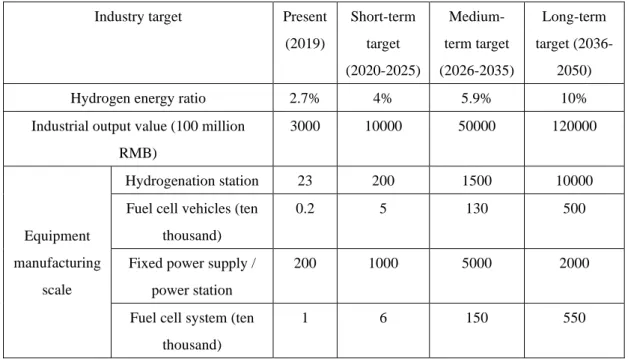
The overall goals are shown in Table 1-3 below. The policy system guarantee of China's hydrogen energy are shown in Tables 1-4 below. The focus of development and assurance is large-scale university hydrogen production, distributed hydrogen production, hydrogen purification technology, key materials and technical equipment for hydrogen storage and transportation, advanced hydrogen energy and fuel cell technologies such as PEMFC and SOFC.
Table 1-3 China's overall target of hydrogen energy and fuel cell industry
Industry target Present (2019) Short-term target (2020-2025) Medium-term target (2026-2035) Long-term target (2036-2050)
Hydrogen energy ratio 2.7% 4% 5.9% 10%
Industrial output value (100 million RMB) 3000 10000 50000 120000 Equipment manufacturing scale Hydrogenation station 23 200 1500 10000
Fuel cell vehicles (ten thousand)
0.2 5 130 500
Fixed power supply / power station
200 1000 5000 2000
Fuel cell system (ten thousand)
1 6 150 550
Table 1-4 China's policy system guarantee of hydrogen energy and fuel cell industry policy system guarantee
Standard system Standard system of hydrogen Laws and regulations of fuel cell
Present (2019)
Lack of systematic hydrogen production, storage and transportation and filling standards
The fuel cell standard system has basically been formed and needs to be continuously refined and improved
Short-term target (2020-2025)
45Mpa gas transportation, type IV bottle group standard; hydrogen station safety, technical acceptance standard; liquid hydrogen civil standard
According to the terminal fields of transportation, industry and construction, continue to improve the standard system, timely expand and follow up the standard formulation of new application scenarios
Middle-term target (2026-2035)
Hydrogen fuel standards; solid and organic liquid storage and transportation standards; pipeline transmission and distribution standards
Long-term target (2036-2050)
CHAPTER1: RESEARCH BACKGROUND AND PURPOSE OF THE STUDY
-1-21- (4) International organizations and industrial cooperation
1) International Partnership Program of Hydrogen Economy and Fuel Cell (IPHE)
The International Hydrogen Economy and Fuel Cell Partnership Program is an international government cooperation organization that was launched in Washington, DC, in November 2003. It was originally called the "International Hydrogen Energy Economic Partnership Program", and China is one of the initiators of IPHE. At present, the organization has absorbed extensive participation from 18 countries and the European Union.
2) International Energy Agency Hydrogen Cooperation Group (IEA-HCG)
The International Energy Agency's Hydrogen Energy Collaboration Group was established in April 2003 and was jointly signed by 24 member countries of the International Energy Community (IEA). It aims to promote cooperation in hydrogen R & D and fuel cell technology development and policy formulation among member countries.
3) International Association of Hydrogen Energy (IAHE)
The International Hydrogen Energy Association was established in the United States in 1974. It is committed to accelerating the promotion of hydrogen energy as the basis and guarantee for the future rich clean energy supply in the world. It is the world ’s highest level of hydrogen energy and the most influential non-profit academic organization.
4) International Hydrogen Council
The International Hydrogen Energy Commission was established at the 2017 World Economic Forum in Davos. It was the first CEO to accelerate the development and commercialization of hydrogen energy and fuel cell technology, and promote the role of hydrogen energy technology in the global energy transformation. Initiative organization. At present, the International Hydrogen Energy Commission has recruited a total of 53 leading companies in the hydrogen energy industry from Asia, Europe and North America to join, National Energy Group and other four Chinese companies are its guiding member units. In addition, the International Organization for Standardization Hydrogen Energy Technical Committee (ISO / TC197), mission innovation and other organizations and initiatives continue to play a role in the global hydrogen energy and fuel cell standard formulation, technological innovation and other fields.
5) Hydrogenation Infrastructure Alliance
Germany has established a joint venture H2Mobility, led by the National Hydrogen and Fuel Cell Technology Organization, with the participation of multinational companies such as Air Liquide,
CHAPTER1: RESEARCH BACKGROUND AND PURPOSE OF THE STUDY
-1-22-
Daimler, Linde, OMV, Shell and Total, aiming to create convenient hydrogenation within Germany Station network to promote fuel cell vehicles on a large scale. It is planned to build and operate 100 hydrogen refueling stations in major metropolitan areas such as Hamburg, Berlin, Rhine-Ruhr, Frankfurt, Nuremberg, Scogart and Munich, as well as major roads and highways by 2019; Construct 400 hydrogen refueling stations in Germany and establish a nationwide supply network to promote the development of the hydrogen energy industry.
6) Alliance of fuel cell vehicle manufacturers
In the promotion of fuel cell vehicles, Japan and South Korea took the lead in large-scale mass production, successfully launched mass-produced models such as Toyota Mirai, Honda Clarity, and Hyundai Nexo. In recent years, four major automobile group alliances have gradually formed in the market: Daimler, Ford and Renault-Nissan, GM and Honda, BMW and Toyota, Audi and Hyundai. Through the alliance, all parties are committed to jointly developing a fuel cell system platform to accelerate the commercialization process.
1.3.2 Development and current status of hydrogen energy in Japan 1.3.2.1 Historical process
Japan attaches great importance to the development of the hydrogen energy industry and proposes to "become the first country in the world to realize a hydrogen society". The government has failed to issue policies such as the "Japan Renaissance Strategy", "Energy Strategy Plan", "Hydrogen Energy Basic Strategy", "Hydrogen Energy and Fuel Cell Strategic Roadmap", etc., and has planned a technical route to realize a hydrogen energy society. In 2018, Japan held the world ’s first hydrogen ministerial meeting, and energy ministerial government officials from more than 20 countries and the European Union participated in the meeting; and took the opportunity of the Tokyo Olympics to promote fuel cell vehicles and build a hydrogen energy town. The following table1-5 shows the development history of hydrogen energy in Japan over the years.
CHAPTER1: RESEARCH BACKGROUND AND PURPOSE OF THE STUDY
-1-23-
Table 1-5 Development history of hydrogen energy in Japan
Year Event
1973 The "Hydrogen Energy Association" was established to carry out hydrogen energy technology research and development centered on university researchers.
1981 The Ministry of International Trade and Industry initiated the development of fuel cells in the "Long-term Research Plan for Energy Saving Technologies".
1990s
Toyota, Nissan and Honda automobile manufacturers start the development of fuel cell vehicles, Sanyo Electric, Matsushita Electric and Toshiba start the development of home fuel cells.
1993
Leaded by NEDO, a 10-year comprehensive project of "Hydrogen Energy System Technology Research and Development" was established.
2002
1) The government activates the fuel cell demonstration vehicles of Toyota and Honda.
2) Practical application of hydrogen fuel cell and fuel cell demonstration project (JHFC) to start fuel cell vehicles and hydrogen refueling stations
2005 NEDO started large-scale practical application research on fixed fuel cells. 2008
The Fuel Cell Commercialization Association (FCCJ) developed a plan to promote fuel cell vehicles to ordinary users from 2015.
2013
1) The "Renewal Strategy for Japan" launched by the Ampere government promotes the development of hydrogen energy as a national policy and starts the preliminary work of the construction of hydrogen refueling stations.
2) The Ministry of Economy, Trade and Industry has established the "Hydrogen and Fuel Cell Strategic Agreement" with wide participation of industry, research institutions and government representatives.
2014
1) The Cabinet revised the "Japan Revival Strategy" and issued a call for the construction of a "hydrogen energy society".
2) The fourth "Energy Basic Plan", positioning hydrogen energy as the core secondary energy in parallel with electricity and heat, and proposing to build a "hydrogen energy society"
3) Announcement of "Japan's Hydrogen and Fuel Cell Strategic Roadmap"
2015
1) In his policy address speech, Ampere expressed his determination to realize a "hydrogen society", aiming to continue to build fuel cell hydrogen refueling stations and increase the circulation of hydrogen energy and reduce prices through the commercial operation of hydrogen power plants.
2) NEDO issued a hydrogen energy white paper, positioning hydrogen energy as the third pillar of domestic power generation.
CHAPTER1: RESEARCH BACKGROUND AND PURPOSE OF THE STUDY
-1-24-
The NEDO mentioned in the table 1-5 is called The New Energy and Industrial Technology Development Organization in Japan. It is the largest public research and development management organization in Japan. Its main goal is to solve energy and environmental problems and promote the transformation of scientific and technological products. According to statistics, from 2010 to 2015, NEDO received a total of 52.98 billion yen from government investment, mainly for hydrogen and fuel cell technology development support. NEDO's research on fuel cells began in 1981, mainly including phosphoric acid fuel cells (PAFC), solid oxide fuel cells (SOFC) and solid polymer fuel cells (PEFC). In addition to fuel cells, NEDO also develops technologies related to the use of hydrogen energy, and has built approximately 100 hydrogen refueling stations in 2015 centered on Tokyo, Nagoya, Osaka, and Fukuoka. In addition, NEDO also conducts research and development on hydrogen power generation technology and new technologies related to the entire hydrogen industry chain such as hydrogen production, hydrogen storage, and hydrogen transportation.
1.3.2.2 Development strategy
(1) National strategy
Fig1-12 Japan’s strategic road map for hydrogen and fuel cells ( Source: Ministry of Economy, Trade and Industry (METI))
In December 2017, the Japanese government released the "Basic Strategy for Hydrogen Energy" (Fig. 1-12), proposing strategic steps and goals for the application of hydrogen energy. "Basic Hydrogen Energy Strategy" aims to achieve hydrogen energy parity production, establish the entire supply chain covering production to downstream market applications, in addition to fuel
CHAPTER1: RESEARCH BACKGROUND AND PURPOSE OF THE STUDY
-1-25-
cell vehicles, it also includes hydrogen energy power generation, fuel cell shipping, chemical production industry, hydrogen replacement of natural gas and other applications . The strategy also clarifies the reasons for Japan's vigorous development of hydrogen energy, which comes down to energy security, environmental protection, energy conservation, and promotion of related industries. There are two main points below, one is energy security considering diversified energy supply and improving energy self-sufficiency rate; the second is to build a deep decarbonized energy system to achieve emission reduction goals.
1) Guarantee national energy security
Japan's primary energy is extremely scarce, and energy for industrial production and daily life depends heavily on imports. At present, about 94% of primary energy in Japan depends on fossil fuels imported from overseas, and about 87% of oil is mainly imported from the Middle East. Coupled with the impact of the Fukushima nuclear power plant accident in Japan, the role of nuclear energy in the energy structure is weakening, and Japan ’s energy self-sufficiency rate is only 6% -7% [22]. To achieve energy security and enhance industrial competitiveness, Japan has accelerated the pace of development of alternative energy sources. Hydrogen energy has become one of Japan's alternative energy sources due to its energy efficiency, cleanliness, and diversity of manufacturing sources and manufacturing methods.
2) Help to achieve carbon emission reduction goals
In the Paris Agreement, Japan set a goal of reducing carbon emissions by 26% by 2030 (compared to 2013 emissions). Among them, the electricity sector accounts for 40% of the total emissions. However, based on the fact that Japan ’s current power generation relies on coal, LNG and nuclear power, and the relatively low proportion of renewable energy power generation, achieving this goal is more challenging. Regarding the hydrogen production route, Japan is currently mainly producing hydrogen from fossil fuels. The "Basic Hydrogen Energy Strategy" proposes to establish domestic renewable energy hydrogen production technology by 2030 and build an international hydrogen energy supply chain. CCS) technology realizes the
decarbonization of cheap fossil fuels (such as lignite) to produce hydrogen and renewable energy to produce hydrogen. Therefore, combining carbon capture technology and renewable energy hydrogen production technology, hydrogen energy has become an important way for Japan to achieve carbon emission reduction targets.
(2) Industry strategy
In addition to the government, Japanese companies are also very active in the construction of fuel cells. On October 15, 2015, Toyota Motor announced "Toyota Environmental Challenge
![Fig 1-1 Global primary energy consumption forecast by 2040 by terminal industry and region [1]](https://thumb-ap.123doks.com/thumbv2/123deta/8004560.1250278/15.892.139.759.286.587/global-primary-energy-consumption-forecast-terminal-industry-region.webp)
![Fig 1-2 Forecast of global primary energy consumption and carbon emission in 2040 [1]](https://thumb-ap.123doks.com/thumbv2/123deta/8004560.1250278/16.892.140.745.143.434/fig-forecast-global-primary-energy-consumption-carbon-emission.webp)
![Fig 1-3 Mind map for the definition of zero-energy hydrogen economy [12]](https://thumb-ap.123doks.com/thumbv2/123deta/8004560.1250278/19.892.151.750.140.569/fig-mind-map-definition-zero-energy-hydrogen-economy.webp)
![Fig 2-2 Estimated delivered hydrogen costs to large-scale industrial users, 2030 [2]](https://thumb-ap.123doks.com/thumbv2/123deta/8004560.1250278/54.892.222.669.246.558/estimated-delivered-hydrogen-costs-large-scale-industrial-users.webp)
![Fig 2-5 Forecast global range of levelized cost of hydrogen production from large projects [2]](https://thumb-ap.123doks.com/thumbv2/123deta/8004560.1250278/57.892.145.747.526.822/forecast-global-range-levelized-hydrogen-production-large-projects.webp)
![Table 2-1 Comparison of hydrogen energy storage and conventional energy storage [40]](https://thumb-ap.123doks.com/thumbv2/123deta/8004560.1250278/58.892.128.767.842.1119/table-comparison-hydrogen-energy-storage-conventional-energy-storage.webp)
![Fig 2-7 Schematic comparison of the key characteristics of PEMFCs, SOFCs and MCFCs as a function of the scale [59]](https://thumb-ap.123doks.com/thumbv2/123deta/8004560.1250278/61.892.162.743.149.543/schematic-comparison-characteristics-pemfcs-sofcs-mcfcs-function-scale.webp)