International Survey Regarding Oral Health Care in Facilities for Elderly
in the Dental Hygiene Student Exchange Program
Hiroki IGA
1), Daisuke HINODE
1), Omar Marianito Maningo RODIS
1),
Yasuhiko SHIRAYAMA
1), Tuula TOIVANEN-LABIAD
2), Erja NUUTINEN
2),
Päivi HAARALA
2), Aija AHOKAS
2), Fumiaki KAWANO
1)Keywords:International survey, dental hygiene students, exchange student program
Abstract:Background: In 2010, Tokushima University School of Dentistry concluded an academic agreement with Metropolia University of Applied Sciences (Metropolia UAS), which offers degree programs of oral health in Finland. We have collaborated through the student exchange program to foster the knowledge of future global dental hygienists in both schools. In this study, we carried out a survey on the attitude of the dental hygiene students regarding oral health care in facilities for the elderly to develop a new international education program for dental hygiene students.
Materials and Methods: The questionnaire on oral health care in facilities for the elderly was given out to the exchange students of Metropolia UAS and students of Tokushima University. Ninety-one (91) dental hygiene students of Metropolia UAS and fifty-six (56) dental hygiene students of Tokushima University participated in this study and statistical analysis were carried out.
Results: One hundred forty-seven (147) students from both schools participated in the survey. 80.2% of the students from Metropolia UAS and 69.6% of the students from Tokushima University chose Moderate and Bad to the questions of What is your opinion about the current state of oral health care in health care facilities for the elderly? . There was no statistically significant difference in the answer to the question Could you work in a health care facility for the elderly as a dental hygienist? from students of both schools. There was also a statistically significant difference observed by Chi-squared test in the answer of Do you think that your knowledge of oral health care for the elderly is sufficient? and the answers of free writing which suggested that Metropolia UAS students have a more positive attitude towards the knowledge of oral health care for the elderly than Tokushima University students.
Conclusion: The results of this international questionnaire survey suggested that many students of Metropolia UAS can be considered to have enough knowledge of oral health care for elderly when compared with students of Tokushima University.
1)Tokushima University Graduate School of Biomedical Sciences, Japan
2)Metropolia University of Applied Sciences, Department of Health Promotion, Finland
74 Journal of Oral Health and Biosciences Vol.31, No.1 2018
I. Introduction
In 2010, Tokushima University School of Dentistry concluded an academic agreement with Metropolia University of Applied Sciences (Metropolia UAS), which is the largest University of Applied Sciences in Finland. It is well known that Finland is one of the countries in Scandinavia with a developed welfare system for their aged society, which would become a social problem as that of Japan. We have collaborated with some international programs to foster dental hygienists who can contribute to an aged society in each country.
This international collaboration consists of three projects. One of them is cooperative research to develop new educational strategies, second is regular long-distance video conferences to understand each other, and the last one is the student exchange program. Many results have already been produced by the cooperative researches; For example, a new common subject, oral health promotion was introduced into the curriculum of both universities, and a guide of exercises for oral health care in Japanese, English and Finnish in the joint researches, and so on. We are also holding regular long-distance video conferences to report progress of the programs or discuss future plans.
Among the three programs, the student exchange program is the most important project in this international collaboration. For the inbound program, we have accepted two or three exchange students from Metropolia UAS for 3 months every year while for the outbound program, we have sent 4 to 8 students to Metropolia UAS as exchange students for 8 days every year1, 2). Students in the inbound program can
discuss with our students about the difference of oral health care between Finland and Japan. This program is useful for them to be global dental hygienists.
The aim of this study is to clarify the differences in the attitude of students in both schools regarding oral health care in facilities for elderly and to develop a new international education program for dental hygiene students.
II. Materials and Methods
1. Student Exchange Program in 2016 and 2017
We accepted two students in 2016 and one student in 2017 from Metropolia UAS as exchange students.
On the other hand, we sent four students from Tokushima University in 2016 and five students in 2017 to visit Helsinki and they joined the exchange students program in Metropolia UAS.
2. Questionnaire
To investigate the differences in the attitude towards oral health care in facilities for elderly between Metropolia UAS
and Tokushima University, the survey was conducted in both Universities as one component of the student exchange program. The questionnaire was given out in English and Japanese to students in both countries as shown in Fig 1. 3. Participants
Ninety-one dental hygiene students from Metropolia UAS (mean age 26.3 ± 2.83 years) and fifty-six dental hygiene students from Tokushima University (mean age 20.3 ± 2.12 years) participated in this study. The mean age of students from Metropolia UAS was higher than the students from Tokushima University.
4. Statistical analysis
Statistical analysis was carried out with SPSS 20.0 (SPSS Inc., Chicago) and the difference of survey regarding oral health care in facilities for elderly was analyzed by Chi-squared tests. We used a significant level of p < 0.05 for regression coefficients.
5. Ethics
This study was approved by the Ethics Committee of the Tokushima University Hospital (No. 2721) and by the Director of Research and Development and the RDI Team in Metropolia UAS.
III. Results
1. Student Exchange Program in 2016 and 2017
The exchange students from Metropolia University of Applied Sciences in 2016 and 2017 joined the special program, including a discussion with our Japanese DH students, practical training in anatomy, visiting the University Hospital as shown in Fig 2.
Four students from Tokushima University in 2016 and five students in 2017 joined the exchange program in Metropolia UAS and learned not only the skills for oral health care in Finland and the curriculum of DH course in Metropolia UAS, but also the comprehensive social welfare system in Finland as shown in Fig 3.
2. International questionnaire survey ① Questionnaire sheet
The number of respondents against the Questionnaire in each grade of both Universities is shown in Table 1.
② Statistical analysis
82.4% of the students from Metropolia UAS and 73.2% of the students from Tokushima University chose Moderate , Bad and Very bad to Q2 as shown in Table 2. There were no significant differences between the answers to Q1, Q2, Q3 and Q5 between both universities (data not shown).
Fig. 1 Questionnaire sheet in English (Q1∼ Q6)
Fig. 2 The student exchange program in Tokushima University in 2016 (a, b) and in 2017 (c, d).
(a) Practical training at Tokushima University Hospital. (b) Presentation in an elementary school. (c) Group discussion with the students of Tokushima University. (d) Practical training in oral pathology.
Fig. 3 The student exchange program in Metropolia University of Applied Sciences in 2016 (a, b) and in 2017 (c, d).
(a) Clinical practice in the hospital. (b) Discussion with the Lecturer of Metropolia University of Applied Sciences. (c) Clinical practice in the hospital. (d) Visit of an elderly facility in Espoo city.
76 Journal of Oral Health and Biosciences Vol.31, No.1 2018
On the other hand, a statistically significant difference was observed between both universities in the answers of Fully agree + Agree and slightly agree + Disagree to Q4 between both universities in the analysis using Chi-squared test as shown in Table 3.
3. Free description
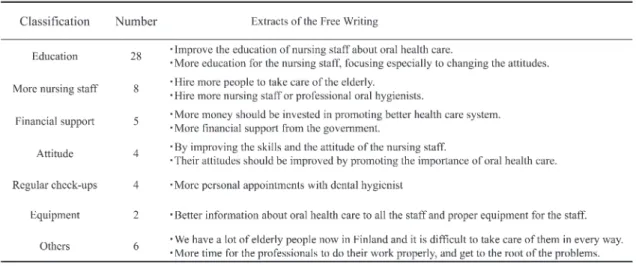
The students classified all free descriptions into 7 categories namely; education, more nursing staff, financial support, attitude, regular check-ups, equipment and others. The numbers of free descriptions were almost the same in both Universities but it was suggested that Metropolia UAS students have more positive attitude towards the knowledge of oral health care for the elderly than Tokushima University students by the free descriptions as shown in Table 4.
IV. Discussion
We have continued to implement the international student exchange program for dental hygiene students between Metropolia UAS and Tokushima University from 2010. In this study, we carried out an international questionnaire survey in the student exchange program and reported the differences in
the attitude of oral health care in facilities for elderly between students from both universities.
The results indicate that the oral health care in health care facilities for the elderly is not enough in both countries (Q2), and the major problems of oral health care in health care facilities for the elderly are almost the same in both countries (Q5 and Q6).
Though there are no significant differences in Q3, many students of Metropolia UAS think that they will be able to work in a health care facility for the elderly as good dental hygienists. In other words, they have self-confidence in their knowledge and skills as a dental hygienist.
A statistically significant difference is observed in Q4. This result indicated that many students from Metropolia UAS are considered to have enough knowledge of oral health care for elderly when compared with students from Tokushima University and the answers of free writing also suggested that Metropolia UAS students have a more positive attitude towards the knowledge of oral health care for the elderly than Tokushima University students. The reason is not clear, in general, Europeans and Americans tend to value themselves highly3).
Table 2 The answers to Question 2 showing the current state of oral health care in health care facilities for the elderly in both countries
Table 3 Analysis of question 4 showing the difference of the knowledge of oral health care for the elderly between Metropolia University of Applied Sciences and Tokushima University
Table 4 Extracts of the free description by the students of Metropolia University of Applied Sciences
In contrast, most Japanese tend to underestimate their own ability or skills3). If this difference depends on the education
level, we must reexamine our curriculum for DH students. We would like to conduct the same survey to nursing staff in health care facilities in both countries and develop a more effective educational system on oral health care for nursing staffs in facilities for elderly.
V. Conclusion
These results revealed that oral health care in health care facilities for the elderly is not enough in both countries. However, the results also suggested that many students from Metropolia UAS have enough knowledge on oral health care for elderly when compared with students from Tokushima University.
Acknowledgements
We thank the three exchange students for their supports. Nelli Candelin-Palmqvist and Tytti Törhönen who were exchange students in 2016 cooperated with Tokushima University students to develop the questionnaire, and Sole Katrin Viktoria Englund who was an exchange student in 2017 cooperated with the statistical analysis.
This study was supported by JSPS KAKENHI Grant Number JP15K11449.
References
1) Iga H and Ichikawa T: A Report of Academic Exchange Program between the University of Tokushima and Helsinki Metropolia University of Applied Sciences. Shikoku Den Res 25, 11-14 ( 2013)
2) Kakiuchi N, Minato A, Okazawa Y, Otsu A, Fujiwara N, Hinode D and Iga H: A Report of Activity in a
Short-Term Study Abroad to Helsinki Metropolia University. Shikoku Dent Res 27, 49-53 (2014)
3) Ishiguro I and Murakami F: The effect of shared attitudes behavior on self-effacement. Jpn Soc Social Psychol 23(2), 130-139 (2007)