DOI: 10.5897/IJNM2016.0249 Article Number: 4B4678F62577 ISSN 2141-2456
Copyright © 2017
Author(s) retain the copyright of this article http://www.academicjournals.org/IJNM
International Journal of Nursing
and Midwifery
Full Length Research Paper
Factors related with low back pain and pelvic pain at
the early stage of pregnancy in Japanese women
Yuko Uemura
1,2*, Toshiyuki Yasui
3, Kimiyo Horike
4, Kazuhisa Maeda
4, Hirokazu Uemura
5,
Mari Haku
6, Reiko Sakae
1and Keiko Matsumura
11
Department of Nursing, Kagawa Prefectural College of Health Sciences, Kagawa, Japan. 2
Tokushima University Graduate School, Tokushima, Japan. 3
Department of Reproductive and Menopausal Medicine, Institute of Biomedical Sciences, Tokushima University Graduate School, Tokushima, Japan.
4
Shikoku Medical Center for Children and Adults, Kagawa, Japan. 5
Department of Preventive Medicine, Institute of Biomedical Sciences, Tokushima University Graduate School, Tokushima, Japan.
6
Department of Midwifery, Institute of Biomedical Sciences, Tokushima University Graduate School, Tokushima, Japan.
Received 8 December, 2016; Accepted 25 January, 2017
The aim of this study was to clarify the proportion of women with low back and/or pelvic pain (LBPP) and related factors at the early stage of pregnancy and to clarify the differences between LBPP-related factors in primiparous women and multiparous women in Japan. 157 pregnant women were recruited. Information about the presence of LBPP, degree of pain by using a visual analog scale (VAS), location of pain, past history of LBPP and background characteristics were collected. Physical status was assessed by the pregnancy mobility index (PMI). The Ethics Committee of Tokushima University Hospital approved the study. The proportion of women who complained of LBPP was 65.6%. PMI score in women with LBPP was significantly higher than that in women without LBPP (p<0.001). The proportions of women with a past history of LBPP before pregnancy and with a past history of LBPP in the previous pregnancy were significantly higher in women with LBPP (p<0.001 and p=0.002, respectively). In women with LBPP, the score of VAS in multiparous women was significantly higher than that in primiparous women (p=0.019). Early management for women with a past history of LBPP before pregnancy and with a past history of LBPP in the previous pregnancy is important. Management for lumbar pain according to parity is needed for health guidance at the early stage of pregnancy.
Key words: Pregnancy, first trimester, low back pain, pelvic pain, parity.
INTRODUCTION
Low back and/or pelvic pain (LBPP) during and after pregnancy is a common complication of pregnancy and puerperium. Mogren and Pohjanen (2005) reported that the overall prevalence of LBPP was 71.7% and that the mean gestational age at the start of LBPP was 22.1 weeks. It has been reported that the proportions of
pregnant women with LBPP were approximately 50% in the first trimester (Gutke et al., 2008), 40 to 70% in the second trimester (Olsson et al., 2012) and 70 to 80% in the third trimester (Kovacs et al., 2012). Also, 70% of postpartum women complained of LBPP immediately after delivery and 40% of women complained of LBPP
3 to 4 months after delivery (Ostgaard, 1992). Pain in the pelvic girdle and lumbar region that occurs at the early stage of pregnancy has been suggested to be a predictor for persistent pain after delivery (Gutke et al., 2008). For pregnant women, prevention of LBPP is an important issue since LBPP is not only the most frequent complaint during pregnancy but also persists for a long period of time.
Several factors related to LBPP have been demon-strated. The association of LBPP with age has been controversial. It has been reported that the age of women without lumbopelvic pain was significantly higher than that of women with lumbopelvic pain in the second trimester (Olsson et al., 2009). On the other hand, it has been reported that older pregnant women are more likely to have pain in the lower back, pelvis and buttock regions in the third trimester (Brown et al., 2013).
It has been reported that increase in parity was associated with increased risk for lumbar pain and that risk for lumbar pain in multiparous women was higher than that in primiparous women (Mota et al., 2015). A past history of lumbar and pelvic pain related or unrelated to previous pregnancy (Kovacs et al., 2012), low educational level (Chang et al., 2011), and high body mass index (BMI) and overweight (Mogren and Pohjanen, 2005) have been reported to be as factors related to LBPP. It has also been reported that a longer period of previous regular physical activity decreased the risk of LBPP during pregnancy and that a physically demanding occupation was associated with increased risk of LBPP during pregnancy (Mogren, 2005). Ostgaard et al. (1992) reported that persistent postpartum back pain was associated with the presence of back pain before pregnancy, the presence of back pain during pregnancy, physically heavy work and multipregnancy. Mogren (2006) reported that women with persistent LBPP at 6 months after delivery had significantly earlier onset of pain during pregnancy, higher maternal age and higher BMI, suggesting that the level and timing of onset of pain during pregnancy were strong predictors of persistent LBPP after delivery (Mogren, 2006). The aim of this study was to clarify the proportion of women with LBPP and LBPP-related factors at the early stage of pregnancy and to clarify the differences between LBPP-related factors in primiparous women and multiparous women in Japan.
MATERIALS AND METHODS Study setting and date collection
This study was conducted from March in 2015 to January in 2016 in a birth center in Kagawa Prefecture in Japan. Number of delivery was approximately 500 per year in the hospital that was examined,
and sample size was 184 by using permissible errors (5%), reliability (95%) and a ratio of a population (25%). The sample size was determined to be 215, considering the number of uncollected sample. 157 pregnant women were recruited at the first trimester in the birth center. Participants were informed of the purposes and procedure of the study.
The study protocol was reviewed and approved by the Ethics Review Board of Tokushima University Hospital (Approval No. 2201).
Questionnaire
A self-administered questionnaire was designed consisting of three parts that took about 20 min to complete. With respect to location of pain, the reference was cited (Al-Sayegh et al., 2012). VAS score was used, which was widely used as objective assessment for degree of pain. Ten women were tested using self-administered questionnaire for assessment of validity in advance and studied using revised self-administered questionnaire. The first part of the questionnaire consisted of questions regarding baseline characteristics such as age, marital status, education and week of pregnancy. The second part of the questionnaire consisted of questions regarding the presence of LBPP, location of pain and 10 cm visual analog scale (VAS) with the end-points of no pain (0 cm) and worst thinkable pain (10 cm). The third part consisted of questions on factors related to low back pain including employment, smoking, and menstruation before pregnancy and history of low back pain. Physical status was evaluated using the pregnancy mobility index (PMI) (Van et al., 2006). In the question for PMI, daily activities were categorized into three scales: (1) daily mobility in the house, (2) ability to perform normal household activities, and (3) mobility outdoors. Every item has a score option from 0 to 3 (‘no problem in performing the task’, ‘some effort in performing the task’ and ‘not possible to perform the task or only possible with the aid of others’), which was transformed to a 0 to 72 scale. A higher score indicates limitation of the activity in daily life.
Data analyses
Differences in background characteristics, physical factors, LBPP-related factors, and PMI were evaluated by the 2 test or
Mann-Whitney U test in all subjects and in women with LBPP. Odds rations (OR) and their corresponding to 95% confidence interval (CI) were calculated by using logistic regression analyses. All p values are two-tailed and those less than 0.05 were considered to be statistically significant. Statistical analyses for data evaluation were carried out using SPSS version 22 for Windows (IBM Crop., Aromonk, NY).
RESULTS
Baseline characteristics of the subjects are shown in Table 1. Mean age ± standard deviation (SD) of the subjects was 32.2 ± 5.1 years. The proportion of women whose age was more than 35 years was 31.8%. The mean week of pregnancy was 14.8 weeks, ranging from 9 to 20 weeks. The subjects included 38.9% primiparous
*Corresponding author. E-mail: [email protected]. Tel: +81-87-870-1212.
Author(s) agree that this article remain permanently open access under the terms of the Creative Commons Attribution License 4.0 International License
Table 1. Background characteristics of the subjects.
Age (year) - 32.2 ± 5.1
Week of pregnancy (weeks) - 14.8 ± 1.6
Height (cm) - 157.0 ± 5.3
Weight (kg) - 53.4 ± 9.8
Body mass index (kg/m2) - 21.6 ± 3.9
Marital status Married 150 (95.5)
Not married 7 (4.5) Working Yes 109 (69.4) No 48 (30.6) Smoking Current 2 (1.3) Previous 35 (22.3) Never 120 (76.4) Parity Primiparous 61 (38.9) Multiparous 96 (61.1) Education level High school 43 (27.4)
Junior college or professional school 72 (45.9) College and/or graduate school 42 (26.7)
Presence of LBPP before pregnancy Yes 81 (51.6)
No 76 (48.4)
Past history of treatment for LBPP Yes 37 (23.6)
No 120 (76.4)
Past history of orthopedic diseases Yes 32 (20.4)
No 125 (79.6)
Past history of LBPP in the previous pregnancy (n=96) Yes 67 (69.8)
No 29 (30.2)
LBPP: Low back and/or pelvic pain. The values of age, duration of pregnancy, height, weight and BMI are presented as means ± standard deviation.
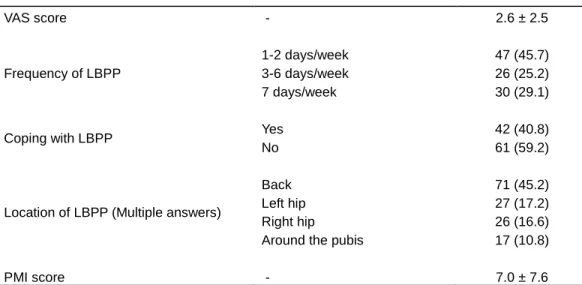
women and 61.1% multiparous women. The proportion of working women was 69.4% and the proportion of primiparous working womenwas significantly higher than that of multiparous working women (p=0.013). The proportion of women with a past history of LBPP before pregnancy was 51.6% and the proportion of women with a past history of LBPP in the previous pregnancy was 69.8%. As shown in Table 2, the proportion of women who complained of LBPP was 65.6%. The mean ± standard deviation (SD) of VAS score was 2.6 ± 2.4, ranging from 0 to 8.6. The proportion of women whose VAS scores were more than 7 was 6.4%. The proportion of women whose frequency of LBPP was once or twice per week was 45.7%. Only 40.8% of women coped with LBPP. The proportion of women who coped with pain in
working women was lower than the proportion of women who did cope with pain in non-working women (p=0.019). The region in which women complained most frequently of pain was the lower back followed by the buttocks.
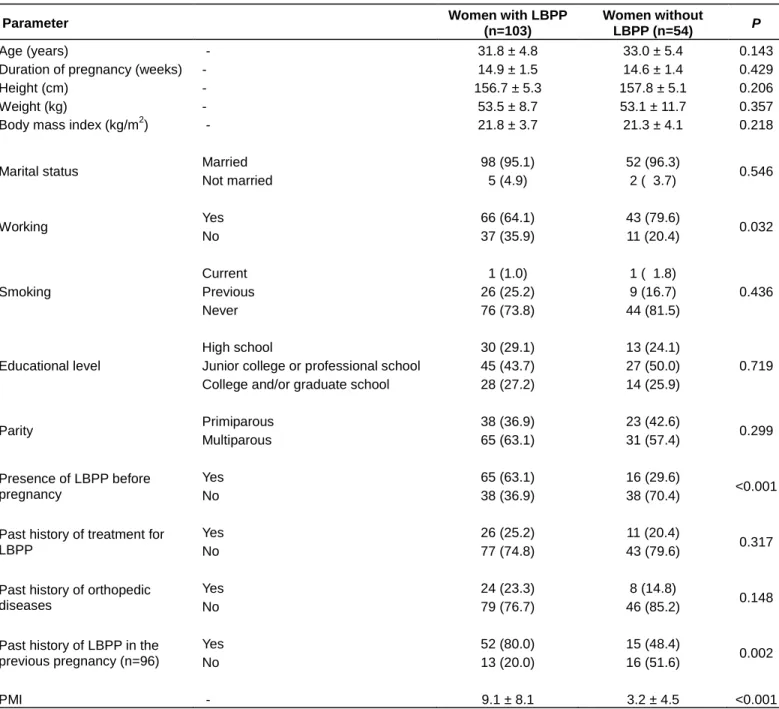
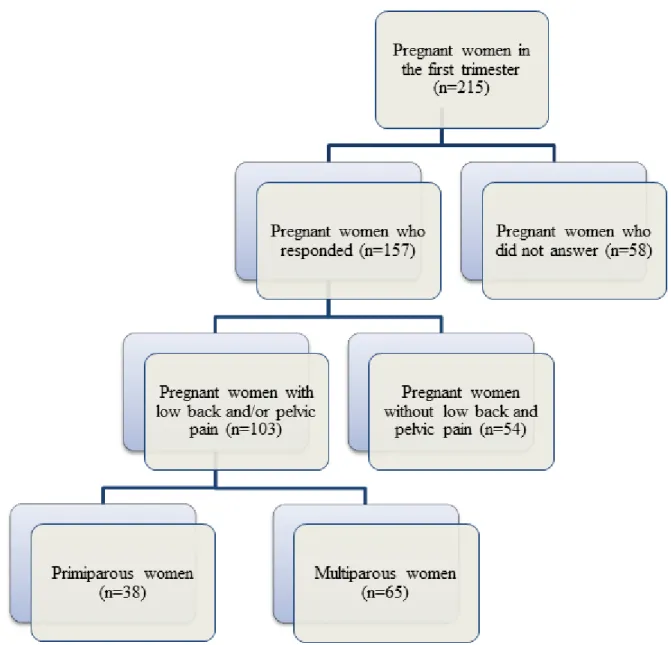
The subjects were classified into two groups: women with LBPP and women without LBPP as shown in Figure 1. As shown in Table 3, PMI score in women with LBPP was significantly higher than that in women without LBPP (p<0.001). The proportion of working women in women without LBPP was significantly higher than that in women with LBPP (p=0.032). The proportions of women with a past history of LBPP before pregnancy and with a past history of LBPP in the previous pregnancy were significantly higher in women with LBPP (p<0.001 and p=0.002, respectively). The presence of LBPP before
Table 2. Characteristics of LBPP in the subjects. VAS score - 2.6 ± 2.5 Frequency of LBPP 1-2 days/week 47 (45.7) 3-6 days/week 26 (25.2) 7 days/week 30 (29.1)
Coping with LBPP Yes 42 (40.8)
No 61 (59.2)
Location of LBPP (Multiple answers)
Back 71 (45.2)
Left hip 27 (17.2)
Right hip 26 (16.6)
Around the pubis 17 (10.8)
PMI score - 7.0 ± 7.6
LBPP: Low back and/or pelvic pain; PMI: pregnancy mobility index. The values of VAS score and PMI are presented as means ± standard deviation.
pregnancy was an increased risk for LBPP (OR 5.33, 95%Cl 2.18-13.06).
There was no significant difference between the proportions of primiparous women with LBPP (62.2%) and multiparous women with LBPP (67.7%). In order to clarify the characteristics of women with LBPP according to parity, the women were classified into two groups: primiparous women with LBPP and multiparous women with LBPP (Figure 1). In women with LBPP, the proportions of primiparous women and multiparous women were 36.9 and 63.1%, respectively. As shown in Table 4, mean VAS scores were 3.3 in primiparous women and 4.2 in multiparous women and VAS score in multiparous women was significantly higher than that in primiparous women (p=0.019). In primiparous women with LBPP, the proportion of working women was higher than that of working multiparous women (p=0.013). In multiparous women with LBPP, the proportion of women who coped with LBPP was higher than that in primiparous women (p=0.047). The region of pain that primiparous women most frequently complained of was around the pubic bone (p=0.043), and the region of pain that multiparous women most frequently complained of was the lower back (p=0.04).
DISCUSSION
In the present study, we found that the prevalence of LBPP in women at the early stage of pregnancy was 65.6%, that pregnant women with LBPP had a past history of LBPP before pregnancy and a past history of LBPP in the previous pregnancy, and that LBPP-related factors were different in primiparous women with LBPP and multiparous women with LBPP.
Previous studies demonstrated that the prevalence of lumbar pain was approximately 50% at the first trimester (Gutke et al., 2008; Robinson et al., 2010) and that the prevalence of pelvic and low back pain was 59 to 66% in Japan (Shinkawa et al., 2009). The prevalence (65.6%) in the present study is consistent with those previous studies. The region of pain shown in the present study is also consistent with a previous study (Brown et al., 2013). On the other hand, it has been reported that 14.6% of pregnant women at the first trimester experienced pain in which the value of VAS was more than 7 (Brown et al., 2013). The proportion of such women in the present study (6.4%) was lower than that in the previous study. Also, the frequency of LBPP was shown to be once or twice per week. The relative low intensity and frequency of LBPP might have been the reason why 60% of the pregnant women did not have to cope with LBPP. However, it has been reported that pelvic girdle pain and lumbar pain at the early stage of pregnancy persist in the puerperium period (Gutke et al., 2008). Therefore, health guidance for LBPP at the early stage of pregnancy is important even if the intensity and frequency are low.
In the present study, high proportions of women with a past history of LBPP before pregnancy and with a past history of LBPP in the previous pregnancy were found in women with LBPP. These factors were shown in previous studies to be risk factors of lumbar pain during pregnancy (Ostgaard et al., 1992; Mogren and Pohjanen, 2005; Mohseni-Bandpei et al., 2009; Bjelland et al., 2011; Al-Sayegh et al., 2012). It has been reported that the proportion of women with chronic lower back pain increased from 20 to 30 years of age to 50 to 60 years of age (Meucci et al., 2015), suggesting that the occurrence of lumbar pain increases with advance of age. An increase in the number of women in Japan who have
Table 3. Comparison of characteristics of women with and without LBPP.
Parameter Women with LBPP
(n=103)
Women without
LBPP (n=54) P
Age (years) - 31.8 ± 4.8 33.0 ± 5.4 0.143
Duration of pregnancy (weeks) - 14.9 ± 1.5 14.6 ± 1.4 0.429
Height (cm) - 156.7 ± 5.3 157.8 ± 5.1 0.206
Weight (kg) - 53.5 ± 8.7 53.1 ± 11.7 0.357
Body mass index (kg/m2) - 21.8 ± 3.7 21.3 ± 4.1 0.218
Marital status Married 98 (95.1) 52 (96.3) 0.546
Not married 5 (4.9) 2 ( 3.7) Working Yes 66 (64.1) 43 (79.6) 0.032 No 37 (35.9) 11 (20.4) Smoking Current 1 (1.0) 1 ( 1.8) 0.436 Previous 26 (25.2) 9 (16.7) Never 76 (73.8) 44 (81.5) Educational level High school 30 (29.1) 13 (24.1) 0.719 Junior college or professional school 45 (43.7) 27 (50.0)
College and/or graduate school 28 (27.2) 14 (25.9)
Parity Primiparous 38 (36.9) 23 (42.6) 0.299 Multiparous 65 (63.1) 31 (57.4) Presence of LBPP before pregnancy Yes 65 (63.1) 16 (29.6) <0.001 No 38 (36.9) 38 (70.4)
Past history of treatment for LBPP
Yes 26 (25.2) 11 (20.4)
0.317
No 77 (74.8) 43 (79.6)
Past history of orthopedic diseases
Yes 24 (23.3) 8 (14.8)
0.148
No 79 (76.7) 46 (85.2)
Past history of LBPP in the previous pregnancy (n=96)
Yes 52 (80.0) 15 (48.4)
0.002
No 13 (20.0) 16 (51.6)
PMI - 9.1 ± 8.1 3.2 ± 4.5 <0.001
LBPP: Low back and/or pelvic pain; PMI: pregnancy mobility index. The values of age, duration of pregnancy, height, weight, body mass index and PMI are presented as means ± standard deviation.
LBPP before pregnancy is expected since the age of birth has recently been increasing in Japan (Ministry of Health, Labour and Welfare, 2015). Health guidance for prevention of lumbar pain at the early stage of pregnancy is important since lumbar pain in women with a past history of LBPP before pregnancy may become worse throughout pregnancy.
Previous studies showed that the proportion of women who were working was not significantly different between women with lumbar pain and women without lumbar pain
(Gutke et al., 2008; Olsson et al., 2009; Mohseni-Bandpei et al., 2009). It has been reported that women without LBPP were more likely to work than women with LBPP in the late stage of pregnancy (Kovac et al., 2012). In the early stage of pregnancy, the proportion of working women in women without LBPP was we shown to be higher than that in women with LBPP. However, a causal relationship between LBPP and working was not found. Given that physical and psychological factors related to jobs have also been reported to be predictors for lumbar
Figure 1. Classification of subjects.
pain (Wáng et al., 2016), a prospective longitudinal study is needed to determine the relationship between LBPP and working.
The mean PMI score (7.0) in the present study was higher than that (3.5 at 12 weeks of age) in a previous study (Bakker et al., 2013). Bakker et al. (2013) suggested that PMI score at the first trimester can predict PMI score at the third trimester since PMI score increases with advance of gestational weeks. Therefore, PMI at the early stage of pregnancy is important. Since PMI score in women with LBPP was high, activity in daily life was limited due to pain in women with LBPP. In addition, Bakker et al. (2013) reported that PMI score caused by lumbopelvic pain was significantly associated with psychological determinants during all stages of
pregnancy (Bakker et al., 2013). Management for LBPP at the early stage of pregnancy may also be involved in prevention of the development of a poor psychological condition.
The characteristics of primiparous and multiparous pregnant women with LBPP might be different. A previous study showed that multiparty was a risk factor for LBPP during pregnancy (Mogren and Pohjanen, 2005). Since a past history of lower back pain in the previous pregnancy has been suggested to be a risk factor for LBPP (Mogren and Pohjanen, 2005; Mohseni-Bandpei et al., 2009), the risk of LBPP in multiparous women may be higher than that in primiparous women. The fact that 80% of multiparous women with LBPP in the present study had a past history ofLBPPintheirprevious pregnancy suggests
Table 4. Comparison of primiparous and multiparous women with LBPP. Parameter Primiparous (n=38) Multiparous (n=65) P Age (year) 30.5 ± 5.0) 32.6 ± 4.5 0.028
pregnancy duration (weeks) 14.7 ± 1.2 14.9 ± 1.8 0.428
Height (cm) 155.6 ± 5.0 157.3 ± 5.4 0.110
Weight (kg) 52.5 ± 10.4 54.1 ± 7.7 0.140
Body mass index (kg/m2) 21.7 ± 4.2 21.9 ± 3.4 0.335
Marital status Married 34 (89.5) 64 (98.5) 0.061
Not married 4 (10.5) 1 ( 1.5) Working Yes 30 (78.9) 36 (55.4) 0.013 No 8 (21.1) 29 (44.6) Smoking Current 0 ( 0.0) 1 ( 1.5) 0.543 Previous 8 (21.1) 18 (27.7) Never 30 (78.9) 46 (70.8) Educational level High school 8 (21.1) 22 (33.8) 0.291 Junior college or professional school 20 (52.6) 25 (38.5)
College or Graduate school 10 (26.3) 18 (27.7)
Presence of LBPP before pregnancy
Yes 28 (73.7) 37 (56.9)
0.067
No 10 (26.3) 28 (43.1)
Past history of treatment for LBPP
Yes 12 (31.6) 14 (21.5)
0.184
No 26 (68.4) 51 (78.5)
Past history of orthopedic diseases
Yes 11 (28.9) 13 (20.0)
0.212
No 27 (71.1) 52 (80.0)
Past history of LBPP in the previous pregnancy
Yes - 52 (80.0)
No - 13 (20.0)
Coping with LBPP Yes 11 (28.9) 31 (47.7) 0.047
No 27 (71.1) 34 (52.3)
Location of LBPP
Back Yes 22 (57.9) 49 (75.4) 0.040
No 16 (42.1) 16 (24.6)
Left hip Yes 12 (31.6) 15 (23.1) 0.250
No 26 (68.4) 50 (76.9)
Right hip Yes 11 (28.9) 15 (23.1) 0.348
No 27 (71.1) 50 (76.9)
Around the pubis Yes 10 (26.3) 7 (10.8) 0.043
No 28 (73.7) 58 (89.2)
VAS score - 3.3 ± 1.6 4.2 ± 2.1 0.019
PMI score - 6.8 ± 5.5 10.3 ± 9.2 0.100
LBPP: Low back and/or pelvic pain; VAS: visual analog scale; PMI: pregnancy mobility index. The values of age, duration of pregnancy, height, weight, body mass index, VAS and PMI are presented as means ± standard deviation.
that multiparous women generally have LBPP. However, the proportion of multiparous women with LBPP was not significantly different from the proportion of primiparous women with LBPP being in line with the results of previous studies (Mohseni-Bandpei et al., 2009; Mota et al., 2015). Mogren and Pohjanen (2005) reported that mean gestational age at the onset of LBPP was 22.1 weeks. The reason for no significant difference between proportions of multiparous and primiparous women with LBPP in the present study might be that the subjects were in the early stage of pregnancy.
The proportion of working women was shown to be high in primiparous women with LBPP. Previous studies showed that occurrence of lumbar pain were not associated with working status (Olsson et al., 2009; Mohseni-Bandpei et al., 2009). To the best of our knowledge, there has been no report regarding the association of LBPP with working status according to parity. It was found that VAS level in multiparous women with LBPP was higher than that in primiparous women with LBPP. Since subjective and personal experiences in the past contribute to the feeling of pain, a high VAS level may be associated with a past history of LBPP in the previous pregnancy in multiparous women. It is important to obtain information regarding a past history of LBPP in the previous pregnancy.
Multiparous women with LBPP were likely to cope with pain, while primiparous women with LBPP did not cope with pain sufficiently. Given that a past history of LBPP in the previous pregnancy is a risk factor for LBPP, coping with LBPP is important for primiparous women, and active management for LBPP is needed. Primiparous women with LBPP were likely to have pain around the pubic bone, while multiparous women with LBPP were likely to have pain at the lower back. It has been reported that the areas of pain for which the VAS score was more than 7 were the lower back (12.4%) and pelvis (9.8%) in the first trimester. However, to the best of our knowledge, a difference in location of pain according to parity has not been demonstrated.
A significant relationship between LBPP and age was also not found in our study. In previous studies, both younger age (Olsson et al., 2009; Mohseni-Bandpei et al., 2009; Bjelland et al., 2011; Kovacs et al., 2012) and older age (Gutke et al., 2008) were shown to be risk factors for LBPP. Wu et al. (2004) reported that both youngest age and oldest age were higher risks for lower back pain. Increase in abdominal girth and change in posture do not occur at the early stage of pregnancy. This might be the reason for no significant association of LBPP with age being found in the present study.
This study has several limitations. First, the proportions of primiparous women and multiparous women were not similar, though the difference was not significant. Further study with a large sample size may be needed. Second, this study is of a cross-sectional nature. Prospective studies including subjects in middle and late gestational
stages and puerperium may be required to clarify the characteristics of LBPP in each stage.
In conclusion, 65% of women complained of LBPP at the early stage of pregnancy and daily life of women with LBPP was limited. Early management for women with a past history of LBPP before pregnancy and with a past history of LBPP in the previous pregnancy is important. Management for lumbar pain according to parity is needed for health guidance at the early stage of pregnancy.
Conflict of Interests
The authors have not declared any conflict of interests.
ACKNOWLEDGEMENTS
The authors are grateful to doctors, midwives and medical assistants in Shikoku Medical Center for Children and Adults for supporting this research. They also thank the women who participated in this study. This work was supported by JSPS KAKENHI Grant Numbers JP16K12104.
REFERENCES
Al-Sayegh NA, Salem M, Dashti LF, Al-Sharrah S, Kalakh S, Al-Rashidi R (2012). Pregnancy-related lumbopelvic pain: prevalence, risk factors, and profile in Kuwait. Pain Med. 13(8):1081-1087.
Bakker EC, van Nimwegen-Matzinger CW, Ekkel-van der Voorden W, Nijkamp MD, Völlink T (2013). Psychological determinants of pregnancy-related lumbopelvic pain: a prospective cohort study. Acta Obstet. Gynecol. Scand. 92(7):797-803.
Bjelland EK, Eberhard-Gran M, Nielsen CS, Eskild A (2011). Age at menarche and pelvic girdle syndrome in pregnancy: a population study of 74973 women. BJOG 118(13):1646-52.
Brown A, Johnston R (2013). Maternal experience of musculoskeletal pain during pregnancy and birth outcomes: significance of lower back and pelvic pain. Midwifery 29(12):1346-1351.
Chang HY, Jensen MP, Yang YL, Lee CN, Lai YH (2011). Risk factor of pregnancy-related lumbopelvic pain: a biopsychosocial approach. J. Clin. Nurs. 21(9-10):1274-1283.
Gutke A, Ostgaard HC, Oberg B (2008). Predicting persistent pregnancy-related low back pain. Spine 33(12):E386-393.
Kovacs FM, Garcia E, Royuela A, González L, Abraira V (2012). Prevalence and factors associated with low back pain and pelvic girdle pain during pregnancy: a multicenter study conducted in the Spanish National Health Service. Spine 37(17):1516-1533.
Meucci RD, Fassa AG, Faria NM (2015). Prevalence of chronic low back pain: systematic review. Rev. Saude. Pub. 49(1):3-22.
Ministry of Health, Labour and Welfare (2015). Vital Statistics. (In Japanese). Available at : http://www.mhlw.go.jp/english/database/db-hw/vs01.html
Mogren IM (2005). Previous physical activity decreases the risk of low back pain and pelvic pain during pregnancy. Scand. J. Public Health 33(4):300-6.
Mogren IM (2006). BMI, pain and hyper-mobility are determinants of long-term outcome for woman with low back pain and pelvic pain during pregnancy. Eur. Spine. J. 15(7):1093-1102.
Mogren IM, Pohjanen AI (2005). Low back pain and pelvic pain during pregnancy: prevalence and risk factors. Spine 30(8):983-991. Mohseni-Bandpei MA, Fakhri M, Ahmad-Shirvani M, Bagheri-Nessami
M, Khalilian AR, Shayesteh-Azar M, Mohseni-Bandpei H (2009). Low back pain in 1,100 Iranian pregnant women: prevalence and risk factors. Spine J. 9(10):795-801.
Mota MJ, Cardoso M, Carvalho A, Marques A, Sá-Couto P, Demain S (2015). Women's experiences of low back pain during pregnancy. J. Back Musculoskelet. Rehabil. 28(2):351-357.
Olsson C, Buer N, Holm K, Nilsson-Wikmar L (2009). Lumbopelvic pain associated with catastrophizing and fear-avoidance beliefs in early pregnancy. Acta Obstet. Gynecol. Scand. 88(4):378-385.
Olsson CB, Nilsson-Wikmar L, Grooten WJ (2012). Determinants for lumbopelvic pain 6 months postpartum. Disabil. Rehabil. 34(5):416-422.
Ostgaard HC, Andersson GB (1992). Postpartum Low-Back Pain. Spine 17(1):53-55.
Robinson HS, Veierød MB, Mengshoel AM, Vøllestad NK (2010). Pelvic girdle pain-associations between risk factors in early pregnancy and disability or pain intensity in late pregnancy: a prospective cohort study. BMC Musculoskeletal Disorders 11(1):91.
Shinkawa H, Shimada M, Hayase M, Inui T (2009). A survey of the variety, incidence rate, and frequency of minor symptoms currently experienced by expectant mothers. J. Jpn. Acad. Midwif. 23(1):48-58. (In Japanese).
Van de Pol G, de Leeuw JR, van Brummen HJ, Bruinse HW, Heintz AP, van der Vaart CH (2006). The Pregnancy Mobility Index: a mobility scale during and after pregnancy. Acta Obstet. Gynecol. Scand. 85(7):786-791.
Wáng YX, Wáng JQ, Káplár Z (2016). Increased low back pain prevalence in females than in males after menopause age: evidences based on synthetic literature review. Quant. Imaging. Med. Surg. 6(2):199-206.
Wu WH, Meijer OG, Uegaki K, Mens JM, van Dieën JH, Wuisman PI, Ostgaard HC (2004). Pregnancy-related pelvic girdle pain (PPP), I: Terminology, clinical presentation, and prevalence. Eur. Spine. J. 13(7):575-589.