Approximating Vertex Cover
on
Dense
Graphs
Tomokazu Imamura and Kazuo Iwama
School$\circ \mathrm{r}\mathrm{i}\mathrm{m}\mathrm{a}\mathrm{m}\mathrm{u}\mathrm{r}\mathrm{a}.$iwa
$\mathrm{m}\mathfrak{P}\mathrm{I}\mathrm{n}\mathrm{f}\mathrm{o}\mathrm{r}\mathrm{m}\mathrm{t}$ics,$\mathrm{K}\mathrm{t}\mathrm{o}\mathrm{U}\mathrm{n}.\mathrm{i}\mathrm{v}\mathrm{y}\mathrm{k}\mathrm{u}\mathrm{i}8\mathrm{k}\mathrm{o}\mathrm{t}\mathrm{o}-\mathrm{e}\mathrm{r}\mathrm{s}\mathrm{i}\mathrm{b}\mathrm{y},\mathrm{K}\mathrm{y}\mathrm{o}\mathrm{t}\mathrm{o}606- 8501\mathrm{u}.\mathrm{a}\mathrm{c}.\mathrm{j}\mathrm{p}$ School of$\{^{\mathrm{I}\mathrm{n}\mathrm{f}\mathrm{o}\mathrm{r}\mathrm{m}\mathrm{t}\mathrm{i}\mathrm{c}\mathrm{s},\mathrm{x}_{\mathfrak{P}^{\mathrm{t}\mathrm{o}\mathrm{U}\mathrm{n}\mathrm{i}\mathrm{v}\mathrm{e}\mathrm{r}\mathrm{s}\mathrm{i}\mathrm{b}\mathrm{y},\mathrm{K}\mathrm{y}\mathrm{o}\mathrm{t}\mathrm{o}606- 8501}}}\mathrm{i}\mathrm{m}\mathrm{a}\mathrm{m}\mathrm{u}\mathrm{r}\mathrm{a}.\mathrm{i}\mathrm{w}\mathrm{a}\mathrm{m}\mathrm{k}’ \mathrm{u}\mathrm{i}8.\mathrm{k}\mathrm{y}\mathrm{o}\mathrm{t}\mathrm{o}-\mathrm{u}.\mathrm{a}\mathrm{c}.\mathrm{j}\mathrm{p}$
今村 友$\ovalbox{\tt\small REJECT} \mathrm{D}$ 岩間 一雄
京都大学情報学研究科,東都市 {lmamura.iwama}\Phi mskyot0-u
.
ac.
jpAbstract
Although many problems in MAX-SNP admit a PTAS for dense graphs, that is not the
case
for Vertex Cover, which is MAX-SNP hardeven
for dense graphs. Thispaper presentsa randomized approximation algorithm for Vertex Cover on dense graphs which is probably optimal: Let $\epsilon$
$=\overline{d}$/ISwhere
1
and A arethe averageand maximum degreesofagiven graphG. $G$is said tobedense ifits$\overline{d}$
is$\Omega(n)$
.
(i) Our algorithm achievesanapproximation factorof$2- \frac{\epsilon}{1+\epsilon/2}$for dense graphs,whichimprovesthe best-known bound by Karpinski and Zelikovsky.
(ii) It achieves the samefactor for a wider range of graphs, i.e., br the graphs whose $\Delta$ 狛
$\Omega(n\frac{1\mathrm{o}\mathrm{g}1\mathrm{o}\mathrm{g}n}{1\mathrm{o}\mathrm{g}n})$
.
1 Introduction
It is often true that although there is
no
good algorithm for general instances, there does existan
excellentalgorithm
foran
important subclass. A typical example of sucha
subclass
isdense
graphs with
an average
degreeof$\Omega(n)$.
Recently, it has been shown [1] thata
variety of NP-hard optimization problems, suchas
${\rm Max}$ Cut and Steiner Tree, admit polynomial time approximation schemes (PTASs) for dense graphs, while the existence of such schemes for general instances of these problemswouldimply$\mathrm{P}=$NP.Dense graphs obviously constitute
an
important subclass since, information theoretically, d-most all graphsare
dense. Thereforeweare
naturally interested inwhetheror
not other popular optimization problems, like Vertex Cover, havea
similar property. Unfortunately, it is highly un-likelythat VertexCoverhas aPTAS for dense graphs sincetheproblemisstillMAX-SNPhard fordense instances [4]. Nevertheless,it is
an
interesting question whetheror
notVertexCovercan
beapproximatedwithin
a
factorof$\alpha$ which issignificantlysmaller thantwo. Thereason
is much thesame
as
before: For generalinstances, whetheror
not VertexCover
hasa
$($2 -$\epsilon)$ approximationalgorithmis
one
of the majoropen
questionsandmany researchersconjecturenegatively. Karpinskiand Zelikovsky [10] affirmatively answeredthis question with the algorithm whose approximation
factor is $\ovalbox{\tt\small REJECT}^{2}2-1-\overline{d}/n$
where
$\overline{d}$
is the
average
degree of the given graph. Unfortunately, however,thisapproxi mation factor quickly approaches to 2.0 while density decreases; it remains unanswered
whetherit is possibleto take
more
substantial advantage ofthe density condition.Our Contribution. Against this curiosity, this
paper
answers
positively. Let$\epsilon$ $=\overline{d}/\Delta$.
Wepresent
a
randomized approximationalgorithm which,with high probability, yieldsan
apprnina-than fiwtor of $2- \frac{\epsilon}{1+\epsilon/2}$ andruns
in polynomial time if$\Delta$ is $\Omega(n^{1_{0}1}\#_{\mathrm{o}\mathrm{g}n}^{\mathrm{p}\mathrm{o}\underline{n}})$
.
Thus the algorithm isquite attractive when $\epsilon$ is close to
one.
For example, it approximates withina
factor of 1.334ifthe graph is regular, which remainstrue
even
for “quasi-dense” graphs whose degree is sub-linear in$n$ (but thecomputation time increases within polynomial). Wecan
achievea
similar factor for random graphs ifthey satisfy thesame
densitycondition. Note that the approximation factor of the previous algorithm [10] gets close to2.0even
for regulargraphsif their density decreases.Ouralgorithmdepends
on
thesame
basic ideaas
thepreviousone
by Karpinski and Zelikovsky[10]. Although it includes nontrivial extensions using recursionand randomization, thetechnique
itself is fairly standard. Even so,
our
algorithm is probably optimalas
mentioned above, which would indicate that it is relativelyeasy
to take full advantage of the density condition in thecase
of VertexCover. This findingis another important contribution of thispaper.
Previous work. Forgeneral Vertex Cover, findingany maximalmatching in the given graph
and choosing the allvertices in the matching yields
a
fact0r-2 vertexcover.
However,no
approxi-mation algorithm of factor $2-\epsilon$isknownfor any constant$\epsilon$ $>0.$ Thecurrent best approximation
algorithm
was
found by Halperin [7] whose approximation factoris $2- \frac{21\mathrm{n}1\mathrm{n}n}{1\mathrm{n}n}$.
And all the knownalgorithms’ approximation factor converge to2 when $|V|$ issufficiently large.
However for the restricted version of the problems,many goodapproximation algorithmsexist. For graphswhosemaximumdegreeis boundedby $\Delta$
,
Hochbaum [9] presented2-z2
factor usinga
coloring method. Exploiting$\mathrm{H}\mathrm{a}\mathrm{l}\mathrm{l}\mathrm{d}6\mathrm{s}\mathrm{s}\mathrm{o}\mathrm{n}$andRadhakrishnan’s [6] approximation algorithm for the
IndependentSet problem,
one
can
obtainfactor of$2- \frac{\log\Delta+O(1)}{\Delta}$.
Usingsemidefinite programming,Halperin [8] asymptotically improved these results by presenting
an
approximation algorithm of factor $2-(1-o(1)) \frac{21\mathrm{n}1\mathrm{n}\Delta}{1\mathrm{n}\Delta}$.
Forsmall $\Delta$, Berman andFujito [3] achieved afactor of$2- \frac{5}{\Delta+3}$.
Forplanargraphs this problem admits PTAS [2]. Karpinski and Zelikovsky [10] showed that there is
an
approximation algorithm of factor $2/(2-\sqrt{1-\epsilon})$ for dense graphs. They also showed that foreverywhere-dense graphs,i.e.,forgraphs whose minimum degree is at least $\epsilon|V|$, we
can
obtainanalgorithm of factor $2/(1+\epsilon)$
.
Forthe negative direction, Hastad [8] showed that it is $\mathrm{N}\mathrm{P}$-hard to approximateVertex Cover
within
a
factor of less than $7/6=$ 1.1666. Dinur and Safra [5] improved this lower-bound to$10\sqrt{5}-21=$ 1.3606. Even for graphs whose maximum degree isbounded by A$\geq 3,$this problemis stillAPX-complete andfor large$\Delta$ it is $\mathrm{N}\mathrm{P}$-hardto approximatewithin 7/6 [4]. In [4], it is shown
that Vertex
Cover
is${\rm Max}$-SNPhard (andhence does not havea
PTAS)even
for dense graphs. Asa
most recent result,Khot andRegev [11]showedthat, if
a
certain conjecture about thePCP
theoryistrue,
we
can prove
thenonexistenceof2-\epsilon factor approximation algorithm for VertexCover.
2
Notation and
Basic Ideas
The Minimum Vertex Cover problem (MVC) is, for
a
given graph $G=(V, E)$, to obtaina
set$C$ ofvertices (called
a
vertex cover) such that (i) $C$ contains at leastone
endpoint ofevery
edge and (ii) $|C|$ isas
smallas
possible. Opt{G) denotes the size ofa
smallest vertexcover
and ifan
algorithm $A$ alwaysfinds a vertex
cover
$C$such that $|C|/$Opt{G) $\leq r,$ we say that $A$ achieves anapproximation
factor
of$r$.
We usually require that $A$runs
in polynomial time.Our notations
are
standard: the number of vertices $(=|V|)$, theaverage
degree $(=2|E|/|V|)$, and the maximum degreeare
denoted by $n$, $\overline{d}$ and $\Delta$, respectively. $\mathrm{N}\{\mathrm{v}$) denotes the set of theneighbors ofthe vertex $v$ andinthis paper, $N(v)$ does not include$v$ itself $\deg(v)$ denotes $|\mathrm{N}(\mathrm{v})$$|$
.
If
we
need to showthe underlying graph $G$ explicitly,we
use
the notations suchas
$n_{G}$,
$\overline{d}_{G}$,
$\Delta_{G}$,
$N\{v$) and$\mathrm{N}\{\mathrm{v})$
.
In [10], Karpinski and Zelikovsky found the following simple and elegant property about
a
minimum vertex
cover
$C$: Supposethatwe
can
take $k$vertices $v_{1}$,
$v_{2}$,
$\ldots,$
$<$)
$k$ such that$\deg(v_{i})\geq k$
for all $1\leq i\leq C.$ Then either (i) $\{v_{1}, /)2, \ldots, v_{k}\}\subseteq C,$
or
(ii) $N(v_{i})\subseteq C$ forsome
$1\leq i\leq k,$ istrue. (Reason: For any $v\in V,$ either $v\in C$
or
all vertices in $N(v)$are
in $C$.
Hence the negationof (ii), i.e., $N(v_{i})$
\not\subset
$C$ for all $i$, implies (i).) Therefore, ifwe
consider the family of the $k+1$sets, $\{v_{1},v_{2}, \ldots,v_{k}\},N(v_{1}),N(v_{2})$,$\ldots$,$N(v_{k})$, then at least
one
ofthem, say $W$,
is includedin $C$.
Furthermore,supposethat $k=\Omega(n)$
.
Then it turns out thatwe canyield anapproximationfactorofstrictlyless than two, by taking$W$
as
apart ofthe vertexcoverandthenapplyingthestandard2-approximation algorithm [10] against the remaining graph. (Notethat
we
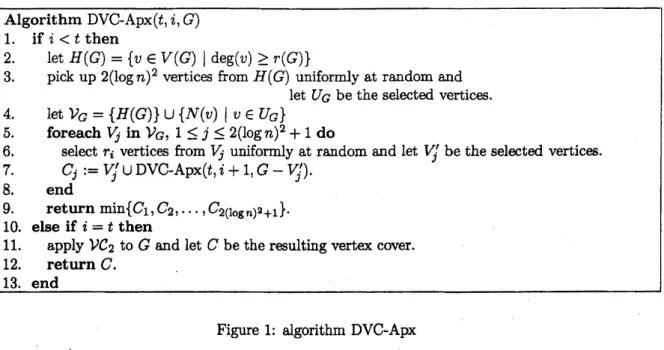
do not know which$W$Algorithm DVC-Apx(t,$i$,$G$)
1. if$i<t$then
2. let $\mathrm{H}(\mathrm{G})=\{v\in \mathrm{V}(\mathrm{G})|\deg(v)\geq$ r(G),
3. pickup$2(\log n)^{2}$ vertices ffom$H(G)$ uniformly at random and
let $U_{G}$ be the selected vertices.
4. let $\mathcal{V}_{G}=\{H(G)\}\cup$
{N(v)
$|v\in U_{G}$}
5. foreach $\mathrm{y}$ in$\mathcal{V}$
G, $1\leq j\leq 2(\log n)^{2}+1$do
6. select $r$
:
vertices from$V_{j}$ uniformly at random andlet $V_{j}’$ be the selected vertices.7. $C_{j}:=V_{J}’\cup$DVC-Apx(t,$i+1$,$G-V_{j}’$).
8.
end9. return $\min\{C_{1}$,$C_{2}$,
. .
.
,$C_{2(\log n)^{2}+1}\}$.
10. else if$i=t$then
11. apply $\mathcal{V}$
C2
to$G$ and let $C$ betheresulting vertexcover.
12. return $C$
.
13. end
Figure 1: algorithm DVC-Apx
is how we can achieve such
a
large$k$.
Fortunately, it is quiteeasy
if the graph is dense: Sort thevertices by their degrees and take $u_{1},u_{2}$,$\ldots$,u7 from the largest
one
untilwe
have $k>\deg(u_{k})$.
Then
a
simple calculation guarantees that $k=$ O(n) if$\overline{d}=$ O(n),thus [10] gives the algorithm whose approximation
factor
is $\frac{2}{2-\sqrt{1-\overline{d}/n}}$.
Our new algorithm is an extension of this algorithm based on the following idea: (i) $\overline{d}/n$ in
the approximation factor
can
be replaced by $\overline{d}/\Delta$.
(ii) If the original graph is dense, then theremaining graph $G$’ after removing the vertex set $W$ is still somewhat dense. Hencewe
can
use
the
same
algorithm for $G’$.
Ifwe
repeat this procedure$t$ times, thenwe
can
takemore
verticesin $C$ than before, but at the
same
time,our
search spacebecomes larger, i.e., from $O(k)=O(n)$previouslytoroughly$O(n^{t})$
.
(i\"u) Toreducethissearchspace,we
introducerandomization. Insteadof considering the$k+1$ sets, $\{v_{1},v_{2}, \ldots, v_{k}\},N(v_{1})$,$N$ Vk},
. . .
,$\mathrm{N}(\mathrm{y}\mathrm{k})$,we
consider only $2(\log n)^{2}+$$1$ sets,
{
$v_{1},v_{2},$$\ldots$ Vk},$\mathrm{N}(\mathrm{y}\mathrm{k})$,$N(v_{\dot{\mathrm{a}}_{2}})$,
...
,$N(v_{i_{2(}}\mathrm{l}’ \mathrm{g}n)^{2})$
.
Here, the last $2(\log n)^{n}$ setsare
selecteduniformly at random from the original it sets. Intuitively speaking, if
some
$v_{i_{f}}$ does not belongto$\mathrm{G}$, then
we
have$N(v_{i_{f}})\subseteq C$and thereis
no
problem. Otherwise,if all$v_{i_{1}}$,$v_{\dot{8}2}$,.. .
,$v_{i_{2(\log n)^{2}}}$ belongto$\mathrm{G}$,thenitfollowsthat almost allverticesin
$\{v_{1}, v_{2}, \ldots, Vk\}$
are
in$C$with high probability,whichisagain desirable for
us.
Note that the searchspace
is reducedto $O((\log n)’)$.
3
New Approximation Algorithm
Before starting arguments,
we
definea
function$7(\mathrm{G})$as:
$\gamma(G)=\{$
$(1- \frac{\Delta}{n}\geq 2\mathrm{z})\overline{d}$
($1- \frac{\Delta}{n}<$
2A)
This functionrepresents howmany vertices
our
algorithmcan
extracts from the given graph $G$.
Figure 1 shows
our
algorithmDVC
Apx(t,$i$,$G$). Our algorithm hasa
recursive structure anditsmaximumlevel oftherecursion is given by integer$t\geq 0.$ For
a
given graph$G=$ $()\}$,we
firstcallDVC-Apx(t,0,$G$). If$t$ isset to 0, then the algorithm is equal to the standard 2-apprdximati0n
algorithms which is denoted by$\mathrm{V}\mathrm{C}_{2}$
.
Otherwiseit recursivelycalls DVC-Apx(t,1,$G’$) forsome
$G’$.
Before explainingDVC-Apx(t,$i,$$G$),
we
needto definethefunctions$r(G)$,
$\deg(\mathrm{i})$ andsequences
(denoted by $u_{1}$,U2,$\ldots$,$u_{k}$ in the previous section). $r(G)$ determines the minimum degree ofthose
vertices andisdefined asfollows:
$r(G)=n_{G}(1-\sqrt{1-\frac{\overline{d}_{G}}{n_{G}}})$
In
our
aigothrm,we
repeat removing verticeswhichare
included ina
minimum vertexcover
and,in doingso,
we
havetoestimatethedecrease of thesum
of the degrees. Forthatpurpose we
define &g(i)as
$\deg(\mathrm{i})$ $= \min\{\Delta,n-i\}$
.
This
represents
theupper
boundof
thedegreeof ithremoved vertexsince, all vertices have degreeatmost A and ith removed vertex has degree atmost the number of remainingvertices minus 1,
which is $n-i.$
$n_{l},$
-i
and$r_{\dot{*}}$denote the numbers ofvertices,a
lowerbound of theaveragedegree,a
lowerboundof$r(G)$ of
a
graph$G$and thesum
ofthenumber of removed vertices at the recursion level$i$.
Theyare
definedas
follows:$n_{t+1}$ $=$ $n-s_{i}$,
$\overline{d}_{t+}1$ $=$ $\frac{\overline{d}n-2\sum_{k=1}^{s}deg(k)}{n_{i+1}}$
.,
$r_{\+1}$
.
$=$ $\frac{\overline{d}_{t+1}}{1+\sqrt{1-\frac{\overline{d}_{l+1}}{n_{t+1}}}}$,
$s_{i+1}$ $=$ $\sum_{i+1}^{k=1}r_{k}$,
where $n_{1}=n_{G}$, $\overline{d}_{1}=\overline{d}_{G}$
’ $r_{1}$ $=$r(G) and $5^{\mathrm{j}}1$$=l_{1}$ for the original graph $G$
.
Before proceeding,weshow basic properies of these
sequences.
Lemma 1. $n_{t}\geq\overline{d}_{\dot{l}}$ and$r_{i}\geq\lrcorner\overline{d2}$ hold
for
each i.Proof.
Consider removing $k$vertices froma
graph $G$ and let $G’$ bethe resultinggraph. Then thedecreaseofthe
sum
of the degrees,i.e.,$-6n;-\overline{d}_{G’}n_{G^{t}}$ is at most $\sum_{\mathrm{j}=1}^{k}$&g(j). Since$G’$has$n-k$vertices, the
sum
of the degrees of$G’$is at most $(n-k)^{2}$.
Therefore, thesum
of the degrees of$G$is upper-bounded by$\sum_{j=1}^{k}de9(j)+(n-k)^{2}$, which
means
in
$\mathrm{s}\sum_{j=1}^{k}deg(j)+(n-k)^{2}$.
Andthis leadsto
$n-k \leq\frac{\overline{d}n-\sum_{j=1}^{k}deg(j)}{n-k}$
.
Setting $k=s:,$
we
can
prove
$r\mathrm{h}$$\geq\overline{d}i$.
Next
we
show that $r_{\dot{l}}\geq\overline{\#}$ for each $i$.
Thiscan
be shown easily by the definition of$r_{\dot{l}}$ and
$\%\geq\overline{d}i$
.
$\square$
One
can
see
that the algorithm follows the basic idea given in the previous section almostthe previous overview of the algorithm,
we
consider the whole vertex set $V$ in $\mathcal{V}_{G}$as
a
candidateto be a part of$C$,
remove
itfrom $G$ and go to thenext level. Actuallywe
select $r_{i}$ vertices from$V$uniformly at randomandremoveonly those$r_{i}$
ones
from $G$.
This is just for simpleranalysis, inotherwords, it is enoughforachieving
our
approximation factor toremove
this number of vertices. Onecan
easilysee
that each $C_{j}$ in line 7 isa
vertexcover
of $G$ at that level. If the level is $t$,then
we
directlyobtaina
vertexcover
of$G$by using$\mathcal{V}$C2.
Sinceeach computation path splits into$(2(\log n)^{2}+1)^{t}$pathsat eachlevel,
we
have $(2(\log n)^{2}+1)^{t}$computationpathsin total. ApparentlyDVC-Apx(t,0,$G$) gives
a
correct vertexcover
of the original graph $G$.
In the next section,we
analyzeitssize.
4
Analysis
of Approximation Factor
In thissection
we
evaluate the approximation factor ofDVC-Apxdescribed in the previoussection. Actually,we
provethefollowingtheorem.Theorem 1. Givenagraph$G$, whoseaverage degreeis$\overline{d}=\overline{d}_{G}$ and the maximum degreeis$\Delta=\Delta_{G}$,
DVC-Apx yields
an
approximate solutionfor
$G$ whose apprvimationfactor
is at most$\frac{2}{1+\{1-(1-\frac{\Delta}{2n})^{t}\}\gamma(G)}$
in time$O((\log n)^{2t})$
.
Especially, since $(1-;)^{x}$ $<$ 1/e, bysetting$t=O(n/\Delta)$, the approximation factor obtained by
DVC-Apx
can
be arbitrarilyclose to $\frac{2}{1+\gamma(G)/n}$.
Thecorrectness ofthecomputation timeis obviousffom the recursionstructuregiven inthe previoussection,whichis$O((\log n)^{O(n/\Delta)})$ under the
same
setting. Thus
we
have the following corollary.Corollary 1. Suppose that A$=\Omega(n^{1}\Leftrightarrow_{\mathrm{g}n}^{1\mathrm{g}\underline{n}})$
.
Then our algorithmruns
inpolynomial time and itsapprvirnation
factor
is $\frac{2}{1+\gamma(G)/2}$.
In the following
we
focusontheanalysisof the approximationfactor,for whichweneedseveral lemmas.Lemma 2.
Let
$G=(V,E)$, $C\subseteq V$ beone
of
the minimum vertexcover
of
$G$ and$W$ bea
setof
vertices $s.t$
.
$|W|=n_{1}+n_{2}$, $|W\cap C|\geq n_{1}$ and$|W$-C$|\leq n_{2}$.
Thenwe can
constructa
vertexcover
whose approirnationfactor
is atmost $\frac{2}{1+_{n}^{\underline{\hslash}_{\mapsto-n}}}$.
Thislemmais
a
generalizationof Lemma 4.1 in[10]. In [10], thecase
that $n_{2}=0$$(W\subseteq C)$was
considered andthe Lemma 2
can
be proved similarly. Hencewe
omit the proof here. By using thislemma,
we
can
concentrate onlyon
findinga
set of vertices which hasa
large fraction of verticesin$C$
.
Consider the recursion tree generated by theexecution ofDVC-Apx
on
$G$.
For apath $P$fromthe root to
a
leaf in this tree, let $G_{i}^{P}$ be the input graph at the ith level (see Figure 2). Wedenote by $W_{\dot{1}}^{P}$ the set of removed vertices at level $i$ on $P$ and let $W_{P}= \bigcup_{\dot{\mathrm{s}}=1}^{t}W_{i}^{P}$
.
Note that $\mathrm{C}_{=1}|\mathrm{F}^{P}|=\sum_{\dot{\iota}=1}^{t}$r:
and $G_{i+1}^{P}=G_{i}^{P}-W_{i}^{P}$ holds for each $i$.
Inthe rest ofthe paper, whenwe
say
a
”node” inthe tree,it oftenmeans
theinput graph in that node. Notethat the root of tree is $G_{1}=G.$ We often omit the superscript$P$from these notations when the underlying path $P$isclearffomthe context.
Lemma 3. Foranypath $P$ and any level $i$
we
have$n_{G_{*}}=n_{t},\overline{d}_{G_{l}}\mathit{2}$$\overline{d}_{\mathfrak{t}}$ andFigure2:
a
recursiontreeProof.
By inductionon
$i$.
For $i=1,$ these equalities hold by the definitions. For $i32$, since$G_{\dot{\iota}+1}=G_{\dot{l}}-W_{\dot{l}}$,
we
have $n_{G_{*+1}}.=$n{Gi)
$-r_{\dot{\gamma}}=n_{\dot{*}}-r_{\dot{l}}=n_{\dot{\mathrm{a}}+1}$.
Hence $n_{G_{t+1}}=n_{\dot{|}+1}$.
Sincetheaverage
degreeof$G_{\dot{\iota}+1}$ is at least $\frac{\overline{d}_{G}n_{G}-2\Sigma_{b=1}^{\epsilon_{l}}deg(k)}{n_{G_{t+1}}}$,we
have$\overline{d}_{G}.\cdot+1$ $\geq$ $\frac{\overline{d}_{G}n_{G}-2\sum_{\dot{k}=1}^{s}deg(k)}{n_{t+1}}$ $=\overline{d}_{t+1}$
.
Therefore,$\overline{d}_{G_{t+1}}$ $\mathrm{a}$$\overline{d}_{t+1}$ holds. For $\{r_{j}\}$
,
using$n_{G_{t+1}}=n_{i+1}$ and$\overline{d}_{G}\dot{.}+1$ $\geq\overline{d}_{\dot{*}+1}$,
we
have$r(G_{i+1})$ $=$ $\frac{\overline{d}_{G_{t+1}}}{1+\sqrt{1-\frac{\overline{d}_{G_{t+1}}}{nc_{+1}}}}.\cdot$ $=$ $\frac{\overline{d}c_{+1}}{1+\sqrt{1-\frac{\overline{d}_{G}}{n_{t}}}}$
.
$.+1+1$ $\overline{d}_{t+1}$ $\geq$ $\overline{1+\sqrt{1-\frac{\overline{d}_{+1}}{\overline{n_{l+1}}}}.\cdot}$ $=r_{i+1}$,whichprovesthe lemma. 0
Lemma 4. Let$P$ be any path
from
the root toa
leaf
inthe recursion tree and$G_{1}$,
$G_{2}$,
$\ldots$
,
$G_{t-1}$ bethe nodes along P. For
every
$G_{i}$,
withprobability at least $1- \frac{1}{n^{2}}$,
thefamily $v_{G}.\cdot$ contains at leastone
set173
$\mathrm{s}$.t. $|5$$\cap C|\geq(1-1/\log n)|V_{j}|$.
Proof.
If$|H(G_{i})$$\cap C|\geq(1- 1/ \log n)|H(G_{i})|$,then theclaimholds with probability1since$H(G_{i})\in$$\mathcal{V}$
G$t$ and$H\{Gi$) satisfies theconditions. Otherwise, i.e., if$|H(G_{i})$$\cap C|<(1-1/\log n)|H(G_{\dot{l}})|$
,
thenthe set$U_{G_{t}}$ of randomlychosenverticescontains
a
vertex$v\mathrm{s}.\mathrm{t}$.
$v\not\in C$with highprobability. Indeed,when $|\mathrm{H}(\mathrm{G}\mathrm{i})$ $\geq 2(\log n)^{2}$,theprobabilitythat $UGi$ contains such
a
vertex is:$\mathrm{P}\mathrm{r}[\exists v\in U_{G}.-C]]$
$\geq$
1-$\prod_{v\in U_{G_{l}}}\mathrm{P}\mathrm{r}[v\not\in U_{G_{*}}.-C]$ $\geq 1-(1- 1/ \log n)^{2(\log n)^{2}}$
$\geq$ $1-( \frac{1}{e})^{2\log n}=1-\frac{1}{n^{2}}$
.
If$|H(G_{i})|<2(\log n)^{2}$
,
thisprobabilityis1since$\mathrm{U}\mathrm{G}$. $\mathrm{H}(\mathrm{G}\mathrm{i})$ and$|H(G:)-C|>|H(G:)|/$$\log n>0.$
For such
a
vertex$v$$(C, NGi(v)\subseteq C$, whichmeans
$|N_{G}$:$(v)\cap|=|\mathrm{V}_{G},.(v)|>(1-1/\log n)|N_{G}.(v)|$.
Lemma 5. For anycomputation path$P$
of
height$t$, thesum
of
the degreeof
the removed vertices,$i.e.$
,
$\sum 7_{k=1}^{\epsilon_{t}}$$deg(k)$, is at least $(1-(1- \frac{\Delta}{2n})^{t})\overline{d}n$.
$deg(k)$
$\backslash \backslash \backslash \backslash \backslash$
$\backslash$
$\backslash \backslash \backslash \backslash$
A———————$\cdot$
$n$ $k$
Figure3: $\deg(\mathrm{k})$
Proof.
Let$4$. $=\overline{d}$n
-2$\sum_{k^{l}=1}^{\mathit{8}}deg(k)$
,
which intuitively represents the lower bound of the numberofremaining edges. We first prove that $a_{t}$ decreases exponentially. To do so,
we
show the followinginequality.
$\frac{a_{i+1}}{a_{i}}\leq 1-\frac{\Delta}{2n}$
.
(1)Supposingthis inequality holds, we
can
show that $a_{t} \leq(1-\frac{\Delta}{2n})^{i}a_{0}=(1-\frac{\Delta}{2n})^{i}\overline{d}n$ and the lemmawill be proved. Hence from here
we
will prove equation (1). First, cq $-a_{\dot{*}+1}=2 \sum_{k=s_{\mathrm{f}}+1}^{\epsilon_{t+1}}$&g(tC)can
belower-bounded by$r_{i+1^{\frac{\ g(s_{i})+deg(s_{i+1})}{2}}}$
.
(2)This
can
beseen
in Figure 4 because $\sum_{k=s_{i}+1}^{\epsilon_{i+1}}deg(k)$ equals to the grayarea
and expression (2)equalstotheunderlyingtrapezium.
$\backslash \backslash .\backslash \backslash \backslash ..\backslash \backslash \backslash \backslash$ $\backslash .\backslash \backslash \backslash \backslash \backslash \backslash \backslash \backslash \backslash$ $\backslash \backslash \backslash \backslash \backslash \backslash \backslash ..\backslash \backslash \backslash$
1 2 3
Figure4:
gray
area
represents $\sum_{\dot{k}=*\mathrm{r}+1}^{\partial}.+1$$\deg(\mathrm{k})$case
1. Thecase
$s_{i}<s_{i+1}\leq n-\Delta$, it follows that $\ g(s_{\dot{*}})=\ g(s_{i+1})$ $=$A. Therefore,$=$ $r_{i+1}\Delta$ $\geq$ $\frac{\overline{\iota}_{+1}}{2}$ . A $=$ $\frac{\overline{d}n-2\sum_{k^{i}=1}^{s}deg(k)}{n_{i+1}}$
.
$\frac{\Delta}{2}$ $=$ $\frac{a}{n_{\mathrm{t}+1}}\dot{.}\frac{\Delta}{2}$ $\geq$ $\frac{a_{t}}{2}\frac{\Delta}{n}$.
Here
we
used Lemma 1 and the definition of$\overline{d}_{t}$.
case
2. Thecase
$s_{\dot{*}+1}>$$\mathrm{f}\mathrm{f}\mathrm{i}-\Delta$$\geq s_{i}$, $deg(s_{\dot{*}})=\Delta$and $deg(s_{i+1})$ $=n-s_{i+1}$
.
Therefore,$\sum_{k=\epsilon\iota+1}^{\epsilon_{\mathrm{t}+1}}deg(k)$ $\geq$ $r_{i+1}^{\mathrm{i}^{S}+1}\Delta+n_{2}-$
$\geq$ $\frac{a_{t}}{2}\frac{\Delta+n-s_{i+1}}{2n_{t+1}}$ $\geq$ $7$ $( \frac{\Delta}{2n_{i+1}}+\frac{n-s_{\mathrm{i}}-r_{i+1}}{2r_{4+1}}.)$ $\geq$ $\frac{a_{t}}{2}(\frac{\Delta}{2n_{i+1}}+\mathrm{i}n_{i+\mathrm{l}}-r_{+1})2\mathrm{n}_{t+1}$ $\geq$ $\frac{a_{\dot{*}}}{2}\frac{\Delta}{2n_{\dot{\iota}+1}}$ $a_{i}\Delta$ $\geq$ $\overline{2}\overline{2n}$
.
Here
we
used $n_{t+1}=n-s_{i}$ and$n_{i+1}\geq$ $r_{if1}$.
case
3. Finally, thecase
$s_{i+1}>s_{i}>n-\Delta,$$\ g(s_{i})=n$-$S$:
and$\ g(s_{\dot{l}+1})=\mathit{1}\mathit{9}$-$s_{+1}$
.
Thus$\sum_{k=s_{t}+1}^{s_{t+1}}$&g(k) $\geq$ $r_{i+1^{\frac{n-s_{i+1}+n-s_{i}}{2}}}$
$\geq$ $\frac{a_{t}}{2}\frac{2n-s_{i+1}-s_{i}}{2n_{i+1}}$
$=$ $\frac{a_{t}}{2}\frac{2(n-s_{i})-s_{\dot{\iota}+1}+s_{i}}{2n_{i+1}}$
$=$ $\frac{a_{\mathrm{t}}}{2}(1-\frac{r_{\iota+1}}{2n_{i+1}})$
$\geq$ $\frac{a_{t}}{4}$
.
Here
we
used$t:\leq n_{t}$.
Thus in
any
case
$a_{t}-a_{t+}4$ $= \sum_{k=s_{*}+1}^{\epsilon_{t+1}}$. degfa) $\geq\yen$$\cdot\pi\Delta$holds since$\varpi\Delta=\min${
$\frac{\Delta}{n}$b
,
$\frac{\Delta}{2n}$,
$\mathrm{J}$}
Thereforeit follows that $a_{t+1}\leq(1-c)a_{t}$
and
we
have shown that $a_{*}$.decreases exponentially. $\square$Usingthis lemma,
we
next show that $s_{i}$ converges to $\gamma(G)$ and the difference $\gamma(G)-s_{i}$ alsodecreases exponentially.
Lemma 6. For any computation path$P$
of
height$t$, thesurn
of
the numberof
removed vertices,Proof, InLemma5,
we
have shownthat 2$\sum_{k=1}^{s}$.
$deg(k)$ convergesto $\overline{d}n$exponentially. Thisimplies
that $s_{i}$ converges tothevalue ofthesolution of the following equation:
2$\sum_{k=1}^{x}$dig(kl)
$=\overline{d}$
n.
(3)So let
us
first solve this equation. To solve this, we have to consider twocases.
Onecase
is thecase
$1- \frac{\Delta}{n}\geq\frac{\overline{d}}{2\Delta}$, in which $\deg(\mathrm{k})$ $=$ A holds forau
$k$.
Thiscan
be shownas
follows. Let $x_{0}$be the solution of the above equation and
suppose
that $deg(k)=n-k$ holds forsome
$k\leq x_{0}$.
$Bn$
Then it follows that $x>n-\Delta\geq\not\subset\overline{d}n$ and $\overline{d}n=2\sum_{k=1}^{x}eg$( c) $>2 \sum_{k=1}^{\mathrm{g}}$$\deg(\mathrm{k})=dn$
.
This is acontradiction and $\deg(\mathrm{k})=$A holds for all $k$
.
The other
case
is $1- \frac{\Delta}{n}<\frac{\overline{d}}{2\Delta}$,
in which forsome
$k$ it holds that $\deg(\mathrm{k})=n-k$.
Thiscan
beshown similarly.
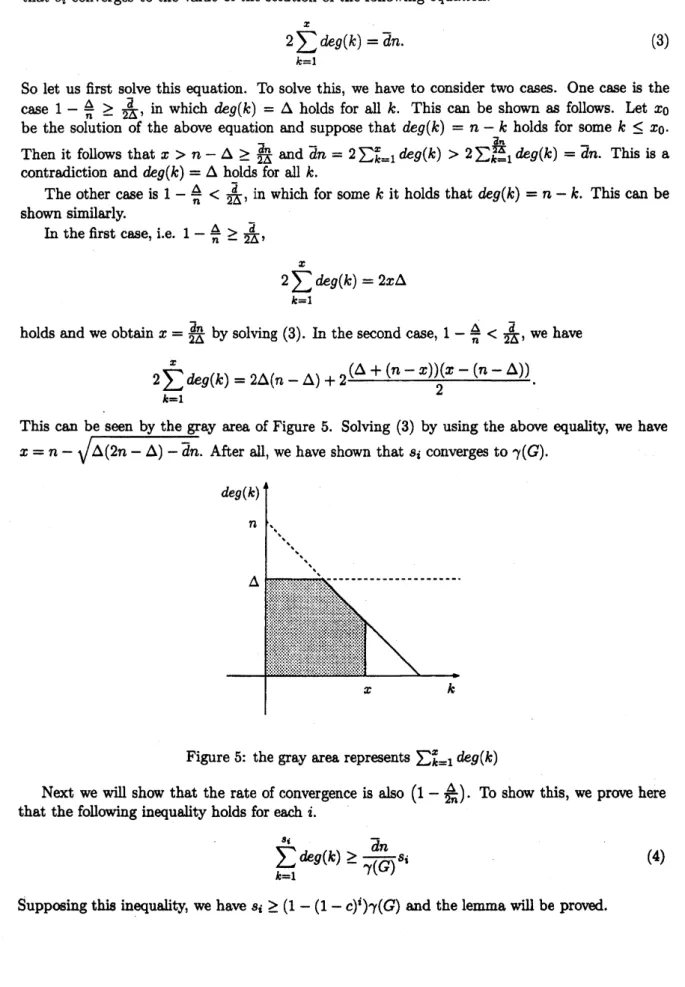
Inthefirst case, i.e. $1- \frac{\Delta}{n}\geq\frac{\overline{d}}{2\Delta}$,
2$\sum_{k=1}^{x}$$\deg(\mathrm{k})$$=2x\Delta$
holds and
we
obtain$x= \frac{\overline{d}n}{2\Delta}$ bysolving (3). In thesecondcase, $1- \frac{\Delta}{n}<\Pi 2\overline{d}$, we
have2$\sum_{k=1}^{x}\ g(k)=2 \Delta(n-\Delta)+2\frac{(\Delta+(n-x))(x-(n-\Delta))}{2}$
.
This
can
beseen
by the grayarea
of Figure 5. Solving (3) by using the above equality,we
have$x=n-\sqrt{\Delta(2n-\Delta)-\overline{d}n}$
.
After all,we
have shown that $s_{i}$converges
to$\gamma(G)$.
Figure 5: thegray
area
represents $\mathrm{i}\mathrm{I}_{k=1}^{x}$$\deg(\mathrm{k})$Next
we
$\mathrm{w}\mathrm{i}\mathrm{U}$ showthat the rate ofconvergence
is also $(1-\mathrm{A})$
.
To show this,we prove
herethat thefollowing inequality holds for each $i$
.
$\sum_{k=1}^{s}.deg(k)\geq\frac{\overline{d}n}{\gamma(G)}s_{\dot{1}}$ (4)
This
can
be easilyshown byseeingFigure 6 since theuppercurve
represents $\sum_{k=1}^{s}\dot{.}deg(k)$ and the lower line represents $\frac{\overline{d}n}{\gamma(G)}s_{i}$.
For$0\leq x\leq n-\Delta$, $\sum_{k=1}^{x}$$deg(k)= \Delta x\geq\frac{\overline{d}n}{\gamma(G)}x$holds by definition of$7(\mathrm{G})$ For $x>n-\Delta$, $\sum_{k=}^{x}1$$deg(k)=\Delta(n-\Delta)+(\Delta+(n-x))(x-(n- \mathrm{A}))/2$ and let $f(x)$be the right hand side ofthe equation. Since $f(x)$ is
convex
upward and $f(x)> \frac{\overline{d}n}{\gamma(G)}x$ holds for$t=n-\Delta$,$7(\mathrm{G})$,
we
have $/( \mathrm{x})>\frac{\overline{d}n}{\gamma(G)}x$for all$n-$A $\leq x\leq\gamma(G)$.
Henceequation (4) holds andthe lemma proved.
$\overline{d}n.$..–.——– 1 1 $\Delta(n-\Delta)$ $—-\cdot---$ $1||1$ $l$ $|1\mathrm{t}|$ $1||$ $\prime 1|\mathrm{I}11$ $|\iota^{\mathfrak{l}}$ $n-\Delta$ $\gamma(G)$ Figure 6: 0 Lemma
7.
Forevery
$V_{j}\in \mathcal{V}_{G}\dot{.}$,
$|V\mathit{5}|2$$r_{j}$.
Proof
Recall that $H(G)=\{v|\mathrm{d}(\mathrm{v})\geq r(G)\}$.
Foreach $v\in U_{G}‘$’ therefore,we
have $d(v)\geq r(G_{i})$and $|N_{G_{\mathrm{J}}}(v>)|\geq$ r(Gi). By lemma 3, $r(G_{i})2$ $r_{i}$ holds, which also
means
$|N_{G}$.
$\cdot$(v)$|\mathit{2}$ $r_{i}$
.
Toprove $|\mathrm{H}(\mathrm{G}))|\geq r(G_{i})$,
suppose
forcontradictionthat $|H(G)|<r(G_{i})$.
Thismeans
only $|H(G)|$ verticeshave
a
degree at most $n_{G_{t}}$ and$n_{G}\dot{.}-|H(G)$$|$ vertices havea
degreeless than $r(G)$.
Now the totalsum
of thedegree of vertices in $G_{i}$ is bounded by$\sum_{v\in V(G:)}d_{G}\dot{.}(v)$
$<$ $|H(G)|nc_{:}+$$(n_{G_{t}}$$-|\mathrm{H}(\mathrm{G})\mathrm{r}(\mathrm{G}\mathrm{i})$
$=n_{G_{t}}r(G_{\dot{*}})+(n_{G_{l}}-r(G_{i}))|H(G_{i})|$
$<$ $n_{G_{l}}r(G_{i})+(n_{G}.\cdot-r(G_{\dot{*}}))r(G_{i})$
$=$ $(2n_{G_{l}}-r(G_{i}))r(G_{i})$
.
Here the second inequalty holds since $r(G_{i})\leq\overline{d}_{G}.\cdot\leq n_{G_{2}}$
.
Since $\overline{d}_{G_{t}}n_{G_{5}}=\sum_{v\in V(G_{l})}d$ $(v)$, itfollowsthat$\overline{d}_{G}$
.
$n_{G_{l}}<(2n_{G_{l}}-r(G_{i}))r(G_{i})$
.
Solving this inequalitywe
obtain$r(G)< \frac{\overline{d}_{G_{*}}}{1+\sqrt{1-\overline{d}_{G_{l}}/n_{G_{t}}},\square }.$
,,
which contradicts the definition of$r(G)$
.
By this lemma
we
can
always select $r_{i}$ vertices in the 7th line of the algorithm. Hence $|W_{P}|$ $=$ $\sum_{i=1}^{t}r_{i}$ for any path$P$.
Lemma 8. LetC be one
of
the minimum vertexcovers
of
G. Then, with highprobability, there isProof.
We call a path $P$ a good path if, at every node $G_{i}^{P}$.
$\mathcal{V}_{G_{i}^{P}}$
$\mathrm{h}\mathrm{s}$ a set
$V_{7}$ $\mathrm{s}.\mathrm{t}$
.
atleast $1- \frac{1}{\log n}$ffaction of$V_{j}$ is in $C$
.
Recall that forsome
set $V_{j}’\subseteq V_{J}$ ofrandomly chosen vertices $\mathrm{s}.\mathrm{t}$.
$|V\mathrm{J}$’$|=r_{i}$, $G_{i+1}^{P}=G_{i}^{P}-$ $\mathit{7}$
’ holds.
We
can
observe that, by Lemma7 the probabilitythata
recursion tree has at least onegoodpath ofheight$t$ is at least $(1-^{t}$ and $t$is obviously at most $n$ since $|G_{i}|>|G_{i+1}$$|$ holds for any
$i$
.
Thus this probabilityis at least $(1-\overline{n}^{\mathrm{T}})^{n}1$.
Note that since $(1- \frac{1}{x})^{x}\geq$ l/2e for sufficiently large $x$,the probability isgreaterthan $(1/2e)^{1/n}$, which is almost equalto 1for sufficiently large$n$.
Next let$P$be
a
goodpathon
the tree generated by the algorithm andwe
considerthe probabilitythat $|W_{P}\cap C|>$ $(1-1/ \log n)\sum_{i=1}^{t}r_{i}$
.
Let$W_{P}=${Xl,X2,
$\ldots$,$v_{1}W_{P}1$}
be theset of all theremovedvertices along path $P$ and$X_{i}$ be the randomvariable $\mathrm{s}.\mathrm{t}$. $X_{i}=1$ if$v_{i}\in C$and $X_{i}=0$otherwise.
Then$X=$ $\mathrm{g}!\mathrm{j}\mathrm{r}|X_{i}$ is
a
random variable that represents $|W_{P}$$\cap C|$.
Theexpectation $\mu$of$X$is$\mu=E[X]=E|\sum_{i=1}^{|W_{P}|}X_{i}|=\sum_{i=1}^{|W_{P}|}$ E$[X] \geq(1-\frac{1}{\log n})\sum_{i=1}^{t}r_{i}$
.
This isbecause each verticesin $W_{i}^{P}$israndomlychosen from
some
$V_{j}$ which hasat least 1-1/$\log n$fraction ofvertices in $C$
.
Nextwe
estimate the probability that $X$ deviates from its expectation.Since$X_{1}$,$X_{2}$,
.
. .
,$X_{|W_{P}|}$can
beseen as
independentPoisson trials, wecan
use ChernoffBound toimply that
$\mathrm{P}\mathrm{r}[X<(1-1/\log n)\mu]<e^{-}\mathrm{p}$ $<e^{-}\mathrm{d}$ $=e^{-o(\frac{\mathrm{a}}{(\log n)^{2}})}$
.
Here, the second inequality follows $\mathrm{f}$
om
$\mu\geq$ $(1- \frac{1}{\log n})\sum_{i=1}^{t}r_{i}\geq(1-\frac{1}{\log n})r_{1}\geq\frac{(1-\frac{1}{1\mathrm{o}\mathrm{g}n})\overline{d}}{2}$ by Lemma 6. Hence theprobabilitywe
are
consideringis at least:$(1-7)^{t}$ $(1-e^{-O}\mathrm{G}_{\mathrm{l}\circ}\mathrm{g}n))$$)$
.
Since
we are now
considering (almost) dense graphs, this probability is almost equal to 1 forsufficiently large $n$
.
Thus thelemma follows. $\square$Putting these lemmas all together,
we can now
prove the theorem. By Lemma 8, with high probability, there isa
path$P\mathrm{s}.\mathrm{t}$.
$|W_{P}\cap C|\geq(1-o(1))|W_{P}|$, whichmeans
$|W_{P}-C|\leq o(1)|W_{P}|$.
Then by Lemma 2 the approximation factor of DVC-Apx is at most $\frac{2}{1+\frac{(1-o(1))|W_{P}|-o(1)|W_{P}|}{n}}=\frac{2}{1+\frac{(1-o(1))|W_{P}|}{n}}$
.
Next, byLemma 6, $|W_{P}|$ is at least $($1-(1- $\frac{\Delta}{2n}$)’$)\mathrm{v}(G)$.
Therefore
we
have22
$1+ \frac{(1-- o(\overline{1}))|W_{P}|----}{\overline{n}}--\neg-1+(1-o(1))\{1-(1-1-\frac{\Delta}{2n})^{t}\}\gamma(G)--$
.
That completes the proofof Theorem 1.5
Concluding
remarks
Thereare afew remarkswe could not mention
so
far: (i) Althoughwe have mainlydiscussedthecase
that$\Delta=\Omega(n_{1\mathrm{o}n}^{1\mathrm{o}\mathrm{l}_{\frac{\mathrm{o}}{\mathrm{g}}}})\mathrm{A}\mathrm{L}^{n}$, the algorithm works for smaller $\Delta$ifwe
allow super-polynomial runningtime. Especially, if$\Delta=$ $(\log\log n)$, then the algorithm achieves the
same
approximation factor(i.e.,strictlyless thantwoif$\overline{d}$
ils
is constant) intime$2^{o(n)}$.
(ii) Theapproximationfactoris strictly less than two only if$\overline{d}/\Delta$ is constant. This conditioncan
be slightly relaxedas
follows: Namely,suppose
thatwe
can
obtaina
graph $G$’ such that $\overline{d}_{G^{J}}/b_{G^{t}}$ is constant by removing$o(n)$ verticesffom the original graph $G$
.
Thenwe
can
applyour
algorithm to $G$’ andcan
obtain ananswer
(avertexcover) for the original$G$ byadding the $o(n)$ removed vertices to the
answer
for$G’$.
Onecan
see
easily that this still givesus a
factor of less than two.References
[1] Sanjeev Arora, David Karger, and Marek Karpinski. Polynomialtime approximationschemes fordense instancesof
N7
-hard problems. In Proceedingsof
the Twenty-Seventh AnnualACM Symposiumon
the Theoryof
Computing,pages
284-293, Las Vegas, Nevada, 29 May-l June 1995.[2] Brenda
S.
Baker.
Approximation algorithmsfor
$\mathrm{N}\mathrm{P}$-complete problemson
planar graphs. J.Assoc. Comput. Mach.,41:153-180,
1994.
[3] Piotr Bennan and Toshihiro Fujito. On the approximation properties of independent set problemindegree3 graphs. In Workshop
on
Algorithms andDataStructures,pages
449-460, 1995.[4] Clementiand Trevisan. Improved non-approximability resultsfor minimumvertex
cover
withdensity constraints. TCS: Theoretical Computer Science, 225, 1999.
[5] Irit Dinur andShmuel Safra. The importance of being biased. In Proceedings
of
thes4
thAnnualACM Symposium
on
$Theo\tau y$of
Computing (STOC-O 2),pages
3S-42, New York, May 19-212002.
ACM
Press.[6] Magnus M.
HaUd6rsson
and Jaikumar Radhakrishnan.Greed
is good: Approximating $\mathrm{i}\mathrm{n}\mathrm{d}\triangleright$pendent setsinsparseandbounded-degreegraphs. In Proceedings
of
the Twenty-SixthAnnualACM
S ymposiumon
the Theoryof
Computing,pages
439-448, Montreal, Quebec, Canada,23-25 May
1994.
[7] Eran Halperin. Improved approximation algorithms for the vertex
cover
problem in graphsand hypergraphs. SIAM Journal
on
Computing, 31(5):1608-1623, October2002.[8] Johan Hastad. Some optimal inapproximability results. Electronic Colloquium on Computa-tional Compleity (ECCC), $4(037)$, 1997.
[9] Hochbaum. Efficient bounds for the stable set, vertex
cover
and set packing problems.DAMATH: Discrete Applied Mathematicsand
Combinatorial
Operations Research andCom-putefScience, 6,
1983.
[10] Marek Karpinski and
Alexander
Zelikovsky.Approximating
densecases
of
covering problems.Electronic Colloquium
on
Computational Complexity (ECCC), $4(004)$,1997.
[11] S. Khot and