186
Additive structure
Masanori SawaGraduate School of Information Science, Nagoya University,
Furo-cho, Chikusa-ku, Nagoya, 464-8601, Japan,
e-mail:
[email protected]
Keywords: balanced incomplete block (BIB) design; nested design;
incidence matrix; pairwise additive structure.
1
Definitions
A BIB design isa orderedpair $(V, B)$ with $v$ points $(|V|=v)$ and $b$blocks of
size$k$, each point appearingin exactly$r$ blocks, each pair ofpoints appearing
in exactly A blocks, which is widely denoted by $\mathrm{B}(v, b, r, k, \lambda)$, or $\mathrm{B}(v, k, \lambda)$
for short [10]. The value $r$ is called replication number and A coincidence
number. A BIB design originates in the design of experiments for statistical
analysis, but now it is of combinatorial interest
as
well. Let $N=(n_{ij})$be a $v\mathrm{x}$ $b$ incidence matrix of
a
BIB design, where $n_{ij}=1$ or 0 for all$\mathrm{i}$ $(=1,2, \ldots, v)$ and $j(=1,2, .,,, b)$, according
as
the$\mathrm{i}\mathrm{t}\mathrm{h}$ point
occurs
in the$j\mathrm{t}\mathrm{h}$block
or
otherwise. Hence an incidence matrix $N$ satisfies the followingconditions: (i) $n_{ij}=0$
or
1 for all $\mathrm{i}$,$j$, $( \dot{\mathrm{x}}\mathrm{i})\sum_{j=1}^{b}n_{ij}=r$ for all $\mathrm{i}$, (iii)
$\sum_{i=1}^{v}n_{\iota j}=k$ for all $j$, $( \mathrm{i}\mathrm{v})\sum_{j=1}^{b}nijni’j=$ A for all $i$,$\mathrm{i}’(\mathrm{i}\neq \mathrm{i}’)=1,2$, $\ldots 7v$.
Let $2\leq\ell\leq s$
.
A set of $\ell \mathrm{B}(v, k, \lambda)$ design, say $\{(V, B_{i}) : \mathrm{i}=1, \ldots, P\}$where $B_{i}=\{B_{j}^{(i)} : j=1, \ldots, b\}$, is said pairwise additive if there is a
numbering ofblocks in each $B_{i}$ such that
(A) for any pair $\{h, h’\}\subset V$, $(V, B(h,h’))$ is a $\mathrm{B}(v=sk,$$k^{*}=2k$,$\lambda^{*}=$
$2\mathrm{r}(2\mathrm{f}\mathrm{c} -- 1)/(sk-1))$ where $B(h,h’)=\{B_{j}^{(h)}\cup B_{j}^{(h’)} : j=1, \ldots, b\}$.
When $\ell=s$, such $s$ BIB designs
are
said to have additive struc ture. In thiscase, it holds that for any $j$, $\bigcup_{\dot{x}=1}^{s}B_{j}^{(i)}=V$ $(1.1)$
.
The notion of additivestructure has been introduced by Matsubaraet al. [11]. The
same
authors[20] analyzed the existence of such structure and proposed its mathematical
applications. When $k=3$ and $\lambda=1$, instead of additive structure, the term
compatibly minimalpartitionis used by Colbourn and Rosa [3]. It is easy to
state the condition (A) in terms of incidence matrices. Let $N_{i}$ be incidence
matrices of$\ell$ pairwise additive BIB designs with parameters$v$, $b,r$,$k_{\lrcorner}$,$\lambda$, then
187
$N_{i_{1}}+N_{i_{2}}$ is an incidence matrix of
a
$\mathrm{B}(v=sk,$ $k^{*}=2k$,$\lambda^{*}=2r(2k-$$1)/(sk-1))$ for any distinct $\mathrm{i}_{1}$,$i_{2}\in\{1,2, \ldots, p\}$,
which makes the proof ofProposition 3.1 easy. Since $n_{ij}=0$ or 1 for all $i,j$, if $\ell=s$, then the relation (1.1) implies that $\sum_{i=1}^{s}N_{i}=JvXb$, where JvXb
is the $v\mathrm{x}$ $b$ matrix all of whose elements
are
1.Suppose that pairw ise additive $\mathrm{B}(v=sk_{2}b, r, k, \lambda)$ exist. Then, for any $\{h, h’\}\subseteq V$, $(V, B_{(h,h^{I})})$ is a BIB design with parameters
$v^{*}=v$, $b^{*}=b$,$r^{*}=2r$,$k^{*}=2k$, $\lambda^{*}=2r(2k-1)/(sk-1)$.
Since $\lambda^{*}$ must be a positive integer and
$(k-1,2k-1)$
$=1$, it holds that$2\lambda\equiv 0$ mod $(k-1)$. (1.2)
It follows from (1.2) pairwise additive symmetric BIB designs cannot exist
for $s\geq 3$ and $k\geq 2$
.
Furthermore, by using (1.2), characterizations ofparameters of BIB designs with pairw ise additive structure can be made.
Especially, we find that it is combinatorially meaningful to focus on the
case that $k>\lambda$, noting the following facts. If $k$ is an odd integer, then by
(1.2), it holds that A $\geq$ (A $・1$)$/2$, and hence BIB designs with $s(2\lambda+1)$
points and blocks of size $k=2\lambda$ $+1$
are
minimal among BIB designs withpairwise additive structure. If$k$ is
an even
integer, then similarily A $\geq k-1$,and hence BIB designs with $s(\lambda+1)$ points and blocks of size $k=\lambda+1$
are
minimal. Furthermore, by the well known relation of BIB designs thatA $=(k-1)r/(sk-1)$ , if(sk-l,$k-1$) $=1$ and there existsa BIB design with
$v$ points and blocks of size $k$, then it is a minimal possible design for given $v$
and$k$. Therefore, if(sk-l,$2k.-1$) $=1$, $(V, B(i,i/))$ generates a$\mathrm{B}(v, 2k, 2k-1)$
minimal in terms of coincidence numbers among BIB designs with $v=sk$
points and blocks of size $2k$. Thus,
we
will combinatorially focus on thecase
that $k=2\lambda+1$ and $k=\lambda+1$. Pairwise additive BIB designs with $k=2\lambda+1$ or $k=\lambda$$+1$ have the following parameters:$v=sk$, $b=s(sk-1)$ ,$r=sk-1$ ,$k$, $\lambda=k-1$, (1.3)
$s(sk-1)$
$v=sk$,$b=\overline{2}$,$r= \frac{sk-1}{2}$, $k$, $\lambda=\frac{k-1}{2}$. (1.4)
We note that the 2-copy ofa BIB design with $v=sk$ and $k=2\lambda+1$ yields
a
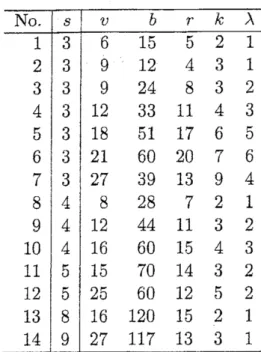
BIB design with $v^{*}=sk^{*}$ and $k^{*}=\lambda^{*}+1$.Two lists are given; one is
a
list of parameters $s$,$v$,
$b$,$r$, $k$,A for whichadditive BIB designs with $k>$ A exist, and the other is a list of admissible
parameters ofBIB designs for which the existence of additive BIB designs
is not known. In the latter, “Yes” shows the existence of the design, and ?
Table 1. Additive BIB designs with s $\geq 3$, v $\leq 1\mathrm{O}\mathrm{O}$, $2\leq k$,r $\leq 20$
and k $>\lambda$
.
Table 2. Unknown additive BIB designs with s $\geq 3$
,
v $\leq 1\mathrm{O}\mathrm{O}$,
$2\leq k$,r $\leq 20$ and k $>$ A.189
of $k=\lambda$, pairwise additive BIB designs
are
eitherone
of (i) 2-copies ofcomplete designs or (ii) 3-fold triple systems:
$v=2s$, $b=2s(2s-1)$, $r=2(2s-1)$, $k=$ A$=2$, $(3,2)$
$v=3(2\ell+1)$, $b=3(2\ell+1)(3P+1)$, $r=3(3P+1)$, $k=$ A$=3$, (3.3)
where $\ell\geq 1$
.
We omit characterizations for thecase
because pairwiseaddi-tive designs with $k<$ A have large parameters,
2
Links with perpendicular arrays
A perpendicular array, denoted by P\^A $(\#, s)$, is a matrix with $g$
rows
and$d(\begin{array}{l}s2\end{array})$ columns such that every pair of an s-sei appears in exactly $d$ columns
among every two
rows
(see [1], [18]), where $g$ $\geq 1$. $d$ is called index. When$d=1$, we suppress the index in the notation and write $\mathrm{P}\mathrm{A}(g, s)$. Some
necessary conditions for perpendicular arrays can be obtained as follows.
Theorem 2.1 [8]. Suppose that 0 $\leq t’\leq t$ and $(\begin{array}{l}k’t\end{array})$
$\geq$ $(\begin{array}{l}kt\end{array})$, then, a
P\^A $(\mathrm{t}, k, s)$ is also a $\mathrm{P}\mathrm{A}_{d’}(t’, k, s)$, where
$d’=d$$(\begin{array}{l}s-t’t-t\end{array})/(\begin{array}{l}tt\end{array})$ .
In
case
of $t=2$ and $t’=1$, if $g\geq 3$ and there existsa
$\mathrm{P}\mathrm{A}(g, s)$, thenevery element appears in each row of the PA equally, and hence $s$ must be
an odd integer. We
can
easily construct a perpendicular array with $g=2$and the above property,
so
that combining these facts with the definition ofperpendicular arrays,
we
have the following.Theorem 2.2 [20]. $g$ pairwise additive $\mathrm{B}(v=s, b=ds(s-1)/2,$ $r=$
$d(s-1)/2$,$k=1$,$d=0)$ is equivalent to a perpendicular array$\mathrm{P}\mathrm{A}_{d}(g, s)$ for
some
$d\geq 1$.
Especially,
we
note that when $g$ $=s$, the notion of additive BIB designswith $s$ points and $k=1$ is equivalent to that ofa
$\mathrm{P}\mathrm{A}_{d}(s, s)$. It is well known that there exists a $\mathrm{P}\mathrm{A}(s, s)$ for an odd prime power $s[15]$. For $d\geq 2$,
some
resultson
the existence ofa
$\mathrm{P}\mathrm{A}_{d}(s, s)$are
known. We note that thereare
some
connections between $t$-designs and perpendicular arrays; for example,if there exists
a
t-$(v, t+1, t)$ design, then there exists a $\mathrm{P}\mathrm{A}_{d_{1}}(t, t+1, v)$where $d_{1}=d/(d, t+1)[9]$. Many informations
on
perpendicular arrays are3
Links with
nested
designs
Preece [16] introduced the concept of a nested BIB design for the design of
experiment in statistics. Many papers on this topics have been published.
A nested $\mathrm{B}(v;b_{1}, b_{2};k_{1}, k_{2})$ is
a
triple $(V, B_{1}, B_{2})$ with $v$ points $(|V|:=v)$and two systems of blocks $(|B_{i}|:=b_{i})$, $\mathrm{i}=1,2$, such that (i) the first
system is nested within the second, i.e., each block in $B_{2}$ is partitioned into
$l$ subblocks of size $k_{1}$ and the resulting subblocks form $B_{1}$, say, $b_{1}=lb_{2}$ and
$k_{2}=lk_{1}$, (ii) $(V, B_{1})$ is aBIB design with $v$ points and $b_{1}$ blocks of$k_{1}$ points
each, (iii) $(V, B_{2})$ is a BIB design with $v$ points and
&2
blocks of $k_{2}$ pointseach. Similarly, Morgan et al. have reviewed and extended the concept of
nested BIB designs [13]. A multiply nested BIB design [13] is an $(m+1)-$
triple $(V, B_{1}, B_{2}, \ldots, B_{m})$ with $v$ points and $m$ systems of blocks $(|B_{i}|=b_{i})$,
$\mathrm{i}=1$,
$\ldots$,$m$, such that (i) the jth system is nested within the
$\mathrm{i}\mathrm{t}\mathrm{h}$ system,
$\mathrm{i}>j$, (ii) for each $\mathrm{i}(1\leq \mathrm{i}\leq m)$, $(V, B_{i})$ is
a
BIB design with $v$ points, $b_{i}$blocks of$k_{\dot{\mathrm{t}}}$ points each. Such a design is denoted by MNB$(v,\cdot b_{1},$ $b_{2}$, .
.
., $b_{m}$; $k_{1}$, $k_{2}$,
$\ldots$, $k_{m}$). The spectrum of nested BIB designs is available within
the scope of$v\leq 16$ and $r\leq 30[13]$. Sawa et al. [20] have proposed a
new
method of constructing nested (resolvable) BIB designs.
Proposition 3.1 [20]. For $1\leq\ell\leq s$, let $\{(V, B_{i}) : i=1, \ldots, l\}$ beasetof$\ell$
pairwise additive $\mathrm{B}(v=sk, k, \lambda)$, where blocks in $B_{i}=\{B_{f}^{(i)} : j=1, \ldots) \ \}$
are
ordered suitably. Let$B_{R}= \{\bigcup_{\ell\in R}B_{j}^{(l)} : j=1, \ldots, b\}$
for $R$ $\subseteq\{1, \ldots,l\}$, then $(V, B_{R})$ yields
a
$\mathrm{B}(v, gk, \lambda^{*})$, where $g=|R|\leq p$.Proof.
Let $N_{i}$, $\mathrm{i}=1_{?}\ldots$ ,$p$, be incidence matrices of $(V, B_{i})$ with pairwise additivestructure, then $(N_{\mathrm{i}}+N_{j})(N_{i}+N_{j})^{T}=\lambda^{*}I+(r^{*}-\lambda^{*})J$.
Hence,it holds that
$( \sum_{i\in R}N_{i})(\mathrm{I}N_{i})^{T}=\sum_{i\neq j}(N_{i}+N_{j})(N_{i}+N_{j})^{T}-(g-2)\sum_{ii,j\in R\in R}N_{i}N_{i}^{T}$
,
which completes the proof. $[]$
By using Proposition 3.1, if there exist pairwise additive BIB designs
with $v$ points and blocks of size $k$ each, then
a sum
of any$g$ incidence
matrices generates
a
BIB design with $v$ points and blocks of size $gk$ each.Multiply nested BIB designs with $v=sk$ points
can
be also constructedby
use
ofProposition 3.1.Theorem 3.2 [20]. Let m $=\lfloor\log {}_{2}P\rfloor+1$, where
\lfloorx\rfloor
means
the greatestinteger y such that y $\leq x$. If there exist $\ell$ pairwise additive
I
E1I
then an MNB($v;b_{1}=2^{m-1}b_{m}$, $b_{2}=2^{m-2}b_{m}$, . . .
’ $b_{m}$ ; $k_{1}$, $k_{2}=2k_{1}$,
.
.
.
’$k_{m}=2^{m-1}k_{1})$
can
be constructed. In particular, when $p=s=2^{m-1}$, aresolvable multiply nested BIB design can be obtained.
4
Links with
combinatorial
geometries
Morgan [14] has constructed series of BIB designs by taking union ofblocks
of symmetric BIB designs sutably. This method of constructing designs has
been referred as ‘the union method” by Rahilly [17]. The union method
is considered under the situation that each block of the resulting design is
composed of blocks each being not necessarily disjoint. In the sense, the
notion ofadditive designs are included in the union method, thinking about
Proposition 3.1.
Rahilly [17] alsohasfocused on aparallelism, and tooktheunion method. Suppose that there exists a resolvable $\mathrm{B}(v=sk, k, \lambda)$, $(V_{)}B)$, with $2\leq p\leq$
$s-$ $1$. Rahilly has constructed BIB designs by taking the union of any $\ell$
blocks in each parallel class. Hence, we have the following result.
Theorem 4.1 [17]. If there exists a resolvable $\mathrm{B}(v=sk,$b,r,k,$\lambda)$, then
there exists
a
$\mathrm{B}(v=sk, \ell k, \lambda(\begin{array}{l}t-1\ell-\mathrm{l}\end{array})+(r-\lambda)(\begin{array}{l}t-2\ell-2\end{array}))$ for $2\leq p\leq s$ -1.Using a parallelism in different way from Rahilly’s, we
can
get thefol-Jowing new result.
Theorem 4.2 [20]. If thereexistsaresolvable$\mathrm{B}(sk, b, r, k, \lambda)$ and a$\mathrm{P}\mathrm{A}(\#, s)$, then there $\mathrm{e}\mathrm{x}\mathrm{i}\mathrm{s}\mathrm{t}\mathrm{s}$ a$\mathrm{B}(sk, s(s-1)r/2$, $(s-1)\ell r/2$, $Pk$, $\lambda P(\ell k -1)/(k-1))$ for
any $1\leq\ell\leq g\leq s$ and $g\geq 2$.
As series of BIB designs with block size being
a
prime power, it is wellknown that theset of$t$-flats in $\mathrm{A}\mathrm{G}(n, s)$ forms a BIB design with$v=s^{n}$, $k=$
$s^{t}$ and $\lambda=[_{t-1}^{n-1}]_{q}$
.
By applyingTheorems 4.1 and 4.2 each to the fact thatthe well-known necessary conditions for
a
resolvable $\mathrm{B}(v=s^{n}, k=s^{m}, \lambda)$with $n>m$
are
sufficient for any prime power $s[23]$, series of BIB designs$\mathrm{n}\mathrm{s}$with $v=s^{n}$ points and blocks of size$ps^{m}$
can
be obtained. We observe thatwhen $P=2$, two resulting designs of these two theorems each are the same,
but when $\ell\geq 3$
,
the resulting BIB design of Theorems 4.1 has much largercoincidence number than that Theorem 4.2. For illustrative purpose, two
series of BIB designs, each of which is obtained by applying Theorems 4.1
and 4.2 to the WoelfePs result $\mathrm{w}$ith $m=n-1$ and A $=(s^{n}-1)/(s-1)$,
are
given.
Theorem 4.3 [17]. There exists a $\mathrm{B}(v=s^{n},$ k $=\ell s^{n-1}$,$\lambda=\frac{s^{n}-1}{s-1}$$(\begin{array}{l}s-1\ell-1\end{array})$ $+$
Theorem 4.4 [20]. There exists a$\mathrm{B}(v=s_{7}^{n}k=\ell s^{n-1}, \lambda=\ell(\ell s^{n-1}-1)/2)$.
We note that when $\ell=2$, the resulting BIB designs have the minimal
coincidence numbers for given $v=s^{n}$ and $k=s^{n-1}$. More generally, Jimbo
and Sawa have constructed [19]
new
series ofBIB designs by $\mathrm{A}\mathrm{G}(\mathrm{n}, s)$Theorem 4.5 [19]. There exists (i) a $\mathrm{B}(v=s^{n}, k=Is, \lambda=(Is-1)1/2)$ for
any $2\leq l\leq s$ and $s$ being any odd prime power (ii) a $\mathrm{B}(v=3_{7}^{n}k=3l$,A $=$
$(3l-1)l/2)$ for any $2\leq l\leq 3^{n-1}$.
For $P=2$, the minimalities of A for given $v$ and $k$ can be analyzed.
Mahmoodian and Shirdarreh [12] showed that Morgan’s BIB designs in
[14] are simple. Rahilly also investigated the simpleness of his designs [17].
Jimbo and Sawahave shownthat the BIB designs in Theorem4.5
are
simplefor $2\leq l\leq(p+1)/2$
.
Theorem 4.6 [19]. Let
s
$=p^{m}$ be an odd prime power. There exists asimple B(v $=s^{n}$, k $=ls$, A $=(ls-1)l/2$) for any $2\leq l\leq(p+1)/2$.
In the last of this section, we introduce
some
results on the union methodofconstructing designs with higher regular incidence structure.
Theorem 4.7 [6]. If$(2m+1,3)=1$, thenthere exists asimple $\mathrm{S}_{3}(3,4,2(2m+$
$1))$
.
There are many results of constructing simple $t$-designs by using
a
paral-leiism ofa resolvable design. For example,
see
[21], [22].5
Additive
structure
Arguments in this section is all characteristic of the case that $\ell=s$. A
new method of constructing BIB designs is provided in Proposition 5,1. For
given $v$ and $k$, minimalities of the resulting BIB designs, together with the
property of resolvablity, have been analyzed [20]. We will introduce
one
of such constructions without proofs.A difference matrix, denoted by $\mathrm{D}(g, \lambda,\cdot s):=(d_{mn})$, based
on a
group$(G, *)$ of order $s$, is a$g\mathrm{x}$ $\lambda s$ matrix satisfying the condition that for any $x$ in $G$, there exist exactly A columns in which $x$ is represented by$d_{mn}*(d_{m}/_{n})^{-1}$
among the $m\mathrm{t}\mathrm{h}$ and $m’\mathrm{t}\mathrm{h}$ row of the matrix. A is called index. Necessarily,
the number of columns of $\mathrm{D}(g, \lambda;s)$ is $\lambda s$
.
For $\mathrm{D}(g, \lambda;s)$, a row with allentries $x$ for
some
$x$ in $G$ is possibly included, and there exist at mostone
sucha row
[5]. Some existence results of difference matrices should bereferred to literatures [2], [5]. Here we use a difference matrix with
more
193
in the mth and $m’\mathrm{t}\mathrm{h}$
row
precisely$\ell$ times, then $\beta$ and a appears in the mthand $m’\mathrm{t}\mathrm{h}$
row
precisely$\ell$ times (ii) arow with allentries $x$forsome
$x$ in $G$ ispossibly included. Such a difference matrix is called symmetric, and denoted
by $\mathrm{S}\mathrm{D}(g, \lambda,\cdot s)$
.
When $g=s$, we suppress the index A in the notation.By
use
of $\mathrm{S}\mathrm{D}(s, \lambda)$, we have the following theorem.Theorem 5.1 [20]. Let $c$ and $d$ be integers with $2\lambda c\equiv 0$ mod $d(k-1)$. If
there exist additive $\mathrm{B}(v=sk, b,r, k, \lambda)$, an $\mathrm{S}\mathrm{D}(s, c)$ based
on
a group $(G, *)$ and a $\mathrm{P}\mathrm{A}_{d}(s, s)$, then there exist additive $\mathrm{B}(v^{*}=s^{2}k,$$b^{*}=cs[(s+1)r-s\lambda]$, $r^{*}=c[(s+1)r-s\lambda]$, $k^{*}=sk$, $\lambda^{*}=c7^{\cdot})$.By the assumption of additive BIB designs, the condition that $2\lambda c$ $\equiv 0$
mod $d(k-1)$ is always satisfied for the case of$d$ dividing $c$
.
Corollary 5.2 [20]. Let $s$ be an odd integer, If there exist additive $\mathrm{B}(v=$
$sk$, $b$,$r$, $k$, $\lambda)$, an $s\mathrm{x}$ $s^{2}$ OA and a $\mathrm{P}\mathrm{A}(s, s)$, then there exist additive $\mathrm{B}(v^{*}=$
$s^{2}k$,$b^{*}=s^{2}[(s+1)r-s\lambda]$, $r^{*}=s[(s+1)r-s\lambda]$, $k^{*}=sk_{\backslash }\lambda^{*}=sr)$
.
Proof.
Obviously, an $s\mathrm{x}$ $s^{2}$ OA is regarded asan
$\mathrm{S}\mathrm{D}(s, s)$. $[]$The resulting BIB designs given in Corollary 5.2 have the large
coinci-dence numbers, thinking about the minimalities of pairwise additive BIB
designs. In order to get additive BIB designs with small coincidence
num-bers, the existence of symmetric difference matrices with small indices is
essentially required. It can be shown [20] from the definition of SD that
if there exists an $\mathrm{S}\mathrm{D}(s, \lambda)$ and $s$ is an
even
integer, then A is also aneven
integer. Concerning the arguments ofthe existence of symmetric difference
matrices, Sawa et al. $\mathrm{L}\lceil 20$] showed that when $s$ is a prime power, there exists
an $\mathrm{S}\mathrm{D}(s, 2)$, and when $s$ is
an
odd prime, there exists an $\mathrm{S}\mathrm{D}(s, 1)$. For other value A $\leq 2$, we cannot find whether there exists an $\mathrm{S}\mathrm{D}(s, \lambda)$. Since a $\mathrm{D}(s, 1)$generates an $s\mathrm{x}$ $s^{2}\mathrm{O}\mathrm{A}$, it may exist only for a prime power.
Theorem 5.3 [20]. If there exist additive $\mathrm{B}(v=sk,$b, r, k,$\lambda)$, then there
exist additive BIB designs with parameters
(i) $v^{*}=s^{2}k$, $b^{*}=2s[(s+1)r-s\lambda]$,$\tau^{*}=2[(s+1)r-s\lambda]$,$k^{*}=sk$,$\lambda^{*}=2r$
for a prime power $s$, and
(ii) $v^{*}=s^{2}k$, $b^{*}=s[(s+1)r-s\lambda]$,$r^{*}=(s+1)r-s\lambda$,$k^{*}=sk$, $\lambda^{*}=r$
for
an
odd prime $s$.Proof.
Apply Theorem 5.1 and the facts mentioned above, $\square$In Theorem 5.3 (ii), we start from additive BIB designs with $v$ points
and $k=\lambda+1$
or
$k=2\lambda+1$ respectively, and then additive BIB designs with $v^{*}=sv$ points and $k^{*}=\lambda^{*}+1$or
$k^{*}=2\lambda^{*}+1$ respectively, can be6
Related unsolved
problem
Firstly, there are many admissible parameters left, for which it is still
un-known that additive BIB designs exist or not.
Problem 1 Do BIB designs in Table 2 have additive structure?
Secondly, in order that we can get minimal additive BIB designs by using
Theorem 5.3, an $\mathrm{S}\mathrm{D}(s, 1)$ is required. Unfortunately, Sawa et al. [20] cannot
find whether an $\mathrm{S}\mathrm{D}(s, 1)$ exists or not for
an
odd prime power $s=p^{m}$, where$m\geq 2$.
Problem 2 Does there exist
an
$\mathrm{S}\mathrm{D}(s, 1)$ for an odd prime power $s=p^{m}$ and $m\geq 2$?References
[1] J. Bierbrauer, Ordered designs and perpendicular arrays, in: The CRC
Handbook
of
Combinatorial
Designs, (C.J. Colbourn and J.H. Dinitz),CRC Press, Boca Raton FL, 396-399, 1996.
[2] C. J. Colbourn, Difference matrices, in: The
CRC.
Handbookof
Com-birtatoial Designs, (C.J. Colbourn and J.H. Dinitz), CRC Press, Boca
Raton FL, 287-297, 1996.
[3] C. J. Colbourn andA. Rosa, Triple Systems, OxfordPress, Boca Raton,
New York, 404-406, 1999.
[4] J. H. Dinitz and D. R. Stinson, Comtemporary Design Theory, Wiley,
New York, 576-577, 1992.
[5] S. A. Hedayat, N. J. A. Sloane and J. Stufken, Orthogonal Arrays:
Theory and Applications, Springer, Oxford Press, New York, 113-144,
1999.
[6] D. Jungnickel, S. A. Vanstone, Onresolvabledesigns $\mathrm{S}_{3}(3,$4,v), J. Com-bin. Theory. A 43, 334-337, 1986.
[7] S. Kageyama, A survey ofresolvable solutions of balanced incomplete
block designs, Internal Statist Rev. 40, 269-273, 1972.
[8] E. S. Kramer, D. L. Kreher, R. Rees and D. R. Stinson, On
perpendic-ular arrays with t $\geq 3$, Ars Combin. 28, 215-223, 1989.
[9] E. S. Kramer, Q. Wu, Some perpendicular arrays for arbitrarily t,
185
[10] R. Mathon and A. Rosa, 2-(v, k,$\lambda)$ designs ofsmall order, in: The CRC
Handbook
of
Combinatorial Designs, (C. J. Colbourn and J. H. Dinitz),CRC Press, Boca Raton FL, 3-41, 1996.
[11] K. Matsubara, M. Sawa, D. Matsumoto, H. Kiyama and S. Kageyama,
An additive structure on incidence matrices ofa BIB design, To appear
in Ars Combin. 2004.
[12] E. S. Mahmoodian, M. Shirdarreh, Some new families of simple
t-designs, Australas. J. Combin. 5, 159-168, 1992.
[13] J. P. Morgan, D. A. Preece and D. H. Rees, Nested balanced incomplete
block designs, Discrete Math, 231, 351-389, 2001.
[14] E. J. Morgan, Construction of balanced incomplete block designs, J.
Austral Math. Soc. 23 (Ser. A), 348-353, 1977.
[15] R. C. Mullin, P. J. Schellenberg, G. H. J. van Rees and S. A. Vanstone,
On the construction of perpendicular arrays, Utilitas Math. 18,
141-18,1980.
[16] D. A. Preece, Nested balanced incomplete block designs, Biometrika.
54, 479-486, 1976.
[17] A. Rahilly, Constructing designs using the union method, Australas. J.
Combin. 6, 7-21, 1992.
[18] C. R. Rao, Combinatorialarrangements analogous to orthogonal arrays,
Sankhya A, 23, 283-286, 1961.
[19] M. Sawa, M. Jimbo, BIB designs derived from affine geometry with
blocksizes being non prime power and their additive structure,
submit-ted.
[20] M. Sawa, K. Matsubara, The spectrum of additive BIB designs, Sub-mitted.
[21] T. V. Trung, Construction of3-designs using parallelism, J, Geom. 67,
223-235, 2000.
[22] T. V. Trung, Recursive constructions for 3-designs and resolvable
3-designs, J. Statist Plann.
Inference.
95, 341-358, 2001.[23] P. Woelfel, Aconstruction method for optimally universal hashfamilies
and its consequences for existence of RBIBDs, Springer Lecture Notes