一般化された
sine-Gordon
方程式の厳密解法
Exact method of solution for the generalized sine-Gordon equation
山口大学大学院理工学研究科 松野 好雅 (Yoshimasa Matsuno)
Division ofApplied Mathematical Science
Graduate School of
Science
and EngineeringYamaguchi University
Abstract
We develop
a
direct method for solving the generalized sine-Gordon equation$u_{tx}=(1+\partial_{x}^{2})\sin u$. Using the bilinear transformation method,
we
construct exactmultisoliton solutions and investigate their properties. In particular,
we
show thatthe equationexhibits kinkand breathersolutions and does not admit multi-valued
solutions like loop solitons. We also demonstrate that the equation reduces to the
short pulse and sine-Gordon equations in appropriate scaling limits. The limiting
form of
the multisoliton solutionsare
also presented. Finally,we
derivean
infinite
number ofconservation laws by using
a
novel B\"acklund transformation connectingsolutions of the sine-Gordon and generalized sine-Gordonequations.
1. Introduction
The generalized sine-Gordon $(sG)$ equation
$u_{tx}=(1+\nu\partial_{x}^{2})\sin u$, (1.1)
where $u=u(x, t)$ is
a
scalar-valued function, $\nu$ isa
real parameter, $\partial_{x}^{2}=\partial^{2}/\partial x^{2}$and the subscripts $t$
and
$x$ appended to $u$ denote partial differentiation, has beenderived by Fokas [1]. In the
case
of $\nu=-1$, its integrabilitywas
establishedby constructing
a
Lax pair associated with it and the initial value problemwas
formulated for decaying initial data by
means
ofthe inverse scatteringmethod [2].Quite recently,
we
developed asystematic method for solving equation (1.1) with$\nu=-1$ and obtained soliton solutions in the form of parametric representation
[3].
Here,
we
consider equation (1.1) with $\nu=1$$u_{tx}=(1+\partial_{x}^{2})\sin u$. (1.2)
One
ofthe remarkable features ofequation (1.2) is that it does not admitmulti-valued solutions like loop solitons
as
obtained in thecase
of $\nu=-1$. The detail2. Exact method of solution
2.1. Hodograph
transformation
First,
we
introduce thenew
dependent variable $r$ in accordance with the relation$r^{2}=1-u_{x}^{2}$, $(0<r<1)$, (2.1)
to transform equation (1.2) into the conservation law ofthe form
$r_{t}-(r\cos u)_{x}=0$
.
(2.2)This expression makes it possible to define the hodograph transformation $(x, t)arrow$
$(y, \tau)$ by
$dy=rdx+r\cos udt$, $d\tau=dt$
.
(2.3)The $x$ and $t$
derivatives
are
then rewritten in terms of the$y$ and $\tau$ derivatives
as
$\frac{\partial}{\partial x}=r\frac{\partial}{\partial y}$, $\frac{\partial}{\partial t}=\frac{\partial}{\partial\tau}+r\cos u\frac{\partial}{\partial y}$.
(2.4)With the
new
variables $y$ and $\tau,$ $(2.1)$ and (2.2)are
recast into the form$r^{2}=1-r^{2}u_{y}^{2}$, (2.5)
$( \frac{1}{r})_{\tau}+(\cos u)_{y}=0$, (2.6)
respectively. FUrther reduction is possible if
one
defines the variable $\phi$ by$u_{y}=\sinh\phi$, $\phi=\phi(y, \tau)$
.
(2.7)It follows from (2.5) and (2.7) that
$\frac{1}{r}=\cosh\phi$. (2.8)
Substituting (2.7) and (2.8) into equation (2.6),
we
find$\phi_{\tau}=\sin u$
.
(2.9)If
we
eliminate the variable $\phi$ from (2.7) and (2.9),we
obtaina
single PDE for$u$
$\frac{u_{\tau y}}{\sqrt{1+u_{y}^{2}}}=\sin u$
.
(210)Similarly, elimination of the variable $u$ gives a single PDE for $\phi$
By inverting the hodograph transformation (2.3) and using (2.8), the equation
that determines the inverse mapping $(y, \tau)arrow(x, t)$ isfound to be governed by the
system of linear PDEs for $x=x(y, \tau)$
$x_{y}=\cosh\phi$, $(2.12a)$
$x_{\tau}=-\cos u$
.
$(2.12b)$$2.2$. Bilinear
formalism
Let $\sigma$ and
$\sigma^{l}$ be solutions of the $sG$ equation
$\sigma_{\tau y}=\sin\sigma$, $\sigma=\sigma(y, \tau)$, $(2.13a)$
$\sigma_{\tau y}’=\sin\sigma’$, $\sigma’=\sigma’(y, \tau)$
.
$(2.13b)$The solutions of the above equations
can
be put into the form$\sigma=2i\ln\frac{f’}{f}$, $\sigma’=2i\ln\frac{g’}{g}$. $(2.14a, b)$
For soliton solutions, the tau functions $f,$$f’,$$g$ and $g’$ satisfy the following system
of bilinear equations:
$D_{\tau}D_{y}f \cdot f=\frac{1}{2}(f^{2}-f^{\prime 2})$, $D_{\tau}D_{y}f’ \cdot f’=\frac{1}{2}(f^{;2}-f^{2})$, $(2.15a, b)$
$D_{\tau}D_{y}g \cdot g=\frac{1}{2}(g^{2}-g^{\prime 2})$, $D_{\tau}D_{y}g’ \cdot g’=\frac{1}{2}(g^{\prime 2}-g^{2})$, $(2.16a, b)$
where the bilinear operators $D_{\tau}$ and $D_{y}$
are
defined by$D_{\tau}^{m}D_{y}^{n}f\cdot g=(\partial_{\tau}-\partial_{\tau’})^{m}(\partial_{y}-\partial_{y’})^{n}f(\tau, y)g(\tau’, y’)|_{\tau’=\tau,y’=y}$, $(m, n=0,1,2, \ldots)$
.
(2.17)
Now,
we
seek solutions of equations (2.7) and (2.9) of the form$u= i\ln\frac{F’}{F}$, $\phi=\ln\frac{G’}{G}$, $(2.18a, b)$
where $F,$$F’,$$G$ and $G’$
are new
tau functions. Ifwe
impose the condition$F’F=G’G$, (219)
among these tau functions, then equations (2.7) and (2.9)
can
be transformed tothe following bilinear equations
$iD_{\tau}G’\cdot G=\frac{1}{2}(F^{2}-F^{\prime 2})$, (2.21)
respectively. The proposition below provides the tau functions $F,$$F’,$ $G$ and $G’$ in
terms of $f,$$f’,$$g$ and $g^{l}$
.
Proposition 2.1.
If
we
impose the conditionsfor
the $tau$functions
$f,$$f’,$$g$ and$g’$$iD_{y}f\cdot g’=\frac{1}{2}(fg’-f’g)$, $iD_{y}f’\cdot g=\frac{1}{2}(f’g-fg’)$, $(2.22a, b)$ $iD_{\tau}f\cdot g=-\frac{1}{2}(fg-f’g’)$, $i$D..$f’ \cdot g’=-\frac{1}{2}(f’g’-fg)$,
$(2.23a, b)$
then the solutions
of
bilinear equations (2.20) and (2.21) subjected to the condition(2. 19) are given by
$F=fg$, $F’=f’g’$, $(2.24a)$
$G=fg’$, $G’=f’g$
.
$(2.24b)$2.3. Pammetric representation
Proposition 2.2. $\cosh\phi$ is given in terms
of
the $tau$functions
$f,$$f’,$$g$ and$g’$as
$\cosh\phi=1+i(\ln\frac{g’g}{f’ f})_{y}$
.
(2.25)Integrating (2.12a) with (2.25) by $y$ yields the expression of $x$
$x=y+ i\ln\frac{g’g}{f’ f}+d(\tau)$, (2.26)
where $d$ is
an
integration constant which depends generallyon
$\tau$
.
The expression(2.26) now leads to
our
main result:Theorem 2.1. The solution
of
equation (1.2) can be expressed by the parametricrepresentation
$u(y, \tau)=i\ln\frac{f’g’}{fg}$, $(2.27a)$
$x(y, \tau)=y-\tau+i\ln\frac{g’g}{ff}+y_{0}$, $(2.27b)$
where the $tau$
functions
$f,$$f’,$$g$ and $g’$ satisfy equations (2.15), (2.16), (2.22) and(2.23) and $y_{0}$ is
an
arbitrary constant independentof
$y$ and $\tau$.An interesting feature of the parametric solution (2.27) is that it never exhibits
singularities
as
encountered in thecase
of equation (1.1) with $\nu=-1$.
Indeedshowing that $u_{x}$ always takes
a
finite value.2.4.
Multisoliton solutionsTheorem 2.2. The
tau-functions
$f,$$f’,$$g$ and$g’$ givcn bclow satisfy both thebilin-ear
forms
(2.15) and (2.16)of
the $gG$ equation and the bilinear equations (2.22)and (2.23),
$f= \sum_{\mu=0,1}\exp[\sum_{j=1}^{N}\mu_{j}(\xi_{j}+d_{j}+\frac{\pi}{2}i)+\sum_{1\leq j<k\leq N}\mu_{j}\mu_{k}\gamma_{jk}]$ , $(2.29a)$
$f’= \sum_{\mu=0,1}\exp[\sum_{j=1}^{N}\mu_{j}(\xi_{j}+d_{j}-\frac{\pi}{2}i)+\sum_{1\leq j<k\leq N}\mu_{j}\mu_{k}\gamma_{jk}]$ , $(2.29b)$
$g= \sum_{\mu=0,1}\exp[\sum_{j=1}^{N}\mu_{j}(\xi_{j}-d_{j}+\frac{\pi}{2}i)+\sum_{1\leq j<k\leq N}\mu_{j}\mu_{k}\gamma_{jk}]$ , $(2.30a)$
$g’= \sum_{\mu=0,1}\exp[\sum_{j=1}^{N}\mu_{j}(\xi_{j}-d_{j}-\frac{\pi}{2}i)+\sum_{1\leq j<k\leq N}\mu_{j}\mu_{k}\gamma_{jk}]$ , $(2.30b)$
where
$\xi_{j}=p_{j}y+\frac{1}{p_{j}}\tau+\mathscr{F}0$, $(j=1,2, \ldots, N)$, $(2.31a)$
$e^{\gamma_{jk}}=(\frac{p_{j}-p_{k}}{p_{j}+p_{k}})^{2}$, $(j, k=1,2, \ldots, N;j\neq k)$, $(2.31b)$
$e^{d_{j}}=\sqrt{\frac{1+\mathscr{A}_{j}}{1-ip_{j}}}$, $(j=1,2, \ldots, N)$
.
$($2.31
$c)$Here, $p_{j}$ and $\xi_{j0}$
are
arbitmry complex pammeters satisfying the conditions $p_{j}\neq$$\pm p_{k}$
for
$j\neq k,$ $i=\sqrt{-1}$ and $N$ isan
arbitmry positive integer. The notation$\sum_{\mu=0,1}$ implies the summation
over
all possible combinationof
$\mu_{1}=0,1,$$\mu_{2}=$$0,1,$ $\ldots,$$\mu_{N}=0,1$.
The parametric solution (2.27) with (2.29) and (2.30) is characterized by the $2N$
complexparameters$p_{j}$ and$\xi_{j0}(j=1,2, \ldots, N)$
.
It producesin general thecomplex-valued solutions. The real-valued solutions
are
obtainable ifone
imposes certainconditions
on
these parameters. Actually, there arise various type of solutionsdepending
on
values of the parameters. These solutions include kinks, antikinksand breathers. Among them,
we
consider following three types:First, let $p_{j}$ and $\mathscr{F}o(j=1,2, \ldots, N)$ be real quantities. Then $f’=g^{*}$ and $g’=f^{*}$
and (2.27) becomes
$u(y, \tau)=i\ln\frac{f^{*}g^{*}}{fg}$, $x(y, \tau)=y-\tau+i\ln\frac{f^{*}g}{fg^{*}}+y_{0}$
.
$(2.32a, b)$Type 2; Breather solution
We put $N=2M$ where $M$ is
a
positive integer, and specify the parameters$p_{j}$ and$\xi_{j,0}(j=1,2, \ldots, 2M)$
as
$p_{2j-1}=p_{2j}^{*}$, $\xi_{2j-1,0}=\xi_{2j,0}^{*}$, $(j=1,2, \ldots, M)$. (2.33)
It turns out that $f’=g^{*}$ and $g’=f^{*}$. Then, the solution
can
be written in thesame form as (2.32).
Type 3: Kink-breather solution
Let $N=2M+M’$ where $M$ and $M’$
are
positive integers. In addition to theparameterization given by (2.33), the 2$M’$ parameters$p_{j}(>0)$ and $\xi_{j0}(j=2M+$
$1,2M+2,$ $\ldots,$$2M+M^{l})$
are
chosen to be real. Then, the parameteric solution(2.32) represents the solution describing the interaction among $M$ breathers and
$M^{l}$ kinks. The antikink-breather solution
can
be constructed similarly.For the above three types of solutions, $\phi$ from (2.18b) and
$u_{x}$ from (2.28) can
be given explicitly in terms of the tau functions $f,$$g$ and their complex conjugate
as
$\phi=\ln\frac{g^{*}g}{f^{*}f}$, (2.34)
$u_{x}= \frac{(g^{*}g)^{2}-(f^{*}f)^{2}}{(g^{*}g)^{2}+(f^{*}f)^{2}}$
.
(2.35)Note that (2.34) provides real solutions of equation (2.11).
3. Properties ofsolutions
3.1. l-soliton solutions
The tau-functions for the l-soliton solutions
are
given by (2.29) and (2.30) with$N=1$:
$f=1+ie^{\xi_{1}+d_{1}}$, $g=1+ie^{\xi_{1}-d_{1}}$, $(3.1a, b)$
$\xi_{1}=p_{1}y+\frac{\tau}{p_{1}}+\xi_{10}$, $e^{d_{1}}=\sqrt{\frac{1+ip_{1}}{1-ip_{1}}}$
.
$(3.1c)$The real parameters $p_{1}$ and $\xi_{10}$
are
related to the amplitude and phase of thesoliton, respectively and $\xi_{1}$ is the phase variable characterizing the solution. The
parametric representation of the solution (2.32)
can
be written in the form$x=y-\tau+2\tan^{-1}(p_{1}\tanh\xi_{1})+2\tan^{-1}p_{1}+y_{0}$. $(3.2b)$
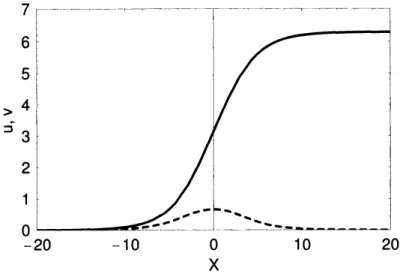
Figure 1 shows
a
typical profile of the kink solutionas a
function of $X$ togetherwith the corresponding profile of$v\equiv u_{x}$
.
$-20$ $-10$ $0$ 10 20
X
Figure 1 The profile of a kink $u$ (solid line) and corresponding profile of $v\equiv u_{X}$
(broken line). The parameter $p_{1}$ is set to
0.4
and the parameter $y_{0}$ is chosen suchthat the center position of $u_{X}$ is at $X=0$
.
Here, $X=x+c_{1}t+x_{0},$ $c_{1}=1/p_{1}^{2}+1$.
3.2. 2-soliton solutions
The tau-functions for the 2-soliton solutions read from (2.29) and (2.30) with
$N=2$ in the form
$f=1+i(e^{\xi_{1}+d_{1}}+e^{\xi_{2}+d_{2}})-\delta e^{\xi_{1}+\xi_{2}+d_{1}+d_{2}}$, $g=1+i(e^{\xi_{1}-d_{1}}+e^{\xi_{2}-d_{2}})-\delta e^{\xi_{1}+\xi_{2}-d_{1}-d_{2}}$,
$(3.3a, b)$
$\xi_{j}=p_{j}y+\frac{\tau}{p_{j}}+\xi_{j0}$, $e^{d_{j}}=\sqrt{\frac{1+ip_{j}}{1-ip_{j}}}$ $(j=1,2)$, $\delta=\frac{(p_{1}-p_{2})^{2}}{(p_{1}+p_{2})^{2}}$. $(3.3c)$
The parametric solution (2.32) with (3.3) represents three types of solutions,
de-pending on values of the parameters $p_{j}$ and $\xi_{0j}(j=1,2)$, i.e., kink-kink,
kink-antikink and breather solutions.
3.2.1. Kink-kink solution
If we specify $p_{1}$ and $p_{2}$ be positive and $\xi_{01}$ and $\xi_{02}$ be real, then the kink-kink
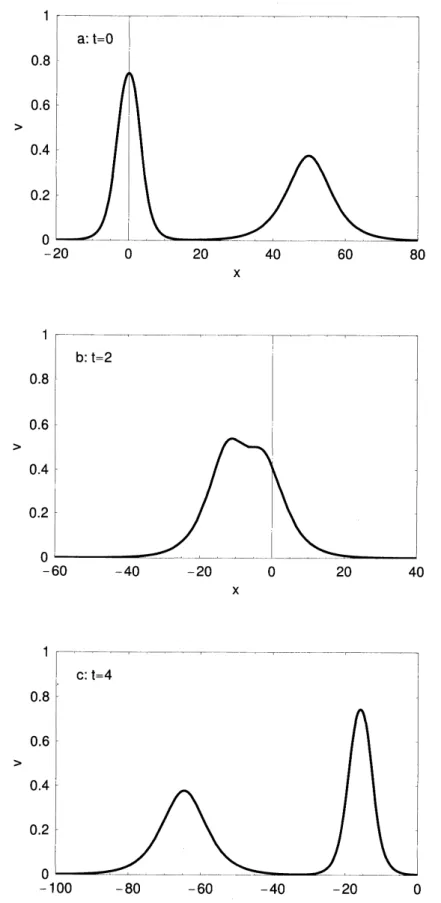
solution is obtained. The solution represents the so-called $4\pi$ kink. In figure
2a-$c$, we depict
a
typical profile of $v(\equiv u_{x})$ instead of $u$ for three different times.It represents the interaction of two solitons with the amplitudes $A_{1}=0.38$ and
$-20$ $0$ 20 40 $x$ 60 $-60$ $-40$ $-20$ $0$ 20 40 $x$ $-100$ -SO $-60$ $-40$ $-20$ $0$ $x$
Figure 2
a-c
Theprofile ofa
two-soliton solution$v\equiv u_{x}$ for three different times,a:
$t=0,$ $b:t=2,$$c:t=4$
. The parametersare
chosenas
$p_{1}=0.2,$ $p_{2}=$The formula for the phase shift arzsing from the interaction of two solitons is
given
as
follows:$\Delta_{1}=-\frac{1}{p_{1}}\ln(\frac{p_{1}-p_{2}}{p_{1}+p_{2}})^{2}+4\tan^{-1}p_{2}$, $\triangle_{2}=\frac{1}{p_{2}}\ln(\frac{p_{1}-p_{2}}{p_{1}+p_{2}})^{2}-4\tan^{-1}p_{1}$
.
$(3.4a, b)$
It
can
be verified from (3.4) that $\Delta_{1}>0$ and $\Delta_{2}<0$ for $0<p_{1}<p_{2}$.
In thepresent example,
formula
(3.4) yields $\Delta_{1}=10.3$ and $\Delta_{2}=-4.2$.
3.2.2. Bruather solution
The breather solution
can
be constructed following the parameterization given by(2.33). For $M=1$, let
$p_{1}=a+ib$, $p_{2}=a-ib=p_{1}^{*}$, $(a>0, b>0)$, $(3.5a)$
$\xi_{10}=\lambda+i\mu$, $\xi_{20}=\lambda-i\mu=\xi_{10}^{*}$. $(3.5b)$
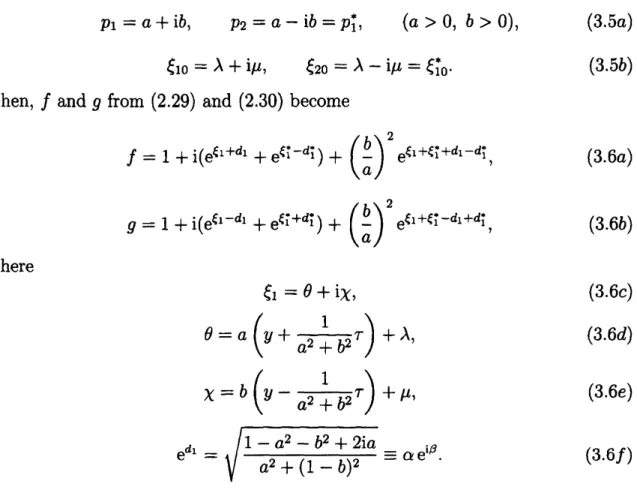
Then, $f$ and $g$ from (2.29) and (2.30) become
$f=1+ i(e^{\xi_{1}+d_{1}}+e^{\xi i-d}i)+(\frac{b}{a})^{2}e^{\xi_{1}+\epsilon i+d_{1}-d};$, $(3.6a)$
$g=1+ i(e^{\xi_{1}-d_{1}}+e^{\xi i+d};)+(\frac{b}{a})^{2}e^{\xi_{1}+\xi_{1}^{*}-d_{1}+d;}$, $(3.6b)$ where $\xi_{1}=\theta+i\chi$, $(3.6c)$ $\theta=a(y+\frac{1}{a^{2}+b^{2}}\tau)+\lambda$, $(3.6d)$ $\chi=b(y-\frac{1}{a^{2}+b^{2}}\tau)+\mu$, $(3.6e)$ $e^{d_{1}}=\sqrt{\frac{1-a^{2}-b^{2}+2ia}{a^{2}+(1-b)^{2}}}\equiv\alpha e^{i\beta}$. $(3.6f)$
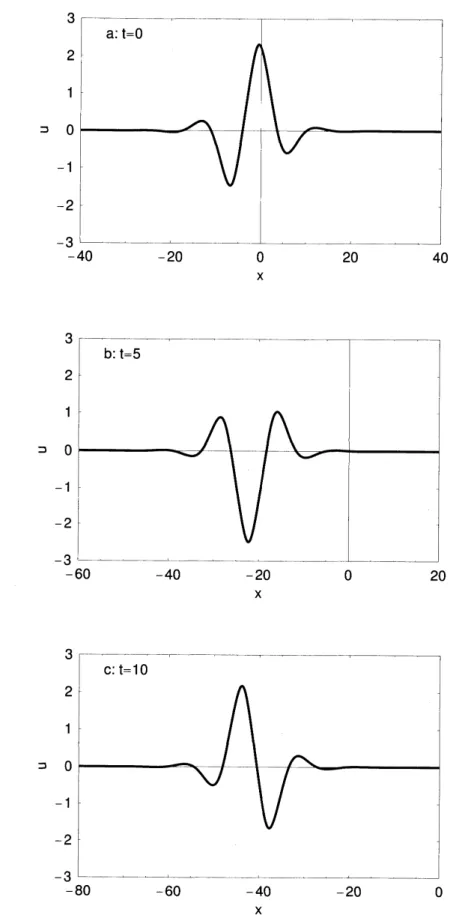
$-40$ $-20$ $0$ $x$ 20 40 $-60$ $-40$ $-20x$ $0$ 20 $-80$ $-60$ $-40x$ $-20$ $0$
Figure 3
a-c
The profile ofa
breather solution for three different times, a:$t=$ O, b: $t=5,$ $c:t=10$. The parameters
are
chosenas
$p_{1}=0.3+0.5i,$ $p_{2}=$3.3.
N-soliton solutions3.3.1. N-kink solution
Let the velocity ofthe jth kink be$c_{j}=(1/p_{j}^{2})+1(p_{j}>0)$and order the magnitude
of the velocity of each kink
as
$c_{1}>c_{2}>\ldots>c_{N}$.
We observe the interaction of $N$kinks in
a
moving frame witha
constant velocity $c_{\eta}$. We take the limit $tarrow-$oo
with the phase variable $\xi_{n}$ being fixed. Then
$u\sim 2\tan^{-1}[\sqrt{1+p_{n}^{2}}\sinh(\xi_{n}+\delta_{n}^{(-)})]+\pi$, $(3.7a)$
$x \sim y-\tau+2\tan^{-1}[p_{n}\tanh(\xi_{n}+\delta_{n}^{(-)})]+4\sum_{j=n+1}^{N}\tan^{-1}p_{j}+2\tan^{-1}p_{n}+y_{0}$
.
$(3.7b)$As $tarrow+\infty$, the expressions corresponding to (3.7)
are
given by$u\sim 2\tan^{-1}[\sqrt{1+p_{n}^{2}}\sinh(\xi_{n}+\delta_{n}^{(+)})]+\pi$, $(3.8a)$
$x \sim y-\tau+2\tan^{-1}[p_{n}\tanh(\xi_{n}+\delta_{n}^{(+)})]+4\sum_{j=1}^{n-1}\tan^{-1}p_{j}+2\tan^{-1}p_{n}+y_{0}$ . $(3.8b)$
where
$\delta_{n}^{(+)}=\sum_{j=1}^{n-1}\ln(\frac{p_{n}-p_{j}}{p_{n}+p_{j}})^{2}$ , $($
3.8
$c)$$\delta_{n}^{(-)}=\sum_{j=n+1}^{N}\ln(\frac{p_{n}-p_{j}}{p_{n}+p_{j}})^{2}$, $(3.8d)$
$\delta_{n}=n+\cdot\prod_{\leq j<k\leq N}(\frac{p_{j}-p_{k}}{p_{j}+p_{k}})^{2}$
.
$(3.8e)$Let $x_{c}$ be the center position of the nth kink in the $(x, t)$ coordinate system. As
$tarrow-\infty$
$x_{c}+ c_{n}t+x_{n0}\sim-\frac{1}{p_{n}}\delta_{n}^{(-)}+4\sum_{j=n+1}^{N}\tan^{-1}p_{j}+y_{0}$ , (3.9)
where $x_{n0}=\xi_{n0}/p_{n}-2\tan^{-1}p_{n}$
.
As $tarrow+\infty$,on
the other hand, thecorrespond-ing expression turns out to be
$x_{c}+c_{n}t+x_{n0} \sim-\frac{1}{p_{n}}\delta_{n}^{(+)}+4\sum_{j=1}^{n-1}\tan^{-1}p_{j}+y_{0}$. (3.10)
If
we
take into account the fact that all kinks propagate to the left,we
can
definethe phase shift of the nth kink
as
Using (3.8c), (3.8d), (3.9) and (3.10),
we
find that$\Delta_{n}=\frac{1}{p_{n}}\{\sum_{j=1}^{n-1}\ln(\frac{p_{n}-p_{j}}{p_{n}+p_{j}})^{2}-\sum_{j=n+1}^{N}\ln(\frac{p_{n}-p_{j}}{p_{n}+p_{j}})^{2}\}$
$+4 \sum_{j=n+1}^{N}\tan^{-1}p_{j}-4\sum_{j=1}^{n-1}\tan^{-1}p_{j}$, $(n=1,2, \ldots, N)$. (3.12)
3.3.2. M-breather
solutionWe specify the parameters in (2.29) and (2.30) for the tau-functions $f$ and $g$
as
$p_{2j-1}=p_{2j}^{*}\equiv a_{j}+ib_{j}$, $a_{j}>0$, $b_{j}>0$, $(j=1,2, \ldots, M)$, $(3.13a)$
$\xi_{2j-1,0}=\xi_{2j,0}^{*}\equiv\lambda_{j}+i\mu_{j}$, $(j=1,2, \ldots, M)$. $(3.13b)$
Then, the phase variables $\xi_{2j-1}$ and $\xi_{2j}$
are
writtenas
$\xi_{2j-1}=\theta_{j}+i\chi_{j}$, $(j=1,2, \ldots, M)$, $(3.14a)$
$\xi_{2j}=\theta_{j}-i\chi_{j}$, $(j=1,2, \ldots, M)$, $(3.14b)$
with the real phase variables
$\theta_{j}=a_{j}(y+c_{j}\tau)+\lambda_{j}$, $(j=1,2, \ldots, M)$, $(3.14c)$
$\chi_{j}=b_{j}(y-c_{j}\tau)+\mu_{j}$, $(j=1,2, \ldots, M)$, $(3.14d)$
$c_{j}= \frac{1}{a_{j}^{2}+b_{j}^{2}}$, $(j=1,2, \ldots\dot{\prime}M)$
.
$(3.14e)$The parametric solution (2.32) with (3.13) and (3.14) describes multiple
colli-sions of $M$ breathers.
3.3.3 Kink-breather solution
We take
a
3-soliton solution with parameters $p_{j}$ and $\xi_{0j}(j=1,2,3)$. Ifone
impose the conditions that $p_{2}=p_{1}^{*},$$\xi_{02}=\xi_{01}^{*}$
as
already specified for the breathersolution and$p_{3}(>0),$ $\xi_{03}$ real for the kink solution, then the expression of$u$ would
represent
a
solution describing the interaction between a kinkanda
breather. Thetau functions $f$ and $g$
now
become$f=1+ i(s_{1}e^{\xi_{1}}+\frac{1}{s_{1}}*e^{\xi i}+s_{3}e^{\xi_{3}})+(\frac{b}{a})^{2}\frac{s_{1}}{s_{1}}*e^{\xi_{1}+\xi_{1}^{*}}$
$g=1+ i(\frac{1}{s_{1}}e^{\xi_{1}}+s_{1}^{*}e^{\xi i}+\frac{1}{s_{3}}e^{\xi_{3}})+(\frac{b}{a})^{2}\frac{s_{1}^{*}}{s_{1}}e^{\xi_{1}+\xi_{1}^{*}}$
$- \frac{\delta_{13}}{s_{1}s_{3}}e^{\xi_{1}+\xi_{3}}-\delta_{13}^{*}\frac{s_{1}^{*}}{s_{3}}e^{\xi i+\xi_{3}}+i(\frac{b}{a})^{2}\frac{s_{1}^{*}}{s_{1}s_{3}}\delta_{13}\delta_{13}^{*}e^{\xi_{1}+\xi i+\xi_{3}}$ .
where
$(3.15b)$
$s_{1}= e^{d_{1}}=\sqrt{\frac{1-b+ia}{1-b-ia}}=\frac{1}{s_{2}}*$, $s_{3}=\sqrt{\frac{1+ip_{3}}{1-ip_{3}}}$, $\delta_{13}=(\frac{a-p_{3}+ib}{a+p_{3}+ib})^{2}=\delta_{23}^{*}$
.
$(3.15c)$
Figure 4a-c shows
a
typical profile of $v\equiv u_{x}$ for three different times. Wesee
that the soliton overtakes the breather whereby it suffers
a
phase shift. Actually,one has for $p_{3}^{2}<a^{2}+b^{2}$
$\Delta=\frac{2}{p_{3}}\ln\frac{(p_{3}+a)^{2}+b^{2}}{(p_{3}-a)^{2}+b^{2}}+4\tan^{-1}\frac{2a}{1-a^{2}-b^{2}}$, $(3.16a)$
and for $a^{2}+b^{2}<p_{3}^{2}$
$\triangle=-\frac{2}{p_{3}}\ln\frac{(p_{3}+a)^{2}+b^{2}}{(p_{3}-a)^{2}+b^{2}}-4\tan^{-1}\frac{2a}{1-a^{2}-b^{2}}$
.
$(3.16b)$In the present example, formula (3.16a) gives $\triangle=7.7$
.
$-50$ $0$ 50 100 150
$-200$ $-150$ $-100$ $-50$ $0$
$x$
$-300$ $-250$
$-200x$ $-150$ $-100$
Figure 4
a-c
Theprofile of$v\equiv u_{x}$ forthree differenttimes which representstheinteraction between
a
soliton anda
breather,a:
$t=$ O, b: $t=15,$ $c:t=30$.
Theparameters are chosen
as
$p_{1}=0.2+0.4i,$ $p_{2}=p_{1}^{*}=0.2-0.4i,$ $p_{3}=0.3,$ $\xi_{10}=$$\xi_{20}=0,$ $\xi_{30}=-30$
.
3.3.4
Breather-breather solutionThe breather-breather (or 2-breather) solution isreduced from
a
4-soliton solution.Figure 5a-c shows
a
typical profile of $u$ for three different times. It representsa
typical feature
common
to the interaction of solitons, i.e., each breatherrecovers
2 1 コ $0$ $-1$ $-2-100$ $0$ 100 $–$ $—200^{---}300$ $x$ 2 $—————————$ 1 コ $0$ $-1$ $-2-400$ $-300$ -200 $x$ $–100$ $—0$ $-600$ $-500$ -400 $x$ $-300$ $-200$
Figure $5a-c$The profile of
a
breather-breather solution $u$for threedifferent times,a:
$t=$ O, b: $t=15,$ $c:t=30$.
The parametersare
chosenas
$p_{1}=0.1+0.2i,p_{2}=$$p_{1}^{*}=0.1-0.2i,p_{3}=0.15+0.3i,$ $p_{4}=p_{3}^{*}=0.15-0.3i,$ $\xi_{10}=\xi_{20}^{*}=-15,$ $\xi_{30}=$
4. Reduction to the short pulse and $sG$ equations
We write the short pulse equation in the form
$u_{tx}=u- \frac{\nu}{6}(u^{3})_{xx}$, (4.1)
where $u=u(x, t)$ represents the magnitude of the electric field and $\nu$ is a real
constant. The short pulse equation (4.1) with $\nu=-1$ was proposed
as
a modelnonlinear equationdescribing the propagation of ultra-short optical pulses in
non-linear media [5]. Quite recently, equation (4.1) with $\nu=1$
$u_{tx}=u- \frac{1}{6}(u^{3})_{xx}$, (4.2)
was
shown to modeltheevolution of ultra-short pulses inthe band gap of nonlinearmetamaterials [6]. See [7] for
a
reviewon
exactsolutions oftheshortpulseequationand related topics.
4.1.
Reduction to the short pulse equation4.1.1.
Scaling limitof
the genemlized $sG$ equationLet
us
first introducenew
variables with bar according to the relations$\overline{u}=\frac{u}{\epsilon}$, $\overline{x}=\frac{1}{\epsilon}(x+t)$, $\overline{y}=\frac{y}{\epsilon}$ $\overline{y}_{0}=\frac{y_{0}}{\epsilon}$, $\overline{t}=\epsilon t$, $\overline{\tau}=\epsilon\tau$,
$\overline{p}_{j}=\epsilon p_{j}$, $\overline{\xi}_{j0}=\mathscr{F}0$, $(j=1,2, \ldots, N)$, (4.3)
where $\epsilon$ is
a
small parameter and the quantities with bar are assumed to be order1. Rewriting equation (1.2) in terms of the
new
variables and expanding$\sin\epsilon\overline{u}$ inan infinite series with respect to $\epsilon$ and comparing terms oforder $\epsilon$ on both sides,
we
obtain equation (4.2) written by thenew
variables.Under the scaling (4.3), expression (2.7) is invariant and hence
we
put $\overline{\phi}=\phi$ togive
$\overline{u}_{\overline{y}}=\sinh\overline{\phi}$. (4.4)
Equation (2.9) then reduces to
$\overline{\phi}_{\overline{\tau}}=\overline{u}$
.
(4.5)
Equations (2.10) and (2.11) now become
$\frac{\overline{u}_{\overline{\tau y}}}{\sqrt{1+\overline{u}_{y}^{2}}}=\overline{u}$ (4.6)
$\overline{\phi}_{\overline{\tau y}}=\sinh\overline{\phi}$, (4.7)
4.1.2.
Scaling limitof
the N-soliton solutionThe expansion ofthe tau function $f$ is given by
$f= \sum_{\mu=0,1}(1-i\epsilon\sum_{j=1}^{N}\frac{\mu_{j}}{\overline{p}_{j}})\exp[\sum_{j=1}^{N}\mu_{j}(\overline{\mathscr{F}}+\pi i)+\sum_{1\leq j<k\leq N}\mu_{j}\mu_{k}\overline{\gamma}_{jk}]+O(\epsilon^{2})$
$=\overline{f}-i\epsilon\overline{f}_{\overline{\tau}}+O(\epsilon^{2})$, (4.8a)
where
$\overline{f}=\sum_{\mu=0,1}\exp[\sum_{j=1}^{N}\mu_{j}(\overline{\mathscr{F}}+\pi i)+\sum_{1\leq j<k\leq N}\mu_{j}\mu_{k}\overline{\gamma}_{jk}]$ , $(4.8b)$
$\overline{\mathscr{F}}=\overline{p}_{j}\overline{y}+\frac{\overline{\tau}}{\overline{p}_{j}}+\overline{\xi}_{j0}$, $(j=1,2, \ldots, N)$, $(4.8c)$
$e^{\overline{\gamma}_{jk}}=(\frac{\overline{p}_{j}-\overline{p}_{k}}{\overline{p}_{j}+\overline{p}_{k}})$ , $(j, k=1,2, \ldots, N;j\neq k)$
.
$(4.8d)$Similarly
$f’=\overline{g}-i\epsilon\overline{g}_{\overline{\tau}}+O(\epsilon^{2})$, $g=\overline{g}+i\epsilon\overline{g}_{\overline{\tau}}+O(\epsilon^{2})$, $g’=\overline{f}+i\epsilon\overline{f}_{\overline{\tau}}+O(\epsilon^{2}),$ $(4.9a, b, c)$
with
$\overline{g}=\sum_{\mu=0,1}\exp[\sum_{j=1}^{N}\mu_{j}\overline{\xi}_{j}+\sum_{1\leq j<k\leq N}\mu_{j}\mu_{k}\overline{\gamma}_{jk}]$. $(4.9d)$
The parametric solution of the short pulse equation (4.2) in terms of the tau
functions $\overline{f}$ and
$\overline{g}$ is given
as
follows:$\overline{u}=2(\ln\frac{\overline{g}}{\frac{}{f}})_{\overline{\tau}}$ , $\overline{x}=\overline{y}-2(\ln\overline{f}\overline{g})_{\overline{\tau}}+\overline{y}_{0}$
.
$(4.10a, b)$4.2.
Reductionto
the $sG$ equationIf
we
introduce the followingnew
scaled variables$\overline{u}=u$, $\overline{x}=\epsilon x$, $\overline{y}=\epsilon y$, $\overline{t}=\frac{t}{\epsilon}$, $\overline{\tau}=\frac{\tau}{\epsilon}$,
$\overline{p}_{j}=\frac{p_{j}}{\epsilon}$, $\overline{\xi}_{j0}=\xi_{j0},$ $(j=1,2, \ldots, N)$, (4.11)
then in the limit of $\epsilonarrow 0$,
we can
deduce the generalized $sG$ equation (1.2) to the$sG$ equation
The
scalinglimit
of (2.27b)now
leads to the expression $\overline{y}=\overline{x}$ which, combinedwith the obvious relation $\overline{\tau}=\overline{t}$, yields the limitingform ofthetau functions
(2.29)
and (2.30)
$f=\overline{f}$, $f’=\overline{f}’$, $g=\overline{f}$, $g’=\overline{f}’$, $(4.13a)$
where
$\overline{f}=\sum_{\mu=0,1}\exp[\sum_{j=1}^{N}\mu_{j}(\overline{\xi}_{j}+\frac{\pi}{2}i)+\sum_{1\leq j<k\leq N}\mu_{j}\mu_{k}\overline{\gamma}_{jk}]$ , $(4.13b)$
$\overline{f}’=\sum_{\mu=0,1}\exp[\sum_{j=1}^{N}\mu_{j}(\overline{\xi}_{j}-\frac{\pi}{2}i)+\sum_{1\leq j<k\leq N}\mu_{j}\mu_{k}\overline{\gamma}_{jk}]$ , $(4.13c)$
$\overline{\xi}_{j}=\overline{p}_{j}\overline{x}+\frac{\overline{t}}{\overline{p}_{j}}+\overline{\xi}_{j0}$, $(j=1,2, \ldots, N)$, $(4.13d)$
$e^{\overline{\gamma}_{jk}}=(\frac{\overline{p}_{j}-\overline{p}_{k}}{\overline{p}_{j}+\overline{p}_{k}})^{2}$, $(j, k=1,2, \ldots, N;j\neq k)$
.
$(4.13e)$The parametric solution (2.27) with the tau functions (2.29) and (2.30) reduces to
the usual form of the N-soliton solution of the $sG$ equation i.e.,
$\overline{u}(\overline{x},\overline{t})=2i\ln\frac{\overline{f}’}{\overline{f}}$. (414)
5. Conservation laws
First, let
$\sigma=u-i\sinh^{-1}u_{y}$. (5.1)
By direct substitution,
we
find the relation$\sigma_{\tau y}-\sin\sigma=\{(1+u_{y}^{2})^{\frac{1}{2}}-i\frac{\partial}{\partial y}\}\{\frac{u_{\tau y}}{(1+u_{y}^{2})^{\frac{1}{2}}}-\sin u\}$ . (5.2)
Thus, if $u$ is
a
solution of equation (2.10), then $\sigma$ given by (5.1) satisfies the $sG$equation (2.13a). First, note that the $sG$ equation (2.13a) admits local
conserva-tion laws of the form
$P_{n,\tau}=Q_{n,y}$, $(n=0,1,2, \ldots)$, (5.3)
where $P_{n}$ and$Q_{n}$ arepolynomialsof$\sigma$and itsy-derivatives. Rewriting thisrelation
in terms oftheoriginal variables $x$ and $t$ by (2.4) and using equation (2.2),
we
can
recast (5.3) to the form
The quantities
$I_{n}= \int_{-\infty}^{\infty}rP_{n}dx$, $(n=0,1,2, \ldots)$, (5.5)
then become the conservation laws of equation (1.2) upon substitution of (5.1).
We present the first threeofthem. The corresponding $P_{n}$ for the$sG$ equation may
be written
as
$P_{0}=1-\cos\sigma$, $P_{1}.=_{\overline{2}}\sigma_{y}$
12
, $P_{2}=_{\overline{4}}\sigma_{y}-\sigma_{yy}^{2}$.
(5.6)1 4
It follows from (5.5), (5.6) and the relations $r_{x}=-u_{x}u_{xx}/r,$$(u_{x}/r)_{x}=u_{xx}/r^{3}$
which stem from (2.1) that
$I_{0}= \int_{-\infty}^{\infty}(r-\cos u)dx$, $(5.7a)$
$I_{1}= \frac{1}{2}\int_{-\infty}^{\infty}$ $( \frac{u_{x}^{2}}{r}$ 一 $\frac{u_{xx}^{2}}{r^{5}})dx$, $(5.7b)$ $I_{2}= \int_{-\infty}^{\infty}[\frac{1}{4}\frac{u_{x}^{4}}{r^{3}}+\frac{3}{2}\frac{u_{xx}^{2}}{r^{5}}+\frac{1}{r^{7}}(u_{xxx}^{2}-\frac{5}{2}u_{xx}^{2})+\frac{7u_{xx}^{4}}{r^{9}}-\frac{35}{4}\frac{u_{xx}^{4}}{r^{11}}]dx$
.
$(5.7c)$The conservation laws generated by the procedure outlined above reduce to
those ofthe short pulse and $sG$ equations in the scaling limits described in section
4. In particular, the
first
threeconservation laws ofthe short
pulse equation (4.2)read
$I_{0}= \int_{-\infty}^{\infty}(r-1)dx$, $(5.8a)$
$I_{1}=- \frac{1}{2}\int_{-\infty}^{\infty}\frac{u_{xx}^{2}}{r^{5}}dx$, $(5.8b)$
$I_{2}= \int_{-\infty}^{\infty}(\frac{u_{xxx}^{2}}{r^{7}}+\frac{7u_{xx}^{4}}{r^{9}}-\frac{35}{4}\frac{u_{xx}^{4}}{r^{11}})dx$ . $(5.8c)$
6. Conclusion
1. We have developed a systematic procedure for solving the generalized$sG$
equa-tion (1.2). The structure of solutions
was
found to differ substantially from thatof the generalized $sG$ equation (1.1) with $\nu=-1$
2. We have obtainedthreetypes ofsolutions, i.e., kink, breather and kink-breather
solutions and investigated their properties.
3. We have shown that thegeneralized $sG$ equation reduces to the short pulse and
4. We have obtained
an
infinite number of conservation laws by usinga
novelB\"acklund
transformation
connecting solutions of the $sG$ and generalized $sG$equa-tions.
Acknowledgement
This work
was
partially supported by the Grant-in-Aid for Scientific Research (C)No.
22540228
from Japan Society for the Promotion of Science.References
[1] Fokas AS
1995
On a class ofphysically important integrable equations Phys.$D87145$
[2] Lenells $J$ and Fokas AS
2010
On a novel integrable generalization of thesine-Gordon equation J. Math. Phys.
51023519
[3] Matsuno $Y$
2010
A direct method for solving the generalized sine-Gordonequation J. Phys. $A$: Math. Theor.
43105204
$(28pp)$[4] Matsuno $Y$
2010
A direct method for solving the generalized sine-Gordonequation II J. Phys. $A$: Math. Theor.
43375201
$(24pp)$[5] Sh\"affer $T$ and Wayne CE
2004
Propagation of ultra-short optical pulses incubic nonlinear media Phys. $D19690$
[6] Tsitsas NL, Horikis TP, Shen$Y$, Kevrekidis PG, Whitaker $N$and Frantzeskakis
DJ 2010 Short pulse equations and localized structures infrequency band gaps
of nonlinearmetamaterials Phys. Lett. A
3741384
[7] Matsuno $Y$2009 Soliton and periodic solutions of the short pulse model
equa-tion in Handbook