ON THE
REIDEMEISTER-TURAEV
TORSION OF STANDARD SPINCSTRUCTURES ON SEIFERT FIBERED 3-MANIFOLDS
YUYA KODA
ABSTRACT. The Reidemeister-Turaev torsion is an invariant of 3-manifolds equipped
with Spi$n$ structures. Here, a $Spin^{c}$ structure ofa 3-manifold is a homology class of
non-singular vector fields on it. Each Seifert fibered 3-manifold has a standard $Spin^{c}$
structure,which isrepresented as anon-singularvectorfield thesetof whose orbits givesa
Seifertfibration. This shortnoteprovidesan algorithm for computing the
Reidemeister-Turaev torsion of the standard $Spin^{c}$ structure on a Seifert fibered 3-manifold. The
machinery used to computethe torsion is that ofpunctured Heegaard diagrams.
INTRODUCTION
Reidemeister-Turaev
torsion is an invariant of3-manifolds equipped with Spi$n$struc-tures. This invariant is defined by Turaev [12] as a refinement ofthe Reidemeister torsion, which is one of the most well-known classical invariant of 3-manifolds. A Spi$n$ structure
can be represented as a homology class of non-singular vector fields on the ambient 3-manifold. On the other hand, a branched standard spine ofa 3-manifold carries a
non-singular vectorfield. The computation of theReidemeister-Turaev torsion usingbranched
standard spines is first introduced in [3] for the casewith non-empty boundary and then
in [1] for the closed case. In [6], the author developed the method via Heegaard splittings
compatible with thebranched standard spines. In [7], the author introduced a
Heegaard-type diagram, which we call a punctured Heegaard diagram, to present a branched spine
and this diagram allows to compute the Reidemeister-Turaev torsion quite easily. In the
case
of closed 3-manifolds, a punctured Heegaard diagram is exactly a Heegaard diagramwith a fixed complementary region ofslopes satisfying a special condition, see Section 1.5. In the present paper, we introduce the method for constructing punctured Heegaard
diagrams ofSeifert fibered 3-manifolds equipped with standard Spi$n$ structures
as
apar-allel construction of [11] and then explain how to compute its Reidemeister-Turaev
tor-sion. Each Seifert fibered 3-manifoldhas a standardSpi$n$ structure, which is represented
as non-singular vector fields everywhere tangent to its Seifert fibration. Recall that most
Seifertfibered 3-manifolds admits auniqueSeifert fibration, see Section 1. ForsuchSeifert
fibered 3-manifolds, the Reidemeister-Turaev torsion of the standard Spi$n$ structure can
be regarded as the principal values of the Reidemeister torsion of the manifold. Note
that a general algorithm for computing Reidemeister-TMraev torsions of any 3-manifold
equipped with any $Spin^{c}$ structure has already been described by Turaev ([16, 17]) by
means
ofsurgery presentations on links in $S^{3}$.In the final section, we observe that the Reidemeister-Turaev torsions of the standard
Spi$n$ structures ofa Seifert fibered 3-manifold have standard values among the set ofthe
Reidemeister-Turaev torsions of all Spi$n$ structures on the manifold.
Notation 0.1. Let $X$ be
a
subset of agiven topological spaceor a manifold $Y$. Through-out this paper, we will denote the interior of$X$ by Int$X$, the closure of $X$ by$\overline{X}$and the number ofcomponents of $X$ by $\# X$. We will use $\eta(X;Y)$ to denote
a
regularneighbor-hood of $X$ in $Y$. If the ambient space $Y$ is clear from the context, we simply denote it
by $\eta(X)$. By 3-manifold, we always mean a connected, compact and oriented one, with
or without boundary, unless otherwise mentioned.
1. PRELIMINARIES
1.1. Spi$n^{}$ structures. Let $M$ be a closed smooth 3-manifold. Two non-singular vector
fields$\mathcal{V}_{1}$ and$\mathcal{V}_{2}$ on $M$ aresaidto be homologous if thereexists aclosed 3-ball $B\subset M$such
that therestrictions of$\mathcal{V}_{1}$ and $\mathcal{V}_{2}$ to $M\backslash$Int$B$ arehomotopic as non-singular vectorfields.
A Spi$n^{}$ structure is a homology class [V] of non-singular vector fields
$\mathcal{V}$. We denote by
Spi$n^{}$ $(M)$ the set of Spi$n^{}$ structure on $M$. The action of $H_{1}(M)$ to Spi$n^{}$ $(M)$ is defined
through Reeb surgery,
see
[17, 9] for details.1.2. Review of the Reidemeister-Turaev torsion. Let $F$ be a field and let $E$ be
an n-dimensional vector space over $F$. For two ordered bases $b=(b_{1}, \ldots, b_{n})$ and $c=$
$(c_{1}, \ldots, c_{n})$ of $E$,
we
write $[b/c]=\det(a_{ij})\in F^{\cross}$, where $b_{i}= \sum_{j=1}^{n}a_{ij}c_{j}$. The bases $b$ and$c$
are
said to be equivalent if $[b/c]=1$.
Let $C=(0arrow C_{m}\partial_{m}arrow C_{m-1}\partial_{m-1}arrow\cdotsarrow C_{1}arrow C_{0}aarrow 0)\partial_{-1}$ beafinitedimensional chain
complex over $F$
.
For each $0\leq i\leq m$, set $B_{i}={\rm Im}\partial_{i},$ $Z_{i}=Ker\partial_{i-1}$ and $H_{i}=Z_{i}/B_{i}$.
Thechain complex is said to be acyclic if $H_{i}=0$ for all $i$. Suppose that $C$ is acyclic and $C_{i}$ is
endowed with a distinguished basis $c_{\eta}$ foreach
$i$
.
Choose an ordered set of vectors $b_{i}$ in$C_{i}$for each : $0\leq i\leq m$ such that $\partial_{i-1}(b_{i})$ forms a basis of $B_{i-1}$. By the above construction,
$\partial_{i}(b_{i+1})$ and $b_{i}$
are
combined to bea new
basis $\partial_{i}(b_{i+1})b_{i}$ of $C_{i}$. With this notation, thetorsion of$C$ is defined by
$\tau(C):=\prod_{i=0}^{m}[\partial_{i}(b_{i+1})b_{i}/c_{i}]^{(-1)^{i+1}}\in F^{\cross}$.
Let $M$ be
a
compact connected orientable smooth manifold of an arbitrary dimension.Let $X$ be a CW-decomposition of $M,\hat{X}arrow X$ be its maximal abelian covering and $F$ be
a field. We canequip $\hat{X}$
with the CW-structure naturallyinduced bythat of$X$, and then
we regard $C_{*}(\hat{X})$
as
a left $\mathbb{Z}[\pi_{1}(X, *)]$-module via the monodromy. Let $\{e_{i}^{k}\}$ be the setof all oriented k-cells in $X$, and $\{\hat{e}_{i}^{k}\}$ be a family oftheir lifts to
$\hat{X}$. Give
an
orientationwith each of these cells and order the cells $\{\hat{e}_{i}^{k}\}$, for each $k$, in an arbitrary way. Then
this family gives
an
ordered $\mathbb{Z}[H_{1}(X)]$-basis of $C_{k}(\hat{X})$. In this way, we can regard $C_{*}(\hat{X})$as
an
ordered, based chain complex.Let $\varphi:\mathbb{Z}[H_{1}(X)]arrow F$be a ring homomorphism. Ifthe based chaincomplex C’(X) $=$
$F\otimes_{\varphi}C_{*}(\hat{X})$ over $F$ is acyclic, the ($\varphi$-twisted) Reidemeister torsion of $M$ is defined as
$\tau^{\varphi}(M):=\tau(C_{*}^{\varphi}(X))\in F^{\cross}/\pm\varphi(H_{1}(M))$
.
Otherwise, set $\tau^{\varphi}(M)$ $:=0\in F$.
Let $M$ be a smooth 3-manifold and let $X$ be its CW-decomposition. A family of cells
of $\hat{X}$
is said to be
fundamental
ifover
each cell of $X$ exactly$\wedge$
one cell of this family lies. When we choose a fundamental family $\{\hat{e}_{i}^{k}\}$ of cells of $X$ and orient and order
these cells in arbitrary way, this family becomes a free $\mathbb{Z}[H_{1}(X)]$-basis of $C_{k}(\hat{X})$. (i.e.
$C_{k}(\hat{X})=\oplus_{i}\mathbb{Z}[H_{1}(X)]\hat{e}_{i}^{k})$. In this way, we can regard $C_{*}(\hat{X})$ as a
chain complex with
basis.
A Spi$n^{}$ structure [V] on $M$ instructs to obtain a fundamental family of cells of$\hat{X}$
, and
hence the Reidemeister torsion is refined to be an invariant $\tau^{\varphi}(M, [\mathcal{V}])\in F/\pm 1$ of$Spin^{c}$
structureson $M$, see [12, 13, 15, 17]. In [1, 3], this construction isdescribed viathe notion
of bmnched standard spine.
Let $M$ be a Seifert fibered 3-manifold. In this paper, all Seifert fibered 3-manifolds are
as
sumed to be closed orientableones
havingorientable base surfaces. Recall that a Seifertfibered 3-manifold issaid to be large if its base surface is different from a spherewith less
than four singular points.
We call a non-singular vector field (a Spin structure, respectively) on a Seifert fibered 3-manifold is standard if it is everywhere tangential to a Seifert fibration. In [11],
Taniguchi, Tsuboi and Yamashita introduced an algorithm to obtain a bmnched spine of a standard vector field on an arbitrary closed Seifert fibered 3-manifold in term of
the Seifert invariants $S(g;b;(p_{1}, q_{1}), (p_{2}, q_{2}), \ldots, (p_{r}, q_{r}))$, where $g$ is the genus ofthe base
surface, $b$ is its obstruction class, and $(p_{i}, q_{i}),$ $i=1,2,$
$\ldots,$$r$, are the types of its
singu-lar fibers. It is well-known (see e.g. [5]) that a large Seifert fibered 3-manifold except
$S(O;4;(2,1), (2,1), (2, -1), (2, -1))$ has a unique (up to isotopy) Seifert fibration.
1.3. Branched spines. Let $N$ be a compact orientable 3-manifold. A branched surface
$P\subset N$ is a union of finitely many compact smooth surfaces glued together to form a
compact subspace locally modeled onone ofthe three possibilities in Figure 1. Note that
FIGURE 1. Local pictures of a branched surface.
the general definition of branched surface allows more sheets than just two on one side
and one onthe other side, but weonlyconsiderthis situation (which is generic and stable,
i.e. corresponds to an open dense set in the space of branched surfaces).
The branch locus $S(P)$ of $P$ is the set of points none of whose neighborhoods (in $P$)
is a disk. $S(P)$ is a collection of smooth immersed curves in $P$. Let $V(P)$ be the set of
doublepoints of$S(P)$. We associatewith everycomponent of$S(P)\backslash V(P)$ avector (in $P$)
pointing in the locally one-sheeted direction, as shown in Figure 1. We call a component
of$P\backslash S(P)$ a sector of$P$. Let $R$ be a sector of $P$. Ifall branch directions along $\partial\overline{R}$ point
out from $R$, then $P\backslash R$ is still a branched surface, see Figure 2 (i). One can regard $\eta(P)$
as an interval bundle over $P$ as drawn in Figure 2 (ii). The boundary $\partial\eta(P)$ decomposes
into two parts: the endpoints of the fibers, $\partial_{h}\eta(P)$, and the rest, $\partial_{v}\eta(P)$. In this paper,
all branched surfaces are assumed to be tmnsversely oriented, that is, $P$ is equipped with
a
global orientation on the l-foliation of $\eta(P)$ whose leaves are fibers of $\eta(B)$. Refer to[4, 10] for
more
details about branched surfaces.A branched surface $P\subset N$ is called a bmnched spine (of$N$) if$N$ collapses onto $P$
.
A branchedspine $P$ is naturallystratified as $V(P)\subset S(P)\subset P$. A branched spine$P$ issaid(i) (ii)
FIGURE 2. (i) Removable sector; (ii) A regular neighborhood of
a
branched surface.to be standard if this stratification induces a CW decomposition of $P$, namely, there is
no loop in $S(P)$ and sectors are disks. See [2] for a precise definition. If$P$ is abranched
spine ofa compact 3-manifold $N$ with $\partial N=S^{2}$, then $P$ is also called
a
branched spineofthe closed 3-manifold $M$ obtained from $N$ by attaching a3-ball to the unique 2-sphere
boundary. A branched spine of a closed 3-manifold is called a flow-spine if$\partial_{v}\eta(P)$ is
an
annulus.
In [2], BenedettiandPetronio proved that every orientable3-manifoldadmits
a
branched(standard) spine and it naturally encodes a well-defined homotopy class of vector fields,
which is called the
concave
tmversing field,on
the ambient manifold. We requirethat theflow intersects $P$ in the
same
directionas
the fixed transverse orientation. In thecase
where $P$ is a flow-spine of a closed oriented 3-manifold $M$,one can
extend theconcave
traversing field, whose orbits arethe I-fibers ofthe regular neighborhood ofthe spine, to
the whole of $M$.
1.4. Oriented, based Heegaard diagrams. Throughout the paper, we only consider
closed orientable 3-manifolds.
By a Heegaard diagmm
we means a
triple $(S_{g};\alpha, \beta)$ where(1) $S_{g}$ is a closed, connected, orientable surface of genus $g\in N$; and
(2) $\alpha=\bigcup_{i=1}^{g}\alpha_{i}$ and $\beta=\bigcup_{i=1}^{g}\beta_{i}$ are compact, mutually transverse l-manifolds with
$g$ components
on
$S_{g}$.(3) $\overline{S_{g}\backslash \eta(\bigcup_{i}^{g}\alpha_{i};S_{g})}\cong\overline{S_{g}\backslash \eta(\bigcup_{i}^{g}\beta_{i};S_{g})}\cong$ ($2g$-th punctured sphere)
A Heegaard diagram gives rise to a closed 3-manifold $M_{(S_{9};\alpha,\beta)}$ by adding 2-handles
$H_{\alpha_{1}},$
$\ldots,$ $H_{\alpha_{9}}$ and
$H_{\beta_{1}},$
$\ldots,$$H_{\beta_{9}}$ to $S_{g}\cross[-1,1]$ along the
curves
$\alpha_{1}\cross\{-1\},$
$\ldots,$$\alpha_{g}\cross\{-1\}$
and $\beta_{1}\cross\{1\},$
$\ldots,$$\beta_{g}\cross\{1\}$, respectively, and then adding 3-handles along the resulting
2-sphere boundary components. We will denote the core disk of $H_{\alpha}:$ ($H_{\beta}.$, respectively)
(fairly extended so that its boundary is on $S_{g}$) by $D_{\alpha}$
.
($D_{\beta_{1}}$, respectively) for $1\leq i\leq g$.
When we consider (and draw in $\mathbb{R}^{3}$) a Heegaard diagram, we always equip thesurface $S_{g}$
with the positive normal $w_{p}(x\in S_{g})$ pointingtoward the $\alpha$side, and with the orientation
$(u_{p}, v_{p}),$ $u_{p},$$v_{p}\in T_{p}S_{g}$, such that $(u_{p}, v_{p}, w_{p})$ gives the right-hand orientation on
$\mathbb{R}^{3}$.
A Heegaard diagram is said to be oriented if the l-manifolds $\alpha$ and $\beta$
are
oriented.A Heegaard diagram $(S_{g};\alpha, \beta)$ with a fixed point $b_{i}\in\beta_{i}\backslash \alpha$ for each $\beta_{i}$ is said to be
based. A Heegaard diagram $(S_{g};\alpha, \beta)$ is said to be standard if everyconnected component
of $S_{g}\backslash (\alpha\cup\beta)$ is
an
open ball. It is clear that wecan
make any Heegaard diagramstandard up to isotopy of $\beta$. We often denote an oriented, based Heegaard diagram by
$(S_{g};\vec{\alpha},\vec{\beta}, \{b_{k}\}_{k=1}^{g})$. A system of pairwise disjoint, simple, closed, oriented
curves
$\gamma=$ $\bigcup_{i=1}^{g}\gamma_{i}$on
$S_{g}$ is called a dual system of $\beta$ ifeach $\gamma_{i}$ intersects $\beta_{i}$ transverselyonce
at thepoint $b_{i}$ in the positive direction shown in Figure 3, where $(u_{x}, v_{x})$ is compatible with the fixed orientation of$S_{g}$, and $\gamma_{i}\cap\beta_{j}=\emptyset$ when $i\neq j$.
FIGURE 3. The positive intersection with a dual loop.
1.5. Punctured Heegaard diagrams. Given a genus $g$ Heegaard diagram $(S_{g};\alpha, \beta)$,
let $D$ be a disk component of $S_{g}\backslash (\alpha\cup\beta)$. Then $D$ is said to be joining if it satisfies the following: i) $\partial\overline{D}$
is asimple loop, where the closure is taken in the surface $S_{g}$; and ii)
$\partial\overline{D}\cap\alpha_{i}$ ($\partial\overline{D}\cap\beta_{i}$, respectively) is a single
connected
arc
for all $1\leq j\leq g$. See Figure 4.We call a Heegaard diagram $(S_{g};\alpha, \beta)$ withjoining disk $D$ a punctured Heegaard diagmm
$\alpha_{1}$ $\alpha_{2}$
FIGURE 4. A punctured Heegaard diagram of genus 3.
and denote it by $(S_{g};\alpha, \beta;D)$
.
Given a punctured Heegaard diagram $(S_{g};\alpha, \beta;D)$, wemay equip the polyhedron
$P_{(S_{g};\alpha,\beta;D)}$ $:=(S_{g} \cup(\bigcup_{i=1}^{g}D_{\alpha i})\cup(\bigcup_{i=1}^{g}D_{\beta_{i}}))\backslash$Int$D\subset M_{(S_{9};\alpha,\beta)}$
with a structure ofan transversely-oriented flow-spine. We denote by $\mathcal{V}_{P_{(S_{9},\alpha,\beta,D)}}$ avector
field on $M_{(S_{g};\alpha,\beta;D)}$ obtained by extending the concave traversing field on a regular
neigh-borhood of$P_{(S_{g};\alpha,\beta;D)}$, see Section 1.3. Note that such avector field $\mathcal{V}_{P_{(S_{g},\alpha,\beta,D)}}$ is uniquely
defined up to homotopy.
Each punctured Heegaard diagram $(S_{g};\alpha, \beta)$ defines an oriented, based Heegaard
dia-gram
as
in the following way:$\bullet$ Since each of the slopes $\alpha$ and $\beta$ appears on $\partial\overline{D}$ exactly as a
single arc, the
orientation of$\partial\overline{D}$
determines orientations ofall ofthese slopes. Here, we consider
that $D$ inherits the orientation from $S_{g}$ and weuse “outernomal first” convention.
$\bullet$ For each $1\leq i\leq g$, take a base point $b_{i}$ on the interior of the arc $\beta_{i}\cap\partial\overline{D}$.
Let $(S_{g};\vec{\alpha},\vec{\beta};\{b_{k}\}_{k=1}^{g})$ be an oriented, based Heegaard diagram and set $M$
$:=M_{(S_{g};\alpha,\beta)}$
.
Let $p$ be a point on $\alpha_{i}$. Then we define the normal vector $n_{p}\in T_{p}S_{g}$ of $\alpha_{i}$ at $p$ in such
a
way that $(n_{p}, a_{p})$ is coherent to the fixed orientation of $S_{g}$, where $a_{p}\in T_{p}\alpha_{i}$ is coherent
$r_{j}=r_{j}(x_{1}, \ldots, x_{g})\in\pi_{1}(M, *)$ starting at the point $b_{j}$ and following the oriented loop $\beta_{j}$, for each $i,j=1,$$\ldots,$ $g$. Namely,
we use
the convention such that at eachpoint$p\in\alpha_{i}\cap\beta_{j}$
we read $x_{i}$ ($x_{i}^{-1}$, respectively) when the normal vector $n_{p}\in T_{p}S_{g}$ of $\alpha_{i}$ at $p$ is coherent
(not coherent, respectively) to the orientation of$\beta_{j}$ at$p$.
Moreover, if we choose a dual system $\gamma=\bigcup_{i=1}^{g}\gamma_{i}$ of $\beta,$
$\gamma_{i}$ determines $y_{j}\in\pi_{1}(M, *)$
in the same manner. Let $p:\mathbb{Z}[\pi_{1}(M, *)]arrow \mathbb{Z}[H_{1}(M)]$ be the canonical projection and
denote $[z]=p(z)$ for $z\in\pi_{1}(M, *)$. The following is immediate from the above setting
and definition of the Reidemeister-Turaev torsion.
Corollary 1.1. Let$(S_{g}, \alpha, \beta)$ be apunctured Heegaard diagmmand set$M=M((S_{g}, \alpha, \beta))$
.
Let $(S_{g};\vec{\alpha},\vec{\beta};\{b_{j}\})$ be an oriented, based Heegaard diagmm
defined
by $(S_{g}, \alpha, \beta)$.
Let thetwisted chain complex $C_{*}^{\varphi}(M)$ be acyclic. Then there exist two integers $k,$$l\in\{1, \ldots, n\}$
such that
$\tau^{\varphi}(M, [\mathcal{V}_{(S_{9};\alpha,\beta;D)}])=\frac{\det B_{k,l}}{(\varphi([x_{k}])-1)(\varphi([y_{l}])-1)}\in F^{x}/\pm 1$,
where $B_{k,l}$ is the$(k, l)$-minor
of
the matm $( \varphi([\frac{\partial r}{\partial x}L]))_{1\leq i,j<g^{f}}$ namelythe $mat\dot{m}$obtainedby removing k-th row and l-th column
from
the matrix $( \varphi-([\frac{\partial}{\partial}x_{i}\lrcorner^{r}]))_{1\leq i,j\leq g}$ Here, $\frac{\partial}{\partial x_{j}}$denotes the $Fox^{f}s$
free differential
calculus, andif
$B_{k,l}=\emptyset$, we set $\det B_{k,l}=1$.
1.6. BW-decompositions and DS-diagrams. Let $P$ be a flow-spine of a closed
3-manifold $M$. Let $N$ be a regular neighborhood of $P$. Recall that $\partial N\cong S^{2}$. Then
the collapsing $N\searrow P$ induced a retraction $\pi$ such that $N$ is the mapping cylinder of
$\pi|_{\partial N}:\partial Narrow P$. This map satisfies the following:
(1) $\pi^{-1}(S(P))\cap\partial N$ is
a
trivalent graph;(2) For $x\in P,$ $\phi^{-1}(x)$ consists of 2, 3 or 4 points according
as
$x\in P\backslash S(P),$ $x\in$$S(P)\backslash V(P)$
or
$x\in V(P)$; and(3) There exists a circle $e$ in $\pi^{-1}(S(P))\cap\partial N$ such that
(a) $\partial N\backslash e$ is the disjoint union of$B$ and $W$ (this is called a Black and White (or
simply B-W) decomposition);
(b) Every component of $e$ has $B$ on one side and $W$ on the other side;
(c) $\pi$ maps $e\backslash \pi^{-1}(V(P))$ bijectively onto $S(P)\backslash V(P)$; and
(d) $\pi$ maps $B$ ($W$, respectively) bijectively onto $P$.
The left-hand side of Figure 5 depicts the B-W decomposition of$\partial N$. In the figure, the
arrows show the concave traversing field on $N$ defined by the branched spine $P$
.
Remarkthat the
curve
$e$ consists of theconcave
points on the boundary. The right-hand sideshows the trivalent graph $\pi^{-1}(S(P))\cap\partial N$. In the figure, the
arrows
shows the retraction$\pi$ induced by the collapsing,
see
[2, Section 3.3] formore
detailson
B-W decomposition.The above description provides away to present the flow-spine $P$ by a 3-regular graph
$G:=\pi^{-1}(S(P))\cap\partial N\subset\partial N\cong S^{2}$ and the pairing on $S^{2}$ given by $\pi$. This presentation
is called a DS-diagmm.
2. THE REIDEMEISTER-TUREAV TORSIONS OF THE STANDARD $SPIN^{c}$ STRUCTURES In this section, we introduce an algorithmic method for constructing punctured
Thcconcavetraversingfield
FIGURE 5. The B-W decomposition of$\partial N$.
2.1. Constructionofpunctured Heegaard diagrams of the standard Spi$n^{}$
struc-tures. It is easyto see that each Seifert fibered 3-manifold decomposes into finite copies
of the pieces (trice-punctured sphere) $\cross S^{1}$, (once-punctured torus) $\cross S^{1}$ and a fibered
torus, where $D_{1},$ $D_{2}$ and $D_{3}$ are mutually disjoint closed disks in $S^{2}$ and $D’$ is a closed
disk in $S^{1}\cross S^{1}$, by cutting along tori on which the fibers are tangential. Our
construc-tion of a punctured Heegaard diagram of a Standard Spi$n^{}$ structure of a Seifert fibered
3-manifold is based on this decomposition.
Let $H_{R},$ $H_{L},$ $H_{\overline{R}},$ $H_{\overline{L}}$ and $H_{C}$ be the pieces of a punctured Heegaard diagram shown in
Figure 6. In the figure, the curves $\alpha$ are bold and the curves $\beta$ are thin. For $H_{R}$ or $H_{L}$,
thedisks $D^{-}$ and $D^{+}$ are identified to be ameridian disk $D$ of genus 1 compact orientable surface with two boundary components.
$\oplus$
$H_{L}$ $H_{Jt}$ $H_{C}$
$H_{\overline{L}}$ $H_{\overline{It}}$
We use the following notation for a continued fraction:
$[a_{1}, a_{2}, \ldots, a_{n}]:=\frac{1}{a_{1}+\frac{1}{a_{2+}\underline{1}}}$.
$+ \frac{1}{a_{n}}$
For a pair ofmutually coprime natural numbers$p,$$q$ such that$p>q$, we define a word
$w(p, q)$ of the letters $L$ and $R$ as follows:
$w(p, q):=\{\begin{array}{l}L^{a_{1}}R^{a_{2}}L^{a_{3}}\cdots L^{a_{\mathfrak{n}-2}}R^{a_{n1}}L^{a_{n}} (if n is odd)L^{a_{1}}R^{a_{2}}L^{a_{3}}\cdots R^{a_{n-2}}L^{a_{n-1}}R^{a_{n}} (if n is even),\end{array}$
where $a_{1},$ $a_{2},$$\ldots,$$a_{n}$ are natural numbers with $q/p=[a_{1}, a_{2}, \ldots, a_{n}, 1]$.
Given aword $w(p, q)$, where $q/p=[a_{1}, a_{2}, \ldots, a_{n}, 1]$, we construct apiece ofpunctured
Heegaard diagram $H_{(p,q)}$, which corresponds to a fibered solid torus oftype $(p, q)$, in the
following way. Take $a_{1}$ copies of the diagram $H_{L}$
.
Then attach the boundary$\partial E$ ofthe
i-th diagram $H_{L}$ and the disk $\partial I$ of the $(i+1)-$th one along their boundaries following
the numbers 1, 2, 3, 4, for each $i=1,2,$$\ldots,$$a_{1}-1$. For the disk
$I$ of the first diagram $H_{L}$,
attach the disk $E$ of the diagram $H_{C}$. Next, take $a_{2}$ copies of the diagrams $H_{R}$. Then
attach the boundary $\partial E$ of the j-th diagram $H_{R}$ and the boundary $\partial I$ ofthe$j+1-$th
one
along their boundaries so that the numbers 1, 2, 3,4 on the both boundary circles match,
for each $j=1,2,$$\ldots,$$a_{2}-1$. For the disk
$I$ ofthe first diagram $H_{R}$, attach the boundary $\partial E$ of the
$a_{1^{-}}$th diagram $H_{L}$. Continuing this process, we finally get a diagram by gluing $1+ \sum_{i=1}^{n}a_{i}$ pieces of $H_{L},$ $H_{R}$ and $H_{C},$ , see Figure 7. We denote the resulting piece ofa
$H_{C}$ $H_{L}$ $H_{R}$ $H_{L}$ $a_{1}$ copies of$H_{L}$ $H_{R}$ $a_{2}$ copies of$H_{R}$
FIGURE 7. Gluing $H_{C}$ and $a_{1}$ copies of$H_{L}$ makes alarger piece of
a
punc-tured Heegaard diagram.
We define $H_{b}(b\in \mathbb{Z})$ to be another piece ofa punctured Heegaard diagram constructed
following the same argument using the word $LR^{b}\overline{L}$ when $b$ is non-negative and $L\overline{R}^{-b}\overline{L}$
otherwise.
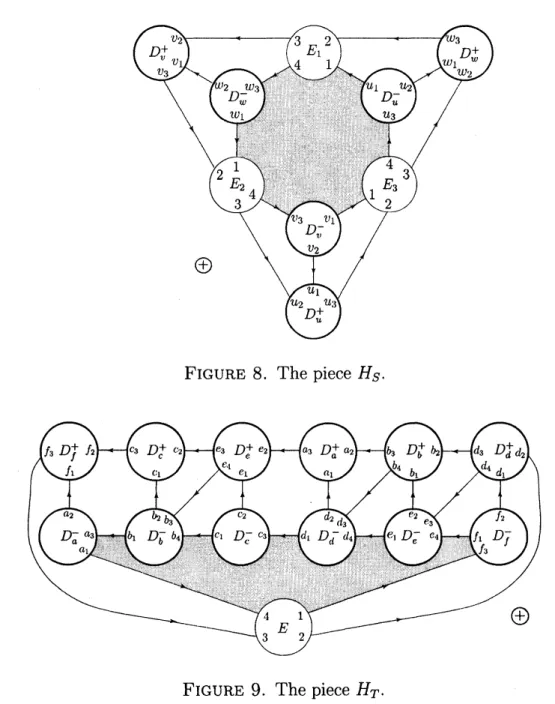
Let $H_{S}$ and $H_{T}$ be the pieces of a punctured Heegaard diagram shown in Figure 8
and 9, respectively. These pieces correspond to either (trice-punctured sphere) $\cross S^{1}$ and
(once-punctured torus) $\cross S^{1}$, respectively. Again, we consider that the curves $\alpha$
are
boldand the
curves
$\beta$are
thin in the figure.FIGURE 8. The piece $H_{S}$.
FIGURE 9. The piece $H_{T}$.
Let $g$ be a non-negative integer and $b$ be an integer. Let $(p_{1}, q_{1}),$ $(p_{2}, q_{2}),$ $\ldots,$$(p_{r}, q_{r})$ be
Assume that $g+r\geq 2$. Prepare $g+r-1$ copies $H_{s}^{1},$$H_{s}^{2},$
$\ldots,$$H_{s}^{g+r-2}$ of the piece $H_{S}$
and $g$ copies $H_{T}^{1},$$H_{T}^{2},$ $\ldots,$$H_{T}^{g}$ ofthe piece $H_{T}$. First, attach the boundary
$E$of the piece
$H_{b}$ of punctured Heegaard diagram to the boundary $\partial E_{1}$ of the piece $H_{S}^{1}$ so that the
numbers 1, 2, 3, 4 on the both boundary circles match. For odd $k$ with $1\leq k\leq r$, attach
the boundary $I$ ofthe piece $H_{(p_{k},q_{k})}$ ofpiece to the boundary $\partial E_{2}$ of the piece $H_{S}^{k}$ in the
same manner as above. For even $k$ with $1\leq k\leq r$, attach the boundary $E$ of the piece
$H_{(p_{k},p_{k}-q_{k})}$ of
a
punctured Heegaard diagram to the boundary $\partial E_{2}$ of the piece $H_{S}^{k}$ in thesame
manner
as
above. For $1\leq k\leq g-1$, attach the boundary $E$ of the piece $H_{T}^{k}$ to theboundary $\partial E_{2}$ of the piece $H_{s}^{r+k}$ in the
same manner as
above. Attach the boundary $E$of the piece $H_{T}^{g}$ to the boundary $\partial E_{3}$ of the piece $H_{s}^{g+r-1}$ in the
same
manner as
above.Note that
now we
have $g+r-1$ components ofpieces $W_{1},$ $W_{2},$$\ldots,$$W_{g+r-1}$ ofapunctured
Heegaard diagram such that
$\bullet$ $W_{1}$ contains both $H_{b}$ and $H_{s}^{1}$; $\bullet$ $W_{k}$ contains $H_{S}^{k}$ for $2\leq k\leq r$;
$\bullet$ $W_{k}$ contains $H_{T}^{k}$ for $r<k\leq g+r-2$; and $\bullet$ $W_{g+r-1}$ contains both $H_{T}^{g+r-1}$ and $H_{T}^{g+r}$.
For each even $k$ with $1\leq k\leq g+r-2$, change the fixed normal direction ofthe diagram
$W_{k}$ and
Now
we
geta
punctured Heegaard diagram by attaching the boundary $\partial E_{3}$ of thediagram $W_{k}$ to the boundary $\partial E_{1}$ of the diagram $W_{k+1}$ for $1\leq k\leq g+r-2$. We denote
it by $H_{(g;b;(p_{1},q_{1}),(p_{2},q_{2}),\ldots,(p,,q,))}$.
If $g+r\leq 2$, attach the piece $H_{b}$ of a punctured diagram to the boundary $\partial E_{1}$ of the
piece $H_{S}^{1}$. Moreover, attach the rest ofthe pieces $H_{(p_{i},q_{i})}$ and copies of $H_{T}$, if any, to the
boundaries $E_{2}$ and $E_{3}$. In particular, if $g+r<2$, attach the copies of $H_{C}$ to all the
remaining boundary components of $H_{s}^{1}$.
Theorem 2.1. The punctured Heegaard diagmm $H_{(g;b;(p_{1},q_{1}),(p_{2},q_{2}),\ldots,(p_{r},q_{f}))}$ corresponds to
the
Seifert fibered
3-manifold
$S(g;b;(p_{1}, q_{1}), (p_{2}, q_{2}), \ldots, (p_{r}, q_{r}))$ with a standard $Spin^{c}$structure.
Pmof.
The idea ofthe proof isto construct the pieces ofthepunctured Heegaarddiagramcorresponding to the pieces of the DS-diagram constructed in [11] following the proof of Theorem 5.5.
Let $\pi,$ $B,$ $W$ and $e$ be
as
described in Section 1.6. Set $A:=\eta(e;\partial\eta(P))$. Recall that $e$has the $B$ part
on
one side and the $W$one on
the other side. The key idea is to drawa
simple closed curve $C$ in $A$ such that
(1) $C$ is isotopic to $e$ in $A$;
(2) $C\cap e\neq\emptyset$ and $C$ intersects $e$ transversely; and
(3) $C\cap\pi^{-1}(S(P))\subset e\backslash \pi^{-1}(V(P))$.
Let $\mathcal{H}_{L}$ beapieceofDS-diagram (onthe annulus) showninFigure 10 (i). Thisdiagram
was
constructed in [11]. The curve $e$ lies horizontally in the middle part of the diagramand it separates the diagram into B-part, on the upper side, and W-part, on the lower
side. Then the intersection $C\cap \mathcal{H}_{R}$is depicted bythe bold linesin Figure 10 (ii). The two
curves $C\cap \mathcal{H}_{R}$cut the annulus intotwodisks, the under pieceof which correspondsto the
joining disk. Note that the disk $D^{-}$ shown in the figure is identified via the projection $\pi$
3 2
く i
$(\mathfrak{i})$ $\{\dot{t}i)$ $(\mathfrak{i}ii)$
FIGURE 10. From $\mathcal{H}\iota$ to $H_{L}$
.
$\oplus$
FIGURE 11. The pie く ce $H_{L}$ ofapunctured Heegaard diagram.
For the other pieces shown in [11],
we
can
apply thesame
argument. Cnsequently, $weD$get the assertion.
Remark2.2. Forgetting thejoiningdiskofthediagram $II_{(g;b;(p_{1},q\iota)_{)}\infty,\varphi),\ldots,(p_{r},q,))}$,
one
hasa
Heegaard diagram of theSeifert fibered manifold$S(g;b, (p_{1}, q_{1}), (p_{2}, q_{2}), \ldots, (p_{r}, q_{r}))$.
Fores&
pieceoftheHeegaard diagram corresponding toa
singularfiberobtained in the aboveconstruction, thediagram
can
bedestabilizedso
thatit isa
diagramon aonce-puncturedtorus.
2.2. Algorithm. Let $M$bea Seifert fibered 3-manifold$S(g;b;(p_{1}, q_{1}),$$(p_{2}, q_{2}),$
$\ldots$ ,$(p_{r}, q_{r})$
.
Let $fI_{\text{く}S(g;b;\phi,q_{1}),\infty,\alpha),.,.,\phi_{Y},q_{r}))}=(S_{g};\alpha, \beta, D)$ be the punctured Heegaard diagram
con-structed
as above.
Recall thatonce
givena
punctured Heegaard diagram, the Heegaardsurface$S_{9}$ assumed tobenaturallyoriented
as
explainedin Section1. Let $F$ be afield and $\varphi:\mathbb{Z}[H_{1}$く$M_{(S_{1}\alpha,\beta;D)})]arrow F$ bea
ring homomorphism. Wecan
calculate theReidemeister-Turaev torsion of the standard Spin’ structure of $M$, i.e. the principal Reidemeister
torsion $7^{\tau\varphi}(M)$, in the following algorithmic way (cf. [7]):
Step 1: Orient a and $\beta$, and take base points of$\beta$ following the rule prescribed in
Section 1.
Step 2: Get apresentation $\langle x_{\lambda},$
$\ldots$,$x_{g}|r_{1},$ $\ldots,$
$r_{g}\rangle$ of $\pi_{1}(M, *)$ using the punctured Heegaard diagram $(S;\alpha,\beta_{2}\cdot D)$
as
inthe rule of Section 1.5.Step 3: Find
an
arbitrarydualsystem $\gamma$ of$\beta$ in the diagram $(S;\alpha, \beta;D)$ and relateStep 4: Ifthereexist twointegers $k,$$l\in\{1, \ldots, g\}$such that all of$\det B_{k,l},$ $\varphi([y_{l}])-1$
and $\varphi([y_{l}])-1$ are nonzero, then wehave
$\tau^{\varphi}(M, \mathcal{V}_{st})=\pm\frac{\det B_{k,l}}{(\varphi([x_{k}])-1)(\varphi([y_{l}])-1)}\in F^{\cross}/\pm 1$ ,
where $B_{k,l}$ is the $(k, l)$-minor of the matrix $( \varphi([\frac{\partial r_{j}}{\partial x_{i}}]))_{1<i,j\leq g}$. If there are not
such integers $k$ and $l$, then it turns out that the twisted chain complex $C^{\varphi}(M)$ is
not acyclic, hence we have $\tau^{\varphi}(M, V_{st})=0$ by definition.
Remark that due to [8] and [14], the above alsogives
an
purely combinatorial algorithmto compute the Seiberg-Witten invariant of standard $Spin^{c}$ structure when the given
Seifert fibered 3-manifold has the first homology group of infinite order. 3. EXAMPLES AND OBSERVATIONS
3.1. Lens spaces. Using the algorithm in Section 2.2 for a lens space $L(p, q)$, we get a
Spi$n^{}$ structure on $L(p, q)$ and a presentation of $\pi_{1}(L(p, q))$ corresponding to the $Spin^{c}$ structure can be written
as
$\pi_{1}(L(p, q))=\langle x|x^{p}\rangle$ after simplifying the generators andrelators. Then for a representation $\varphi$ : $H_{1}(L(p, q))arrow F^{\cross}$, we have a well-known result
$\tau^{\varphi}(L(p, q), [V_{st}])=\pm 1/(\zeta-1)(\zeta^{r}-1)$, where $\zeta=\varphi([x])$.
Let
us
focuson
the lens space$L(11,1)$.
Thesetof the values of the Reidemeister-Turaevtorsions ofthe Spi$n^{}$ structures of $L(11,1)$ is:
$\{\tau^{\varphi}(L(11,1), [\mathcal{V}])|[\mathcal{V}]\in Spin^{c}(L(11,1))\}=\{\pm\frac{(^{i}}{(\zeta-1)^{2}}\in F^{\cross}/\pm 1$ $0\leq i<11\}$ . In this set, only the two values $\pm 1/(\zeta-1)^{2}$ and $\pm\zeta^{2}/(\zeta-1)^{2}$ can be modified so that the
numerator is $\pm 1$ and the denominator are the form of $(\zeta^{a}-1)(\zeta^{b}-1)$ for some $a,$$b\in \mathbb{Z}$.
In fact, we have $\pm\zeta^{2}/(\zeta-1)^{2}=\pm 1/(\zeta^{10}-1)^{2}$. Note that the value $\pm 1/((-1)^{2}$ is the
torsionof the Spi$n^{}$ structurederived from thestandard Seifert fibration of $(L(11,1))$ and
$\pm\zeta^{2}/(\zeta-1)^{2}$ is that ofthe Spi$n^{}$ structure derived from the standard Seifert fibration of
$(L(11,10))$. $(^{6}/(\zeta-1)^{2}$ $\zeta^{5}/(\zeta-1)^{2}$ $\zeta^{7}/((-1)^{2}\cdot$ $\zeta^{8}/(\zeta-1)^{2}$
.
$\zeta^{9}/(\zeta-1)^{2}$.
$\zeta^{10}/(\zeta-1)^{2}$.
$1/(\zeta-1)^{2}0$ $\zeta^{4}/(\zeta-1)^{l}$ $\zeta^{3}/(\zeta-1)^{2}$ $o(^{2}/(\zeta-1)^{2}=1/(\zeta^{10}-1)^{2}$ $\zeta/(\zeta-1)^{2}$FIGURE 12. The set ofSpi$n^{}$ structureson $L(11,1)$ and their Reidemeister-Turaev torsions (the signs $\pm$
are
omitted). The white dotsare
the standardSpi$n^{}$ structures.
Next, consider the lens space $L(11,2)$. For this manifold, the set of the values of the
$\{\tau^{\varphi}(L(11,2), [\mathcal{V}])|[V]\in Spin^{c}(L(11,2))\}=\{\pm\frac{\zeta^{i}}{(\zeta-1)(\zeta^{6}-1)}\in F^{\cross}/\pm 1$ $0\leq i<11\}$
In this set, exactly the four values $\pm 1/(\zeta-1)(\zeta^{6}-1),$ $\pm\zeta/(\zeta-1)(\zeta^{6}-1),$ $\pm(^{6}/(\zeta-$
$1)(\zeta^{6}-1)$ and $\pm\zeta^{7}/(\zeta-1)(\zeta^{6}-1)$ can be modified so that the numerator is $\pm 1$ and
the denominator are the form of $(\zeta^{a}-1)(\zeta^{b}-1)$ for some $a,$$b\in \mathbb{Z}$. In fact, we have
$\pm\zeta/(\zeta-1)(\zeta^{6}-1)=\pm 1/(\zeta^{6}-1)(\zeta^{10}-1),$ $\pm\zeta^{6}/(\zeta-1)(\zeta^{6}-1)=\pm 1/(\zeta-1)(\zeta^{5}-1)$ and
$\pm\zeta^{7}/(\zeta-I)(\zeta^{6}-1)=\pm 1/(\zeta^{5}-1)(\zeta^{10}-1)$.
$\zeta^{0}/(\zeta-1)(\zeta^{6}-1)=1/(\zeta-1)(\zeta’\sigma-1)0$ $\zeta^{6}/(\zeta-1)(_{\backslash }^{\Gamma 6}-1)$
$\zeta^{-}/(\zeta-1)(\zeta^{6}-1)=1/(\zeta^{10}-l)(\zeta^{5}-1)0$ $\zeta^{4}/(\zeta-1)(\zeta^{6}-1)$
$\zeta^{8}/(\zeta-1)(\zeta^{6}-1)$
.
$\zeta^{3}/(\zeta-1)(\zeta^{6}-1)$ $\zeta^{9}/(\zeta-1)(\sigma^{6}-1)$.
$\zeta^{2}/(\zeta-1)(\zeta^{6}-1)$$\zeta^{10}/(\zeta-1)(\zeta^{6}-1)$
.
$\circ(/(\zeta-1)(C^{6}-1)=1/(\zeta^{10}-1)(\overline{t}^{6}-1)$ $1/(\zeta-1)(\zeta^{6}-1)0$FIGURE 13. Theset ofSpi$n^{}$ structures on$L(11,2)$ and their Reidemeister-Turaev torsions (the signs $\pm$ are omitted). The white dots are the standard
Spi$n^{}$ structures.
Observation 3.1. The Reidemeister- Tumev torsion
of
a Spi$n^{}$ structureof
a lens spaceis
of
the$fom\pm 1/(\zeta^{a}-1)(\zeta^{b}-1)$for
some $a,$ $b\in \mathbb{Z}$if
and onlyif
the Spi$n^{}$ structure is standard.3.2. $S_{g}\cross S^{1}$
.
Let $S_{g}$ be a closed orientable surface of genus $g>1$ and consider the Seifertfibered 3-manifold $S_{g}\cross S^{1}$. Using the algorithm in Section 2.2 for $S_{g}\cross S^{1}$, we get a $Spin^{c}$
structure $V_{st}$ on $S_{g}\cross S^{1}$ and a presentation of $\pi_{1}(S_{g}\cross S^{1})$ corresponding to the $Spin^{c}$
structure can be written as
$\pi_{1}(S_{g}\cross S^{1})=\langle x_{1},$$x_{2},$ $\ldots,$ $x_{2g},$$y|x_{i}yx_{i}^{-1}y^{-1},$$i=1,2,$
$\ldots,$$2g,$$\prod_{i=1}^{g}(x_{2i-1}x_{2i}x_{2i-1^{-1}}x_{2i^{-1}})\rangle$,
and its abelianization is:
$H_{1}(S_{g} \cross S^{1}):=(\bigoplus_{i=1}^{2g}\mathbb{Z}\langle[x_{i}]\rangle)\oplus \mathbb{Z}\langle[y]\rangle$.
Let $\varphi:\mathbb{Z}[H_{1}(S_{g}\cross S^{1};\mathbb{Z})]arrow F$be aring homomorphism to a field $F$ such that each of
$\zeta_{i}=\varphi([x_{i}])$ and $\zeta=\varphi([y])$ has an infinite order. Then we have
The set of the values of the Reidemeister-Turaev torsions of the Spi$n^{}$ structures of
$S_{g}\cross S^{1}$ is:
$\{\tau^{\varphi}(S_{g}\cross S^{1}, [V])|[V]\in Spin^{c}(S_{g}\cross S^{1})\}$
$=$ $\{\pm\zeta_{1}^{i_{1}}\cdots\zeta_{2g}^{i_{2g}}\zeta^{i}(\zeta-1)^{2g-2}\in F^{\cross}/\pm 1|i_{1},$
$\ldots,$$i_{2g},$ $i\in \mathbb{Z}\}$
...
$\bullet$ $\bullet$$\bullet\zeta^{-1}(\zeta-1)^{\underline{?}_{g-2}}$
:
: $:$ ::
:...
$\bullet\bullet\bullet$ $\zeta(\zeta-1)^{2g-2}$ $\bullet\bullet$...
...
$\bullet$ $\bullet$ $o(\zeta-1)^{2g-2}$ $\bullet$ $\bullet$.. .
$\bullet$ $\bullet$...
$:$ :
:
: : :...
$\bullet$ $\bullet$ $\bullet(\zeta-1)^{g-1}(\zeta^{-1}-1)^{g-1}$ $\bullet$ $\bullet$$arrow a$ Spi$n^{}$ structure derivedfromaSpin structure
:
:
.
:
::
.
:
...
$\bullet$ $\bullet$ $\bullet$ $\bullet$ $\bullet$...
$\bullet$ $\bullet$ $o\zeta^{-(2g-2)}(\zeta-1)^{2g-2}=(\zeta^{-1}-1)^{2g-2}$...
$\bullet$ $\bullet$ $\bullet$ $\bullet$ $\bullet$...
: : :
:.
:
:FIGURE 14. The set ofSpi$n^{}$ structures on $S_{g}\cross S^{1}$ and their Reidemeister-Turaev torsions (the signs $\pm$
are
omitted). The white dotsare
the standardSpi$n^{}$ structures.
Observation 3.2. The Reidemeister- Tumev torsion
of
a Spi$n^{}$ structureof
$S_{g}\cross S^{1}$ isof
the$fom\pm(\zeta^{a}-1)^{2g-2}$
for
some
$a\in \mathbb{Z}$if
and onlyif
the Spi$n^{}$ structure is standard. 3.3. Brieskorn 3-manifolds. The Brieskom manifold $\Sigma(p, q, r)$ of type $(p,q, r)$ is aclosed 3-manifold defined by:
$\Sigma(p, q, r):=\{(x, y, z)\in \mathbb{C}^{3}||x|^{2}+|y|^{2}+|z|^{2}=1, x^{p}+y^{q}+z^{r}=0\}$,
where$p,$$q$ and $r$ are integers greater than 1.
$\Sigma(p, q, r)$ is the r-fold branchedcovering ofthe 3-sphere$S^{3}$ branched alonga torusknot
or link oftype $(p, q)$. The first integral homology groups of the Brieskom manifolds is
$H_{1}(\Sigma(p, q, r);\mathbb{Z})=\{\begin{array}{ll}1 n=\pm 1(mod 6)\mathbb{Z}/3\mathbb{Z} n=\pm 2(mod 6)\mathbb{Z}2\mathbb{Z}\oplus \mathbb{Z}/2\mathbb{Z} n=3(mod 6)\mathbb{Z}\oplus \mathbb{Z} n=0(mod 6)\end{array}$
Usingthe algorithm inSection2.2for $\Sigma(2,3,6n)$, wegetaSpi$n^{}$ structure$V_{st}$ on$\Sigma(2,3,6n)$
as
$\pi_{1}(\Sigma(2,3,6n))=\langle x_{1},$$x_{2},$
$\ldots,$$x_{6n}|x_{i}x_{i+6n-1^{-1}}x_{i+1^{-1}},1\leq i\leq 6n\rangle$
and its abelianization is:
$H_{1}(\Sigma(2,3,6n);\mathbb{Z})$ $:=\mathbb{Z}\langle[x_{1}]\rangle\oplus \mathbb{Z}\langle[x_{2}]\rangle$
.
Let $\varphi$: $\mathbb{Z}[H_{1}(\Sigma(2,3,6n);\mathbb{Z})]arrow F$ be a ringhomomorphism to a field $F$ such that each of
$\zeta_{1}=\varphi([x_{1}])$ and $\zeta_{2}=\varphi([x_{2}])$ has an infinite order. Then we have
$\tau^{\varphi}(\Sigma(2,3,6n), [V_{st}])=\pm\frac{\det(\varphi([\frac{\partial x_{i}x_{i+6n-1^{-1-1}}x_{i+1}}{\partial x_{j}}]))_{1,1}}{(\zeta_{1}^{-1}-1)(\zeta_{1}-1)}=\pm n$
.
Theset ofthe values ofthe Reidemeister-Turaevtorsions of the Spi$n^{}$ structuresof$S_{g}\cross S^{1}$
is:
$\{\tau^{\varphi}(\Sigma(2,3,6n), [\mathcal{V}])|[\mathcal{V}]\in Spin^{c}(\Sigma(2,3,6n))\}=\{\pm n(_{1}^{i_{1}}\zeta_{2}^{i_{2}}\in F^{\cross}/\pm 1|i_{1},$$i_{2}\in \mathbb{Z}\}$
.
.
.
..
.
.
...
$n\zeta_{1}^{-2}\zeta_{2}^{2}$ $n\zeta_{1}^{-1}\zeta_{2}^{2}$ $n\zeta_{2}^{2}$ $n\zeta_{1}\zeta_{2}^{2}$’
$n\zeta_{1}^{2}\zeta_{2}^{2}$
..
.
...
$n\zeta_{1}^{-2}\zeta_{2}$ $n\zeta_{1}^{-1}\zeta_{2}$ $n\zeta_{2}$ $n\zeta_{1}\zeta_{2}$’ $n\zeta_{1}^{2}\zeta_{2}$...
.
. .
$n\zeta_{1}^{-2}$ $n\zeta_{1}^{-1}$ $n$ $n\zeta_{1}$ $n\zeta_{1}^{2}$$0arrow_{aSpiri^{c}}$
struct$\iota irederii\cdot edf_{I}om$aSpin structurc
.
.
. $n\zeta_{1}^{-2}\zeta_{2}^{-1}$ $il$$\zeta_{1}^{-1}(_{2}^{-1}$ $n\zeta_{2}^{-1}$ $n(\iota\zeta_{2}^{-1}$ $n\zeta_{1}^{2}\zeta_{2}^{-1}$.
. .
. . .
$n\zeta_{1}^{-2}\zeta_{2}^{-2}$ $n\zeta_{1}^{-1}\zeta_{2}^{-2}$ $n\zeta_{2}^{-2}$ $n\zeta_{1}\zeta_{2}^{-2}$ $n\zeta_{1}^{2}\zeta_{2}^{-2}$. .
.
:
:
:
.
:
.
.
FIGURE 15. The set of $Spin^{c}$ structures on $\Sigma(2,3,6n)$ and their
Reidemeister-Turaev torsions (the signs $\pm$ are omitted). The white dot
is the standard Spi$n^{}$ structure.
Observation 3.3. The Reidemeister- Tumev torsion
of
a Spi$n^{}$ structureof
the Brieskom3-manifolds
$\Sigma(2,3,6n)(n\in \mathbb{N})$ isof
the $form\pm a$for
some $a\in \mathbb{Z}$if
and onlyif
the $Spin^{c}$ structure is standard.From the aboveobservations, wemayroughlysay that the Reidemeister-Turaev torsions of the standardSpi$n^{}$ structures of a Seifert fibered 3-manifoldhave standardvaluesamong the set ofthe Reidemeister-Turaev torsions of all Spi$n^{}$ structures on the manifold.
Acknowledgements. The author is supported by Grant-in-Aid forYoung Scientists (B)
REFERENCES
[1] G. Amendola, R. Benedetti, F. Costantino, C. Petronio, Branched spines of 3-manifolds and
torsion ofEulerstructures, Rend. Ist. Mat. Univ. TYieste 32 (2001), 1-33.
[2] R. Benedetti, C. Petronio, Bmnched Standard Spines of3-manifolds, Lecture Notes in Math.
1653, Springer-Verlag, Berlin-Heiderberg-New York, 1997.
[3] R. Benedetti, C. Petronio, Reidemeister-hmev torsion of3-dimensional Euler structures with
simple boundary tangency and$pseudo-Legend\dot{m}an$ knots, Manuscripta Math. 106 (2001), 13-74.
[4] W. Floyd, U.Oertel, Incompressiblesurfacesviabmnchedsurfaces, Topology23 (1984), 117-125.
[5] A. Fomenko, S. Matveev, Algorithmic and Computer Methodsfor Three-Manifolds, Mathematics
and its Applications425, Kluwer Academic Publishers, Dordrecht, 1997.
[6] Y. Koda, Spines, Heegaard splittings and the Reidemeaster-Turaev torsion of Euler structure,
Tokyo J. Math. 30 (2007), 417-439.
[7] Y. Koda, A Heegaard-type presentation ofbmnched spines and the Reidemeister-Tumev torsion,
Math. Z. 260 (2008), 203-228.
[8] G. Mengand C. H. Taubes, $\underline{SW}=$ Milnortorsion, Math. Res. Lett. 3 (1996), 137-147.
[9] L. I. Nicolaescu, The Reidemeister Torsion of 3-Manifolds, de Gruyter Stud. Math. 30, de
Gruyter, Berlin, 2003.
[10] U. Oertel, Incompressible bmnchedsurfaces, Invent. Math. 76 (1984), 385-410.
[11] T. Taniguchi, K. Tsuboi, M. Yamashita, Systematic singular triangulations for all Seifert
mani-folds, TokyoJ. Math. 28 (2005), 539-561.
[12] V. Turaev, Euler $str\tau\iota cture$, nonsingular vector flows, and Reidemeister-type torsions, Math.
USSR-Izv. 34 (1990), 627-662.
[13] V. Turaev, Torsion invariants of Spi$n^{}$ -structures on 3-manifolds, Math. Res. Lett. 4 (1997),
679-695.
[14] V. Turaev, A combinatorialfomulation forthe Seiberg-Witten invariants of3-manifolds, Math.
Res. Lett. 5 (1998), 583-598.
[15] V. Turaev, Introduction to combinatorial torsions, Lectures in Mathematics ETH Z\"urich,
Birkh\"auserVerlag, Basel-Boston-Berlin, 2001.
[16] V. Turaev, Surgery fomula for torsions and Seiberg-Witten invariants of 3-manifolds,
$arXiv:math.GT/0101108$.
$[17|$ V. Turaev, Torsions
of
3-dimensional Manifolds, Progress in Math. 208, Birkh\"auser Verlag,Basel-Boston-Berlin, 2002.
MATHEMATICAL INSTITUTE, TOHOKU UNIVERSITY, SENDAI, 980-8578, JAPAN