Voices from the South:
Identity Construction of Malay Muslim Women in Thailand through
Auditory Media
by
CHUNSAM Phawarin
51114602
September 2016
Master’s Thesis
Presented to
Ritsumeikan Asia Pacific University
In Partial Fulfillment of the Requirements for the Degree of
Master of Science in Asia Pacific Studies
i
To
Grandpa and Grandma,
for having been there for me from the very start,
ii
ACKNOWLEDGEMENTS
Writing a Master’s thesis has been a long and difficult process. I could not have done it without inspiration, support and encouragement from individuals I sincerely love and respect.
First, I would like to express my deepest gratitude to Professor Kaori Yoshida, my supervisor, for her time, guidance, encouragement and invaluable advice. May I extend my gratefulness to Professor Robert A.C. Salazar for his guidance at the very beginning of my research. My respect also goes to every faculty of the Graduate School of Asia Pacific Studies and Ritsumeikan Asia Pacific University (APU) for helping me “grow up” as a researcher.
Secondly, I would like to thank Pear Sirisinudomkit, Joe Chalaophakdee, Dulce A. Fortunado, Carmen Palma, Atsumi Nakao and all friends in APU and Japan for their encouragement and for making my time in Japan the most memorable years of my life. My gratefulness is also sent to my friends in Thailand; Nudii Sassananand, Panyavut Janta, Fang Arjthaweekul, Earn Jitrjai, Jan Jiravallop and Pimpattra Liengpanich, I can never thank them enough for their love and morale support from afar.
Last but not least, I would like to express my sincerest gratitude my parents for making me who I am today, and my grandparents for every smile they had brought to my days. I would like to also thank my brother and the rest of my family for their endless support throughout my journey.
I am very grateful to each and everyone who have been a part of my study and my life in Japan. I wish you all the very best from the bottom of my heart.
iii TABLE OF CONTENTS ABSTRACT ... 1 CHAPTER 1: INTRODUCTION ... 3 1.2 Research objective ... 7 1.3 Hypotheses ... 7 1.4 Research questions ... 7
1.5 Significance of the study ... 8
CHAPTER 2: LITERATURE REVIEW ... 9
2.1 Transcultural identity ... 9
2.2 Media representation of ethnic minorities in Thailand ... 13
2.3 Media representation of women in Thailand ... 15
2.4 Malay Muslim women in Thailand: an overview ... 18
2.5 Connections among culture, religion, and genders ... 21
CHAPTER 3: METHODOLOGY AND THEORETICAL FRAMEWORKS ... 25
3.1 Postcolonial Feminism: Islamic Feminism ... 25
3.2 Framing Theory in Media ... 30
3.3 Analysis of the text: Critical Discourse Analysis and Rhetorical Analysis ... 32
3.3.1 Critical Discourse Analysis (CDA) ... 33
3.3.2 Rhetorical Analysis ... 35
3.4 Data analysis procedure ... 37
3.5 Choice of auditory media to be studied... 37
CHAPTER 4: FINDINGS AND DISCUSSION ... 40
iv
4.1.1 Reframing the South Thailand Insurgency: showing the positives ... 42
4.1.2 Peaceful coexistence between Islam and Buddhism ... 54
4.1.3 Education as a crucial factor for development ... 63
4.1.4 Feminine qualities as a strength of women at work ... 68
4.2 Rhetoric strategies ... 73
4.3 Negotiating identity: Thainess without Buddhism ... 76
4.4 Renegotiating Islamic womanhood ... 81
CHAPTER 5: CONCLUSION AND RECOMMENDATIONS ... 90
REFERENCES ... 95
v
LIST OF TABLES
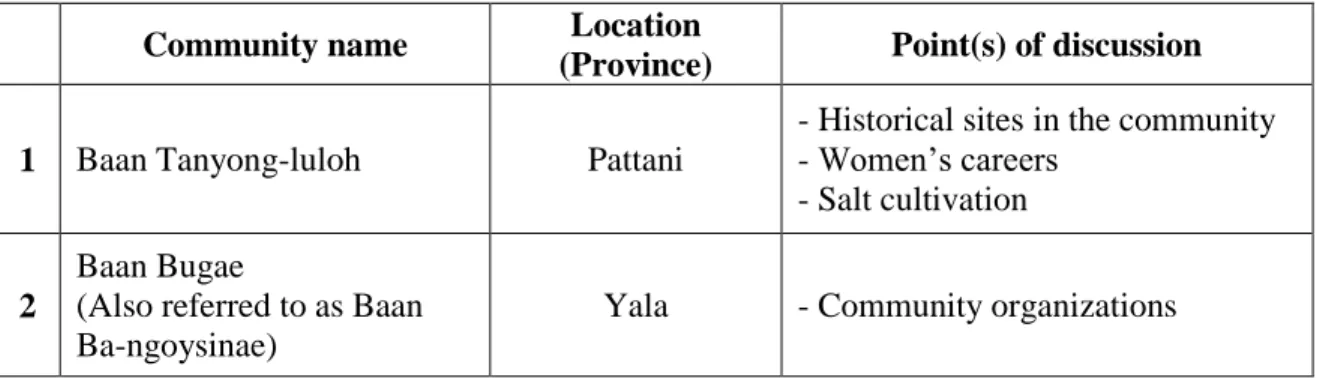
Table 1: List of communities and main topic(s) of discussion in the program ….……. 38
vi
LIST OF ABBREVIATION
1
ABSTRACT
This thesis explores the identity construction of Malay Muslim women in Thailand through the radio program ‘Voices from the Women of the Southern Frontiers’. In the midst of the South Thailand Insurgency, Malay Muslims, the majority of population in the southernmost provinces of Thailand, were portrayed as the antagonist, excluded and overlooked by Thai society. However, with an emergence of local media dedicated to peace-building, Malay Muslim women are given opportunities to speak to the public and have become the main actor in constructing and negotiating Malay Muslims’ space with the Thai society. At the same time, changes in these women’s roles are observed; from mothers and household caretakers to active actors in socioeconomic sphere.
The aim of this thesis is to discover the “Malay-Thai Muslim women” identity displayed through auditory media, and how these women, as senders of the messages, construct and negotiate their identity with their surroundings utilizing narratives.
This thesis employs Critical Discourse Analysis (CDA) and rhetorical analysis to study narratives in the radio program ‘Voices from the Women of the Southern Frontiers’. It utilizes Framing theory of media as a theoretical framework and Islamic feminism, which is considered as a variety of postcolonial feminism theory, as a conceptual framework. Four rhetoric regarding the South Thailand Insurgency, Malay Muslim community, and Malay Muslim women are found. These rhetoric contribute to constructing and negotiating Malay Muslim identity and Islamic womanhood with their surroundings.
2
This thesis has identified an attempt to include Malay Muslim into Thai national discourse through historical narratives that invite audience to realize and embrace the multicultural nature of Thai society and create a new discourse of Thainess: one can be a Thai without being a Buddhist. The Malay-Thai Muslim selfhood is therefore a mixture of being Malay by blood, Muslim by faith, and Thai by nationality.
Regarding Islamic womanhood, this thesis has found that predominant gender construct which is heavily based on religious principles was a hindrance in women’s activities in the public sphere. However, they were able to achieve a compromise. The redefined Islamic womanhood consists of a traditional and non-traditional womanhood; it is a modernized woman conforming to mainstream Thai’s notion of modernization, and at the same time, preserves the “right” womanhood according to the religious principles.
The conclusion argues that Malay Muslim women have constructed their identity and negotiate their space in the surroundings through narratives based on a mixture of being a Thai, a Malay, and a Muslim, and a woman. And their effort has paved ways for Muslim women’s emancipation from domestic sphere, thus gives them an easier access to the public space where the needed resources are available to aid them in self-development which can lead to poverty elevation and empowerment. At the same time, their movement can be considered “feminist” in a way that it strives to relieve patriarchal pressure on women within the principles of Islam. This “local” feminism is unique in its characteristic and is proven effective in the emancipation and empowering women under the context of Islam and Thai society.
3
CHAPTER 1: INTRODUCTION
1.1 Background of the research
Thailand is a country consisting of various ethnic groups, culture, and religions. Yet what usually is defined as an essence of ‘Thai’ is heavily based on Buddhist values, and this is not surprising since 94.6 percent of its population is Buddhist (National Statistical Office of Thailand, 2011). The number is so large that it overwhelms the second largest religious community, Islam, with 4.6 percent of the population being Muslim (National Statistical Office of Thailand, 2011). Like its Buddhist counterpart, the Muslim population is heterogeneous, originating from various ethnic groups and spreading across the country. There are indigenous Thai, Persian, Myanmar, Cambodian (Cham), Bengalis, Javanese, Chinese Muslim (Haw) whose major settlement is in the northern provinces, and Malay, which is the largest Muslim ethnicity (Forbes, 1982; Bajunid, 1999). The Malay population in Thailand is as large as 900,000 people or nearly 15 percent of all ethnic minority population (Ministry of Social Development and Human Security, 2015), dominating the southern provinces of Satun, Pattani, Yala, Narathiwat, and some areas of Songkla, which share the border with Malaysia, therefore generally known as “changwat chai daen paak tai” (the southern border provinces) in Thai. While most Muslim groups appear to be well-integrated into the Thai society, Malay Muslim seems excluded; physically by the way they dress – women covering their heads or faces with veils and men wearing caps, and linguistically by the Malay language widely spoken by Muslim locals instead of Thai. The
4
obvious deviation of language and culture from mainstream Thai is suggested to be one of the reasons of difficulties in integrating Malay Muslim into Thai national discourse (Forbes, 1982; Bajunid, 1999; Harish, 2006). Another reason that may suggest the root of exclusion and resistance of Malay Muslim toward the Thai state is that, instead of the Malay community coming to Thailand like other Muslim communities, Thailand came to them (Forbes, 1982). Historically, the three southern border provinces of Pattani, Yala, and Narathiwat, and some part of modern-day northern Malaysia constituted the Kingdom of Patani, located between the Kingdom of Siam, now Thailand, and the Malacca Sultanate. The kingdom became ancient Siam’s vassal state as early as the 1500’s. Through centuries, Siam and Patani conflicted over Patani’s sovereignty until the early 1900’s that Patani was split up by the British imperialist, resulting in some part of it falling under Malaysia’s sovereignty while the rest belonged to Siam. It is noted that the ongoing conflict between Siam and Patani until the early 20th century, however, concerned political power rather than the notion of ethnicity or religion (McVey, 1989, cited in Harish, 2006). Although belonged to Siam, the people of former Patani have maintained close bond, personally and culturally, with the present day Malaysian community even in modern days (Farouk, 1984, cited in Harish, 2006). However, this is not the case for Muslims of Malay ancestry in Satun province, one of Thailand’s southern frontiers which is not affected by the South Thailand Insurgency (Dulyakasem, 1991, cited in Harish, 2006).
It was in the 1930’s when the Malay community came to face harsh cultural assimilation in an attempt to create a nation of one ‘Thai’ culture out of fear of the rise of Malay Nationalism. The nationalist regime was carried out by a military government of Field Marshal Plaek Pibulsongkram who began to erase the notion of being Malay from the
5
southern provinces (Harish, 2006, p. 55). Islamic codes of conduct, including clothing and language, were highly discriminated against or banned. This led to a cultural confrontation between Malay locals and ruling Thai bureaucrats (Bajunid, 1999, p. 221) and is suggested by scholars to be the root of conflicts that later developed into the South Thailand Insurgency (Forbes, 1982; Bajunid, 1999; Harish, 2006). Since the 1940’s, there have been movements led by groups of Malays to reclaim cultural and political autonomy from the Thai state. Later, what first appeared to be a political debate between Malay and Thai turned into a conflict between Islam and Buddhism for several reasons. First, the emergence of an insurgent group called Pattani United Liberated Organization (PULO) in the late 1960s. PULO’s doctrine, unlike other groups, centered on the liberation of Islam and therefore took the notion of Islam to justify their mission above others’ (Harish, 2006, p. 56). Second, the failure of the term “Thai Muslim” coined by the state in the hope to put all Islam groups under the Thai national discourse. It is suggested that the term only created wider religious cleavage (although other groups of Muslims seem to receive the term well) by pointing out that “you are Thai but you are Muslim” (Harish, 2006, p. 58, original emphasis), which pushes one away from being “Thai” since he/she is not a Buddhist – a fundamental quality of Thainess. Third, the lack of support from Malaysia which diminished the ethnicity aspect of the conflict and left the insurgent groups with a stronger notion to religion (Harish, 2006, pp. 58-59) as a sole purpose of the fight to liberate Malay Muslim from the Thai nation state. Fourth, the outflow of Thai Muslims to pursue religious education overseas, followed by an increase in religious education institutions in Thailand, heightening Islamic consciousness of the younger generations in the southern provinces of Thailand. And fifth, the Islamophobia following the September 11, 2001 incident (Harish, 2006, p. 59). And in the state where Buddhist
6
aristocrats hold power over Muslim minorities, “Muslim” militants in southern Thailand are said to be responsible to the killing and other loss in the South Thailand Insurgency. All have contributed to a widened religious cleavage between (Malay) Muslims and Buddhists in Thailand.
January 2004 marked the beginning of the modern-day South Thailand Insurgency. Along the course of a decade, there have been approximately 14,700 incidents, 6,300 deaths, and 11,000 injuries (Deep South Watch, 2014). Four provinces have become the targets of the Insurgency; Pattani, Yala, Narathiwat, and six districts in Songkla (Srisamran, 2013).
While the public are often given information about casualties of each incident, the group of people often left unspoken of by mainstream media are those who have to live through economic, physical, and emotional struggles following the events of South Thailand Insurgency. In this research, Malay-Thai Muslim women are the main subject of discussion. They are Muslim women of Malay ancestry living in Thailand, where, through the portrayal of mainstream media, Malay Muslims are seen as the antagonist in the South Thailand Insurgency (Harish, 2006; Kaosaiyaporn, 2012; Srisamran, 2013). They are often overlooked by mainstream media, but with the emergence of local media dedicated to peace-building, they are given a chance to speak up for themselves and for the sake of Malay-Thai Muslim community. This research will therefore explore how these women negotiate their identities with the public, keeping in mind their purpose of creating better understanding toward Malay Muslim community in the southern frontiers of Thailand. The answer to the question ‘Who are the Malay Muslim women?’ in this research is based on a mixture of their identities as a woman, a Muslim, a Malay descendant, and a Thai citizen represented in auditory media.
7
1.2 Research objective
This thesis aims to discover the “Malay-Thai Muslim women” identity displayed through auditory media, and how these women, as senders of the messages, construct and negotiate their identity with their surroundings utilizing narratives.
1.3 Hypotheses
Two hypotheses are proposed for the research;
1. A “Malay-Thai Muslim” identity is constructed in Thai (Buddhist) and Malay (Islam) dynamic society.
2. The ongoing South Thailand Insurgency has resulted in death and arrest of Malay Muslim men which causes changes in family structure and increases women’s participation in socioeconomic activities. The visibility of women in the public realm has given the women power to negotiate Islamic womanhood with prevailing gender ideology.
1.4 Research questions
In order to examine the aforementioned hypotheses and fulfill the research objective, this thesis attempts to answer the following questions;
8
1. What are the rhetoric of the narratives about southern Thailand regarding religions, genders, culture, and nation in the radio program ‘Voices from the Women of the Southern Frontiers’?
2. What are the implications of these narratives on feminist movements particularly regarding Malay-Thai Muslim women’s identity?
1.5 Significance of the study
Auditory media holds its power in words, voices, and the construction of narratives. It does not limit the audience’s perception of the world with its visible image. However, few studies have been conducted on auditory media. While the most prominent symbolic identity of Muslim women is the hijab which has been widely studied by scholars (See Odeh, 1993; Maddem, 2011), it is also interesting to study their identity hidden in invisible artifacts such as narratives to expand understandings toward different culture and different ways to utilize media. As the Thai state and private sectors are employing media as a means for peace-building, local media are looking for a stage where they can voice the locals’ experience, thoughts, and opinions to be a part of a conflict resolution. It is important to study these locals’ – Malay Muslims – strategies in the hopes to create better understanding of Muslim culture in Thai-Malay dynamic. This thesis will contribute to Thailand’s media studies and studies of minorities and hopefully will become a contribution in the nation’s quest for peace.
9
CHAPTER 2: LITERATURE REVIEW
2.1 Transcultural identity
This section reviews previous studies on how a collective identity of a group is influenced and articulated by multicultural coexistence, dominant ideology, and socialization.
Benard Lewis (1998) states that people primarily acquire their identities at birth by their bloodlines, affiliations to a group, and places of origin. Under some cultural contexts – in this case, Middle Eastern Islam – religion can be the only factor constituting an identity that transcends bloodlines and location. Thus, individuals can identify themselves as members of not only a location, but also a religious community. Prasit Leepreecha (2004) explains that identities exist in both individual and collective levels and one may selectively display some, if not all, aspects of identities in different scenarios. While individual identity is acquired from birth and through socialization by relating one’s self with others or simply by being identified by someone else, collective identity is created on the basis of common characteristics of a group’s members and can distinguish one group from another. From a constructionist’s point of view, collective identity is an artifact built to unite, fabricate, and mobilize a group of individuals according to relevant cultural scripts and centers of power (Cerulo, 1997, p. 387). By homogenizing, one group can distinguish “us” from “them” and mobilize for “our” advantage (Santiwutmethee, 2002 cited in Ayae, 2010).
10
The topic of race and ethnicity among ethnic minorities is explored by various constructionists. Citing Richard Alba’s (1990) and Mary Water (1990), Cerulo (1997) writes that ethnic identity is rather a constructed symbol of ethnic cultures than the cultures themselves that individuals choose to adopt or cling to in need of community. Racial and ethnic identity are connected with nation and class (Balibar & Wallerstein, 1991, cited in Cerulo, 1997), therefore they can shift in accordance to relevant sociopolitical phenomenon (Nagel, 1995, cited in Cerulo, 1997).
For the sake of this thesis, the transculturality of Malay ethnic identity in Thailand and Islamic religious identity will be discussed.
At a glance, it is probably easy to consider ethnic Malays ‘un-Thai’ due to their often obviously difference in customs, language, and religious practice from the Thai majority. Marte Nilsen (2012) defines “Thainess” as the practice and ideology heavily based on the nation’s dominant religion – Theravāda Buddhist – values and the Thai language which implies loyalty toward the three pillars; nation, religion, and monarchy (p. 48). Any practices that are not Buddhist and not linguistically Thai, while generally tolerated by the state, are not recognized as Thai and thus can be considered as a threat to the unified national identity (pp. 48-49). Therefore, in the construction of the Thai nation-state, minorities may be culturally assimilated by the state’s ideology of Thainess.
The manifestation of Islamic religious identity, whether behaviorally or linguistically, seems more prominent than other religions in Thailand. It was explained by Sawvanee Jitmound (1992) and Dolmanach Baka (1997) that Islamic practices are integrated in a Muslim’s life as a duty which he or she must observe whether in daily habits or any
11
significant progresses in life. These Muslim’s practices may be considered ‘un-Thai’ according to Nilsen’s definition of Thainess. Nevertheless, there have been efforts to negotiate the un-Thai characteristic into the Thainess discourse. Penchan Phoborisut (2008) investigates the identity of Muslims in the Thai capital city of Bangkok, situated in the central region of the country. It is important to note that the Muslims in Phoborisut’s research are made up of different races such as Persian, Malay, Indonesian, and Chinese whose ancestors migrated to central Thailand and have lived in a community for generations. Phoborisut’s work observes adoption and adaptation of a variety of the residents’ indigenous cultures with its surrounding; Thai and Chinese culture, whether it is architecture, language, food, or festivals while maintaining strict Islamic practice. There is also an attempt of a Muslim community to claim itself as related to an important Thai Muslim historical figure. While calling themselves Thais, they cherish their religious practices, creating a ‘self’ of being a Thai while practicing Islam, not Buddhism, as a religion. The identity of Muslims in Bangkok is therefore a product of mixing two dynamics; Thai as a national identity and Islam as a religious identity, and remains static in all scenarios.
The case is different for its Malay Muslims counterpart. They are not immigrants to Thailand, but were indigenous to the area that was taken over by Siam (Thailand) in early 1900’s, followed by an extreme cultural assimilation regime imposed by the state that caused strong resistant among Malay Muslims. As a result, Malay Muslims appear different and separated from mainstream Thais (Forbes, 1982). Malay Muslims tend to maintain strong Malay culture, such as language and rituals among themselves while selectively adopt surrounding cultures as a part of their way of life. Marte Nilsen’s (2012) work agrees with Nikjamal Ayae (2010), stating that various aspects of a Malay Muslim’s identities – Thai,
12
Malay, Muslim – can be emphasized or downplayed according to the relationship with different groups and social contexts while Islamic religious identity is always maintained (though the religiosity may be displayed in different degrees). As Ayae (2010) writes, Malay Muslim identity is a result of negotiations between their deep-rooted Malay culture and its multicultural environment of their location1. Malay Muslims in Thailand consider themselves unrelated to their neighboring Malaysian Muslims despite several linguistic and cultural similarities (Nilsen, 2012, p. 130) and friendly relationship at the personal level (Farouk, 1984, cited in Harish, 2006). It is rather the sense of belonging to the Malay Muslim community in Thailand that distinguishes them from Malaysian Muslims. Therefore, to follow the constructionist view (See Alba, 1990 & Water 1990), the Malay Muslim identity is a unique identity made up of a mix of the dominant Thainess discourse and the symbol of Malay culture (e.g. religion, language, customs) constructed and reinforced within their surroundings (Thailand) in order to maintain, to some extent, the Malay-ness (‘we-ness’) of the community.
The “symbol of Malay culture” can be Islam. Because Malay culture is closely tied to Islam, religion is therefore the domain Malay Muslims can reinforce their ethnic identity (Nilsen, 2012). Their Islam has been shaped by its surroundings. Alexander Hosrtmann (2011) observes peculiar Islamic practices and rituals among Malay Muslims in southern Thailand which is influenced by Buddhism and local superstitions. Likewise, in a wider context, by interviewing Muslims from different countries, Elham Bagheri (2012) finds that Islamic practices, while maintaining fundamental principles, may take different shapes
1 Ayae’s research was conducted in Yala Province where the majority of population is Malay
Muslim. Other groups mentioned in the research are Thai Buddhist, Thai Muslim, Chinese, Indian Sikh, Burmese Muslim, Pakistani Muslim, Karen, and Arabian.
13
according to its surrounding and prevailing cultures. The adaptability and transculturality of Islam has therefore contributed to the construction of Malay cultural symbol that Malay Muslims in Thailand cling to in order to construct the Malay Muslim identity.
2.2 Media representation of ethnic minorities in Thailand
This section reviews previous studies on how ethnic minorities in Thailand are represented in Thai media. Ethnic minorities are given stereotyped characteristic by dominant groups and represented as inferior “Others”. Marginalization these Others is expressed and reproduced in mass media through various strategies – for example, lexical styles, figure of speech, rhetoric, story-telling – which benefits “us” and the social elites (Jiwani & Richardson, 2011).
Treepon Kirdnark (2012) finds that the portrayal of minorities, even in different countries, under different cultural and political contexts, shares the same characteristic; that minorities are subjected to negative stereotype such as being a threat to the mainstream society (p. 2935). The portrayal of ethnic minorities as Others in Thai media is also not uncommon. However, there is an attempt to utilize media, which initially was a tool to exclude, to include them in the mainstream Thai society as well. Krisadawan Hongladarom’s (2000) study of the representation of hill tribes in Thailand finds two competing images. On one hand, hill tribes in newspaper articles and television news are included as members of the Thai nation-state in a politically correct manner, but are subjected to negative stereotypes and excluded from mainstream Thai society. For example, for decades, hill tribes have been
14
represented in news reports as less-educated, poor and often associated with illegal drug trafficking and forest invasion, to which Kirdnark (2012) explains that this constructed reality regarding minorities allows the dominant groups (the state) to discriminate against and control them. On the other hand, the representation of hill tribes in a television documentary which tells stories of hill tribes from an insider’s perspective shows an attempt include hill tribes into the Thai nation-state, not merely politically but as a rightful Thai citizen, only with different ethnic heritage (Hongladarom, 2000, p. 16), and to eliminate a stereotypic, antagonistic image of hill tribes (Hongladarom, 2000).
Malay ethnicity is much excluded from mainstream Thai society for having different language and religious practice. Malay Muslims in Thailand are most talked about in news reports on the South Thailand Insurgency. Scholars such as Duangkamol Tawapitak (2012) and Chanokporn Angsuviriya (2014; 2015) find that the newspaper report portrayal of South Thailand Insurgency marginalizes Malay Muslims as “others” and stigmatizes them as being radically religious, which leads to violence by utilizing extreme and provocative terms and metaphors such as “Muslim militants” (Harish, 2006), “Southern bandits” (Kirdnark, 2012), “human scums”, “Southern Fires” (Angsuviriya, 2015, pp. 61-64). Later, less religion-specific terms such as “Disturbance doers” or simply “insurgents” are used instead (Askew, 2008; Angsuviriya, 2014). This method of narration creates even deeper separation between religions and ethnicities and gives the public a negative perception of southern Thailand and the Islamic religion (Angsuviriya, 2014).
Media plays a role of a messenger to tell stories about ethnic minorities in the Thai society either from the ‘outsiders looking in’ point of view (e.g. news scoops, documentaries) or the subject’s point of view (e.g. interview footages with a hill tribe person)
15
like many other countries. With the existence of a space for ethnic minorities to speak up, there is a hopeful tendency to an attempt to eliminate negative stereotypes on ethnic minorities. But because of the scarce number of such space and the prevalence of news reports, negative stereotypes still persist (Hongladarom, 2000; Kirdnark, 2012).
2.3 Media representation of women in Thailand
This section reviews previous studies on the representation of women in media, especially under the Thai cultural context. Aekthida Sermthong’s (2013) study of various popular media in Thailand finds two trends of women representation. On the one hand, women are objects of media. They are passively ‘set up’ and ‘put on display’ in accordance to the norm established by patriarchy discourses constantly produced and reproduced in media artifacts. Women under such representation are weaker and less intelligent than men, are and closely tied with the roles of wife and mother. She notes that women have the power and freedom to produce an alternative representation of themselves which one may assume as an attempt to challenge the patriarchal power, yet it is limited by the cultural hegemony of patriarchy and capitalism (p. 135). On the other hand, she writes that women can also be a subject. With an emergence and a spread of ‘new’ online media, women are allowed to create and present a new representation of themselves and negotiate their power with less strains from the dominant cultural hegemony. Women are able to gather together and create a space exclusively for themselves to both accommodate and challenge the power that formerly put them in merely the position of a passive object in the media industry.
16
To clarify Sermthong’s point and provide an example, the researcher looked up several studies on the representation of women in different types of media. In Thai literatures and theaters, a heroine is often portrayed with a Thai feminine ideal while a female antagonist is usually more ‘masculine’: expressive and sexually explicit. Most antagonists are faced with ‘bad ends’, which Carkin (1984), as cited in Diamond (2006), translates as a grim messages to the audience; a woman deviated from the ideal is evil and thus not desirable. At the same time, however, some female antagonists are portrayed as capable of fulfilling the social’s expectation of an ideal woman. This suggests men’s anxiety toward women’s hidden potential (Diamond, 2006) that may put the men’s status quo in peril. Here, theaters, like other forms of consumer culture mostly dominated by men, in a feminist sense, plays a part in securing traditional gender ideology (Fung, 2000), and that women’s security and happiness are not guaranteed in real life even though they follows the feminine ideal (Diamond, 2006, p. 114) but instead are dependent on men. In addition, previous studies of television commercials (Lovdal, 1989) and Thai soap operas (Prakorbphol, 1992; Daengchamroon, 1995; Watcharadecha, 1996 cited in Panitchpakdi, 2007) yield similar findings; women are portrayed as subordinated to men and almost exclusively limited within the domestic – household – sphere. This has remained unchanged despite women nowadays taking up more space in the ‘outside’ world (Lovdal, 1989, p. 722) which implies that such change in women’s role is not yet ideologically normalized by the dominant construction of gender, thus the media has made the audience blind to the reality, and that women in cultural industry are suppressed by patriarchal hegemony that prevents them from creating an alternative representation (Sermthong, 2013) that reflect reality of Thai women.
17
However, Jarupa Panitchpakdi (2007) argues that the previous studies blindly conform to culturally dominant gender ideologies (men as dominant and women as subordinate), thus, produced only a one-dimensional meaning of a text which is, in this case, messages about genders (p.10-11). By analyzing three – at that time, recent – Thai soap operas, she unveils an attempt to challenge hegemonic (patriarchal) gender discourses, especially the discourse on ‘good/desirable women’. She finds that although portrayals of female characters still fundamentally follows ‘patriarchal’ convention, at the same time, at some points, they deviate from the convention whether visually or behaviorally. And unlike others, these deviations are not punished. Panitchpakdi notes that such a symbolic challenge on prevailing representation of women in Thai society presented in the soap operas has marked a hopeful tendency to develop into a challenge in the politic of genders in reality which agrees with Sermthong’s (2013) point that although women have limited power to create their ideal representation, they do have the power to do so to some extent in some types of media popular among female consumers (e.g. magazines, television dramas, websites). It is also important to note that two out of three soap operas studied in Panitchpakdi’s work were produced by a woman and a homosexual man. The presence of non-male producers in cultural industry may have led to an unconventional representation of genders.
However, to consider the unconventional female representations discussed above “feminist” is still too hasty because of the lack of (female) gender consciousness in the Thai society and an antagonistic view toward western feminism (Chantharothai, 2004). Likewise, Anthony Fung (2000) notes an accommodation and acculturation of western feminist values into Asian cultural industries as a means to challenge the hegemonic representation of
18
genders, but such attempt may have come to an impasse due to the complexity of ethnicity, race, class, sexual orientations, etc. that contests in the constitution of the so-called ‘feminist’ cultural representation of women (van Zoonen, 1994) and distractions by other contents in the media artifacts preventing an effective encoding and decoding of messages into the text (van Zoonen, 1994, cited in Fung, 2000).
2.4 Malay Muslim women in Thailand: an overview
Malay Muslim women are defined by the religious and public discourses. Dolmanach Baka (1997) and Suchada Titiravevong (2011) conclude the rights and duties of Muslim women according to Islamic doctrines that women’s lives are equally valuable as those of men.
Muslim women’s fundamental roles are as a daughter, a wife, and a mother. They are given feminine traits and codes of conduct by the religious discourse. For example, women must seek knowledge and skills that correspond to their naturally womanly traits such as homemaking, sewing, and childcare (Baka, 1997, pp. 19-20). They may study any other subjects and skills or practice a career as long as they do not prevent her from conducting her normative duties as a wife and a mother and only if it is agreed or permitted by her husband (Baka, 1997; Othman, 2006). Baka (1997) also states that women’s physical condition such as menstruation or pregnancy may become a constraint for women to become leaders, except leading a female-only group (p. 26). The gender-based rights and duties are written in the Qur’an and are a part of Shari’a – the Muslim code of law – and therefore
19
should be followed by faithful Muslim individuals as a mean sto organize and maintain orders in the Muslim society (Othman, 2006).
Scholars argue that the discourse on masculine and feminine traits put women in subordinate position (Ong, 1990; Mojab, 2001; Tohidi, 2003; Neelapaijit, 2009), having to be taken care of by a male guardian (a father or a husband). Men, on the other hand, are obliged to care for their female family members because they have ‘masculine traits’ – being physically stronger (Baka, 1997) and more rational (Ong, 1990). Thus, men are seen as more potential in conducting activities in public sphere in which their duties are involve socioeconomic activities such as practicing careers and engaging in political decision-making.
As in social discourse, Larry Poston (2001) identifies two groups of non-Muslim “outsiders” whose views toward Muslim women are opposite. The first group sees Islam as patriarchal, and therefore the women are being oppressed and insecure. They view women in the Islamic sense as having “lesser capacity than does [their] male counterparts” (p. 54) because they are less active in public space. Such view is heavily based on western second-wave feminist ideology that seeks liberty for women to be educated and to work like their men counterpart. The second group, on the other hand, holds a more positive view; seeing Islamic womanhood as the true value of a woman (p. 55) that they take pride in. It is heavily based on the idea that women are exclusively granted roles as a wife and a mother which disagree with western feminist’s view of Islamic womanhood as inferior and oppressed. Although, Poston points, not all faithful Muslim women agree. Some Muslim women are putting effort in liberating women from “the tyranny of Islamic Laws” by looking for
20
reinterpretation of even the most fundamentalist doctrine (p. 56). This create a movement some scholars call ‘Islamic feminism’ which shall be later discuss in section 3.1.
As in Thailand, a country dominated by Buddhism in which laws and national customs are based on Buddhist values, non-Buddhist values are not frequently mentioned. However, Islam, being the largest minority religion, is most talked about in mass media. This is probably due to the South Thailand Insurgency that has continued for a decade and has caught the media’s attention. The negative representation of Malay Muslim in mass media results in non-Islamic audience having negative perception toward Islamic religion (Angsuviriya, 2014). The status of Muslim women as defined by the outsiders is also affected. They are seen as helpless victims of both the insurgency and Islam’s patriarchal values (Neelapaijit, 2009). At the same time, they are Malay, the radical ethnic group that needs to be tamed by the Thai Buddhist power.
Women in the Islamic view, as discussed above, are provided with three main roles; a daughter, a wife, and a mother where they are mostly confined in the private space. Economic needs have brought them out into public space as working women. As the consequence of South Thailand Insurgency, a number of women are not only working, but have become the family’s sole leader and breadwinner. However, Taweeluck Pollachom’s (2014) work provides the narrative that such transition had begun even before the beginning of South Thailand Insurgency. Women first strived for religious education as a mean to be recognized by the Muslim community and to fulfill their duty as a Muslim in which one must always seek knowledge (Baka, 1997; Maddem, 2011; Pollachom, 2014). As a result, the Muslim womanhood is redefined and two types of womanhood have emerged. First; the traditional daughter, wife, and mother who takes care of the household, and second; the
21
knowledgeable and confident woman who works for the family and the community, but still maintains the ‘right’ womanhood according to the religion’s doctrine.
2.5 Connections among culture, religion, and genders
Frances Raday (2003) conceptualizes the interactions among the Three Constructs; culture, religion, and gender in different levels as follows. First, culture as a “macroconcept” (p. 665) which constitutes a society of members who share the same basic code of behavior and belief. Culture can be static or adaptive to external influences. By using “cultural defense” concept, culture resists external influences commonly by claiming the autonomy of the religion. Second, religion, constituted by culture, is an “institutionalized aspect of culture” (p. 667) most resistant to changes from without. The religion’s written code of behavior is dogmatic and to be followed by the members to preserve the society’s order. Lastly, gender, which is defined by the interpretation of religious texts (Klingorova & Havlicek, 2015), is the “norms of behavior imposed on men and women by culture and religion” (Raday, 2003, p. 669). According to Raday, gender has been constructed in favor of patriarchy in most societies long before the recognition and institutionalization of human’s rights and women’s right (ibid.). Raday’s view on women’s right is rather pessimistic. According to her, gender relation (read: a systematic domination of women by men and women’s right infringement) is justified in the name of cultural defense and the religious dogmas. In short, “[the] intersection between traditionalist culture, religious norms, and gender speaks patriarchy” (p. 709).
22
Culture and religion are interactive. Culture shapes religious practices which in turn constitutes formal and informal institutions such as laws, codes of conducts, or social norms that then shape the ever-changing culture based on predominant religious belief. The construction of gender is put under the culture-religion interactions (Raday, 2003, p. 669). In addition, it is found in Kamila Klingorova and Tomas Havlicek’s (2015) work that, the more religious a society is, the higher the society is gender unequal because of the public acceptance and consent toward the reinforcement of patriarchy by the religious institution. Genders, women in particular, can sometimes influence changes in culture and religion, but still with very little success (Klingorova & Havlicek, 2015).
Stereotyping is one of the issues resulting from patriarchal cultural practices. By stigmatizing women as mothers and housewives, women are stripped off opportunities to participate in sociopolitical sphere (Raday, 2003, p. 671). Although women are respected in the domestic space, this kind of stereotype does not advocate them in the emancipation in the sense of equality with men (Klingorova & Havlicek, 2015, p. 3).
Elham Bagheri’s (2012) work provides a more in-depth picture of the interactions among culture, religion (Islam), and gender from the perspective and experience of Muslim men in the United States. Bagheri concludes that people hold religions, not necessarily Islam, as a guidance of life that provides them with the ‘right’ behavioral and ideology guidance, including their belief about men and women. Indeed, participants in the research indicated that they use religious doctrine as a guide to the ‘right’ masculinity. Women’s status according to the participants, although to an extent labelled with stereotypes of being physically weaker and that women are to be a mother and a homemaker according to the Islamic belief (pp. 81-82, 85), is inclined toward western notion of gender equality. The
23
influence of religion in gender construction here has been downplayed by the significance of western consciousness and practices regarding gender equality. It is noted that this “pro-feminist” ideology (p. 83) of genders is a core value of democracy in western society and that participants must follow to be an active member of such society (p. 80). The “Islamic” gender ideologies here is a mix between traditional and non-traditional, and influenced by interactions between two dynamics; religion (Islam) and its surroundings (United States) (Bagheri, 2012, p. 95) due to Islam’s flexibility and adaptability to different culture (p. 86). Like the Islamic practices in Thailand discussed in section 2.1, religious practices in Bagheri’s work appeared to be influenced by the American dominant cultural practices and norm. Islam, for Bagheri’s participants, has become a cultural symbol where they can reinforce their ethnic and religious identity while the actual practices (here, the construction of genders) is influenced by American culture according to Raday’s Culture - Religion - Gender model.
In contrast, “Islam” in Raday’s work is of the societies where religious beliefs are fundamentalist, rigid and antagonistic to external influences, holding hegemony over formal institutions. Therefore, if Islam is patriarchal, the environment has allowed patriarchy to reinforce, resulting in her view toward gender construction under culture-religion interactions as patriarchy. Similarly, the construction of gender in the Buddhist Thai society has been in favor to men and in the past put women in subordinate position; restricting them from education and autonomy. It was after westernization of the Thai society that patriarchal
24
pressure imposed on women by Thai Buddhism was slowly relieved, but not eradicated (Tantiwiramanond & Pandey, 1991)2.
In summary, Raday’s (2003) work provides an explanation of the interplay among the Three Constructs; culture, religion, and gender that; first, culture subsumes religion. Religious hegemony and practices are determined by its surrounding cultural hegemony and social context. And second, the interactions of culture and religion result in the construction of genders which takes different forms under different social context, as exemplified by Bagheri’s (2012) work on Islamic construct of genders under western (American) social and cultural context.
25
CHAPTER 3:
METHODOLOGY AND THEORETICAL FRAMEWORKS
3.1 Postcolonial Feminism: Islamic Feminism
For the sake of the discussion about “feminism” in Thailand’s Islamic community, it is important to consider the cultural context that influences the actors’ notions of women’s rights and empowerment, as well as the potential of culture and religion to advocate or constrain their actions. Therefore, keeping in mind the difference in historical background and culture of women in Thailand from the western world, I propose to apply postcolonial feminism theory, in particular “Islamic feminism”, as a conceptual framework for the discussion in later chapters.
In her article ‘Postcoloniality, Feminist Spaces, and Religion’, Musa Dube (2002) writes that the belief in western (the colonizer) superiority gives the colonized space for transformation in order to be saved, developed, and modernized – conforming to western ideas. Therefore, the white western ideologies have become a norm in the colonized world. Postcolonial feminism, however, challenges the idea of the white western middle-class women as the norm (Gunjate, 2012). Chandra Mohanty (1984) criticizes the normalization of western ideologies in the third-world in her article ‘Under Western Eyes: Feminist Scholarship and Colonial Discourses’, stating that western feminist writings often neglect the historical and social background and the heterogeneity of the third-world women by constructing third-world women as a singular, monolithic group of “Other” – usually
26
ignorant, poor, uneducated, tradition-bound, and victimized. As a result, such issues as racism and religious discriminations are faced by third-world women, but is often ignored by western feminist writers.
In addition, Dube (2002), Gunjate (2012), Raj Kumar Mishra (2013), and Ritu Tyagi (2014) claim that postcolonial women suffer “double colonization”, the term first coined by Kirsten Holst Peterson and Anna Rutherford (1986, cited in Tyagi, 2014). This concept indicates that those women are being controlled simultaneously by colonial power and the patriarchal power of their colonizer and their indigenous society. It is explained in G.C. Svipak’s (1988) work ‘Can Subaltern Speak?’, arguing that subaltern’s – powerless women – struggles against the mistreatment by indigenous patriarchy (as claimed by the west) helps colonial powers justify their imperialist mission in one hand. On the other, they are also exploited and imprisoned in stereotypical image of pre-colonial traditional women (Katrak, 1992) by indigenous patriarchal power in the process of reclaiming their pre-colonial cultural values and identities, cloaked by the discourse of nationalism (Mishra, 2013; Tyagi, 2014). Postcolonial feminism is therefore a way the women in postcolonial world reclaim their rights and identity as those of their indigenous culture. However, on the contrary to western feminists, postcolonial feminists do not seek to dismantle prevailing family order, custom, tradition, but call for balance and mutual respect and harmony among women and between genders (Mishra, 2013, p. 133) in respect with their history and cultural identity (Tyagi, 2014).
In the non-white, non-western world, exists one variety of postcolonial feminism: Islamic feminism, which is the debate “centered on the compatibility of the idea of woman’s emancipation with the principles of Islam” (Mojab, 2001, p. 127). It utilizes secular feminist
27
concept in the context of Islam. Its feminist movements encourage questioning and reinterpreting patriarchal values within the religion’s doctrines and, occasionally, legal reforms, toward the creation of a gender-equal society (Mojab, 2001) where women can enjoy empowered social status in their personal lives, socioeconomic activities and religious practices.
Whether Islamic feminism is “feminist” is still debatable. In this regard, Hammed Shahidian (1998) wrote; if feminism meant easing the pressures of patriarchy on women, ‘Islamic feminism’ can be considered feminist. However, “if feminism is a movement to abolish patriarchy, to protect human beings from being prisoners of fixed identities […] then ‘Islamic feminism’ proves considerably inadequate.” (pp. 11-12). The definition of feminism is still very erratic. Muslim women’s identity and so-called “feminist” movements are strictly under the given principles of the religion. Some varieties of “Islamic feminism” justify patriarchy (Mojab, 2001). Therefore, in the ‘feminism to abolish patriarchy’ perspective, Islamic feminism cannot be considered feminist. However, some scholars treat Islam as “the builder of identity” (Mojab, 2001, p. 131) that aids women in the strife to relieve patriarchal pressures on women. Considering the feminine consciousness that predates western feminism, it can be argued that Islamic feminism is a variety of feminist movements established on the basis of indigenous culture and conform to the notion of postcolonial feminism of ‘challenging the normalization of white western’ and ‘exploring the women’s issues overlooked by western feminism’. Therefore, it is safe to say that, from a postcolonial perspective, Islamic feminism is feminist.
In many Muslim societies where religion is the basis of codes of conduct and ideology, Islamization of gender relations has created an environment friendly to patriarchy
28
(Mojab, 2001, p. 124), which was not the case in the early days of Islam. As Christiane Staninger (2003), citing Fatima Mernissi (1991) writes: Islamic doctrine fundamentally acknowledged equality between men and women, but at the time and the society where religion was (and probably still is) a powerful institution, the sacred text was reinterpreted and manipulated for the sake of a group’s political and economic interests. Over time, Islam has forgotten and ignored the laws of gender equality and has regarded it as a Western imperialism intrusion (pp. 73-75) that the postcolonial world distastes.
Mojab (2001) claims that consciousness of gender (in)equality in Islamic societies predates the contact with western feminism, but there were no records of any social movements more than literary works by aristocratic women criticizing male oppressions. It is further explained that Islamic “feminism” in its early days is unrelated to and took a different form from western feminism. Women in the Islamic world were not driven by discourses of rights and citizenship like western women. They simply demanded a better treatment in the private sphere of the household. Therefore, the consciousness of gender then was rather “feminine” than “feminist” (Mojab, 2001, pp. 125-126).
It was not until late nineteenth century that western idea of gender equality reached the Islamic societies. From the beginning, the debate has always been centered on the compatibility between women’s emancipation and Islamic principles (Mojab, 2001, p. 127). What distinguished Islamic feminism from western feminism is that, while western feminists mainly look for legal reforms, Islamic feminists fundamentally prioritize changes in unwritten norms and/or informal institution such as the Qu’ran interpretation or public perspective toward genders since they are the basis of what they argue as a gender-unequal society.
29
Islamic feminists believe in the uniqueness of the “Muslim” identity of the society and the women and believe that women are to be granted equal dignity and rights to men. However, the notion of ‘women’s rights’ in contemporary Islamic feminism is the “products of the democratization struggles in western societies” (Mojab, 2001, p. 137). In the pre-colonial Islamic world, women’s right could be referred to a fair treatment in the household. But with the new discourse on ‘rights’ brought about by the west that incorporated citizenship and civil society (ibid.), along with the anti-colonial movements that required women as a new social force (Mojab, 2001, p. 128), Muslim women came to demand space in the public realm. Some scholars believe that contemporary Islamic feminist movement is an impact of an expansion of western modernity (e.g. democratization, urbanization, literacy and increasing women’s employment) that urges, or forces, an Islamic community to conform to the global – western – norm of gender equality, and urges women to strive for equality and a reconstruction of gender relations (Mojab, 2001; Tohidi, 2003) which now includes legal reforms. Feminism in the Islamic world thus has shifted form to resemble that of its western counterpart but is somehow “presenting and “alternative” that is to look distinct and different form the West” (Tohidi, 2003, p. 139, original emphasis). By “nativizing” feminism influenced by western ideologies, Islamic feminism can avoid being alienated as a “Western import” (ibid.). I therefore argue that contemporary Islamic feminism is a product of resistance, adoption, and adaption of indigenous culture and ideologies in the postcolonial Islamic world to the influence of the west, utilized under the Islamic principle and each community’s cultural context.
Islamic feminism is not yet institutionalized (Tohidi, 2003) and therefore has little effect at the national level in many Islamic countries. As for Thailand, the “Islamic feminist”
30
movement only occurs in community level in the form of development initiatives that brings women from domestic space and strife for opportunities for education, employment, and participations in sociopolitical activities. I argue that Malay-Thai Muslim women benefit from such activities as they pave ways for their movement to redefine Islamic womanhood in the hope to gain more space in the public realm and the better view on the Islamic religion from the general public.
3.2 Framing Theory in Media
In media research, framing, as Robert Entman (1993) writes, is an important tool for senders to raise a certain aspect of reality to the audience’s attention. There are two terms regarding media framing that need to be distinguished; “framing” and “frame”. “Framing” is the ‘process’ by which senders put a frame in a piece of information. The process of framing requires selection and salience. Senders must “select some aspects of a perceived reality and make them more salient” (Entman, 1993, p. 52) in order to promote an interpretation, moral evaluation, or treatment to a piece of reality. Placement, repetition, or associating a certain piece of information with culturally familiar symbols can elevate an aspect of reality in salience (Entman, 1993).
On the other hand, “frame”, according to Karen Johnson-Cartee (2005), is the organization of ideas that emphasizes and downplays a certain aspect. Entman (1993) wrote that frames are manifested by the presence or absence of a certain keyword, phrases, images, and sources of information that provide a themed reality and/or judgment. At the same time,
31
audience may detect different frame from the sender’s intention (Entman, 1993, pp. 53-55; Scheufele, 1999). Therefore, Scheufele (1999) separated frames into two concepts; media frames and individual frames. Media frame is “a central organizing idea or story line that provides meaning to an unfolding strip of events” (Gamson & Modigliani, 1987, p. 143). Media frame suggests to the audience where to pay attention to and direct their perspective on a piece of reality. Individual frame, on the other hand, is an individualized set of experience, knowledge, beliefs that guides how one processes information (Entman, 1993, p. 53). Both frames can influence how an audience interpret and process the data. Thus, media frame may influence each audience differently. In short, “framing” is the process to make an aspect of reality prominent to the audience, while the “frame” is a product of such process.
Frames can be dependent on or independent from several social, ideological, and/or individual variables. In regard to media frame as dependent variable in an analysis, one need to consider 1) what influences the way senders frame an issue, and 2) how the framing process works and what the frames that senders come up with are (Scheufele, 1999). In this particular research, senders aim to show the audience a positive aspect of a generally negatively-framed reality of southern Thailand. Therefore, media frame is established under the pre-existing condition of ‘showing positives to the audience’. By studying the narratives, the framing process can be clarified and the frames, especially on the ‘positive’ identity of Malay Muslim women, which is the aim of the research, will be identified.
32
3.3 Analysis of the text: Critical Discourse Analysis and Rhetorical Analysis
This thesis employs textual analysis to find out how narratives in auditory media creates Malay Muslim women’s selfhood. Texts, in media studies, are not only written, but can be voices, pictures, or an object that the audience can make meaning from (McKee, 2003). Textual analysis is “a way for researchers to gather information about how other human beings make sense of the world” (McKee, 2003, p. 1) by “drawing conclusions from a close examination of individual elements or small part of a particular text” (Clark, Lewis, & Baker, 2002, p. 77). Therefore, one can make meaning and find out intentions behind narratives in auditory media by analyzing their contents e.g. monologue (or dialogue), chronological order in narratives, tone.
Narratives are an instrument human use to construct meaning and knowledge (Mitchell & Egudo, 2003). It is how human make sense of the world around them (Feldman, Skoldberg, Brown, & Horner, 2004) and promote certain values and beliefs to “contribute to the construction of individual identity or concept of community” (Mitchell & Egudo, 2003). It is broadly defined as a sequence of events tied together by a plot to create meaningful whole with the use of (un)chronological ordering, emphasis, inclusion, or exclusion (Feldman, Skoldberg, Brown, & Horner, 2004). Progression of narratives – the logical movement from the beginning through middle to the end – is a means by which senders achieve their purpose (Phelan & Rabinowitz, 2012a). Progressions can be done in various ways to pose different impacts on the audience (Richardson, 2012). It can downplay some aspects while emphasize others, set the tone of a narrative, or set the level of audience’s emotional engagement. Narrative progression encompasses not only audience’s
33
understanding toward the interconnection of events in a narrative but also interactions of story-level dynamics and discourse-level dynamics (Phelan & Rabinowitz, 2012b) that stem from the interrelations among those elements.
An analysis of narratives answers the question of how one interprets things, why narratives are told this way generally by looking at their form, structure, and content (Bruner, 1990; Franzosi, 1998; Feldman, Skoldberg, Brown & Horner, 2004). More specifically, Critical Discourse Analysis (CDA) – a study of how social phenomena are reflected in the form of texts (Fairclough, Critical Discourse Analysis: The Critical Study of Language, 2010) especially how social power are enacted, reproduced, resisted (van Dijk, 2001), – along with Rhetorical Analysis – a study of a communication process to affect the audience in a certain way – will be employed in the analysis of the auditory media for this thesis.
3.3.1 Critical Discourse Analysis (CDA)
CDA is “transdisciplinary”, cutting across linguistic, social, and political science disciplines (Fairclough, Critical Discourse Analysis: The Critical Study of Language, 2010) and therefore fill the gap between linguistically-oriented studies and social approaches which van Dijk (2001) points; the first one often ignores social concepts in the study of texts while the second one lacks detailed discourse analysis (p. 363).
Based on the idea that language is connected to society through being the primary domain of ideology (Fairclough, Critical Discourse Analysis: The Critical Study of Language, 2010), CDA aims to find an explanation of how social power controls the construction and reproduction of texts (discourse) that influence socially shared knowledge,
34
attitudes, and ideology (van Dijk, 1993). It also concerns how discourse practices are shaped and transformed by power relations and power struggle (Fairclough, 1992, p. 36).
Fairclough’s (1992) provides a three-dimensional framework for discourse analysis namely; 1) text as the object of analysis; 2) discursive practice – the process by which the text is produced, distributed and consumed, and 3) social practice – the sociopolitical situation that controls the production and consumption process. The main focus of this thesis is the text – the discourses themselves. Discourses are reflective and constitutive in nature. On one hand, discourses reflect not only how people act upon the world but also social context, laws, institutions, and conventions that control it. On the other, they constitute the social structure which may shape and transform their own norms, conventions, relations and institutions (Fairclough, 1992, p. 64). Therefore, by studying the text (narratives) in the selected radio program, this thesis will be able to find discourses regarding Malay Muslim women as influenced by or opposed to prevailing (and perhaps more powerful) discourses.
In the analysis of discourse as text, Fairclough (1992) suggests four headings; vocabulary, grammar, cohesion, and text structure (p. 75). Vocabulary, cohesion, and text structure are particularly paid attention to in this thesis in order to identify the narrative scope, style, and progression. Wording in texts can be symbolic, signifying shared ideology, norms or institutions that may underlie the making of the text. Wording is also connected to cohesion – a larger text unit conveying a certain meaning which can be achieved by using words of the same semantic field along with conjunctions. The text unit is then structured in different styles (e.g. monologue, dialogue, newspaper article, report) (pp. 77-78) that encompasses the audience’s engagement and interpretation of a narrative (Phelan & Rabinowitz, 2012b).
35
This thesis does not analyze the text word by word or sentence by sentence. However, it initially observes the text’s corpus – a repetitive use of words from the same semantic field – that constitutes a few cohesive narrative themes. At the same time, it observes the narrative’s structure – how a story progresses. By looking at the vocabulary, cohesion, and text structure, the researcher was able to identify rhetoric that reflects discourses about Malay Muslim women and related subjects, along with the rhetorical strategies. Rhetorical Analysis, which is the main framework of the text analysis for this thesis, is discussed in the next part.
3.3.2 Rhetorical Analysis
One approach to conduct narrative analysis is by looking at the narrative’s rhetoric. Narratives can be seen as a rhetorical act rather than an object stating facts or thoughts (Phelan & Rabinowitz, Narrative as Rhetoric, 2012). Rhetoric was defined by Aristotle as the art of persuasive public speaking. However, this research employs contemporary scholars’ definition of rhetoric: an act of using symbols in communication not necessarily on the sole purpose to persuade, but to make others see and understand the worldview as the speaker does (Foss, Foss, & Trapp, 2002; Foss, 2004). In rhetorical analysis, one analyzes the process of communication – the choices made by the speaker – to affect the audience with its main purpose being to invite understanding. There are three modes of persuasions in Aristotelian rhetoric; 1) Ethos: making of the speaker’s credibility to the subject that may lie in his or her personal character, 2) Pathos: use of emotions to appeal to the audience, and 3) Logos: use of arguments to prove something truthful (Standford Encyclopedia of Philosophy, 2010). In
36
the scope of this research, the medium in which persuasion takes place is spoken narratives and its primary tool of persuasion is language.
Sonja K. Foss (2004) wrote that humans are creators of symbols and symbols are used to convey their perspectives toward a piece of reality to others. A symbol is something that stands for or represents something else. They can be discursive or non-discursive and can be made consciously or unconsciously. Symbols may have different representations among audience and may not be interpreted according to the sender’s intention. Rhetorical criticism, as defined by Foss (ibid.), is a systematic investigation of symbols in a text with a purpose of understanding the nature of rhetoric. In short, the main difference between rhetorical analysis and rhetorical criticism is the focus. Rhetorical analysis focuses on how speakers talk to persuade or to invite the audience to understand their worldview while rhetorical criticism focuses on how the symbols (such as choice of words, ordering, emphasizing) works to make a communication achieve its purpose. This research on identity construction of Malay Muslim women in a radio program employs both rhetorical analysis and rhetorical criticism to answer the research question on the characteristic of the narratives. First, it explores the strategies used by the program’s presenter and guest speakers in storytelling to convey their view toward the subject (Malay Muslim women and their environments). Then, it explores how symbolic artifacts presented in the program may have formed a pattern and create a media frame toward a piece of reality.
37
3.4 Data analysis procedure
The text analysis is conducted on a selected radio program. In the initial stage, the researcher took notes mainly of each episode’s synopsis and points emphasized implicitly or explicitly by the speakers. The researcher was able to note a pattern of the narratives’ flow and themes, repetitive use of words and phrases. Then, using the notes as a guideline, upon re-listening to the program, the researcher identified 1) frames on the narratives regarding women, religion, and the South Thailand Insurgency, and 2) rhetoric and rhetorical strategies of the narratives. Throughout the process, transcription was done on some monologues and conversations as necessary for further reference.
Upon the completion of the text analysis, the researcher found relation between the narratives’ patterns and the concepts in the theoretical framework which will be discussed in the later chapter. In the discussion, the researcher will provide an English translation of one or more excerpts from the episodes for reference and clarity.
3.5 Choice of auditory media to be studied
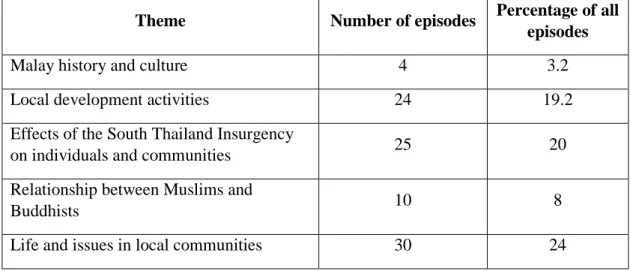
In order to answer the research objective of finding out mediated identity of Malay-Thai Muslim women, the researcher has looked for materials produced by Malay Muslim women which is scarce in number due to its limited audience. The researcher chose the first season of the radio program “Voices from the Women of the Southern Frontiers” (Hereafter, VWSF) as the material to be analyzed. The program is run by the Network of Civic Women for Peace, an NGO based in southern Thailand. It was first broadcast in 2010 in twelve local