Determinants of International Labor Migration from
Bangladesh: A Gravity Model of Panel Data
Muhammad Shariat Ullah
*Abstract
This paper presents empirical evidence on determinants of international migration from the perspective of a source country. It applies the gravity model to investigate panel data of emigrants from Bangladesh to 23 destinations during the period from 1995 to 2009. Empirical results under alternative specifications unveil that economic, demographic, and cultural factors have significant influence on emigration decision. However, marginal effects of cultural factors like religion and language are stronger than the other set of determinants. Furthermore, when considered as a group, the OECD countries were found to have a strikingly negative effect although such countries possess high per capita income and they accommodate the bulk portion of the world s immigrants. Hence, Bangladesh requires bolstering bilateral relations with the oil-rich Persian Gulf countries to stimulate manpower export. At the same time, institutional strengthening should be given priority to develop skilled manpower, to foster emigration in the OECD bloc, and to ensure proper management of the manpower export sector.
Keywords
Emigration, Remittances, Panel Data, Gravity Model, Bangladesh
JEL Classifi cation F22, F24
1. Introduction
Along with a rise in cross border trade and investment, the number of migrant 査読論文
* Correspondence to:Muhammad Shariat Ullah
Graduate School of Economics, Ritsumeikan University 1-1-1 Noji-Higashi, Kusatsu, Shiga 525-8577 Japan E-mail : [email protected]; [email protected]
workers has been increasing globally. According to the world migration report in 2010, the number of immigrants globally were 214 million, up from 150 million in 2000; and the fi gure is predicted to rise to 405 million by 2050 (International Organization for Migration, 2010). In congruence with the global trend, emigration from Bangladesh continues to rise as more and more people are searching for employment in the international labor market due to low income, intense unemployment, and high growth of a young population in the country. The World Bank (2011) estimated that there were 5.4 million Bangladeshi emigrants in the world that placed it as the second largest South Asian country of international labor supply and the sixth largest source of global immigration. International migration of manpower from Bangladesh is closely inter-linked with the country’s socio-economic prosperity. Employment in a foreign country serves as primary means of livelihood for millions of families at home. Apart from benefi ts at the household level, remittances earned by emigrants serve as a strategic component of macroeconomic stability and development. Expatriates’ remittances constitute a key source of offsetting ever widening deficits in Bangladesh’s current account. Earnings from remittances contributed to cover about 35% of import payments during the period from 2001 to 2010, compared to 22% during 1991-2000. After the readymade garments sector, manpower export generates the second highest foreign currency earnings in the country. Offi cially recorded infl ow of remittances was equivalent to 74% of total export receipts in 2010 and this fi gure would be much more if the infl ow of remittances through unoffi cial channels were taken into account. Furthermore, growth trends of receipts from expatriates’ remittances and merchandise exports signal that earnings from the former might exceed the latter in the future1. Remittances also became a key segment of Bangladesh’s GDP growth over the last decade. At the same time, stability of the country’s foreign exchange market heavily depends on remittances inflow. Under this scenario, fostering labor mobility in international markets emerges as the prime thrust sector for sustainable socio-economic development in Bangladesh.
As a result of the rapid rise in international labor fl ows, research on migration drew immense attention. Empirical literature on international migration can be grouped into three streams of analyses: (1) determinants of international labor migration; (2) relationship between international trade and immigration; and (3) migration and development linkage. Among others, Zavodny (1999), Clark et al. (2007) examined immigration to USA from different angles. Karemera et al. (2000) examined factors
infl uencing the size and composition of migration fl ows to the USA and Canada. Kim and Cohen (2010) studied determinants of international migration flows to 17 western industrialized countries as well as from 13 of these countries. Besides, Pedersen et al. (2008), Mayda (2007), and Lewer and Berg (2008) investigated panel data of migration fl ows into the OECD countries. All these studies enriched literature on immigration dynamics of advanced economies primarily from the host country perspective. The International Labor Offi ce – a wing of the International Labor Organization (ILO) – primarily analyzes migration dynamics of the least developed countries (LDCs) by focusing on migration trends and associated socio-economic impacts in the source country. Wickramasekara (2002) analyzed Asian migration including Bangladesh that mainly highlighted migration trends and composition. Besides, research by Abrar (2005), Refuge and Migratory Research Movement Unit (2002), and Siddiqui (2005) provided a descriptive picture of international labor migration from Bangladesh. All such studies are informative and useful to understand various facets of emigration and remittances in the economy of Bangladesh. Nevertheless, such studies lack any empirical analysis on the infl uence of economic, social, cultural, and historical factors affecting decision to emigrate. The present study therefore investigates panel data of international migration fl ows from Bangladesh to major destinations with the help of the gravity model to ascertain the factors governing the choice of emigration destinations. In the backdrop of growing signifi cance of labor mobility and remittances earnings in Bangladesh’s economy, this analysis aims to contribute to discern the potential locations for sending labor and also to suggest strategies for achieving targets. The rest of the paper is organized as follows: Section 2 briefly discusses various aspects of emigration and remittances; Section 3 provides methodology; Section 4 presents data sources and empirical results; and Section 5 gives a conclusion and suggests strategies for stimulating emigration in the future.
2. Various Dimensions of Emigration
2.1: Annual Outfl ow of Migrants
Figure 1 clearly evidences that legal labor migration from Bangladesh has maintained an upward trend over the decades. In particular, Bangladesh has witnessed a rapid rise in manpower export during the periods of 1991-1995 and 2006-2011. The number of annual legal emigrants has increased from 30,073 to 568,062 between 1980 and 2011. In addition to legal emigration, labor from Bangladesh also moves through illegal routes. Therefore,
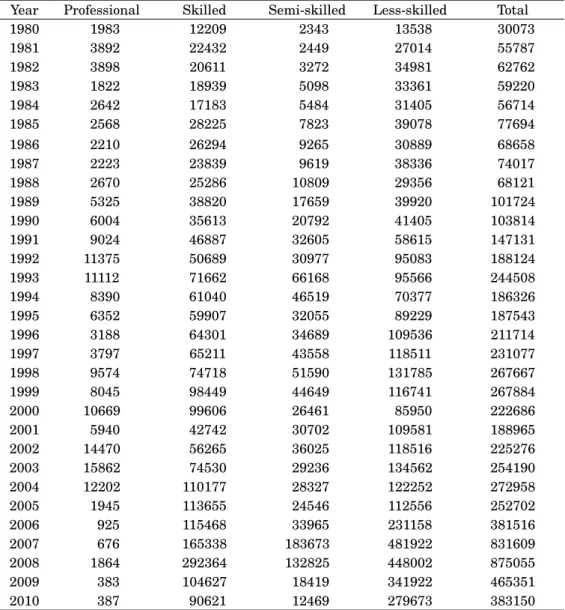
the actual number of annual emigrants would be much higher than the offi cial fi gures. The offi cial statistics by the Bangladesh Bureau of Manpower Employment and Training (BMET) reports that (see Appendix C), of the total emigrants in 2010, 73% were less-skilled or unless-skilled, 3.3% were semi-less-skilled, 23.6% were less-skilled, and 0.1% were professional. Thus, Bangladesh primarily supplies un-skilled manpower to international labor markets.
2.2: Infl ow of Remittances
Alongside the rapid growth in international migration from Bangladesh, remittances infl ow into the country has also sharply increased over time. In particular, remittances fl ow witnessed a remarkable rise since 2000. Bangladesh’s earnings from remittances in 2010 were fi ve times higher than that of 2000. Average growth rates of remittances were
Fig. 1: Number of Yearly Emigrants from Bangladesh (1980-2011)
Sources: (a) BMET: 1980-2010, (b) Bangladesh Bank: 2011
Fig. 2: Skill Composition of Emigrants
10%, 17% and 21% during 1996-2000, 2001-2005, and 2006-2010, respectively. However, the country achieved highest growth in remittances in the years 2002 and 2008. In both years, remittances grew at 36%. As a result of spectacular growth in remittances, its share to GDP continued to rise. Figure 4 revels that remittances’ contribution to GDP increased from 4% in 2000 to 10.5% in 2010. Modernization of the banking sector and growth of telecommunications services during the last decade positively contributed to mobilize remittances through the fi nancial intermediaries.
2.3: Emigrant Stocks
The stock of emigrants from Bangladesh globally stood at 5.4 million at the end of 2010 (World Bank, 2011). However, there are no offi cial statistics in Bangladesh showing its emigrant stocks in the world since data on return migrants are not maintained. Hence,
Fig 3: Bangladesh s Earnings from Remittances (1985-2010)
Source: The World Bank
Fig. 4: Earnings from Remittances (% of GDP)
numerous international data sources (see Table D in the Appendix) were accessed to compile emigrant stocks in some major countries over the last three decades and Fig. 5 exhibits stock trends. It is evident that Saudi Arabia accommodates the largest share of Bangladesh’s emigrants. The number of emigrants in Kuwait also signifi cantly increased between 2000 and 2010. Other major countries in the Gulf and Middle East regions including Oman, Malaysia, and United Arab Emirates also serve as import destinations for labor migration. Among the OECD countries, Great Britain, and the USA host a growing share of emigrants from Bangladesh.
3. Methodology
This study applies the gravity model as the empirical tool to ascertain the determinants of emigration decision. The gravity model has been well-proved as a robust ex-post methodology to model international trade and investment. Along with numerous applications of the gravity model in empirical studies of international economics, authors including Anderson (1979); Bergstrand (1985, 1989, 1990); Deardorff (1998); Evenett and Keller (2002); Feenstra et al. (2001); and Helpman (1987) provided theoretical justifi cation for the model. However, migration studies relying on the gravity model are fewer than those in the fi elds of trade and investment. Among others, Emmanuel et al. (2009); Karemera et al. (2000); and Lewer and Berg (2008) applied this model to analyze various
Fig. 5: Stock of Emigrants (1990-2010)
Source: Author’s compilation from various sources (see data sources in the Appendix A) Note: iso3 codes are the United Nations Standard Countries/Area codes used in trade data. See Table B in the Appendix for the country names corresponding to the iso3 codes.
facets of international labor migration. Some of these studies presented empirical estimates of factors infl uencing international migration while others examined the linkage between migration and development. Using different empirical settings, determinants of international migration has also been studied by Clark et al. (2007), Mayda (2007), and Pedersen (2004). In particular, Karemera et al. (2000) applied a modifi ed gravity model by incorporating political variable to investigate the factors infl uencing migration fl ows to North America. This study reported that demographic condition of the source country, civil and political rights of people at home, and income of the destination country were important determinants of migration fl ows to Canada and the USA. In the context of OECD countries, Lewer and Berg (2008) developed a gravity model of immigration and justified that immigration responds in a similar fashion of gravitational forces and distance.
Economic theory suggests that immigration is determined by a set of push and pull factors that are related to the source and destination country, respectively. The key push factor is income or wage difference between the sending and receiving country. Borjas (1987) found that migration fl ows was negatively related to origin-country income per capita. A study by Karemera et al. (2000) showed that source country income was negatively related to US migration but not in the case of migration to Canada. Another essential gravity factor for immigration is the population or size of labor market in the home and host country. Furthermore, international labor fl ows are restrained by migration cost that can be captured by geographic distance between source and destination country. Thus, the basic gravity model of migration is analogous to the specifi cation of Tinbergen’s gravity model of trade (Tinbergen, 1962). Equation 1 sets the basic gravity model with panel data.
M
ijt=β
0+β
1(S
ijt)+β
2(N
itN
jt)+β
3dist
ij+
εijt (1) where, Mijt represents immigration from country i to country j at time t; Sijt indicates GDP per capita of destination country relative to source country; Ni (Nj) stands for population of the source country i (destination country j); distij is the distance (in km) between source and destination country; and εijt is the normally distributed error term. The primary economic consideration for migration decision is income differences between home and host country. According to the labor market theory of immigration, a higher per capita income at home reduces propensity to emigrate while a higher per capita income ofrecipient country induces immigration. Under this consideration, β1 should have a positive effect on emigration decision. Population is the measure of labor market size in a country. The larger the size of labor pool in the source country, the higher the rate of emigration. Lewer and Berg (2008) argued that the larger the population in the destination country, the larger the labor market for immigrants. Hence, β2 is expected to have a positive sign. Geographic distance between host and home country is inversely related to emigration decision and therefore, β3 should have a negative sign.
The benchmark gravity equation 1 could be extended to include some historical and cultural factors that either ‘facilitate’ or ‘inhibit’ emigration. In addition to the variables found in previous studies on international migration, the present research incorporates two new factors: bilateral real exchange rates and commonality in religion between source and destination country. Thus, this study applies the specifi cation 2 of the gravity model to ascertain the determinants of emigration from Bangladesh.
M
ijt=β
0+β
1(S
ijt)+β
2(N
itN
jt)+β
3dist
ij+β
4Ex
ijt+β
5free
ijt+
β
6relg
ij+β
7comcol
ij+β
8lang
j+β
9OECD
jt+β
10Yrrowth
j+ε
ijt(2)
Equation 2 adds seven additional variables to equation 1. Exijt indicates real exchange rates between source and destination countries at time t which were calculated following Montenegro and Soloaga (2006). Bilateral exchange rates indicate the value of one unit of the source country’s currency against one unit of a destination country’s currency. A rise (fall) in the bilateral exchange rate indicates depreciation (appreciation) of the source country’s currency. The sign of β4 is not known from a ‘priori’ since no previous study on immigration included this variable. Bangladesh’s currency (country i) has undergone continuous depreciation over time that might have had two possible effects on immigration. Firstly, depreciation of domestic currency increases emigrants’ monetary outlay due to increases in job contract fee, transportation cost, and other agency fees. As a consequence of higher initial investment requirement, currency depreciation might negatively affect propensity to emigrate. Secondly, depreciation of local currency results in higher streams of income from remittances that can cause higher rate of emigration. Thus, the sign of β4 can be either positive or negative. The variable freeijt stands for the destination country’s index of freedom from corruption relative to source country which is one of the components of the Index of Economic Freedom devised by the World Heritage Foundation. A corruption free environment is likely to attract more immigrants since the
new entrant can expect fair treatment in the work place. Under such consideration, β5 should positively infl uence emigration decision. The variable relgij is a dummy indicating common religion between Bangladesh and country j. In this case, the dummy variable takes the value 1 if Bangladesh (country i) and destination country (country j) share a common religion, and 0 otherwise. Although commonality in religion is a key component of cultural similarity between two countries, no previous study has examined its possible effect on immigration. Since Bangladesh is predominantly a Muslim country, the usual prediction is that its people would be motivated to emigrate to other Muslim countries. In order to explore the role of history on immigration, the common colonial dummy (comcolij) is incorporated which equals 1 when two countries (country i and j) have had a common colonizer after 1945. It is expected that β7 should be positive. The variable lang j indicates whether country j is predominantly an English speaking country, and if so it takes the value 1, and 0 otherwise. Educated emigrants usually prefer to emigrate to an English speaking country due to ease of settlement. In the context of a rising education rate in Bangladesh, it is expected that β8 would be a positive motivator for emigration decision. The OECD dummy takes the value 1 if the destination country belongs to the OECD classifi cation of the World Bank, and 0 otherwise. The OECD countries are the major destinations for global immigration. However, such countries usually invite skilled migrants. Since Bangladesh mostly supplies unskilled labor, the OECD dummy should have a negative sign. The last variable in equation 2 is GDP growth rates of the host countries which capture the effects of economic cycle on emigration fl ows. This variable is hypothesized to have a positive sign because host countries’ economic boom pushes emigration while economic recession deters it.
In order to estimate the panel gravity equation 2, four alternative techniques are adopted: ordinary least squares (OLS), scaled ordinary least squares (SOLS), Tobit model, and fi xed effect (FE). Feenstra (2002) advocated that FE is the consistent technique for estimating the panel gravity equation of trade since this methodology overcomes the bias arising from the use of unilateral and bilateral variables in a single regression. Empirical works by Kandogan (2007, 2008) provided further evidences on the robustness of FE methodology. Clark et al. (2007) and Lewer and Berg (2008) adopted the fi xed effect method for analyzing migration issues. Apart from the FE estimation, the presence of missing values in bilateral migration fl ows for some years has motivated the researcher to apply alternative estimation techniques. Literature on the gravity model suggests that the
simplest solution to missing or zero values in a dependent variable is to omit those observations and confi ne estimation to the rest of the samples (truncated estimation). The second alternative approach to deal with missing data is to apply SOLS method, as done by Eichengreen and Irwin (1995). Moreover, some authors including Rose (2004), Soloaga and Winters (2001) have used the Tobit model (censored regression) in the presence of zero values in the data set.
4. Data and Empirical Results
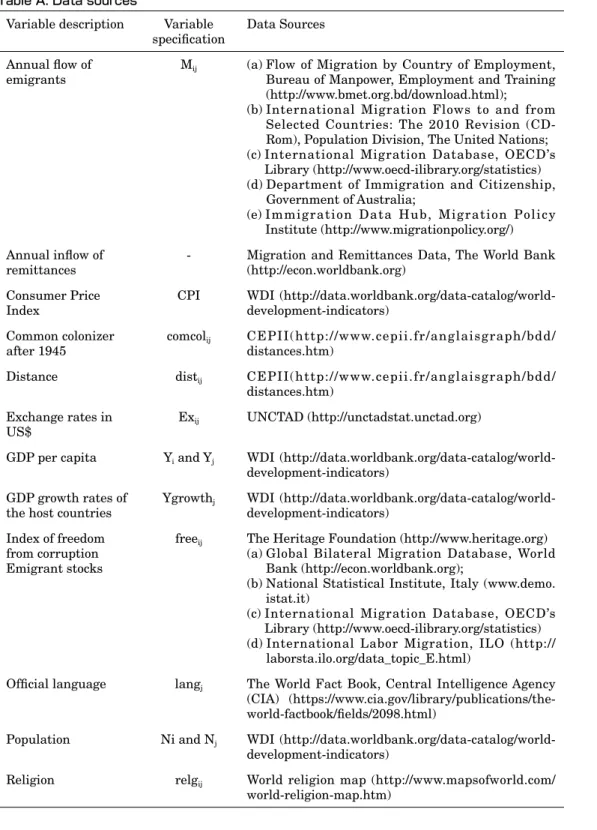
Panel data of emigration from Bangladesh to 23 major destinations over the period from 1995 to 2009 were compiled from various sources which are mentioned in Table A in the Appendix. GDP per capita (nominal value in US$), GDP growth rates, population, remittances, and consumer price index (CPI) data come from the World Bank’s World Development Indicators (WDI)2. The UNCTAD’s dataset provides the nominal exchange rates in US$ of source and destination countries. Distance between capital cities (in km) and common colonizer data were collected from the CEPII’s database. The data on religion was obtained from the World Religion Map. Offi cial language data of the sample countries were collected from the Central Intelligence Agency’s (CIA) The World Fact Book. The Index of freedom from corruption was taken from The Heritage Foundation’s Index of Economic Freedom.
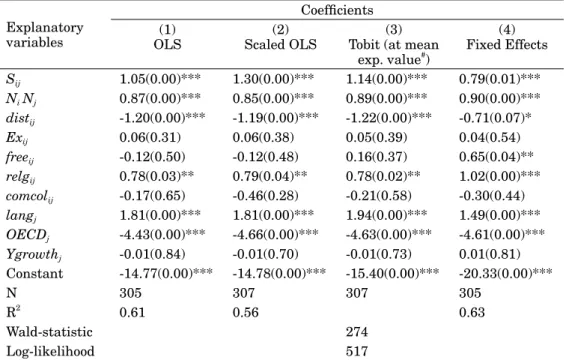
Empirical estimates reported in Table 1 reveal that economic, demographic, and cultural factors have signifi cant effects on emigration decision. The signs and signifi cance of the main gravity variables – income, population, and distance – fi t well with the literature. Among the variables representing historical and cultural dimensions, three variables – freeij, relgij Ygrowthj – produce subtle variant results under the alternative estimation techniques. In general, the estimated outputs under the OLS and SOLS are more comparable since all the parameters have similar signs and signifi cance levels under both of these regression techniques. There is no serial correlation and the error component is normally distributed. This study uncovers that missing values for a small number of observations do not cause any difference in the estimated outputs whether missing values are truncated or not. Thus, comparison of estimated results under the fi rst two techniques supports Baldwin’s (1994) conclusion that zero values do not have much impact on empirical results. However, estimated output in the fi rst two columns show that two
variables, namely, freeij (freedom from corruption in country j relative to country i) and
comcolij (common colonial history between country i and country j) do have a negative but insignifi cant effects on emigration. The two latter regression techniques including Tobit and fi xed effect (FE) correct the sign for freeij variable while the sign of comcolij remains unchanged. Moreover, results under the censored model (column 3) and FE model (column 4) as compared to OLS and SOLS show an increase in the level of signifi cance for the religion dummy (relgij). Thus, it appears that results under the censored regression and FE are more comparable than their OLS counterparts. Above all, estimations under the FE with period dummies fi t better with the theories on gravity and economics of migration decision. Because, FE method allows to incorporate time fi xed effects for accommodating cyclical infl uences. Hence, the subsequent explanations relate to the estimated results in column 4 using FE technique.
Table 1. Empirical Results Explanatory variables Coeffi cients (1) OLS (2) Scaled OLS (3) Tobit (at mean
exp. value# ) (4) Fixed Effects Sij 1.05(0.00)*** 1.30(0.00)*** 1.14(0.00)*** 0.79(0.01)*** NiNj 0.87(0.00)*** 0.85(0.00)*** 0.89(0.00)*** 0.90(0.00)*** distij -1.20(0.00)*** -1.19(0.00)*** -1.22(0.00)*** -0.71(0.07)* Exij 0.06(0.31) 0.06(0.38) 0.05(0.39) 0.04(0.54) freeij -0.12(0.50) -0.12(0.48) 0.16(0.37) 0.65(0.04)** relgij 0.78(0.03)** 0.79(0.04)** 0.78(0.02)** 1.02(0.00)*** comcolij -0.17(0.65) -0.46(0.28) -0.21(0.58) -0.30(0.44) langj 1.81(0.00)*** 1.81(0.00)*** 1.94(0.00)*** 1.49(0.00)*** OECDj -4.43(0.00)*** -4.66(0.00)*** -4.63(0.00)*** -4.61(0.00)*** Ygrowthj -0.01(0.84) -0.01(0.70) -0.01(0.73) 0.01(0.81) Constant -14.77(0.00)*** -14.78(0.00)*** -15.40(0.00)*** -20.33(0.00)*** N 305 307 307 305 R2 0.61 0.56 0.63 Wald-statistic 274 Log-likelihood 517
Notes: All but the dummy variables are in natural logarithms. P-values are in parenthesis. *, **, and ***, indicate significance at a 10%, 5% and 1 % level, respectively. It fails to reject the null hypothesis that the error term is normally distributed at any level of signifi cance since the probability of skewness of residual was 0.57. Standard errors were corrected for heteroskedasticity. Fixed effects estimation includes time dummies.
#
: Mean expected value for zero data in the dependent variable is generated based on the OLS results for non-zero observations.
Results in column 4 reveal that higher per capita income of destination countries relative to source country motivates emigration and the coeffi cient is signifi cant at a 1% level of significance. The demographic variable represented by the interaction of population in the country i and j shows a positive signifi cant effect. In line with the theory, longer distance between source and destination countries discourages emigration at a significant rate. However, FE shows a much lower degree of impact of distance on emigration fl ows since this method accounts the effects of time period. This reveals that the role of distance as a barrier to emigration has been decaying over time. Furthermore, although all the three main gravity variables appear as signifi cant determinants of labor migration from Bangladesh, the extent of marginal effects of the demographic factor is the highest. Depreciation of domestic currency was found to exert a positive but insignifi cant impact on emigration. The variable freeij indicates that the higher the freedom from corruption in country j relative to country i, higher is the rate of emigration. The coeffi cient of the freeij variable is signifi cant at a 5% level and signifi es that people have strong preference to emigrate in a corruption free destination. Two variables relating to cultural aspects such as relgij (common religion between source and destination country) and langj (dominantly English speaking destination) infl uence emigration positively and signifi cantly. The relgij dummy clearly demonstrates that common religion between home and host country has a profound infl uence on emigration rates3. Although English is not the fi rst language in Bangladesh, literate people understand English better than any other foreign language. With the increase in literacy rate (secondary school enrollment) in Bangladesh, it is likely that more and more emigrants prefer English speaking destinations. In particular, emigrants for long-term settlement in a foreign country have strong preference for English speaking countries. In order to capture the effects of economic cycle on emigration decision, this study included the GDP growth rates of the host countries (Ygrowthj). Although the estimation result has the hypothetical sign, the coeffi cient is insignifi cant at any level of signifi cance. This proves that economic growth of the destination countries does not constitute a sensitive factor of emigration flows Bangladesh. Finally, the OECD dummy shows a significant negative sign and it is acceptable since unskilled emigrants from Bangladesh mostly unfit with the labor requirements of the OECD countries. In this analysis, skilled manpower means people possessing technical and professional expertise. A signifi cant negative sign for the OECD dummy implies that non-OECD countries constitute the key destinations for international labor migration from Bangladesh. The non-OECD sample countries are mostly located in
Asia, have high per capita income and share more cultural similarities with Bangladesh.
5. Conclusion and Future Strategies
This study applies the well-known gravity model to empirically assess the determinants of international migration fl ows from Bangladesh – a critically important sector for sustainable socio-economic development in the country. Apart from the economic, demographic, historical, and cultural determinants of immigration found in the literature, the current research examined the possible effects of two new variables: bilateral real exchange rates and common religion between home and host country. In the presence of zero observation in the dependent variable, four alternative estimation techniques i.e. OLS, SOLS, Tobit, and FE were employed; and the FE methodology was found robust and superior than the other three. The fi ndings of the study unveil that along with economic and demographic factors, cultural similarities dominantly infl uence decision to emigrate. In general, high income non-OECD countries of the Gulf Cooperation Council (GCC) and the English speaking OECD countries were found as favorable destinations for emigration. The member states of the GCC and the OECD bloc usually invite different kinds of immigrants; as such the former group mainly offers contract employment for unskilled labor while the latter group mostly attracts skilled immigrants. Thus, usually two distinct kinds of emigrants move to the GCC and the OECD countries. Overall, countries in the Persian Gulf region remain the major destinations since Bangladesh mainly supplies unskilled manpower. Furthermore, the Gulf countries not only have higher income than Bangladesh but also share more cultural similarities with the latter and have a shorter geographic distance.
Besides, a number of studies i.e. Clark et al. (2007); Pedersen et al. (2008); Zavodny (1999); reveal a strong positive ‘network effect’ on immigration fl ows which means existing stock of emigrants in a particular country play a positive role to future emigration in the same destination. Thus, prospective emigrants from Bangladesh are more likely to emigrate in those destinations where the existing stock of own nationals is high. In contrary to this underpinning, emigration fl ows from Bangladesh to some of the Gulf and Middle East countries during the last few years declined substantially although emigration from other South Asian countries increased during the same time. This suggests failure of the regulatory agencies and institutions in Bangladesh to protect its
manpower export market through strengthening diplomatic relations and bilateral negotiations. Besides, cases of severe violation of law by some emigrants in some host countries and also emigration through illegal routes dampen the prospect of sending manpower. The outbreak of political turmoil in some of the Arab states might cause a further decline in demand for emigrant workers that might hurt economic emancipation of a large segment of population in Bangladesh. Furthermore, current emigration prospect to the OECD countries seems to dim due to rising unemployment rates and budget constraints caused by long persistent economic crisis. However, in the long run, demand for immigrants in some of the OECD countries including Japan and the Republic of Korea are expected to rise due to declining birth rates and aging populations. Under this circumstance diversifi ed strategies should be undertaken for sustainable development of manpower export as such; (1) strengthening bilateral relations with the GCC countries to expedite manpower export to those economies and also signing memorandum of understanding with the host country’s government to protect labor rights of emigrant workers; (2) tackling unlawful avenues of sending labor through active and supportive government intervention on recruitment agencies; (3) extending legal support to protect potential emigrants from harassment by recruitment agencies at the home and host countries; (4) imparting training to workers on foreign language, work rules, and law and order systems of the host countries prior to leaving for overseas employment; (5) designing strategic plans for sending technically skilled labors like nurses, electricians, plumbers, and carpenters; (6) exploring new market for manpower export and implementing supportive policies for building appropriate labor pool to meet the requirements of the receiving countries; (7) adopting the model of other countries like Indonesia and Philippines to materialize manpower export potentials in the OECD countries, particularly in Japan and the Republic of Korea. Above all, institutional strengthening should be prioritized for smooth management of manpower export and for sustaining congenial bilateral relations.
Acknowledgements
The author is thankful to the two anonymous referees for their helpful and constructive comments. The author would also like to gratefully acknowledge suggestions from Kazuo Inaba and Masayuki Okawa on earlier versions of the paper.
Notes:
1 Over the period of 2001-2010, average growth rates of remittances and exports in Bangladesh were 19.1% and 10.7 %, respectively.
2 Any missing data in the World Development Indicators (WDI) were collected from the International Financial Statistics (IFS).
3 Robustness of the religion dummy has been checked by using alternative regression specifi cations and by putting GCC dummy (dummy for the member states of the Gulf Cooperation Council) and OPEC dummy (dummy for the countries included in the Organization of Petroleum Exporting Countries) separately. The logic behind the framing of alternative dummies is that religion of all the GCC and the OPEC member countries included in the sample is similar to source country’s religion. All estimations reported positive signifi cant results for the alternative dummies without any change in the signs of other variables. Regression results with alternative dummies are not reported in the paper but can be obtained upon request.
Appendix
Table A: Data sources
Variable description Variable specifi cation
Data Sources
Annual fl ow of emigrants
Mij (a) Flow of Migration by Country of Employment,
Bureau of Manpower, Employment and Training (http://www.bmet.org.bd/download.html); (b) International Migration Flows to and from
Selected Countries: The 2010 Revision (CD-Rom), Population Division, The United Nations; (c) International Migration Database, OECD’s
Library (http://www.oecd-ilibrary.org/statistics) (d) Department of Immigration and Citizenship,
Government of Australia;
(e) I m m i g r a t i o n D a t a H u b , M i g r a t i o n P o l i c y Institute (http://www.migrationpolicy.org/) Annual infl ow of
remittances
- Migration and Remittances Data, The World Bank (http://econ.worldbank.org)
Consumer Price Index
CPI WDI (http://data.worldbank.org/data-catalog/world-development-indicators)
Common colonizer after 1945
comcolij CEPII(http://www.cepii.fr/anglaisgraph/bdd/
distances.htm)
Distance distij CEPII(http://www.cepii.fr/anglaisgraph/bdd/
distances.htm) Exchange rates in
US$
Exij UNCTAD (http://unctadstat.unctad.org)
GDP per capita Yi and Yj WDI
(http://data.worldbank.org/data-catalog/world-development-indicators) GDP growth rates of
the host countries
Ygrowthj WDI
(http://data.worldbank.org/data-catalog/world-development-indicators) Index of freedom
from corruption Emigrant stocks
freeij The Heritage Foundation (http://www.heritage.org)
(a) Global Bilateral Migration Database, World Bank (http://econ.worldbank.org);
(b) National Statistical Institute, Italy (www.demo. istat.it)
(c) International Migration Database, OECD’s Library (http://www.oecd-ilibrary.org/statistics) (d) International Labor Migration, ILO (http://
laborsta.ilo.org/data_topic_E.html)
Offi cial language langj The World Fact Book, Central Intelligence Agency
(CIA) (https://www.cia.gov/library/publications/the-world-factbook/fi elds/2098.html)
Population Ni and Nj WDI
(http://data.worldbank.org/data-catalog/world-development-indicators)
Religion relgij World religion map (http://www.mapsofworld.com/
Table B: List of destination countries included in the analysis:
Australia (AUS), Bahrain (BHR), Brunei Darussalam (BRN), Canada (CAN), Germany (DEU), Italy (ITA), Republic of Korea (KOR), Kuwait (KWT), Libyan Arab Jamahiriya (LBY), Malaysia (MYS), Mauritius (MUS), Netherlands (NLD), Norway (NOR), Oman (OMN), Qatar (QAT), Saudi Arabia (SAU), Singapore (SGP), Spain (ESP), Sudan (SDN), Sweden (SWE), United Arab Emirates (ARE), United Kingdom (GBR), United States of America (USA)
Note: iso3 codes shown in parenthesis are the United Nations Standard Countries/Area codes used in trade data.
Table C: Category-wise Overseas Employment from Bangladesh (1980-2010)
Year Professional Skilled Semi-skilled Less-skilled Total
1980 1983 12209 2343 13538 30073 1981 3892 22432 2449 27014 55787 1982 3898 20611 3272 34981 62762 1983 1822 18939 5098 33361 59220 1984 2642 17183 5484 31405 56714 1985 2568 28225 7823 39078 77694 1986 2210 26294 9265 30889 68658 1987 2223 23839 9619 38336 74017 1988 2670 25286 10809 29356 68121 1989 5325 38820 17659 39920 101724 1990 6004 35613 20792 41405 103814 1991 9024 46887 32605 58615 147131 1992 11375 50689 30977 95083 188124 1993 11112 71662 66168 95566 244508 1994 8390 61040 46519 70377 186326 1995 6352 59907 32055 89229 187543 1996 3188 64301 34689 109536 211714 1997 3797 65211 43558 118511 231077 1998 9574 74718 51590 131785 267667 1999 8045 98449 44649 116741 267884 2000 10669 99606 26461 85950 222686 2001 5940 42742 30702 109581 188965 2002 14470 56265 36025 118516 225276 2003 15862 74530 29236 134562 254190 2004 12202 110177 28327 122252 272958 2005 1945 113655 24546 112556 252702 2006 925 115468 33965 231158 381516 2007 676 165338 183673 481922 831609 2008 1864 292364 132825 448002 875055 2009 383 104627 18419 341922 465351 2010 387 90621 12469 279673 383150 Source: BMET
Table D: Stock of emigrants from Bangladesh (1990-2010) Destination country 1990 2000 2010 AUS 2237 8943 20497 BHR 7980 12198 n.a. BRN 663 943 1334 CAN 2277 21945 38684 DEU 4103 14155 7093 ITA 5134 23376 71830 JPN 3855 7151 11385 KOR n.a. 5148 5227 KWT 33157 31310 208893 MYS 37871 77856 122912 MUS 18 97 n.a. OMN 69525 102360 149275 QAT 10724 19135 n.a. SAU 338332 366007 447055 SGP 14569 16327 20432 ESP 1171 1214 8706 ARE 35862 61616 100668 GBR 107183 163655 210244 USA 23029 92655 148326
Note: n.a. indicates not available data
References
Abrar, C.R. (2005) Labor Migration from SAARC Countries: Reality and Dynamics, Refuge and
Migratory Movement Research Unit, University of Dhaka: Bangladesh. http://www.gurn.
info/en/topics/migration/research-and-trends-in-labour-migration/asia/study-on-labour-migration-from-saarc-countries-reality-and-dynamics (Accessed: 20 December 2011)
Anderson, J.E. (1979) A Theoretical Foundation for the Gravity Equation, American Economic
Review, 69(1):106-116
Baldwin, R.E. (1994) Towards an Integrated Europe, London: CEPR
Bangladesh Bank, Economic Trends (April 2012), Dhaka: Bangladesh. http://www.bangladesh-bank.org/pub/index.php (Accessed: 15 May 2012)
Bergstrand, J.H. (1985) The Gravity Equation in International Trade: Some Microeconomic Foundations and Empirical Evidence, The Review of Economics and Statistics, 67(3):474-481
Bergstrand, J.H. (1989) The Generalized Gravity Equation, Monopolistic Competition and the Factor Proportion Theory in International Trade, The Review of Economics and Statistics, 71(1):143-153
Bergstrand, J.H. (1990) The Heckscher-Ohlin-Samuelson Model, the Linder Hypothesis and the Determinants of Bilateral Intra-Industry Trade, Economic Journal, 100(403):1216-1229
BMET (Bureau of Manpower, Employment and Training), Dhaka: Bangladesh. http://www. bmet.org.bd/download.html (Accessed: 6 February 2011)
Borjas, J.G. (1987) Self-selection and the Earnings of Immigrants, American Economic Review, 77(4), 531-553
Clark, X., Timothy, J., J.G. Williamson (2007) Explaining U.S. Immigration, 1971-1998, The
Deardorff, A.V. (1998) Determinants of Bilateral Trade: Does Gravity Work in a Neoclassical World? In: Frankel J.A. (Ed.) The Regionalization of the World Economy, Chicago: University of Chicago Press, 7-32
Eichengreen, B., Irwin, D.A. (1995) Trade Blocs, Currency Blocs and Reorientation of World Trade in the 1930s, Journal of International Economics, 38(1-2):1-24
Emmanuel, L., Mark, P., Francisco, R., Mathew, C. (2009) Revisiting the Migration-Development Nexus: A Gravity Model Approach, Human Migration-Development Research Paper
2009/44, UNDP. http://mpra.ub.uni-muenchen.de/19227/ (Accessed: 10 January 2012)
Evenett, S.J., Keller, W. (2002) On Theories Explaining the Success of the Gravity Equation,
Journal of Political Economy, 110(2):281-316
Feenstra, R.C., Markusen, J.A., Rose, A.K. (2001) Using the Gravity Equation to Differentiate among Alternative Theories of Trade, The Canadian Journal of Economics, 34(2):430-447
Feenstra, R.C. (2002) Border Effects and the Gravity Equation: Consistent Methods for Estimation, Scottish Journal of Political Economy, 49(5):491-506
Helpman, E. (1987) Imperfect Competition and International Trade: Evidence from Fourteen Industrial Countries, Journal of Japanese and International Economics, 1(1):62-81
International Organization for Migration (2010) The Migration Report, Geneva: Switzerland
Kandogan, Y. (2007) Sensitivity of International Bloc’s Trade Effect to Alternative Specifi cations of the Gravity Equation, Journal of Applied Economics, 10(2):337-360
Kandogan, Y. (2008) Consistent Estimates of Regional Blocs’ Trade Effects, Review of
International Economics, 16(2):301-314
Karemera, D., Oguledo, V.I., Davis, B. (2000) A Gravity Model Analysis of International Migration to North America, Applied Economics, 32(13):1745-1755
Kim, K., Cohen, J.E. (2010) Determinants of International Migration Flows to and from Industrialized Countries: A panel Data Approach beyond Gravity, International Migration
Review, 44(4):899-932
Lewer J.J. and Berg, H. Van den (2008) A Gravity Model of Immigration, Economic Letters, 99(1):164-167
Mayda, A.M. (2007) International Migration: A Panel Data Analysis of the Determinants of Bilateral Flows, Center for Research and Analysis of Migration, Discussion Paper No. 07/07. http://eprints.ucl.ac.uk/14276/1/14276.pdf (Accessed: 4 May 2012)
Montenegro, C.E., Soloaga, I. (2006) NAFTA’s Trade Effects: New Evidence with Gravity Model,
Estudios de Economia, 33(1):45-63
Pedersen, P.J., Pytlikova, M., Smith, N. (2008) Selection and Network Effects-Migration fl ows into OECD Countries, European Economic Review, 52(7):1160-1186
Refuge and Migratory Research Movement Unit (2002) Recruitment and Placement of Bangladeshi Migrant Workers: An Evaluation of the Process, International Organization for
Migration (IOM), Regional Offi ce for South Asia. http://www.iom.org.bd/publications/15.pdf
(Accessed: 5 December 2011)
Rose, A.K. (2004) Do We Really Know That the WTO Increases Trade? American Economic
Review, 94(1): 98-114
Siddiqui, T. (2005) International Labor Migration from Bangladesh: A Decent Work Perspective,
International Labor Organization, Working Paper No. 66
Soloaga, I., Winters, L.A. (2001) Regionalism in the Nineties: What Effect on Trade? North
American Journal of Economics and Finance, 12(1):1-29
Tinbergen, J. (1962) Shaping the World Economy: Suggestions for an International Economic
Wickramasekara, P. (2002) Asian Labor Migration: Issues and Challenges in an Era of Globalization, International Labor Offi ce, International Migration Papers No. 57. http:// www.ilo.org/asia/whatwedo/publications/WCMS_160632/lang--en/index.htm (Accessed: 10 January 2012)
World Bank (2011) Migration and Remittances Fact Book 2011, 2nd Edition, Washington: USA
World Bank, Migration and Remittances Data, Washington: USA. http://econ.worldbank.org (Accessed: 8 April 2012)
Zavodny, M. (1999) Determinants of Recent Immigrants’ Locational Choices, The International