Relationships between the Use and Environment of an
Unagi-no-nedoko-like Green Space in Downtown Kyoto City
Akiko Niino
1, Junichi Imanishi
2, Katsue Fukamachi
2and Shozo Shibata
21 Graduate School of Agriculture, Kyoto University, Kyoto, Japan
2 Graduate School of Global Environmental Studies, Kyoto University, Kyoto, Japan
Corresponding author: Akiko Niino, Graduate School of Agriculture, Kyoto University, Kitashirakawa Oiwake-Cho, Sakyo-Ku, Kyoto, 606-8502, Japan, E-mail: [email protected]
Keywords: small urban space, image evaluation, behavior survey
Abstract: It is becoming necessary to consider the effective use of vacant lots that have developed due to the demolition of
Kyo-machiya (traditional houses) in Kyoto. These long, narrow lots are called Unagi-no-nedoko (“beds of eel”). Their spatial
characteristics might make them unsuitable as green spaces because there is the possibility of creating a dark, small, exclusive, and dangerous atmosphere. Thus, we investigated the influence of the environment of an Unagi–no-nedoko-like green space on user awareness and behavior. The results found that the inner area of the green space was as quiet as an indoor room and was recognized as a “relaxing” environment, which caused users to stay longer. Moreover, users found the whole area “large” and “open.” These findings demonstrate that the spatial characteristics of Unagi-no-nedoko do not necessarily make them uncomfortable as green spaces, and it is possible to use such lots as green spaces in downtown Kyoto.
1. Introduction
Kyo-machiya (traditional houses in Kyoto) are an important
component of the old-town atmosphere in Kyoto city. However, they have gradually been demolished: from 1948 to 2000, in the central part of Kyoto city, demolition of about 70% of
Kyo-machiya was confirmed by an investigation based on aerial
photograph interpretation (Kawasumi et al., 2003). Moreover, the results of the second Kyo-machiya Community Building Survey (2003) made it clear that 927 out of 7,308 Kyo-machiya that existed in 1998 had been demolished in the central parts of Kyoto city (Kamigyo-ku, Nakagyo-ku, Shimogyo-ku, and Higashiyama-ku), and about 20% of those had been replaced with parking or vacant lots. Thus, Kyoto city has two problems: how to prevent the demolition of traditional houses and how to effectively use the vacant lots that have appeared since their demolition.
Although Kyoto city has for many years been known for its beautiful scenery, there is insufficient green space in the city area. In 2008, 861 parks were open in Kyoto city, but their distribution deviated. There are especially few parks in the central city areas of Nakagyo-ku and Shimogyo-ku (Kyoto City, 2010). In response to this, Kyoto city is now carrying out many projects to prompt greening, but the city area contains a lot of private land, so there is little space for greening (Kyoto City, 2010). In order to solve these problems, it is important to study the usefulness of
Kyo-machiya sites as potential new green spaces.
It is thought that there might be some problems in the use of
Kyo-machiya sites as green spaces. Due to their spatial
characteristics—narrow frontage, close adjacency to houses, and long depth—they are called Unagi-no-nedoko (“beds of eel”). These characteristics cause Kyo-machiya sites to have the potential to be environments that are dark, small, exclusive, and dangerous, which are considered unsuitable characteristics for
green spaces. Through an analysis of the impressions that subjects acquired from photographs of the approach to open green spaces, the narrowness of the entrances to those spaces and the size of their walls were shown to be negative factors regarding the user’s desire to enter the spaces (Miyazono et al., 2002).
The space patterns of pocket parks all over the country have been typified (Kumano et al., 2002), but no case studies have yet examined the relationship between the use and spatial characteristics of no-nedoko. Thus, we selected a
Unagi-no-nedoko-like green space in the central part of Kyoto city as
our study area (there were no green spaces that actually used a
Kyo-machiya site) and examined how its spatial characteristics
influenced its users’ awareness and behaviors in order to consider the feasibility of using the same type of space as a green space in the future.
2. Methods
2.1. STUDY AREA
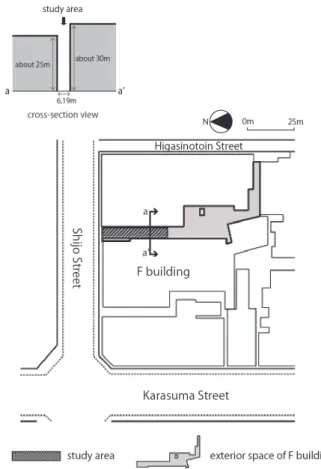
The study area (hereafter green space (GS), area = 220 m2) was
part of the exterior space of the F building, which is located on the southeast side of the intersection of Karasuma and Shijo Streets and has Unagi-no-nedoko-like spatial characteristics (Fig. 1). We did not include the other section of the exterior space of the F building because it contains no places for people to sit, so people only walk through it. The entrance section of the GS (90.67 m2) is called Naginataboko-Ryokuchi; it was opened on
April 1, 1998, and is owned by Kyoto city. The rest of the exterior space is owned by the proprietary company of the F
Fig 1. Map of the study area and the surrounding area building. Routine cleaning, planting management, and security in the GS are performed by the same company. Fig. 2 is a schematic view of the study area, which contains eight benches of four different types, two ashtrays, and a garbage can. The plantings are comprised of Japanese zelkova (Zelkova serrate), Japanese spurge (Pachysandra terminalis), flowering dogwood (Cornus florida), and Mondo grass (Ophiopogon japonicus). The space above the entrance to the GS is covered by a canopy of three Japanese zelkovas, and parts of the eastern and western walls of the GS contain reflective glass panels.The GS has the three spatial characteristics of Unagi-no-nedoko: its depth is long (39.6 m) from south to east, its frontage is narrow (6.19 m), and its east and west sides are interrupted by walls (cf. cross-section view in Fig. 1). As the GS is clearly distinguished by central
pillar P, we classified it into two areas based on the distance from Shijo Street: area A (0.0 m to 17.6 m) and area B (17.6 m to 39.6 m).
2.2. EXAMINATION METHOD
2.2.1. Noise Survey
As one of the environmental indicators in the GS, we conducted an attenuance survey of the noise from Shijo Street. We selected four weekend days with good weather for the survey dates and carried out surveys from 11:00 to 15:00 on October 14 and 21, 2012, and November 3 and 18, 2012. We used the noise SD card recorder SD-23SD (manufacturer: Sato Shoji, measuring range: 30 to 130 dB, resolution: 0.1 dB, frequency: 31.5 to 8000 Hz, frequency compensation circuit: A-weighting), which was set on a stand 1 m above the ground and took measurements every two seconds. The points of measurement were one point (a) at the entrance of the GS and five points (b to f) inside the GS, at equal intervals (8.8 m) along the measurement line (Fig. 2). We eliminated the noise values acquired during the time when traffic on Shijo Street increased unusually (due to the stopping of a campaign car or demonstration parade) as abnormal values in their influence on the GS environment.
2.2.2. Questionnaire Survey
The questionnaire survey was conducted on four weekdays (November 2, 7, 17, and 19, 2012) and three weekend days (November 3, 4, and 14, 2012) from 11:00 to 15:00 each day. We randomly distributed questionnaires to bench users in the two areas (A and B). We then asked them to answer the questions and collected their surveys on the spot.
First, we had the users evaluate the environment of the area via ten pairs of contrasting adjectives (Fig. 6) on a five-point scale (-2, -1, 0, 1, 2) (Survey 1). Among the questionnaires that we collected, we considered only those that contained effective answers to all questions. We then created an impression evaluation profile showing the average value of the users’ impression evaluation of each area’s environment and the 95% confidence interval of the average value. In order to compute the confidence interval, we used R version 2.15.2 (R Core Team, 2012) and the BCa bootstrap method by setting the number iterations at 10,000. We also asked all of the respondents if they had visited GS before (Survey 2).
2.2.3. Behavior Survey
We conducted behavior surveys in areas A and B on September 29, 2012, and October 21 and 24, 2012, from 11:00 to 15:00 each day. Study subjects were bench users who were sitting in the GS within the survey time.
Two investigators observed the users’ activity and length of stay and recorded them on the sheet associated with the specific position (cf. Fig. 2, points X and Y) in order to not disturb the users’ activity.
We counted the number of occurrences of each activity in each area and classified users’ activity based on existing classifications (Shirai et al., 2002). We analyzed the relevance of users’ sitting areas and activities through a chi-square test and performed a residual analysis. We also analyzed the differences in length of stay between the two areas using the Mann-Whitney U test (a two-sided test, α = 0.05). We excluded the activities that were counted less than five times in the two areas. We used IBM SPSS Statistics19 for all analyses except that of the impression evaluation profile.
3. Results and Discussion
3.1. NOISE SURVEY
The results of the noise survey are shown in Fig. 3. It became clear that the average noise value in the GS changed from 70.3 dB to 58.1 dB from point (a) (−4.4m) to point (f) (35.2 m). This noise value change is equivalent to the experience of moving from a major arterial road in the daytime to a quiet inner room. Thus, although GS is outdoors, its noise environment was found to be equivalent to that of an indoor location. We assume that its narrow entrance and the plantings along both side walls prevented the noise of the main street from entering GS.
Fig 3. The relevance of noise value and depth in the GS 3.2. QUESTIONNARE SURVEY
There were a total of 90 effective answers to the questionnaire surveys: 36 from area A users and 54 from area B users. Figs. 4 and 5 show the respondents’ age, gender, and occupation. The impression evaluation profile is shown in Fig. 6.
3.2.1. Survey 1
The results (Fig. 6) show that area A users felt there was more “green” in their area than area B users did. Since trees and groundcover plants are arranged near the GS entrance (Fig. 2),
Fig 4. The respondents’ age and gender
Fig 5. The respondents’ age and occupation
the users are believed to have evaluated the real green space conditions in the GS. On the other hand, although there are various types of plantings, both areas’ users showed a tendency to evaluate their areas as “artificial” spaces. The cause of this is believed to be the fact that the GS is an exterior space united with the F building, which makes it easy for users to have an inorganic impression of the space. Moreover, area B was evaluated as significantly more “relaxed” than area A.
Furthermore, although a significant difference was not observed, area B users showed a tendency to evaluate their environment as more “quiet” and “inconspicuous” than area A users. These results are considered to be compatible with the results of the noise survey and the spatial characteristics of GS.
It also became clear that users of both areas A and B evaluated the environment of each area as “large,” “open,” and “safe.” These factors are considered to have occurred because (1) parts of the eastern and western walls of the GS contain reflective glass panels, so users sensed that the space was larger than it actually is; (2) many office workers use the GS (Fig. 5) and tend to experience feelings of openness while outdoors; and (3) a guard regularly patrols GS.
Users of both areas A and B tended to evaluate their areas as “light.” We believe that this occurred because the GS is long in a north–south direction, and there are no tall buildings on the south side, so sunlight is free to enter the space.
3.2.2. Survey 2
The results show that 84 of the 90 respondents (about 93%) had visited the GS two or more times (Fig. 7). This result is a higher percentage than that found in previous research that investigated the number of people who repeatedly used an artificial green space (34 of the 58 respondents, about 59%) (Shirai et al., 2002).
6
84
new users repeat uers
Fig 7. The percentage of repeat users of GS
Many users called the GS “inconspicuous” in Survey 1, so we believe that one of the reasons why few new users visit GS is that, in spite of facing the main street, its narrow frontage makes the GS hard for pedestrians to find.
3.3. BEHAVIOR SURVEY
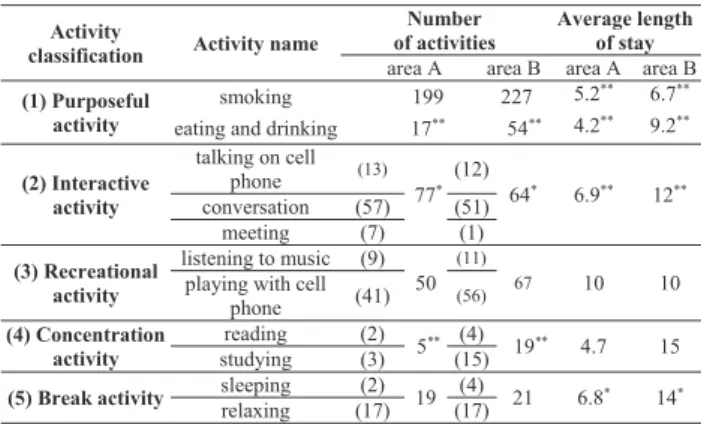
There were 11 activities observed in GS, which were divided into five groups. Table 1 shows the number of activities and average length of stay. It also shows the statistical test results regarding the differences in activity numbers and length of stay between the two areas.
3.3.1. Number of Activities
The most often observed activity was smoking, and the number of activities did not significantly differ between areas A and B. These factors are considered to have occurred because (1) the circumference of the GS is a nonsmoking street area, so GS plays
the role of a smoking space; (2) ashtrays are installed in both areas A and B; and (3) its location between tall buildings means that the GS has good ventilation.
Table 1. Average length of stay and number of activities in each area [**: P < 0.01, *: P < 0.05]
Moreover, (1) purposeful activities and (4) concentration activities were observed significantly more often in area B than in area A. Its distance from the main street, which contains many cars and pedestrians, is thought to make area B more suitable for the people who visit the GS on their lunch breaks, and a quiet space is more suitable for activities such as reading and studying. Thus, it is thought that users generally preferred area B to area A.
On the other hand, (2) interactive activities were observed significantly more often in area A than in area B. The cause of this is thought to be that area A is more visible from the main street than area B and is therefore more suitable for “waiting” activities.
3.3.2 Average Length of Stay
The statistical test results regarding the average length of stay for each activity (Table 1) showed that the average length of stay in area B was significantly longer than that of area A. It is likely that the quiet environment of the inner section of the GS caused users to stay longer. Regarding (4) concentration activities, although the difference in the average length of stay between the two areas was large (more than 10 minutes), it was not found to be significant due to the low number of activities (p = 0.059).
On the other hand, regarding (3) recreational activities, there was no significant difference in the average length of stay between the two areas. When users play with cellular phones, they concentrate on small screens. When users listen to music, they cover their ears with earphones. These recreational activities intercept outside stimulation, so it is thought that they are less influenced by their users’ surrounding environments.
4. Conclusion
The results of this investigation showed that, in spite of its outdoor location, the sound environment inside of the GS was equivalent to that of a quiet indoor space, and area B users stayed longer because they felt that their environment was more “relaxed” than area A users did. The cause of this difference is thought to be that the narrow frontage and long depth of the GS induced an environmental change and influenced users’ awareness and behavior. These findings show that the GS’s depth potentially makes it a comfortable space for its users.
Activity
classification Activity name
Number
of activities Average length of stay
area A area B area A area B
(1) Purposeful
activity smoking 199 227
5.2** 6.7**
eating and drinking 17** 54** 4.2** 9.2** (2) Interactive activity talking on cell phone (13) 77* (12) 64* 6.9** 12** conversation (57) (51) meeting (7) (1) (3) Recreational activity listening to music (9) 50 (11) 67 10 10
playing with cell
phone (41) (56)
(4) Concentration
activity studying (3) (15) reading (2) 5** (4) 19** 4.7 15
(5) Break activity sleeping (2) 19 (4) 21 6.8* 14*
Furthermore, the surveyed users gave positive evaluations of the space, such as “large,” “open,” and “safe,” in both of the study areas. Although the influence of the GS’s internal design and the southern exterior space adjacent to the GS were possible influential factors, this result indicates that the spatial characteristics of Unagi-no-nedoko do not necessarily make them unsuitable as urban open spaces, as shown in previous research (Miyazono et al., 2002). In other words, these results show that it is possible to use Unagi-no-nedoko-like spaces as urban green spaces.
Although the GS is a somewhat narrow, small space, differences in users’ behavior occurred due to its long depth. These findings indicate that, in order to make use of the unique spatial characteristics of Unagi-no-nedoko, it is important to consider compartmentalizing designs that will allow various activities to occur within long, open spaces.
References
Kawasumi, T., Yano, K., Kawahara, D., Inoue, M., & Iwakiri, S. (2003). Construction of the Kyo-machiya Time Space Database Using Aerial Photo Images. IPSJ Symposium Series 2003(21), 111-118 (in Japanese).
Kumano, M., Kameno, T., Maruyama, T., & Kamiura, M. (2002). The Purpose and Spatial Characteristics of Vest-Pocket Parks in Japan.
Journal of the Japanese Institute of Landscape Architecture 65(5),
801-804 (in Japanese).
Kyoto City. (2010). Kyoto City Master Plan for Parks and Open Spaces
15, 29 (in Japanese).
Kyoto City. (2004). Results of the Second Kyo-machiya
Community-Building Survey. Retrieved January 18, 2014, from
http://www.city.kyoto.lg.jp/tokei/cmsfiles/contents/0000004/4287/1 5_gaikan.pdf (in Japanese).
Miyazono, T., Hirate, K. & Munakata, J. (2002). Study on the Approaching Space of Open Spaces and Level of Resistance Felt upon Entry. Summaries of Technical Papers at the Annual Meeting
of the Architectural Institute Of Japan, D-1, 835-836 (in Japanese).
R Core Team. (2012). R: A Language and Environment for Statistical
Computing. R Foundation for Statistical Computing, Vienna,
Austria. Retrieved from http//www.R-project.org.
Shirai, Y., & Fukuda, Y. (2002). On the Necessity and the Possibility of Artificial Green Space in a City: The Case of the Commercial Institution in Hiroshima. Artificial Institute of Japan 25, 669-672 (in Japanese).
Sueoka, S., Uchida, H., & Kikuchi, H. (2009). An Investigation of the New Noise Level Index in Japan. Journal of Environmental