On
Breadth
First Construction of
OBDDs
Representing Maximal Independent Sets
Kazuyoshi HAYASE
早瀬千善
Department ofInformation Science University of Tokyo
東京大学理学部情報科学科
$\mathrm{e}$-mail
:
hayase@is.$\mathrm{s}.\mathrm{u}$-tokyo.$\mathrm{a}\mathrm{c}$.
jpAbstract
Breadth firstconstructionofOBDDs has beenproposed as an output-size sensitive algorithm to cope with a defect of conventional method. In this paper, we illvestigate applications of this method to the problems of independent, dominating, and maximal independent sets of a graph. A maximal independent set corresponds to a prime implicant of the function of independent sets and also of dominating sets. We show the difficulty in constructing the OBDD of maximal independent sets by the breadth first construction. But OBDDs ofthe two other functions can be obtained in an output-size sensitive manner
bythe breadth first algorithm and theOBDDofmaximal illdependent sets can beconstructed withthese two OBDDs, although not in a purelyoutput-size sensitive sense.
1
Introduction
OBDDs (Ordered Binary Decision Diagrams) are useful $1^{\cdot}\mathrm{e}\mathrm{p}_{\Gamma \mathrm{e}}\mathrm{s}\mathrm{e}\mathrm{n}\mathrm{t}\mathrm{a}\mathrm{t}\mathrm{i}\mathrm{o}\mathrm{n}\mathrm{S}$ for Boolean functions, which can be used for efficient manipulation [1]. Because of their good properties, OBDDs have been investigated
and applied tovariousfields such as design and formal verification of digital systems, combinatorics, and so
on. In combinatorial problelns, generatingand counting the number of all objects satisfying some condition
are sometimes needed, and these computation can be efficiently done with OBDDs.
In almost all the conventional $\mathrm{a}\mathrm{p}\mathrm{p}_{\mathrm{l}\mathrm{o}\mathrm{a}\mathrm{c}\mathrm{h}}\mathrm{e}\mathrm{s}$ using OBDDs, we have to represent problems in Boolean
expressions and apply Boolean operations repeatedly on OBDDs. By these methods, some intermediate
OBDDs may become much larger than the target OBDD and it is desired to construct OBDDs in some
output-size sensitive manner. In [7], a framework is proposed to resolve this difficulty by constructing
OBDDs directly in a top-down fashion from scratch with a breadth $\mathrm{f}\mathrm{f}\mathrm{i}\cdot \mathrm{s}\mathrm{t}$ algorithm. It has been shown that
thisalgorithmcan construct OBDDs with output-size sensitive complexity and be applied to some problems
in graphtheory.
The maximal independent sets problem is an interesting and important problem in graph theory and
therefore several efficient algorithmsfor generating maximal independent sets have been proposed [8, 5, 4].
One of merits to represent maximal independent sets by an OBDD is that we can generate and count the
number of allthe maximalindependent setswith it and its size is sometimesmuchsmaller than thenumber
of the sets.
Independent sets and dominating sets have some interestingrelationship to maximal independent sets.
The class of functions of independent sets is that of negative $2\mathrm{C}\mathrm{N}\mathrm{F}\mathrm{s}$ and that of dominating sets isasubclass
of positive CNFs of polynomial size. Andwe can identify anlaximalindependent set witha prime implicant
of the function representing independent sets or donlinating ones respectively. In other words, the sets
of the prime implicants of these two functions can be seen as a dual pair. Therefore generating maximal
independent sets can be seen as generating prime implicants of these two functions $[2, 6]$
.
Furthermore,since a set is maximal independent if and oldy if it is independent and dominating, we can construct an
OBDD of maximalindependent sets from the two OBDDs ofindependent sets and dominating ones.
In this paper, we investigate the complexity to construct the OBDD representingmaximalindependent
of making subproblems and testingequivalencebetween two subproblems. However the test of equivalence
between two problems or functions is intractable in general; for example, the problem ofequivalence test
between two Boolean expressions is known to be co-NP complete [3]. To support the equivalence test,
we should investigate problems to choose a good representation. Unfortunately, it will be shown that
the equivalence test between two subproblems of the problem of maximal independent sets is also co-NP
complete. This fact states that the OBDD representing maximal independent sets can not be constructed
efficiently by the algorithm as long as we encode subproblenms in a simple and $\mathrm{d}\mathrm{i}\mathrm{r}\mathrm{e}\dot{\mathrm{c}}\mathrm{t}$
way. On the other
hand, the twoproblems ofindependent sets anddominatingsets have much simpler structures thanthat of
maximal independent sets. We show how to apply the breadth first algorithm to these problems. Using the
resulting OBDDs, as mentioned above, we can construct an OBDD representing maximal independent sets,
althoughit may not always be done in output-size sensitive manner.
2
Preliminaries
In this section, we summarize basic notations ofOBDDs and introduce the breadth first algorithm.
2.1
$\mathrm{O}\mathrm{B}\mathrm{D}\mathrm{D}_{\mathrm{S}}[1]$An OBDD is a labelled directed acyclic graphrepresenting a Boolean function. Non-terminal nodes of
an OBDD are called variable nodes and ternlinal ones are constant ones. A variable node is labelled as a
Boolean variable and a constant one a constant$\mathrm{f}\iota \mathrm{m}\mathrm{c}\mathrm{t}\mathrm{i}\mathrm{o}\mathrm{n}$ ($0$ or 1). Thereis atotalorder onvariables and the
order of the labels of a path from a variable node to a constant node does not contradict it. In thefollowing,
this total order is assumed as $x_{1}<x_{2}<\ldots<x_{n}$ and we define the level of a variable node to be the
subscript ofits label. It is assumed that there is a rootnode and that its level is the smallest in the OBDD.
The Boolean value labelled to a constant node $v$ is denoted as $value[v]\in\{0,1\}$. The Boolean variable
labelled to a variable node$v$ is denoted as $indeX[v]\in\{x_{1,2,\ldots,n}xx\}$. Fromeach variable node $v$, there are
two outgoing edges labelled as $0$ and 1 and the two nodes directedby them are denoted as edge$(v, \mathrm{o})$ and
edge$(v, 1)$ respectively. For each node $v$, the Boolean function $F[v]$ represented by the subgraph rooted by
$v$ is defined as the following equations
$\{$
$F[v]=value[v]\in\{0,1\}$ if$v$ is a constant node
$F[v]=\overline{x_{i}}\cdot F[edge(v, 0)]+x_{i}\cdot F[edge(v, 1)]$ if$indeX[v]=x_{i}$ (1)
It has been known that there exist two canonical forms for a Boolean functionusing OBDDs and this is
one of the most delightful merits of OBDDs. These forms are the smallest in
some
senses, so we define two$\mathrm{k}\mathrm{i}11\mathrm{d}_{\mathrm{S}}$ of “unnecessary” nodes as follows.
A redundant node $v$
:
edge$(v, 0)=edge(v, 1)$Equivalent nodes $u,$$v$ : the two subgraphs rooted by $u$ and $v$ are isomorphic.
An OBDD without redundant nodes and equivalent nodes is called as an ROBDD (Reduced OBDD).
An OBDD without equivalent nodes and in which every pathfrom the root node to a terminal one consists
of$n+1$ nodesis called as a QOBDD (Quasi-reduced OBDD). As previously mentioned, it has been proved
that for any Boolean function there are an $\mathrm{R}O$BDD and a QOBDD representing it and that they are
uniquely determined up to isomorphism. It is trivial that the QOBDD is not smaller than the ROBDD for
any Boolean function, but the size ($=$ number of nodes) of the QOBDD is of the order of the number of
variables times the size of the ROBDD. We will consider mainly QOBDDs rather than ROBDDs for the
2.2
The Breadth
First
Algorithm for
Constructing
QOBDDs
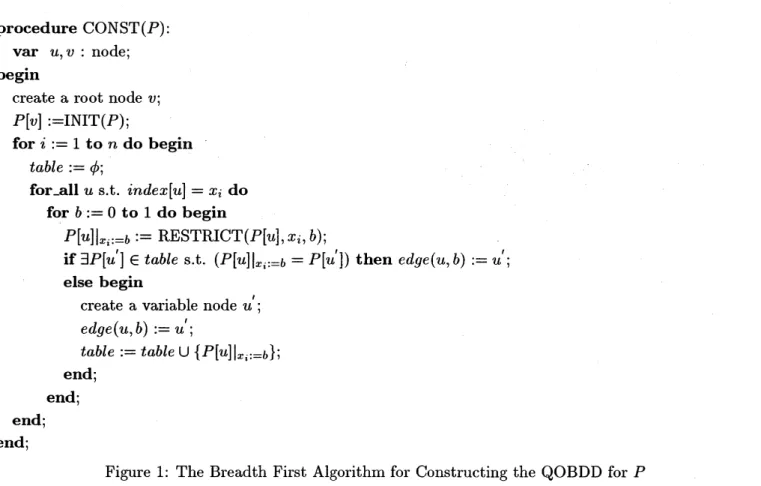
A breadth first algorithm for constructing a QOBDD based on (1) is proposed in [7], and Figure 1 shows
an outline of it. This algorithm uses an idea that resembles the branching operation of the$\mathrm{b}\mathrm{r}\mathrm{a}\mathrm{n}\mathrm{c}\mathrm{h}- \mathrm{a}\mathrm{n}\mathrm{d}- \mathrm{b}_{0}\mathrm{u}\mathrm{n}\mathrm{d}$ method.
Each node in an OBDD represents a Boolean function, and each subproblem in the $\mathrm{b}_{\Gamma}\mathrm{a}\mathrm{n}\mathrm{c}\mathrm{h}-\mathrm{a}\mathrm{n}\mathrm{d}-\mathrm{b}\mathrm{o}\mathrm{u}\mathrm{n}\mathrm{d}$
canbeseen as representinga Booleanfunction because thereexists a$\mathrm{o}\mathrm{n}\mathrm{e}- \mathrm{t}_{\mathrm{o}^{-}\mathrm{o}\mathrm{n}\mathrm{e}}$ correspondence between the
feasible solutions of the subproblem and the satisfying assignmentsof the Boolean function. (Asubproblem
$P|_{x}::=b_{*}.,xj.--bj,\ldots$ of a problem $P$ is defined by adding the constraints $x_{i}=b_{i},$$x_{j}=b_{j},$$\ldots$ to $P.$) We can
identify a subproblem with the corresponding function and consider a node $v$ in an
OBDD
as representinga subproblem $P[v]$. The level of$P[v]$ is defined to be the same as that of $v$.
An algorithmwhich constructs QOBDDs (for a specifiedproblem)is called output-sizesensitive ifit has
atime complexity of the order of a polynomial in the size of them and the number of variables. If we can
find good strategies for representing subproblems and testing equivalence
among
them, we can constructQOBDDs in output-size sensitive manner using this algoritllm.
procedure CONST$(P)$:
var $u,$$v$
:
node;begin
create aroot node $v$;
$P[v]$ $:=\mathrm{I}\mathrm{N}\mathrm{I}\mathrm{T}(P)$;
for$i:=1$ to $n$ do begin
table:$=\phi$;
for-all$u\mathrm{s}.\mathrm{t}$
.
$indeX[u]=x_{i}$ do for $b:=0$ to 1 do begin$P[u]|_{x:b}i=:=\mathrm{R}\mathrm{E}\mathrm{S}\mathrm{T}\mathrm{R}\mathrm{I}\mathrm{c}\mathrm{T}(P[u], Xi, b)$;
if$\exists P[u^{l}]\in$ table $\mathrm{s}.\mathrm{t}$. $(P[u]|x::=b=P)$ then edge$(u, b):=u’$;
else begin
create a variable node $u^{l}$
; edge$(u,b):=u^{l}$; table $:=table\cup\{P[u]|_{x:=}:b\}$; end; end; end; end;
Figure 1: The Breadth First Algorithmfor Constructing the QOBDD for $P$
3
OBDDs Representing Maximal
Independent Sets
In this section, we investigate the functions that represent the independent, maximal independent, and
dominating sets of a graph. Then, we examine the breadth first algorithm for these three problems.
3.1
Maximal Independent Sets and Boolean
Functions
Let $G=(V, E)$ be a simple undirected graph where $V=\{1,2, \ldots,n\}$ is the set of vertices and $E$ is the
Aset $S\subseteq V$ is calledindependent if any pairof vertices in $S$arenot adjacent to each other. A set $S\subseteq V$
is called maximal independent if$S$ is independent andthere is noindependent set that includes
properly $S$.
A set $S\subseteq V$ is called dominating if any vertex is in $S$ or has an adjacent vertex in $S$. Let IS$(G),$$DS(c)$,
and $MIS(G)$ denote the classes of all the subsets ofvertices that are independent, maximal independent, or
dominating, respectively. The next fact is wellknown in graph theory amongthese three classes.
Fact 3.1 A set$S\subseteq V$ is maximalindependent
iff
$S$ is independent and dominating.Here we introduce how we treat a class of subsets bymeans ofa Booleanfunction. Let $U$ be a finite set
$\{1, 2, \ldots, |U|\}$. The characteristic vector of $S$ on $U(S\subseteq \mathrm{U})\chi^{U}(S)$ is a $|U|$-dimensional Boolean vector in $\{0,1\}^{|U|}\mathrm{s}.\mathrm{t}$.
$\chi_{i}^{U}(s)=\{$
$0$ $(i\not\in S)$
1 $(i\in S)$
We identify an element of $U$ and the coordinate of$\mathrm{x}$ to which it corresponds, as long as there is no
ambiguity. The Boolean function $f_{C}$ representing the class $C$ of subsets of $U$ is defined as:
$f_{C}(\mathrm{X})=1\Leftrightarrow\exists S\in C\mathrm{S}.\mathrm{t}$. $\mathrm{x}=\chi^{U}(S)$
3.2
A Boolean Expression for Maximal Independent Sets
We can form Booleanexpressions of the functions $fIs(G),$$fDs(c)$, and $f_{MIS()}c$ as follows:
Proposition 3.1
$f_{IS(G)}$ $=$ $\wedge$ $(\neg x_{u}\mathrm{v}\neg X_{v})$ (2)
$(u,v)\in E$ $f_{DS()}c$ $=$
$\bigwedge_{v\in V}(X_{v}\mathrm{v} x_{u})$ (3)
$u\in^{\mathrm{r}(v)}$
$f_{MIS(}G)$ $=$ $f_{is()}G\wedge f_{D}S(G)$ (4)
The next proposition can be provedwhere $PI(f)$ denotes the set of the prime implicants of$f$.
Proposition 3.2 $f_{IS(G)}$ is negative and $f_{DS(G)}$ is positive. strategies
for
There exist two one-to-onecor-respondences $R_{IS(G)}$ between $MIS(G)$ and $PI(fIS(c))$, and $R_{DS(G)}$ between $MIS(G)$ and $PI(f_{DS(}G))$ as
follows.
$X= \bigwedge_{-v\in S}V\neg xv$
$\Leftrightarrow$
$(S,X)\in R_{IS()}c\subseteq MIS(c)\cross PI(f_{Ic)}s_{(})$
$X= \bigwedge_{v\in S}X_{v}$
$\Leftrightarrow$ $(S,X)\in R_{Ds}c)\subseteq(MIS(c)\mathrm{x}PI(f_{DS(}G))$
3.3
The QOBDDRepresenting
Maximal
IndependentSets
As stated in section 2.2, the breadth first algorithm requires goodstrategies for INIT and RESTRICT.
We concentrate on how these can be doneefficiently for the rest of this paper. Theessential problem ofthe
algorithmis that it requires equivalence test among subproblems. Inthe case of maximal independent sets
problem, its complexity is intractable because the followingproblem $\mathrm{E}\mathrm{Q}$, which would have to be solved if
Definition 3.1 Problem $EQ$: Given a graph $G$, an integer$j$ and two subsets
of
vertices $V_{1}$ and $V_{2}\subseteq V$.Let$U=\{j+1,j+2, \ldots , n\}\subseteq V$. Two Boolean
functions
$F_{1}$ ancl$F_{2}$ on the characteristic vectorof
a subset $X\subseteq U$ aredefined
as:$F_{i}(\chi^{U}(X))=1\Leftrightarrow(V_{i}\cup X)\in MIS(G)$ $(i=1,2)$
Decide whether $F_{1}=F_{2}$ or not.
Theorem 3.1 The problem $EQ$ is co-NP complete.
Proof: It is easy tosee that EQ $\in$ co-NP. We will show a polynomialtimereduction from$3\mathrm{S}\mathrm{A}\mathrm{T}$like in [4].
An instance of$3\mathrm{S}\mathrm{A}\mathrm{T}$is given as a set of clauses $\{c_{1}, C_{2}, \ldots, c_{m}\}$ and aset of variables $\{x_{1,2,\ldots,n}xx\}$ where
a clause $c_{i}=\{l_{i1}, l_{i}2, li3\}$
.
We will construct a graph $G$ indicated as follows. $G$ has a vertex for a clause, avertexfor a literal and an additional vertex $a$. The vertex $a$ is adjacent to all the others, and $x_{i}$ is adjacent
to $\neg x_{i}$. For a clause ci, there are three edges: (ci,$l_{i1}$), (ci,$l_{i2}$),$(c_{i}, l_{i3})$. Set $j=m+1,$ $V_{1}=\{a, c_{1}\}$, and
$V_{2}=\emptyset$
.
Let the order of the vertices be as follows:
$a<c_{1}<c_{2}<\ldots<c_{m}<x_{1}<\neg x_{1}<x_{2}<\neg x_{2}<\ldots<x_{n}<\neg x_{n}$
$F_{1}=\perp \mathrm{i}\mathrm{s}$ obvious by the definition of $MIS(G)$. We can consider that an truth assignment $A$ of $3\mathrm{S}\mathrm{A}\mathrm{T}$
gives an independent set $X_{A}=\{(\neg)X_{i}\in A|1\leq i\leq n\}$ of$G$ and only such a set can be maximal under
$V_{2}=\emptyset$
.
If$F_{1}=F_{2}$, on the other hand, we can conclude that any $A$ does not satisfy all the clauses because$X_{A}$ is not maximal and there must be a vertex $c_{i}$ that is not dominated by $X_{A}$.
$\square$
Notethatwe can not conclude that there isno possibility to construct the QOBDD representing$f_{MIS()}c$
with an output-size sensitive complexityevenwiththis fact and $NP\neq P$
.
Wemight be able to findanotherapproachtoconstruct the QOBDD or a good representationofsubproblems and strategy to solvethishard
problem.
3.4
QOBDDs for Independent Sets and
Dominating
Sets
Here we show two strategies for the problems of independent sets and dominating sets. As mentioned
above, an OBDD that represents $f_{MIS()}c$ can be constructed with a strategy that uses these twostrategies
although it may not always be a QOBDD because of its equivalent nodes.
In thefollowing, UNFIX$[i]=\{x_{j}|j\geq i\}$denotes the set of the variablesthat are notfixedin subproblems
oflevel $i$. If a subproblem is found to be inconsistency (0) or tautology (1), it is represented as $\perp \mathrm{o}\mathrm{r}\mathrm{T}$,
respectively, and exceptionally processed, but that will not be mentioned explicitly.
3.4.1 The QOBDD Representing Independent Sets
Herewe show a strategy forthe independent set problem. Ifwefix avariable $x_{i}$ to be 1 in a subproblem
$P_{a}$ where somevertex$v$in $\Gamma(x_{i})$ has been fixedto be 1, the subproblem$P_{a}|_{x_{i}:=1}$ canbe decided to $\mathrm{b}\mathrm{e}\perp$. So
a subproblem $P_{a}$ canbe represented by the set that consists of unfixed variables that have adjacent vertices
that have been fixed to be 1. Figure 2shows the strategies for $f_{IS()}c$ based on this consideration.
Theorem 3.2 The OBDD constructed by the strategies indicated in figure 2 is the QOBDD representing
function INIT$(G)$: problem;
return $\emptyset$;
function RESTRICT$(P[u], Xi, b)$
:
problem;begin
if$b=0$ then return $P[u]-\{x_{i}\}$;
else if $x_{i}\in P[u]$ then return $\perp$;
else return $P[u]\cup$ ($\Gamma(x_{i})\cap$ UNFIX$[i+1]$);
end;
Figure 2: The Strategies for Independent Sets
3.4.2 The QOBDD Representing Dominating Sets
In this section, we show a strategy for the dominating sets problem. We
investigate
difference betweenthe Boolean expressions of independent sets and dominating sets. Equation (2) gives a positive $2\mathrm{C}\mathrm{N}\mathrm{F}$ of
$f_{IS()}c$ and the strategy described in the previous section can be recognized to compute a canonical form
ofeach subproblem in a sense. So we expect that we could get a similar strategy for $f_{DS(G)}$ by computing
canonical forms. Here we describe a strategyfor $fDS(G)$ only, but it can be applied to a little wider class of
expressions.
We introduce an equivalencerelation $\equiv_{i}$ on $V$ basedon the set ofunfixed adjacentvertices ofeachnode.
Define a partial order $\prec_{i}$ on the quotient set $V/\equiv_{i}$ of the relation $\equiv_{i}$. Note that we define only a partial
order on $V/\equiv_{i}$, but we can define a total order on it and we use it to indicate subscript of a characteristic
vectoron $V\not\in\underline{=}_{i}$.
Definition 3.2
II$i(x_{p})$ $:=$ UNFIX$[i]\cap(\Gamma(x)P\cup\{x_{p}\})$ $(\forall x_{p}\in V)$
$x_{p}\equiv_{i^{X_{q}}}$ $\Leftrightarrow$ $\Pi_{i}(x_{p})=\square i(_{X}q)$ $(\forall x_{p}, X_{q}\in V)$
II$i(S)$ $:=$ $\Pi_{i}(x)$ $(\forall x\in V, S\in V\mathcal{F}-i\mathrm{s}.\mathrm{t}. x\in S)$ $S\prec_{i}T$ $\Leftrightarrow$ II$i(S)\subset\Pi_{i}(T)$ $(\forall S, T\in V\neq\underline{=}_{i}\mathrm{s}.\mathrm{t}.S\neq T)$
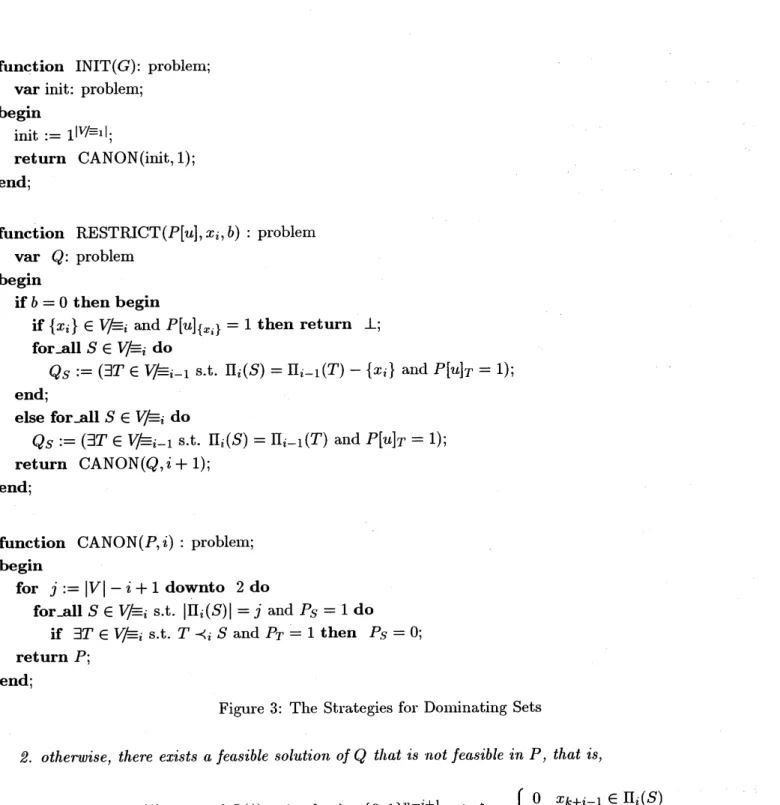
Thestrategy (Figure 3) represents a subproblem of level$i$ with acharacteristicvectoron $V\mathcal{F}-i$
.
Weprovethat the strategy constructs the QOBDD representing$f_{DS(G)}$
.
Proposition 3.3 $Vt–i$ is a
refinement of
$V\mathcal{F}-j$if
$i\leq j$.Lemma 3.1 For an equivalence class $S$ and a subproblem $P$
of
level $i$ that is not decided to $be\perp$, thefollowing is true where $POS(P)$ denotes the set
of
variables that arefixed
to be 1 in the subproblem $P$.$P_{S}=1$ $\Leftrightarrow$ $(\mathrm{a})$“$\exists x\in S$, $\Pi_{1}(x)\cap POS(P)=\emptyset$” and $(\mathrm{b})$“$\forall T\prec_{i}S$, $P_{T}=0$”
Lemma 3.2 Assume that two subproblems $P$ and $Q$ in level $i$ are given and $P\not\leq Q,$ $i.e$. there exists an
equivalence $clas\mathit{8}S$ in level$i$ such that $P_{S}=1$ and$Qs=0$, then the following holds:
1.
if
there exists$T$ such that$T\prec_{i}S$ and $Q_{T}=1$, there exists afeasible
solution in $P$ but is not in $Q$.That is the next equation holds:
$P(\xi)=1$ and$Q(\xi)=0$
for
$\xi\in\{0,1\}n-i+1s.t$.
$\xi_{k}=\{$$0$ $x_{k+i-}1\in \mathrm{I}\mathrm{I}_{i}(T)$
function INIT$(G)$: problem;
var
init: problem;begin
init $:=1^{|V/\equiv_{1}|}$;
return CANON$(\mathrm{i}\mathrm{n}\mathrm{i}\mathrm{t}, 1)$;
end;
function RESTRICT$(P[u], Xi, b)$
:
problemvar
$Q$: problembegin
if$b=0$ then begin
if $\{x_{i}\}\in V\mathcal{F}-i$ and $P[u]_{\{:}x\}=1$ then return $\perp$;
for-all $S\in Vf\underline{=}_{i}$ do
$Q_{S}:=$ ($\exists T\in V\neq\underline{=}_{i-1}\mathrm{s}.\mathrm{t}$
.
$\Pi_{i}(S)=\Pi_{i-1}(\tau)-\{x_{i}\}$ and $P[u]_{T}=1$);end;
else for-all$S\in V\mathcal{F}-i$ do
$Qs:=$ ($\exists T\in Vk-i-1\mathrm{s}.\mathrm{t}$
.
$\mathrm{I}\mathrm{I}_{i}(S)=\Pi_{i-1}(T)$ and $P[u]\tau=1$);return CANON$(Q, i+1)$;
end;
function CANON$(P, i)$ : problem;
begin
for $j:=|V|-i+1$ downto 2 do
for-all$S\in V/\underline{=}_{i}\mathrm{s}.\mathrm{t}$. $|\Pi_{i}(S)|=j$ and $P_{S}=1$ do
if $\exists T\in Vt--_{i}\mathrm{s}.\mathrm{t}$. $T\prec_{i}S$ and $P_{T}=1$ then $Ps=0$;
return $P$;
end;
Figure 3: The $\mathrm{S}\mathrm{t}_{1}\cdot \mathrm{a}\mathrm{t}\mathrm{e}\mathrm{g}\mathrm{i}\mathrm{e}\mathrm{s}$for Dominating Sets
2. otherwise, there exists a
feasible
solutionof
$Q$ that is not$fea\mathit{8}ible$ in $P$, that is,$P(\xi)=0$ and$Q(\xi)=1$
for
$\xi\in\{0,1\}^{n-i}+1s.t$. $\xi_{k}=\{$$0$ $x_{k+i-}1\in\Pi_{i}(S)$
1 otherwise
Theorem 3.3 The OBDD constructed by the strategies indicated in Figure 3 is the QOBDD representing
$f_{DS(c)}$.
Proof: A subproblem $P$ is decided to $\mathrm{b}\mathrm{e}\perp \mathrm{i}\mathrm{f}\mathrm{f}P=Q|_{x_{i}:=}0$ and $Q_{\{x\}}:=1$. Then any $x$ in $\Pi_{1}(x_{i})$ is fixed
to be$0$ in$P$ bylemma 3.1. It proves that $P$ has nofeasible solution and that the OBDD represents$f_{DS(G)}$
.
Furthermore we can confirm the OBDD is a QOBDD bylemma 3.2. $\square$
We can
see
that a characteristic vector$P$ indicates whichclauses ofequation (3) are left inthesubprob-lem. Therefore we can also devise a similar strategy for positive CNFs because they have unique smallest
forms and we
can
compute them as canonical forms.Furthermore, as noticed above, we can obtain an OBDD representing $MIS(G)$ using the strategies for
IS$(G)$ and $DS(G)$ in top-down$\mathrm{f}\mathrm{a}\mathrm{s}\mathrm{l}\dot{\mathrm{u}}\mathrm{o}\mathrm{n}$,
although this OBDD may not be a QOBDD because we could make
equivalent nodes and therefore it may not be in a purely output-size sensitive manner.
4
Conclusion
We have investigated an application of the breadth first algoritlum for constructing QOBDDs to the
problems of the independent sets, dominating sets, and maximal independent sets ofa graph. It has been
shown that we have to solve a hard problem to construct the QOBDD of the maximal independent sets
in breadth first manner, although we have shown strategies to apply the algorithm to the problems of
independent sets and dominating sets usingtheir monotonicity.
As future works, we will study possibility to construct the QOBDD of maximal independent sets in
output-sizesensitive manner and to apply the breadth first algorithm whenthe input is limited to a certain
class. We also investigate relationships between the size of the QOBDD of maximal independent sets and
that ofindependent or $\mathrm{d}_{\mathrm{o}\mathrm{n}\dot{\mathrm{u}}\mathrm{n}\mathrm{a}}\mathrm{t}\mathrm{i}\mathrm{n}\mathrm{g}$ sets.
Acknowledgement
The author would like to thank members of Imai $1\mathrm{a}\mathrm{b}\mathrm{o}\mathrm{r}\mathrm{a}\mathrm{t}_{0}\mathrm{r}\mathrm{y}.\mathrm{f}\mathrm{o}\mathrm{r}$theirhelpful discussions and comments
tothis work.
References
[1] R. E. Bryant. Graph-based algorithms for Boolean function nlanipulation. IEEE Trans. on Computers,
$\mathrm{C}- 35(8):677-691$, 1986.
[2] O. Coudert and J. C. Madre. Implicit and incremental computation of primes and essential primes of
Boolean functions. In Proc. 29th $ACM/IEEE$ DAC, pages 36-39, 1992.
[3] M. R. Garey and D. S. Johnson. Computers and Intractability: A Guide to the Theory
of
NP-completeness. W.H.Freeman, 1979.
[4] D. S. Johnson, M. Yannakakis, and H. Papadimitriou. On generating all maximal independent sets.
Information
Proce8sing Letters, 27:119-123,1988.
[5] E. L. Lawler, J. K. Lenstra, and A. H. G. Rinnooy Kan. Generating all maximal independent sets:
$NP$-hardness and polynomial-time algorithms. SIAM J. Comput., $9(3):558-565$,
1980.
[6] S. Minato. Fast generation of prime-irredundant covers from binary decision diagrams. IEICE Trans.
Fundamentals, $\mathrm{E}76- \mathrm{A}:967^{-}973$, 1993.
[7] S. Tani and H. Imai. A reordering operation for an ordered binary decision diagram and an extended
framework for combinatorics of graphs. In ISAAC’94, Lecture Notes in ComputerScience, volume 834,
pages 575-583,
1994.
[8] S. Tsukiyama, M. Ide, H. Ariyoshi, and I. $\mathrm{S}\mathrm{h}\dot{\mathrm{n}}\cdot \mathrm{a}\mathrm{k}\mathrm{a}\mathrm{W}\mathrm{a}$. A new algorithm for generating all the maximal