Continuous, Discrete,
Ultradiscrete
Waves
TAKAHASHI Daisuke (
高橋大輔
)
Dept.
of Mathematical Sciences, (
数理科学科
)
Waseda Univ. (
早稲
大学
)
1
Introduction to Ultradiscretization
‘Ultradiscretization’ is a technique to discretize dependent variable of
differ-ence equations. Using this technique, we can obtain universal mathematical
structure among differentialequations, difference equations and digital equa-tions. The following is one example on the diffusion equation,
$g_{t}=gxx$. (1)
We have a difference analogue to the above equation,
$f_{j}^{n+1}= \frac{1}{2}(f_{j+}^{n}1+f_{j-1}n)$. (2)
If we use the following transformation,
$f_{j}^{n}=\exp(F_{j}^{n}/\epsilon)$, (3)
we obtain from (2),
$F_{j}^{n+1}=\mathcal{E}\log(e^{F_{j+1}^{n}}/\mathcal{E}+e^{F_{j}^{n}}-1/\epsilon)-\mathcal{E}\log 2$
.
(4)Taking $\epsilonarrow+0$ and using an identity
we obtain
$F_{j}^{n+1}= \max(F_{j+1}^{n}, F_{j-1}^{n})$. (6)
Note that $F_{j}^{n}$ are always integer if initial $F$ are all integer. In this meaning,
we discretize a dependent variable in (2) and obtain (6).
In the above discretizing process, we only use atransformation of variable (3) and an identity (5). Therefore, this technique can be applied to other equations including nonlinear ones. We call this kind of discretizing process on dependent variable ‘ultradiscretization’.
The second example is Burgers equation. It is well known Burgers equa-tion can be linearized through Cole-Hopf transformation.
$\{$
$g_{t}=g_{xx}$ (diffusion eq.)
$\uparrow$ $v=(\log g)_{x}$ (Cole-Hopf trans.)
$v_{t}=2vv_{x}+v_{xx}$ (Burgers eq.)
(7)
We can obtain a difference analogue to the above system,
$|_{u_{j}}^{f_{j}^{n}}n+1n \frac{=1}{\triangle}\log(e_{\triangle xu^{n}J-}^{-\Delta x}J^{-1f)}e^{\Delta x})u^{n}u_{j+}\mathrm{t}\uparrow u\frac{1}{-1x\triangle x\{}j(n\mathrm{g}\mathrm{o}f_{j+}^{n}1\mathrm{g}j(\mathrm{d}\mathrm{i}\mathrm{f}\mathrm{f}\mathrm{e}_{\mathrm{i}}\mathrm{r}\mathrm{e}\mathrm{n}\mathrm{c}\mathrm{e}\mathrm{C}\mathrm{o}1\mathrm{e}\mathrm{H}\mathrm{o}\mathrm{p}\mathrm{f}\mathrm{r}\mathrm{a}\mathrm{o}\mathrm{n}$ S
$+1=u_{j}+= \frac{1}{2}(f_{j+1}n+f_{j-}^{n_{\mathrm{l}}}1)\mathrm{o}\mathrm{g}(e-1^{+}+e)(\mathrm{d}\mathrm{i}\mathrm{f}\mathrm{f}\mathrm{e}\mathrm{r}_{\Delta}\mathrm{e}\mathrm{n}xnu_{j}^{n}\mathrm{C}\mathrm{e}_{1}\mathrm{d}\mathrm{i}n\}\mathrm{f}\mathrm{f}\mathrm{u}\mathrm{S}\mathrm{i}_{\mathrm{o}\mathrm{n}\mathrm{e}\mathrm{q}.)}(\mathrm{d}\mathrm{f}\mathrm{f}\mathrm{e}\mathrm{r}\mathrm{e}\mathrm{n}\mathrm{C}\mathrm{e}\mathrm{B}^{-}\mathrm{u}\mathrm{r}\mathrm{g}\mathrm{e}\mathrm{r}\mathrm{S}\mathrm{e}\mathrm{q}.).)$
(8)
Moreover, if we use the following transformations of variables,
and take a limit $\epsilonarrow+0$, we obtain
$\{$
$F_{j}^{n+1}= \max(F_{j+1}^{n}, F_{j-1}^{n})$ (ultradiscrete diffusion eq.)
$\downarrow$
$U_{j}^{n}=F^{n}-F^{n}j+1j+1/2$ (ultradiscrete Cole-Hopftrans.)
$U_{j}^{n+1}=U_{j}^{n}+ \min(U_{j-1}^{n},1-U_{j}^{n})-\min(U_{j}n, 1-U_{j+1}^{n})$
(ultradiscrete Burgers eq.)
(10)
Ifall initial $U’ \mathrm{s}$ are integer in
$\mathrm{u}$-Burgers $\mathrm{e}\mathrm{q},$
$U’ \mathrm{s}$ at any time become integer.
(In this case, $F$ may be half integer but is also discretized.)
Moreover, assuming that initial $U’ \mathrm{s}$ are all $0$ or 1, we can easily show
$U’ \mathrm{s}$ at any time also become $0$
or 1. Under this restriction of values, we can consider that $\mathrm{u}$-Burgers equation is a cellular automaton
$(\mathrm{C}\mathrm{A})$ with state
values $0$ and 1. This CA follows a time evolution rule,
$\frac{U_{j-1}^{n}U_{jj+}^{n}U^{n}1}{U_{j}^{n+1}}$ : $\frac{000}{0}\frac{001}{0}\frac{010}{0}\frac{011}{1}\frac{100}{1}\frac{101}{1}\frac{110}{0}\frac{111}{1}$, (11) and it is equivalent to the rule-184 elementary CA after Wolfram. Note
that there is a common linearization structure among Burgers, d-Burgers
and $\mathrm{u}$-Burgers equations, we can propose their
explicit solutions through
diffusion equation, even to $\mathrm{u}$-Burgers equation. Especially, we can easily
show a pattern selection mechanismof rule-184 CA using the linearization.
We have already obtained various ultradiscretizable nonlinear equations and
interesting
results. Ultradiscretization gives a universal view on systemsfrom continuous to digital, and proposes a new approach to analyze their
mathematical structure.
2
${\rm Max}$-Plus
Equation
on
Pattern
Formation
In the previous section, we introduced successful examples of
ultradiscretiza-tion method. However, there is a weak point in the method. We usually use
transformation of variables like (3) in the
ultradiscretization.
Then,ofdifferenceequations can be automatically ultradiscretized. When we meet
this difficulty, one of possible solutions is ‘back-ultradiscretization’, that is,
to make a CA or ultradiscrete equation first, follow thereverse path of
ultra-discretization, and obtain a continuous (differential or difference) equation.
There occurs another difficulty in this approach though
back-ultradiscre-tization is always easy. Because the continuous equation obtained often be-comes trivial. However, when there is no clue to digitalize a system, this
approach is always valuable to try.
In this section, we show a digital equation relevant to pattern formation
system. This equation is expressed by $\max$ and addition operators. Since
ultradiscrete equations are always expressed by $\max$ and addition, they are
called $‘ \max$-plus equation’ after $\max$-plus algebra. Since we have not yet
obtained a successful back-ultradiscretization of the digital equation shown
below, we call it $\max$-plus equation, not ultradiscrete equation.
The equation is
$u_{ij}^{t+1}= \max(u_{i+}^{t}u-1j’ u_{ij}1j’ itt+1’ iu^{t}j-1’ u_{ij}^{t})-u_{i}-tjuijt-1$, (12)
where $i$ and $j$ are space lattices and$t$ isinteger time. This equation is second
orderin timeand we can rewrite theabove equation to a system of equations offirst order using $v_{ij}^{t}=u_{ij}^{t-1}$,
$\{$
$u_{ij}^{t+1}= \max(u_{i\dagger 1j’ i-1}^{t}u^{t}u_{ij}^{t}j’+1’ u_{i}tj-1’ u_{ij}^{t})-u_{ij}-v_{i}^{t}tj$
$v_{ij}^{t+}=u_{i}^{t}1j$
(13) In this form, we may consider that it is an activator-inhibitor system. The
reason is as follows:(i) $u$ has a diffusion effect by $\max$ term. (ii) $u$ decreases
by $v$. (iii) $v$ is equal to $u$ at a previous time step, that is, $v$ increases if $u$
increases. (iv) Thus $u$ is activator and $v$ is inhibitor.
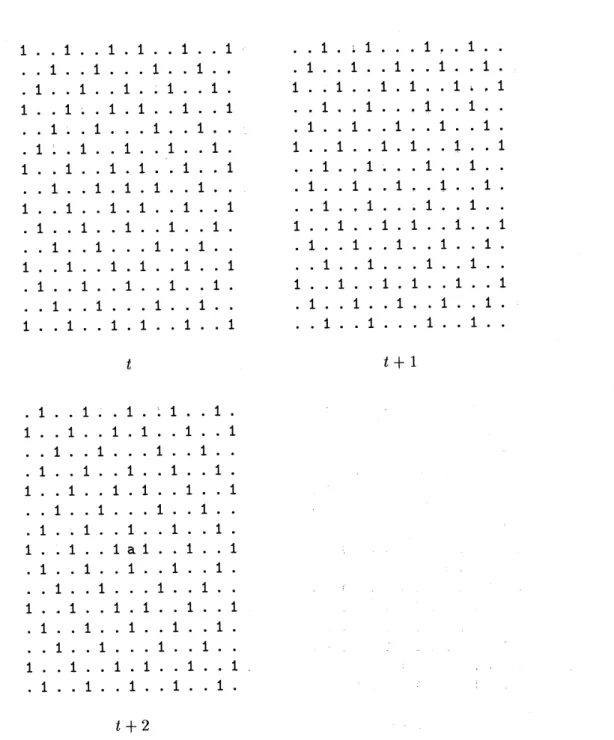
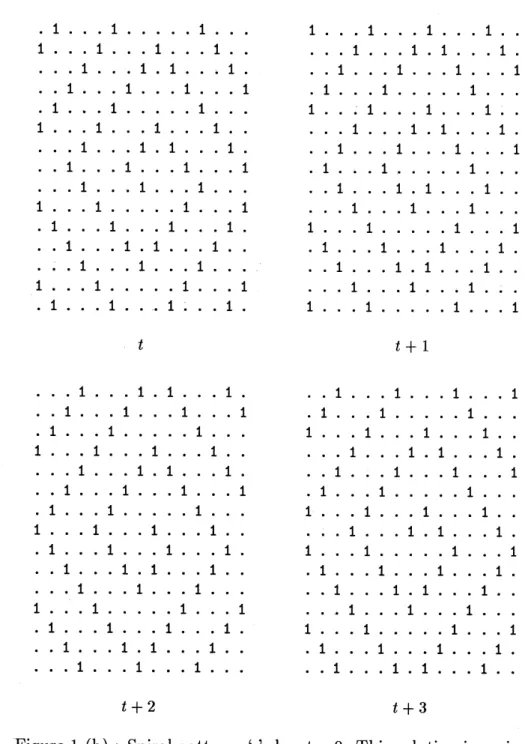
Figure 1 showstwo numerical results, Fig. 1 (a) showsatargetpattern and
(b) aspiral pattern. This pattern is often observedin some of typical pattern
formation systems, for example, reaction-diffusion systems. However, there
One is that (12) is reversible in time and the other is that if $u$ is a solution,
$Cu$ is also. Therefore, we consider that a usual reaction-diffusion system
can not be obtained by back-ultradiscretization of (12). Thus there occurs a question ‘What is a continuous system corresponding to (12)?’
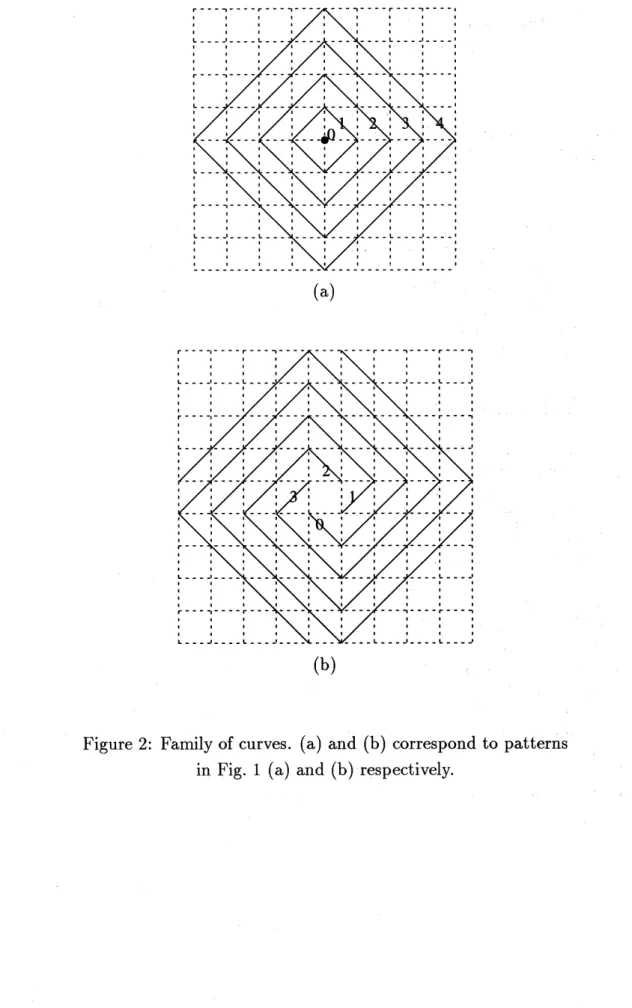
We have not yet succeeded non-trivial back-ultradiscretization of (12), we can not answer this question now. However, the above system has a remarkable feature. Let us prepare a family of curves shown in Fig. 2 (a) and (b) corresponding to Fig. 1 (a) and (b). Each curve is labeled with
an integer as shown in figures. Then, assume values of $u’ \mathrm{s}$ on curve
$n$ are the same and $f_{n}^{t}$ denotes the value on curve $n$ at time $t$. Then, from a
symmetry of (12), (12) reduces to the following one-dimensionalequation for both patterns:
$f_{n}^{t+1}= \max(f^{t}n+1’ f^{t}n’ fn-1)t-fn-f_{n}^{t}t-1$. (14)
Note that
$f_{0}^{t+1}= \max(f^{t}\mathrm{o}’ f^{t}1)-f\mathrm{o}^{t}-f\mathrm{o}^{t-1}$ (15)
is applied for $n=0$ as a boundary condition in the target pattern and $n$ becomes a periodic lattice with period 4 in the spiral pattern. Under
this difference on boundary condition, both patterns satisfy the same
one-dimensional equation exactly.
Moreover, both patterns become atravelingwave solution in (14).
There-f\"ore, we can make a reduction further. If we set a traveling wave form
$f_{n}^{t}=g_{n-t}$, we obtain
$g_{n+1}= \max(gn+1,gn’ gn-1)-_{\mathit{9}n}-gn-1$ (16)
from (14). We would emphasizethefollowings:(i) Such exact reduction is very difficult in continuous reaction-diffusion systems. (ii) The families of curves in Fig. 2 can be considered to be digital analogues to circles and spirals in a $\mathrm{c}\mathrm{o}\mathrm{n}\mathrm{t}!\mathrm{n}\mathrm{u}\mathrm{o}\mathrm{u}\mathrm{S}$ coordinate system. These points suggest (12) is related to a $\mathrm{s}\mathrm{o}1_{\mathrm{V}}\mathrm{a}\mathrm{b}\mathrm{l}\mathrm{e}$
,continuous
pattern
model.
It is an interesting future problem to1 1
.
1.
1.
1.
1 1.
1.
.
1..
1. 1. .
1..
1..
1. .
1.
1. 1.
1 1.
1 1 1. 1. . .
1.
1.
1 :.
1 1.
1.
1 1.
1.
1.
1.
.
1. .
1 1 1 1 1.
1 1.
.
1.
.
1.
1.
1.
.
1 1 1 1 1 1 1 1.
.
1..
1. 1. .
1. .
1.
1 1 1 1.
1 1 1 1 1..
1 1..
1 1.
1.
1 1 1. .
1 1 : 1.
1 1 1.
.
1 1.
1. 1.
1 1 1 1 1 ‘.
1 1.
.
1.
.
1..
1. .
1..
1. .
1 1 1 1. .
1.
1 1.
1.
1 1.
1 1 1 1 1.
1 ,.
1 1. .
1.
1.
.
1. 1 1.
.
1. .
1. 1.
.
1.
.
1.
1.
1 1 1 1 1 $i$.
1 1 1 1.
.
1.
1. 1. .
1. .
1 1 1.
1 1 , 1 1.
1.
.
1..
1.
$t$ $t+1$.
1. .
1.
.
1.
$\backslash$.
$1$.
.
1 1 1. .
1.
1.
1. .
1 1 1 1.
1.
.
1 1 1 1. 1 1..
1..
1. 1. 1...
1 1. 1.
1..
1..
1.
.
1..
1..
1..
1. 1. 1.
.
1 a 1. .
1.
1.
1..
1.
1..
1..
1. 1.
1. .
1..
1. 1.
1 1. 1 $*$ $\cdot$ 1. .
1 1 1..
1..
1..
1 1 1..
1 1 1..
1. , 1. 1 ,.
1. 1 1..
1..
1. 1. 1 $t+2$Figure 1 (a) : Target pattern. ‘.’ and $‘ \mathrm{a}$’ denote $0$ and-l respectively. This
1
.
1.
. .
1.
1.
.
.
1.
1..
1 1..
1. 1..
.
1.
1.. .
1..
.
1.. .
1 1.
. .
1. .
.
.
1. .
1.. .
1..
.
1. . .
1..
1.
1 1.
1.
1.
1.. .
1.
1.
.
1.
.
1. .
1.
1.
.
.
1..
.
.
.
1..
.
1.
1.
1.
1..
.
1.
.
.
1..
1 1..
1.
.
1.
.
1..
1.
.
1.
.
1.. . . .
1.. .
1.
1..
1.
.
$arrow 1$.
.
1. 1.
. .
1.
1 1 1. . .
1.
1.. .
1.
1.
.
.
1.. .
1.
.
.
1.
1.. .
1. . . .
.
1 1.
. .
1.
.
1. . .
1 1. .
1.
1.
. .
1.
1 1.
1 1.
1.
.
.
1 $\mathrm{r}$. . . .
1 $*$ 1. .
1 1.
.
1..
1 1.
. .
1. .
1. . .
1.. . . .
1. . .
1 1.. .
1. .
.
1..
1. .
1. . .
1.1.
.
1.
.
1. . .
1. .
.
1.
: 1..
.
1.. . . .
1. .
.
1 $t$ $t+1$ 1. .
.
1.
1. . .
1.
.
1.
.
.
1. .
.
1.
.
..
1.
. .
1.. .
1.. .
1.. .
1 1 1. . . .
1 1.
$-$.
1.
.
. .
1.
.
1.
.
1.. .
1..
.
1.
1 $*$ $\cdot$.
1..
1.
1.
.
1.
.
.
1.
1..
1.
.
.
1..
.
1. 1.. .
1.
.
1. .
.
1.. .
1.
1 1..
1..
.
1. .
11. .
1.
.
.
1 1.. .
1.. . . .
1..
1.
1.
.
1.
.
1 1. .
.
1..
1..
1..
1.
1.
1..
1.
1..
.
1..
.
1..
1. 1. . .
1.. . .
1. . .
1 1 1 1.
.
1.
1..
1.
.
1.
.
1.
1 1.. .
1.
.
.
1.
.
.
1. 1..
.
1. 1. .
1. .
.
1.
1. .
.
1. . .
1.
.
.
1. .
.
1.. .
1.
.
.
1..
1. 1..
.
1.. . . .
1. .
1 1. .
1. 1.
.
1. 1.
.
1. .
.
1..
.
1.
.
.
1.
.
1.. .
1.
1. 1. 1.
1..
$t+2$ $t+3$Figure 1 (b) : Spiral pattern. ‘.’ denotes $0$. This solution is periodic
(a)
(b)
Figure 2: Family of curves. (a) and (b) correspond to patterns