部分
$k$木を全彩色する線形時間アルゴリズム
A
Linear Algorithm for Finding
TotalColorings
of
Partial
$k-\mathrm{n}_{\mathrm{e}\mathrm{e}}\mathrm{s}$Shuji
Isobe1
XiaoZhou2
TakaoNishizeki3
Graduate School ofInformation Sciences, Tohoku University
Aoba-yama 05, Sendai 980-8579, Japan
1isoOnishizeki.
ecei.tohoku.$\mathrm{a}\mathrm{c}$.
jp[email protected].
$\mathrm{j}\mathrm{p}$3nishiOecei.
tohoku.$\mathrm{a}\mathrm{c}$.
jpAbstract
A total coloring of a graph $G$ is a coloring of all elements of $G$, i.e. vertices and edges, in such a
waythat no two adjacent or incidentelements receive the samecolor. The total coloring problem is
to find a total coloring ofa given graph with the minimum number ofcolors. Many combinatorial
problems can be efficientlysolved for partial$k$-trees, i.e., graphs with bounded tree-width. However,
no efficient algorithm has been known for the total coloring problem on partial $k$-trees although a
polynomial-time algorithm ofvery high order has been known. In this paper, we give a linear-time
algorithm forthe total coloring problem on partial $k$-trees with bounded $k$.
Keywords: vertex-coloring, edge-coloring, total coloring, generalizedcoloring, partialk-tree
1
Introduction
A total coloring is a mixture of ordinary
vertex-coloringandedge-coloring. That is, a total
color-ing of a graph $G$ is an assignment of colors to its
vertices and edgessothat
no
twoadjacent verticeshave the
same
color, no two adjacent edges havethesame color, andno edge hasthesamecolor as
one of its ends. The minimum number of colors
requiredforatotal coloring of
a
graph $G$is calledthe total chromatic number of$G$, and denotedby
$\chi\iota(G)$
.
Figure 1 illustratesa
total coloring of agraph $G$ using $\chi_{t}(G)=4$ colors.
This paper deals with the total coloring
prob-lem which asks to find atotal coloring ofa given
graph $G$ using the minimum number $xt(G)$ of
colors. Since the problem is $\mathrm{N}\mathrm{P}$-complete for
general graphs $[\mathrm{S}\acute{\mathrm{a}}\mathrm{n}89]$, it is very unlikely that
there exists an efficient algorithm for solving
the problem for general graphs. On the other
hand, many combinatorial problems including
the vertex-coloringproblem andtheedge-coloring
problem can be solved for partial $k$-trees with
color $c_{1}$ –
color $c_{2}$ –
color $C3$
color c4 $—-\cdot$
Figure 1: A total coloring of a graph with four
colors.
bounded $k$ very efficiently, mostly in linear time
[ACPS93, AL91, BPT92, Cou90, CM93, ZSN96].
However, no efficient algorithm has been known
for the total coloring problem on partialk-trees.
Althoughthe total coloring problem
can
be solvedin polynomial time for partial $k$-trees by a
dy-namic programming algorithm, thetime
complex-ity $O(n^{2^{4(k}+1})+1)$ is very high [IZN99].
In thispaper, wegivealinear-time algorithm to
solvethe totalcoloringproblemforpartialk-trees
follows. For agiven partial $k$-tree $G=(V, E)$, we
first findanappropriate subset $F\subseteq E$ inducinga
forest of$G$, then find a “generalized coloring” of
$G$ for $F$and an ordinaryedge-coloring of the
sub-graph $H=G[\overline{F}]$ of$G$ inducedby$\overline{F}=E-F$, and
finally superimposethe edge-coloringon the
gen-eralized coloring to obtain a total coloring of$G$
.
The generalized coloring isanextended versionof
a total coloring and an ordinary vertex-coloring,
and is newly introduced in this paper. Since$F$
in-duces a forest of$G$, a generalizedcoloringof$G$for
$F$ can be found in linear time. Since $H$ is a
par-tial $k$-tree, an edge-coloring of$H$can be found in
linear time. Hence the total running time of our
algorithm is linear. Thus our algorithm is
com-pletely different from an ordinary dynamic
pro-gramming approach.
The paper is organized as follows. In Section2,
we give some basic definitions. In Section 3, we
give a linear algorithm for finding a total coloring
of a partial $k$-tree, and verify the correctness of
the algorithm. Finally we conclude in Section 4
with adiscussion ofthe results and some related
works.
2
Terminologies and Definitions
In this section we give some basic terminologies
and definitions.
For two sets $A$ and$B$, we denote by $A-B$ the
set of elements $a$ such that $a\in A$ and $a\not\in B$.
We denote by $G=(V, E)$ a simple undirected
graph with avertexset $V$ and anedge set $E$
.
Foragraph $G=(V, E)$ weoften write $V=V(G)$ and
$E=E(G)$
.
We denote by $n$ the cardinality of$V(G)$. We denote by $\chi’(G)$ the minimum number
ofcolors required for an ordinaryedge-coloringof
$G$, and call $\chi’(G)$ the chromatic index
of
$G$.For a set $F\subseteq E$ and a vertex $v\in V$, we write
$d_{F}(v, G)=|\{(v, w)\in F:w\in V\}|$ and $\triangle_{F}(G)=$
$\max\{d_{F}(v, G) : v\in V\}$. In particular, we call $d(v, G)=d_{E}(v, G)$ the degree of $v$, and $\triangle(G)=$
$\triangle_{E}(G)$ the maximum degree of$G$
.
Let $F$beasubset of$E$, calleda colored edge set,
and let$C$bea set ofcolors. Ageneralized coloring
of
a graph $G$for
$F$ is a mapping$f$:
$V\cup Farrow C$satisfying the following three conditions:
(1) the restriction of the mapping $f$ to $V$ is a
vertex-coloringof$G$, thatis, $f(v)\neq f(w)$ for
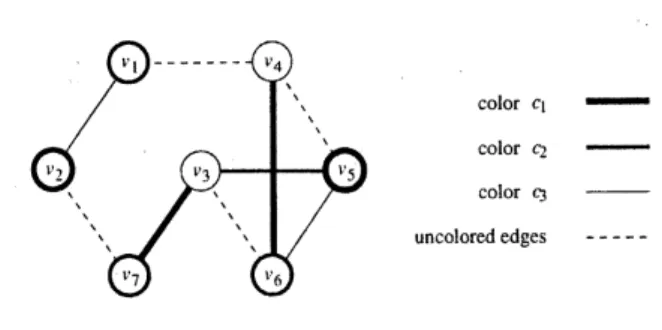
color $c_{1}$ –
color $c_{2}$ –
color $c_{3}$
uncolorededges $—–$
Figure 2: A generalized coloring ofa graph with
three colors.
any pair of adjacent vertices $v$ and $w$ in $G$;
(2) the restriction of the mapping $f$ to $F$ is an
edge-coloring of the subgraph $G[F]$ of $G$
in-ducedby$F$, that is, $f(e)\neq f(e’)$ for any pair
of edges$e,$$e’\in F$sharinga
common
end; and(3) $f(v)\neq f(e)$ for any pair of a vertex $v\in V$
and an edge $e\in F$ incident to $v$
.
Note that the edges in$\overline{F}=E-F$ are not colored
by the generalized coloring $f$. We call the edges
in $F$ colored edges and the edges in $\overline{F}$
uncolored
edges. A total coloring
of
$G$ isa generalizedcolor-ing for a colored edge set $F=E$, while a
vertex-coloringisageneralized coloring foracolored edge set $F=\emptyset$. Thus a generalized coloring is an
ex-tension ofa total coloring and a vertex-coloring.
It should be noted that a generalized coloring of
$G$ for $F$ is a total coloring of $G[F]$ but a total
coloring of $G[F]$ is not always a generalized
col-oring of$G$for $F$. The minimum number of colors
required for a generalized coloring of $G$ for $F$ is
called the generalized chromatic number
of
$G$, andis denoted by $\chi_{b}(G, F)$. In particular, we denote
$x\iota(G, E)$ by $\chi_{t}(G)$, and call $\chi_{t}(G)$ the total
chro-matic number
of
a graph $G$. Clearly $\chi_{t}(c, F)\geq$$\triangle_{F}(G)+1$ and $xt(c)\geq\triangle(G)+1$. Figure 2
de-picts a generalized coloring of a graph $G$ using
$\chi_{t}(G, F)=3$ colors for the colored edge set $F=$
$\{(v_{1,2}v), (v_{3}, v_{5}), (v_{3}, v_{7}), (v_{4}, v_{6}), (v_{5}, v_{6})\}$, where
the uncolored edges $(v_{1}, v_{4}),$ $(v_{2}, v_{7}),$ $(v_{3}, v_{6})$ and
$(v_{4}, v_{5})$ in $\overline{F}$ are drawn by dotted lines.
Suppose that $g$ is
a
generalized coloring of $G$for $F,$ $h$ is an ordinary edge-coloring of the
sub-graph $H=G[\overline{F}]$ of $G$ induced by $\overline{F}$, and
$g$
and $h$ use disjoint sets of colors. Then,
super-imposing $h$ on $g$, one can obtain a total
color-ing $f$ of $G$
.
Unfortunately, the total coloring $f$obtained in this way may use
more
than $xt(G)$$\chi’(H)$ colors, because $xi(c)\leq\chi_{b}(G, F)+\chi’(H)$
but the equality does not always hold; for
exam-$\mathrm{p}\mathrm{l}\mathrm{e},$
$\chi t(G)=4,$ $\chi t(G, F)=3$ and $\chi’(H)=2$, and
hence $xt(G)<xt(G, F)+\chi’(H)$ for the graph $G$
in Figure 2. However, in Section 3, we will show
that, forapartial$k$-tree $G=(V, E)$ with the large
maximum degree, there indeed exists$F\subseteq E$ such
that $\chi\iota(G)=xt(G, F)+\chi’(H)$, and show that
such a set $F$, a generalized coloring of $G$ for $F$
and an edge-coloringof$H$ can be found in linear
time.
A graph $G=(V, E)$ is defined to be a $k$-tree if
eitherit isacomplete graph of$k$verticesor it has
avertex$v\in V$whose neighbors induce acliqueof
size $k$ and the graph $G-\{v\}$ obtained from $G$by
deleting the vertex$v$ and all edges incidentto$v$ is
again a $k$-tree. A graph is defined to be a partial
$k$-tree if it is a subgraph of a $k$-tree [Bod90]. In
the paper we
assume
that $k=O(1)$. The graphin Figure 1 is a partial 3-tree.
For a natural number $s$, an $s$-numbering of
a graph $G=(V, E)$ is a bijection $\varphi$
:
$Varrow$$\{1,2, \cdots, n\}$such that
$|\{(v, x)\in E : \varphi(v)<\varphi(x)\}|\leq s$
for each vertex $v\in V$. A graph having an
s-numbering is calledan$s$-degenerated graph. Every
partial $k$-tree $G$ is a$k$-degenerated graph, and its
$k$-numberingcan befound inlinear time.
For an$s$-numbering$\varphi$of$G$and avertex$v\in V$,
we define
to
find
a total coloringof
$G$ with the minimumnumber$\chi_{t}(G)$
of
colors in linear time.We first have the following lemma [ZNN96,
IZN99].
Lemma 3.2 For any $s$-degenerated graph $G$, the
following (a) and (b) hold:
(a)
if
$\Delta(G)\geq 2s$, then $\chi’(G)=\triangle(G)$; and(b) $\chi_{t}(G)\leq\triangle(G)+s+2$
.
Using a standard dynamic programming
algo-rithm in [IZN99], one can solve the total
col-oring problem for a partial $k$-tree $G$ in time
$o(n\chi t)2^{4(k+)}1$ where $\chi_{t}=\chi_{t}(G)$; the size ofa
dy-namic programming tabIe updated by the
algo-rithm is $O(x_{t}^{2^{4(k+1)}})$. Since $G$isapartial$k$-tree, $G$
is $k$-degenerated. Furthermore $k=O(1)$.
There-fore, if $\triangle(G)=O(1)$, then $\chi_{t}(G)=O(1)$ by
Lemma $3.2(\mathrm{b})$ and hence the algorithm takes
lin-eartimetosolve thetotalcoloringproblem. Thus
it suffices to give an algorithm for the case $\triangle(G)$
is large, say $\triangle(G)\geq 8k^{2}$
.
Our idea is to find a subset $F$ of $E$ such that
$\chi_{t}(G)=\chi t(G, F)+\chi’(H)$ as describedin the
fol-lowing lemma.
Lemma 3.3 Assume that $G=$ (V,$E$) is an
s-degenerated graph and has an $s$-numbering $\varphi$
.
If
$\triangle(G)\geq 8s^{2}$, then there exists a subset $F$
of
$E$satisfying the following conditions $(\mathrm{a})-(\mathrm{h})$:
(a) $\Delta(G)=\triangle_{F}(G)+\triangle_{\overline{F}}(G)$, where $\overline{F}=E-F$;
$E_{\varphi}^{\mathrm{f}\mathrm{w}}(v, G)$ $=$ $\{(v, x)\in E:\varphi(v)<\varphi(x)\}$;
$E_{\varphi}^{\mathrm{b}\mathrm{w}}(v, G)$ $=$ $\{(x, v)\in E^{\sim}.\varphi(_{X)}<\varphi(v)\}$;
$d_{\varphi}^{\mathrm{f}\mathrm{w}}(v, G)$ $=$ $|E_{\varphi}^{\mathrm{f}\mathrm{w}}(v, G)|$; and
$d_{\varphi}^{\mathrm{b}\mathrm{w}}(v,$$c\rangle$ $=$ $|E_{\varphi}^{\mathrm{b}\mathrm{w}}(v, G)|$
.
The edges in $E_{\varphi}^{\mathrm{f}\mathrm{w}}$ are called
forward
edges, andthose in$E_{\varphi}^{\mathrm{b}\mathrm{w}}$ backward edges. The definition ofan
$s$-numbering implies that $d_{\varphi}^{\mathrm{f}\mathrm{w}}(v, G)\leq s$ for each
vertex $v\in V$
.
3
A
Linear Algorithm
In this section we prove the following main
theo-rem.
Theorem 3.1 Let$G=(V, E)$ be apartialk-tree
with bounded $k$. Then there exists an algorithm
(b) $\triangle_{F}(G)\geq s+1$;
(c) $\triangle_{\overline{F}}(G)\geq 2s$;
(d) the set $F$ can be
found
in linear time;(e) $\varphi$ is $a$ 1-numbering
of
$G’=(V, F)$, andhence$G’$ is a forest;
(f) $\chi_{t}(c, F)=\Delta_{F}(G)+1$, and a generalized
col-oring
of
$G$for
$F$ using$\Delta_{F}(G)+1$ colors canbe
found
in linear time;(g) $\chi’(H)=\Delta_{\overline{F}}(G)$, where $H=(V,\overline{F})$; and
(h) $\chi_{t}(G)=x_{t}(G, p)+\chi’(H)$
.
Proof. Theproofsof$(\mathrm{a})-(\mathrm{e})$ willbegiven later.
We now prove only $(\mathrm{f})-(\mathrm{h})$
.
(f) Let $C$ be a set of $\Delta_{F}(G)+1$ colors. For
each $\dot{i}=1,2,$$\cdots,$ $n$, let $v_{i}$ be a vertex of $G$ such
$E,$ $\varphi(v_{i})<\varphi(x)\}$, andlet$E_{F}^{\mathrm{f}\mathrm{w}}(v_{i})=\{(v_{i}, x)\in F$ :
$\varphi(v_{i})<\varphi(x)\}$
.
Since $\varphi$ isan
$s$-numbering of $G$,$d_{\varphi}^{\mathrm{f}\mathrm{w}}(v_{i}, G\rangle=|N^{\mathrm{f}\mathrm{w}}(vi)|\leq s$for each$i=1,2,$$\cdots,$ $n$.
By (e) $\varphi$ is a 1-numbering of $G’=(V, F)$, and hence $d_{\varphi}^{\mathrm{f}\mathrm{w}}(v_{i}, G’)=|E_{F}^{\mathrm{f}\mathrm{w}}(vi)|\leq 1$ for each $\dot{i}=$ $1,2,$$\cdot$,1,$n$.
We construct ageneralized coloring$g$of$G$for$F$
using colors in $C$ as follows. We first color $v_{n}$ by
any color $c$ in $C$: let $g(v_{n}):=c$. Suppose that
we have $\mathrm{c}o$lored the vertices $v_{n},$$v_{n-1},$$\cdots,$ $v_{i}+1$
and the edges in $E_{F}^{\mathrm{f}\mathrm{w}}(v_{n-1})\cup E_{F}^{\mathrm{f}\mathrm{w}}(v_{n-2})\cup\cdots\cup$ $E_{F}^{\mathrm{f}\mathrm{w}}(v_{i+}1)$, and that we
are
now going to color $v_{i}$and the edge in $E_{F}^{\mathrm{f}\mathrm{w}}(v_{i})$ if$E_{F}^{\mathrm{f}\mathrm{w}}(v_{i})\neq\emptyset$. There are
two cases to consider.
Case 1: $E_{F}^{\mathrm{f}\mathrm{w}}(v_{i})\neq\emptyset$.
In this case $E_{F}^{\mathrm{f}\mathrm{w}}(v_{i})$ contains exactly one edge
$e=(v_{i}, v_{j})$, where $\dot{i}<j\leq n$.
We first color$e$. Let$C’=\{g((v_{j}, vl))$ : $(v_{j}, v_{l})\in$
$F,\dot{i}+1\leq l\leq n\}\subseteq C$, then we must assign to $e$
acolor not in $\{g(v_{j})\}\cup C’$. Since $e=(v_{j}, v_{i})\in F$,
we have
$|\{(v_{j}, v_{i})\}\cup\{(v_{j}, v_{l})\in F:\dot{i}+1\leq l\leq n\}|$ $\leq d(v_{j}, G’)$
andhence $|C’|\leq d(v_{j}, G’)-1$. Clearly$d(v_{j}, G’)\leq$
$\triangle_{F}(G)=|C|-1$. Thereforewe have $|C’|\leq|C|-$
$2$. Thusthereexists a color$c’\in C$notin$\{g(v_{j})\}\cup$
$C’$. We color $e$ by $c’$: let $g(e):=c’$.
We next color $v_{i}$. Let $C”=\{.q(x)$ : $x\in$
$N^{\mathrm{f}\mathrm{w}}(vi)\}$, then we must assign to $v_{i}$ a color not
in $\{c’\}\cup C’’$. Since $|C^{\prime;}|\leq|N^{\mathrm{f}\mathrm{w}}(vi)|\leq s$ and
$\triangle_{F}(G)\geq s+1$ by (b) above, wehave $|\{c’\}\cup C\prime\prime|\leq$
$s+1\leq\triangle_{F}(G)=|C|-1$. Thusthere exists a color $c”\in C$ not in $\{c’\}\cup C’’$, and we can color $v_{i}$ by $c”$: let $g\langle v_{i}):=c^{\prime;}$.
Case 2: $E_{F}^{\mathrm{f}\mathrm{w}}(v_{i})=\emptyset$
.
Inthis case we need to color only$v_{i}$. Similarly
as above, there exists a color $c”\in C$ not in $C”$
since $|C’’|\leq s<\triangle_{F}(G)<|C|$. Therefore we can
color $v_{i}$ by $c”$: let $g(v_{\dot{x}}):=c’’$.
Thuswehavecolored$v_{i}$ andtheedge in$E_{F}^{\mathrm{f}\mathrm{w}}(v_{i})$
if $E_{F}^{\mathrm{f}\mathrm{w}}(v_{i})\neq\emptyset$. Repeating the operation above
for $\dot{i}=n-1,$$n-2,$$\cdots 1*$
’ we can construct a
generalized coloring $g$ of $G$ for $F$ using colors
in $C$. Hence $\chi_{t}(c, F)\leq|C|=\triangle_{F}(G)+1$.
Clearly $xt(G, F)\geq\triangle_{F}(G)+1$, and hencewehave
$\chi_{t}(G, F)=\triangle_{F}(G)+1$. Clearly the construction
of$g$above takes linear time. Thus we have proved
(f).
(g) Since $G$ is $s$-degenerated, the subgraph $H$
of $G$ is $s$-degenerated. By (c) we have $\Delta(H)=$
$\triangle_{\overline{F}}(G)\geq 2s$. Therefore by Lemma $3.2(\mathrm{a})$ we have
$\chi’(H)=\triangle(H)=\Delta_{\overline{F}}(G)$. Thus we have proved
(g).
(h) We
can
obtain a total coloringof$G$ bysu-perimposing an edge-coloring of $H$ on a
gener-alized coloring of $G$ for $F$. Therefore we have
$\chi_{t}(G)\leq\chi_{t}(G, F)+\chi’(H)$. Since$\chi_{t}(G)\geq\triangle(G)+$ $1$, by (a), (f) and (g) we have
$\chi_{i}(G)$ $\geq$ $\triangle(G)+1$
$=$ $\Delta_{F}(G)+\triangle(\overline{F}G)+1$
$=$ $\chi_{t}(G, F)+\chi’(H)$.
Thus we have $\chi_{i}(G)=x_{t()}G,$$F+x’(H)$
.
$Q.\mathcal{E}.D$.
We now have the following theorem.
Theorem 3.4
If
$G$ is an$s$-degeneratedgraph and$\triangle(G)\geq 8s^{2}$, then $\chi_{t}(G)=\triangle(G)+1$.
Proof. By (a), (f), (g) and (h) in Lemma 3.3
we have
$xt(G)$ $=$ $\chi_{t}(G, F)+x’(H)$ $=$ $\triangle_{F}(G)+1+\triangle_{\overline{F}}(G)$
$=$ $\triangle(G)+1$.
We are now ready to present our algorithm to
find atotal coloring of a givenpartial $k$-tree $G=$
(V,$E$) with $\triangle(G)\geq 8k^{2}$.
[Total-Coloring Algorithm]
Step 1.Find a subset $F\subseteq E$ satisfying
Condi-tions $(\mathrm{a})-(\mathrm{h})$ in Lemma 3.3.
Step 2. Find ageneralized coloring $g$ of$G$ for $F$
using$\chi_{i}(G, F)=\triangle_{F}(G)+1$ colors.
Step 3. Find an ordinary edge-coloring $h$ of $H$
using $\chi’(H)=\triangle_{\overline{F}}(G)$ colors.
Step 4. Superimpose the edge-coloring $h$ on the
generalized coloring $g$ to obtain a total
coloring $f$ of$G$ using $xt(G)=\triangle(G)+1$
colors.
Since $G$ is apartial $k$-tree, $G$ is k-degenerated.
the subset $F\subseteq E$ in Step 1 in linear time. By
Lemma $3.3(\mathrm{f})$ one can find the generalized
color-ing $g$ in Step2 in lineartime. Since $G$ isa partial
$k$-tree, asubgraph $H$ of$G$ is also apartialk-tree.
Therefore, in Step3 one canfind the edge-coloring
$h$ of$H$in linear time by an algorithm in [ZNN96]
although $x’(H)$ is not always bounded. Thus the
algorithm runs in linear time.
This completes the proof ofTheorem 3.1.
In the remainder of this section we prove $(\mathrm{a})-$
(e) ofLemma 3.3. We need the following two
lem-mas.
Lemma 3.5 Let $G=(V,E)$ be an s-degenerated
graph, andlet $\varphi$ be an $s$-numbering
of
G.If
$\Delta(G)$ is even, then there exists a subset $E’$of
$E$satis-fying the following three conditions $(\mathrm{a})-(\mathrm{c})$:
(a) $\Delta(G’)=\triangle(G\prime\prime)=\triangle(G)/2$;
(b) $\varphi$ is an $\lceil s/2\rceil$-numbering
of
$G’$; and(c) $|E’|\leq|E|/2$,
where $G’=(V, E’)$ and $G”=(V, E-E’)$
.
Fur-thermore, such a set $E^{l}$ can be
found
in linear time.Proof. We first construct a new graph $G^{*}$ from
$G$ as follows. For each vertex $v\in V$ of $G$,
re-place $v$ with two copies $v_{\mathrm{f}\mathrm{w}}$ and $v_{\mathrm{b}\mathrm{w}}$; attach to
the copy $v_{\mathrm{f}\mathrm{w}}$ the $d_{\varphi}^{\mathrm{f}\mathrm{w}}(v, G)$ edges in $E_{\varphi}^{\mathrm{f}\mathrm{w}}(v, G)$; if
$d_{\varphi}^{\mathrm{f}\mathrm{w}}(v, G)$ is even, then attach to thecopy
$v$bw the
$d_{\varphi}^{\mathrm{b}\mathrm{w}}(v, G)$ edges in $E_{\varphi}^{\mathrm{b}\mathrm{w}}(v, G)$; and if $d_{\varphi}^{\mathrm{f}\mathrm{w}}(v, G)$ is
odd, then attach to thecopy$v$bw any$d_{\varphi^{\mathrm{W}}}^{\mathrm{b}}(v, G)-1$
edges in$E_{\varphi}^{\mathrm{b}\mathrm{w}}(v, G)$andattach to thecopy
$v_{\mathrm{f}\mathrm{w}}$ the
remaining edge in $E_{\varphi}^{\mathrm{b}\mathrm{w}}(v, c)$. Let $G^{*}$ be a
re-sulting graph. Note that $d(v_{\mathrm{f}\mathrm{w}}, G^{*})$ is even and
$d(v, G)=d(v_{\mathrm{f}\mathrm{w}}, G^{*})+d(v_{\mathrm{b}\mathrm{w}}, G^{*})$ for each vertex $v\in V$
.
We then construct agraph $G^{**}\mathrm{f}\mathrm{r}\mathrm{o}\mathrm{m}G^{*}$ as
fol-lows. Addadummy vertex to $G^{*}$andadd dummy
edges joining the vertex and every vertex of odd
degree in $G^{*}$. Let $G^{**}$ be the resulting graph.
Then each connected component of $G^{**}$ is
Eule-rian, and has an Eulerian circuit.
We number the edges in $G^{**}$ by
1, 2,$\cdots$ , $|E(G^{**})|$ along any Eulerian circuits
of the connected components of $G^{**}$
.
Let $E_{\mathrm{o}\mathrm{d}}^{*}$be the set of odd-numbered (non-dummy) edges
in $G^{*}$, and let $E_{\mathrm{e}\mathrm{v}}^{*}$ be the set of even-numbered
(non-dummy) edges in $G^{*}$
.
Let $G_{\mathrm{o}\mathrm{d}}^{*}$ be thesubgraph of $G^{*}$ induced by $E_{\mathrm{o}\mathrm{d}}^{*}$, and let $G_{\mathrm{e}\mathrm{v}}^{*}$ be
the subgraph of$G^{*}$ induced by $E_{\mathrm{e}\mathrm{v}}^{*}$
.
Then, since$d(v_{\mathrm{f}\mathrm{w}}, G^{*})$ is evenfor any vertex $v\in V$, we have $d(v_{\mathrm{f}_{\mathrm{W}}}, G_{\mathrm{o}}*) \mathrm{d}=d(v_{\mathrm{f}_{\mathrm{W}}}, G_{\mathrm{e}}*)\mathrm{V}=\frac{d(v_{\mathrm{f}\mathrm{w}},G^{*})}{2}$
.
(1)
Onthe other hand, since $d(v_{\mathrm{b}_{\mathrm{W}}}, G^{*})$ is not always
even and at most one dummy edge is incident to
$v_{\mathrm{b}\mathrm{w}}$, we have
$\lfloor\frac{d(v_{\mathrm{b}\mathrm{w}},G^{*})}{2}\rfloor$ $\leq$ $d(v_{\mathrm{b}\mathrm{w}}, G_{\mathrm{o}\mathrm{d}}*)$
$\leq$ $\mathrm{r}\frac{d(v_{\mathrm{b}\mathrm{w}},G^{*})}{2}\rceil$
,
(2) and$\lfloor\frac{d(v_{\mathrm{b}\mathrm{w}},G^{*})}{2}\rfloor$ $\leq$ $d(v_{\mathrm{b}\mathrm{w}}, c_{\mathrm{e}\mathrm{V}}*)$
$\leq$ $\mathrm{r}\frac{d(v_{\mathrm{b}\mathrm{w}},G^{*})}{2}\rceil$
.
(3)Onemay
assume
without loss of generality that$|E_{\mathrm{e}\mathrm{v}}^{*}|\leq|E_{\mathrm{o}\mathrm{d}}^{*}|$. Let $E’$ be the set of all edges of$G$
that correspond to edges in $E_{\mathrm{e}\mathrm{v}}^{*}$ of $G^{*}$. We first
show that (a) holdsfor this set $E’$
.
Let $v\in V$ beanyvertex of $G$
.
Then by the construction of$G^{*}$and $G_{\mathrm{e}\mathrm{v}}^{*}$ above we have
$d_{E’}(v, G)=d(v_{\mathrm{f}\mathrm{w}}, c*\mathrm{e}\mathrm{V})+d(v_{\mathrm{b}\mathrm{w}’ \mathrm{e}}G^{*})\mathrm{v}$ . (4)
By Eqs. (1), (3) and (4) we have
$d_{E’}(v, G) \leq\frac{d(v_{\mathrm{f}\mathrm{w}},G^{*})}{2}+\mathrm{r}\frac{d(v_{\mathrm{b}\mathrm{w}},G^{*})}{2}\rceil$
.
Since $d(v_{\mathrm{f}\mathrm{w}}, G^{*})$ is even, we have
$d_{E}’(v, G)$ $\leq$ $\lceil\frac{d(v_{\mathrm{f}_{\mathrm{W}}},G^{*})+d(v\mathrm{b}_{\mathrm{W}}G^{*})}{2},\rceil$
$=$ $\mathrm{r}\frac{d(v,G)}{2}\rceil$
$\leq$ $\lceil\frac{\triangle(G)}{2}\rceil$ ,
and hence $d_{E’}(v, G)$ $\leq\triangle(G)/2$ since $\triangle(G)$ is
even. In particular, if $d(v, G)=\Delta(G)$, then we
have $d_{E’}(v, G)=\triangle(G)/2$, because by Eqs. (1)
and (3)
$d_{E}’(v, G)$ $=$ $d(v_{\mathrm{f}\mathrm{W}}, G_{\mathrm{e}\mathrm{V}}^{*})+d(v\mathrm{b}\mathrm{w}’ G_{\mathrm{e}}^{*})\mathrm{v}$
$\geq$ $\frac{d(v_{\mathrm{f}\mathrm{w}},G^{*})}{2}+\lfloor\frac{d(v_{\mathrm{b}\mathrm{w}},G^{*})}{2}\rfloor$
$=$ $\lfloor\frac{d(v_{\mathrm{f}_{\mathrm{W}}},G^{*})+d(v\mathrm{b}_{\mathrm{W}},G^{*})}{2}\rfloor$
$=$ $\lfloor\frac{d(v,G)}{2}\rfloor$
Thus we have $\triangle(G’)=\triangle_{E’}(G)=\triangle(G)/2$.
Sim-ilarly, we have $\triangle(G’’)=\triangle(G)/2$. Thus we have
shown that (a) holds.
We next show that (b) holds. We first claim
that $d(v_{\mathrm{f}\mathrm{w}}, G_{\mathrm{e}}^{*})\mathrm{v}\leq\lceil s/2\rceil$ for each vertex $v\in V$.
Since $\varphi$ is an $s$-numbering of $G,$
$d_{\varphi}^{\mathrm{f}\mathrm{w}}(v, G)\leq s$
.
Therefore $d(v_{\mathrm{f}\mathrm{w}}, G^{*})\leq d_{\varphi}^{\mathrm{f}\mathrm{w}}(v, G)+1\leq s+1$,
be-causealledges in$E_{\varphi}^{\mathrm{f}\mathrm{w}}(v, c)$ andat most oneedge in $E_{\varphi}^{\mathrm{b}\mathrm{w}}(v, G)$ are attached to $v_{\mathrm{f}\mathrm{w}}$ in the
construc-tion of$G^{*}$ above. Thus by Eq. (1) we have
$d(v_{\mathrm{f}\mathrm{w}’ \mathrm{v}}G_{\mathrm{e}}*)= \frac{d(v_{\mathrm{f}\mathrm{w}},G^{*})}{2}\leq\frac{s+1}{2}$,
and hence $d(v\iota_{\mathrm{W}}, G_{\mathrm{e}\mathrm{v}}*)$ $\leq$ $\lceil s/2\rceil$ since both $s$
and $d(v_{\mathrm{f}\mathrm{w}}, G_{\mathrm{e}\mathrm{v}}^{*})$ are integers. Thus we have
proved that $d(v_{\mathrm{f}\mathrm{w}}, G_{\mathrm{e}\mathrm{v}}*)\leq\lceil s/2\rceil$. The edges in
$G’=(V,$$E\rangle$ correspond to the edges in $G_{\mathrm{e}\mathrm{v}}^{*}$, and
all edges in $E_{\varphi}^{\mathrm{f}\mathrm{w}}(v, G’)$ are attached to $v_{\mathrm{f}\mathrm{w}}$ in $G_{\mathrm{e}\mathrm{v}}^{*}$. Therefore $d_{\varphi}^{\mathrm{f}\mathrm{w}}(v, G’)\leq d(v_{\mathrm{f}\mathrm{w}’ \mathrm{V}}G_{\mathrm{e}}^{*})$. Hence
$d_{\varphi}^{\mathrm{f}\mathrm{w}}(v, G’)$ $\leq$ $\lceil s/21$, and consequently $\varphi$ is an
$\lceil s/2\rceil$-numbering of $G’$.
Finally we have $|E’|=|E_{\mathrm{e}\mathrm{v}}^{*}|\leq|E|/2$ since $|E|=|E_{\mathrm{e}\mathrm{v}}^{*}|+|E_{\mathrm{o}\mathrm{d}}^{*}|$ and $|E_{\mathrm{e}\mathrm{v}}^{*}|\leq|E_{\mathrm{o}\mathrm{d}}^{*}|$. $Q.\mathcal{E}.D$.
Lemma 3.6 Let $G=(V, E)$ be an s-degenerated
graph, and let$\alpha$ be a natural number.
If
$\triangle(G)\geq$$2\alpha\geq 2s$, then there exists a subset $E’$
of
$E$ suchthat $\triangle_{E’}(G)+\triangle_{\overline{E}’}(G)=\triangle(G)$ and $\triangle_{E};(G)=\alpha$
where $\overline{E}’=E-E’$. Furthermore, such a set $E’$
can be
found
in linear time.Proof. Since $G$ is an $s$-degenerated graph and
$\Delta(G)$ $\geq$ $2\alpha$ $\geq$ $2s$, there exists a partition $\{E_{1}, E_{2}, \cdots, E_{l}\}$ of $E$ satisfying the following
three conditions $(\mathrm{i})-(\mathrm{i}\mathrm{i}\mathrm{i})$ [ZNN96, pp. 610]: (i) $\sum_{i=1}^{l}\triangle_{E_{i}}(G)=\triangle(G)$;
(ii) $\Delta_{E_{i}}(G)=\alpha$for each $\dot{i}=1,2,$$\cdots$ ,$l-1$; and
(iii) $\alpha\leq\triangle_{E_{\iota}}(G)<2\alpha$.
Let $E’=E_{1}$
.
Then $\triangle_{E’}(G)=\triangle_{E_{1}}(G)=\alpha$ andby (ii), clearly
$\triangle_{\overline{E}’}(G)\geq\triangle(G)-\triangle_{E(}\prime G)$. (5)
On
the.
other hand, since $\overline{E}’=E_{2}\cup E_{3}\cup\cdots\cup E_{l}$,by (i) we have
$\triangle_{\overline{E}’}(G)$ $\leq$ $\sum_{i=2}^{l}\Delta_{E_{i}()}G$
$=$ $\triangle(G)-\triangle E_{1}(G)$
$=$ $\Delta(G)-\triangle_{E’(G)}$. (6)
Thus by Eqs. (5) and (6) we have $\Delta_{\overline{E}’}(G)=$
$\Delta(G)-\triangle_{E’}(G)$, and hence $\triangle_{E’}(c)+\triangle_{\overline{E}’}(G)=$ $\triangle(G)$. Since the partition $\{E_{1}, E_{2}, \cdots, E_{l}\}$ of
$E$ can be found in linear time [ZNN96], the set
$E’=E_{1}$ can be found in linear time. $Q.\mathcal{E}.D$.
We are now ready to give the remaining proof
of Lemma 3.3.
Remaining Proof of Lemma 3.3: Since we
have already proved $(\mathrm{f})-(\mathrm{h})$ before, we nowprove
$(\mathrm{a})-(\mathrm{e})$.
Let $p=\lfloor\log\triangle(G)\rfloor$. Then $2^{p}\leq\triangle(G)<2^{p+1}$.
Since $\Delta(G)\geq 8s^{2}$, we have$p=\mathrm{L}^{\log}\triangle(G)\rfloor\geq 3+$
$\lfloor 2\log s\rfloor>2+2\log s$
.
Therefore we have $\triangle(G)\geq$$2^{p}>2^{2+}2\log S=4S^{2}>2s$.
Let $q=\lceil\log s\rceil$. Then $2^{q-1}<s\leq 2^{q}$. We find
$F$ by constructing a sequence of$q+1$ spanning
subgraphs $G_{0},$ $G_{1},$$\cdots,$$G_{q}$ of$G$ as follows.
1 procedure FIND-F
2 begin
3 by Lemma 3.6, find a subset $E_{0}$ of $E$ such
that
(3-1) $\triangle_{E_{0}}(G)=2^{p-1}$; and
(3-2) $\triangle_{E_{0}}(G)+\triangle(\overline{E}0)G=\Delta(c)$,
where $\overline{E}_{0}=E-E0$;
{Choose
$\alpha=2^{p-1},\mathrm{t}\mathrm{h}\mathrm{e}\mathrm{n}\Delta(G)\geq$ $2^{p}$ $=$ $2\alpha$ $\geq$ $2s$, and hencethere exists such a set $E_{0}$ by
Lemma
3.6}
4 let $G_{0}$ $:=$ (V,$E_{0}$) and let $s_{0}$ $:=$ $s$;
{
$\triangle(G_{0})=2^{p-1}$ and $\varphi$ is an $s_{0^{-}}$numbering of$G_{0}$
}
5 for $\dot{i}:=0$ to $q-1$ do
6 begin
7 by Lemma 3.5, find asubset $E_{i}’$ of$E_{i}$
satisfying
(7-1) $\triangle(G_{i}’)$ $=$ $\Delta(G_{i}’’)$ $=$ $\triangle(G_{i})/2$;
{
$\triangle(G_{i})$ iseven}
(7-2) $\varphi$ is an $s_{i+1}$-numbering of$G_{i}’$,
where $s_{i+1}=\lceil s_{i}/2\rceil$; and
(7-3) $|E_{i}’|\leq|E_{i}|/2$,
where $G_{i}’=(V, E_{i}’),$ $G_{i}’’=(V, E_{i}^{l\prime})$ and
8 let $E_{i+1}:=E_{i}’$ and let $G_{i+1}:=(V, E_{i+1})$;
9 end
10 let $F:=E_{q}$;
11 end.
We first prove (a). Since $F=E_{q},$ $\triangle_{F}(G)=$
$\triangle_{E_{q}}(G)=\triangle(G_{q})$. Therefore we have
$\triangle_{\overline{F}}(G)\geq\Delta(G)-\triangle_{F}(G)=\triangle(G)-\Delta(G_{q})$
.
$(7)$By line 7 and line 8 in the procedure above, we
have $G_{i+1}=G_{i}’,$ $\triangle(G_{i+1})=\Delta(c_{i}’)$ and $\triangle(G_{i}’)+$
$\Delta(G_{i}’’)=\triangle(G_{i})$, and hence $\Delta(G_{i}’’)=\triangle(G_{i})$
-$\triangle(G_{i+1})$ foreach$\dot{i}=0,1,$$\cdots,$$q-1$. Therefore we
have
$\sum_{\iota=0}^{q-}\triangle(c1i\prime\prime)$ $=$ $i0 \sum_{=}^{q-1}(\Delta(Gi)-\triangle(Gi+1))$
$=$ $\Delta(G_{0})-\Delta(Gq)$. (8)
Since$\Delta(G_{0})=\Delta_{E_{0}}(G)$, by (3-2) in theprocedure
above wehave
$\triangle(G_{0})+\triangle_{\overline{E}_{0}}(G)=\triangle(G)$. (9)
Furthermore, since $\overline{F}=E-F=\overline{E}_{0}\cup E_{0}^{\prime;}\cup E_{1}’’\cup$
$\cup E_{q-1}^{;;}$ and $\triangle_{E_{i}^{\prime\prime(G)}}=\triangle(G_{i}’’)$ for each $\dot{i}=$
$0,1,$$\cdots,$$q-1$, by Eqs. (8) and (9) we have
$\triangle_{\overline{F}}(G)$ $\leq$ $\triangle_{\overline{E}_{0}}(c)+i=\sum^{q-1}\triangle E_{i}’l(G)0$
$=$ $\triangle_{\overline{E}_{0}}(G)+q\sum_{0i=}^{-1}\triangle(G’’i)$
$=$ $\Delta_{\overline{E}_{0}}(G)+\triangle(G0)-\triangle(c)q$
$=$ $\Delta(G)-\Delta(G_{q})$
.
(10)Therefore by Eqs. (7) and (10) we have $\triangle_{\overline{F}}(G)=$
$\triangle(G)-\triangle(G_{q})$. Since $\triangle(G_{q})=\triangle_{F}(G)$, we have $\Delta_{\overline{F}}(G)=\triangle(G)-\triangle_{F}(G)$, and hence $\Delta_{\Gamma\prec}(G)+$ $\Delta_{\overline{F}}(G)=\Delta(G)$
.
Thus we have proved (a).We next prove (b). By (7-1) and line 8 in the
procedure above we have $\Delta(G_{i+1})=\Delta(G_{i}’)=$
$\Delta(G_{i})/2$ for each $\dot{i}=0,1,$$\cdots$,$q-1$, and by (3-1)
we have $\Delta(G_{0})=2^{p-1}$
.
Thereforewe have$\triangle_{F}(G)=\triangle(G)q=\frac{\Delta(G_{0})}{2^{q}}=2^{p-q-1}$
.
(11)Since $2^{p}>4s^{2}$ and $2^{q-1}<s$, we have $\Delta_{F}(G)=$
$2^{p-q-1}>4s^{2}/4s=s$
.
Thuswe
have $\Delta_{F}(G)\geq$$s+1$, and hence (b) holds.
We next prove (c). By (a) andEq. (11) we have
$\triangle_{\overline{F}}(G)=\Delta(G)-\triangle F(G)=\Delta(G)-2^{pq-}-1$, and
hence $\triangle_{\overline{F}}(G)$ $=$ $\triangle(G)-\frac{2^{p}}{2^{q+1}}$ $\geq$ $\Delta(G)-\frac{\Delta(G)}{2^{q+1}}$ $=$ $\triangle(G)(1-\frac{1}{2^{q+1}})$ $\geq$ $8s^{2}(1- \frac{1}{2s})$ $=$ $4s(2s-1)$ $\geq$ $2s$
since $\triangle(G)\geq 8s^{2},$ $\triangle(G)\geq 2^{p}$ and $s\leq 2^{q}$. Thus
we have proved (c).
We next prove (d). ByLemma 3.6, line3
can
bedone intime$O(|E|)$. By Lemma 3.5, line7canbe
donein time$O(|E_{i}|)$. Therefore the forstatement
in line 5 can be done in time $O( \sum_{i^{-1}}^{q}=0|E_{i}|)$ time.
Since $|E_{0}|\leq|E|$ and $|E_{i+1}|=|E_{i}’|\leq|E_{i}|/2$ for
each $\dot{i}=0,1,$$\cdots,$$q-1$ by (7-3) in the procedure
above, we have $\sum_{i=0^{1}}^{q-}|E_{i}|\leq 2|E|$. Thus one can
know that the for statement can be done in time
$O(|E|)$. Thus $F$ can be found in linear time, and
hence $(\mathrm{d}\backslash )$ holds.
We finallyprove (e). Since$s=s_{0}\leq 2^{q}$ and$s_{i}=$
$\lceil s_{i-1}/2\rceil\leq s_{i-1}/2+1/2$ for each $\dot{i}=1,2,$$\cdots,$$q$,
we have
$s_{q}$ $\leq$ $\frac{s_{0}}{2^{q}}+\frac{1}{2}+\frac{1}{2^{2}}+\cdots+\frac{1}{2^{q}}$
$=$ $\frac{s_{0}}{2^{q}}+1-\frac{1}{2^{q}}$
$<$ 2,
and hence $s_{q}=1$. Therefore $\varphi$ is a l-numbering
of$G’=(V, F)$. Thus we have proved (e).
This completes the proofofLemma 3.3.
4
Conclusion
In this paper we showed that the edge-disjoint
paths problem is $\mathrm{N}\mathrm{P}$-complete for
partial3-trees.
Since the graph $G_{f}$ constructed by
our
reduc-tion has abounded pathwidth,
our
reductionim-plies that the edge-disjoint pathsproblem is
NP-complete for the class of graphs with bounded
pathwidth. Therefore themaximumedge-disjoint
paths problem is $\mathrm{N}\mathrm{P}$-hard for the
same
class. It
the reductionin [GVY97]hasanunbounded path-width.
Zhou et al. provedthefollowing fact: the
edge-disjoint paths problem can be solved in
polyno-mial time for a partial $k$-tree $G$ if the augmented
graph $G^{+}$ obtained from $G$ by adding $p$ edges
$(s_{i}, t_{i}),$ $1\leq i\leq p$, remains to be a partial k-tree
[ZTN96]. The result in this paper does not
con-flict with the fact above, because the augmented
graph$G_{f}^{+}$of$Gf$ isnotalways a partial$k$-tree with
bounded $k$.
A class of tractable problems for partial k-trees
has been characterized in terms of the monadic
second order logic [ACPS93, ALS91, BPT92,
Cou90]. It remains open to characterize a class of
intractable problems, including the edge-disjoint
paths problem, the subgraph isomorphism
prob-lem, and the bandwidthproblem.
References
[CM93] B. Courcelle and M. Mosbath,
Monadic second-order evaluations on
tree-decomposable graphs, Theoret.
Com-put. Sci., 109, pp.49-82, 1993.
[IZN99] S. Isobe, X. Zhou and T. Nishizeki, A
polynomial-time algorithm for finding total
colorings of partial $k$-trees, Int. J. Found.
Comput. Sci., 10(2), pp. 171-194, 1999.
[GVY97] N. Garg, V.V. Vazirani, and M.
Yan-nakakis. Primal-dual approximation
algo-rithms for integral flow and multicut in
trees. Algorithmica, 18, pp. 3-20, 1997.
$[\mathrm{S}\acute{\mathrm{a}}\mathrm{n}89]$ A. S\’anchez-Arroyo. Determining the
to-tal colouring number is $\mathrm{N}\mathrm{P}$-hard, Discrete
Math., 78, pp. 315-319, 1989.
[ZNN96] X. Zhou, S. Nakano and T. Nishizeki,
Edge-coloring partial $k$-trees, J.
Algo-rithms, 21, pp. 598-617, 1996.
[ACPS93] S. Arnborg, B. Courcelle, A.
Proskurowski and D. Seese, An
alge-braic theory of graph reduction, J. Assoc.
Comput. Mach. 40(5), pp. 1134-1164, 1993.
[AL91] S. Arnborg and J. Lagergren, Easy
prob-lems fortree-decomposablegraphs, J.
Algo-rithms, 12(2), pp. 308-340, 1991.
[ALS91] S. Arnborg, J. Lagergren, and D. Seese.
Easy problems for tree-decomposable
graphs. Journal
of
Algorithms, 12(2), pp.308-340, 1991.
[ZSN96] X. Zhou, H. Suzuki and T. Nishizeki,
A linear algorithm for edge-coloring
series-parallel multigraphs, J. Algorithm, 20, pp.
174-201, 1996.
[ZTN96] X. Zhou, S. Tamura, and T. Nishizeki.
Finding edge-disjoint paths in partial
k-trees. InProc.
of
the 7th InternationalSym-posium on Algorithms and Computation,
Lect. Notes in Computer Science,
Springer-Verlag, 1178, pp. 203-212, 1996.
[Bod90] $\mathrm{H}.\mathrm{L}$. Bodlaender, Polynomialalgorithms
for graphisomorphismand chromatic index
on partial $k$-trees, Journal of Algorithms,
11(4), pp. 631-643, 1990.
[BPT92] R. B. Borie, R. G. Parker and C. A.
Tovey, Automatic generation oflinear-time
algorithms frompredicate calculus
descrip-tions of problems
on
recursivelyconstructedgraph families, Algorithmica, 7, pp.
555-581, 1992.
[Cou90] B. Courcelle, The monadic second-order
logic of grpahs I: Recognizable sets of
fi-nite graphs, Inform. Comput., 85, pp.