Types and Activities of Small Fishing
Economies in the South Pacific : A Case Study
of Fiji
著者
IWAKIRI Shigero, RAM Vina
journal or
publication title
鹿児島大学水産学部紀要=Memoirs of Faculty of
Fisheries Kagoshima University
volume
37
page range
57-96
別言語のタイトル
南太平洋における小漁業経済の諸形態と活動 : フ
ィジーの事例
Mem. Fac. Fish. Kagoshima Univ., Vol. 37,pp. 57-96 (1988)
Types and Activities of Small Fishing Economies
in the South Pacific
— A Case Study of Fiji —
Shigero Iwakiri* and Vina Ram
Keywords'. Rural Community, Coastal Fishery, Household Economy,
Marine Tenure,
Abstract
This study emphasises the special character of small-scale fisheries within the complex economic structure. It is seen that household production for subsistence still predominates the domestic fisheries within a communal society. While within this traditional framework, artisanal-commercial fisheries has developed with introduced simple techniques and gear, distinguished by low productivity and inferior marketing and distribution systems. These coastal fisheries and communal tenure system has led towards a reasonable exploitation, conservation and management of resources and has enabled the coastal fisheries to provide for the domestic demand. The study further tries to point out the limitations of its progress and its near stagnation under the present circumstances.
The rural socio-economics of the peasant farmer has been adopted for the analysis on small scale household fishermen and fisheries production. The fishing and agricultural community studies has been based on sociological analysis in terms of the structure and organisation of the communityand the social and cultural relations of production and distribution. Furthermore an economicapproach has been used to visualise within the definitions of the capitalistic process.
1 . Small Fishing Economies - Definition 1 (a). Classification
"Classification of fishing activities into small-scale or large-scale, inshore or offshore, artisanal or commercial have been made by numerous national bodies in an attempt to define the target group for development purposes and for collection of statistics. Most often, the separation into groups has been made by vessel size or power unit, by type of gear, by
distance from shore, or by some combination of these" (SMITH ; 1979 : p. 3). These distinctions are useful within a national framework depending upon the circumst ances of the situation of fisheries and its development. For example, a small scale for one
*1 Laboratory of International Marine Policy, Faculty of Fisheries, Kagoshima University, 50-20 Shimoarata 4, Kagoshima, 890 Japan
country may be considered as a large scale for another. On the other hand, a broader perspect of fisheries could be achieved using the socio-economic characteristics of the
fishing activities, where fisheries could be classified into three categories ; industrial, artisanal and subsistence. Industrial and artisanal fishermen are considered to be commercially orientated while the subsistence fishermen fish for self consumption and do not enter the market economy. Figure 1. gives a comparison of the basic socio-economic characteristics of the industrial, artisanal, and subsistence fisheries.
(b). Small Fishing Economies
For the purpose of this study, a socio-economic classification has been used. The South Pacific Islands fishery exhibits clearly these three categories of fisheries. To look at these categories in the context of small fishing economies, it is important to look at the micro aspect of the sector which is largely characterized by household as a unit of production and management. This household production comprises of artisanal, expressed as artisanal-commercial, and subsistence fisheries.
Small fishing economies is also represented by the fact that the small scale household
fisheries are existing independently alongside the capital intensive, export - orientated
Figure 1. Socio-economic Characteristics of Industrial, Artisanal—Commercial and Subsistence Fisheries
Industrial Artis
anal-Commercial Subsistence
1) Fishing Unit specialised division small,group or household individual, family, of labour labour, may employ labour community group
2) Ownership of
means of produc tion (boat & gear)
3) Time Frame 4) Gear & technology 4) Motivation 5) Marketing & distribution of catch concentrated in small group, often non—operators full—time capital—intensive, mechanised high—affected prize, demand, competition organised marketing systems Capital accumul ation
necessity for profit,
high competition
individual ownership, a
joint or group owned
part—time /full—time simple introduced, partly mechanised ie use of power
boats, ice boxes, etc. need for cash, subsistence
consumption, obligatory
purposes
self—consumption, local market & unofficial markets; distribution affected access to means of production, kinship relations, household
consumption needs may need profit to over come competition, can continue without profit
communal, individual
ownership
part—time
simple traditional some introduced ie. nylon nets,
power boats, etc.
immediate consumption of family, traditional ceremo nial consumption self—consumption, family, friends; distribution affect ed by kinship patterns, consumption needs of family
Iwakiri and Ram '. Small Fishing Economies 59
industrial pelagic fisheries. The progress ofthe latter is not the result ofthe former, instead
these are two isolated fisheries systems.
Moreover, the small fishing economies could be seen in the general setting of the small island economies ; characterizedby lack of basic capital and expertise, limited economies of
scale, limited scopefor high technology industry, distances from major markets, social and
economic dualism, natural catastrophies and so on ; thus giving an idea in terms of scale and
mode of production. c. Household Fisheries
Household fisheries is one where the production and management of fisheries is carried
out by the members of the household. Yengoyan (1977) defines the household as ...
"... the major link which embeds economic tasks and cultural practices into a semi-collective unit whose structure may be constant over time, but whose composition is highly variable depending upon endogenous and exogenous forces which govern how populations
are regulated by socio-economic conditions" (YENGOYAN ; 1977 : p. 13).
To have a clear comprehension on the relations that prevail in the household fisheries, it
is important to look at the fishery within the theoretical framework of the rural economy of
the household production. That is to say that the household production are weighed down most heavily by traditions of the past and the traditions of the patriarchal life. Therefore it is important to understand the consequences either of a pre- capitalistic stagnation or of a
situation where the transformative effects of capitalism (development of the productive
forces, and the change of all social relations, etc. ) are taking place in the most slow
m a n n e r .
Historically, fishing in the South Pacific has been a major socio-economic activity
towards sustaining the livelihood of the coastal population. Fish provided a major source of protein supplemented by food gathering and shifting cultivation to provide towards self-sufficiency in food.
The western influence by missionaries, traders and later colonial administrators brought
about the first major move towards socio-political and economic changes. These changes
have worked towards a process of transition from production for subsistence only, to various
degrees of involvement towards market economy. The artisanal-commercial fishermen as a group of production agents have also become integrated into this economic systemby wayof participating in the market to satisfy their subsistence needs. However, the structure of production unit in the rural fisheries is still dominated by village type household production both for commercial purposes and for subsistence.
Although the society may be referred to as one in transition, but a large part of the
household is characterised by subsistence production. The subsistence fishery comprises of
a large part of the production volume which is difficult to account for in value because of
lack of statistics. It is undertaken by the members of the household where the labour and
productivity vary according to the consumption requirements of the household and their social obligations. The artisanal-commercial fishermen are also dominated by household
The organization of production for the household fisheries is based on a non-capitalistic
production process. It is influenced largely by two basic factors as indicated by Halapua,
(1982.)"The socio-economic relations under which production, hence distribution, takes place
have two correspondingaspects ; the co-operative relations, in relation to their direct access
to their means ofproduction and subsistence which shape the organization ofproduction and
; the kinship relations which influence the distribution of the social production hence thehousehold consumption patterns." (HALAPUA ; 1982 : p. 3)
The fishermen operate on a self-regulated basis, either full-time or part-time. In most
cases they own their means of production such as fishing gear and boat and some have
ownership offishing rights overtheirfishing grounds. Halapua(1982 : p. 3) further describes the social situation as one where... "thefishermen own the product oftheir labour or fishing effort; the fish they harvest" to illustrate as a feature ofnon-capitalistic production system.
These characteristics of the household production system therefore are not based under
competitive approach towards market participation. A fishermen does not have to
accumulate capital by way of profit towards improving his productive capacity or for his
market survival. His participation in the market is for some means of cash to meet his other
subsistence requirements. This is a common feature of the household rural economy where
market participation is towards providing a means of some cash.
"As in the case of all low-income rural producers, it is likely that the small fishermen's
greatest need is primarily for a guaranteed subsistence level of income. This is a fundamental and very common motivation both in small-scale fisheries and traditional
small-scale farming throughout the world" (LAWSON; 1977 : p. 49, HALAPUA ; 1982 ;
p. 3.).
In the South Pacific, the household fisheries play an important socio-economic role in terms of providing employment and as a source of food supply for the rural population.
2 ) Fiji's Fisheries
Fiji's fisheries could be divided into three categories, industrial, artisanal-commercial
andsubsistence. Industrial fisheries consists ofa joint-venture fish processing factory and a
state established fishing fleet to supply fish to the factory. Detailed analysis of this sector is discussed in section three.
The artisanal-commercial and the subsistence fisheries consisting of household produc
tion caters for the domestic consumption. Artisanal-commercial fishermen are those who
have to obtain licence for fishing and have to register their fishing vessels. In Fiji,
artisanal-commercial fisheries is dominated by two ethnic groups of fishermen from the two
majorcommunities, Indians and Fijians. Indianfishermen operateas individualsusually on a part-time basis whennot engagedin plantingor harvesting of crops. The Fijian fishermen operate on a full-time or part-time basis either as individuals or in a group. Subsistence fisheries is carried out on the reef and lagoon areas by the Fijian community.
To understand the significance and the role of household fisheries in the national economy, it is important to analyse the structure and operations of the household fishing
Iwakiri and Ram ! Small Fishing Economies 61
activities in its social and economic setting and the conditions under which fishing activities
take place. This section attempts to look at the fishing operations of the artisanal-commer
cial and subsistence fishermen in terms of ownership systems, fishing grounds, social relations to production and distribution, licensing and fisheries management systems.
2 . Social Situation of Small-Scale Fisheries
1 ) Marine Tenure and "Mataqali" Ownership System
Fisheries modernisation or capitalistic development is associated with breakdown of the old mode of production, modification, and replacement of it by a new type. To what extent the new system brings about a dissolution of the old mode of production depends on its solidity and internal structure. In what direction this process of disolution will lead, in other words, what new mode of production will replace the old, does not depend on commerce, but on the character of the old mode of production itself.
Ownership and rights to use of fishing grounds have always been controversial issues throughout history as sea boundaries are difficult to identify and manage compared to land. Evidences of customary fishing regulations show that customary rights and ownership of fishing grounds existed in early coastal societies where fishing was largely for subsistence and in where production and utilization were ruled by custom. The purpose of such regulations were mainly to keep harmony within the neighbouring settlements by identifying some physical features as limits to one's boundaries so that each settlement had access to means of subsistence from the seas adjacent to their settlement.
However, through passage of time, increase in population, and improvement in technology together with shift towards competitive market-orientated fisheries necessiated for stringent changes in regulations towards management and control of resources by codifying and legislating the sea boundaries. For example, in Japan during the Feudal Era exclusive customary fishing rights were observed on foreshore and shallow waters adjacent to the settlements, but with the shift towards modern fishery and increase in population there was increased pressure on the resources. The traditional tenure system needed codified legislation and regulations, therefore the government used extensive and elaborate systems of dividing up coastal fishing rights based on the principles of the traditional fishing grounds. In the Meiji Reform, the feudal property was legislated by the state under a new fisheries law. With the development of coastal fisheries and aquaculture systems, the state divided the coastal areas into common fishing right areas and issued exclusive rights to these areas to fisheries co-operatives (under a new fisheries co-operative law). The fisheries co-operatives are now responsible for the management and control of their common fishing rights area. Thus, the coastal community operates its traditional fishing grounds as members of a co-operative.
Marine civil engineering techniques are used for measuring the baseline and limits of the boundaries of each common fishing rights area of a co-operative and the demarcated areas of each member of the co-operative. Boundaries are sometimes marked by placing stone poles for baselines and other focal points. In this manner the co-opertive is able to regulate and
manage the use of coastal resources.
Marine tenure in Fiji is based on customary fishing rights on the reef, lagoon and forshore areas. The present fisheries legislation makes provision for the recognition of these
customary fishing rights towards protection of the native subsistence fisheries and the native
social and cultural systems. Ownership of fishing rights and access to fishing grounds are
based on the system of kinship relations. To understand these customary fishing rights
based on kinship patterns and its status of legislation, it is important first to look at its social
organization in which the socio-economic activities including fishing take place and secondly to look at the systemof land ownership which is crucial to the understanding of the ownership of the sea or the sea tenure.
a. Social Organization
Basis of traditional social organization in the Fijian community illustrated in (BIGAY. et
al. ; 1981 : p. 52), shows six levels of organization from the household to the largest level of
military alliance.
A village may sometimes consist of one or more ('Yavusa') which would consist of more than one 'mataqali'. Sometimes members of one 'Yavusa' may be found in more than one village. The 'Mataqali' are regarded as a hereditary unit with certain rights and functions within the 'Yavusa'.
"The Mataqali are first concerned with the more formal aspects of everyday living, such as
the owning and cultivating of land. In this context, they sometimes divide into smaller
units, 'itokatoka', consisting of a group of closely related households acknowledging the head of one as head of the whole group, living in a defined area of the village and organizing
subsistence activities on a cooperative basis. 'Mataqali' also have a ritual and ceremonial function of which 'itokatoka' partake only as elements of the larger unit. For purpose of ceremony and religion and for the functioning of the 'Yavusa' beyond the village - which in traditional times usually meant in war-each 'Mataqali' was responsible for a ritual function concerned with food-bearing or weapon-bearing" (ROUTLEDGE ; 1985 : p. 28). Therefore 'Mataqali' tended to assume specialized roles within the community in terms of defence, building, farming, fishing and so on.
b. Mataqali Ownership of Land
There is no individual title of ownership for village land. Land is held by a traditional
land-holding unit called a 'mataqali' or 'itokatoka' and is used communally.
"There are more than 6, 600 recognized land-owning units" (KERR & DONNELY ; 1969 :
p. 156).
Any member of the unit is entitled to use part of the land which is determined by rules of local custom. Farming is not done communally, that is, individual village members work separate plots within their 'matagali' land.
When Fiji became a British Colony in 1874, Fijians were assured by the Queen that their lands would not be taken away from them.
Iwakiri and Ram '. Small Fishing Economies 63
and traditions. The framework developed for the control of Fijian Affairs, closely followed the principle of indirect rule, and a Native Lands Commission investigated Fijian land titles, confirming the Fijian owners in possesion, under customary law, of the lands they were using. As this usuage rested upon membership of reputedly patrilineal social groups known as 'Mataqali' the legally recognized system of land tenure now acted as bulwark for the preservation of these groups and the 'Fijian way of life'" (NAYACAKALOU ; 1979 : p.3).
Land is registered in terms of patrilineally organized social units which form lineages of the classical segmentary type of the one shown in Figure 2. The Native Lands Commission is a government body which looks after native land ownership affairs and disputes while the Native Land Trust Board is an independent statutory body which operates on behalf of the owners in concern with native lands. Legally recognized tenure of the native lands is based on the Native Lands Commission register of native lands which contains description of the boundaries of all blocks of land, their area and the owning units, and a reference to maps upon which the boundaries are marked.
The present law makes provision for ownership of native lands according to native custom as evidenced by usage and tradition, where ; ....
"... "Native Lands" means lands which are neither Crown land nor the subject of a Crown
Figure 2. Fijian Traditional Social Organization
MATANITU
(large scale military alliance)
VANUA
(alliance of yavusa)
YAVUSA
(federation of mataqali)
MATAQALI (clan or lineage group)
TOKATOKA (extended family)
VUVALE (household)
grant (36 of 1921, s. 2. ) "Native Owners" means the 'mataqali' or other division or subdivision of the Natives having customary rights to occupy and use any Native Lands ;. .."(sec. 2 Native Lands Ordinance 1902, cpt. 114 of Laws of Fiji (1967 ed. ).
"Native lands shall be held by Native Fijians according to Native Custom as evidenced by
usage and tradition, subject to the provisions herein after contained such lands may by cultivated, alloted and dealt with by Native Fijians as amongst themselves according to their Native Customs and subject to any regulations made by the Fijian Affairs Board and
approved by the Legislative Council, and in the event of any dispute arising for legal
decision on which the question of the tenure of land amongst Native Fijian Courts of Law shall decide such dispute according to such regulation or Native Custom and
usage (sec. 3 Native Lands Ordinance 1902, cpt.114 of Laws of Fiji (1967 ed.)"
(CROCOMBE ; 1971 : p. 207).
The purpose here has been to show the codification of the communal system based on traditional custom, as the British Colonial Administrators did not want to have conflict with
the native customs and practices. With the development of agriculture, that is capitalistic
plantation systems, the government felt the necessityof codifying the land boundaries ; thus giving communal and individual titles for land.
c. Customary Fishing Right on the Reef, Lagoon and Foreshore Areas
In the pre-contact time, the 'mataqali' owning coastal lands also held tenure to the
adjacent mangroves, lagoon and reef, and had exclusive ownership of the sea floor, water,
shellfish, fish and rights of passage. The ownership of land was seen to form the basis of the
ownership of sea. This is seen to be defined in the word 'Vanua' which is also the word for
land. However the word 'Vanua' is used not only for the physical dimension, but also the
social and cultural dimensions of a particular social unit.
"The physical dimension ofthe 'vanua' consists ofall the 'gele' (soil ordry land) and 'wai'
(water) which the members of a particulartribe haveclaimed and substantiatedto the NativeLand Commission to be their rightful forageing, hunting and gardening areas since their
great ancestors first occupied the place.
It includes all areas now registered under each 'mataqali' (sub-clan of agnatically related
people). Although land registration has since established the legal rights of ownership to
the 'mataqali', all the land areas under the control of the various 'mataqali' which still
recognize, the ritual leadership of the 'Turaga-ni-Vanua' (tribal paramount chief) are still
to some extent considered as 'vanua' land. The land and water areas belonging to a 'vanua'
(tribe or Yavusa [clan]) are generally of four main classes. They are the 'gele ni teitei'
(gardening land), the 'veikau' (forest land), the 'yavutu' (founding ancestor's house sites)
and the 'qoliqoli' (fishing area). [RAVUVU ; 1983 : p. 71]"The qoliqoli (fishing area) includes all rivers, creeks, lakes and stretches of sea which a particular 'vanua' or its component 'yavusa' and 'mataqali' claimed as their traditional
fishing grounds. Although other classes of land have been registered under the 'mataqali',
the 'qoliqoli'is still opento the wider community of related kinsmen to exploit as their mostIwakiri and Ram '. Small Fishing Economies 65
Sea tenure of the 'qoliqoli' area varied according to geographic, social and political
factors like population pressure, marriage, adoption, shift of power and influence through
warfare and alliances. As a result, the allocation of marine resources have been uneven
between villages and territories. Further, Baines (1982) in his studyon marine tenure in the
Vanua Balavu Island of the Lau Group added that...
"... the order of establishment of the village has also contributed towards unequal marine
resource territories. Moreover, that resource gains made by those communities whose
chiefs gained enhanced power and influence through early adoption of Christianity in the
nineteenth century had further complicated the pattern of fishing rights areas" (BAINES ;
1982 : p. 193).
To formalize land tenure for agricultural development, the colonial government codified land boundaries existing during 1874 by adopting the 'mataqali' as the land-owning unit based on the traditional system of ownership. Sea tenure on the reef, lagoon and foreshore areaswas treateda little different in that Native Customary Rights were recognized basedon
the native custom without codifying the boundaries, thus the traditional system continued as
it was ; according to its own forces of social tradition and custom.A Native Fisheries Commission was established in 1923 to administer these customary
boundaries but did not make moves to clarify the legal problems of ownership as it avoided to have clash with Native Custom. Furthermore, the colonial government and colonial
capitalist were not in any extent interested in fisheries development as there was not enough
market for fish and fisheries products, thus the traditional pattern was allowed to continue
on its own.
Hornell (1940) in his report on 'Fisheries of Fiji' includes the following clarification on
the fishing rights of 'mataqali' inreef and foreshore areas... "Prior to the voluntary cession
of Fiji to the British Crown, fishing in the rivers and in the sea was ruled by custom. The
rights of the chiefs were paramount, and in practice the chiefs were the distributing agency
in the areas which each controlled. Each tribal unit, the Matanggali (Mataqali) had its
fishing area accurately defined ; fishing within this area by people of another Mataqali was
resented, and the intruders treated as poachers. (HORNELL ; 1940 : p. 45. )
1881 : At a meeting of a Native Council held at Nailanga(Nailaga) 5th November, 1881,
the Governer Sir George William de Vouex, in his opening address said :
-"Chiefs of Fiji
I now return to the Queen's letter, and as I have to tell you, with regard
to your representation on the subject of the reefs, that the matter will be carefully
investigated and that it is Her Majesty's desire that neither you nor your people should be
deprived of any rights in those reefs which you have enjoyed under your own laws and
customs ; and I may tell you, on my own part, that measures will be taken for securing to
each Mataggali, the reefs that properly belong to it exactly in the same way as the rest of
their land will be secured to them." ( ditto ; p. 45).
'Native Customary Fishing Right' was first defined in the Birds, Game and Fish
Protection Ordinance of 1923. It stated the following
".... it shall be unlawful for any person to fish on any reef or any kai (cockle) or other
mataqali unless he shall be a member of such mataqali or shall first have obtained license so to do under the hand of the Colonial Secretary All dispute between mataqalis as to the limits of their customary rights shall be referred to the Governor in Council whose decision there upon after inquiry shall be final...", (...ditto ; p. 34).
This clause has been incorporated in the Fisheries Ordinance (1942) as the "Protection of Native" (section 12) which is still in effect.
Hornell (1940) in presenting the stateoffisheries regulations made the following comment
on the mataqali rights,
"The customary fishing rights of native Fijian in the reefs and shell fish beds being thus
recognized, the present is an appropriate time to clarify the position further, and to have the
limits of the reefs and shell fish beds belonging to the different mataqalis defined and properly recorded" (...ditto ; p. 35).
Section 13 to Section 19 of the present Fisheries Legislation (Fisheries Ordinance (1942)
chapter 135 of Laws of Fiji) state that the Native Fisheries Commission established under
the Ministry of Fijian Affairs is to be responsible for issues relating to customary fishing rights and boundaries. Section 18 and Section 19 of the Ordinance relate to the register of the customary fishing rights boundaries. Section 18(2) makes provision that the register of
native customary fishing rights would be kept by the Register of Titles in the same manner
as Register of Lands. Section 19 finally indicates that the register would be for public
u s e
"... when the boundaries of the fishing rights of such mataqali or subdivision have been
finally fixed and determined."From the foregoing extracts it is evident that the basis for sea tenure was determined in the same manner as the land according to the native custom. However, land has been codified
for the purpose of agricultural development but the sea has not been codified yet.
Under the present system, the customary fishing rights boundaries tend to be distinct
geomorphological features observable from the surface.
"Thus aboundary may begin from the tip of arocky promontory, bear along astraight line to
a patch reef, perhaps a kilometer off-shore, change direction at this reef to continue several
hundred meters to a pass in the main reef then tofollow the seaward edge ofthe main reef to a
conspicious reef hole before re-crossing reef and lagoon to intersect the coast" (BAINES ;1982 : p. 191).
Baines(1982) used the above description for giving the identification of the fishing
boundary of a fishing mataqali in the island of Lau.
In otherwords, the fishing rights boundaries are identifiable marine physical features like
patch reefs, reef holes and reef passages which are bounded with the outer limit of barrier
reef which is exposed at mean low water.
The customary fishing rights are divided into yavusa or vanua, depending upon the
historical status ofthe social group and its existence through time. These vanua and yavusa
would consist of more than one village, therefore several mataqalis would have a commonfishing ground where as the vanua and yavusa land is divided into actual mataqali plots.
Iwakiri and Ram '. Small Fishing Economies 67_
culture and tradition. Eachmataqali or sub-division has its own identity and localized set of customary fishing practices which are passed on from their ancestors.
According to a fisheries officer interviewed at the Native Fisheries Commission, surveys
have been carried out by the Commission to identify the boundaries of particular mataqalis
as part of a yavusa or vanua fishing rights. The villagers until such time were only aware of
their ancestral boundaries which usually over lapped with the neighbouring boundaries.
Thus, with the increase in pressure on resources, for the purposes of management, and to
clarify the legality ofthe boundaries, the Native Fisheries Commission is making progress
to map the boundaries for all coastal communities. This identification of boundaries has
been based upon discussion with various villages with overlapping ancestral customary
boundaries to come with terms with a common boundary by the Fijian Administrators,chiefsand the Native Fisheries Commission. Thus, these customary rights boundaries have
been mapped by distinguishing the boundaries of marine physical features and seas adjacent
to the settlement and the land of the particular group. These physical features are still used
to distinguish boundary limits in settling disputes and in negotiations with coastal
developers, etc. These mapping patterns for determination of boundary for each 'yavusa' or
'vanua', thus do not take account of the ecological factors or the size of population of the
particular group, etc. but is based on the traditional boundaries claimed by the chiefs of the
particular area in the similiar manner as the land codification took place.
On a separate issue, based on socio-political reasons such as the growing cash economy,
increase in commercial fishing operations, widening racial imbalance and increase in
coastal development activities, the Fijian chiefs have sought to clarify the legal aspects of
the present regulations. Much of the survey activities on boundary limits carried out by the
Native Fisheries Commission has been as a result ofthe efforts made bythe Great Council of
Chiefs.
The Great Council ofChiefs have criticised the British Policy on the sea tenure and have
restated 'Queen Victoria's' original intent to govern according to customary practices. They
have further claimed that the existing laws are unclear and that they need clarification, as by
the customary practice they are the owners of the fishing grounds including the reef and
lagoon areas.
At the meeting of the Great Council of Chiefs in Bau in November 1982, the Council
discussed issues relating to ownership of fishing grounds following the report prepared by
the committee appointed at the 1978 (Lakeba, Lau) Council Meeting. The report made the
following request: "Laws should be enacted to make the situation clear so that there would
be no arguments in future on the ownership of the land beneath the seas bordering Fijian
land". (The Fiji Times ; November 4,1982 : p.l).
The present study limits analysis on the legal aspects relating to clarification of the
legislation. However it must be pointed out that if the present customary rights are turned
into exclusive property ownership like the land ; the whole scene of coastal fisheries or the
traditional patterns of coastal subsistence utilization would change into a completely new
direction. Unlike the agricultural resources, the fisheries and sea resources are difficult to
Furthermore, in the context of Fiji's multiracial economy, the coastal communities who
possess the ownership of the fishing grounds would be in a position to "lease" their fishing
grounds like the land to those with entreprenual capabilities and capital for exploitation.
Thus, not only will there be problems of resource management, but also social problems
relating to the breakdown of traditional subsistence of protein and a further lack of social
and economic progress of the fishing communities.
2 ) Fishing Licensing System
Fisheries legislation in Fiji is governed by the the Fisheries Ordinance (1942) and the
Marine Spaces Act (1977). Section 8 ofthe Fisheries Ordinance empowers the Minister to
make regulations on fishing methods, areas and seasons, minimum size limits of fish, netregulations, etc. The Marine Spaces Act has been enacted as a result of the declaration of
the 200 mile Exclusive Economic Zone to regulate the activities including fisheries within
the 200 mile zone.
Coastal fishing licence are of two categories, inside and outside the demarcated areas.
Demarcated areas are areas which have customary fishing rights. All commercial fisheries
require application to the Fisheries Division and require payment offee and registration of
fishing vessels. In the case of licence inside the demarcated area, fisheries regulations
require permission from the customary right owners by the authority of section 12 of the
Fisheries Ordinance. To seek permission, the fisherman has to follow certain customary
norm, in that he has to make presentation of 'yaqona' (kava), money and food items to the
head of the fishing rights area in which he seeks to carry out his fishing operations. If the
chief, usually (Turaga-ni-Yavusa) or (Tui-Vanua) approves on behalf of the right holders,
he would issue a written permission which would then be presented to the 'Roko' at the
District Administration Office. The 'Roko' would check that the area agreed in the letter
actually belongs to the signatories of the letter. Upon confirmation by section 8, Part II
4(1) of the Fisheries Ordinance, the request is put forward to the District Commissioner in
which the fishing area is located. The District Commissioner has discrete powers to refuse
any arrangements between villagers and individuals seeking permit to fish. The District
Commissioner acts on the advice of the Fisheries Division and ifa permit is granted by the
District Commissioner, the fisherman then pays his yearly licence fee at the Fisheries
Division.
Fishing outside demarcated area by artisanal-commercial fishermen do not require any
customary permit but fishermen have to apply for licence from the Fisheries Division.
Foreign fishing vessels and other pelagic fisheries registration is covered by the Marine
Spaces Act (1977).
3 ) Structure of Fishing Communities
The small scale fishing operations are organized on individual basis, formal, and
informal group operations. Informal groups include members of a particular mataqali,
groups of friends, relatives, and women fishing groups. Formal fishing groups are those
initiated by the Fisheries Division as a new approach towards rural fisheries development.
Group operations have been emphasized on the outer islands of Fiji and only recently,
Iwakiri and Ram ! Small Fishing Economies 69
groups from the rural areas of the main islands have participated in this type of fishery. There are some groups, which operate independently in the village community towards
the Fisheries Division Scheme where as in some villages the Fisheries Division Scheme involves most members of the village. Records on group formation, procedures of
operation, etc. and statistics on group fishing have been limited. However, during the
interview on village fishing activities ; group operations under the Fisheries Scheme
operated in Vatutavui Village in Ba where the group was limited to three members of one mataqali. The villagers claimed that the group operation was an independent venture of a particular household in one mataqali of the village. Since the group belonged to the same yavusa it had equalrights to carry on activities at its own efforts which was approved by the chief. Thus, the group was utilizing its rights of customary access to the fishing grounds.
On the other hand, Nokowaqa village on the Mali Island operated a group fishery under the Fisheries DivisionScheme with equal participation of all members of the village in terms of
contribution of funds and participation in the fishing operations.
Another type of group operation is the Co-operative organization registered under the
Co-operative Law. In general, co-operative development in Fiji has largely been
concentrated on village level consumer and marketing operations. That is Co-operativesoperate as retail stores for supply ofgoods. As a result co-operative development has been
limited to these areas which has further limited the scope for growth of any infrastructure to
raise the co-operative system into higher levels ofactivity. Moreover, attempts toestablish
co-operative for a wider role in the society have been unsuccessful due to lack of capital,
expertise, managerial skills, and conflict of ideas with the social systems of these
traditional societies.
In 1981 there were eleven fishing co-opertives operating under the Ministry of
Co-operatives. Activities offishing co-operatives involve fishing operations and marketing
of catch. Membership and operational procedures are of a rather static nature where a groupof people organize and operate like a joint-activity. Most fishing co-operatives failed to
continue operations partly because ofthe lack ofcapital and expertise on management ofthe
business but moreover because of the variable fishing income. Co-operative principlesincorporate that any surplus should be distributed equally, however this rarely happened in
the fishing co-operative operations within the rural communities as a result of poor pricing
of fish, the rural fishermen's motive to production, and with a further influence by the traditional customs and obligations. The fishing co-operatives therefore do not operate with the motive or intention of generating large surpluses but some means of cash to meet their subsistence needs. It must also be pointed out that co-operative extension services for fishermen have been limited towards providing the necessary impetus for commercial operations and taking advantages of joint working and selling.Village fishing activites of subsistence and artisanal-commercial fisheries are still based
on traditional social relations between groups and kinship members either formal groups asunder the Fishing Scheme or informal groups. Fishing is carried out to meet immediate
consumption need and for some demand for cash.
individually or group owned. Sometimes mutual borrowing of vessel and gear takes place in
return for fish, or other payment in kind. According to the Fisheries Division Survey in
1979, there were about 850 coastal fishing villages.
Non-Fijian fishermen, majority of whom comprise of Indian artisanal-commercial
fishermen operate as individuals usually on a part-time basis. These fishermen operate fishing because they are unable to lease or rent land to operate farming, and/or their
position in their families require other sources of income to meet basic needs, and some
enter into fishing operations becausethey are not engagedactively in farming or harvesting, thus seeking other sources of income to better their economic positions.
Family or hiredlabouris usually used. Thesefishermen favour shallow-water gill netting
using one motorized (25-35ft) vessel and one or two punts or skiffs. Some fishermen use launches but majority use outboard motor boats. Income from farming and children or relative working on paid employment supply the main source of capital for these fishermen.
Therefore there is no basic accumulation, instead capital is transferred from non-fishing
incomewith which the fishermen are able to purchase necessarygear and equipmentand are
able to operate independently and some are able to hire labour whenever required. Within this category of artisanal-commercial operations over the last ten years or so, therehas beendevelopment of a few enterprise operations which operate on a full-time basis with comparatively large scale activities, owning more than one vessel and use improved gear and technology andemploy hired labour. These fishermen usually operate part of their
operations on some secured market i. e. supply on a contract basis to hotels, restaurants and
supermarkets and sell part of their catch at the local market or to the National Marketing
Authority.
The small scale fishing society exhibits various types of fishing organizations much of
which exists under the traditional social relations of production. Some modified and to a
lesser extent some new developments emerging in a contradictory manner or otherwise are
all a result of economic process ; much of the activities exhibit a pre-capitalist fishery or
production mode, where as on the other hand some activities indicate the development or
direction of adherence towards a capitalistic fishery.To understand these various types of fishery opertions within a society at a particular point in time as components of the development process, and to comprehend the
significance ofeach type, and the direction inwhich each would lead and hence its planning
needs some systematic details onactual organization, management and operations ofeach ofthe types of fishing activities.
4 ) Organization, Management and Operation of Fishing Activities
a. Subsistence Fishery
Subsistence fishing is still an important activity towards self supply of protein for the coastal population. This non-monetary activity poses several practical barriers to estimate production and record details on its operation as it takes place in a complex set of
environment.
Iwakiri and Ram I Small Fishing Economies 71
during 1978-1979. Results from the survey indicated that the entire subsistence fishery was
estimated to be 13, 826.1 mt/year. The subsistence scale-fish catch was estimated to be 37
mt/day or 0.34 kg/day/head of coastal population. The survey further indicated that
subsistence activities varied according to the location ofthe coastal village, for example, in
theRewa Province it was estimated to be 129 kg/village where as in Lauit was 3,455 kg/pervillage per year. Table 1 indicates below the results of the survey.
Table 2gives an indication of the total production by small scale fisheries, It is seen that
the subsistence fishery contributes a significant part towards the total production which is
used for rural consumption.Subsistence estimates given by the Fisheries Division show a constant increase which is
supposed to be indicative of increase in effort. Major fishing techniques include collection
by hands of intertidal shellfish and crustaceans, fishing in shallow waters, diving and
Table 1. Subsistence Fishery Parameters Derived from the Survey Results: (Fisheries Division)
Total No. of Villages Estimated Total Annual Catch
(mt)
221 553.8 74.5 190.5 397.3 276.6 650.5 2,777.8 2,570.8 1,911.6 1,004.4 3,197.3TOTAL
850
13,826.1
Source: Fisheries Division Annual Report. 1979; p.36—37.
Province Totsd No. of >
Kadavu 66 Lomaiviti 72 Rewa 48 Serua 25 Bua 41 Cakaudrove 128 Macuata 57 Lau 67 Tailevu 105 Nadroga 88 Ba 60 Ra 93
Table 2. Small—scale Fisheries Production (mt)
Year: 1979 1980 1981 1982 1983 1984
Total Artisanal
-commercial
2,987.3
3,527.2
3,797.3
4,505.8
5,662.5
5,987.3
(fish & nonfish products)
Subsistence 13,800 14,000 14,200 14,400 14,600 14,800
spearfishing as well as gill netting from punts, fish drives, and traditional traps.
With the introduction ofcash economy and increase in demand for goods andservices, thefisheries sector like other agricultural sectors is also gradually changing although a larger
part is still under subsistence production. It is seen that coastal villages near to urban
centres often attempt to sell their extra catch to earn some cash to meet their other
subsistence needs. Also with the adoption of introduced techniques by fishermen, such as
those who use motor boats also attempt to sell their excess catch in order to meet their fuel
expenses. Thus, these group of fishermen could be referred as semi-subsistence.
Much ofthe subsistence catch (under non-licensed production) is sold along the road side
or near the jetties or landing spots as these fishermen cannot enter the official market ; besides their activities are too small to afford transportation costs,.Women contribute a large portion of subsistence catch for the dailyconsumption and also forsale. Much of the subsistence catch for sale includes non-fish production of crustacean, molluscs, and seaweeds sold by women along the outskirts of the municipal markets and
along the roadsides.
Womenengaged in these semi-subsistence activities provide an alternative source of cash for their families immediate needs. During the field survey, it was found that in Draunivi
village in the Ra Province, women were actively engaged in collecting of crab and selling
when there was a shortage of cash. During the observation period, on one occasion the
women organized into a group for collecting crabs to sell for cash to pay for the expenses to attend a church gathering in Nadroga. On a second occasion, two high school girls caught crabs for sale to buy new school uniforms. In both cases, the crabs were sold along the road
side in front of the village.
However, subsistence fisheries at large still provides themost important source ofprotein for the coastal population ; involving the women and children who glean on the reef at low
tide to provide for one ortwo meals. Men usually use boats for fishing either in groups or as
individuals to provide for their household's subsistence requirements.Both categories of fisheries show increasing trends in production, and the fact that both
fisheries have a common fishing grounds, and further that the subsistence fishery is
gradually changing towards commercialization, therefore it is necessary that subsistencefisheries as part of fisheries planning cannot be ignored or left unnoticed as the subsistence component of the sector is considerably large in its contribution towards resource
exploitation. Moreover, both categories ofsharing the same fishing grounds provide high
competition forresources, thuswould pose problems of resource depletion if left unnoticed.Although estimating of the non-monetary sectoris difficult, it still needs great care in its
methodology of estimates for planning. Some degree of detail would enable for better
forecast, give the status of resource exploitation, the degree of self-sufficiency, and the
direction of surplus contribution, if any, towards commercialization, b . Artisanal-Commercial Fisheries
Artisanal-commercial fishermen operate either inside the demarcated areas, that is areas
which extends from the low water mark to outer boundary on the fringing reefs ; or outside
Iwakiri and Ram '. Small Fishing Economies 73
Table 3 shows the number of licensed fishermen in both the areas. From the figures it is
seen that fishing has largely been concentrated inside the demarcated areas (areas having customary fishing rights) or the coastal areas because of the use of simple introduced and
traditional techniques of gear and equipment which restricted deep water fishing. With
development of storage facilities such as use of ice boxes, fishing techniques of trolling,
and use of cabin launches, fishermen are able to operate outside the demarcated areas. Licence issued outside the demarcated areas shows a rapid increase, however, much of the activities is still restricted to inshore waters with only some deep sea fishing.
Some fishermen are hesitant to invest into larger vessels with cold storage facilities
because of the part-time fishing operations as well as fear of the uncertainity of renewal of
fishing permits from the customary owners.
According to the fisheries regulations, fish saleman has to obtain a fishing licence of
either inside or outside demarcated area. It is seen that some licence holders in fact do notinvolve in actual fishing operations but engage as agents or middlemen in selling of fish
only. Majority ofthese group of fishermen hold outside demarcated area licence since there
are no customary permits required. Although this is only a minority group practice in the
larger urban centres, it has several socio-economic implications on the direction of
development of the fisheries sector. Firstly, it shows a reflection on the poor licensing
system and secondly, it indicates the development of middlemen system as with high
transportation cost and lack of storage facilities, the fishermen are unable to transport in
time and carry out the selling themselves as a result they are forced tosell tothe middlemen.
Fisheries regulations also require artisanal-commercial fishermen to register their fishing
vessels. Open canoes and traditional punts are now being replaced by out board motor boats
and launches. Table 4 gives the number of registered local fishing vessels from 1980-1983.
It is seenthat the number of vessels registered in the Eastern Division is lower than Central or Northern Division. Most of the small islands fall in the Eastern Division where thefishermen are largely engaged in subsistence or group fishery, where vessels are usually
Table 3. Total Local Licensed Fishermen Inside and Outside the Demarcated Areas
Division 1980 1981 1982 1983 1984
inside outside inside outside inside outside inside outside inside outside
WESTERN 216 150 296 129 355 169 294 154 232 190 NORTHERN 310 60 288 67 287 148 309 117 431 63 EASTERN 35 2 28 1 40 4 58 2 41 4 CENTRAL 206 767 176 387 240 852 234 431 210 287 205 320 315 262 TOTAL 892 608 866 593 1,019 519
Source: Fisheries Division Annual Reports. (1980-1982),
Ministry of Primary Industries. Commodity Profile: Fish. 1985: p. 3.
Note -The number of licensed fishermen does not relate to the total number of fishermen involved, as members of fishermens' scheme and fishing group's do not have seperate license.
borrowed or shared. Thus the number of fishermen registered and vessels registered from the outer islands are comparatively less. The highest number of outboard punts and launches and the highest number of registered crew are from the Central and Northern Division, which indicates the areas of greater artisanal-commercial activities.
c . Rural Fishing Groups
Rural fishing groups include village groups, co-operative, church groups, social and
kinship groups. Group activities could either befor subsistence or for commercial purposes.
Groups are organized and managed either by equal cooperation of members in terms of participation in fishing activities and contribution of funds, investment, and so on ; or a
fishermen owning the means ofproduction (boat &gear) would operate a group fishery ona
share basis with the largest share to the owner and a certain proportion to the other membersdepending to the extent of their contribution for labour and equipment. A fisherman may
also operate a group fishery by employment of labour and pay them wages or pay in kind.
Table 4. Registered Local Fishing Vessels
Punts Outboard Punts Launches H.C.Launches Sail Boats Skiffs TOTAL No. of Crew (1980) CENTRAL 185 243 102 19 0 4 553 1,032 WESTERN 0 133 19 220 5 8 385 849 NORTHERN 6 206 29 0 0 7 248 570 EASTERN 9 25 4 0 0 0 38 101 TOTAL 200 607 154 239 5 19 1,224 2,552 (1981) CENTRAL 205 304 117 24 0 12 662 1,471 WESTERN 0 159 13 200 2 10 384 822 NORTHERN 77 189 50 0 0 0 316 543 EASTERN 3 21 5 0 0 0 29 78 TOTAL 285 673 185 224 2 22 1,391 2,914 (1982) CENTRAL 163 259 122 39 0 0 583 1,534 WESTERN 4 217 17 270 1 0 509 1,101 NORTHERN 92 267 77 0 0 0 436 965 EASTERN 9 25 10 0 0 0 44 99 TOTAL 268 768 226 309 1 0 1,572 3,699 (1983) CENTRAL 211 241 134 122 0 8 716 1,638 WESTERN 0 165 16 250 0 2 433 922 NORTHERN 43 213 106 0 0 0 362 928 EASTERN 7 39 13 0 0 2 61 151 TOTAL 261 658 269 372 0 12 1,214 3,639
Iwakiri and Ram ! Small Fishing Economies 75
This operates as a group fishery because it needs certain amount of cooperationon the part
of the owner and the labour towards the continuity of the same members and towards increasing the fishing effort.
According to the theory of economic progress, the latter group clearly illustrate the
beginnings or foundations of a capitalistic process where as the former groupoperating with joint-working and selling signify of a co-operative or towards co-operative development
process.
The Fisheries Division Rural Fisheries Development Programme on rural fishing groups
facilitates for technical assistance on group operations. Membership within a group and
group administration and management have not been given attention. Thus, group
formation is based on several types of formal and informal socio-cultural relationships. A rural fishermens' training program is established which attempts to provide training to the nominees of fishing schemes, village groups, co-operatives and other organizations.
This is a six month program on fisheries related subjects and upon completion the trainees
can buy a fishing vessel and gear if desired, through loan facilitated by the Fisheries
Division from the Fiji Development Bank.
The Fisheries Divisionhas yet to defineits main objectivesof rural fisheries development
and accordingly try to determine the types of rural groups desired and hence its operation andmanagement. Under the present circumstances of rural development programme, sooner or later economic inequalities within the fishing communities would arise if the second
group type of fishery becomes the dominant type offishing operation. Table 5indicates the
rural fishing group operations. These are the fishing groups and schemes operating under
the Fisheries Division Programme.
Besides fishing group development, the Fisheries Division also has a program to assist the
rural fishing communities on fish processing. This is facilitated through the rural food
processing unit of the Fisheries Division. This involves extension advise to rural
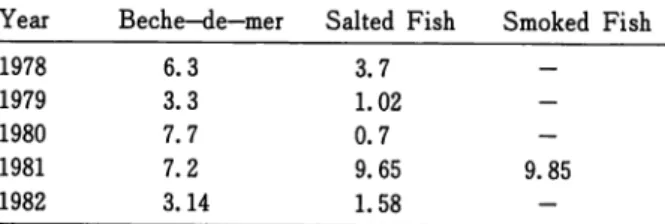
communities on preparation and preservation of mullet and beche-de-mer. Table 6 shows
the details on the quantity of fish processed.
Fluctuations are due to lack of constant supervision by reasonof lack of staff, together with natural disasters like cyclone and unfavourable weather.
Although the scheme provides a reasonable base for development of the outer islands rural
fisheries where transportation costs are high for a reliable transportation network ; theTable 5. Rural Fishing Group Operations
Year No. of schemes Catch (mt.) Catch (S)
1978 24 37.5 25,537 1979 27 35.8 32,935 1980 26 39.6 40,725 1981 24 79.04 104,933 1982 34 99.31 133,321 1983 56 143.82 192,033
Table 6. Food Processing Unit Activities
Quantity of fish and fish products processed
Year Beche—de—mer Salted Fish Smoked Fish
1978 6.3 3.7 —
1979 3.3 1.02 —
1980 7.7 0.7
-1981 7.2 9.65 9.85
1982 3.14 1.58
-Source: Fisheries Division Annual Reports. (1978—1982).
program has yet to be established with involvement ofgreater part ofthe island community
and with the necessary motivation by the Fisheries Division.3 . Production Structure of Small Scale Fisheries
1 ) Fisheries Production
Small scale fisheries production is composed of fin fish and a variety of non-fish aquatic products. Table 7 gives a list of common species sold in the local markets. Non-fishery products including crustaceans, molluscs and holothurians are largely collected by the
subsistence fisherwomen who usually sell their own catch in the local markets.
Fin fishery is mostly carried outbymen who operate within the reefand lagoon areas with some deep sea fishing. Certain species like the rabbit fish, sardines, surgeonfishes and so on are seasonal. Table 8 gives the artisanal-commercial production including the
subsistence estimates to illustrate the domestic production by small-scale fishery.
Statistical information is limited on the proportion of contribution by the different types of
fishermen. Table 9 indicates the distribution of domestic production by the various
channels.
2 ) Organization of Production
Subsistence activities are carried out mostly by women and children for the daily
consumption requirements. There is an increasing tendancy of the subsistence fisherwomen and men to sell their catch to meet their cash needs.During low tide after completing the daily household activities women organize into
groups for fishing. Several types of groups exists ; it may consist of a few neighbouring
households, or women members of a particular mataqali or the whole village women who atthe particular time are not engaged in other activities like gardening or weaving. The
women eitherhand collect or use hand wading nets on the reef flats and mangroves and fish in the lagoon at low tide. Much of the actual catching and gathering is done on a self-basisfor each household, but sometimes combined group effort is required eg. when encircling a
school of fish or whenoperating larger nets. Fishing operationsfor these women are seen asIwakiri and Ram '. Small Fishing Economies
Table 7. Species of Fish and Non—fish Aquatic products Commonly Caught by Small—scale Fishermen
FISH
LOCAL NAME SCIENTIFIC NAME ENGLISH NAME
Tilapia Tilapia mossambica Tilapia
Yawa Chanos chanos Milkfish
Kawakawa Fam. Serranidae Rock cods
Kake Lutjanus spp. Small snappers
Kaikai Leiognathus equulus Pony fish
Mama Monotaxis grandoculis Large—eyed bream
Kawago / Kabatia Lethrinus spp. Emperors Ase, Ki, Mataroko Fam.Mullidae Goatfishes
Kalia/Ulavi Fam. Scaride Parrotfishes
Matu Fam. Gerreidae Moj arras
Nuqa Siganus vermiculatus Rabbitfish
Balagi/Ta Fam. Acanthuridae Surgeonfishes
Cumu Fam. Balistide Triggerfishes
Busa Hemiramphus far Halfbeak
Oqo Sphyraena barracuda Barracuda
Kanace/Kava Mugil cephalus Mullet
— Fam. Atherinidae Silversides
Saqa Caranx spp. Trevallies
— Sardinella spp. Sardinellas
— SprateUoides spp. Round herrings
Daniva Herkbtsichihys punctatus Spotted herrings
— Stolephorus spp. Anchovies
Walu Scorn beromorus commerson Spanish mackerel
Salala RastrelUger kanagurta Indian mackerel
— Mackerel
— Series Percomorpha Demersal fishes
* Not elsewhere included (others).
CRUSTACEANS. MOLLUSCS AND OTHERS
Ura moci Macrobrachium spp. Prawns
Ura moci Penaeus spp. Prawns
Urau Panulirus spp. Rock lobsters
Qari Scylla serrata. Mangrove crab
Kuka Sesarma spp. Mangrove crab
Mana Thalassina anomola Mud lobster
Lairo Cardisoma carnifex Land crab
Vasua Tridacna spp. Giant clams
— Conus spp. Cone shells
Kaikoso Anadara spp. Cockles
Kai Cristaria plicata Fresh water mussel
Kuita — Octopus
Dairo Microthele nobilis Teat fish
Nama, Lumi Caulerpa racemosa Mangrove algae
Vonu Chebnia mydas Green turtle
* Beche -de mer (sea cucumber)
Source: Crossland, J. & R. GRANDPERRIN. 1979: p.5 & 6 .
Year
Table 8. Artisanal—Commercial Production
1980 1981 1982 1983 mt. ($000) mt. ($000) mt ($000) mt. ($000) Fish 2,571.41 4.34 2,632.42 5.80 2,928.14 5.63 3,549.34 6.73 Non-fish 1,255.1 1.20 1,352.53 1.21 1,775.32 3.76 2,330.34 2.68 Rural fishing scheme 14.0 0.15 79.04 0.11 99.4 0.13 143.82 0.19 TOTAL 3,810.51 5.69 4,063.99 7.12 4,802.86 9.52 6,023.5 9.6 Subsistence 14,000 14,400 14,600 14,800
Source: Fisheries Division Annual Reports. (1980—1983).
Table 9. Summary of Local Fisheries Production and Distribution (Excluding Tuna & Subsistence Fisheries)
1979 1980 1981 1982 1983 mt. ($000) mt. ($000) mt. ($000) mt. ($000) mt. ($000) Fish Markets 837.4 1,281.0 843. 9 1,348.0 1,132. 9 2,022.2 973. 7 1,832. 7 818. 3 NMA 195.9 177.5 133.3 193.0 127.9 206.4 128.5 239.0 290.6 Other outlets 1,040.3 1,572.0 1,537.6 2,377.0 1,305.2 3,252.0 1,755.8 3,265.7 2,360.6 Fish Products Shark fin n. a n. a 53.7 403.0 41.6 207.7 14.5 108.8 n. a Smoked fish - - - - 9.9 36.9 21.5 64.5 35.8 Salted fish - - - - 9.7 41.7 26.7 80.1 33.8 Frozen fish n. a n. a 2.9 14.0 5.4 24.4 7.5 37.5 n. a 1,538.2 365.6 4,484.3 TOTAL Non—fish Markets NMA & Other
Outlets 26.7 Trochus shells n. a Mother of Pearls n. a Beche—de—mer n. a Frozen crab n. a n . a 123.1 141.7 n. a 2,075.6 3,020.5 2,571.4 4,341.0 2,632.4 5,791.3 2,928.1 5,628.2 3,539.2 6,652.9 885.0 322.2 956.4 662.0 1,093. 5 719.0 1,443. 2 2,879.1 1,450. 3 45.7 42.0 190.0 39.3 145.0 57.1 113.9 849.2 n. a 180.0 104.0 182.7 109.6 219.1 328.7 n. a n. a 29.8 66.0 17.1 26.4 17.1 51.5 n. a n. a 16.9 169.0 15.8 190.1 34.6 346.0 n. a n. a - - 4.1 20.5 4.3 34.1 881.0 732.3 n. a n. a n. a TOTAL 911. 7 367. 9 1,255.1 1,191 1,352. 5 1,210. 6 1,775. 3 3.752. 9 1,939.5 1,613. 2 Rural fishing scheme 14.0 150.0 79.0 105.0 99.4 133.3 143.8 192.0
Iwakiri and Ram ' Small Fishing Economies 79
participate and cooperate in the group for their greater relationship outside the fishing circle.
In the outer islands women are engaged in processing of mullet and beche-de-mer to provide as a source of income. Women therefore contribute towards the domestic subsistence consumption, providing for the family nutrition as well as getting involved in commercialization of catch. When one looks at the statistics on the total production, subsistence estimates show the highest proportion of production, indicating the significant role of women in the fisheries sector. However as SCHOEFFEL (1983) in her report on "Women's role in Fisheries in the South Pacific" states the "despite the active role of women, the women do not own the means of production besides simple hand nets'. (SCHOEFFEL ; 1983 : p. 160).
The artisanal-commercial fishermen in the village usually belong to the mataqali of traditional fishermen called the 'Gonedau'. The Gonedau are recognized as the skilled fishermen who have acquired skills from their ancestors. However, with progress in time and influence of western culture other village members are also entitled to engage in fisheries, although fishing for traditional and ceremonial purposes is still directed by the Gonedau clan.
Villages close to the fisheries Division Centres which have access to ice may engage in
fishing for more than one night. Majority of the village fishermen engage in day fishery,
however some operate night fishery. The fishing grounds are chosen according to the gear
available, the engine speed, and hold capacity of the boats used ; and the availablity of storage facilities. Artisanal-commercialfishermen mainly concentrate fishing in the inshore and offshore banks where as the subsistence fishermen's catch consists of varied range of resources include some deep water bottom fishes, but mainly reef, lagoon, and mangrove
fishes. For a fishing trip, the previous catch affects the decision of the fishermen for the
choice of the fishing spots as well as the seasonal availability of the certain species.
Experienced fishermen ie. those who have been using the same fishing ground for a long time, usually have knowledgeas to whichareas of the reef or lagoon may have a higher yield of certain species at certain times. Table 10gives an idea of the trip length, boat type and
fishing methods.
In a one day fishing trip, fishermen usually leave early morningand return by afternoon in
time to sell their catch. In the case of night fishery, the fishermen usually return early
morning and sell their catch during the day. Fishermen operating part-time fishery and those living further awayfrom the urban centers usually fish on Fridays in order to sell their
Table 10. Boat—type, Trip Length & Fishing Methods Boat—Type Length (m) Crew Trip Length (d) Fishing Methods Motor launch 7.4-12.3 6 3-12 Netting, Handlining Open motor boat 4.9—6.2 4 1 Netting, Handlining Large canoe 4.9—6.2 4 1 Handlining, Spearing diving