Studies on Some Marine Algae from Southern
Japan, III
著者
TANAKA Takeshi
journal or
publication title
鹿児島大学水産学部紀要=Memoirs of Faculty of
Fisheries Kagoshima University
volume
9
page range
91-105
別言語のタイトル
日本南海産海藻類の研究 : 其の三
Studies on Some Marine Algae from Southern Japan, III
Takesi Tanaka
Recently, marine algal surveys were made by the writer around the islands of
Southern Japan; Amami Islands, Tanegashima and Yakushima, Uji Islands, Tokara
Islands and others.
Furthermore, on board the training ship of our Faculty of fisheri
es, other surveys were executed in the Ryukyu Islands, twice in 1957 and 1959.The result of the investigation seems to the writer, to be of interest and may con tribute, to some extent, to the further study of the marine algal flora of the southern parts of Japan and also of the Ryukyu Islands. Among the specimens of marine algae
from these islands, collected by the writer since 1947, there are many interesting ones,
some of which are described in the following pages.
Certain specimens of these were taken to the University of California in 1958 and were compared with those kept in the Herbarium of that University.
Here the writer wishes to express his most sincere thanks to Prof. G. F. Papenfuss
of the University of California for his valuable suggestions and kind guidance. Thanks are also due to Mr. Koji Nozawa, Assistant Professor and Mr. Yuzo Hayashida,
Assistant of our Faculty, and Mr. Yasushi Nakamura, Officer of our training ship, the
Keitenmaru, for their help and co-operation in this research.
This is intended to be an article for the memorial publication of Prof. Yukio
Yamada and Hajime Matsuura's sexagenary birthday anniversary.
Punctaria mageshimensis Tanaka, spec. nov.
PI. I, A, PI. II, A. and Text-fig. 1.
Frons foliacea, subcoreacea, perforata, altitudine major 40 cm alta, 280-450 ju
cra-ssa, stipite brevissimo, irregulariter ramosa; laminis latioribus infra saepe lobularis,
supra 2-3-chotomis; segmentis ultimis plus minus ligulatis; cellulis laminaris 4-5 stra-tosis, duabus vel triabus mediis multo majoribus quam corticalibus, illis 100-170 u his40-55 ju altis; cellulis corticalibus parietalibus tenuibus, a superficie visis 4-5-angulatis,
\5-2S ju diam.; sporangia solitaria vel 2-3 aggregata, subglobosa vel obovata, 90-150/*
diam.; colore fulvo vel lurido. Japanese name. Goanme.
Habitat and localities. Mageshima Island, Tanegashima (Col. Aug. 14th, 1959 and Aug. 10th, 1960). The plants were collected by Mr. Yazo Goan from about 20 meter's
depth at rocky bottom.
Frond broadly foliaceous, subcoreaceous, more or less perforate, 40 cm in height,
280-450 m in thickness, somewhat stupose at the base, ending below in short stipes,
irregularly ramified, lower part*of the blade often lobular, but often dividing di-to tri-chotomous in upper part; ultimate segments more or less ligulate; blade consisting of 4-5 layers of cells, of which the cells in the inner layers much larger than those of the cortical layers, measuring 100 m to 170 m diam. for the former and 40 m to 55 u forthe latter; cortical cells 4-5 sided in surface view, 15-28 ju in diam.; sporangia usually
solitary, sometimes 2-3 together aggregate, subglobose or obovate, 90-150 ju in diam.;colour of the frond brown or dirty brown.
This large, broad Punctaria is very distinct and characteristic of large size species.
In this present new species, the blade is ramified in a peculiar and irregular manner.
92 Mem. Fac. Fish. Kagoshima Univ. Vol. 9 (I960)
Fig. 1. Punctaria mageshimensis Ta A. Portion of a cross section of the young frond a cross section of the frond, showing sporangia. >
NAKA.
X150. B. Portion of
150.
Therefore, this is distinguishable from the other species of Punctaria, in its having a
blade which is ramified at the above portion into di-to trichotomous. The base of the
frond is generally simple and somewhat broadly cuneate, but is often lobular margina lly. The perfarations do not so often appear in young plants, but are abundantly found in the old. The sporangia are scattered promiscously on both sides of the frond, in single or small groups. The hair and paraphyses are usually absent.
The Japanese name for the above species is Goanme. after Mr. Yazo Goan, a fi sherman of Mageshima Island, to whom I give my hearty thanks for his help and ki
ndness to the writer.
Tretnatocarpus pygmaeus Yendo v. elongatus Tanaka, var. nov. PL I, B. and Text-fig. 2.
Frons pulvinatim caespitosa, 3-5 cm alta, 0.5-0.8 mm lata, radice nodoso implicata,
parce dichotoma, ramulis ad basin leviter subcomplanata, ramis ramulisque saepe
tere-tiusculis in parte superiore, ultimis ramulis elongatis et plus minus acutis; cystocarpiis
globosis vel subglobosis infra apicem ramulorum inflatis ; colore bruneo-rubro vel
luteo-rubro; substantia subcoreacea.Japanese name. Hoso-mianagusa.
Habitat and localities. Mageshima Island, Tanegashima (Col. July 5th, 1950). Growing on rocks in the lower littoral zone.
Fig. 2. Trematocarpus pygmaeus Ykndo v. elongatus Tanaka. A. Cross section of a young frond. X250. B. Cross section of a frond. X450. C. Apex of a ultimate branchlet, showing colourless hairs. X50. D. A portion of the cystocarpic ultimate branchlets. X2.5. E. cross section of a cystocarp. X450.
forming a globular tuft, standing a short subcylindrical stem from a callus disc, more or less dichotomously branched, branches usually subcomplanate below, ultimate bran chlets elongate and cylindrical, often with colourless hair-like cells ; proliferous branches very few and not so developed; medullary tissue consisting of loosely packed, elongated, vertically oblong small cells, with diameter of ca. 17 i± ; cortical layer consisting of 2-3 layers of coloured cells, intermediate, of a dense layer of larger roundish cells, glandular cells absent; cystocarps almost globose or subglobose, sessile, on the surface of the upper part of the branchlets; colour of the frond brownish red or yellowish red.
Yendo, in 1920 first described Trematocarpus pygmaeus which was found in Nomo, Nagasaki. Later it was also reported by Okamura in his Icones of Japanese Alage, Vol. V, pi. 243, figs. 1-8 (1927). The writer got the chance of comparing his specimens with Okamura's authentic materials collected from Misaki, preserved at the Herbarium
94 Mem. Fac. Fish. Kagoshima Univ. Vol. 9 (1960)
of the University of California.
In general appearance, the present new variety can be differentiated from the other by its shape and the size of the ultimate branchlets.
Hypnea yamadai Tanaka, spec. nov.
PI. II, B, and Text-figs. 3-4.
Frons intricato-caespitosa, 4-10 cm alta, subcomplanata, teres ad apicem 0.7-2 mm
crassa, irregulariter alternato-ramosa, pleurumque ramo principale percurrenti; ramis alternis ramulos breves horizontales gerentibus, subpaniculatibus; ramulis ultimis ramo-sissima, apice abrupte obtusis aut attenuatis acutis; cellulis internis magnis, ad superfi-ciem diminuendis, omnibus hyalines, strato superficiali parvis cellulis coloratis unistra-tosis composito; parte incrassata lenticulata cellularum medullarum non adeunte; tetra-sporangiis in partibus tumidus ramulorum ultimorum gerentibus; cystocarpiis et antheri-diis ignotis; colore pulchere rubro; substantia membranacea.
Japanese name. Beni-ibaranori.
Habitat and localities. Uji Islands (Col. May 30th, 1953) ; Koshikijima (Col. June 10th, 1959) ; Tomioka, Amakusa (Col. June 19th, 1959) ; Shimoda, Izu; Tanabe, Kii.
Growing on rocks in upper sublittoral zone.
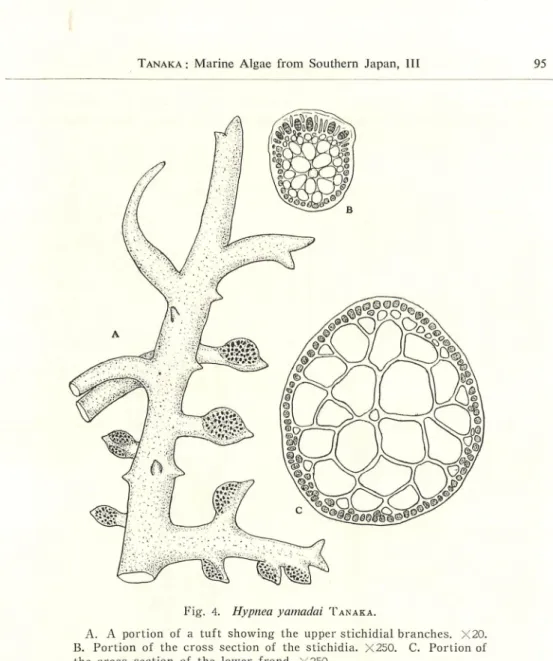
Frond intricate-caespitose, 4-10 cm high, subcomplanate, somewhat subcylmdrical towards the apex, 0.5-2 mm broad, irregularly alternate ramified, principal axis more
or less percurrent, branches mainly standing at almost right angle to the axis; upper branches subcylindrical and not so intricate, 0.5-1.5 cm high, 0.7 mm thick, irregularly much branched and more or less subpaniculate; ultimate branches spinous or obtuse at the apex; cells of the inner layer, excepting central axis, large, gradually smaller
towards periphery; lenticular thickening in the walls of the medullary cells absent;
Fig. 3. Hypnea yamadai Tanaka. Habit of a fertile plant. X2.
Fig. 4. Hypnea yamadai Tanaka.
A. A portion of a tuft showing the upper stichidial branches. X20. B. Portion of the cross section of the stichidia. X250. C. Portion of the cross section of the lower frond. X250.
tetrasporangia on one side (afterwards gradually around) of the swollen part of the ultimate branchlets, tetraspores irregularly zonate, 16-20 /iX28-36 ix ; cystocarps and
antheridia unknown; colour of the frond pretty red; substance membranaceous.
The present plant of Hypnea is a rather special one among the Japanese Hypnea species. In general appearance, this has some resemblance to H. cervlcornis J. Ag., but differs from it in its ramification and in the shape of the branchlets. Hypnea yamadai
belongs to the Section Spinuligerae. This species is distributed widely in the warmer parts of Honshu and Kyushu, Japan.
Dictyopteris fucoides Tanaka, spec. nov. PI. Ill, and Text-fig. 5.
Frons ad 35 cm altitudine, foliacea, subcoreacea, 3-4es regulariter dichotoma, stipi-tata; stipite longo, ad basin stuposo, 2-5 cm longo, ca. 1.8 mm diam., raro diviso;
96 Mem. Fac. Fish. Kagoshima Univ. Vol. 9 (1960)
segmentis subcuneatis, 1.5-3.4 cm latis; membrana in supra parte 4-5 stratosa, 240-300 /t crassa, in infra ad partim mediam 6-7 stratosa, ad 540 n crassa; soris oogonialibus in
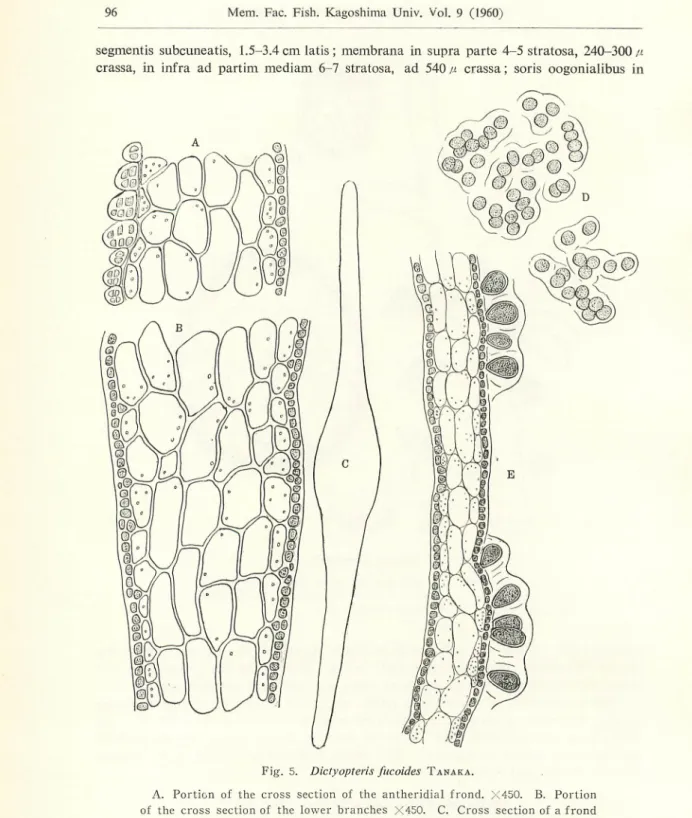
Fig. 5. Dictyopteris fucoides Tanaka.
A. Portion of the cross section of the antheridial frond. X450. B. Portion of the cross section of the lower branches X450. C. Cross section of a frond X20. D. Oogonial patches seen from above. X250. E. Portion of the cross section of the female frond, showing the oosporic sorus. X250.
superficie unaque laminae irregulariter lateque evolutis ; oogonia aggregata, ellipsoidea
vel obovata, 40-46p, x 65-85 p. ; antheridia cuboidea, ca. 65 /< alta, 75 p. lata ; colore
brunneo vel umbrino.
Japanese name. Ooba-yahazu.
Habitat and localities.
Funauke, Iriomote Island, Ryukyu Islands (Col. Oct. 25th,
1959); Koniya, Amami Islands (Col. Oct. 18th, 1959) ; Mageshima Island and
Ni-shinoomote, Tanegashima (Col. Aug. 20-25th, 1960). Dredged from 20-40 meter's depth
off a rocky or coral bottom.
Frond exceeding 35 cm in height, foliaceous, 3 or 4 times regularly dichotomous,
stipitate; stipe rather long, subterete, 2-5 cm long, about 1.8 mm thick, one or two
times regularly ramified, with remnants of the marginal membranes attached, segments
subcuneate, 1.5-3.4cm wide, 240-300/'. thick; midrib relatively broad, distinct in the
middle part of the frond, consisting of 4-5 layers above, increasing to 6-7 layers in
the lower part and about 540 p. in thickness; stalks continued into the blade and its
divisions as definite though distinct midribs which divide notably far down in advance
of the divisions of the blade, so that two forkings of the midribs occur before the first
corresponding division of the margin; oogonial sorus scattered, in groups of 4-10, elli
psoidal or obovate, 40-46 pX65-85 p, usually only on one side surface of the frond;
antheridia nearly cubic, ca. 65 p broad, and 75 p. high; colour of the frond brown or
dark brown and black on drying.
This new species is very distinct.
In point of size, this stands in the same rank,
with Dictyopteris justii, D. anstralis, D. mellerl, D. membranaceous, D. cokii, D. diaphana
Taylor etc. Among these species of Dictyopteris, the shape of the present species
resembles the figures of Haliseris Justii (Lamx.) Kg., in Tabulae Phycologicae, vol. 9,
no. 55, but can be distinguished from those figures by the shape of blades and also by
the situation of the sorus. The sorus are developed on only one side of the blade,
occupying almost the whole surface of the frond, except the midribs, according to the
writer's examination.
The segments are rather broad, mostly subcuneate, and are more
than 1.5 cm in width.
Dictyopteris papenfussii Tanaka, spec. nov. PI. IV, B. and Text-fig. 6.
Frons ad 15 cm altitudine, delicata, foliacea, membranacea, ad basin stuposa, sparse
dichotomeque ramosa, furcatae intervalis 2-3 cm angulisque angustatis ; segmentis linearis
vel lineari-spathulatis ad apicem plus minus obtusis, 4-6 mm latis, 80-100 n crassis;
membrana crassitudine duarum cellularum in parte stipites 6-7 stratosa, ca. 350 p. crassa;
sorus ignotis; colore aureo-fusco.Japanese name. Ribon-yahazu.
Habitat and localities.
Shodon, Kakeroma Island, Amami Islands (Col. May 25th,
1954).
Frond to 15cm high, somewhat foliaceous, regularly dichotomous, membranaceous,
sparingly branched, stalk-like base narrow and stupose, gradually expanding to about
4 mm in width below the first forking, branches dichotomous, often unequal, at interva
ls of 2-3cm; angle below narrow acute or slightly rounded, in the upper portion
45"-60° and a little rounded; segments linear or linear-spathulate, usually same width, 4-6
mm broad, 2-3cm long, consist of two layers of cells, together measuring 80-100 p, in
thickness; midrib relatively narrow, distinct in the whole part of the frond, consist of
6-7 layers of cells; reproductive organ unknown; colour of the frond golden brown.
98
Mom. Fac. Fish. Kagoshima Univ. Vol. 9 (1960)
Fig. 6. Dietyop teris papenfussii
Tanaka.
A. Portion of the cross section of the frond.
X250.
B. Portion of the ultima te branchlet, showing the midrib and indefi nite side ribs. X20.
Generally, the present species is allied to Dictyopteris delicatula Lamx., but differs
from it in its longer segments and in its narrow angle of branching.
And also, this
very delicate Dictyopteris has a taller and broader thallus than. D. repens Okam.
The
thallus consists of two layers of cells, with the exception of the ribs in the middle andsides of the frond where the ribs are composed of several layers of thick wall cells,
measuring 350 a in total thickness.
The hair grow on one side of the thallus.
In this
plant, there are no creeping fibers from the under surface of the thallus, according to
the writer's examination.
Galaxaura yaeyamensis Tanaka, spec. nov. PL IV, A. and Text-fig. 7.
Frons arborescentes, ca. 9 cm lata, regulariter dichotomo-ramosa, stipitata ; stipes
subteretis, dichotomis, velutinos; internodia complanata, plus minus canaliculata, 0.5cm
longa, 2.6-3.5 mm lata, 240-320 p crassa, calce forte incrassata; tela assimilatoria e
aspectu, superficiali, circiter ca. 20 u diam.; cellulis papillosis minutes, 12—14 /s latis, 30-40 p longis, solum ad margines; colore albo-roseo.
Japanese name. Usuyuki-garagara.
Habitat and localities. Funauke, Iriomote Island, Ryukyu Islands (Col. Oct. 25th, 1959) ; Nishinoomote, Tanegashima (Col. Aug. 25th, 1960). Dredged from 20-30 me ter's depth at coral bottom.
Fig. 7. Galaxaura yaeyamensis Tanaka. cells.
A. Section of the frond to show tristromatic cortical cells. X200. B. Portion ;in, showing the spinulose cells. X250. C. Epidermal of the cortex from the marg
layer seen from above. X450.
Frond arborescens, 9 cm high, regularly dichotomous, strongly calcified, stipitate; stipe long, cylindrical and velvety, about 4 cm long, 3 mm in diam., giving rise cunea-tely to the complanate blades; internode complanate, and more or less canaliculate, 0.5-2 cm long, 2.6-3.5 mm wide, and 230-320/! thick, without any striations on the surface of the internode, apices blunt and rounded, scarcely taperd; medullary fila ments ramifying very rarely, entangleing in a irregular manner, about 15 thick; cortex
consisting of three layers of cells, parenchymatic, and about 50-75 p in thickness;
epidermal cells consisting well developed stellate chromatophores, lens-like or obconical in cross section, but but 5-6 gonal when seen from surface, 20 p in diam.; papillate
processes very rare, small, 12-14 /i x 30-40 p, usually aggregated only at the marginal portion of the frond; reproductive organ unknown; colour of the frond reddish white.
The present species is allied to Galaxaura vetnamensis Dawson in its general cha racteristics, but differs from it in its somewhat well developed stipe, and in its tristro matic cortical tissue. It bears some resemblance also to G. elegans Tanaka, having a well developed stipe, but, in this species, the width of the frond is broader than that of G. elegans Tanaka.
100 Mem. Fac. Fish. Kagoshima Univ. Vol. 9 (1960)
Padina stipitata Tanaka et K. Nozawa, spec. nov.
PI. V, A. B. and Text-figs. 8-10.
Frons 3-12 cm alta, 80-100 p crassa, longe stipitata, flabelliformis, plerique 3 sra-tosis cellularum, ad basin saepe 4 strasra-tosis composita; stipites cylingraceo-teretis, 2-3.5 cm longo, 0.6-0.8 mm diam.; parenchymaties, ad basin plus minus discalis pilloso adfi-xis ; segmentis flabellatis, subfissus, margine integris, membranaceis; zonis interpilaribus latioribus, ca. 3mm latis; calce leve incrassatis; sori tetras orangiorum ad ciuamque zonam interpilarem irregulariter dispositi, indicio contecti; sporangia obovata, 40-60//
x45-70ft; colore flavido, autem postea brunneo. Japanese name. Etuki-umiuchiwa.
Habitat and localities. Funauke, Iriomote Island, Ryukyu Islands (Col. Oct. 25th, 1959) ; Koniya, Amami Islands (Col. Oct. 19th, 1959). Dredged from 25-40 meter's depth at coral bottom.
Fig. 8.
Padina stipitata Tanaka et K. Nozawa.
Habits of the matured plants, showing inrolled and not-inrolled marginal portions. X1.5.
Frond 3-12 cm high. 80-100/; thick, flabellate, provided wtih a long stipe, often
dividing into many small segments in old, composed of three layers of cells, but often
four toward the base; stipe very long, cylindrical, 2-3.5 cm long, 0.6-0.8 mm diam.,
composed of parenchymatic tissue, basal part of the stipe somewhat disc, hairy, often divided; segments flabellate, membranaceous, entire or often shallowly split at the ma rgin, incrusted very slightly with chalk on the dorsal surface; interpilar zones ratherof every hair-line on the ventral surface, making a discontinous line, provided with a
well marked indicium; sporangia usually obovate, densely gathered in irregular round
ish sori, 40-60 p x 45-70 p ; colour of the frond yellow, but yellowish brown in old.
The most clearly distingushing characteristics of Padina stipitata is that it is a
clearly stipitate species among the genus.
This stem-like stalk is usually divided into
two portions, namely, the base segment which is short hairy and the other one which
is long and cylindrical.
The hairy part is more or less discoidal and is often divided
several times.
The long stem-like portion is straight and not ramified, reaching the
length of no less than 3.5 cm.
Fig. 9. Padina stipitata Tanaka et K. Nozawa.
A. Sorus seen from the surface of the frond. \ '200. B. Vertical section through a sorus. X250.
Structually, the stalk consists of parenchymatic tissue, and medullary layers consists
of somewhat vertically elongated cells.
The marginal part of the frond is always
inrolled, showing the characteristic of genus Padina, but in its old stage, this margin
often disappeared, showing the general appearance like Section Zonarieae of
Dictyo-taceae. The frond consists of three layers of cells, but often of four layers in thelower part of the frond.
At the surface layer of the ventral side, the frond is covered
with very thin chalk, the surface cells of which store the more developed
chromato-phores than those on the dorsal surface. The cells of the medullary layers are larger
than those of the cortical cells, showing a square or rectangular figure in cross section.
The tetrasporangial sorus range concentrically on the middle parts in every interpilar
space. Tetrasporangia are irregular, usually obovate in shape, with remarkably clear
indicium.
Rosenvingea intricata (J. Agardh) Boergesen
Fig. 11.
Marine Algae Danish West Indies, vol. 1 (1914) p. 182, Some Marine Algae from
Mauritius II (1941) p. 65; Taylor Plants of Bikini and Northern Marshall Islands
(1950) p. 97, Pacific Marine Algae Allan Hancock Foundation to the Galapagos Isla:
nds (1945) p. 83; Dawson, Mar. Algae Gulf of California (Allan Hancock Pacific
Expedition, vol. 3, no. 10, 1944) p. 233, pi. 52, fig. 1, An annotated List Marine Algae
Eniuetok Atroll, Marshall Islands (Pacific Science, vol. 9, 1957) p. Ill, fig. 15.
102
Mem. Fac. Fish. Kagoshima Univ. Vol. 9 (1960)
Fig. 10. Padina stipitata Tanaka et K. Nozawaa.
A. Radial lomgitudinal section of the marginal portion. X250. B. portion of the
vertical section of the young frond X250. C. Portion of the vertical section of the frond. X450. D. Portion of the vertical section of the lower part of the frond. X450. E. Portion of the cross section of the stipe. X100. F. Fortion of the verti cal section of the stipe. X50. G, H, 1. Basal parts of the stipes. X6,
Syn. Asperococcus intricata J. Ac, Nya Alga fran Mexico (1847) p. 137, Spec. Alg.,
1 (1848) p. 77; Weber van Bossae, Liste des Algues du Siboga (1913) p. 137.
Syn. Encoelium intricatum Kuetz., Spec. Alg. (1849) p. 551, Tab. Phycol., vol. 9,
5.
Japanese uame. Mosa-kudafukuro.
Habitat and localities.
Nishinomote, Tanegashima (Col. Aug. 24th, 1960). Dredged
from 25 meter's depth off Sandy Bottom.
Distribution. Mexico, Gulf of California; India; Marshall Islands, Bikini; Gala pagos Islands, Bikini; Galapagos Islands; Ecuador; Barbadoes.
vol.
tab.
Fig. 11. Rosenvingea intricata (J. Ao.) Boeroeren.
A. Habit of part of a plant. X20. B. Surface cells. X250. C. Transection of a thallus through a sorus of plurilocular sporangia. X250.
Frond small, to 3 cm tall, bushy, intricate, membranaceous, much and very irregular
ly dichotomously branched, terete or subcomplanate, hollow, about 1-1.5 mm wide below,about 0.5 mm above, but the tips obtuse, marked by minute darker sori; frond wall 70
-100 m thick, consisting of a single surface layer of small, somewhat periclinally elonga
ted, densely pigmented cells mostly 10-13 u in length, and a subsurface tissue ofthin-walled, rounded, colourless cells up to 80 m in diameter; gametangia unaccompanied
by paraphyses or hairs, 20-30 m long, 7-9 u diameter; colour of the frond yellowish brown.
The writer has been able to examine the Mexican specimens of Rosenvingea from Gulf of California, collected by Dr. E. Y. Dawson. In outer appearance and anatomi cal structure of the frond, our plants fairly agree with the Mexican ones. In the speci mens at hand, however, the frond is more slender and more intricate than those of the
Mexican ones. This plant is here reported for the first time in Japan.
104 Mem. Fac. Fish. Kagoshima Univ. Vol. 9 (1960)
of Rosenvingea, which is assumed by the writer to be Rosenvingea orientalis (J. Ag.)
BOERGESEN.
*n •&. Wi w
eh
*
m
•cut, m^-^n io^fflmffim&wi$x°$>z>. Mr 1957^^t>* 1959^020, wmm JftO mm<DS S 4-f t 5 »£*»;£ • - fi b <o WBgc ZZUM 5. r-fi ic l*|6#. hlW$g ^ %co
**##&!?.
c;ftk©WS£te^V-^4c>as#v^,
^Htt-to^ <—SS&Stfe^EL
£ ©gf^fT 5 JCa D, ft * m$L. h(DWM>kJ3-x- bfifc, *@ * P * ;v « T^#o^
-fc -5.
LxfcV^k,i,5.
=tT v J- : fa-Si 40 cm ^Mx-?>Syv&-'^^* F^i©-fritt*. ##£#^€>:£HK;&5j!Lt>
^ = ^^9/1) : **H$tiW0:**ft¥#.
ftirn7S*BBlcj£ <*tt5ift
*©*HfidM6
©W ^ ? x P k<iZMt£"3~c\,->z>. itLxiife^fi-rs -1^7/ p ©• -firefes.
x-^x.^x: : #:* 35cm ^iiSg^&t.^xx-x©—ifftT?, H^fiX liStfi
M1J*<'/£f), MlSfe'Sb, —i.t/^-v^©int^ia:5.
N'lilli, W3<A, IS??-. *JI
**, l^Oi, Xt)fJS^A*paS6 (20-4 0m) K.£iirt*.
5. « t c A , #(ifrg$c&, ff£fijg.
p Xa- ^ *" 5 ** 9 : 2f X -// X MflS^Fh > G• vetnamensis Dawson, t y- if X A* 5 k 5Iii£j.<D
3 Hi !)J8&5j&s,
#:©TS&-m 4 jpr.fr 5 *"%*>!?,
^m&te&^mMffifc-J&j&itbti,
ftR&frt-*. (I'll. MSA, f&ff-;&0*«7cA, •3Tt«0 25—40mO8fii^e>Kv»s>
lc-C^Sfe$*vtei©.
-&-XX/-7XP : il-T-A, W£MW&<0 25m<D'Ml&£ ') K u y 5>iC t i i L f c %Ot'#
®Or5fr-'fiOSI|k«4.L-CV^.
i^-Wri^S* P *^ = 7^^if^^rr3f^$ttS
RosenvingeaJU © §81^ flBr'i" ?> ?£#5tfr5K::fcj5s>
/fcfflUi Rosenvingea intricata (J. Ag.)
Boergesen k Sat/JJ-.!^ 5 k ,§, 5 • •* ^ ~> 3 iH© 4 © iCtfa L T ^#$*fH < - WkXf'lAtt1i o t i u i ^ t t i / ^ .
ffi. Igfe*:*,
MrSftA.
ff#&K-T 19»4£Syfcl,;fc46©
A. Punctaria mageshimensis Tanaka. X2/5.
B. Trematocarpus pygmaeus v. elongatus Tanaka. X2/3.
A. Punctaria mageshimensis Tanaka. X2/5. B. Hypnea yamadai Tanaka. XI.
A. Galaxaura yaeyamensis Tanaka. X2/3. B. Dictyopteris papenfussii Tanaka. XI/2.
Plate V.