《論 説》
Pol
i
ti
calEconomi
cProcessf
rom the
‘
Pl
azaAccord’totheStructural
Adj
ustmentTal
ksbetween
JapanandtheUS
*― Howshoul
dweconsi
derthe‘
Pl
azaAccord’as
structuraltransf
ormati
onssi
nce
theSecondWorl
dWar?―
MasaoFuruta
Contents Introduction
Chapter1 PoliticalEconomicsonMonetaryPolicy Chapter2 TheJapanese-USCurrencyPolicyProcessover
the‘PlazaAccoed’
Chapter3 TheNegotiationProcessinthe‘PlazaAccord’ Chapter4 Japanandthe‘PlazaAccord’
Chapter5 ThreePoints
Chapter6 Validationonthe‘PlazaAccord’30Yearslater Chapter7 TheJapan-USEconomicRelationsin1990s Chapter8 MultilayeredSecurities
Chapter9 Comparison between Japan and the US on Mercantilisms
Chapter10 How shouldweevaluatethePoliticalEconomic System sincethe‘PlazaAccord’?
Conclusion Note References
Introducti
on
PrimeMinisterAbeofJapanandPresidentTrumpoftheUS(United StatesofAmerica)talkedatthefirstsummitmeetingofJapan-USon February10,2017.TrumphasbeencomplainingabouttheJapan-US economicrelationssuchastradedeficitwithJapanandexchangeratefor awhile.IntheJapan-USJointStatementofEconomyandCommercethis time,itwasconfirmedthatthreeapproaches,mutuallycomplementary fiscal,finance,andstructuralpolicyareused,andbasedonfreeandfair trade rules.They also confirmed to strengthen regionaleconomic relations.ItissaidthatJapan’smutualcomplementaryfinancialaffairs, moneymarket,andstructuralreform policiesimpliedthat“monetary easinginJapanisnotcurrencyinduction”.Isthiscommentoutfrom the lessonlearnedfrom the‘PlazaAccord’?OrisitbecausetheUStrade deficitwithJapanhasdecreasedcomparedwiththattime?
The‘Trumpphenomenon’is,ofcourse,partlyattributedtoD.Tramp himself,butweshouldalsopayattentiontotheflow thatcausesthe phenomenon.Isupposethatthis‘Americafirst’phenomenonhasalready begunsincethe1980s,althoughthisphenomenonhasdifferentdegrees.I thinkthatweshouldpayattentiontothepoliticalandeconomicprocess sincethen.Sotospeak,the‘path-dependent’appearsatthesuccessiveUS administrationlevelasthe‘TrumpPhenomenon’atthemomentinthe historicalprocessthathasbeencontinuous.
TheJapan-USeconomicrelationsaftertheSecondWorldWarcanbe calledthehistoryoftradefriction.Japaninitiallyvoluntarilyregulated exports to the US in the order oftextile,then steel,automobile, semiconductorand so forth.In 1985,the ‘Plaza Accord’sometimes
adjustedforeignexchangesignificantlytotheyenappreciation.Sincethe 1990s,themutualsystem wastakenupatthe‘StructuralImpediments Initiative (SII)’,and furthermore in the ‘Japan-US Comprehensive Consultation’“NumericalTargetsforReducingSurplusesbyJapan”went up to the top.Thereafter,the ‘Japan-US Regulatory Reform and CompetitionPolicyInitiativeandtheUS-JapanEconomicHarmonization Initiative’continued,andnow intheconflictbetweenJapanandtheUS economicconflict,suchintensepoliticalbattlescannotbeseen.
Theexchangeraterepresentsthevalue(price)ofthecurrencyand servesasanindexforcomparingandevaluatingthevaluewithother currencies.Theexchangerateaffectsnotonlytheeconomicfieldbutalso everyfield.Theforeignexchangemarketsetstheexchangeratewith foreigncurrencyintheimportandexportofonecountry,andaffectsthe demandandsupplyofgoodsandservicesproduceddomesticallyand abroad.Exchangeratemovementsaffectthecompetitionofgoodsand servicesproducedinvariouscountries,whichinturnaffectsthepattern oftradeflows[KuperandKuper,1996:275].
Theactualexchangeratesettingadjustsitsmovementnominallyor virtually.The relationship between the theory of exchange rate determination and empiricalevidence cannotbe stated clearly.The movementattheexchangeratereflectssupplyanddemandforfinancial resourcesamong thenations.Parity devaluation isconsidered asan indicationofexcesssupplyofdomesticfinancialassets.Exchangerate stability requires continuous currency policy among countries[Broz, Frieden,2006;Bernhard,BrozandClark,2003].Furthermore,politicalspeculation mayworkthere.
hasbecomeamajorturningpointinconsideringthecurrentinternational politicaland economic position ofJapan.The ‘Plaza Accord’was especially as importantas for the Japanese economy in the fixed exchangeratesystem ofadollar=360yen,thecollapseoftheBretton Woodsregimein1971,theSmithsonianagreementin1973anditscollapse [cf.Ito,2016].Because,asaresultofthe‘PlazaAccord’in1985,thestartof yenappreciationstarted[Pempel,1998:11,177],investmentandtradebecame active[Pempel,2005:21],EastAsiancountriespromotingeconomictiesand mutualexchanges[Machintyre and Naughton,2005:77,81;Tachiki,2005:159], subsequentchangesinmaterialandpsychologicalconsequenceinJapan, suchastheAssetBubbleEconomy,traderelationsbetweenJapanand theEastAsiancountries[Pempel,1998:200;Weiss,1999:155;Evans,2005:198],the occurrenceoftheeconomiccrisisin1997,developmentoftherelationship withJapanandtheworld,andfurtherclosingtheconnectionbetween Japanandtheworld,andthelater‘lost20years’[Weiss,1999:177;Tachiki,2005: 169].They hasbecomeatthecriticalmomentstoform thepresent appearanceofJapan.
Thegovernmentdecidesthelevelandstabilityofexchangerate.Its decisionaffectsthedomesticpriceofimports.How todeterminethe domesticpricewillaffecttheinflationrate.Exchangeratesalsoinfluence theactualincomeandwagelevelsthroughthesamemechanism.Tothe extentthattheinternationalcompetitivepositionofdomesticproduction products affects, exchange rate movements are meaningful for productionandemployment.Thegovernmentmayshow resistanceto currency appreciation duetoitsdisadvantageousemploymenteffect. Beyonddoubt,thereremainsalsopossibilityofdevaluationoftheparity withthepoliticalandeconomicbenefits.
Accordingtoeconomictheory,determiningtheexchangerateisbased ontheeconomicstructureandtradebalanceofeachcountry.Ofcourse, theyenanddollarexchangeratesinrealitydonotfunctionasexpected. The‘PlazaAccord’wasaneventthatprovedthattheyenandthedollar exchangeratewasnotinlinewitheconomictheory,butreflectedthe politicalspeculationofmanipulatorsinchargeofeachcountry.Thispaper aimstoreproduceandreconsiderthepoliticaleconomicprocessoverthe Japan-USeconomicrelationssince1980s.Iwouldliketodraw amacro-likecomparisonbetweenJapanandtheUSthroughthiswork.
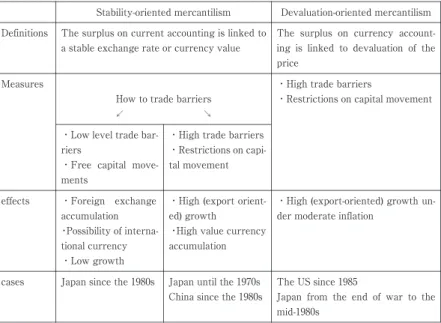
Ibelievethatwecanpresentnation-statemodelofmercantilisttype from thepresentcaseofbothJapanandtheUS.Iwouldliketokeepin mind,needlesstosay,thatthemodelsofbothcountrieshavedifferent points.
Iwouldliketodiscussthisthesisinsevenpartsasfollowinginthis paper.Firstwepresenttheinternationalregimetheoryonexchangerate from thestandpointofpoliticaleconomyinthefirstchapter.Second,with thetheoryinmind,wewillexaminetheprocessoftheJapan-UScurrency negotiationoverthe‘PlazaAccord’ascasestudiesfrom Chapter2to Chapter4.TheconsequenceshaveinfluencedJapanesesocietyuptothe present.Regardingthatpoint,thethirdwillbearrangedfrom thethree pointsinChapter5.Fourth,inChapter6,wewilllookfordifferences betweenJapanandtheUSontheevaluationoverthe‘PlazaAccord’. Fifth,inChapter7,weconsidertheJapan-USeconomicrelationshipafter the‘PlazaAccord’.Sixth,from Chapter8,atbroadperspective,wewill thinkfrom acomprehensivesecuritysystem,includingtheeconomy.And finally,from Chapter9,althoughtheglobalizationerapenetrates,and accordingtoit,wewillconsiderthetransformativeprocesswhichis(or
was)characterizeda(neo-)mercantiliststate.
ProfessorJ.Robinsonhasoncearguedmodernmercantilism asfollows. Governmentsofeachcountryaim toexpandtheshareofinternational economic activitiesonly fordomestic interests.Capitaliststatesare enthusiasticaboutselling,buttheytendtobecautiousaboutbuying. Thatistomaketheown tradesurplus.Thisisazero-sum game, meaningthatsomeonewilllosewhensomeonewins[Robinson,1973].
From the above viewpoint,as Japan has become an economic superpower,weneedtoconfirm thechangeinthecircumstancesofmore than thirty yearssincetheJapan-US currency negotiationsand the meaningofthatchange.
Weknow theterm ‘RashomonEffect’.Thatmeansthatitwillproduce differentinterpretationsdependingonthepositiontoconsiderthesame phenomenon.Nevertheless,thecurrenteconomicfrictionisbasicallya politicalconflict between sovereign states,even in the times of globalization and economic interdependence,even though there are variousactorconflicts.Thecircumstancesleadingtothe‘PlazaAccord’, theirintentions,andtheperceptionofeachcountrycausedagapinthe approachtothe‘agreement’,andtheresponseafterthe‘PlazaAccord’ causeddifferentinterpretationsbetweenJapanandtheUSandrelated countries[Ito,2016:73].
Chapter1PoliticalEconomyonMonetaryPolicy 1.ThreeconceptsandPointsofRegime
Whenconsideringpoliticalandeconomiccircumstancesininternational relations surrounding monetary policy,we must recognize three concepts.Theseconceptsare‘regime’,‘coordination’,and‘cooperation’.
Theinternationalregimeisdefinedasasetofrules,includingformal, partlyincludingtreaties.Ineachfield,theregimesets‘ruleofgame’to avoid conflictby interestsofrelated countries.Itisan international arrangement,asystem thatshouldbeobservedbetweengovernments.It canbeinternationalcommonorpublicgoods.
Regimeisaconceptthatcanapplyprinciples,norms,rules,andpolicy decisionstospecificfieldsofinternationalrelations[Keohane,2001:720];asan example ofthis concept,the InternationalMonetary Fund (IMF) established in 1944 atthe Bretton Woods Conference,private air transportformedinthe1970s,regulationoftelecommunications,rules, andorganizations,setsofinternationalenvironmentalregulations,and monitoringandmanagementofproliferationofnuclearweapons,etc.The regimeformedbetweengovernmentsisthusalsoaconceptappliedatthe issueofinternationalpolitics(e.g.security,economics,environment,etc.). Theinternationalregimeissetup forcommon interestsamong the participating countriestoit.Participating countrieswillactwithin a framework.However,theinstitution thatadherestothesystemized ‘coordination’and ‘cooperation’within thatrangehasunderstood the patterningoftheinterestsandauthoritiesofinternationalpoliticsandthe regimefrom there(thatis,theparticipatingcountriesagreed)havemade adistributionofplannedprofits.
The internationalregime is a mechanism ofinternationalvalue allocation.Itallocatesorredistributesbenefitsandcostsamongcountries. Therefore,the regime can be regarded asa politicalphenomenon. Governmentsofeachcountry,iftheyareconcernedwiththeregime,are involved in thenationalinterest.Itispremised,nottomention,on multilateralinterests(andforgetfulbutobligatory),butitrequiressome
standardsandrules.How tobalancethem leadstotheexistenceofthe regime[Yamamoto,1989:175-179].
The governments have been rapidly and frequently deployed in multilateral‘coordination’and ‘coordination’forinternationalactivities since 1945.Mostregimes contain atleastone ofthe international organizations,suchasspecificservices,monitoringformemberstates (and non-memberstatesconcerned),obedience and compliance with rules,participationinforumsfornegotiations,etc.Regimeisorganizedin internationalrelations,in principle,through horizontal‘adjustment’ ratherthan verticalbetween nations.Needlesstosay,the‘self-help’ functionofparticipatingcountriesisleft.Regimeisconstitutedbythe governments of member states to achieve national interests. Internationalorganizationsresponsiblefortheregimewillnotactasa governancebodysimilartothestate.Whenregime’srulesareapplied,we mustconfirm twoargumentsovertheregime.
Firstwhetherdoestheregimehavetodependonasingledominant country?
Secondwhethertheruleofregimecausesaspecificeffectapartfrom itsinfluence?
Theinternationalregimeischaracterizedbythesuperiorpositionof theUSlocatedatthecenterandtheincreaseofinterdependenceafter theSecondWorldWar.However,itisdifficulttodividetherelationship between the US controlin reality and the interdependence among countries.Cooperationinacomplexandmulti-polarizedworldsurely requiresaregimeframework.
Institutionsintheinternationalregimeareinfluencednotonlybythe powerofthestatebutalsointernationallyapprovedrulesandnorms.Itis
tomutuallyapprovetheagreedprinciplesamongsovereignstatesinthe internationalcommunity.Furthermore,evenastherulessettledtogether with the times,the power between the nations changes relatively irrespectiveofthat.Theyexpectedoutcomeofpowermaythusdiffer from whatisinitiallyobservedwithintheframeworkoftheregime.The differencebecomesapointofdebate.Whenthatrulelosesconsistency duetothechangeofpowerrelationsofthestate,theparticipating countriestrytocircumventtheregimeandseeascenethatmakesthe resultswhichhaveoftenbeenfundingsofarmeaninglessitis.
Itisprerequisitesforanalysisthatcharacterize the international regime.Analysisforinternationalregimesrequireconsiderationofthe followingitems[Young,1989:29-30].Thefirstisinstitutionalcharacter.What arethemainright,rule,andchoiceofregime?Howdotheystructurethe behaviorofactorsthatproducestreamstocollectiveoutcome?
Thesecondisthejurisdictionalboundary.Whatisthecoverageofthe regime under functional scopes,areal domains,and membership requirements?Thatis,howthejurisdictionissetup.
Thethirdisconditionsforoperation.Whichconditionisrequiredfor regimefunction?Underwhatconditionswouldtheregime’sactivities produceparticularlydesirableoutcomes(e.g.economicefficiency,equity ofallocation,ecologicalequilibrium,etc.)?
Thefourthistheconsequenceofoperation.Whattypesofresultscan beexpected from theregime?Whataretheappropriatecriteriato evaluatethisresult?
Thefifthisregimedynamics.How aretheregimeestablishedandthe regimeexperiencingpredictablechanges?Doestheregimeincludea transformationrule?
Eachofthefeaturesfrom thefirsttothefifthcanbeorganizedinto threepoints(whenorganizinginChapter5)accordingtothemainpoints ofthisthesis.
Point1istointegratethepoliciesonexchangeoffeaturesinthefirst andthesecond.
Point2istoclarifytheoriesandexperienceoffeaturesinthethirdand fourth.
Point3istoreflectpolicydecisionbyregimeoffeatureinfifth. Giventhesystem concerninginternationalregimes,itisinevitablethat efficacyissolvedtosolveinternationalissues.Itconcernscommongoods orpublicgoodsintheinternationalcommunity.Ininternationalrelations with members’sense of effectiveness affected by collective fate, establishing effective barriers to destructive events,for example, maintainsorderoverthe internationalenvironmentand the issues. Institutionsandrulessometimesbecomethebehavioralstandardsforthe behaviorofeachactor[Young,1989:235].
Thepoliticalandeconomicanalysisofmonetarypolicyfocusesonthree perspectives.Thefirstisaninter-nationalperspective.Thisrelatestothe natureoftheinternationalfinancialsystem.Thesecond pointisthe domesticfocus.Thisisrelatedtothegovernment’sspecificpolicyonthe exchangerate.Domesticpolicies,especiallyinthecaseoflargepowers, haveagreatimpactontheinternationalfinancialsystem.Similarly,the internationalcurrencyregimealsoaffectsthedomesticcurrencypolicy. Thirdthepoliticalandeconomicsituationofthedomesticaffairshasa greatinfluenceontheinternationaleconomicenvironment.
2.InternationalPoliticalEconomyTheoryofExchangeRatePolicy Eachcountry’scurrencysystem employsoneoftwoexchangerates.One isafixedexchangeratesystem,andtheotherisafloatingexchangerate system.Today,sincetheSmithsonianConference,financialglobalization hasurgedcountriestoshifttoafloatingexchangeratesystem.
Tensionovertheexchangerate,atleastformorethanacentury,has beenafeaturerepeatedintheworldeconomy.
Inthefixedexchangeratesystem,acurrencyratemaybebasedon financialinstrumentssuch asgold orsilver,orlinked toaspecific currencysuchastheUSdollar.Thevalueofacurrencychangesfreely with thefloating exchangeratesystem.Thecurrency valueofthe countryischangedbymarketconditionsandmacroeconomicpolicyof thecountry.Theworldhasexperiencedtheperiodofthreeinternational monetaryordersuntilnow.
First,moststatesoftheworldareintheeraofthefixedratesystem basedontheclassicgoldstandardinaform modifiedinaboutfiftyyears beforetheFirstWorld Warand in the1920s.Governmentsofeach countryexchangedmoneyandcurrencyatthedisplayrateunderthe goldstandard.
Thesecondistheerafrom thelate1940stotheearly1970s.Capitalist countriesorganizedthecurrencysystem basedontheeconomicorderof theBrettonWoodsregimeaftertheSecondWorldWar.Thisis,ina sense,amodifiedfixedratesystem.Thelocalcurrencieswerefixedly linkedinconjunctionwiththeUSdollar,andtheUSdollarwasbackedby goldundertheBrettonWoodsregime.Butgovernmentscouldchange theexchangerate.Currenciescannotbetightlyconnectedlikeaclassic goldstandardunderthis‘adjustablepegsystem’.Puttinganotherway,
theexchangeratehasbeenstabilizedbymarketmanipulation.
Third,since1973,wehaveenteredtheeraoffloatingexchangerate system inmajorpowers.Smallcountrieschoosetoeitherfixtheirown currencyasoneofthemajorcurrencies,oradoptavariableratebasedon governmentcontrollaws.Theglobalizationsincethen,from the1980s, hasmadeitdifficulttocontrolcurrencyfluctuationseasily.
Itisunderstoodthatthecurrencyregimehasinfluencedregionallyas wellasinternationalpresenceafter1973.Ithasbeenlinkedtocountriesin manyregionalratesystems.Somecountrieshavelinkedtheirmajor currenciestotheirowncurrencies.Forexample,the14countriesthat jointheAfricanFinancialCommunitywerelinkedtotheFrenchfranc (currentEuro).SeveralcountriesinSouthAmericaandtheCaribbean havefixedtheirhomeexchangeratestotheUSdollar.TheEuropean MonetarySystem (EMS)wasconsolidatedintoaformerGerman-Mark withalimitedregionalagreement,andasaresulthasresultedinasingle currencyandacommoncentralbank.Theseareakindofinternational monetaryregime.
Thecontradictionbetweenthedomesticequilibrium andtheexternal equilibrium inacountryeconomyisresolvedbythefluctuationofthe exchangerate.Externalshockswillfluctuateasdomesticdemandand resource allocation willincrease exports,and reduce importsifthe internationalbalanceofpaymentsbecomesdeficitorsurplus,ifthe exchangeratefluctuatesfreely,thereexistsaview asasignalfrom the sidethatsupportsthemarketsystem.Thereremaincriticismsthatthe floatingexchangeratesystem raisesuncertaintybyinternationaltrade, sothereexistsadoubtaboutthestabilityoftheexchangemarket.Each countryhastherecognitionthatitisnecessarytopreventthefluctuation
oftheexchangerateaftertheNixonshock.Themanagementoffloating exchangesystem successfully overcametheworld recession in 1975. Althougheachcountrywasaproductofcompromise,itwastheresultof selecting arealmanagementoffloating system.Currenciessuch as formerGerman-Mark,pounds,andyencouldnotplaytheroleofthekey currencyinsteadofthedollar.Thebasiccurrencyisnecessarynotonly tobea‘strongcurrency’butalsotoprovidearemedyforabsorbing anxietyfactors[Ishiyama・Kusakabe,1978:135,154].
Policiesbytheparticipatingcountriesmustberespectedatalltimes fortheinternationalcurrencyregime.Indoingso,itisimportantto establishguidelinestodealwithvariousproblemsin‘coordination’and ‘cooperation’amongparticipatingcountries.Applicationof‘coordination’ requiresmutualcooperationwithconcreteactionamonggovernments. Forexample,connectinglocalcurrencytogoldorUSdollarsrequiresa corresponding balancing measure.Even ifone participating country choosesacurrencyofapowerfulcountry,thegovernmentofanycountry doesnotwanttobecomeacountry whereonly thehomecountry exchangesgold.Everycountryalsodoesnotturndowntogetasole countrywhereitexperiencesfluctuationsincurrency.Therewillbeno effectunlessspiritofcooperationwith‘coordination’issecured.
‘Cooperation’amongcountriescanalsoberelatedtoothercountries participating in ‘coordination’ofpolicy in memberstateswithin the regime.Itislikeajointinterventioninthecurrencymarket.Ifcountries withintheregime‘cooperate’anddonotshow theattitudetocope,we cannotexpectresults.Itcanbethecaseofaprisoner’sdilemmagame,for example.Itisbecauseeachcountryshouldtakethejointactiononthe premiseofmakinghispositionbetter.Theiractionsareforcedtomake
policydecisionswhilelookingatthedirectionofpartnercountryforming theinternationalregime.Thetwoterms,‘coordination’and‘cooperation’, areinterrelated.Toactually maintain aregime,onesolution usually assumesanotherone.
3.Coordination’and‘Cooperation’intheInternationalCurrencyRegime, andConsiderationofPoliticalStrategy
Theinternationalorregionalfixedratesystem hascharacteristicsthat theselectionofthestateisadjusted,forexample,thegoldstandard system and theEuropean Monetary System (EMS).Ifsuch afixed exchangeratesystem isbasedongold,oriftherearemanycountries choosing between US dollarand German-Mark,theinterestsofthe concerned countrieswillbeincreased by thesamechoice.Another countrymaybeabletoreducecurrencyfluctuationfactorsifacountryis evaluated ascurrency stable by a fixed rate.Regime participating countriesshouldnothurtaslongastheyadoptthesamestep.
Ifanumberofcountriesparticipatingintheregimeincreases,thefixed ratewillsucceed.Thiswasthecaseofthegoldstandardsystem before 1914.Itdependedontheinternationaleconomicorderofthenineteenth centurybytheUnitedKingdom (UK)goldstandardsystem.Whenmany countriesparticipate,thenatureofthefixedexchangeratesystem canbe ‘virtuouscircle’.However,whentheregimemeetsthecrisis,itcanleadto atangle,whichisalsoa‘viciouscircle’.Asthegoldstandardsystem ofthe 1930scollapsed,thewithdrawaloftheUKfrom theregimewasvirtually withintwoorthreeyearsthemanystatesoftheworldhadtowithdraw from thegoldstandardsystem.
problemsalsooccurinthefloatingexchangeratesystem.Asthefloating exchange rate system is in common standards for settlementand exchange,participatingcountries(evenifnotall)canbenefitfrom that. Forexample,theIMFstandardprovidesgovernmentswithquotasand restrictionsonexchangewithforeigncurrencies.Thispointwillpromote tradeandinvestmentthatwillbringprofitstoparticipatingcountriesin termsofbeingabletoactonsomecommonstandards.
‘Internationalcooperation’isindispensableforfinancialrelationsamong multiple countries.The fixed exchange rate system willgive the governmentanincentiveof‘cheat’likedefactocurrencydevaluationfor itsowninterests.Itissaidthat‘cooperation’amongrelatedcountrieshas thefollowingthree‘laws’inthecurrencyregime.
Firstthevolatilityofthedevaluedcurrencywouldsurelyincreaseor decreasetradeandinvestmentamongcountries.
Second the fixed rate tends to stabilize internationalfinance to strengthendomesticfinance.
Thirdthepredictablecurrencyvaluecanreducedisputesintradeand investment.
Therapidchangeinthecurrencyisoftenaseriousdrasticsurge, protectionistpressure;blatantenemiesontraderelationswhichleadto turn against.Theremay beproblemsthatthecountry isforced to sacrificeintryingtorealizethejointgainoftheparticipatingcountries. Thefixedexchangeratesystem requiresanadjustpolicyinvolvinga country and another one with respectto the exchange rate.The governmentmayadoptahighofficialdiscountrateinordertoavoid domestic currencies thatare overly highly appreciated.And there remainsapossibilitythatconflictsandadversarialrelationshipbetween
the countries willoccur from the viewpointofeconomic security regardingtheadjustcosttodealwiththedomesticeconomicandpolitical influence.Asasituation arisesin acurrency regimelikethe‘Plaza Accord’mentionedinthispaper,ifacountryundertakestheanchorrole ofaregime,itmayresultinanchor’smonetarypolicybeingsynchronized withothercountries.
And the governmentsofthe concerned countriesare subjectto politicalpressureinordertoimplementthatpolicy.Forexample,West Europeangovernmentshavesoughttoimplementausteritypoliciesto controlUSinflationundertheBrettonWoodsregimefrom thelate1960’s tothecollapse.Itwasbecausecountriesthatcoulddoitwouldbeableto maintain the currency regime if agreeing to the adjust cost. Intergovernmentalcooperation isimportantto sustain the currency regime.Ifcooperativemotivationisabsent,theyareattributedtofailure. Regulations between ‘coordination’and ‘cooperation’depend on the monetarypolicyofonecountryandanotherregardlessofinternational factors.
Wemustkeepinmindsfollowing.Inaddition,oneactorparticipatesin a certain internationalregime,and when consulting and executing ‘coordination’and‘cooperation’thereshouldbeanotherview tothink aboutistoprepareaconceptofpoliticalstrategyrelatedtoacertain issue.
When thinking aboutitsorigins,politicalstrategy departsnotby strategy-makingbutbystructuringofcollectiveactingability.Strategy consists of three basic elements; strategic capabilities, strategy formations,andstrategicguidance.
expertise.Strategy formationsarealsoacognitive‘challenge’tothe problems.Strategicguidancecanbeoverlookedfrom abroadperspective andtheabilitytodirectthewhole.
Buildingastrategiccoreisacentralpartofstrategiccompetenceand isaprerequisiteforitswork.Thepolicymakersinvolvedinitmust understand,accept,andbeinchargeofsuchacentralroleinthatactivity. Strategiccompetenceisjudgedpreferentiallyasamatterofleadership.It may,sotospeak,cometocollectiveactorswithstrategiccapacity.The leaderamong them who willoversee the whole can potentially be executedonlyincooperationwithcollectiveactors.Statedindifferent fashion,allthestrategiescanbeparaphrasedascollectiveactorsthink. Howeverweaknessesofcollectivedimensionareaffectedbyactorswith strongly personalized politicalroles.This weakens a unity among collective actors[Rachke・Tils,2007:531-532].Speaking ofstrategy being indispensable,thoughitisnatural;howeveritissurprisinglyeasytosee thatitrequirescarefulpreparation.
4.ExchangeRatePolicy
Domesticpoliticalfactorscause internationalpressure in relation to ‘coordination’and‘cooperation’withintheregime,whiletheexchange rate policy depends on domestic circumstances.It is difficult for ‘coordination’and‘cooperation’amongcountriestogainapprovalinone country.Exchangeratepoliciesaresusceptibletopoliticalinfluences suchaselections,publicopinions,andpoliticalchanges.Politiciansand monetaryauthoritiesintheadministrationmayoperatetheexchange rateforreasonsoftheirown domesticcircumstances(e.g.elections, cabinetapprovalratings,regimestabilityandinstability,etc.)from the
existenceoftheregime.Distributedpoliticsbasedonexchangeratesand domesticcircumstancesprescribetheexchangerate.Policymakersina countrymustthusconsiderthefollowingtwopoints.
Firstpolicymakersmustdecidewhetherornottoparticipateinthe currencyregimewhilebeingconsciousofdomesticandforeignsignals (e.g.tradeinmemberstates,economicgrowth,andpublicopiniontrends). Theymustselectowncountry’sratesomewhereonthecontinuousline from astrictfixedratetoacompletefloatingratetoparticipateinthis regime.
Secondthepolicymakersmustdecidetheexchangerate,keepingin mind thattheircurrenciesaretraded on foreign exchangemarkets. Participationintheregimeandeachjudgmentonthecurrencylevelare related to the circumstances in the regime,so itis necessary to distinguishthem from eachother.Andthevalueofthelocalcurrencyis positioned somewhereon acontinuouslinefrom acurrency in one countrytoabetteronecountrycurrencyforthecurrencyrate.Policy makersineachcountrymustpreparetheirownstrategiesinadvanceat thattime.
Decisionsonparticipatingintheregimecanincludetrade-offwiththe goalto‘agree’bytheparticipatingcountries.Theprofitsandcostsof targetarebroughttothenation.Ifpriorityisgiventothestabilityof domesticfinancialconditions,twoadvantagescanbeconsideredforthe fixedexchangeratesystem (ormaintenanceofratewithlessfluctuation).
First,by reducing the risk ofexchange rate,long-term stability promotestradeandinvestment.
Secondthefixedratestabilizesdomesticfinance.Sincethevalueof localcurrencyisfixedinthatcurrency(ormoney),low inflationpolicyis
adopted.
Thechoiceofaregime(ornot)isdecidedonthebasisofbenefitsand costs.Banks,investors,exportersand importers,and othersacting globallyontradeandinvestmentwanttochooseafixedratesystem, considering the stability ofexchange rate to promote trade and investment.Ifeconomic activity in contrastis constrained by the domesticeconomy,thegovernmentwillwanttomakechoicestostabilize domesticeconomicconditions.
A governmentcaninfluencethenatureofregimethroughexchange ratepolicy.Thegovernmentmustthereforedeterminethecurrency value.This decision signifies the exchange of‘competitiveness and purchasingpower’.
Theactualexchangerateaffectsthecommoditypriceproducedin each ofthedomesticand foreign markets.Italsoaffectspurchasing powerofpeoplewhoacquirecurrency.Realevaluationalsoincreases domesticpurchasingpowerbyloweringcommoditypricesinforeign countries(moregenerallyabletotrade).Howeveritispossibletoincrease ordecreasethecompetitivenessamongcompetitorswhocantradein theirowncountrybyfluctuatingtheirdomesticpriceratherthanforeign commodityone.
Thereisnocleareconomicguidanceontheoptimizationofexchange rate.Thedevaluedcurrencybringsaboutaneconomiceffectofshifting from importedgoodstodomesticproducts,andpromotesexportsand consumption.Howeverdevaluationhascontradictoryeffects.Exporting industriesmaybesluggishfrom currencydepreciation,ordomestically orientedindustriesmaybenefitfrom currencyappraisals.
hand.Producerswhomakecomplexandspecialdeals,ontheotherhand, areverynervousaboutcurrencyfluctuations.Producersinthatsituation becomesensitivetotheexchangerate.Theseproducerswouldpreferto chooseafixedexchangerate.Alternatively,domesticindustry(orcitizen) maytrytosellitsownproductstoforeignmarketsusingfluctuationsin exchangerates.
Theinterestsconcerningtheexchangerateexplaintheoutcomeofthe policyandform aparticularlyimportantpoliticalsystem atthattime.The politicalsystem,includingtheexchangeratepolicy,hasanimpacton economicpolicy.Exchangeratepoliciesareinfluencedbytheelectoral system,thetimingofelection,andthedeliberationsofParliament.Thisis becausetheexchangerateofacertainsystem affectspurchasingpower, growthrate,pricelevel,etc.Infact,thesesystemsinfluencetheresultsof theelections,andfurtherinfluencethewaygovernmentsandpoliciesare implemented.Forexample,thegovernmentwantstokeepthecurrency valuebeforetheelectionortochoosetoavoidorpostponedevaluation untilafter the election.However,the delay in devaluation further exacerbatestheproblem.Ifthereremainspoliticalunpopularitycaused bydevaluationinthenationalpurchasingpower,thegovernmentmaybe drivenbyastrongincentivetodevaluation,eventocreateamoresevere crisisthanothermethods.
Forexample,thatisinthecaseofMexicofrom 1993to1994orinthe caseofArgentinafrom 1999to2000.Incountrieswherecentralbanks cansecureadequateneutralpositionsfrom politicalpressures,theydo notparticularlyturnintopoliticalissues.Inaddition,thegovernment mustsecureenoughtimetopickupthebig‘tab’duetodelayinchangeat theexchangerate.
Itmaydeterminetheconditionsofdomesticpolicyonwhetherto enforcecurrency appreciation ordevaluation on theonehand.The regime sets rules and sanctions on the exchange rate policy of participatingcountries,anddevaluationconditionsdomesticpoliciesfor competitivepurposesontheotherhand.Regimerulesandmonitoring mechanismswill,in addition,imposeconstraintson thejurisdictional scopeoftheadministrations,thecentralbank,economicministersand governmentagencies,politicians,politicalparties,fiscaland financial authorities,andsoon,whichmanipulateexchangerates.Forexample, monetarypolicyandtradepolicyareasubstituteforexchangerate policy.Thedevaluationof10%isthesameastheimporttariffof10%plus theexportsubsidyof10%.Thegovernmentchoosestoissueexport subsidies,orsetuptradebarriersordevaluationofthelocalcurrency. Exchangeratepoliciesrelatetotheflow ofcapital,financialregulation, andpoliciesinmanyotherareas,whichbringpoliticaleffectsingoodand bad.
Table1:RateofDollarandYen
1989 1988 1987 1986 1985 1984 1983 1982 1981 1980 year 137.9644 128.1517 144.6375 168.5198 238.5358 237.5225 237.5117 249.0767 220.5358 226.7408 dollar 1999 1998 1997 1996 1995 1994 1993 1992 1991 1990 year 113.9068 130.9053 120.9909 108.7791 94.0596 102.2078 111.1978 126.6513 134.7067 144.7925 dollar 2009 2008 2007 2006 2005 2004 2003 2002 2001 2000 year 93.5701 103.3595 117.7535 116.2993 110.2182 108.1926 115.9335 125.3880 121.5289 107.7655 dollar 2018 2017 2016 2015 2014 2013 2012 2011 2010 year 109.9122 112.1661 108.7929 121.0440 105.9448 97.5957 79.7905 79.8070 87.7799 dollar
Chapter2TheJapanese-USCurrencyPolicyProcessoverthe‘Plaza Accord’
1.Internationalpoliticalandeconomicsituationbeforethe‘PlazaAccord’ The exchange rate ofthe world afterthe Second World War(the exchangerateofnationalcurrencies)becameafixed exchangerate system withthedollarasthekeycurrencybytheBrettonWoodsregime in1944.Japanhashelpedtopromotetextiles,steel,electricmachinery, automobiles,semiconductorsand key industriesofthatera,and has enjoyedhigheconomicgrowthunderthedepreciationofyenunderthe fixedexchangeratesystem of360yenperdollar.TheUSeconomic deadlinebecameapparentduetoanincreaseinwarfareexpensesofthe Vietnam Warmeanwhileinthe1960sandtheUSbalanceofpayments worsenedontheonehand,buttheWesternEuropeancountries’and Japan’seconomymadeabreakthroughontheotherhand.Itbecame difficulttomaintaintheBrettonWoodsregime,andPresidentNixon unilaterallystoppedexchangingdollarsandgoldin1971.
TheSmithsonian Agreementdecided thedevaluation rangeofthe dollarand rounded theyen toadollar= 300yen in January 1971. However,trustinthedollarsubsequentlydeclined,anditmovedtoa floating exchange rate system in 1973.Even though the Japanese economyenteredalow growthstageduetotheoilcrisisin1973,it increasedexportswithhightechnology,low wagesandaweakeryen. TheUSeconomylosttheinitiativeinthetriplestructurewithWestern European countriesand Japan,exportsweresluggish,and thehigh dollar’stonecontinued.
TheUSwasabletodrasticallydevaluethedollarwiththeNixonShock andtheSmithsonianAgreement.However,in1982,itreturnednearly280
yenperdollar.ThebackgroundofthissituationwasinfluencedbyUS monetarypolicy.ThehighinterestratepolicyadoptedbytheChairman VolkerofFederalReserveBoard(FRB)oftheUSatthattimeattracted theworldmoneytotheUSmarketandfixedthedollarhighinthe exchangemarket[Kurato,2014].
R.ReagantookofficeasPresidentin1981.TheReaganadministration implementedtheUSeconomicrebuildingplan(‘REGANOMIX’)witha drasticrestraintonexpenditureandtaxcuts.BothThatcher(theUK) andReagangovernmentsreflectedthepredominantperiodofNewRight (e.g.neo-liberalism ineconomyandneo-conservatism inpolitics)inthe 1980s.Bothgovernmentsundertookacomprehensi( ) ve‘smallgovernment’ throughfiscalnarrowing,deregulationofthefinancialandlabormarkets, anddenialofKeynesianpoliciesafterthewar[KingandWood,1999:371].
Howeverthesluggishtaxrevenueandtheincreaseinexpendituredue totaxcutsdidnotincreasetaxrevenueasexpected,militaryexpenses increased,andatthesametimefailedtoreducenon-defenseexpenditure, andtheeconomicpolicybringingafiscaldeficitofabout200million dollars every year since 1983,simultaneously adding trade deficit, suffering from ‘twin deficits’.Supply in the US was satisfied with domesticdemand,maintainingahighinterestratepolicytocurbinflation, leadingtoinflowofoverseasfunds,resultinginahighdollar[Nishimura,1999: 28-29].
TheFirstReagan administration atthattimewelcomed thehigh dollar’srise.However,intherealeconomy,thedeficitoftradebalance widenedasaresultofadeclineinexportsandanincreaseinimports. ThisisbecausetheReaganadministrationwascarryingthedeficitof fiscaldeficitssuchasaggressivefinanceaftertheSecondWorldWar,and
militaryexpensesincrease.Theeconomicrecoveryduetoalargetaxcut wasineffective,resulting in afurtherdeficitexpansion.Thebudget deficitintheUSwasabout700milliondollarsin1980,about1% ofGDP. However,thebudgetdeficitexpandedtomorethan5% in1984,reaching 200billiondollars.Thedeficitinthetradebalanceexceeded30billion dollarsin1977andexceeded100billiondollarsin1984.Thecurrent accountturnedtoadeficitof5.5milliondollarsin1982anditexpandedto 120billiondollarsin1985.Thisisequivalenttominus2.8% ofGDP.The USfellintodebtorcountryin1986.
TheUS and theUK caughtthecrisisofindustrialhollowing out from the 1970s to the 1980s.The internationalcompetitiveness of manufacturingindustryhasinparticulardeclinedmarkedly,and,atthe sametime,themanufacturingindustryhasmovedoverseasabroad.This incident domestically got into trouble within the increase in the unemploymentratefrom thissector.AfterthetradebalanceintheUS turnedintoadeficitinthelatterhalfofthe1970s,thecompetitivenessof US productsstopped in domestic and foreign markets,the import dependencebecameestablished,thetradedeficitrapidlysince1982.The
Table2:GrowthRate/UnemploymentRateofParticipating Countriesofthe‘PlazaAccord’(1960to1993)
UnemploymentRate GrowthRate Country 1990‐93 1980‐89 1973‐79 1960‐73 1990‐93 1980‐89 1973‐79 1960‐73 periods 8.4 9.5 4.2 1.9 -0.3 2.2 1.5 2.6 UK 6.6 7.6 7.0 5.0 -0.8 1.5 1.4 2.6 US 10.6 9.1 4.6 2.0 -0.2 1.6 2.3 4.3 France 7.8 6.7 3.4 0.8 2.1 1.7 2.5 3.7 WestGermany 2.3 2.4 1.8 1.3 2.2 3.4 2.5 8.3 Japan
shareofworld’sshareofindustrialproductsexportsfellfrom 17.2% in 1982to13.4%in1987.
ThemanufacturingindustryintheUSisexpandingoverseasdueto thehighdollarinthefirsthalfofthe1980s,whiledomesticproduction wasshiftingtoimportedproductiongoodssuchasforeign-madeparts andmachineryfacilities.Foreignconsumergoodscontrarytothishave cometoflowintothedomesticmarketinlargequantities.
The decline ofmanufacturing industry had a major impact on employment.While the numberofemployeesin the manufacturing industry increased by 917,000during theyearfrom 1970to1980,it decreasedby1,210,000workersthe10yearsfrom 1980to1999[Ohba,1995: 54].
TheReaganadministrationattemptedtorebuildtheeconomyinthe 1980s,but,asaresult,the‘twindeficit’thatthefiscaldeficitisalsothe currentaccountbalance hasbeen structured,and the tendency of protectionism domestically(especiallyfrom Congress)wasstrengthened. ThereasonforthiswasadeclineinthecompetitivenessofUSeconomy, buttheReaganadministrationcriticizedJapanandWestGermany,which arecurrentsurpluses,ratherthanmakingimprovements,andturnedthe deficit’sproblem abroad.Saiddifferently,asaresultofthefailureof ‘REAGANOMIX’,theUSgovernmenttriedtoimprovefiscalandtrade imbalancemeasuresbyadjustingtheexchangeratewiththeyenand Mark.TheUSgovernmenttriedtoavoidcriticism withintheUSby gettingintosometroublewithJapanthatcausestradefrictionwiththe USwithunreasonableyendepreciation.Becausethe‘PlazaAccord’in anticipationwasnotapureeconomictalk,itwasaplaceofpolitical negotiationsoverdomesticandoverseaseconomiesbothdomestically
andabroad.Itwasalsoatimewhenthemomentum oftheJapanese economypeaked.
Table3:Japan-USTradeConflictRelationsafterthewar(1970-2018)
result overview
tradefriction year
‘Japan-UStextileagreement’signed in1972.TheJapanesesideaccepted voluntaryexportrestricti onsontex-tileproducts.
tradefriction overtex-tilesfrom the1960sto theearly1970s textile
1969~1972
‘Self-regulationary export control agreementbetween theUS,Japan and Europe’in 1969.The ‘second SteelSelf-Regulation(1972-1974)’by Japan.
The US steelmakers asked the US admini -stration to restricti m-portsin1968.
steel 1969~1974
‘Agreement on the order ofthe Japan-UScolortelevisi onmarketor-der(OMA)’concludedin1977.The numberofexportstotheUSwasli m-itedto1.75millionunitsperyear. Japanese TV makers’
dumpingcertificationin 1971.
colorTV 1969~1977
‘Self-regulati onaryexportofautomo-biletotheUS’wasimplementedin 1981-1984byJapan,
Automobile export by self-regulations to the USin1984
automobile 1975~1992
Number agreement (30 thousand tonsofbeef ,80thousandtonsofor-anges)in 1978.Beefincreased by 6,900tonsby1988i nthesecondne-gotiations.Importquota abolished, tax rate gradually lowered in the thirdnegotiations.
The firstbeefand or-ange negotiations in 1977.Thesecondnego-tiation in 1983. The third negotiation 1988 (finalagreement,elimi -nationofimportquota).
beefandor-ange 1977~1988
Discussionsonobstaclestoaccessto theJapanesemarketinspecificfields (electronics, telecommunications, pharmaceuticals / medicalequi p-ment,forestproducts,transportation equipment,etc.)in1985.
MOSS consultation startedin1985 Market-ori -ented sector- spe-cificconsul -tation (MOSS) 1985~1986
The ‘firstJapan-US semiconductor agreement’concludedin1986.The ‘second Japan-US semiconductor agreement’concludedin1991. Consultation of
Japan-US semiconductor started in 1985 (concludedin1989). semi condu-ctor 1985~1991
Fourexpertmeetings,introduction ofgovernmentprocurementproce-duremeasures,settlementofgri ev-ancedisposalinstitutionetc.i n1989-1990. Unfair competition of Japanese supercom-putermarket supercomp-uter 1987~1990 Japantookmeasuresi n1990onsav-ingsandinvestmentpatterns,distri -butionmechanism (revisionoflarge storelaw etc.),exclusi vetradeprac-tice, keiretsu relationship, price mechanism in1990.TheUS’ smeas-uresin1990weretakenonsavings and investment,corporate i nvest-mentactivitiesandproductivi ty,cor-porate activities, government regulations,research and devel op-ment,exportpromotion,labortrai n-ingandtraining.
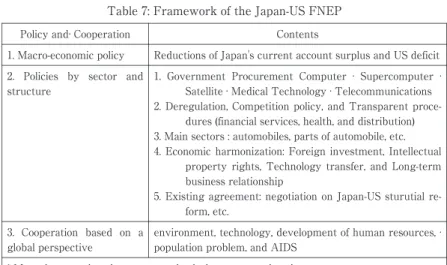
Bilateralconsultationon the efforts and meas-uresofbothJapanand theUS towardsreduc-ingthebal anceofpay-mentsofJapanandthe USin1989 Japan-US structural talks 1989~1992
Announced Japan’s self -regulationary measures in 1994 wereannounced.
‘Discussionstartedasa frameworkofJapan-US comprehensive eco-nomic consultation’ in 1993. Japan-US comprehen-sive eco-nomic con-sultation 1993~1996
Four summittalks between 1998 and2000(JointStatusReport) Deregulation Dialogue
betweenJapanandthe USstartedin1997 Japan-US strengthen-edinitiative on deregu-lation and competition policy 1997~2001
Japan-US economicpartnership for growth(consistingof6frameworks) in2001.
Startof‘Japan- USRegu-latoryReform andCom-petitionPolicyInitiative’ Japan-US
Economic Partnership forGrowth 2001~2007
Japan-US economic harmonization dialogue ‘FactSheetonNew Ini -tiatives’in2010 Factsheets onnew ini -tiatives 2007~2013 JapanandtheUSthatshapethef u-tureoftheAsia-Pacificregionand beyond:announced Japan's global and regionalcooperation.(the US withdrawalfrom theTPPin2017) ‘Japan-UStalksonTPP
negotiating partici pa-tion’concluded in 2013 (agreementin2015). TPP
nego-tiations 2013~2018
2.‘YoungReport’
Thereexistedagoodcontrastoftworeportswhenlookingatthattime theUS’seconomicattitudeintheowncountry.Oneisthe‘YoungReport’, andtheotheristhe‘MorganReport’.Botharecountermeasuresagainst theUSpoliticalandeconomichardshipsatthetime.
ThechairmanJ.A.Young(PresidentofHuettPackerCompany)ofthe ‘Presidential Advisory Committee on Industrial Competitiveness’ submitted the‘Young Report’in 1985.Regarding thedeclineofthe manufacturingindustryintheUS,theindustryintheUSrecognizedthat theUShadlostitscompetitivenessinforeignmarketsbecauseoftherise of overseas emerging industrialized countries,and the domestic productivitydeclinesduetoinsufficientinvestment.Thereportsaidthat “The internationalcompetitiveness ofthe US is now faced with challengesfrom abroad,whichisunprecedented.Theleadershipofour country is in danger of survivaland the living standards and opportunitiesthatcitizensareeagerfor.Itisdangeroustooffer,and pointedoutthatsuchacrisisisabigthreattoencouragethecitizen’s totalrally”[Ohba,1995:56-57].
The report recommended the measures that the manufacturing industryintheUSfacedwith‘new reality’bothinsideandoutside,and should takemeasurestoimproveproductivity.“IftheUS haseven competitivepowerintheworldmarket,manyofthemajornationalgoals canbeachievedsatisfactorily.Allgoals,suchasthepositionofUSasa world leader,raising thestandard ofliving forthepeople,national security,governmentfinancing fordomesticplans,and soon areall dependentonthecompetitivenessoftheUSindustrybothinsideand outsideofthecountry”,andthereportinsistedonthefullinclusionin
internationalcompetitiveness,evaluatingthecurrentsituationasfollows. ①IndustriesintheUScannotrespondtochangesindomesticand overseas for the past40 years,productivity declined,itbecame impossibletoproduceinnovativequalityproducts.
②Thedeclineinproductivityisrootednotonlyinissuessuchashigh capitalcostandlow savingsrate,butalsofundamentalissuessuchas labormotivationofworkers,structureofcorporateorganizationand education.
③Even ifthere remain companiesthathave survived the harsh competition by adapting tothenew economicenvironment,other companieswerepointedoutthehardproblemsintheUSeconomy, whennotimprovedtheirmanagementsystem,stucktopastpractices andviewpoints.
“Furthermore,asspecificcountermeasures,weseektostrengthenour competitivenesswithafocusonfourpoints;technologicalinnovation, reductionofcapitalcost,liquidationoflabormarket,andemphasison trade.Technologicalinnovationencouragesthegrowthofnew industrial sectors.Wewillprepareasystem toincreasethesupplyofcapitalforthe mostproductivepurpose,transferworkforcetohighproductivitysector through worker education and labor market liquidation,further strengtheninternationalcompetitionintheUSbyenhancingthepower ofexportpolicy”.
In addition thebusinesscommunity had toactasthemain body ofcompetitiveness strengthening,product development,technology development,trainingofemployeesandexpansionofinvestment.While promotingfiscalandmonetarypolicyaimingforstablegrowthwithout inflation,the governmentwould take measuresto create consensus
among industrial, labor, political and academic sectors towards strengtheningcompetitiveness.AllnationsintheUShadtorecognizethe significanceofstrengtheningcompetitivenessandchallengetargetsby acquiringnecessaryskills.Thiswastheroleofgovernment,enterprises andcitizens.
The‘YoungReport’pointedouttheproblemsoftheeconomicstructure centeredontheUSmanufacturingindustryatthetime,butittooktime torealizeit,soitwasimpossibletoseekimmediateeffect.Itseemsthat thecontentofthisrecommendationwaspartiallyprojectedtotheideaof ‘New Economy’sincethe1990s.However,giventheimmediateeffect, policyrecommendationsbasedonanotherreport(theMorganReport) wereexecuted.Thiswasthestrategicoriginleadinguptothe‘Plaza Accord’bytheUS.
3.Setting Upsofthe‘Morgan Report’and the‘Japan-US Yen-Dollar Committee’
ThePresidentofCaterpillarTractorCompany L.Morgan drew the ‘Morgan Report’ based on D. Martin’s and E. Solomon’s “The inconsistency ofthedollarand yen,thelocation and solution ofthe problem”,broughtittotheWhiteHouse,MinistryofFinance,andthe EconomicAdvisoryCommitteeetc.attheendofSeptember1983,[Frankel, Bergsten,1985].This‘report’pointedoutthat“theimbalancebetweenthe yenandthedollarratedroppedtheyenagainstthedollarrate;hence pricecompetitionwithJapanbecameimpossible.Thelowyenagainstthe dollarratewasintendedtoenableexportoffensiveagainsttheUSdueto devaluationofthedefactopriceinJapan”.
theyenandthedollarfrom ‘benignneglect’to‘aggressiveexchangerate policy’. He appealed to Treasury Secretary, D. T. Regan that ‘responsibility’.Morgan’sclaim wasalsoaproposalthatwaseasytoagree duetopressureonimportingJapaneseproductsduringthepresidential electioncampaign[Frankel,1984;Bergsten,1985:13].
ReganandFinanceMinisterTakeshitaagreedtosetuptheWorking GroupoftheYen-DollarCommitteesinNovember1983.TheCommittee reported measuresto Japan in May 1984.Itscontentsincluded;① liberalizing regulations on the flow of capital, ②promoting the internationalizationofyen,③improvingthehandlingofUSbanksand otherfinancialinstitutionsthatwishedtooperateinJapan,④determining interestratestoregulateJapanesedomesticfinancialcapitalmarkets, suchasleavingittothemarket,nottothegovernment[Frankel,1984; Bergsten,1982].
From thatviewpoint,“EvenifthemanufacturingindustryintheUS makesefforts,itwillnotberewardedduetofluctuationsintheexchange rate,andmovementsintheexchangeratehavehurtUScompanies.”The basicperceptionwasnottheJapanesegovernment’syenandeconomic policy,buttherapidriseofdollarpriceandtheeconomicpolicyofUS governmentasthecauseofthedollar’srise[Frankel,1984;Bergsten,1982].It predictedthatthefiscalexpansionmeasuresofJapanesegovernments can drastically reduced thedomesticsavingsand thesurplusin the currentaccount.Torealizethis,iftheJapanesegovernmentcouldraise therealinterestrateandreducethecapitaloutflow,theyenappreciation andthetradesurplusasapolicyresultwouldhavebeenreduced.The( ) keytosolvingthefallinthedollarrateagainsttheyenandtheresulting tradeimbalanceproblem wastotakeactiontoreducetheUSbudget
deficit[Frankel,1984;Bergsten,1982]. 4.TowardstabilizingExchangeRate
Japanfacedtheproblem ofcorrectingthebalanceofpaymentsbeforethe ‘PlazaAccord’.Protectionism wasincreasingintheUSCongressagainst thebackgroundofthegrowingtradesurpluswithJapan.Therewas internationalcriticism ofJapan’sausterity fiscalpolicy and monetary policyintheearly1980s.Theproblem inJapan’sausterityfiscalpolicy wasinparticularthetradeimbalancebetweenJapanandtheUS[Kojyo, 2022:377].Itwasconsequentially interpreted thatthe exchange rate betweentheyenandthedollarwasinpoorregulationinthetrade imbalancebetweenJapanandtheUS.TheUStradedeficithascontinued toincreaseeveryyearsince1980,andreached108.3billiondollarsin1984. Not only Japan,but also Canada,the European Community (EC) countries,and the Organization ofPetroleum Exporting Countries (OPEC)postedbilateralbalanceofdeficitsintheUS.
LookingattradeinmanufacturingproductsintheUS,itwasatrade surplusin1980,butitwasadeficitof96.5billiondollarsin1984,andtrade deficitof1984accounted for89%.Japan’stradewith respecttothe manufacturingindustrywas24.7billiondollarsin1980,butthedeficit doubledto49.8billiondollarsin1984.Thetradedeficitofmanufacturing industry,despitethedecliningshareofthetotaltradedeficitintheUS, wasmainlyregardedasthetradeissuewithJapan.
Currency authoritieshavetwomajorpolicy measurestostabilize exchangerates.Oneisinterventionintheforeignexchangemarket.This is a short-term stabilization measure.The other is coordination of economicpolicy.Thisisespeciallythecoordinationofmacroeconomic
policysuchasmonetarypolicy.Thesetwoinstrumentsforpolicymake measuresfunctioneffectively.
There are various arguments aboutthe effectiveness ofmarket intervention in theshort-term stabilization measures.Theposition of currencyauthoritiescanbesummarizedintothefollowingfourpoints.
Firstinterventionsareeffectiveindealingwiththechaoticsituationof themarketandreducingshort-term fluctuationsinforeignexchange rates.
Secondtheinterventionsometimesshowstheattitudeofthecurrency authoritiestothecurrencymarkets.
Thirdinterventionisusuallyeffectiveonlywhensupplementingand supportingotherpolicies.
Fourth each country should implementintervention ifthereisan agreementthatcooperativeinterventionisuseful.
Thefocusonmarketinterventionandpolicycoordinationwasraised bypolicycoordinationwiththeaim ofstabilizingtheexchangerateatthe delegationofthefinanceministersbeforetheconferenceofthe‘Plaza Accord’.Thisledtothestoriesofthe‘PlazaAccord’.
Thetheoryof‘LOCOMOTIVE’wasdiscussedattheBonSummitin 1978.TwocountrieswithgoodeconomicconditionssuchasJapanand WestGermany become the ‘locomotive role’and would pullother countries.Suchinternationalcooperationforcedanexcessiveburdenon somecountries.Forexample,withintheUSgovernment,inanattemptto maintainJapan’sleadershipininternationalpoliticsanddiplomacy,Japan intendedtomakeeffortsofJapaninsurpluscountries.TheUSprovided militaryanddiplomaticpower,andJapantakestheform ofwhichmoney wasborneasinthelaterGulfWar.Howeverthisideawasnotnecessarily
basedonunderstandingofdomesticsituation.Thisoperationforcedthe disadvantageoftheproposedcountryratherthangivingprioritytothe interestsofproposedcountryratherthantheresultof‘cooperation’.
TheTreasurySecretaryJ.BakeroftheSecondReaganAdministration recognizedtheimportanceofconsistentforeignexchangeintervention withpolicycooperationtowardsthe‘PlazaAccord’.TheUSgradually emphasizedpolicycoordination,buthewasstillskepticalofintervention. TheTreasurySecretaryReganandTreasurySecretaryB.Sprinkelin thefirstReaganadministrationwerereluctanttointerveneintheearly 1980s,butinthebeginningof1985atthetimeofthelaunchoftheSecond Reagan administration,afterswitching toTreasury Secretary Baker, DeputySecretaryR.DarmanandAssistantSecretaryD.C.Mulford, marketinterventionbecameapolicyinstrumentthatalignedwithpolicy coordination.ItshowedachangeintheapproachoftheUStowardsthe ‘PlazaAccord’strategy.
Itwastherolesharingofpolicycoordinationinthe‘PlazaAccord’that wasthepillaroftheexpansionofdomesticdemandinJapanandthe reductionofthefiscaldeficitintheUS.Bakermadeexpectationsfor economicstimulusmeasuresinJapanfortwoyears,butbecauseitdid notproducegoodresults,itbegantopositivelyrequestJapantostimulate domesticdemand[Ohba,1955:176]( ).
ThefirstReaganadministrationchangeditspreviousUSeconomic policy.Reaganadheredtotheprincipleofliberalisticmarketeconomyin 1981,andtriedtoregeneratetheUSeconomysufferingfrom stagnation andproductivitysluggishbythemacroeconomicpolicybasedonsupplied economicsandmonetarism.Thispolicyproducedhighinterestratesand dollarappreciation,bringinghugebudgetdeficitandcurrentaccount
deficit.ThepressuresforthedollartobecorrectedbytheNational Association ofManufacturers,the NationalChamber ofCommerce, agriculturalorganizations,etc.increased,andsecretariesinresponseto thatpressurealsobegantoappearwithintheReaganadministrationby theendof1984.SecretaryofStateG.P.Schultz,forinstance,emphasized thereductionoftheUSbudgetdeficit,bothforpublicinvestmentin Japan and expansion ofhousing investment.Thedollarcampaign of Caterpillar’s PresidentMorgan and Chairman ofChrysler Corp.L. Iacocca,forexample,in the businesscircle,which wasexposed to competitionwithJapanesecompanies,receivedattention [Kano,2006:161-162].Protectionism risingtotheUSCongresswascriticaltothetrade policyoftheReaganadministrationandasacountermeasuretothe midterm electionin1986.Ithadnochoicebuttocorrectthedollarto redresstradeimbalances.
TheReaganadministrationdecidedtocarryouttheadjustmentofthe exchangerateoftheimbalanceproblem againsttheyenandtheMark, forexample,becausethe‘REAGANOMIX’policyfailedunwillingly.Said differently,asameasurethatcouldbesaidtoreplacedomesticproblems withexternalcriticism,Japanbecameatargetwheretradeimbalance wasprominent.Theargumentshiftedfrom theinitial“how torestrict exportsfrom Japan”gradually “toincreaseimportsfrom theUS by Japan”.
ConstraintsoncurrencyconversionspeculatingonJapanesecurrency tradingwereliftedinJune1984.Itwasimportantasaform offundingin the US budget deficit.It is said that it was partly due to the reinforcementoftheUSmilitary.Theoutflow ofcapitalasamatterof coursehasbeenpromotedasaresultofsuchfactorsasdifferencesin
interestrates,especiallyintheearly1980s.Thepressuretoopenupthe marketfrom theUS wasnaturally tied totheneedsoftheReagan administrationseekingexternalfunds[Hook,Gilson,Hughes,Dobson,2012:119]. Chapter3TheNegotiationProcessinthe‘PlazaAccord’
1.IntheRun-uptotheJapan-USNegotiations
Variousmeasuresinthe1980swereimplementedforJapan’sfinancial deregulationunderthepressureoftheUS.TheReaganadministration calledforreform oftheJapanesefinancialsystem intheearly1980s.The successfulexampleoftheUSwasopeningtheJapanesefinancialmarket amongthem.TheYen-DollarAgreement,forinstance,permittedforeign companiestojoin theTokyoStock Exchange.In contrast,afterthe revision ofJapan’sForeign ExchangeLaw in 1999,Japanesecapital promotedthemovementtooverseas.
PresidentReagan said thataftertheinauguration heshould have openedtheTokyoStockMarketmoretoadjusttheexchangerateto Japanin1982.Whenthedeficiteconomybecameanimportantdomestic problem,theReaganadministrationbelievedthatifthe‘yenbuying’at theexchangerateoccurs,andthetradeimbalancebetweentheUSand Japanimproves,theUSwouldhavemadeadrasticadjustmentofthe exchangeratebetweenthedollarandtheyen.Theybelievedthatuntil thisstagetheycoulddo.
The‘MorganReport’pointedoutthatthemisalignmentofyenand dollarexchangeratewouldexacerbatethecompetitiveconditionsofUS industryin1983.TheAssistantDeputyofFinanceB.SprinkeloftheFirst ReaganadministrationaskedtheUSgovernmenttointernationalizethe yen in order to correctyen depreciation.He predicted the yen’s
appreciationasfollowing.Iftheinternationalizationofyenprogressed, theUSgovernmenthadthepossibilitythattheyenwouldweakeninthe shortterm duetocapitaloutflow from Japan,butifJapan’sfinancial capitalmarketbecamevital,theappealofyenassetswouldincrease.
Japan in response to this insisted that“high dollar is primarily responsibleforhighinterestratesintheUS”.HowevertheJapanese governmentcouldnotcontinuethisclaim.PresidentReaganandPrime MinisterNakasoneeventuallysetupaJapan-USCommitteetodiscuss theyen and thedollar[Kubota,2013].TheJapan-US Summitmeeting betweenReaganandNakasonewasheldinJanuary1983.Reagansaid,“I am concernedaboutthetradeimbalancebetweenJapanandtheUS,and the trend ofprotectionism in US Congress.Iwould like to close discussionsandcooperationbetweenJapanandtheUSonissuesthe problem ofaccesstotheJapanesemarket,openmarketproblem,the issueofyenanddollar,internationalizationofyenandsoon”.Theyen accordinglymadefulluseofinternationalization.
TheJapan-USYen-DollarCommitteereportedtoJapanliberalizationof financialandcapitalmarkets,eliminationofbarrierstoentryofforeign financialinstitutions into Japan,development of the yen market, regulationondirectinvestmentandeliminationofobstacles.Japanwas intendingtograduallyrelaxfinancialregulation,butonthecontrarythe USdemandedreliefurgentlyfordomesticuse.
HoweveritwasunknownwhethertheopeningoftheJapanesemarket wouldbeafactoroftheappreciationoftheyenintheforeignexchange market.Becausethecapitalmarketwasyen-denominatedtransactions, contrary tospeculation thatexpanding businessopportunitiesin the Tokyo Exchange Marketfrom abroad,ifdirectly connected to the
transactionofthe‘yenbuyinganddollarselling’wasnotsomuchas expected,Japanese investors and financialinstitutions as a result, increasedtheinvestment(capitaloutflow)totheUSandfurtheryen sellinganddollarbuyingoccurred.
TheJapan-USCommitteeconsequentiallybroughtabouttheeffectof expanding ‘marketbusiness’[Kuramoto,2014a:55,57,59].They could not influencetheexchangerate.AfteralltheReaganadministrationdecided thattheadjustmentofexchangeratebetweenthedollarandtheyenhad tobeoperateddirectlyontheexchangerate.BothgovernmentsofJapan andtheUShadtoimplementcooperativecurrencyinterventionbythe G5(theUS,Japan,WestGermany,France,and theUK)in orderto carry outthe agreementon devaluation.Itwas necessary for its implementationtoagreeatthe‘PlazaAccord’.
The agreementhoped thatthe US Treasury liberalizes Japan’s financialmarket,increasing demand for the yen,leading the yen appreciationandreducingthetradedeficit.Thiswasascenarioasthe ‘Morgan Report’.However,even afterthe signing ofthe yen-dollar agreement,the yen’sdepreciation and dollarappreciation continued. Japandeniedthemaincauseofthedollarriseinthehighinterestrate policyoftheUSgovernmentandthehighinterestrateintheUSdenied therelevanceofbudgetdeficit,highinterestrateanddollarhighinthe reportofcommittee.Theviewsoftwocountriesremainedconflicting [Kojyo,2002:359].
TheUSgovernmentaimedatanearlysolutionbyadvancingmonetary liberalizationatastroke,presentedconcreterequestitems,andpressed toformulateitsexecutionplan.TheJapanesegovernmentdidnotagree withthisidea,butapprovedtoconsiderthatfinancialliberalizationand
eliminationofcapitalrequirementswouldbenecessary.( ) 2.CircumstancesinsidetheNakasoneGovernment
Nakasonedeclaredtobeawareoftheresponsibilityofmajorpoweras ‘openJapan’toliberalizeagriculturalproducts,tocoverdefensesharing costs,andtoexpandtheOfficialDevelopmentAssistance(ODA)aidat theinaugurationoftheprimeminister.Nakasonetriedtonormalizethe Japan-USrelationshipthatworsenedduringtheSuzukiCabineterain termsofsecurity,economicsandpolitics[Shomeya,2005;Ch.4].
InJune1985,BakermadeaconsultationwithTakesita,andMulford didwiththeadministrativeviceministerforinternationalaffairsofthe MOFOba[Ohba,1995:173].Sinceavoidingyenappreciationwasthecentral proposition for exchange policy for Japan,cooperating with the appreciationoftheyenwasapoliticalbet[Funahashi,1993:Ch.4].
Nevertheless,Nakasonebelievedthattheyenappreciationwouldbean inconvenience to advance structural reforms commensurate with changesinJapan’seconomicfluctuationsandinternationalstatus.The ideawastopromotereformsoverthemedium tolongterm andopenthe markettotheoutsideworld.Thepolicybrainwastheformerofficer oftheMOF Nakagawa(theformercommissarofBOJ)and Hosomi (the former Finance Officer ofMOF).However Nakasone leftthe currency problem of negotiations to Takeshita,but tried to use the yen appreciation politically[Kano, 2006: 1700].Nakasone ordered countermeasuresforJapan’sexternalimbalanceproblem toOhbabefore thecurrencyadjustmenttalksinJune1995.
Itissaid thatthen theMOF did notactspecifically becausethe measureswereunrealistic.EventhoughNakasonecouldunderstandthe
austeritypolicyofMOFthosedays,notonlyforeconomicreasonsbut alsotheJapan-US military security arrangementswith theUS were extremelyimportanttoJapan,soheintendedtodealwiththecurrency problem positively[Kano,2006:177-171].
Takeshitadid nothavean opinion on theinternationalmonetary system,butcurrencydiplomacyforhim wasconcernedwithhisown politicalambition.HewasapoliticianwhoaimedatthepostNakasone,as arepresentativeofthePlazaconference;itwasagreatplacetomakehim famous in the globalstage.Takeshita had ambition to realize the adjustmentofthe yen and dollar exchange rate ata stroke by cooperativeinterventioninthemarket.Putanotherway,Takeshitatried to use itsposition to advantageously develop the Prime Minister’s successionbattle,whileshowingtheattitudeofdefendingthe ‘financial rebuilding’oftheoffersinMOFasthefinanceminister[Kano,2006:171].
TheMOFinthefirsthalfof1980sdecidedthatthe‘fiscalrebuilding’ wasthemostprominentproposition‘balancedfiscal’asitsfundamental principle.Therefore,theplanoftheMOF shouldbeayenanddollar exchange adjustmentfirstly,and a rate cutsecondly,because they avoidedthefiscalstimulus[Funahashi,1993:76].TheMOF waswaryof the economic expansion measures that the US demanded.That consciousnesswasrootedintheweakconstitutionofpostwareconomy.It is a phenomenon called ‘trauma’after war.Itwas specifically an underestimatedyenandthepursuitofgrowthpolicyledbyexternal demand.TheMOFthustriedtorespondbyadjustingtheexchangerate between yen and dollarby theintervening policy and lowering the interestrate[Kano,2006:173].
centralbank.The government,particularly the MOF,exerted its influenceontheBOJ’smonetarypolicy.TheBOJreceivedpressureson monetarypolicyunderthenameofpolicycoordinationbeforeandafter the‘PlazaAccord’[Kano,2006:174].Theindustrycircles,incontrast,wanted stableexchangerates.OnSeptember1,1985,whenthePublicResearch CouncilchairpersonoftheLiberalDemocraticParty(LPD)maderemarks onthecurrencysummittocorrecttheyen’sdepreciation,apartfrom whetherthebusinesscircleshadanticipatedfuturedevelopments,“We havetoperform thatitisnecessarytotakedrasticmeasures.Ifthe imbalancebetweenJapanandtheUScontinuesasitis,theperception thattheyenbecomeshighinevitablyhasbeenpenetratedingeneralby the crisis ofbecoming a ‘Japan-US trade war’and correcting the imbalance”[Kano,2006:17].
TheFinanceMinistersandtheCentralBankGovernorsofthefive advancedcountries(G5)inJapan,theUS,WestGermany,Franceandthe UKgatheredatthePlazaHotelinNew YorkonSeptember21,1985,and theydecidedtodevaluetheUSdollarthatsupportedtheworldeconomy. Itisthestartingpointoftheso-called‘PlazaAccord’[Pempel,2004:21].The tradeimbalancebetweenJapanandtheUS(Japanesetradesurplus,and USdeficit)wasatthetopatthattime.Forexample,exportsofJapanese carstotheUS were30,000in 1955,butexceeded 3million in 1985. JapaneseproductshadbeensweepingtheUSmarketsequentially,such astextiles,colortelevisions,ironandsteel,machinery,automobilesand others.Japan’stradesurplusin1985wastheworld’slargest56billion dollars,ofwhich80% wasfortheUS.BothleadersofJapanandUS thoughtthattheonlywaytosolvethetradefrictionbetweenJapanand theUSwastoreducetheimbalancebyadjustingyenanddollar[NHK
InterviewTeam,1999a].
TheUSgovernmentaskedtheJapanesegovernmenttoimproveupon theworstJapan-USeconomicfrictionafterthewar.Nakasoneappealedto the Japanese people to purchase foreign products.The Nakasone administrationhadnosolutionsforJapan-USeconomicfriction,andcould notdecreasethetradesurplusagainsttheUS.Hosomi,oneofthepolicy brainsofNakasone’s,suggested;“Thereisonlyanegativeappreciationof immediateaction”.Thehighyenappreciationwastomakeyenanddollar exchangerate,andweleaveyenappreciationanddollardepreciationas itis.Itwasthoughtthattheexportpricefrom Japanroseandtheimport pricedeclined,leadingtotheeliminationoftradefriction.Thismeasure meantsacrificingtheexportindustry.Nakasonehadtosuppressthe resistanceoftheyenappreciationinJapan,andearnestlythinkaboutthe properevaluationofyen.
Nakasone ordered Ohba to dealwith the Japan-US talksforthe appreciationofyen.Nakasonebelievedthatitwouldbebettertoraise yenandtolowerdollartodissolveeconomicfrictionagainsttheUSsince around1982[NHK Interview Team,1999a:24-27].However,inordertomake theyenappreciate,OhbarealizedthatbothJapanandtheUSneededto interveneintheexchangemarketforsellingyenandbuyingdollars. HoweverthefirstReaganadministrationcontinuedtorefusetointervene inthemarket,butchangeditspolicyfrom aroundthetimeofenteringthe secondReaganadministration.MulfordvisitedOhba,andaskedthestart ofnegotiationstocorrecttradeimbalances.AfterthatBakervisited Takeshita,TakeshitaproposedbargainlowerdollartoBaker,andBaker cameroundtothinkingofthedollarwiththerecognitionoftheexchange rate policy to leave the yen apprehensive in order to avoid the
protectionistresolutionintheUSCongress. 3.The‘PlazaAccord’anditsPerformance
NegotiationsbetweenJapanandtheUSinParishadalreadybegunon July23,1985beforethePlazaconference.Mulfordmadeaproposalto expandconsultationsnotonlytoJapanandtheUSbutalsotothefive FinanceMinisters’andCentralBankGovernors’Conferenceincluding WestGermany,theUK andFrance(G5).TheUSgovernmentthought thatthefiveindustrializedcountrieswerewillingtoinfusethemarket significantly,andthat‘coordinationandcooperation’couldshow thatthe marketcould change,and thatitwaspossible to shiftthe dollar’s depreciationfrom 5%to7%.( )
Thejointstatementofthe‘PlazaAccord’on September22,1985 declaredsaidthat“Itisdesirableforthemajornon-dollarcurrenciesto rise furtherin orderwith the dollar,so we are more prepared to cooperatemoreclosely”.Thisdeclarationwasalsoastatementsothat “cooperative intervention by each country could carry out the adjustmenttowardlowerdollar”.
TheJapanandtheUSstressedthepolicycoordinationandcooperation aboutmarketintervention,butbothgovernmentshaddifferentwaysof understandingfrom thebeginninginthewayofputtingemphasisonthe ‘policycoordination’andthe‘policycoordination’.Thisinconsistencyof understandingaffectedthetransitioninsubsequentsituations.
TheconferenceatPlazaHotelfocusedontheextenttowhichthedollar wascutdownandtowhatextentothercurrencieswouldberaised.The ‘PlazaAccord’wasthecorepartofthestatement,acertaindegreeof ordertothedollarofmajorcurrenciesotherthandollar.Thecurrency
diplomacy was announced to the world for the firsttime on 22, September.FirsttheUSgovernmentexplainedUS’smarketintervention. Thedollardevaluation rangewasfrom 10% to12%,and thedollar thereforechangedyenappreciationfrom 218to214perdollar.
Itwasnecessarytoprepareaconsiderableamountofyenappreciation against the dollar by 10% from the perception of the Japanese governmentatthattime.HoweverTakeshitasaidthathemightrevalue theyentoagreaterextentagainstthedollar.Takeshitawouldacceptup to20%,thatis,atthatpoint,theJapanesegovernmentledthemeeting withtheappreciationoftheyenagainstthedollarofupto200yen=1 dollar.TheFRBChairmanVolckersaid,“FinanceMinisterTakeshitais muchmorepositivethanwearethinking,andhisattitudehasplayedan importantroleinthesuccessofthemeeting”[Volcker,Gyoten,1992].
Inthe‘PlazaAccord’statement,“Thereisacertaindegreeoforderly risetothedollarofthemajorcurrenciesotherthanthedollar,soacertain degree oforderly rise ishoped for,so ifnecessary and beneficial, participating countries would prepare to make closer cooperation”. Japanesegovernmentshowedthepositiveattitudetowardit[Takahashi, 1995:13].
TheJapanesegovernmentperformedanactiveinterventionafterthen. Theinterventionplanwasdividedinto30% eachoftheUSandJapan.It wasthetotalinterventionamountof18billiondollars(about4trillion300 billionyen)whichwasexpectedsixweeksfrom September23.However, thepolicyhadtoadoptthepolicyof‘revaluingthemaincurrenciesother thanthedollarandkeepingthedollarweak’asthebasisoftheJapan-US exchangeregime.
4.Miscalculations
Afterthe ‘Plaza Accord’waslaunched in the Wellington exchange marketofNew ZealandonSeptember23,1985,thedollarbeganwitha yenappreciationoffrom 239yento234perdollar.Governmentsbeganto interveneinSydney,HongKong,Singapore,andtheEuropeanexchange markets.Theyenwasupvaluedfrom 233to230.Itbeganwithadollar= 231yen,theUSgovernmentimplementeddollarbuyingof2.5million dollarsinNew York,andadollarreached229to225yen.BothJapanese andtheUSgovernmentsinitiallyagreedtoweakenthedollarfrom 10% to15%.
ThedollarinTokyobeganat229yenonSeptember24,theBOJ’s interventionreducedthedollarto228yen,butthedollarincreasedto232 yen.ThiswasbecauseJapanesecompaniespurchaseddollarforpayment settlement.TheJapanesegovernmentanticipatedthatthedollarwould bearound225yen,butthedollardidnotweakenandtheoriginalplan wasout.Japaneseinterventiontotheexchangemarketamountedto120 milliondollars(about250billionyen)onthefirstdayalone.TheJapanese governmentandtheBOJrepeatedso-called‘talk-down’tointroducethe yenappreciation.Theyenappreciatedandthedollarreachedthe200yen inJanuary.Theyenappreciationandthedollardepreciationexpectedby boththeUSandJapanweresuccessfulatthispointattheendof1985. WestGermany,France,andtheUKstoppedinterveninginamonthafter the ‘Plaza Accord’.Since then,the dollar depreciation and yen appreciationpolicycontinuedbetweenJapanandtheUS.
Howeverthe‘PlazaAccord’cameupwithmiscalculationsoneafter anotherin1986.Takeshitasaidthatitwouldallowtheyenappreciationof onedollartobeintheorderof190yen.Onedollarsurpassed200yen;the
sharpappreciationofyenhadbegun.Sincethe‘PlazaAccord’wasthe ‘politicaladjustment’thatapoliticallycreatedflowsofyenappreciation and dollardepreciation,the characterofexchange marketchanged significantly,andthemarketbecameoverlysensitivetotheremarksof high-rankinggovernmentofficials.Theyenappreciationatthistimewas onlythebeginning.Sixmonthsafterthe‘PlazaAccord’,onMarch17th, 1986,theyenreached174.55yen,thehighestinthepostwaragainstthe dollar.Asthe Japanese companies’competitiveness,because ofthe yen appreciation,radially declined,the export-oriented industries deterioratedmanagement.Japanesecompanieshaveexperi encedaso-calledyenappreciationrecession.Theheavyindustriessuchasiron, steeland shipbuilding etc.had promoted the substantialcorpotrate downsizing,andthesmallandmedium-sizecompanieshaddrastically reducedprofitswiththeappreciationofyen.
TheGovernorofBOJSumidaonOctober22,1986affirmedthatthe yen’sappreciationandthedollar’sweakeningaredesirable,butadrastic measureoftheUSfiscaldeficitwasneededrespectivelyinordertosettle thistrend.However,astheyenappreciated,thepublicopinioninJapan turned overand becamecriticaloftheyen appreciation policy.The Nakasonegovernmenthadtodealwiththatcriticism.Dissatisfaction begantoemergefrom withintherulingLDP.ItwastheChai( ) rpersonof theLDP GeneralCouncilMiyazawawhowasin themoststrident. Miyazawacriticizedthatifthegovernmentadoptedahighyenpolicy,it shouldhavetakencorrespondingbudgetarymeasures.
Chapter4Japansincethe‘PlazaAccord’
Government
Nakasonehad todecidetostop thediametrically oppositeyen from promoting yen appreciation,and requested the US governmentfor cooperation.However,atthistime,the US governmenttook action againstthe requestofJapan.TheWallStreetJournal published statementsmadebyFinanceMinisteroftheUK N.Lawson,whohada talkwithBakerintheirconversationonApril11,1986.Lawsonsaid, “countriesotherthanJapanareseekingafurtherappreciationoftheyen, andBakerhasthesameidea”.Reaganmaderemarkstodriveitdown after10moredays,“weshouldlowerthedollarmore”.
Why did the Reagan administration make such remarks despite advancingthe‘PlazaAccord’incooperationwithJapan,contrarytothe originalintentionofthetwocountries‘agreed’?The‘PlazaAccord’had ‘cooperation’besidesthe‘coordination’ofjointinterventioninthemarket. Itis‘policycoordination’thattheUSemphasized.TheUScalledfor effortsbyJapantoexpandtheeconomy,andincreaseddomesticdemand toreduceJapan’sexportstotheUS.Japanadoptedtheintroductionof privatevitalityandthereductionofinterestrates(flexibleoperationof monetarypolicy).Japan’stradewiththeUSdidnotdecreaseevenafter eightmonthsfrom the‘PlazaAccord’.TheUSgovernmentdecidedthat Japan’sdomesticdemandexpansionpolicywasinadequate.IfJapancould notexpandtheeconomyandincreaseconsumption,theUSgovernment woulddecidetoleavethetrendoftheyenappreciationandthedollar depreciation.
TheUS governmentmadenegotiationswith themeansJapan to negotiate the high yen.The Japan-US jointpace broke down in thatsense.Onlytheinterventionintheexchangemarketwasableto