
ナス科植物における接木雑種の研究
23
0
0
全文
(2) /ol. 17, No. 1 Journal of Hokkaido University of Education (Section II B) September 1966. Studies on Graft Hybrids in Some Plants of Solanaceae. by Rinjiro OHNO Biological Institute, Hakodate,. Hokkaido University of Education. ^mnjllS : ^;fW^c:^;6^»oM-% CONTENTS Introduction. ................................................................................................. l. (I) The morphological studies of grafting plants'" ••••••••••••••••••••••••••••••••••••••• 2 Grafting methods................................................................................. 2. MMerials. .....................................................'..................................... 2. Appearance of the graft unions ............................................................ 2. (II) The cytological studies of grafting plants ••..•.....•..•••...•.•.•.•..•..•.•••.•...•... 9 M'ethods • •• ••• • •••••••• •• • • •• •• • •••••••••••••••••••••• •• • •••••• •• •• ••• • •••••••••••• •• • ••.•.•••••••••• 9. Results. (Ill). FI. .............................................................................................. generation. ..................................................................................... 9. H. (IV) Pi pollen germination ........................................................................ 15 M'aterial and methods ........................................................................ 15. Results. .............................................................................................. 15. Discussion •••••••.•.•••••.••.••.•••••.•.•...........................•.....•......••...•.•••.••.••....•••••••• 16. Summary •••...•••••••••.••••..•.....•................................•.......................•..•...•.•.... 21. Acknowledgement •••••••••••••••.••.................................................................•... 21. References •••.•••••..••••..•••....•••.•.•..................................•.•......•.......•..•............. 21. Introduction In recent years the study of vegetative hybrids has been carried out by many workers especially those in the Soviet Union. The first attempts to demonstrate vegetative hybrids by grafting were undertaken by Michurin in the Soviet Union using a number of higher plants, The results obtained from his work threw light on many problems which have been little studied but which are nevertheless important for understanding the essential. features of genetics. Furthermore, the work in this field was opened up wide by .Lycenko, and then a number of workers in the Soviet Union have clarified many aspects of vegetative hybrids. The present work has been undertaken with a purpose of analyzing the morphological and cytological features of some graft hybrids in Solanaceae which had been used in grafting. Cl).
(3) Studies on Graft Hybrids in Some Plants of Solanaceae.. experiments from rather earlier time, especially by Glushchenko (1948). In the present experiment, some intergeneric, interspecific and intraspecific graftings in Solanaceae were made on the field and in green house from 1956 to 1960. Of some graftings, it was observed that morphologically various variations and cytologically irregular meiosis in pollen mother cells had occurred on either the scions or stocks of certain combinations, and also there was a significantly high percentage of abortive pollen grains. The flower buds of those scions or stocks with abortive pollen grains were selfed, and seeds were obtained. Then they germinated and developed plants among which certain aberrants occurred. The production of those aberrant plants and their behaviour in succeeding generations will be described in the subsequent chapters.. (I) The morphological studies of grafting plants Grafting methods In the methods of grafting, wedge grafting was used, and cleft grafting was frequently tried. The best results were obtained by wedge. grafting (Fig. 1). The scions and stocks were bound together by hemp yarn (linen thread). For a better and faster union between scion and stock, grafting part was moistened by water twice a day for two or three weeks after grafting. Fig. 1. Wedge grafting method.. Materials The following plants were used in the present experiment : Capsicum annuum L., Capsicum anmunn L. var. grossiim. Sendt., Datiira metel L. (as alba Nees), Datiira tatula L., Datura stramonium L., Physalis Francheti var. Bimyardii (Hort.) Makino, Solann.m melongena L. var. esculentum. Nees (Kitsuta, Shinkuro), Petu.nia hybrida vilm. All these were grown in the garden and the green house of Biological Institute at. Hokkaido Gakugei University (1956-1957) and Botanical Institute, Faculty of Science, Hokkaiclo University (1958-1960). Appearance of the graft unions Of 14 graft unions (Table 1) in this experiment, 8 unions resulted in remarkable variations in morphology. The following morphological description is confined to these eight unions. (a) C. annidnn var. grossiim grafted on C. annuit.m (C. annititm/C. amwn.m var. grossu.in) C. annuiun var. grossum was easily grafted on C. anmium by the wedge grafting, but in general cases the growth of the scion had a tendency to be inhibited by the stocks. To obtain a successful growth of the scions it was necessary to remove the leaves on the stocks. The scions, however, grew very slowly.. C2).
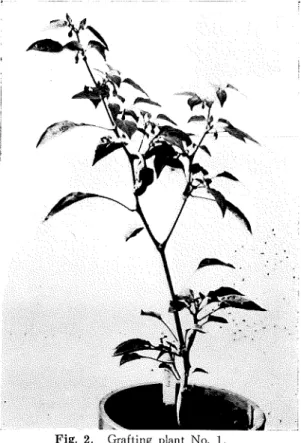
(4) Rinjiro Ohno Table 1. Graft unions Union. No. 1.. c.. 2.. c.. 3.. annuum L. var. grossiim Sendt. scion on C. amwum L.. anmium L. scion on C. annuum L. var. grossum Sendt, c. annitnm L. scion on D. mefel L,. 4.. D.. 5.. c.. tatlila L. scion on D. metel L. (innuurn L. scion on D. tattlla L. Francheti var. Bunyardli (Hort.) Makino scion on L. esculentlim Francheti var. Bunyardii (Hort.) Makino scion on C. amwum L. var. grossum Sendt.. 6.. p.. 7.. p.. 8.. p.. Francheti var. Bunyardii (Hort.) Makino scion on S. melongena L.. 9.. s.. 10.. melogena L. scion on P. Francheti var. Bunyardti (Hort.) Makino. c.. 11.. amitltim L. scion on S. melongena L.. c.. 12.. amwum L. var. grossum Sendt. scion on S. melongena L.. s.. 13.. melongena L. scion on C. anmwm L. var. grossum Sendt.. p.. 14.. ,s.. hybrida vilm. scion on S. melongena L. melongena L. scion on P. hybrida vilm.. Table 2. Percentage and size of fertile pollen of the grafting plant No. 1.. w. Pollen fertility. Species. 95-97 (96.0) 89-91 (90.0) 60-64 (62.0) 50-52 (51.0). C. amiKllin (control) C. awwiim van grossnm (control) C. anilKnm (stock) C. amwum var. grossum (scion). ^. Mean size of fertile. pollen (1 scale : 18/<) 1.7±0.15 1.7±0.20 2.4±0.45 1.7±0.40. Of 18 grafting plants 14 were normal, while 4 were morphologically different on the side of the stocks, Of these 4 plants, one showed remarkable variations on the stock in shape of the fruits (Fig. 2), so. that the stock of this grafting plant (No. 1) was examined in details cytologically and morphologically. When flower buds on the scion were examined it proved that they possessed about 49 per cent. abortive pollen grains, while in flower buds on^ .the stock percentage of abortive pollen grains was about 38 per cent. (Table 2). Morphologically, the leaves of the stock were different from the controlled ones in shape and size, tending to be similar to those of the scion and the flowers of, the stock were larger : both the petals and sepals were larger than the normal ones and the ovaries range in size between those of C. annuwn and C. annuum var.. Fig. 2. Grafting plant No. 1.. grossnm,. (3).
(5) Studies on Graft Hybrids in Some Plants of Solanaceae,. (b) C. annuum grafted on C. annuum var. grossum. (C. anniium var .grossum/C. annuttm) It was not difficult to secure the graft unions of this combination to the same extent as in the preceding combination. But the growth of the stocks tended to inhibited by the scions as observed in the preceding combination. Of 16 successful grafted plants of this combination, one plant (No. 6) was morphologically different from the other. The scion of this plant (Fig. 3) showed the striking deviations in morphology from those of the normal plants : the size of the leaves was slightly smaller, the leaves was thicker than those of C. annuiim plants and C. annuiim. var. grossiim, and in the size of the flowers considerable variation was recognized, the flowers being larger than the normal ones, and having petals twice as larger as those of the normal ones. The fruits showed variation in shape as shown in Fig. 3, The flower buds on the scion showed a high pollen fertility in its anthers as shown in Table, 3. (c) C. annuiim grafted on D. metel.. (D.metel/C. annuiim) The successful graft unions of this combination were difficult than in other combinations. Out of 10 grafted plants, 5 successful grafted plants were obtained in the present experiment. Of these 5 plants, 2 plants were dead in the course of growth. The growth of the scions of 3 plants were inhibited by the stocks. The scion of plant No, 2 differed slightly morphologically(Fig. 4), and the other 2 were normal. The leaves on the scion of plant No. 2 were smaller and thicker. The distance between knots of stems was shorter than the normal ones. The shape of the flowers was normal, but the size of the ovaries seems to be a little smaller than the normal ones. The fruits were smaller, but the shape of these fruits was normal. The percentage of abortive pollen grains on the scion of grafting plant No. 2 was about 46.5 per. cent (Table 4). (d) C. annuum grafted on D. tatula {D. tatula/C. annuuni} The successful graft unions of this combination were more difficult to secure than in any other combinations. Of 10 graftd plants, only 3 were successful in grafting. The growth of the scions of these plants were inhibited by the stocks : none of the scions grew at all in the period of two months after grafting. Therefore the leaves on the stocks were removed twice in the course of growth. Of these 3 plants, the scion of plant No. 3 (Fig. 5) differed slightly morphologically, and the other 2 were normal. As to the scion of plant No, 3, the leaves were smaller and thicker. The length of the stems was shorter. The shape of the flowers was normal, but the size of the ovaries seems to be a little larger than the normal ones. The fruits were smaller and round. The scion of this plant showed about 50 per cent, abortive pollen grains, whereas the stock showed only 3-5 per cent. Especially, the scion of plant No. 7 indicated very low pollen fertility as shown in Table 5. (e) P. Francheti var. Bunyardii grafted on S. melongena (S. melongena/P. Francheti var. Bunyardti) When P. Francheti was grafted on S. melongena, both the scion and stock grew fairly. (4).
(6) Rinjiro Ohno well. Of 60 grafting plants, 56 appeared entirely,..normal, while 4 were distinctly different in morphological characters of the scions and had a high percentage of abortive pollen grains. Of these four plants, generally grew bigger as shown in Fig. 6 and flower 10 to 12 days earlier than the others though the growth was somewhat retarded in the period of about one. Table 3. Percentage and size of fertile pollen of grafting plant No. 6.. w. Pollen fertility. Species. Mean size of fertile. pollen (1 scale : ISfi}. (95.0) (91.5). C. anmiiim (control). 94-96. C. anntium var. grossnm (control). 91-92. C. anniwm (scion). 85-87 (86.0). 1.7±0.80. C. annuiMi var. grossnm (stock). 75-80 (77.5). 1.7±0.70. 1.7±0.10 1.7±0.20. Table 4. Percentage and size of fertile pollen of grafting plant No. 2.. Pollen fertility. Species. Mean size of fertile. pollen (1 scale : 18 ft). C. amwum (control). 94-96 (95.0). 1.7±0.10. D. metel (control). 96-97. 3.1±0.05. C. aiinnum (the scion of grafting plant No, 2). 50-57 (53.5). 2.5±0.40. D. metel (the stock of grafting plant No. 2). 95-97 (96.0). 3.1±0.05. Fig. 3. Grafting plant No, 6.. (96.5). Fig. 4. Grafting plant No. 2.. (5).
(7) Studies on Graft Hybrids in Some Plants of Solanaceae.. month after grafting. The foliage leaves on the scions of these plants larger and thicker than the others and most of the surface of these leaf blades was corrugate. And also the leaves were orbicular in shape. The most characteristic difference of the leaves of the scions was the. Table 5. Percentage and size of fertile pollen of grafting plant No. 3, 5 and 7.. w. Pollen fertility. Species. Mean size of fertile. pollen (1 scale : 18 ft) 1.7±0.10. C. annunrn (control) 94-96 (95.0). D. tattila (control) 96-97 (96.5). 3.1±0.10. C. anmwm (the scion of grafting plant No. 3) 40—42 (41.0). D. tatula (the stock of grafting plant No. 3) 94-95 (94.5). 2.1±0.30 3.2±0.20. C. amintim (the scion of grafting plant No. 5) 45—47 (46.0). D. tatula (the stock of grafting plant No. 5) 95-97 (96.0). 2.0±0.40 3.2±0.20 2.0±0.40. C. annntim (the scion of grafting plant No. 7) 23-25 (24.0). 3.1±0.20. D. fatnla. (the stock of grafting plant No. 7) 90-92 (91.0). Table 6. Percentage and size of fertile pollen of grafting plant No. 1.. w. Pollen fertility. Species. Mean size of fertile. pollen (1 scale : 18 ft). P. Francheti var. Bunyardii (control). 87-90 (88.5). 1.9±0.20. S. melongena (control). 83-85 (84.0). 1.5±0.10. P. Francheti var. Bimyardit (the scion of grafting plant No. 1). 77-79 (78.0). 2.0±0.20. S. melongena (the stock of grafting plant No. 1). 80-84 (82.0). 1.9±0.20. Fig. 5. Grafting plant No. 3. Fig. 6. Grafting plant No, 1,. (6).
(8) .injiro unno. occurrence of abnormal leaves. These abnormal leaves were various in type. The stems were. bigger and longer, but the distance between knots was shorter than the normal ones. The flowers of the scions were slightly larger. The sepals were thicker, and pedicels longer. The fruits on the scions showed abnormal shape, and were various in size. The highest degree of morphological abnormality on the scion of plant No, 1 seems to accompany with certain disorder in the meiotic divisions of the pollen mother cells. The nongrafted P. Fi'ancheti plants always showed normal meiotic divisions in the pollen mother cells and normally developed pollen grains, while the scion showed about 22 per cent. of abortive pollen grains (Table 6). The appearance of the abortive pollen grains seems to be the result of abnormal meiotic divisions. (f) P. Francheti var. Bmiyardii grafted on C. anniium var. grossnm (C. annuiim var. grossum/P. Francheti var. Bunyardii) The successful graft unions of this combination were more difficult than in other combinations. Out of 10 grafted plants, 5 successful grafted plants were obtained in the present experiment. After grafting the stocks of these grafted plants grew satisfactorily, while the scions growthwas retarded. Therefore, to obtain successful growing of the scions, the leaves need to be removed twice in the course of growth as in the preceding combinations (C. annuitm/C. annuuin var. grossiim, and D. fafnla/C. annuum). These 5 plants were dwarf. The leaves showed considerable variation in shape. These leaves were thicker, and had no incision on the marginal part like those of the following combinations (L. esculentum/P. Francheti var. Bun.yardii), The whole surface of the leaf blades was undulatory. The color of the stems was dark violet, especially, at the union parts. The size of flowers was small as well as fruits which had only a few seeds. The scion of plant No. 2 showed abnormal meiotic divisions in the pollen mother cells and the highest percentage as about 72-74 per cent. of abortive pollen grains (Table 7). The appearance of the abortive pollen grains may be due to the result of the meiotic abnormality. (g) P. Francheti var. Bunyardii grafted on L. esculentu.m (L. esculentiim/P. Francheti var. Bunyardii) When P. Francheti was grafted on L. esculentnm, both the scions and stocks grew fairly normally. Out of 60 grafted plants, 55 were entirely normal, while 5 were morphologlcally abnormal on the side of the scions ; in the shape of the leaf blades, those of the scions tended to be round. Especially conspicuous ones had no incision on the margin of the leaves Table 7. Percentage and size of fertile pollen of grafting plant No. 2. Pollen fertility Mean size of fertile :Ies -----(^y'---" pollen (Y scale": 18 ft). P. Francheti var. Biinyardii (control) 87-90 (88.5) 1.9±0.20 C. annuum var. grossimi (control) 91-92 (91.5) 1.7±0.20 P. Francheti var. Bimyadii "(the"sclon"'o'f"grafting plant No. 2) 26-28 (27'0) 1.9±0.60 C. annuum yar. grossiim _ Q^_(. (the ttock "of grafting plant No. 2) 96-98(97.0) 1.7±0.20. (7).
(9) Studies on Graft Hybrids in Some Plants of Solanaceae.. at all (Fig. 7). The thickness of the leaves was greater than the normal ones. The color of the epidermis of the stems usually was darker violet. The microscopic observation on the cross section of the stem of the scions of plant No. 26 showed that parenchyma contains partially violet cells. The size of the flowers was various. In the larger flowers the pedicels were slightly longer than the others. In a few cases abnormal flowers were observed on the scions. The fruits were rather smaller, and showed variations in shape. Both the scion and stock of grafting plant No. 26 indicated very high pollen fertility as shown in Table 8. (h) C. annuum grafted of 5. melongena (5. melongena/C. anmium) The graft unions of this combination were successful in 37 cases, amounting to 68 per cent. Of these cases, nearly all plants appeared entirely normal, excepting the scion of plant. Table 8. Percentage and size of fertile pollen of grafting plant No. 26.. w. Pollen fertility. Species. Mean size of fertile pollen (1 scale : ISt-t). 87-90 (88.5) 92-94 (93.0). P. Francheti van Bunyardti (control) L. escillentwn (control) P. Francheti var. Bunyardii (the scion of grafting plant No. 26) L, escitlentiim (the stock of grafting plant No. 26). 1.9±0.20 1.8±0.20. 85-89 (87.0). 1.8±0.20. 90-91 (90.5). 1.8±0.30. Table 9. Percentage and size of fertile pollen of grafting plant No. 9.. Pollen fertility. w '. Species. Mean size of fertile pollen (1 scale : 18/-i). 94-93 (96.0) 90-92 (91.0). 1.7±0.10. C. ar.miiim var. grossum. 20-22 (21.0). 2.0±0.40. S. melongena (the stock of grafting plant No. 9). 86-88 (87.0). 1.5±0.10. C. annuum var. grossiim (cont-Tol) S.melottgena (control) (the scion of grafting plant No. 9). 1.6±0.20. Fig. 7. Showing non-incision leaf. A, control; B, non-incision Fig. 8. Grafting plant No, 9.. leaf,. (8).
(10) Rinjiro Ohno. No. 9 (Fig. 8) which slightly differed morphologically and had a high percentage of abortive pollen grains (Table 9). The scion of this plant grew more slowly than the others and the stem of the scion was bigger and shorter. The leaf blades showed variations in shape. The flower was normal, but the fruits was smaller and their shape was more round, as compared with those of the control.. (II) The cytological studies of grafting plants The abnormalities in the meiotic division of the grafted shoots were observed in 4 cases.. Methods To observe melotic chromosomes in PMCs either the acetocarmine smear method or paraffin method was used. To stain the permanent preparation, gentian-violet solution was employed.. Results (a) C. annuum var. grossum grafted on C. annunm (C. annuum/C. annuum var. grossum) Controlled C. annuiim plants growing in the normal environmental conditions always showed normal cell division and any chromosome aberrations were not observed in the pollen mother cell, and normally developed good pollen grains, while the shoots of plant No. 1 showed about 36-40 per cent. of abortive pollen grains. The appearance of abortive pollen grains may be due to the following chromosome abnormalities at the meiotic division. 1) Chromosome stickiness and nuclear destruction at meiosis. The destruction of prophase nuclear substance was often observed in the pollen mother cells and the deformed plasm was spread out over the entire cells in irregular shape. At pachytene and diplotene the chromosomes appeared to be somewhat vacuolated. And furthermore, at diplotene and diakinesis a few chromatids and chromosomes were broken. At first metaphase, chromosomes show stickiness between bivalents, making a mass of irregular shape. At first anaphase, the author met with no bridges and fragments. Perhaps, however, this might have been due to too small scale of observation. In the second divisions the compact prophase and sticky metaphase were present but the condition was much less severe than in the first meiot'c division. 2) Abortive pollen grains. The pollen abortion was investigated in both the scion and stock of plant No. 1 . About 49 per cent. of the pollen grains were abortive in the scion, while about 38 per cent. in the stock (Table 2). The viable pollen grains of the stock that stained red in acetocarmine varied greatly in size (Table 2). Probably such chromosome aberrations in the meiosis of pollen mother cells as just described are responsible to the production of these abortive pollen grains. From the selfed buds of the scion and stock of the grafting plant, a number of seeds are obtained that germinated well and developed mature plants. These progenies will be described. (9).
(11) Studies on Graft Hybrids in Some Plants of Solanaceae,. in the subsequent chapters. (b) C. annuwn grafted on D. metel (D. metel/C. annuii.m) The chromosome number and behaviour in the course of the meiotic divisions in the pollen mother cells of C. annunm and D. metel were studied. As to the chromosome number usually 12 bivalents were counted at first metaphase, as described by previous workers. The first and second meiotic divisions were found to proceed regularly in all instances. In contrast with this, the following chromosome aberrations were found in the shoot of plant No. 2. 1) Chromosome stickiness and swelling. At first metaphase chromosomes showed stickiness between bivalents, although sticldness was not so extreme. In a few cases, however, the second meiotic chromosomes showed striking stickiness making a mass of abnormal shape, Furthermore, first and second meiotic chromosomes seemed to show swelling to some extent. 2) Irregular meiotic division. In one case, irregularities were observed in the late anaphase of the second meiotic division ; 12 chromosomes in one of the dyads and 10 in the other.. 3) The lack of synchronization of meiotic division in pollen mother cells in the same anther. The stage of the meiotic divisions in the pollen mother cells of the shoots of plant No. 2 was various in the same anther. For example, a case was recorded in which the pollen mother cells ranged from first prophase to second metaphase, and in another extreme case from first prophase to tetrad stage. (c) P. Francheti var. Bimyardii grafted on S. melongena. (S. melongena/P. Francheti var. Bunyardii) The author made observation on the chromosome number and behaviour during the meiotic divisions in the pollen mother cells of P. Prancheti var. Bunyardii and S. melon.gena. The chromosome number of the both species has already been reported as 2 n= 24 and n=12 respectively (Janaki-Amal 1934, and Sinha 1951). This was confirmed by the present study. The meiotic divisions were found to proceed regularly in all instances, and the meiotic chromosomes were usually associated as bivalent at first and second metaphase. These chromosomes were all similar in size and configulation. In spite of this regularity of meiosis the shoots of the scion of plant No. 1 showed about 21-23 per cent. of abortive pollen grains, The reason for this is not clear, although certain anomalous cases were found, e, g. the lack of synchronization of meiotic processes and the failure of cell membrane formation in tetracl stage.. (d) P. Francheti var. Bunyardii grafted on C. anmiitin var. grossum (C. annittnn var. grossum/P. Francheti var. Btinyardii) The following chromosome aberrations were observed in the shoots of plant No. 2. 1) Chromosome stickiness. At first metaphase, chromosomes often showed certain degree of stickiness between bivalents ; in some cases bivalents showed a tendency of clumping together. In contrast with this, in a few cases it was found that some univalents lied scattering in the pollen mother cells at first meiotic metaphase. At second metaphase stickiness was also. (70).
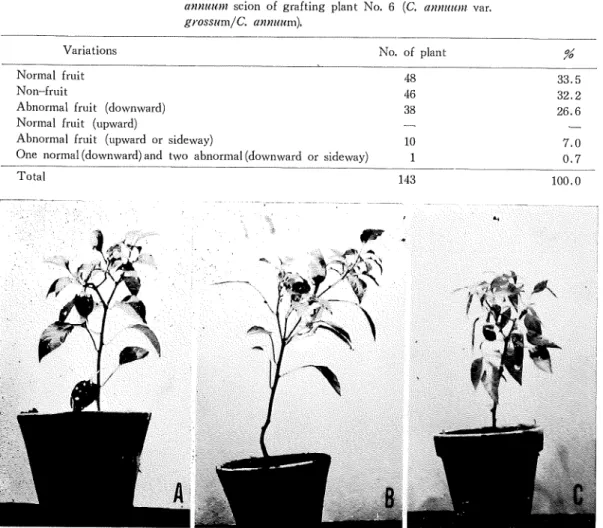
(12) Rinjiro Ohno observed as in first metaphase. 2) Chromosome swelling. The first and second meiotic chromosomes seem to be slightly swelling.. (Ill) Pi generation Among the grafted plant showing certain morphological variations, seeds were sown from the following : C. annuuin stock, C. annuum sewn and P. Francheti var. Bunyardii scion. The experiment aims to test whether the progeny (Fi) contains the so-called vegetative hybrids, or not. (a) Morphology of the Fi generation of C. annuimi stock (C. annittitn/C. annuum var. grossum) From selling of the C. awwuni stock of plant No. 1 which shown variation in shape of fruit, a total of 185 grains of seed was obtained. These were sown in the following year and 177 plants were raised. Most of them showed strong vigour as shown in the parental C. annuiim stock (Fig. 9). All these plants were divided into the following groups (a, b, c, d and e) with respect to shape and direction of fruit. (a) 82 plants (46.3%) showed no alteration, (b) 41 plants (23.2%) were tall, and the stems were vigorous. The flowers had large corolla. But they were all sterile in spite of having many flowers. These sterile plants grew very slowly and began to flower about one month to two months later than the control plants, (c) 43 plants (24.2%) were also tail, and in general the flowers were larger ; the petals, calyx and ovaries were larger in size. But some of them beared larger and smaller flowers. The fruits showed a great diversity in shape and were set downward on the shoots (Fig. 10, A). Noticeable variation was not observed in the leaves of these plants. (d) 7 plants (4.0%) showed visible variation in shape of fruit. The flowers and fruits were set upward on the shoots like those of C. annuum var, grossum (Fig. 10, B). These plants were also tail and the stems were big. (e) 4 plants (2.3%) beared upward fruits which were normal in shape (Fig. 10, C). All these data msntioned above are summerized in Table. 8. (b) Morphology of the Fi generation of C. annuuin sewn (C. annuum var. grossu.m/C. anniium) After self ing of ths scion of plant No. 6, 167 seeds were raised, and 143 plants were grown in the following year. Most of these Fi plants showed greater vigour as in the grafted plants. These Fi plants contains the following groups, (a) 48 plants (33.5%) were non-altered. (b) 46 plants (32.2%) were sterile although the flowers appeared normally. In general the plants were tall and the stem were vigorous, The growth was greatly retarded. The flowers were larger and open. about one month to two months later than the control plants. No apparent variation was observed in the leaves of these plants. The remainning others (c, d and e) showed variation in shape, size and direction of fruit, (c) 38 plants (26.6%') beared downward fruits (Fig. 11, A) like those of C. annimm, although they showed a great diversity in shape of fruit. Some of them. Ul^.
(13) Studies on Graft Hybrids in Some Plants of Solanaceae.. were tail and stems were big, showing no noticeable variation in the leaves of these plants, (d) 10 plants (7.0%) were diverse in shape and size of fruit, and either upward (Fig. 11, B) or sideway in direction as observed in C. anni.Ut.in var. grossu-m. The stems were tall and vigorous and the flowers were larger.. (e) Only one plant beared various fruits Fig. 9. Showing hybrid vigour in Fi plant. Left, Fi Plant No. 91 ; right, control.. in shape (Fig. 11,C),. Fig. 10. Showing abnormal fruits in Fi plants. A, downward and abnormal shape B, upwaid and abnormal shape ; C, upward and normal shape.. Table 10. Variations as to fruit characters in FI generation of C, (imwum stock of grafting plant No. 1 (C. anntltim/C, anmtum var. grossttin). No. of plants. Variations Normal fruit Non-frui t. Abnormal fruit (downward) Abnormal fruit (upward) Normal fruit (upward) Total U2-). °/0. 82 41 43 7 4. 3 2 24. 2 4. 0 2. 3. 177. 100.0. 46, 23..
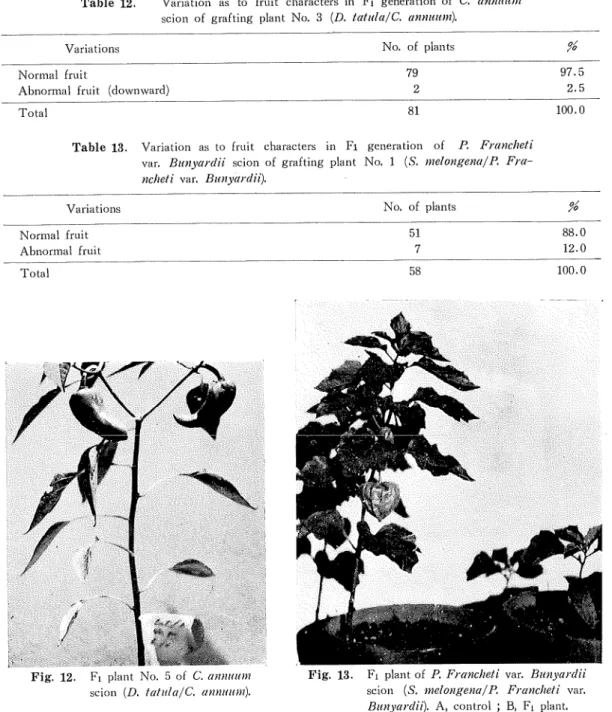
(14) Rinjiro Ohno Table 11. Variations as to fruit characters in FI generation of C. annuwm scion of grafting plant No. 6 (C. anmtum var. grossum/C. awiuum), No. of plant. Variations Normal. fruit. Non-fruit. 48. 33.5. 46. 32.2. Abnormal fruit (downward) 38. 26.6. Normal. fruit. (upward). —. Abnormal fruit (upward or sideway) 10. 7.0. One normal (downward) and two abnormal (downward or sideway) 1. 0.7. 143. Total. 100.0. ^. Fig. 11. Showing various abnormal fruits in Fi plants. A, downward and abnormal shape ; B, upward and abnormal shape C ; various fruits in one plant.. (c) Morphology of the F^ generation of C, annuwn scion (D. tatula/C. annuu.ni) A total of 98 seeds were obtained after selfing of the scion of plant No. 3 and sown in the following year, yielding 81 plants. Among them, 79 plants (97.5%) appeared entirely normal, while 2 plants {2.5%) differed slightly. These two plants were somewhat taller than the others, and showed variation in shape of fruit, although the variation was not so distinct as shown in the progeny of the preceding two combinations (Fig. 12) . Generally, the flowers of these plants were large, and sometimes had abnormal flowers, the petals being slender, split and double. (d) Morphology of the Fi Fi generation of P. Francheti. var. Biinyardii. scion (S. melongena/P. Franchefi var, Bunyardii) From 65 seeds obtained after selfing of the P. Francheti sewn of plant No. 1, 58 plants. U3).
(15) Studies on Graft Hybrids in Some Plants of Solanaceae. Table 12. Variation as to fruit characters in Fi generation of C. annitttin scion of grafting plant No. 3 (D. tatula/C. anmwm). Variations. No. of plants. 79 2. 97.5. 81. 100.0. Normal fruit Abnormal fruit (downward). Total. 2.5. Table 13. Variation as to fruit characters in Fi generation of P. Frunchet't var. Bunyarclii sclon of grafting plant No. 1 (S. melongena/P. Francheti var. Bunyardn). Variations. x. No. of plants. 51 7. 88.0. Abnormal fruit. Total. 58. 100.0. Normal fruit. 12.0. Fig. 12. Fi plant No. 5 of C. unmitiw. Fig. 13. Fi plant of P. Franclieti var. Bnnyardii. scion (D. tattlla/C. annnum).. scion (S. melongena/P, Franclieti var. Bunyardii). A, control ; B, Fi plant.. were raised. Of these 51 plants (88,0%) were entirely normal, growing normally, but the other 7 plants (12.0%) grew more slowly were dwarfish, They were also characterized by certain variation on the vegetative organs ; the foliage leaves were thicker, but the surface of these leaf blades was not corrugate as those of the scions in the grafting. And also the leaves were either elliptical or orbicular in shape. But the occurrence of abnormal leaves as observed in the parental scions (Fig. 13) was not observed in these Fi plants. The stems were low in hight, although the inter-nocle length was not shorter. The flowers were normal, and the. (^4).
(16) Rinjiro Olmo fruits showed normal shape and size,. (IV) Fi pollen germination We have only a few data of the effects of grafting on the germination of mature pollen. grains (Kostoff 1929, 1930, Glushchenko 1948, Didusi & Belogorskaya 1950). According to these workers, it has been stated that increase or decrease on the germination of mature pollen grains is induced by the effects of grafting. The present study was attempted in order to get evidence about this problem,. Material and methods The following Fi plants from C. annittim scions or stocks were used for the present experiment. 1) Fi from the stock (C. annuum/C. annillim var. grossum) 2) Fi from the scion (C. annuum var. grossum/C. anniium) and 3) Fi from the scion (D. tatula/C, annuum), These Fi plants were grouped into two types based on the direction of fruit, i, e., downward type and upward type. A sample of pollen grains was collected from anthers in ' a petri dish with a small brush shortly after thier dehiscence (about 24ha). Then the pollen grains were dusted on artifical medium which contains 1% sugar (.10% in some cases) and 1% agar, and they were kept for 24 hours at the optimum temperature for pollen germination which was determined by preliminary tests. The pollen germinated within 24 hours after dusting in the thermostat ; they were then stained with acetocarmine, and the number of germinated pollen grains was counted.. Results (a) Pollen germination in Fi plants from C. aimuum stock of grafting plant No. 1 (C. annuum/C. annuum var. grossum) As shown in the following Table 14, the percentage of germination is not so different from that of the control. Furthermore significant differences were not observed between the two types of fruit, downward and upward. Among the upward type, however, plant No. 98 which has both normal and abnormal flowers was characterized by much lower percentage of pollen germination in its abnormal flowers. It is not clear at present whether this peculiarity is due to the effects of grafting or to certain physiological factors, (b) Pollen germination in Fi plants from C. annuiun scion of grafting plant No, 6 (C. annuum var. grossum/C. annitum) The percentage of Fi pollen germination in both the downward type and the upward one was not different from that of the control (Table 15). And also any significant difference was presented between the both types. Further no distinct difference was shown between the Fi from the scion and that from the stock as to the pollen germination (Table 14), (c) Pollen germination in Fi plants from C. anniuun sewn. of grafting plant No. 3 (D. tatula/C. finninnn') The Pi plants from C, ailllllinn scion all hem's merely clownwarcl t'rnits. Of these, two. US).
(17) Studies on Graft Hybrids in Some Plants of Solanaceae.. plants No. 5 and No. 27 are characterized by abnormal fruits as shown in the following Table 16. In these two plants germination percentage was much lower than that of the control.. Discussion The existence of vegetative hybrids cannot be denied at the present time when a number of such cases in higher plants have already been reported by many workers. According to Glushchenko (1959) a large number of vegetative hybrids, about 500, was reported by many Soviet workers. Of these experiments, the most extensive ones are those carried out by. Glushchenko (1946, 1948). Opposed to Mendelism, Michurinism presumes that heredity is a property of all parts of the cell, not particular substances, genes, so it is possible to get vegetative hybrids through the. Table 14.. Perccentage of Pl pollen germination from C. anniltlm stock of grafting plant No. 1 (C, annuum/C, annuwn var. grossion).. Downward type No. 141 No. 55 No. 74. No. 91. No. of replications. Control. 1 2 3 4 5 6 7 8 9 10. 77 98 95 75 83 80 92 83 74 90. 90 85 87 89 83 86 85 82 92 90. 85 70 81 92 88 80 87 86 79 82. 80 85 79 77 80 81 89 78 81 79. 85 87 80 81 88 86 83 88 82 80. 84.7. 86.9. 83.0. 80.9. 84.0. No. 68. No. 150 /fruit : abnormal flower : large/. Average. No. 98 (a). /fruit : abnormal flower : abnormal. /fruit : abnormal\ /fruit : abnormal\ /fruit : abnormal\ Vflower : large j Vlower ; normal/ Vlower ; normal^. No. 98 (b). /fruit : f abnormal 1 1 flower : ) \ normal/. /fruit : non Vflower : large/. Upward type. No:35. /fruit : I abnormal. I flower :. normal/. 3 5 4 3 6 5 7 8 8 7. 75 80 76 77 78 79 71 72 79 74. 83 81 86 82 80 85 77 81 84 80. 5.6. 76.1. 81.9. No. 38. /fruit : / abnromal I flower :. ^ normal;. 87 91 90 95 92 97 87 81 80 85. 0<?). /fruit :. I abnormal. I flower ;. \ large/ 79 83 80 77 81 86 81 83. 81 80 77 81. 80 '. 80. 76 74 79 80 78. 81.4. 78.6. • 84.
(18) Rinjiro Olmo Table 15. Percentage of Fi pollen germination from C, annntim scion of grafting plant No. 6 (C. annuwn var. grossum/C. annnum) Downward type No, of replications Control. 1 2 3 4 5 6 7 8 9 10 Average. No. 122. No. 14. No. 2. No. 124. /fruit : abnormal\ /fruit : abnormal\ /fruit ; abnormal\ /fruit : abnormal\ Viewer : normalY \ flower : normal/ ^flower ; normal// ^.flower : normaiy. 82 79 80 77 84 81 78 79 80 85. 81 83 80 80 77 82 80 79 81 78. 80.5. 80.1. 85 87 84 89 90 87 82 91 84 3.7. 94 87 82 79 85 89 77 86 81 84. 94 85 83 73 85 79 81 75 70 84. 84.4. 80.9. Upward type_ No. of replications Control. 1 2 3 4 5 6 7 8 9 10 Average. No. 121. No. 123. /'fruit ; abnormal^ /fruit : abnormal Yflower ; normal// \ flower : large. No. 140. No. 45. /fruit : abnormah /fruit : abnormah Vflower iflower : large / \flower : large }. 82 79 80 77 84 81 78 79 80 85. 76 78 81 75 81 70 82 80 79 77. 82 79 75 77 80 74 87 78 79 76. 70 81 76 73 85 79 78 75 74 86. 78 75 80 70 79 73 78 83 78 77. 80.5. 77.9. 78.7. 77.7. 77.1. Table 16.. Percentage of FI pollen germination from C.. annuiim sc'wn of. grafting plant No. 3[ [D, tatula/ C. amwum), Downward type No. 53. No. 72 . No, 5. No. 27. /fruit : normal Vflower : normal.. fruit : normal \ /'fruit : abnormal\ ' flower : normalY Vlower : normalY. /fruit : abnormal\ Vflower : normal/. No. of replications. Control. 1 2 3 4 5 6 7 8 9. 82 80 75 83 79 87 91 79 88 79. 59 60 64 57 51 63 64 60 59 65. 64 60 54 63 59 56 63 60 57 66. 65 61 59 62 55 64 55 51 59 63. 60 63 49 53 65 63 62 67 61 56. 82.3. 60.2. 60,1. 59.4. 59,9. 10 Average. (.17-).
(19) Studies on Graft Hybrids in Some Plants of Solanaceae.. transmission of hereditary substances from stock to scion, or the reverse, resulting in the exchange of plastic substances between them, 1) The appearance of morphological variation induced by grafting. The problem, whether the appearance of variation is induced by grafting (in the grafted plants) or in the seed offspring has been discussed by several investigators. With respect to this problem Glushchenko (1948, 1957) has stated that morphological variation is in most cases absent insignificant in the year of grafting, although the absence of visible variation in the year of grafting does not mean the absence of qualitative changes in the reproductive cells. There are however some reports showing the appearance of morphological variation in. the scions or stocks in the very year of grafting [Detjen (1943), Polunin(1950), Tyugina (1951), Shakurov (1952), Aaritsi (1955), Zonitsi and Domanovitsi (1953) and Pishenot (1956, 1957)]. In the present experiment too, certain morphological variation was induced in the scions or stocks of some combinations is in the year of grafting. It seems therefore that whether the effect of grafting is manifested in the grafted scion or stock or in the seed progeny may be due to technique of grafting, such as removing the leaves from the scions or stocks. 2) The relation between scion and stock for successful graft union, Generally speaking, the vegetative hybridization between less closely related plants has. been considered to be difficult to produce. According to Krujilin and Belik (1953), it is more difficult to obtain intergeneric or interspecific vegetative hybrids than obtaining intraspecific vegetative hybrids which are nearly similar to each other in metabolic type. In fact, a great number of the data hitherto published are concerned with intraspecific vegetative hybrids. In the present experiment, however, rather high percentage (Table 1) of successful graft union was obtained between different genera which are distant in family relation from each other. In this connection, Krujilin and Belik (1953) also state that the degree of successful graft union alters according to the biochemical differences in both graft components ; for instance, when tomato is grafted on C. aniwiim, the union is easier than that when tomato is grafted on P. Francheti. Furthermore, the degree of successful graft union seems to different according to grafting methods or age of plants involed in grafting. The present experiment revealed that P. Francheti is easily grafted on S. melongena by the wedge grafting method, but in most cases it is not successful when the other grafting methods were adopted. And also when young plants of 10-15 cm. with two or three leaves were chosen for grafting, the graft unions are always successful. Therefore, the age of plants is an important factor in order to obtain successful graft unions (Glushchenko 1948, 1959). The degree of successful graft union is not the same in reciprocal grafts. In the present experiment, when P. Francheti is grafted on S. melongena it shows higher percentage of success than in the case of the reverse. In this connection, there is a similar report by Krujilin and Belik (1953) showing that the graft unions only successful at the time when tomato is grafted on C. anniltllll, but nnsucceKsful in the ciwe of (lie revei-Ke. From tliese results, it may. he concluded tlial (lie degree of successful graft union seems to alter owing to the choice of. (7S).
(20) Rinjiro Ohno the two plants as scion or stock. 3) The removal of green mass after grafting. In some cases of the present experiment it was found that the growth of scions and stocks is strongly retarded and finally stopped during the course of grafting. Especially this phenomenon is often observed in the case of intergeneric grafting. For instance, the growth of the scions in the following combination nearly stops ; D. tatula/C, annuum, S. melongena/P. Francheti var. Bunyardii, C. annumn var. grossiim/P. Francheti var. Bu.nyardii, and S. •melongena/C. annitum, and some of them die at last. Furthermore, in the reciprocal graft union between C. annuiim and C. anniium var. grossum, C. annuwn usually has a tendency to inhibit the growth of C. annwiin var. grossum scion or stock.. Such retardness or inhibition of growth is probably due to, as Glushchenko (1948, 1959) suggests, certain nutritive substances of one side unsuitable to the other. When the leaves are removed from. the scion or stock for a while, the growth on one side was found to considerably be enhanced. According to Alekseeva (1939), the ripeness of fruit is promoted by removing the leaves on scion or stock in the course of growth. As pointed out by several workers (Shiakurov 1952, Gbozdeva 1954, and Glushchenko 1957), the removal of the leaves on scion or stock has another significance of enforcing effects upon scion or stock toward the formation of vegetative hybrids. Petelina (1953) reported that in grafts of buckwheat certain morphological variations are not only induced in the year of grafting but also in the seed generation by removing the leaves. In the present study, some morphological variations in some combinations are shown to be enhanced by removing the leaves on the scions or stocks, but its heritability seems not so distinct. 4) The phenomenon of hybrid vigour of vegetative hybrids. Since Glushchenko's report (1948), a number of investigators (Didsib and Belogorskaya. 1951, Fumeleyov 1951, Pishenot 1957, Ruibakoba 1951, Tyugina 1951, Shakurov 1952, Petelina 1953, Petorov 1955, Glabinitsi 1956, and Polunin 1960, etc.) have confirmed his finding in many cases that the phenomenon of hybrid vigour can be observed in vegetative hybrids in sexual ones though it is somewhat different from that of sexual ones ; the hybrid vigour of sexual hybrids tends to disappear in the progeny, while in vegetative hybrids it is preserved long in the seed offspring. In the present experiment, the hybrid vigour of the C. awwiim stock of a certain graft (C. annum/C. annuum var. grossum) is manifested not only in the graft itself but also in its seed offspring. It is noteworthy that this phenomenon is stronger in the seed generation, as. previously described by Petrov (1955) and Polunin (1960). On the contrary, hybrid vigour is not observed in. the C. annuum scion of the reverse combination (C. annuum var. grossiim/C, annuum) in the graft itself, but it is distinctly shown in the Fi plants. Moreover, when P. Francheti was used as the scion and grafted on S. melongena, the phenomenon of hybrid vigour is observed in both vegetative and reproductive organs of the scion, but it is not so distinctly preserved in Fi generation. The Fi plants are rather dwarf and only their leaves are slightly larger. According to Petelina (1953), hybrid vigour is an essential character of vegetative hybrids,. (^0).
(21) Studies on Graft Hybrids in Some Plants of Solanaceae.. but the present study indicates that hybrid vigour does not always appear in vegetative hybrids and does not always preserved in seed generations, as reported by Glushchenko (1948). The appearance of hybrid vigour induced by grafting may be explained by assuming some favourable effects brought about by combining within the graft the possibility of two differing but complementary heredities ; in other words hybrid vigour is a special form of the increased viability of organisms which results from the union of two differing metabolisms. 5) The meiotic abnormalities in grafted shoots. Kostoff (1930) is perhaps the first investigator who induced the abnormalities in microsporogenesis by grafting. According to him, the meiotic abnormalities are observed in Nicotiana not in the grafted shoot but also in the seed offspring, and all these meiotic abnormalities appear in intergeneric grafting. Glushchenko (1948) analysed cytologically intraspecific, interspecific and intergeneric vegetative hybrids in Solanaceae, The results reported by him showed that the abnormalities in meiotic and somatic divisions are not found in intraspecific vegetative hybrids, but visible abnormalities are observed in interspecific and intergeneric vegetative hybrids in which the parents had different chromosome numbers from each other. Polyakova (1946) reported that the chromosome number and configuration in the somatic cells of Pa and Fg generations .from tomato grafted with potato differ from the normal plants.. And Sujiner (1955) also reported that the deficiency of a satellite in a pair of satellited chromosome is observed in interspecific hybrids as well as in sexual ones, and also various chromosome abnormalities are found in interspecific vegetative hybrids, In the present experiment, remarkable chromosome abnormalities are observed not only in mtergeneric grafting but also in intraspecific one though the cytological studies are few, Among the chromosome aberrations observed in the present study, especially chromosome stickiness and swelling have not yet been reported by the previous workers. Probably these abnormalities in the meiotic divisions are due to certain metabolic disturbance caused by grafting in the course of development of the somatic cells on both components, 6) Fo pollen fertilit)^ and Fi pollen germination.. With regarding to low pollen fertility induced by grafting, Kostoff (1929, 1930), Glushchenko (1948) and Didushi and Belogorskaya (1950) have already reported previously. As shown in Tables 2-9 in the present experiment, the results show that intergeneric grafting results in a higher degree of low pollen fertility on the scions or stocks than in intraspecific and interspecific grafting. This is also observed in Fi pollen germination (Tables 14, 15 and 16); Pi C. annuiim plants in the reciprocal grafting between C. annuu.m and C. anntium var. grossitin show a high degree of pollen germination percentage which is little different from that of the control, but Fi C, aniltwm plants in the grafting between D. tatula and C, anniium show a low germination percentage. From these results, it is presumed that the degree of changes in metabolism induced by intergeneric grafting may be different from that of the metabolism in intraspecific and interspecific grafting. And also, from the results that grafted plants show low pollen fertility in the grafted shoot, but show high pollen germiiiatioii in the seed offspring, it can be further presumed. (20).
(22) Rlnjlro Ohno that certain unknown physiological conditions caused by sharp changes in metabolism are unstable in reproductive organs of the grafted shoot, but may become stable in progeny.. Summary 1) Of 14 graft unions (Table 1) in the present grafting experiments, 8 unions show remarkable variations in morphology on scions or stocks. Moreover, in the following graft unions, vegetative hybrids appear in the seed offspring ; Fi C. awmum stock (C. annuum/C. annumn var. grossum), Fi C. amwum scion (C. annitum var. grossum/C. annuum), Fi C. annuiim), Fi C. annwum scion {D. tatiila/C. annuum}, and Fi P. Francheti scion (S1. melongena/P. Francheti var. Bunyardii), 2) The meiotic abnormalities are observed in the pollen mother cells of the scions or stocks in certain graft unions (C. awwum/C. annnum var. grossum, D. metel/C, annuum, S. melongena/P. Francheti var. Btinyardii and C, annuum var. grossum/P. Francheti var. -BMMyardii}. Especially chi'omosomal aberrants such as stickiness and swelling are worthy of mention.. 3) As to the effect of grafting upon Fi pollen germination, the following Fi C. annutim scions or stocks were used ; Fi C, annilliin stock (C. annuum/C. annutiinva.r, grossnm}, Fi C. anniwm scion (C. anniium var. grossiim/C. anntitim}, and Fi C. anniium scion (-D, tatula/C, annuum). These FI C, annuum plants are divided into two types as to direction of fruit ; the downward type and the upward type. Fi pollen germination in both types indicates no significant difference between them. On the contrary, the germination percentage is greatly different between intraspecific vegetative hybrids and intergeneric ones.. Acknowledgement The author wishes to express his cordial thanks to Professor Hajime Matsuura, Hokkaido University, for his kind advice and criticism throughout this study, and also to the members of the Laboratory, Hokkaido University, for their valuable advices.. References Alekseeva, M. B. 1939. The seed generation in intra-varietal grafting in Solanaceae. Yarovizatsia, 5-6, 26-27, Alekseeva, M. B. 1948. Cultivation of melons in the open near Moscow. Agrobiologia, 2, 104-122. Detjen, L. R, 1943. The influence of the rootstock on seeds and on seedling progenies of tomato grafts. Proc. Amer. Soci. Hort. Sci. 43. Didusi, B. I., and Belogorskaya, E. B. 1950. Vegetative hybridization of cereals at the Harikov state selection station. Selektsia i semenovodostvo, 4, 38-45. Fumeleyov, B. I. 1951. The problem of vegetative hybrids in cereals on the present literatures. Selektsia i semenovodostvo, 6, 69-74, Gbozdeva, Z. B. 1954. Grafting methods between Helianthtis anmms and Ricinus commuunis, Gemledine, 11, 82-86. Glabinilsl, R. 1956. Vcgelative hyliricl.s in lomaloes. Agrobiologia, 1, 86-91. Goraik, R. 1956. The vegetative liybridizalion lietween Solanum Lycopersicnm and Nicofiuna ghltica.. (2^).
(23) Studies on Graft Hybrids in Some Plants of Solanaceae. Biologitsiskl grasnik, Beograd. Glushchenko, I. E, 1946. Expeiimental data on hybridization of tomatoes by grafting. Agrobiologia, 3, 1-28. Glushchenko, I. E. 1948. Vegetative hybridization in plants. Seluxoagltsu. Glushchenko, I. E. 1957. Present status of the problems on vegetative hybrldizatlon. Jinanie, VIII, 52, 1-32. Moscow. Glushchenko, I. E. 1959. Several laws on vegetative hybrids in plants, Proc. Lenin Acad. Agr. Sci. Hajina, E. I. 1949. Changes of heredlty in the seed generation of vegetative hybrids. Agrobiologia, 4, 120-122. Kostoff, D. 1929. Acquired immunity in plants. Genetics, 14, 37-77. Kostoff, D. 1930, Chromosomal aberrants and gene mutations in Nicotiana obtained by grafting. Jour. Genetics, 22, 399-418. Petelina, H. H. 1953. Vegetative hybridization in buckwheat. Selektsia i semenovostvo, 4, 38-45. Petrov, I. A. 1955. New methods of vegetative hybridization in cereals. Michurinskoe uchinie na slujibo norodn, 3, 43-57. Pishuno, M. 1956. The grafting between Solanuni sisyinbrifolitiin and Datttra stramonium. C. R. Acad.. Sci. 243 (25). Pishuno, M. 1957. Genetical change Induced by intra-varietal vegetative hybridization on Petunia violacea L. C. R. Acad. Sci. 244 (12). Pishuno, M. 1960. Formation of variation in C. anniium vat. cayennense grafted on Datura stramonium L. Agrobiologia, 6, 894-895. Polunin, I. I. 1950. Vegetative hybridization in peas. Agrobiologia, 5, 94-103. Polunln, I. I. 1960, Heterosis in the seed generation of grafting plants. Agrobiologia, 4, 530-538. Polyakova, T. 1946. Chromosome changes in tomato induced by grafting. Agrobiologia, 2, 128-130. Ruiubakuba, M. I. 1951. The phenomenon of heterosis in vegetative hybrids between oat and wheat.. Doklad Akad. Nauk SSSR, 79 (3), 541-543. Saritsi, M. 1955. On variations induced by grafting in Hordewn vulgare L, Beograd. Shiakurov, B. Z, 1952. Grafting methods in pulses. Selektsia i ovodostvo, 1, 31-33. Tyugina, E. I. 1951, Vegetative hybridization in soy beans. Selektsia i semenovodostvo, 10, 32-36. Zonitsi, I., and Domanovitsi, I. 1953. Vegetative hybridization between corns and tomatoes. Rev. Res. WK Fac. Agrlc. Beograd. 1 (2). Zvereva, P. A. 1946. Removal of difficulties of crossing in potatoes by vegetative approximation. Agroblologia, 2, 126-128.. (22).
(24)
図


+6



関連したドキュメント
[r]
We present sufficient conditions for the existence of solutions to Neu- mann and periodic boundary-value problems for some class of quasilinear ordinary differential equations.. We
In Section 13, we discuss flagged Schur polynomials, vexillary and dominant permutations, and give a simple formula for the polynomials D w , for 312-avoiding permutations.. In
Analogs of this theorem were proved by Roitberg for nonregular elliptic boundary- value problems and for general elliptic systems of differential equations, the mod- ified scale of
Then it follows immediately from a suitable version of “Hensel’s Lemma” [cf., e.g., the argument of [4], Lemma 2.1] that S may be obtained, as the notation suggests, as the m A
Correspondingly, the limiting sequence of metric spaces has a surpris- ingly simple description as a collection of random real trees (given below) in which certain pairs of
[Mag3] , Painlev´ e-type differential equations for the recurrence coefficients of semi- classical orthogonal polynomials, J. Zaslavsky , Asymptotic expansions of ratios of
Motivated by ongoing work on related monoids associated to Coxeter systems, and building on well-known results in the semi-group community (such as the description of the simple
