The Catalytic Conversion of 1,2-Propandiol to Propanal on
FSM-16 Molded by Wet-Treatment and Pressurization
Shigeru SUGIYAMA1,2*, Yasuhiro OKADA3, Youhei KOSAKA3, Keizo
NAKAGAWA1,2, Masahiro KATOH1, Yuuki KATOU4, Shuji AKIHARA4,
Toshiya YASUKAWA4 and Wataru NINOMIYA4
1Department of Advanced Materials, Institute of Technology and Science, The
University of Tokushima, 2-1 Minamijosanjima, Tokushima-shi, Tokushima 770-8506, Japan
2Department of Resource Circulation Engineering, Center for Frontier Research of
Engineering, The University of Tokushima, 2-1 Minamijosanjima, Tokushima-shi, Tokushima 770-8506, Japan
3Department of Chemical Science and Technology, The University of Tokushima, 2-1 Minamijosanjima, Tokushima-shi, Tokushima 770-8506, Japan
4Otake Research Laboratories, Mitsubishi Rayon Co. Ltd., 20-1, Miyuki-cho, Otake-shi, Hiroshima 739-0693, Japan
Keywords: Catalytic Conversion, 1,2-Propandiol, Propanal, FSM-16
The catalytic conversion of 1,2-propandiol to propanal is examined using FSM-16 particles (0.85-1.70 mm) molded by wet-treatment and pressurization. When FSM-16 was molded with 0.6 g of pressurization and supplied to the catalytic conversion of 1,2-propandiol at 673 K, this system resulted in a 94.8% conversion of 1,2-propandiol and 90.5% selectivity to propanal at 0.25 h on-stream, which was the maximum amount of activity. However, at 4.50 h on-stream, the activity decreased extremely to deactivation 19.9% conversion of 1,2-propandiol and 84.7% selectivity to propanal. In contrast, when FSM-16 molded with wet-treatment (0.15 g) was used for the conversion at 573 K, activity was greatly increased and stable 98.6% conversion of 1,2-propandiol and 56.2% selectivity to propanal at 0.25 h on-stream followed by 91.9% and 52.5%, respectively, at 4.50 h on-stream. The hexagonal structure of FSM-16 was suggested to have contributed to the suitable conversion of 1,2-propandiol to propanal.
Introduction
The recent increase in the production of biodiesel fuel from carbon-neutral biomass has resulted in an extreme surplus of glycerol by-product. In the production of biodiesel fuel, glycerol is produced as a by-product from ca. 10% of the fuel (Mori et al., 2009). Therefore, it is important to develop the most efficient methods to employ glycerol as a renewable resource, along with the chemicals derived from it. Recent publications have reported the catalytic conversion of glycerol to 1,2-propandiol (1,2-PD) via hydroxyacetone (Chiu et al., 2008; Huang et al., 2008; Sato et al., 2009). In the chemicals industry, the production of methyl methacrylate (MMA) has attracted attention since MMA is used as the main raw ingredient for the production of acrylic resin.
Our previous papers (Sugiyama et al., 2011, 2013) described the oxidative esterification of propanal (PA) to methyl propionate (MP), which is an important
intermediate for the production of MMA (Albanesi and Moggi, 1983; Jackson, 2002; So, 2010), using Pd/Al2O3
that favorably proceeded under pressurized oxygen conditions (Figure 1). Therefore, if 1,2-PD can be effectively converted to PA, glycerol would be one of the most viable candidates to use in the production of MMA (Figures 1 and 2).
The conversion of 1,2-PD to PA favorably proceeded using acidic oxides and supported heteropoly acids (Mori et al., 2009). In the present study, mesoporous silica (FSM-16) was employed as a catalyst for the conversion of 1,2-PD to PA. FSM-16 (#16 of Folded Sheets Mesoporous materials), which was first prepared in 1993 (Inagaki et al., 1993), possesses a hexagonal structure and rather strong acidic properties similar to another typical mesoporous silica MCM-41 (#41 of Mobil Composition of Matter) (Iwamoto et al., 2003). Because of the uniform size and shape, mesoporous silica is a valuable heterogeneous catalyst and support (Cheng et al., 1997; Yamamoto et al., 1998). Unfortunately, the preparation of MCM-41
CH2-CH-CH2
OH OH OH
Hydration and hydrogenation CH3CH2CHO (PA)
OH OH
CH3-CH-CH2(1,2-PD) This work
Fig. 2 Reaction scheme for the present study
Fig. 1 Reaction scheme for the production of MMA
from propanal (PA) Catalytic condensation
HCHO + CH3OH CH
2C(CH3)COOCH3 (MMA)
CH3CH2CHO (PA) CH3CH2COOCH3 (MP)
generally requires hydrothermal conditions, and the resultant MCM-41 is thermally unstable. In contrast, hydrothermal conditions are not required in the preparation of FSM-16, which confers thermal stability (Sugiyama et al., 2010). Based on these advantages, FSM-16 was used as a catalyst for the conversion of 1,2-PD to PA. In particular, the effect of the reaction conditions and the preparation of FSM-16 from the conversion of 1,2-PD were studied in order to obtain the most efficient activity and a stable FSM-16.
1. Experimental
FSM-16 was prepared using a hydrated sodium silicate powder (a molar ratio of SiO2/Na2O = 2.00,
Kishida Chemical Co. Ltd.) and cetyl trimethyl ammonium bromide ((CTA)Br, Wako Pure Chemical Industries), according to a procedure established by Inagaki (Inagaki et al., 1993, 1996). After the calcination of a hydrated sodium silicate powder (5.0 g) at 973 K for 6 h, the calcined solid was ground, added to 50 mL of water, and then stirred for 3 h at room temperature. While the stirring, the hydrated sodium silicate powder changed to kanemite (NaHSi2O5.3H2O).
Kanemite was separated using a centrifuge and was added to 100 mL of an aqueous solution consisting of (CTA)Br (0.01 mol). The solution was refluxed at 343 K for 3 h, and then cooled to room temperature. The solution pH was adjusted to 8.5 using 2 M HCl and was then stirred at 343 K for 18 h. The resultant solid was washed and filtered to obtain a wet white solid. The wet white solid was molded via two procedures; pressurization and wet treatment since it has been already reported that the mechanical stability of MCM-41, analogue of FSM-16, was rather low (Tatsumi, 1999). During pressurization, the wet white solid was dried at 333 K for 24 h and calcined at 823 K for 8 h. The solid thereby obtained was pressurized by 6 tons on a 13 mm FSM-16 pellet, then crushed, and sieved to a particle size of 0.85 - 1.70 mm. This catalyst was described as P-FSM-16. During the wet treatment, the wet white solid was dried at 333 K for 24 h, crushed and sieved to a particle size of 0.85-1.70 mm. The sieved particle was finally calcined at 823 K for 8 h. This catalyst was described as W-FSM-16. Therefore, between those two procedures, the evident difference was the presence or absence of pressurization.
The catalysts were characterized using X-ray diffraction (XRD; RINT 2500X (Rigaku Co.) using monochromatized Cu K radiation). The specific surface area was calculated from the adsorption-desorption isotherms obtained using a conventional BET nitrogen adsorption-desorption apparatus (BELSORP-18SP, Bel Japan Inc.).
The catalytic reactions were performed using a fixed-bed down-flow reactor. Unless otherwise stated, the catalyst (0.85-1.70 mm) was heated to the target
temperature for the reaction or the oxygen-treatment, under a continuous flow of helium (30 mL/min). For the latter, the catalyst was pretreated with oxygen (25 mL/min) for 1 h. Then, a reactant solution of 1,2-PD was supplied from the top of the reactor at a liquid feed rate of 1.7 mL/h together with a helium flow of 30 mL/min. No homogeneous reaction of 1,2-PD was detected under the present reaction conditions. The effluent was collected into methanol under ice cooling condition and was analyzed using a gas chromatograph (Shimadzu Corp., GC-8AP) equipped with a 3.2 mm × 2 m glass column (Gaskuropack 55) with a thermal conductivity detector and a capillary gas chromatograph (Shimadzu Corp., GC-2010 Plus) with a 0.25 m × 60 m glass column (Stabilwax) and a flame ionization detector.
2. Results and Discussion
2.1 Effect of oxygen-treatment on the conversion of 1,2-PD using P-FSM-16
Since the conversion of 1,2-PD to PA proceeds through dehydration in appearance and a rather strong acidic catalyst has already shown excellent activity (Mori et al., 2009), the oxygen-treatment for the catalyst was rather inconvenient for the present system due to the enhancement of the basicity of the catalyst.
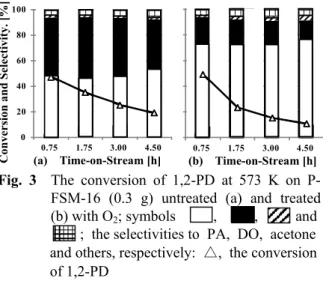
However, as shown in Figure 3 for the conversion of 1,2-PD using P-FSM-16 (0.3 g) at 573 K, oxygen-treatment for 1 h at 673 K resulted in a better conversion of the 1,2-PD, particularly for a shorter time-on-stream, and it resulted in the enhanced selectivity to PA compared with the use of a catalyst untreated with oxygen. Also, 2-ethyl-2-methyl-1,3-dioxane (DO) was produced through the successive reaction between 1,2-PD and PA, while the selectivity to DO on P-FSM-16 treated with oxygen was smaller than when untreated catalyst was used. Based on these results, the remainder of the present paper describes the results using the catalyst treated with gaseous oxygen at 673 K.
Conversion and S
electivity.
[%
]
(a) Time-on-Stream [h] (b) Time-on-Stream [h]
Fig. 3 The conversion of 1,2-PD at 573 K on
P-FSM-16 (0.3 g) untreated (a) and treated (b) with O2; symbols , , and
; the selectivities to PA, DO, acetone and others, respectively: △, the conversion of 1,2-PD 0 20 40 60 80 100 0.75 1.75 3.00 4.50 0 20 40 60 80 100 0.75 1.75 3.00 4.50
2.2 Effect of space-time on the conversion of 1,2-PD using P-FSM-16
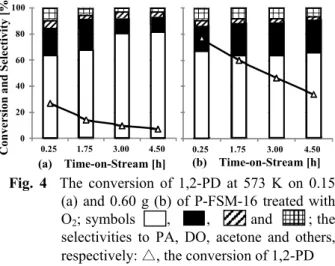
As shown in Figure 3, P-FSM-16 showed better conversion of 1,2-PD and an enhanced selectivity to PA. However, since these results are insufficient, the effects of space-time adjusted according to the amount of the catalyst on the conversion of 1,2-PD using P-FSM-16 were examined. Enhancement in the conversion of 1,2-PD and the selectivity to PA was expected to increase and decrease according to the amount of catalyst, respectively. As expected, the conversion of 1,2-PD was improved using a greater amount of the catalyst while the selectivity to PA was rather insensitive to the amount of catalyst, as shown in Figures 3 (b) and 4, wherein the reaction conditions were the same with the exception of the amount of catalyst.
2.3 Enhancement of the catalytic activity for the conversion of 1,2-PD using P-FSM-16
As shown in Figure 4, much better activity was acquired when using P-FSM-16, but the maximum activity was not beyond that (98.4% of the conversion of 1,2-PD and 67.5% of the selectivity to PA) reported by Mori et al. on silica-supported silicotungstic acid (Mori et al., 2009). In order to exceed the results obtained by Mori et al. (2009), the conversion of 1,2-PD was examined at 673 K using P-FSM-16 (0.6 g) for 0.25 h on-stream, since all the data described above revealed that the deactivation with time-on-stream was evident, indicating that the initial activity should be greater than that described above. As shown in Figure 5, 94.8% of the conversion of 1,2-propandiol and 90.5% of the selectivity to propanal was detected at 0.25 h on-stream and evidently exceeded the results found by Mori et al. (2009).
It is worthwhile to mention that the formation of DO was not detected at 673 K (Figure 5) in contrast to that at 573 K (Figure 4). As described below (Figure
6), DO is produced from the reaction between 1,2-PD
and PA. Therefore, the suppression of adsorption of
those substrates at 673 K resulted in no formation of DO.
2.4 Stable and greater catalytic activity for the conversion of 1,2-PD on W-FSM-16
Although rather greater activity at 0.25 h time-on-stream could be obtained, as shown in Figure 5, it was evident that P-FSM-16 was not stable. In the present study, we noticed that W-FSM-16 might overcome the disadvantages of P-FSM-16 under mild reaction conditions. The catalytic activity of W-FSM-16 (0.15 g) was compared to that of P-FSM-16 (0.15 g) at 573 K (Figure 7). As shown in Figure 7, a smaller amount of the catalyst (0.15 g) and a lower reaction temperature (573 K) was used compared with the amounts (0.6 g and 673 K) used in obtaining the results shown in Figure 5.
As shown in Figures 7 (a) and (b), a greater conversion (98.6%) of 1,2-PD was observed using W-FSM-16 at 0.25 h on-stream, and the conversion was almost maintained after 4.50 h on-stream (91.9%), while P-FSM-16 showed a rather lower conversion of 1,2-PD (39.7%) at 0.25 h on-stream and an evident deactivation with time-on-stream. Although the selectivity to PA
Fig. 4 The conversion of 1,2-PD at 573 K on 0.15
(a) and 0.60 g (b) of P-FSM-16 treated with O2; symbols , , and ; the
selectivities to PA, DO, acetone and others, respectively: △, the conversion of 1,2-PD
Fig. 5 The conversion of 1,2-PD at 673 K on
P-FSM-16 (0.60 g) treated with O2; symbols , ,
and ; the selectivities to PA, DO, acetone and others, respectively: △ , the conversion of 1,2-PD
Fig. 7 The conversion of 1,2-PD at 573 K on
W-FSM-16 (a) and P-W-FSM-16 (b) treated with O2; symbols , , , , ,
and ; the selectivities to PA, DO, acetone, 1-propanol, allyl alcohol and others, respectively: △, the conversion of 1,2-PD
Conversion and S
electivity
[%]
(a) Time-on-Stream [h] (b) Time-on-Stream [h]
0 20 40 60 80 100 0.25 1.75 3.00 4.50 0 20 40 60 80 100 0.25 1.75 3.00 4.50 0 2 0 4 0 6 0 8 0 1 0 0 0 .2 5 1 .7 5 3 .0 0 4 .5 0 Conversion and S electivity [%] Time-on-Stream [h] Conversion and S electivity [%]
(a) Time-on-Stream [h] (b) Time-on-Stream [h]
0 20 40 60 80 100 0.25 1.75 3.00 4.50 0 20 40 60 80 100 0.25 1.75 3.00 4.50
using W-FSM-16 was maintained between 55 and 50%, 1-propanol and allyl alcohol were detected rather than DO. After the reaction, the colors of W-FSM-16 and P-FSM-16 were black and gray, respectively, indicating that the amount of coke on W-FSM-16 was greater than that on P-FSM-16, due to the great activity of W-FSM-16. As shown below, the maintenance of hexagonal structure in W-FSM-16 resulted in the rather stable activity. As shown in Figure 6 (Mori et al., 2009), the presence and absence of pressurization in the preparation of FSM-16 resulted in a different by-product distribution through various routes together with the stabilization of the catalyst.
2.5 Effect of pressurization on the preparation of FSM on its catalyst structure and on the catalysis of FSM-16
Since the catalysis using P-FSM-16 and W-FSM-16 was dissimilar, the characterization of these catalysts was examined using the XRD and BET surface areas.
The XRD pattern of W-FSM-16 showed three diffraction peaks characteristic to the hexagonal structure of FSM-16 at diffraction angles (2) between 2.0 and 5.0°(Figure 8 (a)), which were assigned as diffraction peaks due to the (100), (110) and (200) planes (Inagaki et al., 1993). In contrast, the XRD pattern of P-FSM-16 showed that one XRD peak at the lowest diffraction angle was present while the remaining two peaks detected in W-FSM-16 were absent (Figure 8 (b)), indicating that the hexagonal structure characteristic to FSM-16 was not present in
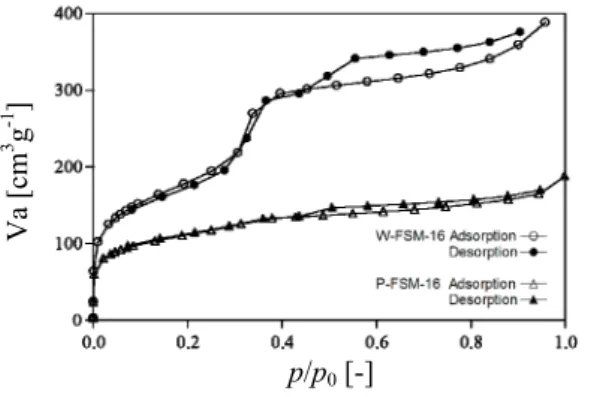
FSM-16. The absence of the hexagonal structure in P-FSM-16 was further confirmed using adsorption-desorption isotherms of W-FSM-16 and P-FSM-16 (Figure 9), in which the amount of nitrogen adsorbed or desorbed (Va) was plotted against relative pressure (p/p0). In Figure 9, it was shown that the isotherm of
W-FSM-16 was dissimilar to that of P-FSM-16. The specific surface area of P-FSM-16 was 405 m2/g and
was evidently smaller than that of W-FSM-16 (650 m2/g). The information on the structure of the catalysts
obtained from XRD and the adsorption-desorption analyses revealed that the maintenance of the hexagonal structure of FSM-16 resulted in a stable and unique product distribution when it was used.
The structural and acidic nature of FSM-16 should be noted for its use as a catalyst. The presence of acidic sites with an acid strength that is not as great as that of either HCl or the protonated zeolite in FSM-16 has been reported when using Hammett’s reagents (Yamamoto et
al., 1998; Iwamoto et al., 2003). Indeed, P-FSM-16
showed great activity for the dehydration of ethanol. The yield of ethylene was greater than 99% (Sugiyama
et al., 2010). Unfortunately the most sensitive
procedure for the detection of acidic nature, NH3-TPD,
showed no evidence of desorption peaks, although it is expected that a strong acidic nature should be obtained using NH3-TPD. Furthermore, only a few studies have
reported on the acidic nature of FSM-16. Therefore a careful investigation using NH3-TPD together with the
catalysis of P-FSM-16 and W-FSM-16 for various reactions is now in progress.
Finally it should be noted that the present catalytic conversion of 1,2-PD produced PA but not acetone, as reported in the previous paper (Mori et al., 2009). If this conversion proceeds through a typical dehydration on an acidic catalyst, acetone should be obtained according to Zaitsev's Rule. As described in the present paper, the activity was enhanced on FSM-16 pretreated with O2. Since the pretreatment of FSM-16 using O2
resulted in the decrease in the acidic nature of FSM-16, this conversion was enhanced on FSM-16 which had a rather weaker acidic nature. This may support that the conversion does not proceed through a simple (a) (b) 0 2 4 6 8 10 2 [°] Intensity [a .u .)
Fig. 8 XRD patterns of W-FSM-16 (a) and
P-FSM-16 (b); symbol ○; due to hexagonal structure
1,2-PD PA DO
Allyl alcohol 1-Propanol H2 H2 H2 -H2O Acetone This work 1,2-PD
Fig. 6 Reaction route for the present reaction
Fig. 9 N2 adsorption-desorption isotherms of W-FSM-16 and P-W-FSM-16
p/p0 [-]
Va [cm
3 g -1 ]
dehydration, but a more complex conversion such as a successive reaction of hydrocracking of 1,2-PD to 1-propanol, followed by oxidation of 1-propanol to PA.
Conclusions
The catalytic activity of FSM-16 in the conversion of 1,2-propandiol to propanal was found to depend on the pressurization of the catalyst during the preparation. Maximum activity (94.8% of the conversion of 1,2-propandiol and 90.5% of the selectivity to propanal) was observed at 0.25 h on-stream using pressurized FSM-16 during the preparation (P-FSM-16), while an evident deactivation was also detected. In contrast, on FSM-16 that was not pressurized during the preparation (W-FSM-16) showed stable activity during 4.50 h on-stream (more than 90% of the conversion of 1,2-propandiol and more than 50% selectivity to propanal). It suggested that the stable nature of the catalyst might have been due to the maintenance of its hexagonal structure.
Acknowledgements
This work was funded by a Grant-in-Aid for Scientific Research (B) (KAKENHI 24360328) that was awarded to SS, for which we are grateful.
Literature Cited
Albanesi, G. and P. Moggi; “Methyl Methacrylate by Gas Phase Catalytic Condensation of Formaldehyde with Methyl Propionate,” Appl. Catal., 6, 293-306 (1983)
Cheng, C.-F., W. Zhou, D. H. Park, J. Klinowski, M. Hargreaves and L. F. Gladden; “Controlling the Cannel Dameter of the Msoporous Molecularsieve MCM-41,” J. Chem. Soc., Faraday
Trans., 93, 359-363 (1997)
Chiu, C. W., A. Tekeei, J. M. Ronco, M.-L. Banks and G. J. Suppes; “Reducing Byproduct Formation during Conversion of Glycerol to Propylene Glycol,” Ind. Eng. Chem. Res., 47, 6878-6884 (2008)
Huang, L., Y.-L. Zhu, H.-Y. Zheng, Y.-W. Li and Z.-Y. Zeng; “Continuous Production of 1,2-Propanediol by the Selective Hydrogenolysis of Solvent-Free Glycerol under Mild Conditions,” J. Chem. Technol. Biotechnol., 83, 1670-1675 (2008)
Inagaki, S., Y. Fukushima and K. Kuroda; “Synthesis of Highly Ordered Mesoporous Materials from a Layered Polysilicate,” J.
Chem. Soc., Chem. Commun., 680-682 (1993)
Inagaki, S., A. Koiwai, N. Suzuki, Y. Fukushima and K. Kuroda; “Syntheses of Highly Ordered Mesoporous Materials, FSM-16, Derived from Kanemite,” Bull. Chem. Soc. Jpn., 69, 1449-1457 (1996)
Iwamoto, M., Y. Tanaka, N. Sawamura and S. Namba; “Remarkable Effect of Pore Size on the Catalytic Activity of Mesoporous Silica for the Acetalization of Cyclohexanone with Methanol,” J. Am.
Chem. Soc., 125, 13032-13033 (2003)
Jackson, S. D., “Production of Unsaturated Acids or Esters and Catalysts Therefor,” Japanese Patent Disclosure JP2002-511336A (2002)
Mori, K., Y. Yamada and S. Sato; “Catalytic Dehydration of 1,2-Propandiol into Propanal,” Appl. Catal, A, 366, 304-308 (2009) Sato, S. M. Akiyama, K. Inui and M. Yokota; “Selective Conversion
of Glycerol into 1,2-Propanediol at Ambient Hydrogen Pressure,”
Chem. Lett., 38, 560-561 (2009)
So, M., “Method of Manufacturing Methacrylic Acid Ester,” Japanese Patent 4497459 (2010)
Sugiyama, S., Y. Kato, T. Wada, S. Ogawa, K. Nakagawa and K.-I. Sotowa; “Ethanol Conversion on MCM-41 and FSM-16, and on Ni-Doped MCM-41 and FSM-16 Prepared without Hydrothermal Conditions,” Top. Catal., 53, 550-554 (2010)
Sugiyama, S., T. Bando, H. Tanaka, K. Nakagawa, K.-I. Sotowa, Y. Katou, T. Mori, T. Yasukawa and W. Ninomiya; “Direct Oxidative Esterification of Propionaldehyde to Methyl propionate Using Heavy-Metal-Free Palladium Catalysts under Pressurized Oxygen,” J. Jpn. Pet. Inst., 54, 380-384 (2011)
Sugiyama, S., T. Bando, Y. Seno, E. Watanabe, K. Nakagawa, M. Katoh, K.-I. Sotowa, Y. Katou, S. Akihara and W. Ninomiya; “The Oxidative Esterification of Propionaldehyde to Methyl Propionate in the Liquid-Phase Using a Heterogeneous Palladium Catalyst,” J. Chem. Eng. Japan., 46, 455-460 (2013)
Tatsumi, T., “Mechanical Stability of Mesoporous Materials, MCM-48 and MCM-41,” J. Porous Mater., 6, 13-17 (1999)
Yamamoto, T., T. Tanaka, T. Funabiki and S. Yoshida; “Acidic Property of FSM-16,” J. Phys. Chem. B, 102, 5830-5839 (1998)