Report of the Biological Survey of Mutsu
Bay_3. Notes on the Protozoan Fauna of Mutsu
Bay. I. Peridiniales.
著者
ABE Tohru Hidemichi
journal or
publication title
The science Reports of the Tohoku Imperial
University, 4th Series(Biology)
volume
2
number
4
page range
383-438
year
1927
URL
http://hdl.handle.net/10097/00131753
Report of the
B~ological Survey of Mutsu Bay.*
3. Notes on the Protozoan Fauna of Mutsu Bay.
I.
Peridiniales
.
BY
ToHR
U
Hm.EMITIAn:E.
(Zoological Institute, Faculty of Science, Tokyo Imperial University, Tokyo, }apan.)
383
The investigation of
the
plankton of Mutsu-Bay carried on
last
August at
the
Asamushi Marine Biological
Station
has
brought to
light
a
rich
protozoan fauna
in
which
the
Dinoflagellates
are
abundant.
The material, as will
be
surmised
from
the
conditions
of
the
oceanic
currents in
the Tsugaru
Strait,
is comprised
partly of a number
of
warm temperate water
s
pecies
and partly of those of
cold temperat
e
seas.
The
present
paper
include
s
only
the
majority
of
the
Peridiniale
s
observed
during
my
sojou
rn
at the station
last
August.
The
rest of
them
and
of
other
cla
sses
·will
be given in
later
papers. Not
only th
e
new
forms which came to
light in my investigation
s
, but also the
other species which
have
already been
r
epo
rted from
warm
and cold
temperate
sea~'jn
.
qther parts
..
.
of the world are
figur
e
d,
and
so
m
e
of
them are fully_
re-de
s
cribed
here. The difficulty
in
getting adequate
literatures
fn
"
this country forc
ed
me,
to my
great
regret,
to
leave
s
om
e,
which seen1
to me
recommendable,
unidentified. The references under
each
speCies
iri
this
paper are
those f
o
r
which I
have been
able
t
o
see some
figures
concerning the species even
though the
original papers
f
o
r the
species
' whether I
could or could
not
get. Of
late
years se
veral
differ
e
nt methods
of
d
es
ignating the
plates of
the
genus
Pcridinium
have been proposed.
The
designating
method
used
in thi
s
paper
is
BRacH's
(1910)
which
-
was partly
mo"
dified by
ROVlG)(Oand
PA
ULSEN
(1911)
(Fig.
14).
F~r thenecessity
of
denoting
the antapical
inter-calary plates of another
ge
nus, I
used
in thu
s
paper
cp,
1.
and
w,
and
T. H. Al31i
the first figure
denoting
each-
s~riesof plates was
put on the
right
shoulder of
numerals,
as,
7"
or
3'Y to indicate
the number
of plates
comprised in
the
series.
Grateful
acknowledgement is
here made
to
Professor
S. GoTO,
of
Tokyo Imperial University, for his kind
advice
to commence
and
-continue
this
work,
to Professor
S. Hoz.-
\\V.
-
\,
of
Tohoku Imperial
University, for collecting
material and supporting this work,
and
also
to
Professor S.
1-IAT.U,
of Tohoku Imperial
University,
the Director of
the
Institute, for
the permission to use the
research table and
for
.getting
some reagents
and
apparatus from
Sendai.
My
sincere thanks to
Profe~so;-M. KomzuM
r,
of Keio University,
to Professor
T.
KABURAKI, of
Tokyo Imperial University,
and to
Professor
K.
OKAMU
RA and
H.
M.-\RUKAWA, of the Marine Fisheries
Bureau
for advice
and
kind help in
getting
literature,
and also
to
Assintant
Professor
S. KoKUBO,
to Assistant
S.
TAKATSUKI,
and to
Assistant Y.
K~~IADA, of the Asamushi
Marine
Biological Station, for
-
collecting
material.
Asterisks
(*)
were
used through
out
the
entire
pages
to
refer to
those
works which
I could not read the
original
papers.
DINOPHYSIS
EHRE::-<BERG.
1) Dinophysis intermedia
PA
VILLARD
(?).
Fig. 1. Dinophysis intermidia P.-\VILt. (?) (X 60.0)
-:+ PAV!Ll.AlW 1916, P· 58, Pl. HI, Fig. 4. FURTI 1922, p. 110, P.L VII, Fig. 119.
An elongated egg
-
shaped species
with
deep
cups
composed
of
singular lists, and a
rounded
.
posterior
end.
The ratio
of the
length
to the breadth is 0.32,
~ndthe wides
_
t
part is
~bout 2J
?>
from the
~~terio,rend.
Dimen
~
i~ms: Len~h,
57
p.;
transdiarpeter,
31,11.
Loc.
Yunoshima, Aug.
16, Hl26.
PER!DIK!ALE
S
OFMUTSU
BAY2)
Dinophysis rotundata
CLi\P.-\REDE et
LACHMANK. ¥.·D. rotuudata ClAI'. et IActDL, ]859, p. 409, Pl.XX, Fig. 16.
SCI-I urr 1 895, Pl. 1, Fig. 5.
I'AUJ.SEN 1908, P· 17, Fig. IS.
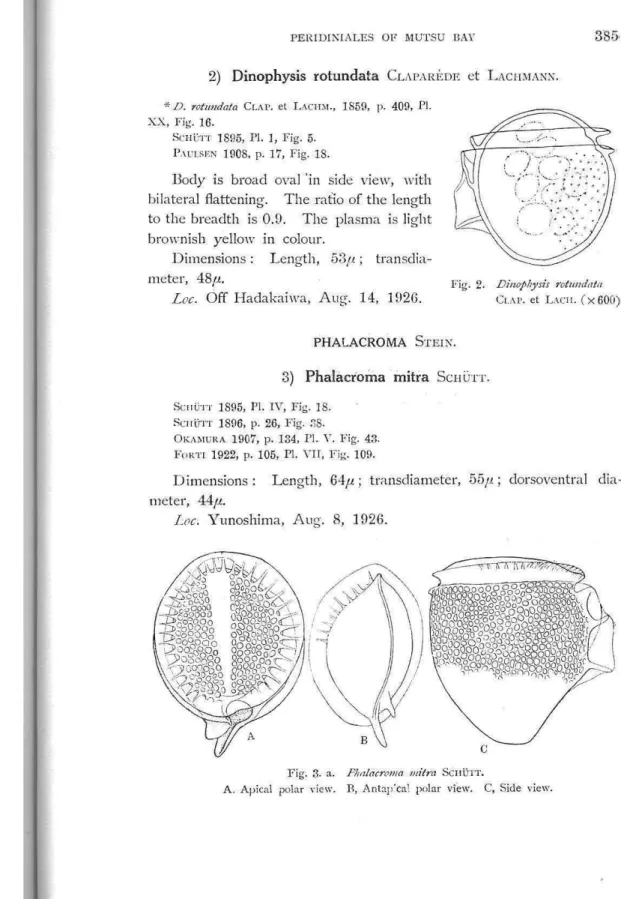
Body is broad
oval 'in side
v
iew,
with
bilateral flattening.
The ratio of the length
to
the breadth is
0.9.
The plasma
is
light
brO\mish yellow in colour.
Dimensions
:
Length,
53p;
transdia-meter,
48p.
L
oc
.
Off
Hadakaiwa,
Aug-.
14,
1926.
Fig. 2. Dinophysis rotundata
C1.A 1'. et LACII. (X 600}
PHALACROMA
STEil\.
3)
Phalacroina mitra
ScH
urr.
ScnU"n 1895, Pl. IV, Fig. ] S.ScnuTT 1896, p. 26, Fig. :18.
O"AMURA 1907, p. 134, Pl. "-Fig. 43.
FORTI 1922, P· 105, Pl. \'II, Fig. 109.
Dimensions:
Length,
64p;
transdiameter,
55;1;
dorsoventral
dia-meter,
44;1.
L
oc
.
Yunoshima,
Aug. 8,
1926.
Fig. 3. a. Phrz/acnmta mifra ScHliTT.
386
T.n.
ABED F
Fig. 3. b. D, ventral view. E, Dorsal view. F, Side view of another smaller specimen with a somewhat deformecl contour. (X 600)
DIPLOPSALIS BERGH.
4)
Diplopsalis lenticula
BERGH. BERGH 1881, p. 244, Figs. 60-62. ScHUTT 1895, Pl. XV, Fig. 50. ScaUT'r 1896, p. 21, 17ig. 31. OKAMURA 1907, p. 131, Pl. v, Fig. 44. PAUL5F.N 1908, p. 35, Fig. 44.The
ve
ntr
a
l
a
rea
is short,
fl
a
ring
s
lightly
posteriorly,
guar
d
ed
with
a
well
de
ve
lope
d
li
st o
n
its
l
e
ft
and posterior rims.
A B
Fig. 4. Dip!opsalis lmticula BERGH.
A and B, Diagrams of plates on .the hypotheca and the epitheca. (X 600)
PERIDINIALES OF ;I'[UTSU llAY
Dimension: Transdiameter, 43p.
Loc.
Off
H
ad
akai
wa,
Aug.
10
,
1926.
5)
Diplopsalis lenticula
BERGHvar.
(?).
38
7
Thi
s
differ
s
from th
e
preceding
spec
ie
s
in having
on
ly
one
an
t
a
pical
plate
a
nd in
it's
s
mall
e
r
size.
The
ve
ntral
area
i
s so
mewhat l
a
r
ge
r
than the
type spec
ie
s
and
is elo
ngat
ed
obliquely
and
posteriorly
to the
l
e
ft
,
along
whic
h l
e
ft rim
exh
ibits
a
bro
ade
r li
st,
but not
exte
nding to
the
p
os
terior
·
rim.
Dimensions:
L
e
n
gt
h,
51p;
tran
s
diam
c
ter, 45p.
Loc.
Off Asamushi, Aug.
10,
1926.
B
A
c
DFig. 5. Dip!opsalis lmtim!n BERGH var?
A and B, Pattern of the plates the hypotheca and the epitheca. C, Ventral
388
T. H. ABE'GONYAULAX DIESING.
6) Gonyaulax polygramma
STEIN.'!.·STEIN 1883. Pl. IV, Fig. 15.
ScHUTT 1895, Pl. IIX, Fig. 33.
OKAMURA 1907, p. 132, 1'1. III, Fig. 13.
PAULSEN 1908, p. 29, Fig. 36. .
KoFOID 191l(a), p. 229, Pl. X, Figs. 6-7, l'l. XVII, Fig. 47.
A medium
-
sized, somewhat
e
l
onga
t
ed s
pecie
s w
ith l
o
ngitudinally
striated and
reticulated
surfa
ce. Bcdy is ru
g
ged
oval w
ith both
sho
ul-ders angled
at
th
e
ap
ica
l-pr
e
cin
gular
and postcingular-an
t
apical
s
utur
es,
c
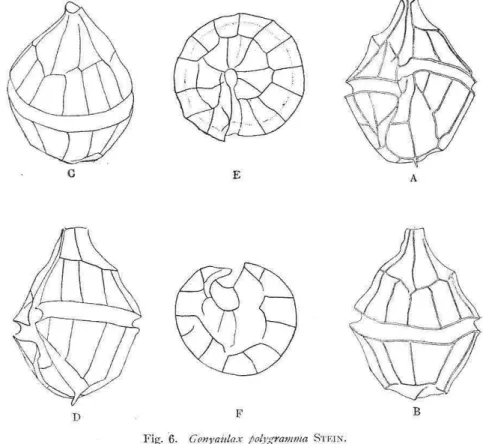
E AD F B
Fig. ·6. Conyaitlax polygmmma STEIN.
A, Ventral view. B, Dorsal view. C, Dorsal right-side view. D, Ventral left-side
~iew. E and F, Apical and antapical view of a :-<pecimen showing the arrangement of the longitudinal ribs. ( x 600)
J'EIUDINIALES OF MUTSU BAY
389
be
a
rin
g o
n
e
or
t
wo sma
ll antapical
s
pin
es
. The l
o
ngitu
di
nal rib
s va
ry
in
number
and a
rran
g
em
e
nt, but
so
me
of
th
e
m are
more or
l
ess
exactly
on
th
e
sutu
r
e
lines,
so
that
it is possib
le
t
o
distinguish the thecal
o
rd
er
from the
a
rran
gemen
t
of the
rib
s
.
The
pla
s
m i
s
dark
y
e
ll
ow
i
sh green.
Dimens
i
ons
:
Length,
5
7
t1;
transdiameter,
45p;
dorsoventral
dia-m
e
t
er,
42fl
.
.
L
oc
.
Off
H
a
da
ka
i
wa
,
Aug.
10,
Hl26
.
7)
Gony
aulax
s
pi
n
ife
ra
(CLAP
.
et
LACullr)
.
PAULSEN 1908, p. 29, Fig. 37.KoFC•ID J91J (a), p. 209, Pl. X, Figs. 8-10, l'l. XVf, Fig. 31), Text-fig. A.D.(') C. 111m~r;ini FAUKf:-FRE~liET HJOS, p. 230, Fig. ]6.; Pl. XVI, Fig. HI.
·» Peridinium spiniferum CI.,\l'. ct L11CJDI., 1895, p. 405, Pl. XX. Figs. 4, 5.
A
minute species with a broad
s
piral
g
irdle
and an antapical
horn,
closely
correspo
n
ding
t
o
G
.
mangi7li
F. F. judging from
the
figure
and
descriptions g
iven
by
the
a
ut
hor
.
B
od
y is
so
m
ewhat short
and
egg-sha
p
ed
.
The epitheca is
subconical
11·ith
a short
apical
h
o
rn
. Th
e g
irdle is
very
b
r
oad
and
median,
with
well d
e
veloped lists
of
the
body wall.
The
furrow is deeply
impres
se
d,
and
d
es
c
e
nding,
and
is
dis
placed distally
3 girdle widths
,
and overla
p
s
one of
its
widths
.
The
g
r
oove connecting
its two
ends is
narrow
but
i
s
d
eeply
impressed. Th
e
ventral
a
r
ea
is
a
n
a
rrow furrow,
curv
ed
so
m
e1
d1at obliquely to the
right.
Th
e
hypoth
eca
i
s
a
flat
hemisphere
,
with
a
s
hort
but
d
i
s
tinct
a
ntapical spine on its
apex at
th
e
r
i
g
h
t
post-mar
g
in
of
the
longitudinal
groove.
I
t
is qu
it
e
probable
that
G.
mo11oacaut/ta
PA \'ILL
is
closely rela
t
ed
to
th
i
s species
in
its
g
eneral
fea
t
ures
except in
i
t
s
lar
ge
, distinct,
a
pical ho
rn
.
Dim
e
nsions: L
en
gth,
27tL;tran
s
diameter,
22fl.
.
L
oc
.
Off
Asa
mu
shi,
Aug
.
21,
1926.
Fig. 7. Conyaula.r sjinifem
D:r~~II\G. \·entral view. (X 600)
8
) Gonyaulax polyedra
STErK.·::·STEI~ JS83, p. 13, Pl. IV, Figs. 7-!J. PAt;LSE'.' 1908, p. 31, Fig. 40.
390
T. II. ABEKoFoiD 1910, p. 23o, PI. XU, Figs. 16-20; Pl. XIV,
Figs. 28, 29, 31; PI.
xvn, F
ig. 43. CoNRAD 1926,. p. 95, PI. U, Fig. 37.A
medium-sized
spec
ie
s.
The
b
ody
i
s
pentago
n
al with a
truncat
e
d
poste
ri
o
r
e
nd.
Dim
e
n
sio
n
s
:
Length
,
34,u;
transdiameter
3
Gt'
·
Loc
.
Off
F
utagoj
i
ma, Aug.
23
,
1926.
Fig. 8. Gonyaulax po!yedm
STEIN. (X 600)
9)
Gonyau
l
a
x
turbynei
lVIUHRAY ~md vVII!TTIKG.1lt;RR. and \\"mn. 1899, P· 323-~24, Pl.
xxrrx,
Fig. 4.KoFOID HJll(a), p. 225, Pl. X\~[[, Fig. 44. Ft)RTI 1922, p. 80, Pl. VT. Fig. 67.
A
sm
all
, ovo
id
spec
i
es
without
a d
i
s
tinct
apical horn.
Th
e su
r-face is
s
tri
a
ted
with
po
re
s
which
a
re
spa
r
sely
but
mo
r
e
o
r
Jess
longitudinally
scat
t
e
r
ed
,
and the
inter-stria
e
r
eg
i
o
n
s
are marJ.::edly
reticulated.
A BDim
e
n
s
i
ons
:
Length, 40,t';
transdiameter,
3
4p.
Fig. 9. C"nyaulax turbymi i\lUIL and
\YHJTL
Loc.
Yunoshima, Aug.
16
,
1926.
A and B, Ventral views of two specimens. (X 600)
PYROPHACUS STEIN.
10)
Pyrophacus horologicum
STEIN. «·STEI:-1 1883, Pl. XXIV, Figs. 1-13. Pl. XXV, Fig. ].BuTsciiu 1885, Pl. LIV, Fig. 3. ScHuTT 1895, Pl. XVII, Fig. 51.
Scni.)rT 1896, p. 13, 15, Figs. 17, 21. l'AULSEN 1908, p. ?7, }<ig. 89.
A
lar
ge,
flatten
e
d
spec
i
es.
The
numb
e
r
o
f pl
a
t
es a
r
e
rou
ghly
pr
o
p
o
rti
o
nal t
o
it
s s
iz
e
,
lar
ge
r
ones
havin
g a
lar
ger
n
umber of plates,
PERIDINIALES OF MUTSU BAY
391
a
nd
smaller ones a
s
maller numb
e
r
of
plates. The
specimen shown
in
Fig. 9, A and B
is
one
ha
v
in
g
probably a minimum
numb
e
r
of plates
.
Dimen
s
i
ons:
Length,
10
3-
134,u;
tran
sdiameter,
94-124p.
Loc.
Off Asamushi, Aug. 16, 1926.
Fig 10. Pyrophacus lwro!"gimm STEIN.
A and B, Arrangement of the plates on the epitheca and the hypotheca of one
specimen, having probably a minimum number of plates. C, The hypotheca of
another larger specimen showing a larger number of plates. ( x 280)
SPHAERIDINIUM WOLOSZYNSKA.
11)
Sphaeridinium
asymmetria,
n
.
sp.
A minute,
sp
her
oidal species
with a
so
mewhat curved
ve
ntral
area,
a relatively wide
g
irdl
e,
and
no
apica
l
nor
an
tapical
process
es.
The
body
is
spherical.
The epitheca and
the
hypotheca are both
hemispherical.
Th
e
most conspicuous character of this
species
i
s a
distinct diagonal
s
uture ridge on
the
ep
itheca
from the left ventral to
the right
dor
s
al, cro
ss
ing the apical pore.
It
is
incompl
ete
as
it i
s
o
nly
within the area of
the
apica
l
and
th
e
intercalary plates, not
extending into the pr
e
cingular
se
ri
es wh
ich
is on
l
y poorly developed
.
392
T. H. ABEIt,
th
e
n,
divides the plates, though incompletely,
into two
gro
up
s
, th
e
ap
ical
I, 2,and
4•
and the
int
e
rc
alary
r
in
the
ventral, and
the
apical
3
and
the intercalary
fJ,
e,
in the
dor
sa
l
half.
H
av
in
g
some relation
with the
ob
l
iqu
ity
of
the ridg
e,
th
e
plates of the
ri
g
ht
ve
ntral and th
e
left
dorsal regions are larger
o
r
more extended than
tho
se
of
th
e
left
ve
ntral
a
nd
the
right d
o
r
sa
l
parts so that the apical plate
2i
s
smaller
than the plate
4
•
and the precingulars
a a
nd
b
are much
sm
alle
r than
th
e
c
orrespond
ing plates
g
a
nd
f.
Of these the first
sure
ly i
s
the
s
m
alles
t in
the epitheca. The intercalary plate
l3
i
s
the
lar
gest
one,
and the others,
r
and
e,
s
h
ow a s
li
g
ht
differe
nce
in s
i
ze
, but they
are
markedly displaced to the
l
ef
t
s
id
e
of the body by
the
asymmetrical
development of
the
apical
a
nd
the precingular plates.
Th
e
precin
gular
c
is a very low but
w
id
e
quadrangular plate.
The
apical pore is
relatively large
wit
h
a little
s
maller
po
r
e-like
ventral
s
lit.
The
s
lit is
not
accu
r
ately
in
th
e
ventral
m
edia
n
side,
but is deflected
abou
t
45°.
to
th
e
right
s
id
e
of the body from
th
e
dorso-ventral median plane.
It
also
m
akes
an angle of about
60°
.
w
ith
the diagonal suture
rid
ge.
The
gird
l
e
i
s
broad
a
nd
median.
Th
e
furr
ow
i
s
n
ot
deeply
impr
essed,
a
n
d
i
s very slig
htl
y
ascending
w
ith
o
ut marked
side-l
i
s
ts
.
The
·
ventral
area
cu
r
ves to
the
l
e
ft
and then
t
o
th
e
ri
ght
in
sa
u
sage shape
, bearin
g
a
sem
i-lunar
list on
it
s
posterior
ri
ght side.
It
is deeply impressed
in
the
anter
ior
pa
rt
and along the
r
i
g
ht
e
d
ge o
f
the post-girdle part
of
the area,
of which
th
e
middle portion
i
s
covered wit
h
the
hyaline
semi
-l
unar list.
Th
e
hyp
otheca is
h
emisp
h
e
ric
al,
as sta
t
ed above.
Its
plate formula is
5A,
2'.and
2'?.As will
be clearly recognized in the
text figures, one
s
mall,
e
l
ongated p
l
ate,
7..,
i
s seen a
t th
e
right of
th
e
incurved right ri
.
n,
an
d
a
minut
e se
mi-lun
ar
plate,
<p
,
at
the rear
of
th
e
,
posterior
ed_;e
of the ventral
area
.
These
sma
ll,
hypothecal,
intercalary plates, with the epithecal
diagonal
ridge, keep
thi
s species
a
l
oo
f
from
any
other
species o
f
P
e
ridinium.
Th
e surface
is
smoot
h
and
the plasm
i
s
colourless. The
s
utur
e
lines,
excludi
n
g the
rid
ge,
a
re
very
narrow
a
nd indi
st
i
nct, being
r
ecogn
i
zed
in
so
m
e spec
im
ens
o
nl
y wit
h
the
o
il
immersion.
This
species
is distinguished
at once
fr
om
P
e
ridinium globulus a
nd
P.
minutum,
by its rounded
apex.
The curved ventral area
and
the
irregularly displaced
t
heca
l
plates serve to separate
it
from
P.
splzericum
MuRR.
&
WHITT.The, ve
n
tral area of
this species has some similarit
i
es
PERIDINJALES OF MUTSU BXI:
393
A B
c
DFig. 11. Sphaeridim"wn a.rymmeHia, n. sp.
. A, Somewhat oblique ventral view. ll, Oblique apical view. v1ew of the hypotheca. D, Right side view. (x600)
C, Oblique dorsal
B
Fig. 13. S. asymmdria, n. sp. Oblique antapical view of the surface of the hypotheca. (x 1500)
ventral
wi
th
Goniodoma
sp!terimm
MURR.&
vVmrr
.
,
wh
ich
differs in
hav
in
g a
smalle
r
ventral ar.:a, a
listed
girdle with
its proximal
arc
h
,
and
a
different plate
pattern.
This
species
is remarkable
both in having two antapica
l
intercalaries
and
in the
development of
the
apical
Fig. 12. S. asy11tmdrin, n. sp.
d"
tagona
I b
an , as
d
well
as in
the st
ru
c-A and B, Diagrams of the plate t
u
r
e o
f
t
h
e ventral area.
It
is not
arrangement of the epitheca and thehypo theca.
(x
1500)
closely re
l
ated s
t
ructurally
to any ot
her
.
.
species
in
t
h
e genus
Peridinium,
and
394
T. H. ABEground of
it
s
spherical
body
without gird
l
e
li
s
t
s
or
a
ny app
e
ndages
except
th
e
ven
tr
al
fin,
and
a
l
so
on
it
s
antapical
int
e
rcalary plates
.
The
anterior antapical
intercalary plate
oug
ht
not t
o
be regard
e
d
as a
post-cin
g
ular plate, but
mu
s
t
be
se
p
a
rated into
another series,
the
antapical intercalary
series, with
th
e
minute posterior plat
e
,
from the
view
point
of
it
s
deve
l
opment, so
th
a
t
the
plates
of
the hypotheca
consist
of 5
precingular,
2 antapical, and 2
int
e
rcalary plates. The
ab
se
nce
of one
apical int
e
rcalary
plate and
th
e
e
xcess
of one plate
in
the
antapical
intercalaries mak
e
it
doubtful as
to
whe
th
e
r
this
spec
i
es
re
a
lly d
ese
rves
to
be
separated in
th
e
g
e
nu
s
Sp!tacridinium
or
not.
Dimensions
:
Len
g
th
3
6,u
; transcliameter, 34p.
Loc.
Off As
a
mushi,
Aug
.
15, 1926.
Very
rare.
PERIDli'liUM
EHRENBERG.Fig.
14-BRocn's modified method of
cleno--ting the thecal plates.
Up
o
n attemptin
g
to
arrange the
vast
diverg
e
ncies
of
the morphological
variations
in the
ge
nus, early observers,
ScHurr,
BERGH,and
Gl{ANdiv
i
ded
the
genus
into
two
sub
s
peci
es
,
Pr
o
t
o
-peridiuium
and
E
uperi
di
nittm,
accordin
g
to the
anter
i
or
di
s
plac
e
ment of the
gi
rdle
,
cour
Jted
with
the
so
lid antapical
horns for the former
,
and the
poster
i
or
displacement of the
g
irdl
e
to
ge
th
et-with
th
e
hollow
an
t
apical
horns f
o
r
the !alter. But in
later yea
r
a
nother
system was
prop
ose
d by
J
¢RGENSEN.(
1912)
on
th
e
basis of plate
relation-ships, which was
c
o
nfirm
e
d by
BAR-_ ROWS(1918),
though
cr
iti
cized
and
somewhat
modified by
PAVILLARD(1
916).
BARROWSd
iv
id
e
d
th
e
g
enus
into
thr
ee
groups, g
i
ving
th
e
name
Orl!wperidinium t
o
those
s
p
ec
ies havin
g
th
e
ventral
plat
e
pattern
of
P.
aclwo-maticmn,
J
ltf
e
t
apet'i
di
nium
to the
se
PERIDINIALES OF l\IUTSU BAY
395
having that
o
f
P.
pelluczdum,
a
nd
Paraperidinium
to
th
ose
h
av
in
g
the
plate
pattern of P.
sph
er
oidea,
In
the
f
o
rm
e
r
system the
main
emphasis
is
placed
upon th
e s
tructur
es
of
the
girdle
a
nd
the
a
nta
p
ical horn, but
in th
e
latt
e
r
it
i
s
bas
e
d
only on
the
plate
patt
e
rn
without considering
any
of
the characters
o
f
the appendages
a
nd
the girdle.
It
would
be
conven
i
ent
if the two
syste
m
s
were used together
t
o
denote
the
_c
har
ac
t
e
r
s
of
the
s
pecies,
an
d the two
are
n
ot
unimportant
in dividin
g
th
e
genus
,
ea
ch
designating
the
d
iff
erent
s
tructur
al
characters.
12)
Peridinium orbiculare
(PAULSEN)var.
temaris, n.
var.
A small
,
sp
h
e
ri
cal
spec
i
es
wit
h
o
ut
e
levati
o
n
of
the
apic
al
horn,
o
r
a
ntapical
s
pin
es.
The
e
pitheca i
s subhem
i
sp
heric
al.
Th
e
plates
a
r
e o
f th
e
Or
t
lzo
-peridiuium
type.
Th
e
plates
o
f th
e
apical
are well
developed.
The
·
g
irdle is median, i
s
relatively wide
and asce
ndin
g,
and
is displaced
d
i
s
tally
half
its
width.
Th
e
furro
w
i
s
n
o
t impr
essed
,
bearing
l
ow
side-lists.
The
section
a
t
th
e
girdle
i
s
circul
a
r.
Th
e
ve
ntr
a
l
area
i
s
narr
o
w
and
short, gua
rd
e
d by
a
broad,
hyalinou
s
,
crescent fin on
its l
e
ft
s
id
e
, n
ot
extending
t
o
the
post
e
rior
ext
r
emity.
Th
e
hypoth
e
ca i
s
al
so
sub-hemi
s
pherical
without
post-ind
e
ntation,
o
r
antap
i
cal
spines.
The antapical
p
l
ates
are
lar
ge
.
A
s
mall,
so
me-what
trian
gular,
intercalary
plate
is
o
n the right
s
ide
of the
ventral a
r
e
a
as
well
as
five
postcingulars.
Th
e
surface
i
s smooth.
The
in
tercalary
band
s
are wide
and
are
pro
v
id
e
d
with
di
st
inct tran
sve
r
se s
triati
o
ns.
D E
Fig. 15. Peridiniwn orbicularel (PAULSEN) var. trmaris, n. var.
A, ventral view. 13, Oblique ventral view. C,
Dorso-~pical view. D, Antapical view. E, Antapical view of the epitheca. ( x 600)
396
Th
e
l
acking
o
f
one
dorsal
intercala
r
y
plat
e
in thi
s va
ri
ety
se
r
ves
t
o
sepa
r
ate
th
is f
r
om
the
a
tl
a
nti
c species.
Dimensions
:
Length,
35f1 ;
transdiameter,
34p.
Loc.
Off
Futagojim
a
,
Aug
. 2
3,
1~26.13)
Peridinium nipponi
ca,
n
. sp
.
A
small, sp
h
e
r
ical
species
with a short apica
l
h
o
rn
a
n
d
fou
r
de
li
cate
a
ntapi
cal spi
n
es.
Th
e
body is
spherical without any ve
n
tral
flattening. Th
e
gi
r
d
l
e
sect
i
on is
circular
and
is perpendicular to
th
e
body
axis.
Th
e apical
pore
i
s at
th
e
termi
n
al of the
sma
ll
apical
h
o
rn
wit
h
a
short ventra
l
s
lit
.
Th
e theca
l
plat
es
are of
the
Paraperidiuium
t
ype wit
h
three
int
e
r
cala
r
y
plat
es
. T
he ep
i
theca
i
s
hemis
ph
erical, spmmetrica
l with the
·
hy
potheca. T
h
e
apica
l
plate
Ii
s
a
lar
ge
hexagonal.
T
he prec
in
gu
l
ars
b
and
f
are
th
e
l
argest
in th
e
se
ri
es, while
th
e
dorsal
d
is
a
flat
plate.
Th
e
dorsal, h
exago
nal.
intercalary
o
i
s
as
l
a
rge
as
the
pla
t
e
h,but
th
e othe
r
two
pentagonals,
r
an
d
e
,
are
t
he s
m
allest
in
the epitheca.
Th
e intercala
r
y b
an
ds a
r
e
wide.
T
he g
irdl
e
is
m
edian and
i
s
r
ela
tiv
e
l
y
narrow,
w
ith
hyaline
s
ide-li
sts.
Th
e
furro
w
is
ci
r
cu
l
ar and
i
s fain
tly
im
pressed.
T
he vent
r
al area
is
s
p
oo
n-
s
haped,
comprising
anterior
n
a
rr
ow
and posterior
wider po
rti
ons.
Th
e
fl
age
llar
por
e
is
in th
e
l
ef
t
corner
of
th
e
p
os
terior
wide
r
portion,
th
e ventral
and the dorsal rims
of
which
h
ea
r t
wo s
hort
spi
n
es
. T
wo other
lon
ger
spines are see
n
on
th
e
postero-lat
e
r
al edges o
f
the a
r
ea,
all
of
th
e
m
having
n
o
si
de-fin
s
exc
ept
the
sho
rt
ventr
al
o
n
e
.
A
longitudinal
fin i
s
on
the left
s
i
de of
th
e
ventra
l
area con
n
e
ct
i
n
g
t
he
s
h
o
rt,
d
o
r
sa
l
spi
n
e a
nd th
e proxi
m
al
part
of the
p
osterio
r
girdle
li
s
t.
Th
e
longer
sp
in
e
i
s 0
.
33
tim
es
that
of
tran
s
d
i
ameter.
Th
e su
rf
ace
is
smoo
th exc
ept
th
e
int
e
rc
ala
r
y
b
an
ds,
wh
ich
ar
e
faintly
st
ri
ated transve
r
sely.
Th
e
pla
s
m
i
s
co
lourl
ess. A
closely
r
esembling species
,
P. splterimm, was
reported
o
ff th
e
coast of
Tosa,
Shikoku
,
by Okamura, but differs
fr
om
thi
s
spec
i
es
in i
ts
l
arger
s
i
ze,
s
lig
htl
y ascendi
n
g g
ir
dle, and
two finned antapical
spi
n
es.
It
i
s
closely related
t
o
P.
Oil7t7/tin
general,
but
diff
e
r
s
in thecal
plates
and some st
ru
ctures
i
n
th
e
p
oste
rior
reg
i
on o
f th
e vent
r
a
l
are
a
.
Dimension
s:
Le
n
gth,
40f1;
transdiam
e
ter,
36p.
Loc. Off
Asam
ushi
,
A
u
g.
16
,
1926
.
PER!DIN!ALES OF MUTSU 13-AY
397
A
D
Fig. 16. Petidiniu>n nipp.mica, n. sp.
A and B, Diagrams of the plates on the epitheca and the hypotheca. C, Side
view. D, Dorsal view of another specimen. E, OLlique polar view of the specimen
C. F, Ventral view of another one. G, Side view of the longitudinal fin of the
ventral area. H, Oblique antapical polar view of the posterior ventral area, showing
the four spines. (X 600)
14)
Peridinium spheroidea,
n.
sp.
A
small
,
spherical
spe
cies
with two
finn
e
d
antapical
spi
n
es a
nd
broad
g
irdl
e
lists. The body
i
s s
ph
e
ric
a
l without ventral
flatt
e
nin
g
,
so
that both the
ep
ith
eca a
nd the hy
po
th
eca
are
hemi
spherica
l.
The
a
pic
a
l
h
o
rn
is
sma
ll
and
fl
a
t, hard to d
e
t
ect.
The apical pore i
s sma
ll
w
ith
a
s
hort
ve
ntral furro
w.
There
see
m
s
t
o
b
e a
v
e
ntral
sl
i
t,
but
close
obse
rv
a
ti
o
n
pro
v
es it to be
n
ot a sl
it but
a groo
v
e.
The
int
e
rcalar
y
bands
a
re br
oad
and
t
r
a
n
sve
r
sel
y
st
ri
ated.
The
pl
a
t
es
are
o
f
th
e
Metap
erid
inium
t
y
p
e wi
th thr
ee
in
tercalaries.
Th
e ap
ic
a
l
Ii
s a
l
arge
he
xagonal
plate
,
but
the dm·sa
l
pl
ate
3
i
s sma
ll.
Th
e
l
ateral intercalary
plates
r
and c are small, and
the
dorsal
a
is
so
m
ew
hat lar
ge
r.
The
ventral
pr
ec
in
g
ul
a
r
aand
g
a
r
e
minute
,
tria
n
g
ul
ar
plates.
Th
e
girdle
398
T. H. ABEis ascending and
is
displaced
'
distally
1.5
it
s
width, with a proximal
arch.
The
furrow is relatively narrow, faintly depressed,
wi
th
broad
s
ide
lists bearing abundantly
ribb
ed
fins
on their
inner
sides
.
Short,
numerous, perpendicu
l
ar wrinkles, their
len
gth
being
shorter
than
one-third
of the girdle
breadth,
are
obse
rved
along both
s
id
es
of
the
groove,
which are
o
nly the trac
es of
the
rib's
bas
es
in
the lists.
The
girdle
pl
a
ne
is
n
ot
perpendicul
ar
to
th
e
body ax
i
s,
but
i
s
inclined
about
15
°.
from
the perpendicular plane.
The
ventral
a
r
ea
is a narrow
g
roo
ve
guarded
with
side
fins
.
The
right
side
fin is a
little
narrower
than
th
e le
ft,
while the left one
is
broad and curves inwardly, spreading
over and
nearly
covering
th
e
left half of the area.
Th
e
fla
ge
llar
pore
is in the
l
e
ft
si
de, near
the truncated posterior
m
a
rgin,
of
the
area.
Two
long,
antapical sp
in
es
,
eac
h
w
i
th
thr
ee
latera
l
fins are on the
antapex
of
the
hypothec
a,
one
o
n
the right corner of
the
truncated
post-ma
r
gi
n
of the ventral are;:t,
and
the otl;ler on
i
ts
l
eft
edge a
little
distance from its
left
corner. The left spine
incline
s vent
rally.
The left
antapical plate
1 is
smaller than
the right
one.
Th
e su
rf
ace
is
s
mooth
.
Three
spine
-like
processes are
observed
at the antapex
in
ventral
view, but the shorter
l
e
ft
one
is
n
o
t r
eally
a
spine,
but
merely
an
image caused by the lengthwise view of
th
e
posteriorly
thickened part
o
f
the side fin at
the inters
ec
tion
of this with the left
median
fin of
the spine, whic
h
is not
noticed in
si
d
e
view.
Thi
s species
is distinguished at once
fr
o
m
P.
g!obulus,
by its
different theca
l
arrang
e
meilt
and in having antapical
spi
nes.
Peridinizt
1Jl
.cerasus
,
and
P.
orbiculare
·
are dist
i
ngu
i
s
hed from
this
by
their
s
maller
size, and its antapical
s
pin
es serves
to separate this from
P.
orbiculare
.
P
e
ridiniu1Jl. spltericum
OKAMURA
i
s
one of the best
r
elated species
, but
differs
in it
s
muc
h
smaller
s
ize, in
haviug the
equato
ri
a
l
girdle
pl
ate
p
e
r
pe
ndicular
to the body axis
a
nd in having
a distinct apical
h
orn
.
On the other
hand, the distal di
sp
l
ace
ment
of
the girdle,
t-lH~...
shorter
but spreading left antapical spine and
the broad
side
list
on the
left
edge of
th
e
ventral area show the close re
l
ation of
the two.
OKAMURA's
non-d
e
tail
e
d
figures and descriptio
n
s
make it
difficult
to
identify
it
with
this
species,
and
it is
quite
probable that they
are
tw
o
different
speci
e
s.
Dim
ensio
ns: Length,
62,u; transdiameter, 58p;
dor
so
-ventral
dia-meter,
54p.
Loc.
Off Futagojima, Aug. 28,
1926.
PE
RIOINIALES
OFMUTSU
BAY399
c
D
Fig. ] 7. Peric.'inium sj>heToiden, n. sp.
A, r\ntapical ventral view. ll, Side view. C and D, Pattern of the plates of the epilheca and the hypotheca. E, Ventral view of another smaller specimen. ( x 600)
15)
Peridinium hirobis,
n.
sp.
A
minute
s
p
ecies
w
i
th
an
extraordinarily wide girdle and
two
antapical
spi
nes. Th
e
ep
i
theca
is
s
ubhcmispherical,
t
h
e anterior surface
of which
is
contracted to a short apical
horn
.
The
plates are of the
Metaperidinium
type with three dorsal intercalaries.
Its
cross-section
at the gird
l
e
i
s
broad
oval.
The
g
ir
dle
i
s
post-median, and
i
s ve
ry
400
T. H. ABEwide,
with ribbed li
sts.
Its proximal part
t
s
far
wider
than
the distal
part.
The furrow i
s
not
deeply
impres
se
d,
and is slig
htl
y ascending
distally.
The
ventral area
is
also wide, widening posteriorly, guarded
with a
broad
fin on
its left
side.
Th
e
fla
ge
llar
pore of this species
is
very
l
arge,
is
elongated
along its left
side and
ex
t
e
nd
s
anteriorly to
the
po
s
t-margin
of
the
proximal girdle end.
The
hypotheca
i
s
a
flat
subhemisphere with a shallow
post-ind
e
ntati
o
n
at the post-margin of
the
ventral area. ln addition to
the two l
o
n
g a
ntapical
spines, slightly
diverging
posteriorly, a short spine
i
s see
n
on
the
inner
si
de
of the
left
spine
in the
ventral view.
It i
s
n
ot a
spine, but an
image
formed
by the
posterior extension of
the
side
li
st.
The
s
urfac
e
is
smooth and
th
e
intercalary bands
are narrow and indistinct.
Dimensions : Length, 26,u ;
tran
sdiameter,
24,u
; d
o
rso
ve
ntral di
a-meter,
22p.
Loc. Off Futagojima, Aug. 23,
1926.
c
DFig. 18. Peridinium hirobis, n. sp.
A, Ventral view of a smaller specimen with a brol<en apical par1. B, Antapical view. C, Dorsal view of another larger one. D, Oblique ventral view. (x600) E, Ventral view of a different, imperfect specimen. (X 1500)
16)
Peridinium pellucidum
(BERGH).
ScHuTT 1805, Pl. XIV, l'ig. 45.AUR!VJLLIUS 1898, p. 98.
PERlDINIALES OF MUTSU UAY
PAULSlcN 1908, p. 49, Fig. 61. EROCH 191.0, p. 188, Fig. 6.
Protoperidinium pell(tcidum BERGH 1881, p. 227, Figs. 46-48.
401
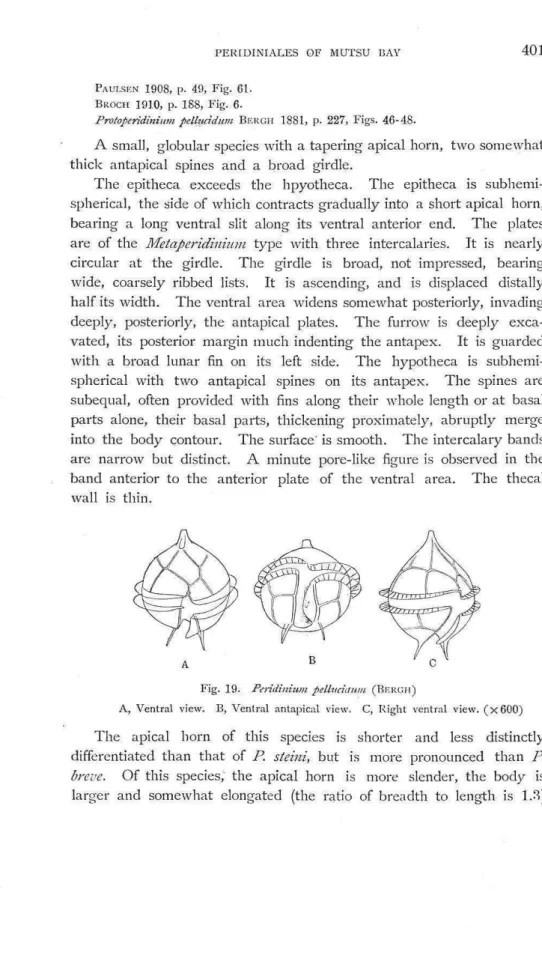
A small, globular spec
i
es with a
tapering
apical horn, two somewhat
thick antapical
sp
in
es and
a broad girdle.
Th
e ep
itheca
exceeds the hpyotheca.
The
epitheca is
subhemi-sp
herical,
the side
o
f
which contracts
g
radually int
o
a short apical
horn,
bearing a long ventral
slit alo
ng it
s
ventral anterior end. The p
l
ates
a~·e
of the Metaperidiuium
typ
e
with
three
intercaldries.
It is n
ea
rly
Ct~·cularat
the
girdle.
The
girdle is broad, not impressed, bearing
w1de:
co~rselyribb
ed
lists.
It
is ascending, and i
s
displaced
di
stally
half tt
s
wtdth.
The
ventral area widens
so
mewhat
posteriorly invadina
d
eeply, posteriorly, the
antapica
l
plates.
Th
e
furrow is deeply exca-
'
"'
v~ted,
its posterior margin much
indenting
the antapex. It
i
s gua
rded
wtth a broad lunar
fin
on its left
side.
The hypotheca
is
subhemi-spherical with
two
antapical
spines
on
it
s
antapex. The
spi
n
es
are
su
bequal,
often provided with fins along their whole length or at basal
~arts
alone,
their
basal part
s
, thickening proximately, abruptly
m
e
rge
mto
the body contour. The surface
·
i
s smoot
h. Th
e
intercalary
band
s
are
n
arrow
but distinct.
A
minute
pore-like figure is observed
in the
band anterior
to
the anterior plate of the ventral area. The
thecal
wall i
s
thin.
A B
Fig. 19. P~ridinium pdlttcilflult (BF.RGI-1)
A, Ventral view. B, Ventral antapical view. C, Right ventral view. (x600)



![Fig. ] 7. Peric.'inium sj>heToiden, n. sp.](https://thumb-ap.123doks.com/thumbv2/123deta/5913502.1050506/10.1547.804.1381.83.836/fig-peric-inium-sj-gt-hetoiden-n-sp.webp)