
聖路加国際大学学術情報リポジトリ
48
0
0
全文
(2) Annual Report St. Luke’s College of Nursing WHO Collaborating Centre for Nursing Development in Primary Health Care 2003. Contents Forward‐Shigeko Horiuchi, Dean, Head, WHO Collaborating Centre WHO Collaborating Centre for Nursing Development in Primary Health Care - Annual Report 2003 PartⅠ Work performed in relation to the terms of reference (1) To develop and evaluate models for nursing in primary health care for an aging society in developed country (2) To identify and promote nursing leadership in primary health care (3) To update standards of nursing education and practice to implement primary health care (4) To facilitate research development relevant to nursing by identifying research priorities and developing research networks (5) To influence governmental and professional agencies to promote nursing leadership in the development of primary health care (6) To support international collaboration in nursing education, research and practice related to primary health care. Part Ⅱ Research Abstracts.
(3) Foreword. This centre was designated as a WHO Collaborating Centre for Nursing Development in Primary Health Care in May, 1990. One of the terms of reference of this centre is the development of nursing models in Primary Health Care (PHC) in the developed country. PHC is the basic concept for medical and health care activities. The most important point of PHC is that the people are centre and the health professionals are the partners with the people in the health care activities. There are three additional important points of PHC. They are: the necessity of education for health workers; the health care is culturally acceptable in the area or the country; and all people have equally access to the health services. We described our center’s activities for the year 2003 from the view point of PHC. The activities of our centre are nursing practice, nursing research, nursing education, international collaboration, and the political and administrative activities for promoting these nursing activities in Japan. In addition, in 2003, the Research Center of Development of Nursing Practice opened, and a project named the Center of Excellence (COE) program was started. We anticipate that these activities will add a stronger international contribution to nursing practice, education and research. This annual report is presented in two parts. Part one is the annual report according to the terms of reference, part two contains the abstracts of research papers related to the activities of our centre. Please note that the majority of our research papers were written in Japanese, therefore our research outcomes are not shared in the world-wide. I hope to share the information about our activities and please let me know your comments for our future activities. March 15 2004 Head of WHO Collaborating Centre for Nursing Development in PHC Dean of St. Luke’s College of Nursing Shigeko Horiuchi.
(4) WHO COLLABORATING CENTRE for Nursing Development in Primary Health Care. ANNUAL REPORT 2003 1. Name of the Centre. WHO Collaborating Centre for Nursing Development in Primary Health Care. 2. Address St. Luke’s College of Nursing, Department of Nursing 10-1, Akashi-cho, Chuo-ku, Tokyo 104-0044, Japan Phone:+81-3-3543-6391 Fax:+81-3-5565-1626 e-mail:[email protected] 3. Head of the Centre Professor Shigeko Horiuchi, Dean e-mail:shigeko-horiuchi @slcn.ac.jp 4. Terms of reference of the Centre 1) 2) 3) 4) 5) 6). To develop and evaluate models for nursing in primary heath care for an aging society in a developed country. To identify and promote nursing leadership in primary health care To update standards of nursing education and practice to implement primary health care. To facilitate research development relevant to nursing by identifying research priorities and developing research networks. To influence governmental and professional agencies to promote nursing leadership in the development of primary health care. To support international collaboration in nursing education, research and practice related to primary health care.. Place and Date: Tokyo, Japan March, 2004 Signature:. Shigeko Horiuchi, RN, DNSc, Dean Head, WHO Collaborating Centre for Nursing Development in PHC. St. Luke’s College of Nursing.
(5) PartⅠ Work performed in relation to the terms of reference.
(6) 1.. Name of Activity. 2.. WHO Priority areas a) HIV/AIDS b) Malaria c) Tuberculosis d) Cancer e) Cardiovascular Disease f) Diabetes g) Tobacco h) Maternal Health i) Food Safety k) Mental Health l) Health Systems m) Safe Blood. 3. Key Result Areas KRA1: Health Planning、 Advocacy and Political Commitment KRA2: Management of Health Personnel for Nursing and Midwifery Services KRA3: Practice and Health System Improvement KRA4: Education of Health Personnel for Nursing and Midwifery Services KRA5: Stewardship and Governance. 4.. Person in charge (Specialty). 5.. Objective(s) and Brief Description of Activity. 6.. Publications and Other Outcomes. 7.. Results of Any Evaluations of the Activity. 8.. Status and Expected Date of Completion. 9.. Plans for Continuation of Activity. 10. Estimated Resources 11. Abstract.
(7) Terms of Reference of the Centre 1. To develop and evaluate models for nursing in primary heath care for an aging society in a developed country 1. 2. 3. 4. Name of Activity. WHO priority area. Key Result Areas. Person in charge (Specialty). Development of a systematic program for home care of children with chronic diseases or disabilities. 1,3,4,5 Ikuko Oikawa. Development of a day care model for cancer patients receiving adjunct chemotherapy in the outpatient setting. 1,3. (Pediatric Nursing). 5. 6. Objective(s) and Brief Description of Activity. 1) Review of literature relating to organization of home care services for children and professional and family education on care at home 2) Analysis of the status of home care for children. Publications and Other Outcomes. 7 Results of Any Evaluations of the Activity. The results of study are under analysis.. The journal of Data analysis is in progress. Japanese Society of Cancer Nursing, Vol.18, Suplement 220, 221. The study was reported in the 18th conference of Japanese Society of Cancer Nursing.. Hiroko Komatsu 1) Evaluation of the model (Adult Nursing). 1. 8. 9. 10. 11. Status and Expected Date of Completion. Plans for Continuation of Activity. Estimated Resources. Abstract. Continue (until 2005). Until 2004. The Ministry of Education, Culture, Sports, Science and Technology (Grant-in-aid for Scientific Research).
(8) Educational The Ministry See programs will be of Education, Attachment further studied. Culture, Sports, Science and Technology (Grant-inAid for Scientific Research "KAKENHI"). Development and evaluation of a model for genetic nursing education. 1,4. Naoko Arimori (Maternal & Midwifery Nursing). Evaluation of the genetic nursing education program. Inter-national Society of Nursing in Genetics International Conference. The team studied the genetic nursing abilities in Japan by classification of basic and advanced levels, and then developed the educational programs as well as making evaluation.. Until 2004. Development and evaluation of nursing guidelines about domestic violence. 2,3,5. Shigeko Horiuchi (Dean, Maternal & Midwifery Nursing). The team is developing evidencebased guidelines to support perinatal women who may be experiencing domestic violence. After content evaluation by medical/nursing specialists as women's organizations, the guidelines will be used for nursing education about domestic violence.. The academic conference of Japan Soceity of Midwifery was held on March 5-6, 2004 (oral presentation on "Evidencebased Guidelines - to suport perinatal women with domestic violence"). Until March 2005. The Ministry of Education, Culture, Sports, Science and Technology (Grant-in-aid for Scientific Research). Development of model to improve care environments for children suffering from chronic disease. 1.3.4.5 Ikuko Oikawa. In 2003, the purpose of this project was to develop evidencebased guidelines for screening domestic violence victims, appropriate interventions for recovery, cooperation with other institutions and ultimately to improve the quality of care, in accordance with government guidelines for evidence-based medicine. We have completed 7 steps following standard process and 3 tips to develop guidelines The study is in progress. between 2003-2005. The Ministry of Health, Labour and Welfare. (Pediatric Nursing). Development of a model, focusing on care environments which provides mental and health stability for children suffering from chronic disease and enables them in actively participating in social life.. 2.
(9) 2. To identify and promote nursing leadership in primary health care Name of Activity. Developing of on-the-job training for visiting nurse(joint project with Liaison Office of Tokyo's Home Visiting Nurse Stations). WHO priority area. l. Key Result Areas. 4. Person in charge (Specialty) Kawagoe Hiromi (Community Health Nursing). Objective(s) and Brief Description of Activity. 1)Continuation of on-job training program for visiting nurses 2)Promote cooperation among home visiting nurse stations and improvement in home visiting care 3)Further discussion and evaluation of current on-job training program. 3. Publications and Other Outcomes. Results of Any Evaluations of the Activity 1) The team has been conducting an on-thejob training course (one-year or sixmonth course) for visiting nurses (about forty visiting nurses are receiving the training program. A total of about 160 visiting nurse have finished the course so far).. Status and Expected Date of Completion. Plans for Continuation of Activity 1) Further improvement in the on-job training program 2) Development of on-job training program for expert visiting nurses who have finished the present on-job training course 3) Inclusion in the training program for qualified visiting nurses. Estimated Resources. Liaison Office of Tokyo's Home Visiting Nurse Stations. Abstract.
(10) Infertility care network. 1,3,4. Akiko Mori (Maternal & Midwifery Nursing). Information exchange about infertility nursing through newsletters and seminars. The Japan Infertility Care Network has been changed to an organization as academic society as of October 4, 2003.. Study of terminal care and spirituality of cancer patients in terminal stage. 1,3,4. Noriko Iba Study of terminal care and (Adult Nursing) spirituality of cancer patients together with clinicians. M. Kawa, M. Kayama, E. Maeyama, N. Iba, H. Murata, Y. Imamura, T. Koyama, M. Mizuno :Distress of inpatients with terminal cancer in Japanese palliative care units:from the viewpoint of spirituality, Support Care Cancer (2003)11 pp.481-490. The project was already completed in March, 2001. However, further study has been made, which was reported in the journal.. Promotion and evaluation of a home care collaboration notebook for the elderly. 1,3,4. Tomoko Kamei Publications of home care (Gerontological collaboration notebook for senior Nursing) citizens. The 7th Asia/Oceanic Regional Congress of Gerontology. The notebook have None sold more than 50,000 copies.. 4. See Attachment. The project was already completed in March, 2001. However, further study has been made, which was reported in the journal.. Continue. None. See Attachment.
(11) Michigan-Japan network to promote an interdisciplinary team approach for support of the elderly (board member). 2,3,5. Tokyo GOLD Health Care Study Meeting. 4. Research meeting on Respiratory Care at Home in Tokyo. 4. Tomoko Kamei 1. Give advice and provide (Gerontological educational and training courses for Nursing) the support of elderly people 2. Research on care support system for elderly people 3. International project on care support for elderly people 4. Promote interdisciplinary team approach for support of elderly people 5. Other project to achieve the aim of this Tomoko Kamei Global initiative for chronic (Gerontological obstructive lung disease (GOLD) Nursing). None. The study is in progress.. None. Japan Society of Respiratory Management. The educational evaluation was reported.. None. Continue. Continue. None. Japan Boheringer Ingelheim. Tomoko Kamei Education and promotion of (Gerontological respiratory care at home Nursing). 3. To update standards of nursing education and practice to implement primary health care 1) Advancement of nursing education (national-level) Name of Activity. WHO priority area. Key Result Areas. Person in charge (Specialty). Objective(s) and Brief Description of Activity. 5. Publications and Other Outcomes. Results of Any Evaluations of the Activity. Status and Expected Date of Completion. Plans for Continuation of Activity. Estimated Resources. Abstract.
(12) Annual report of the Nursing University Association in Japan. Nursing education. 1,4,5. Michiko Hishinuma (Fundamentals of Nursing). Member of the committee of the Nursing University Association in Japan, which works to strengthen nursing education programs and to promote the development of nursing education at colleges and universities. National examination. 1,4,5. Michiko Hishinuma (Fundamentals of Nursing). none Member of the committee that establishes the national examination to certify community health nurses, midwives and nurses under the authority of the Ministry of Health, Labour and Welfare.. 6. Until 2004 The certification of educational programs of nurse specialists at master level was discussed. In addition, a list of minimum essentials of nursing education at the university level was presented to the Ministry of Education, Culture, Sports, Science and Technology.. Continue. the Nursing University Association in Japan. Work for the national examination to certify community health nurses, midwives and nurses.. Continue. the Ministry of Health, Labour and Welfare. Until 2004.
(13) 2) Development of nursing education Name of Activity. WHO priority area. Key Result Areas. Person in charge (Specialty). Objective(s) and Brief Description of Activity. Publications and Other Outcomes. Results of Any Evaluations of the Activity. Status and Expected Date of Completion. Define and structure the meaning of the term “nursing” used in “Notes on Nursing” by Florence Nightingale.. 4. Michiko Ozawa 1) Make a data base from the (Fundamentals textbook, and classify and structure of Nursing) the meaning of the term "nursing" 2) Translate a related book into Japanese. The 8th Academic Conference of St. Luke's Society for Nursing Research. The process of thinking in "Notes on Nursing" by Florence Nightingale is being studied.. Development and evaluation of a training program for college student health volunteers.. 4. Junko Tashiro (Research Methodology & Theoretical Nursing ). "Service Learning As a Nursing Education: Research Article Review, Bulleting of St. Luke's College of Nursing, No.30. p.31-38. 2004. Perceived "Primary Health Issues and Care" and Leaning Needs of Nursing Students Who are Interested in Health Volunteering.. Until March The literature on "service learning" was 2006 reviewed. (See abstract ) and published.The survey conducted in 2002 was analyzed, and published. (See abstract). An interview survey about experiences of students who are doing volunteer work in the area of health care. Fifteen students participated in this survey.. Based on a survey of learning needs regarding nursing student health volunteers using focus groups, there was two major findings. First finding was that numbers of nursing student had experienced as volunteers when they are junior or senior high school students. Second one was that there were three areas of volunteer activities including hospital, home or community, and international field volunteer activities. The program for home care and international volunteers should be developed to guide nursing students properly. “Service Learning” was appropriate as a conceptual frame work to develop a training program.. 7. Plans for Continuation of Activity. Until 2005. Estimated Resources. The Ministry of Education, Culture, Sports, Science and Technology (Grant-in-aid for Scientific Research) We will develop a number of support programs for students who work as health volunteers.. Grant for scientific research in Ministry Education in Japan.. Abstract.
(14) 1) Assess educational needs of nurses in developing countries from perspective of their nursing leaders 2) Identfy perceived obstacles or problems in transferring nursing knowlege from the perspective of nursing experts 3) Develop an educational program for nursing experts in order to improve knowledge transfer processes.. Until 2006 1)The competencies April and continuing educational needs of Japanese international collaborators were determined. 2) The perceived obstacles or problems in transferring nursing knowledge were also determimed. 3) Drafts of different level of educational programs were planned.. St. Luke's College of Nursing. Professor William Holzemer of the University of California at San Francisco School of Nursing (UCSF) provided a series of lectures on research methodology for masters and doctoral students (separately) as well as research consultations for them and faculty members during his three week stay at the college.. The project will be continued.. 1,3,4. Wakako Kushiro, Fumiko Kajii, Tomoko Kamei, St. Luke’s College of Nursing, Gerontological Nursing.. To study the significance of clinical practice in two different institutions by evaluating the clinical practicing records of students.. Japan Academy of Gerontological Nursing. 4. Miwako Matsutani (Nursing Education) et al.. Literature Review about Service Learning. Bulletin of St. A series of basic Until 2005 Luke's College studies on of Nursing establishment of an educational model that can promote nursing education and relationship and cooperation with community services as nursing education and practice interactively develops and improves. A literature review has b l t d. Development of an educational program for nurses who are transferring nursing technical knowledge to developing countries. 1,2,3,4, WHO Collaborating 5. International relationship building in nursing education and research. 3,4. Evaluation of Clinical practice of gerontological nursing - A study of significance of clinical practice in a health service facility for the elderly, and a geriatric hospital -. Service Learning As a Nursing Education: Research Article Review. Centre. l. 8. The significance of Until 2007 clinical practice in two different institutions was amply validated.. Grant for See International Attachment Medicine in Japan. The study is to None be continued.. See Attachment. Development of nursing education model with service learning. See Attachment.
(15) 3) Development of nursing practice. (1) Drafting nursing standards and development of nursing system Name of Activity. WHO priority area. Key Result Areas. Person in charge (Specialty). Objective(s) and Brief Description of Activity. Publications and Other Outcomes. Results of Any Evaluations of the Activity. Status and Expected Date of Completion. Plans for Continuation of Activity. "Pleasure experience" on the development in life from various perspectives. 3. Michiko Ozawa Significance and influence of (Fundamentals pleasure experience on human of Nursing) et al development and mental health are studied.. The 15th Conference of Japan Society of Developmental Psychology, The 56th Conference of Japan ChildCare Society, The 19th Conference of Japan Academy of Mental Health. Constitutional elements of pleasure experience are identified and studied.. Until 2007. "Pleasure experience" as an subjective health indicator will be studied.. Support for twins born after infertility treatment of the parents. 1,4. Masako Momoi (Maternal & Midwifery Nursing). A report of study will be presented in a conference of Japan Academy of Midwifery in March 2004.. The needs of women with multiple pregnancies after infertility treatment, different from those with natural multiple pregnancies were clarified.. Until March, 2005. Based on the study on the needs, the maternity care program for such women will be implemented.. To develop maternity care programs for women who have multiple pregnancies after infertility treatment, which will provide comfortable maternity life and minimize maternity depression. 9. Estimated Resources. Japan Society of Academic Research. Abstract.
(16) Evaluation of a psycho-education group program in a hospital learning center for patients with hematological malignancies. 1, 4. Keiko Takahashi (Psychiatric & Mental Health Nursing). Support for the family with a cancer patient at the end stage, focusing on nursing care to raise the family’s hope.. 1,3,4. Noriko Iba Study of terminal care and (Adult Nursing) spirituality of cancer patients together with clinicians. 3. Kawagoe Hiromi (Community Health Nursing). Development of guidelines for terminal care at home. d. A psycho-education program in a hospital learning center for patients with hematological malignancies were developed and evaluated.. 1) Developing the guidelines for terminal care at home, based on care programs which were found to be useful by the national survey on home-care for end-stage cancer patients 2) Based on the guidelines, care practice is evaluated for future standardization of terminal care at home.. 10. The program has been Until March, introduced (three 2005 groups have received nursing intervention). The Ministry of Education, Culture, Sports, Science and Technology (Grant-in-aid for Scientific Research Type B). The study was The results of completed in analysis will be March 2001. reported.. Palloative M edicine 2003,17:445453. The team members are 1999 - 2003 conducting a comparative study between cancer patients with care guidelines and a control in order to evaluate the care guidelines.. The present study is a part of COE project and continues for four years. 1) Evaluation on the care guidelines 2) Providing training course on terminal care for home visiting nurses and citizens. The Ministry See of Education, Attachment Culture, Sports, Science and Technology.
(17) Development and evaluation of a cognitive group therapy program for women with depression living in the community. Development and evaluation of resources to support decision making by pregnant women about genetic care. Development telenursing system for chronic respiratory failure patients at home. 1,4. h. Yoshie Okada (Psychiatric & Mental Health Nursing). 1,3, Naoko Arimori (Maternal & 4 Midwifery Nursing). 1,3. A practical approach was developed The 23rd for women with mild depression. Annual Meeting of the Japanese Association of Counseling Science. The team is developing a genetic care model to support pregnant women in making decision about prenatal diagnosis and conducting the evaluation on the model.. Tomoko Kamei Publications and other outcomes (Gerontological (Bulletin of St. Luke's College of Nursing) Nursing No30, 2004). 11. Japan Academy of Nursing Science. Cognitive therapy was used on women with mild depression whose problems did not impair their social lives. As a result, modification of automatic thoughts as well as some behavioral techniques in cognitive therapy were effective for them. . The care model has Until 2005 been developed.. (Bulletin of St. The telenursing Luke's College system has been of Nursing completed. No30, 2004). Until 2006. To develop a program of cognitive group therapy in community, based on individual therapies and the literature review.. The Ministry of Education, Culture, Sports, Science and Technology. The model will be implemented as well as evaluation.. The Ministry of Education, Culture, Sports, Science and Technology (Grant-inAid for Scientific Research "KAKENHI"). The trial use of telenursing system is discussed.. The Ministry See of Education, Attachment Culture, Sports, Science and Technology (Grant-in-aid for Scientific Research).
(18) Usefulness of stress management program for women receiving infertility treatment. 3. Akiko Mori (Maternal & Midwifery Nursing). Quality assurance for demented elderly. 5. Tomoko Kamei, To develop evaluation methods of Wakako Kushiro, care quality for demented elderly living at home Fumiko Kajii (Gerontological Nursing). Setting up nursing department for family consultation and comprehensive intervention to support family in cooperation with local community. 3. Kiyomi Asahara Development of care system in (Community cooperation between medical Health Nursing) institutions and local community to support care receiver's family. K. Group interview of women receiving infertility treatment in order to identify their needs.. Until 2005. Leaflets which will play a role as the medium to introduce stress management program will be prepared.. The Ministry of Education, Culture, Sports, Science and Technology. None. The plan of study is being designed. Until 2006. The survey will be made.. Funded by SMTF. Japan Academy of Nursing Science. Until March, The following three types of family support 2004 have been suggested: 1) support in a consultation room in institution; 2) consultation and support in discharge support unit in institution; and 3) support by care manager in hospital. Report will be prepared. The Ministry of Education, Culture, Sports, Science and Technology. Development of stress management program for women receiving infertility treatment as well as evaluation on its usefulness. 12.
(19) (2) On-job training courses Name of Activity. WHO priority area. Key Result Areas. Person in charge (Specialty). Objective(s) and Brief Description of Activity. Providing training courses for medical check-up personnel to perform the Japanese Denver Developmental Screening Test (JDDST). 4. Michiko Ozawa Provide lectures and training for (Fundamentals medical personnel (e.g., doctors, of Nursing) et al public health nurses, psychologists and nurse educators) and award certification. A gerontological nursing seminar was held in Tokyo for members of the Korean Gerontological Society.. 6. Tomoko Kamei A gerontological nursing seminar (Gerontological was held in Tokyo for members of Nursing) the Korean Gerontological Society.. 3. Kiyomi Asahara Development of indices to evaluate (Community cooperation and relationship Health Nursing) between community health nurses to clarify key factors of cooperative relationship. Statistical study on development of indices to evaluate cooperation by community health staff. l. 13. Publications and Other Outcomes. Results of Any Evaluations of the Activity. Status and Expected Date of Completion. Plans for Continuation of Activity. Estimated Resources. Lectures will be provided every year.. Evaluation indices have been developed and survey by questionnaire sheet has been conducted.. Until March, 2006. The results of survey will be reported.. The Ministry of Health, Labour, Welfare. Abstract.
(20) (3) Developing the knowledge base for nursing practice Name of Activity. WHO priority area. Person in charge (Specialty). Objective(s) and Brief Description of Activity. 3,4. Michiko Hishinuma (Fundamentals of Nursing). Investigation of evidence of physiological effects produced by nursing procedures and interventions. 3,4,5. Michiko Hishinuma (Fundamentals of Nursing). Participating as the only nurse none specialist on a committee to discuss medical issues (under the authority of the Tokyo Metropolitan Government).. skin care for fairly elderly at home. 3. Tomoko Kamei, To develop skin care methods for Wakako Kushiro, fairly elderly living at home Fumiko Kajii (Gerontological Nursing). Study on collaboration network in community to prevent COPD in the elderly by the early detection and treatment. 1. Tomoko Research collaboration Kamei(Gerontol ogical Nursing). Study of the physiological effects of nursing interventions. Offering opinions and suggestions to the government about handling medical issues.. l. Key Result Areas. 14. Publications and Other Outcomes. report of Grant-in-Aid for Scientific Research. Results of Any Evaluations of the Activity. Status and Expected Date of Completion. Plans for Continuation of Activity. Until 2003 The results suggest that nursing procedures stimulate autonomic system as well as improvement in physiological functions.. Estimated Resources. MEXT. The long-term medical Until 2004 strategies by the Tokyo Metropolitan Government was discussed and finalized.. The the Tokyo implementation Metropolitan of medical Government strategies will be checked. None. The survey is in progress. None. None. A survey is in progress. Until 2005. Until March, 2004. The study is under a contract (without being funded directly) The Ministry of Environment s. Abstract. See Attachment.
(21) To study the nurses' consciousness of the skin and nail conditions of elderly people to develop the educational manual for foot-care. The study has just started.. Until 2005. Development of foot-care assessment scale and foot-care manual. 1,3,4. Wakako Kushiro, Tomoko Kamei, St. Luke’s College of Nursing, Gerontological Nursing. Mitsuko Misawa. Hatsutomi Hospital. The development of assessment items for early detection of dehydration among healthy elders. 3. Fumiko Kajii Identifying assessment items for (Gerontological early detection of dehydration Nursing) among healthy elderly people who live at home independently. Japanese Society on Nutrition Care and Management. Until 2001 From the results of study, elderly people who presented with diabetes as basic disease were more likely to suffer from dehydration. The necessity of education of water supply and self-checking of dry feeling under the arms, mouth and lips has been suggested.. The development of assessment items for early detection of dehydration among elders at home. 3. Fumiko Kajii Studying the assessment items of (Gerontological early detection of dehydration Nursing) among elderly people living at home who run a risk of poor nutrition. Not specified. The survey has been Until 2004 completed. Data analysis is in progress.. 15. Data of a survey None on nurses' consciousness are being collected. The foot skin and nail conditions are being surveyed.. None. None. The Ministry of Education, Culture, Sports, Science and Technology (Grant-in-aid for Scientific Research "KAKENHI"). See Attachment.
(22) Factors of assistance and support for women of children with Down syndrome which can result in their positive attitudes toward child-care and rearing. h. 3. Yumi Yokoyama Factors of assistance and support (Pediatric for women of children with Down Nursing) syndrome which can result in their positive attitudes toward child-care and rearing. 16. Bulletin of St. Luke's College of Nursing, No.30. Interview of 12 mothers with Down syndrome children. The time of being informed of Down syndrome and presence of knowledge of the disease were identified as important factors.. Funded by SMA Neonatal Nursing Research. See Attachment.
(23) (4) For non-professionals Name of Activity. WHO priority area. Key Result Areas. Person in charge (Specialty). Objective(s) and Brief Description of Activity. Sex education for elementary school children. 1,4. Maternal & Midwifery Nursing. Education for citizens. 5. Michiko Ozawa Giving lectures on "nursing" at (Fundamentals Rikkyo University. As one of the of Nursing) activities to broaden knowledge about Primary Health Care (PHC), a nursing course for non-nursing students in develop positive health attitude. St. Luke's College of Nursing faculty worked with teaching staff at other universities.. Health Promotion Activity for the Elderly. 3. Tomoko Kamei, To work for health promotion in the Wakako Kushiro elderly (educational program for (Gerontological exercise) Nursing). To study constitutional elements of curecare-secure during hospitalization. 3. Michiko Ozawa Focusing on improvement in (Fundamentals patients life in the hospital, a of Nursing) cabinet for stowing personal belongings of patients has been developed.. Publications and Other Outcomes. Results of Any Evaluations of the Activity. Status and Expected Date of Completion. Plans for Continuation of Activity. Estimated Resources. The staff members have been working on a project "Education on life for children." The results of the project have been reported with evaluation.. 17. University Education Research Forum Vol.8. None. The 32nd Conference of Japan Society of Medicine and Welfare. Continue (without time limit). The data has been collected.. As one of the collaborating projects with a company, a cabinet for stowing personal belongings has been developed and a patient has been applied.. Until 2004. The study will be evaluated.. Himawari Fund. As the next step, information technology will be introduced to improve a cabinet.. Funded by St. Luke's International Hospital for Health Science. Abstract.
(24) 4. To facilitate research development relevant to nursing by identifying research priorities and developing research networks. Name of Activity. WHO priority area. Key Result Areas. Person in charge (Specialty). Objective(s) and Brief Description of Activity. Publications and Other Outcomes. Results of Any Evaluations of the Activity. Organize and present the annual Conference of St. Luke’s College of Nursing Society for Research (started in 1996). 4,5. St. Luke's College of Nursing. 1) Organize and present an annual conference 2) Annually, publish the Journal of St. Luke's College of Nursing Society for Research. The project will be continued.. Organize and present an Open Seminar, a formal one day program about current topics. 4. St. Luke's College of Nursing. 1) Study the results presented at ICN. 2) Contribute to academic journals 3) Contribute to Global Newsletter 4) Organize and present an 'Open Seminar,' a formal one day program about current topics. The project will be continued.. 4,5. Noriko Iba (Adult Nursing) (Project of Education and Research under the Authority of Japanese Society of Cancer Nursing). As a member of project for education and research under the authority of Japanese Society of Cancer Nursing, her efforts have focused on a new field of breast cancer care which was approved as the new field of nursing by certified nurse expert.. Working for application and approval of "breast cancer nursing" as a new field of nursing care by certified nurse expert. d. 18. The study will be reported in the 18th academic conference of Japanese Society of Cancer Nursing.. Status and Expected Date of Completion. 2001Nov.2003. Plans for Continuation of Activity. "Breast cancer nursing" has been accepted, and the activity has been completed within 2003.. Estimated Resources. Japanese Society of Cancer Nursing. Abstract.
(25) St. Luke’s College of Nursing 21 st Century Center of Excellence(COE) Program. 3,4,5. Program The goal of this COE program is to Leader: Dr. form, in collaboration with the Hiroko Komatsu general public, a foundation of nursing for people centered initiatives in health care and health promotion. To accomplish this goal, we have set the following objectives: ・developing models for nursing practice, ・ collecting and disseminating evidence obtained from applying the developed models as health information ・ further expanding and elaborating ‘PeopleCentered Care’ through utilization and assessment of the developed nursing practice models.. 19. 1)Formation of Until 2007 flexible and dynamic coordination between the different sectors and arrangement of infrastructure for establishing the center of excellence, 2)Baseline study for model development of People-Centered Nursing, 3)Conducting interviews, and assessing and organizing information system of the college for production and delivery of online health information materials, 4) Promotion of collaboration with people as well as experts, 5)Fostering and collaborating with younger h. 1)Formation of systems to collaborate with people 2) Promotion of communitybased participatory research 3) Collection and dissemination of health information materials 4) Holding a series of COE International Symposiums 5) Curriculum development to construct theories of People Centered Nursing. The Ministry of Education, Culture, Sports, Science and Technology (Grant-inAid for Scientific Research "KAKENHI").
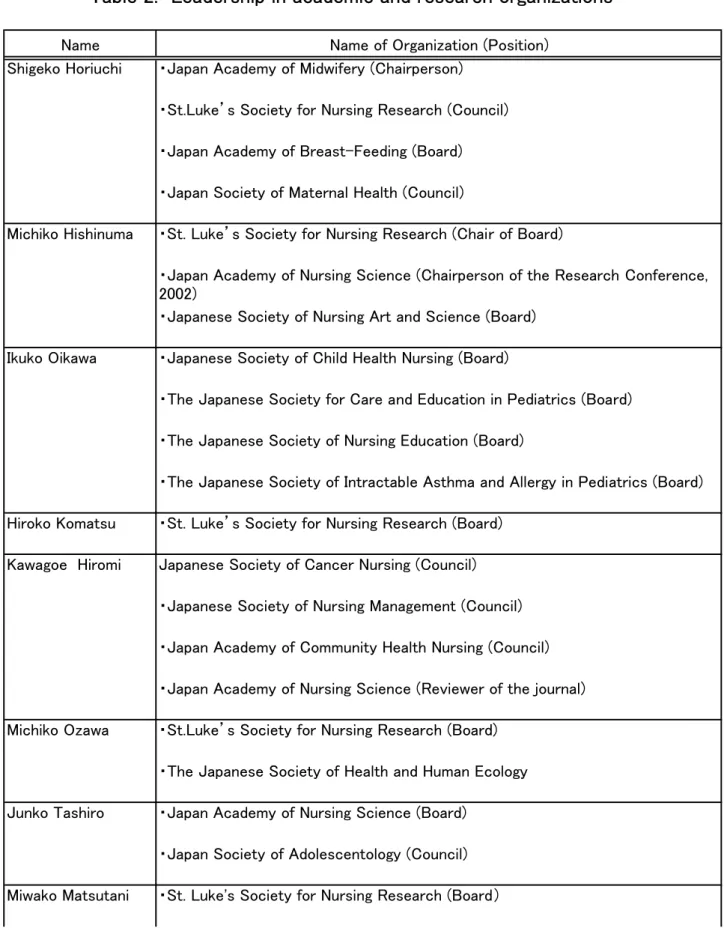
(26) 5. To influence governmental and professional agencies to promote nursing leadership in the development of primary health care. Name of Activity. WHO priority area. Key Result Areas. Person in charge (Specialty). Objective(s) and Brief Description of Activity. Participation in governmental and professional agencies. 1,2,5. Faculty members at St.Luke's College of Nursing play an important role in govermental and professinonal agencies. (cf. Annual Report 2003 , Table1). Participation in academic and research oganizations. 1,2,5. Faculty members at St.Luke's College of Nursing play an important role in academic and research oganizations. (cf. Annual Report 2003, Table2). 20. Publications and Other Outcomes. Results of Any Evaluations of the Activity. Status and Expected Date of Completion. Plans for Continuation of Activity. Estimated Resources. Abstract.
(27) 6. To support international collaboration in nursing education, research and practice related to primary health care. Name of Activity. WHO priority area. Key Result Areas. Person in charge (Specialty). Objective(s) and Brief Description of Activity. Publications and Other Outcomes. Results of Any Evaluations of the Activity. Dean. Horiuchi is working as a board Shigeko Horiuchi (Dean, executive member from WPRO. Maternal & Midwifery Nursing). Participation in the Executive Meeting of the Global Network. Provide and disseminate information about activities of WHO and the WHO Collaborating Centres. 1,2,4. WHO Collaborating Centre. Members of the WHO C.C. Committee are writing articles about global nursing and midwifery information for Japanese nurses using Journal of Japan Nurses Association bi-monthly.. We wrote news on WHO for Japanese nurses, and news about nursing in WPRO for readers of Gloabalnetwork News. Drafts were made for different levels of educational needs.. Mongolian Nurses Association support project. 4. Junko Tashiro (Research Methodology & Theoretical Nursing ). Prof.Tashiro has participated in a project being conducted by Japan Nurses Association to support Mongolian Nurses Association along with International Nurses Association.. In August, Dr. Tashiro went to Mongolia to discuss the needs of the Mongolian Nurses Association.. Support for International Training Programs. 4. Junko Tashiro (Research Methodology & Theoretical Nursing ). Prof. Tashiro is in charge of a number of international leaders' training programs and participates in the training programs for international nursing leaders provided by International Nursing Foundation of Japan and Japanese International Cooperation Association.. Prof. Tashisro received trainees from Uzbekistan, Mongolia, Saudi Arabia, Thailand, Pakistan, and others.. 21. Status and Expected Date of Completion. Plans for Continuation of Activity. Estimated Resources. Abstract.
(28) Support for Brazilian Midwives Training Program. 1,2. Shigeko Dean Horiuchi receives and provides Horiuchi (Dean, seminars for Brazilian midwives in Maternal & Japan. Midwifery Nursing). Support for gerontological nursing care and education in Korea. 4,5. Tomoko Kamei Associate Professor Kamei provides (Gerontological a seminar for gerontological nursing Nursing) care and education in Japan for members of the Korean Gerontological Society.. International Women's Health Conference Korea and Japan-. 1,2. Shigeko Horiuchi (Dean, Maternal & Midwifery Nursing). To support Nepalese midwives through training program. 1,2. Shigeko Dean Horiuchi receives and provides Horiuchi (Dean, seminars for Nepalese midwives in Maternal & Japan. Midwifery Nursing). The work has been implemented.. To support Korean midwives through training program. 1,2. Dean Horiuchi provides seminars for Shigeko Horiuchi (Dean, Korean midwives. Maternal & Midwifery Nursing). The work has been implemented.. International information exchange concerning women's health and midwifery in collaboration with Korean Women's Health Nursing Association and Japan Academy of Midwifery.. 22. The work has been implemented..
(29) Table 1 Leadership in governmental and professional organizations Name Shigeko Horiuchi. Name of Organization (Position) ・Japan Society of Midwifery Education (Board). Michiko Hishinuma. ・Inspection for Nursing and Health (under the authority of the Ministry of Education, Culture, Sports, Science and Technology) (Inspection member) ・Selection Committee of Scholarship for Nurses (under the authority of the Tokyo Metropolitan Government) (Member) ・Project to Strengthen Nursing in El Salvador (Member) ・Inspection for Recognition of Educational Materials (under the authority of the Ministry of Education, Culture, Sports, Science and Technology) (Inspection member on a temporary basis) ・Committee on Medical Technology Authorized by the Ministry of Health, Labour and Welfare (group for community health nurses, midwives and nurses) (Member) ・Steering Committee for Grants-in-aid for Medical Research for International Cooperation (under the authority of the Ministry of Health, Labour and Welfare) (Member) ・Committee on Medical Issues (under the authority of the Tokyo Metropolitan Government) (Member) ・Committee for University Evaluation and National Institution for Academic Degree (Member) ・Japan University Accreditation Association (Committee member for nursing research) ・Japanese Association for Nursing Programs in Universities, Executive Committee (Member). Kawagoe Hiromi. ・Association of Hospice Care at Home (President) ・Japanese Association of Home-Visit Nursing (Board) ・Project to Study Home-Visit Nursing of the Japanese Nursing Association (Head) ・The Liaison Office Between Nursing Stations in Tokyo (Adviser) ・Committee on Medical Issues (under the authority of the Ministry of Health, Labour and Welfare) (Executive Committee Member) ・Project to Study Terminal Care (under the authority of the Ministry of Health, Labour and Welfare) (Member) ・Assessment of the Level of Home-Care in Chuo-ku, Tokyo (Head) Promotion Project for Home-Care Insurance in Chuo-ku, Tokyo (ViceChairperson) ・"Health Chuo 21 Project" (Vice-Chairperson) ・Committee on Scientific Grant by Japanese Association of Academic Research ( Executive Member) ・Educational Programs for Nurse Specialists of Japanese Association for Nursing Programs in Universities (Committee Member).
(30) Michiko Ozawa. ・The Japan Overseas Christian Medical Cooperative Service, Nursing Committee (Member); Evaluation Committee (Member) ・Tokyo Safran Home (institution for blind women) (Council) ・St. Luke's Nursing School (Council). Junko Tashiro. ・Japanese Nursing Association, Committee for Social Welfare and Economics (Member) ・Japanese Nursing Association, Committee for Study of International Activities (Member). Toshiko Ibe. ・Project to Discuss Issues Concerning Pharmacists (under the authority of the Ministry of Health, Labour and Welfare) (Member) ・Project to Study New Nursing Approach (under the authority of the Ministry of Health, Labour and Welfare) (Member) ・ Special Committee to Discuss Guidelines for Clinical Studies (under the authority of the Ministry of Health, Labour and Welfare) (Member) ・Organization to Evaluate Medical Functions in Japan (Inspection member) ・Japanese Nursing Association, Committee for Study of Nursing Ethics (Member) ・Japan Red Cross Medical Center (Committee member of outside evaluation). Kiyomi Asahara. ・Project to Study Nursing Intervention for Depression (under the authority of the Ministry of Health, Labour and Welfare) (Member) ・Project of Research on Manpower Supply in Local Community (Project to Promote Community Health Care" under the authority of the Ministry of Health, Labour and Welfare) (Member) ・Committee to Study Community Health Promotion on Sleep (under the authority of Japanese Nursing Association) (Member). Akiko Mori. ・Teaching Staff at Kobe Training Center (under the authority of Japanese Nursing Association) (Member). Tomoko Kamei. ・Project to Certify Clinical Nurse Specialists of the Japanese Nursing Association (Member) ・Project to Promote Care Providing System (Health Care Room in Community) in Local Community under the Authority of Japanese Nursing Association (Member). Noriko Iba. ・Project to Study Curriculum for Certified Expert Nurse (hospice care) of the Japanese Nursing Association (Member). Masako Sakai. ・Assessment of the Level of Home-care in Chuo-ku, Tokyo (Member). Hiromi Eto. ・Japan Society of Midwifery Education, Education Committee (Member) ・Japan Society of Midwifery, Tokyo, Education Committee (Member).
(31) Table 2. Leadership in academic and research organizations Name Shigeko Horiuchi. Name of Organization (Position) ・Japan Academy of Midwifery (Chairperson) ・St.Luke’s Society for Nursing Research (Council) ・Japan Academy of Breast-Feeding (Board) ・Japan Society of Maternal Health (Council). Michiko Hishinuma. ・St. Luke’s Society for Nursing Research (Chair of Board) ・Japan Academy of Nursing Science (Chairperson of the Research Conference, 2002) ・Japanese Society of Nursing Art and Science (Board). Ikuko Oikawa. ・Japanese Society of Child Health Nursing (Board) ・The Japanese Society for Care and Education in Pediatrics (Board) ・The Japanese Society of Nursing Education (Board) ・The Japanese Society of Intractable Asthma and Allergy in Pediatrics (Board). Hiroko Komatsu. ・St. Luke’s Society for Nursing Research (Board). Kawagoe Hiromi. Japanese Society of Cancer Nursing (Council) ・Japanese Society of Nursing Management (Council) ・Japan Academy of Community Health Nursing (Council) ・Japan Academy of Nursing Science (Reviewer of the journal). Michiko Ozawa. ・St.Luke’s Society for Nursing Research (Board) ・The Japanese Society of Health and Human Ecology. Junko Tashiro. ・Japan Academy of Nursing Science (Board) ・Japan Society of Adolescentology (Council). Miwako Matsutani. ・St. Luke's Society for Nursing Research (Board).
(32) ・Japan Academy of Nursing Science(Reviewer of English version).
(33) Toshiko Ibe. ・Japan Academy of Nursing Science (Board) ・Japan Academy of Nursing Science, Discussion group of nursing ethics (Chairperson) ・Japan Academy of Nursing in Disaster (Vice president) ・The Seventh Academic Conference, St. Luke's Society for Nursing Research (Chairperson) ・St Luke's Society for Nursing Research (Council) ・Committee of Recognized CRC System by the Japanese Society of Clinical Pharmacology (Member) ・The Japanese Society of Nursing Management (Board). Kiyomi Asahara. ・Japan Academy of Nursing Science (Council) ・Japan Academy of Nursing Science (Editor) ・Japan Society of Care at Home (Board) ・Japan Society of Community Health Nursing (Member of Project to Promote International Activities) ・Journal of Public Health Nursing (Reviewer) ・Journal of Japanese Public Health (Reviewer) ・Journal of Japan Society of Community Health Nursing (Reviewer). Yumiko Hayama. ・Project of Planning the 13th Conference of Japan Society of Nursing Education (Member) ・The Third International Conference on Community Health Nursing Research (Member of Project of Planning the Conference) ・Japan Academy of Psychiatric and Mental Health Nursing (Board) ・Health Behavioral Science (Council) ・Japanese Association of Mental Health Policy (Permanent Board member) ・St. Luke’s Society for Nursing Research (Council). Akiko Mori. ・Japan Academy of Infertility Nursing (President). Tomoko Kamei. ・Japan Academy of Home Health Care (Council; Editor) ・The Japanese Society for Low-vision Research and Rehabilitation (Council) ・Japan Society of Care Management (Council; Editor).
(34) ・St. Luke’s Society for Nursing Research (Board) ・Japan Academy of Nursing Science (Reviewer) ・Japan Society of Public Health (Reviewer) ・Japan Society of Gerontological Nursing (Council).
(35) Yuko Hirabayashi. ・Japanese Society of Child Health Nursing (Council) ・Japan Academy of Nursing Education (Council). Chie Kaharu. ・Japanese Society of Nursing Art and Science (Board) ・Japan Academy of Nursing Education (Council, Editor). Noriko Iba. ・Japanese Society of Cancer Nursing (Council). Naoko Arimori. ・Genetic Nursing Committee in Japan(executive) ・Japan Society of Infertility Nursing(Board). Yoshie Okada. ・Japan Academy of Psychiatric and Mental Health Nursing(director). Hiroko Nagae. ・The Japanese Society of Health and Medical Sociology, Nursing Research Section (Vice-President) ・Japanese Association of Hospice Care at Home (Board). Masako Momoi. ・St. Luke's Society for Nursing Science (Accounting Board). Hiromi Eto. ・Japan Academy of Nursing Science(Editor of English Journal; Appointed Board Member) ・Japan Academy of Midwifery (Secretary for General Affairs). Yumi Yokoyama. ・Japan Academy of Neonatal Nursing (Council). Yumi Sakyo. ・Japan Academy of Nursing Science (Project to study nursing ethics) (Member) ・St. Luke's Society for Nursing Research (Editor of Newsletter). Fumiko Kajii. ・Japan Academy of Nursing Science, Project to Promote International Activities (Member).
(36) PartⅡ Research abstracts.
(37) 1.Implementation and evaluation of a genetic nursing training program for the general nurse in Japan Minako Morita1), Hiroko Ando2), Michiko Mizoguchi3), Naoko Arimori4), Satoko Nakagome5), Akiko Mori4), Shigeko Horiuchi4) 1)The Japanease Red Cross College of Nursing 2)Iwate Prefectural University 3)Tokai University 4)ST.Lukes College of Nursing 5)Hiroshima University. Objective: Last year, we reported on the construction and implementation of a pilot genetic nursing training program for acquisition of nursing skills required of the general nurse in this field. This time, we report on the construction, implementation, and evaluation of the actual program, developed upon the findings from the preliminary study. Method: Based on evaluation of the preliminary training program, program design was carried out along the following principles. 1) Splitting of the program into 3 to facilitate attendance: a 3-day, 2-day, and 1-day session, to be carried out within 6 months. 2) Provision of text material and study themes beforehand regarding basic knowledge on genetics and nursing. 3) Construction of a case-oriented program to enable study tailored to actual practice. 4) Incorporation of “role playing” as a practicum. A total of 27 nurses and midwives participated in the program. Evaluations were made as: 1) self-evaluation of nursing skills (before participation and after each session), 2) written exams regarding basic knowledge, 3) written exams regarding a presented case, 4) assessment of degree of satisfaction following each session, and 5) group interview after the 3rd session addressing changes attributable to participation in the program. Tests and questionnaires were submitted to statistical analysis, and the group interview was subjected to content analysis. Results and discussion: Of the 27 participants, 11 were able to attend all sessions. Scores from the post-seminar exam on genetic knowledge were high, and results from the case evaluation test requiring nursing judgments showed significant elevation of scores following participation. No change attributable to participation in the program was notable in the self-evaluation of genetic nursing skills. On the other hand, comments from the group interview indicated that participation in the seminar has instilled a decisive/active attitude towards the practice of genetic nursing. It is believed these changes may account for the rating of “no change” regarding the preand post-participation self-evaluation of nursing skills. As such, our next theme is improving upon the method of evaluation of practical skills, and management of the seminars, such as enabling participants to accumulate credits for each session towards eventual completion of the program. This study was subsidized by grant-in-aid for scientific research A No. 1230759 from the Ministry of Education, Sciences, Sports and Culture. International Society of nurses in genetics,16th annual international conference,2003..
(38) 2 . Distress of inpatients with terminal cancer in Japanese palliative care units: from the viewpoint of spirituality Masako Kawa, Mami Kayama, Etsuko Maeyama, Noriko Iba, Hisayuki Murata, Yuka Imamura, Tikayo Koyama, Michiko Mizuno. Support Care Cancer. 11, 2003, 281-290..
(39) 3.. Development. and. Evaluation. of. a. Model. "Home. Care. Collaboration Notebook" for the Elderly and Families Living at Home Tomoko Kamei1), K.Tsuji2), Y.Hashimoto3), E.Yamamoto6), M.A.Foulk7), R.Campbell7). Y.Kurokawa4),. K,Tanaka5),. )St. Luke's College of Nursing, 2) Life Care System, 3 )University of Taisho, )Keiseikai Institute of Gerontology, 5) Yamaguchi Prefectural College, 6) NPO Home Helper Station Heart and Hand,7 )Turner Geriatric Clinic Univ. of Michigan. 1 4. 【Purpose】 We have developed a model "home care collaboration notebook" for the elderly living at home. We have attempted to enhance the interdisciplinary team approach, and to improve the quality of life of the elderly and their families using this notebook communication. 【Methods】The steps of the development of the notebook were 1) clarification of the goals of the use of this notebook, 2) identifying the existing problems of the similar notebooks used at present, 3) creation of the trial notebook and the pilot of its application by using them with seventy-one elderly and their families at home, 4) focus group methods were used where we interviewed the nineteen care managers who used the notebook with their clients in two different prefectures, 5) we reevaluated the product to make the final version. 【Results & Discussion】 1. Many of them described the significance of using the notebook. 2. The disciplines of the professional care providers included home-helpers, visiting nurses, physicians, day service staff member, and students, and it was apparent that the interdisciplinary professionals were in charge of these cases. This notebook becomes a medium of the communication with the care consumers and professional providers, and it is mostly used in the area of "information exchange" effectively. One care manager expressed that using the notebook helped to gather necessary information in order to monitor the services. The 7th Asia/Oceania Regional Congress of Gerontology 2003..
(40) 4. Competences and Continuing Learning Needs of Japanese Nurses working in Developing Countries. Tashiro Junko, Horiuchi Sigeko, Hirabayashi Yuko, Arimori Naoko, Sakai Masako, Hayashi Naoko, Kajii Fumiko., Hishinuma Michiko. St. Luke's College of Nursing. Background:Since the 1960s, Japanese nurses have been working as international nursing collaborators with or for the people in developing countries in order to promote health through transferring nursing knowledge and skill. Today, even more international health needs have emerged and therefore even more nurses are needed to offer nursing collaboration in developing countries. However a number of nurses reported that they did not have enough competencies as international nursing collaborators. At this time, in Japan, there are limited educational opportunities for those nurses who would like to work in developing countries to learn about effective ways of working with their counterparts in developing countries. Toward this end, it is essential to prepare educational programs that address the actual experiences and resultant learning needs of those international nursing collaborators. Objective: The objectives of this study was to describe the experience of Japanese international nursing collaborators whose mission was nursing knowledge and skill transfer and to determine their learning needs as international collaborators. Method: Semi-structured group or individual interviews were used. The participants of this study were twenty-seven nurses who have had an international collaborative mission and who stayed in a developing country for more than one year. The interview data were taped, transcribed, and analyzed using content analysis from the viewpoint of competency and learning needs. Result: Sixty-two categories were derived from the interview data. Nurses reported needs in two major areas of competency development : International/Cross Cultural Knowledge and Skill and Progressive Competencies for Collaboration. International/Cross Cultural Knowledge and Skill consisted of three components: (1) language ability, (2) mastery of cross-cultural experience, and (3) basic knowledge of international health. Progressive Competencies for Collaboration consisted of four components: (1) establishment of collaborative relationship, (2) decision making and assertiveness, (3) mission and role identification, and (4) nursing administrative, educational and human development knowledge and skill. In addition, we found that international nursing competencies were further enhanced through related learning opportunities after the nurses returned home from their international services. Conclusion: As a result of this study we have identified salient individual and organizational competencies grounded in experience that are necessary for the international nurse collaborator. These competencies will form the core curriculum for developing our international nursing collaborator master’s educational program. 3ed International Multidisciplinary Health Conference of the Department of Health Studies University of South Africa. 2004, 78..
(41) 5.Evaluation of Clinical Practice of Gerontological Nursing -A study of Significance of Clinical Practice in a Health Care Facility for the Elderly, and a Geriatric Hospital- Wakako Kushiro, Fumiko Kajii, Tomoko Kamei St. Luke's College of Nursing. Clinical practice of gerontological nursing in our college is undertaken in two institutions for each student; that is, in a health care facility for the elderly, and in a geriatric hospital. Learning acquired in each setting is then integrated during the campus conference, which takes place in the last day of the practice. The purpose of this study was to consider the significance of practice through the standpoint of students by evaluating their clinical practice records. The subjects were 44 students from the 83 third graders who had gerontological nursing clinical practice in 2002, and agreed to participate in this study. From the free statements written in the “General Self Evaluation” of each institution practice, those concerned with learning and awareness were extracted, classifying and nominating them through considering their similarity. The results were as follows; The 7 items categorized from practice in geriatrics hospitals were: “understanding of the subject”, “Patients information gathering and needs assessment”, “identified of needs”, “practice of nursing care”, “understanding of dementia”, “gerontological nursing view”, and “evaluations/impressions of the practice”. The classifications extracted from practice in health care facilities for the elderly were 5, that is: “understanding of the subject”, “understanding of health care facilities for the elderly”, “care management process”, “role of the nurse”, and “evaluations/impressions of the practice”. The results showed that there was learning acquired commonly in both institutions, and also learning exclusive to a given setting, which allowed a mutual complementation; therefore the significance of clinical practice in two different institutions was amply validated. Future tasks include the use of conferences to discuss the specific role of nursing under the care management, and coraboration with each professions of different fields, given the limited length of practice in health care facilities for the elderly. Key words clinical practice, educational evaluation, gerontological nursing. Bulletin of St. Luke’s College of Nursing. 30, 2004, 97-103..
(42) 6.Service Learning As a Nursing Education: Research Article Review Miwako Matsutani, Junko Tashiro, Chie Kaharu, Masako Sakai, Yasuko Mitsuhashi, Yuko Hirabayashi, Akiko Mori, Michiko Hishinuma, Hiromi Kawagoe, Ikuko Oikawa, Michiko Ozawa St. Luke's College of Nursing. Currently, health, education, and other areas in Japan are being reformed along with changes of our society. Nursing and nursing education are also facing a reform in order to be sensitive to social values or for collaboration with community partners. The aim of this article was to explore the direction of nursing education in Japan based on review studies on development of service learning program in nursing. Twenty three articles retrieved were reviewed. There was no Japanese literature. In United States, service leaning programs have been developed for undergraduate, master, and doctoral students. The programs using service learning were diverse including TB, maternal and child health, diabetes mellitus educational, outreach, and international health programs. The majority of these studies reported positive outcomes for students, faculty, and partners in community. However, one article also reported negative outcomes including time-consuming, heavy workload of faculty as well as partners. Based on these findings from the review, we conclude that health problems of our aging society in Japan are becoming bigger and new health problems are emerging. Nursing should accept some responsibility for those social health needs. We, nursing educators, should develop educational programs with social value and demonstrate social responsibility that is sensitive to our community partners.. Key Words : Service learning, Pedagogy for nursing, Literature review. Bulletin of St. Luke's College of Nursing. 30, 2004,31-38..
(43) 7.Determinants of the place of death among terminally ill cancer patients under home hospice care in Japan Sakiko Fukui1), Hiromi Kawagoe2) and Sakai Masako2), Nishikido Noriko3) and Nagae Hiroko2) and Miyazaki Toshie2) 1) Department of Community Health Nursing, School of Nursing, Tokyo Metropolitan University of Health Sciences, Tokyo, Japan 2) Department of Community Health Nursing, St.Luke's College of Nursing, Tokyo, Japan, 3) 3)Department of Community Health Nursing, University of Tokyo, Tokyo, Japan. Although the place of death of patients with terminal cancer is influenced by multiple factors, few studies have systematically investigated its determinants. The purpose of this study was to examine the influence of the patients’sociodemographic, clinical and support network variables on the place of death of terminally ill cancer patients under the care of home care agencies in Japan. Among 528 patients from 259 home care agencies, 342(65%) died at home and 186(35%) died at a hospital. From the multivariate logistic regression model, patients who expressed the desire for receiving home cafe at referral [odds ratio (OR), 95% confidence interval (CI): 2.19, 1.09-4.40] in addition to the family caregiver's desire for the same (OR,95%CI: 3.19, 175-5.81), who had more than one family caregiver (OR, 95%CI: 2.28, 1.05-4.94), who had the support of their family physician (OR, 95%CI: 2.23, 1.21-4.08), who were never rehospitalized (OR, 95%CI: 0.04, 0.02-0.07), who received more home visits by the home hospice nurse during the stable phase under home hospice care (OR, 95%Cl: 125, 1.02-1.53), and who were in the greatest functionally dependent status during the last week prior to death (OR, 95%Cl: 8.60, 4.97-14.89) were more likely to die at home. Overall, this model could accurately classify 95% of the places of death, which is higher than other published studies. A clearer understanding of factors that might influence the place of death of terminally iii cancer patients would allow healthcare professionals to modify healthcare systems and tailor effective interventions to help patients die at their place of preference. kev words: home care, Japan, place of death, terminally ill cancer. Palliative Medjcine. 17, 2003, 445-453..
(44) 8.Development of Telenursing System to Monitor Daily Life and Symptoms for Home Oxygen Therapy Clients Tomoko Kamei, St. Luke's College of Nursing. To meet their long-term care needs and improve QOL of patients who have chronic respiratory failure and use home oxygen therapy (HOT), I have developed a telenursing support system. Computerized communications are used for daily monitoring and health management focused on early signs symptoms of acute exacerbations. The system consists of interactive communications between the server computer at the telenursing center and a terminal unit set in the homes of clients. 21 questions referring to symptoms of acute exacerbations and daily life and mental information are dispatched from the server once or twice a day. Clients respond by selecting one answer choice for each question and pressing it on the touch panel. Responses are forwarded automatically to the server; data are processed and analyzed simultaneously. Literature-based algorithms analyze client responses and trigger individualized messages; an alarm is produced for serious signs. Messages include specific directions about therapy, exercise and getting physician care immediately. To make operation of the terminal easier for elderly persons a voice response unit is included. Two trials have been conducted. The first, with healthy men, demonstrated system function. The second, with men over 70, demonstrated system feasibility for the elderly. The next steps are trials with HOT patients to determine the effectiveness of the telenursing support system for preventing acute exacerbations and coping with long-term care.. Keywords: Home oxygen therapy, home health care management. Bulletin of St. Luke's College of Nursing. 29, 2003,1-14..
(45) 9.The Effects of Nursing Intervention on Autonomic Nerve System and Daily Living Behaviors Michiko Hishinuma St. Luke's College of Nursing. The present study has been carried out, with an attempt to clarify the effects of nursing intervention on autonomic nerve activity and the activity of daily living. The effect of nursing intervention on the autonomic nerve system was examined on healthy subjects by comparing between the positions that play an essential role in daily living. The heart rate variability was studied with CGSA, by comparison between the following four positions (dorsal position, sitting position with back support, sitting position with back support but no head support, and sitting position without back support). As the result, the sympathetic nerve activity improved and the parasympathetic nerve activity decreased by the above position order. In addition, the influence of habitual exercise on the autonomic nerve system after doing exercise was studied on healthy subjects with CGSA. The result shows that exercise habit should significantly influence biological regulation. On the other hand, the HRV was measured during the application of hot moist compress to the lumber regions of patients. Then Wavelet analysis was made, and evaluated of gas and/or stool. Even though the autonomic nerve activity were not changed immediately after the hot compress application, 38.1% of patients had passed gas and. 52.4% of them had bowel movement. The second purpose of the present study was to elucidate comfortable feeling from the aspect of the autonomic nerve activity. Comfort may be resulted from nursing intervention as well as improvement in the specific activities of daily living. Healthy subjects who were asked to calculate were divided into a group with or without receiving hot compress application to the back region. The average skin temperature was compared between the groups. The result shows that the increased temperature by calculation task significantly decreased to the base line in the hot compress applied group. In addition, healthy subjects with foot bathing were divided into a group with or without calculation task. Then, the temperature of deep skin and the skin conductance level were compared between the groups. There was no change in the group without calculation task, while the deep skin temperature decreased and the SCL increased in the calculation group. There was a significant difference between the groups. These findings suggest that there is relationship between feelings and physiological conditions and that nursing intervention may influence biological regulation. Key words: nursing intervention, autonomic nerve activity, Wavelet, CGSA, positioning, habitual exercise, hot compress applied to lumber region, comfort. The Report of Grant-in-Aid for Scientific Research 2003..
(46) 10.The factor and assistance by which a mother with the child of Down's syndrome can go to child-rearing and care positively Yumi Yokoyama St. Luke's College of Nursing. By looking back upon the child-rearing and care from a notice to present to 12 mothers with the child of Down's syndrome, and having them tell the occasional thought and occasional experience, the factor and assistance which can go to child-rearing and care positively were considered, and following results were obtained. 1.Although early notices (inside of the hospitalization after a delivery etc.) are increasing from it being effective in early care promoting a child's development, considering the process which catches a mother's child, the one-month medical checkup back and a mother is [ "the time of thinking that some are strange" ] timely. 2. Although the fact is also required for the contents of a notice, the viewpoint also including a child's possibility of "raising" is required. 3. Since the continuous support which reaches in the long run is needed, activity of public nurse of a place-of-residence region is desired. 4. If it will be in the state of mind which can be come out outside, it is effective in the ability of introducing the suitable places (parents' meeting, care institution, etc.) for early time to go to child-rearing and care positively.5. it is big for a family to tell also about not only a child's possibility but a family's possibility. 6. The enlightenment to the society to a handicapped child is still more nearly required. Key Words A mother with the child of Down's syndrome, Positive child-rearing and care, Notice time and contents, care. Bulletin of St. Luke’s College of Nursing. 30, 2004, 39-47..
(47) 11.The development of assessment items for early detection of dehydration among healthy elders Fumiko Kajii St. Luke's College of Nursing. Objective :The objective of this study is to develop assessment items for early detection of hypertonic dehydration among healthy Japanese elders. Methods: Data for the study were provided by 384 persons aged 70 or more living in Tokyo. 117 were healthy community-dwelling elders; 267 were living in long-term care units in a geriatric hospital. We collected a blood sample from all subjects. Subjects completed questionnaires about possible related risk factors (sex, age, main disease, current medications) and researchers observed whether or not they were experiencing any of 24 signs and symptoms of hypertonic dehydration. Results: Of our total sample, 31.6% had levels of blood hyperosmolarity. We used logistic regression analysis to compare the adjusted odds ratio between the two groups (with hyperosmolarity and without that) for related risk factors and signs and symptoms. For hyperosmolarity the related factors were diabetes and using drugs to control blood sugar level. It became clear that the signs and symptoms most strongly associated with hyperosmolarity were “ dry armpit” and “ dry tongue”. Conclusion: It was confirmed that these items effectively identified dehydration and that the items would enable healthy elders themselves, and those concerned for their welfare, to check for early signs of dehydration easily.. Key words: assessment,. Early. Hypertonic. dehydration,. hyperosmolarity,. detection. Nutrition Care and Management. 3(3), 2004, 225-234.. healthy. elder,.
(48) Edited by : WHO Collaborating Committee April 2003 to March 2004. St. Luke’s College of Nursing Sigeko Horiuchi, RN, DNSc, Dean ( Head of the WHO Collaborating Centre ) Junko Tashiro, RN, PHN, RNMW, PhD Yuko Hirabayashi, RN, PHN, MN Naoko Arimori, RN, PHN, RNMW, MN Masako Sakai, RN, PHN, MN Naoko Hayashi, RN, PhD Yoshimi Yamazaki, RN, PHN, MN Fumiko Kajii, RN, RD, PhD Special committee member Sarah E. Porter, RN, PhD. All rights reserved. No part of this publication of this may be reproduced, stored in a retrieval system, or transmitted in any from or by any means, electronic, mechanical, photocopying, recording or otherwise, without the prior written permission of St. Luke’s College of Nursing.. St. Luke’s College of Nursing 10-1, Akashi-cho, Chuo-ku, Tokyo 104-0044, Japan Phone:81-3-3543-6391 Fax:81-3-5565-1626.
(49)
図
関連したドキュメント
We construct a Lax pair for the E 6 (1) q-Painlev´ e system from first principles by employing the general theory of semi-classical orthogonal polynomial systems characterised
Standard domino tableaux have already been considered by many authors [33], [6], [34], [8], [1], but, to the best of our knowledge, the expression of the
H ernández , Positive and free boundary solutions to singular nonlinear elliptic problems with absorption; An overview and open problems, in: Proceedings of the Variational
Keywords: Convex order ; Fréchet distribution ; Median ; Mittag-Leffler distribution ; Mittag- Leffler function ; Stable distribution ; Stochastic order.. AMS MSC 2010: Primary 60E05
W ang , Global bifurcation and exact multiplicity of positive solu- tions for a positone problem with cubic nonlinearity and their applications Trans.. H uang , Classification
It is suggested by our method that most of the quadratic algebras for all St¨ ackel equivalence classes of 3D second order quantum superintegrable systems on conformally flat
administrative behaviors and the usefulness of knowledge and skills after completing the Japanese Nursing Association’s certified nursing administration course and 2) to clarify
Inside this class, we identify a new subclass of Liouvillian integrable systems, under suitable conditions such Liouvillian integrable systems can have at most one limit cycle, and
