第 55 卷 第 6 期
2020 年 12 月
JOURNAL OF SOUTHWEST JIAOTONG UNIVERSITY
Vol. 55 No. 6
Dec. 2020
ISSN: 0258-2724 DOI:10.35741/issn.0258-2724.55.6.45
Research article
Electrical and Electronic Engineering
W
ORK
L
IFE
B
ALANCE AND THE
P
ERFORMANCE OF
A
CADEMIC
S
TAFF
AT THE
S
ELECTED
T
ERTIARY
I
NSTITUTIONS IN
K
WARA
S
TATE
,
N
IGERIA
尼日利亚夸拉州某些高等院校的工作生活平衡和学术人员表现
Babatunde S. O.1, Olanipekun W. D.2, Lateef S. A.3*, Babalola H. B.4 1
Department of Business Administration, Faculty of Management Sciences, Al-Hikmah University Ilorin, Nigeria, ([email protected])
2 College of Management and Social Sciences, Summit University, Offa, Nigeria ([email protected]) 3* Faculty of Economics and Management Sciences, University Sultan Zainal Abidin (UniSZA),
4
Department of Business Administration, Osun State University Nigeria, ([email protected])
Received: December 1, 2020 ▪ Review: December 20, 2020 ▪ Accepted: December 28, 2020
This article is an open-access article distributed under the terms and conditions of the Creative Commons Attribution License (http://creativecommons.org/licenses/by/4.0)
Abstract
Ascertaining the effective work and life balance of employees becomes relevant as human needs are evolved in the dynamic environment in which they operate. Several institutions, especially in the education sector have adopted the financial motivation mechanism in covering up for imbalance work life for employees. However, these challenges have persisted and require attention. We therefore aimed at examining a specific impact of work flexibility and environment on the performance of academic staff with a focus on the selected tertiary institutions in Kwara State. We retrieved 246 copies of questionnaires from academic staffs of three selected state-owned institutions. Thus, the data collected were analyzed using SPSS version 25. The new research result revealed that work-life balance through its variables (work flexibility and work environment) significantly affects the employees’ performance. We conducted a search by focusing on the work structures through work flexibility and environment and the analysis has established that work life balance significantly affects the employees’ performance through its indicators. Also, this study found out that with increase in a flexible work style not encroaching into the private life, employees reacts in a positive way and also when the environment becomes conducive, employees tend to rise their work culture thereby affecting their performance. This practical observation also goes in tandem with the position of spill over theory which best appropriates the distinctive factors between home and work. Thus, the new research results recommend making schedules to create clear boundaries between work and private space for attaining effective performance.
Keywords: Employees’ performance, tertiary institutions, work environment, work flexibility, work life balance
变得至关重要。一些机构,特别是教育部门的机构,采用了财务激励机制来掩盖雇员工作生活的 不平衡。但是,这些挑战仍然存在,需要引起注意。因此,我们旨在研究工作灵活性和环境对学 术人员绩效的特定影响,重点是在夸拉州选定的大专院校。我们从三个选定的国有机构的学术人 员中检索了 246 份问卷。因此,使用 SPSS 25 版对收集到的数据进行了分析。新的研究结果表明 ,通过其变量(工作灵活性和工作环境)实现工作与生活的平衡会严重影响员工的绩效。我们通 过工作灵活性和环境关注工作结构进行了搜索,分析发现,工作生活平衡会通过其指标显着影响 员工的绩效。此外,该研究还发现,随着灵活工作方式的增加而不侵犯私人生活,员工会做出积 极的反应,并且当环境变得有利时,员工往往会提升其工作文化,从而影响其绩效。这种实际观 察还与溢出理论的位置相吻合,溢出理论最适合于家庭和工作之间的独特因素。因此,新的研究 结果建议制定时间表以在工作空间和私人空间之间建立清晰的界限,以实现有效的绩效。 关键词: 员工绩效,大专院校,工作环境,工作灵活性,工作生活平衡
I. I
NTRODUCTIONThis study was pinned on examining work life balance and performance of academic staff in tertiary institutions in Kwara State and this issue has generated uprising in the research domain.
In the global context, management and integration of work and home balance has become a pressing issue of discussion especially in the academic terrain. This may be as a result of the peculiarity of the concept and its relationship with the activities in the academic environment [1]. The educational institutions nowadays are faced with series of challenges ranging from competition, environmental challenges among others. However, the most challenging is the employees’ aspect which often times determines the outcome of other factors [2; 3]. Employees are the blood in the veins of an organization as the results of such determines the overall performance of the organization.
Consequently, employees in this sector are faced with challenges of how to integrate work and family affairs [4] in order to keep the ball of life rolling. Responsibilities such as class room works, administrative responsibilities in the university, and most importantly, self-development programs such as acquisition of higher degrees, periodic research publications, attending academic gathering such as conferences and seminars looks cumbersome for individual employee to manage with family affairs. These challenges often times overlap as employees in this category (academia) extra work hour duties and assignments such as weekends class and schedules thereby spending huge time away from home.
Thus, experiments of this nature does have direct influence on how employees perform on
the job and in their respective homes which in turn reflects in the overall performance of the both the organization and individual respective homes. However, to set the record of challenges straight, it was observed in studies that lack of work flexibility in relations to the employees often times constitute part of the lapses in performance caused by the lack of work life balance. Additionally, it was further argued that apart from the flexibility of work, the environment in which employees work contributes the outcome of the performance [5; 6]. Hence, and some of the previous study have failed to tackle this encounters in the academic terrain.
This study however was aimed at investigating the effects of work life balance through the analysis of work environment and flexibility of work hour and it returning effects on the performance of employees in tertiary Institutions. Thus, this study would serve as a guiding map for management of employees’ performance in tertiary Institutions so as to attain optimal performance or productivity.Also, this study would be of relevance to policy makers in designing healthy schedules and also creating workable conducive terrain and competitive culture for employees to thrive and perform effectively and efficiently.
Thus, as observed, this study seeks to fill the knowledge vacuum in respect to analyzing work flexibility and effective work environment in Nigerian tertiary institutions especially in Kwara State.
A. Research Questions
Below are questions raised in this study for the purpose of clarity:
i. To what extent does work flexibility affects the employees’ performance of selected Tertiary Institutions in Kwara State?
ii. To what level does work environment impact on the employees’ performance of selected Tertiary Institutions in Kwara State?
B. Research Objectives
Regarding the above stated questions, this study seeks to:
i. determine the effects of work flexibility on the employees’ performance of selected Tertiary Institutions in Kwara State, and
ii. identify the effects of work environment on the employees’ performance of selected Tertiary Institutions in Kwara State.
C. Research Hypotheses
Below are the study hypotheses stated in null format and in clear terms;
i. Work flexibility has no significant effects on employees’ performance of selected Tertiary Institutions in Kwara State, and
ii. Work environmenthas no significant effects on employees’ performance of selected Tertiary Institutions in Kwara State.
II. L
ITERATURER
EVIEWA. Conceptual Meaning of Work-Life Balance
In the recent ever dynamic work terrain, individual(s) are faced with unpackaged volume of challenges in making sure that there is a balance between work and family life. Irrespective of the various definition of work-life balance, very few have found an acceptable definition and concept as it can be seen as the way of adjusting the working pattern of an employee in order to combine both work and other responsibilities together such as caring for children or elderly relative. Thus, the term work life balance has its classical meaning of being an overall level of equilibrium of an individual where an evaluation of attainment of family responsibility meets, without encroaching with work life [7]. While this was further buttress by [8] which argued work life balance to be the balance between the demands of an individual family life and work lives.
Also, in the opinion of [9], WLB is described as an employees’ observation that work activities and family life are attuned and they both tend to uphold alliance and synergy in man’s life. On the same level, As also posited in [10], WLB is the stability created by an individual which enhance independent and separate affairs of on the job and off the job domains. Furthermore, WLB is seen
as a global assessment which describes works and family resources as being sufficient to meet work and domestic burdens such that the individual involvement and role are efficient and operational enough to satisfy the both parties without hindrance [11].
This by implication means that WLB is described as the situation in which an individual was able to achieve work tasks and functions without jeopardizing the family responsibilities. Consequently, recent opinions such as those of [12] and [13; 1]. This has however assisted organizations in recognizing the limit of work responsibilities and tasks allocation as it appears that majority of the schedule of employees encroach into their personal lives thereby creating conflict of the interested parties [4].
B. Concept of Employees’ Performance As argued in [14], employees are valuable asset in any firm and that the success and performance of any business can be determined by its level of employees’ output. Thus, putting this into context ranging from perspectives and angles in which different respected authors and researchers have seen it owing to the situations and circumstances to its meaning. Employees’ performance was described in [6] as being associated with the degree of outcome which emanated from the level of input and expected result and output of task or job given. This is also measured from the perspective of not just output but the attainment of effectiveness and efficiency of results derived [14].
Consequently, according to the shared view [15]; [16]; [17], performance is described as the accumulation of resulting information arrived at using a identified job activity during a specific period of time. Thus, summarily, employees’ performance can be regarded as a targeted achievement attained during the course of a task and/or responsibility allotted to an individual with guided duration. Also, measuring employees’ performance does not only stop at meeting targets and perform a given task but rather the satisfaction of such an individual employee through improved morale [18]. This in essence implies that measuring of employees’ performance should be seen as a two valve where both the employees and organizational affairs and needs should be which will in turn influence the respective performance [19]. Hence, performance has been argued as to what determines the survival of and continuous existence of an organization and its maintenance, as it determines largely the overall performance of the organization. This has further been proven to
enhance organisations productivity and thus intensify and appropriately employ the capability of the human assets.
C. Concept of Work Flexibility
Working flexibility practical explains measures put in place by a formal system or organizations in which allows an individual or employee design a suitable working arrangement where both parties interest are factored in and put into consideration for effectiveness and expected organizational output without encroaching into the individual’s private life [20].
It was further argued in [21] that there exist numerous benefits features of maintaining a health work flexibility in an organization as it encourages and boast employees’ morale and in turn influence the level of output. Some merits were further widened [22] in terms of enhancing reduction in the overlapping of time spent at work and private life which thus increases employees’ promptness, and respect for work environment. However, the compensations for flexible working-time schedules differs in various organization, geographical location and management of employees by superior in an organization [23].
D. Concept of Workplace Environment Workplace environment was described as a component or system of structures where needs, equipment, and other facilities are put in place in order to serve and meet the requirements and needs of individual tasked with the responsibility to achieve a given set goal [24]. Consequently, workplace environment can be regarded as anything that exists around an individual saddled with the responsibility to carry out a function [25]. However, this environment consists of both internal and external where internal embodies facilities, structures, office arrangement, and welfare arrangement made to serve the employees in specific and organization in general [26]. The external are often regarded as elements which are beyond the control of the housing organization which engages the employees. However, this environment can only be monitored and used to the intended parties’ advantages [27]. Thus, determinants and factors in the environment does influences the employees’ output and in turn the overall performance of the organization. Some of the determinants of a modest and palatable workplace environment are systems where individuals can perform their respective allocated functions without panic of harm and discomfort [28], [29].
D. Empirical Review
In a study conducted by Jackson and Fransman [1] which focused on flexible-work, and the financial well-being, and how these influences the subjective practices of efficiency and individual job satisfaction with special focus on females in an higher institution. Their study hovers around determining the correlationwhich exists between flexible-work, financial welfare,female employees’ efficiency and satisfaction. The study however found that, statistically, work life balance through effective work flexibility, and efficient financial welfare structure does affect female employees’ productivity and satisfaction in the higher institutions.
In a related study [2] on work-life balance and employees’ satisfaction, which focuses on higher education teachers in Oman. The primary objective of the study was to examine WLB and satisfaction of academic staff of advanced education in Oman. The study found that while work interference with privatetime,vice versa causes negative connection with employees’fulfillment, work and individual life enrichment had a encouraging relationship with their respective job satisfaction. In essence, the findings further buttress the previous analysis as stated above.
Another study [30] dealing with work-life balance amid academia of the University of Lagos was aimed at examining work life balance and academia of the institution. However, the study discovered that the University does not have an existing policy to resolve the issue of encounters in work life balance in which respondents affirmed to an existing pitiable work condition in relations to home and work management.
Also, a study was conducted in higher education envronemnt [31] with the main objective of establishing the relationship between maintaining equillibrium betweeen work and home, employees’ satisfaction and engagement with organizational commitment among Lecturers in Indonesia. It was found that with improvement in employees’ work engagement schedule and environement in which they work, commitment tends the grow to a reasonable level of job satisfaction.
F. Theoretical Relevance 2.1 Guest’s Spill-Over Theory
In the management and business terrain, the spill-over theory, which was propounded by Guest [32], is one of the prominent theories in
work life balance after [33]. In this theory, there are similarities between what occur in the work environment and family environment. This theory emphasizes the trend of workers in transmitting individualfeelings, approaches, abilities and behaviours established at work place into their privatetime and vice-versa [32]. As observed, the spill-over theory can either be positive or negative, where the adverse spill-over stimulipressure in an individual and the optimistic spillover can tip to a greater level of satisfaction and job productivity. Consequently, as further argued in [34], studies into the field of work life balance has opined that employees who continuously work for too long hours have higher chances of work and life conflict. In furtherance, the border between work and home is unarguably weak often times and tend to spill over positively or negatively into each other [35].
Therefore, if work-family relationships are rigidly slated in relations to the work time and family time, then spill-over is certainly likely to be negative. On the contrary, when there is work and family flexibility in which allows individuals to synergize and connect work and family roles in time and work schedule, then it is likely to be positive which is instrumental in attaining healthy work and life stability. Hence, this study has found this theory appropriate for adoption as it best describes the link which exists between work and private space.
III. R
ESEARCHM
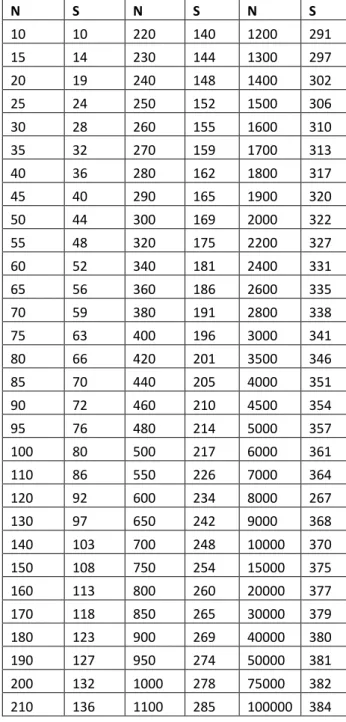
ETHODThis study adopted the survey strategy, with a descriptive method as it aimed at describing the phenomenon involved in the work life balance. Furthermore, the population of this study was the entire academic staff work forceof the selected Institutions in the State. In specifics, Kwara State University, Malete, Kwara State Polytechnic, Ilorin and College of Education, Ilorin recorded 447, 473 and 178 Academic staff, respectively, as of 2018. Thus, a sample of 285 was selected using the Krejcie and Morgan’s sample size table [36] (See Appendix A for table) and copies of close ended questionnaire were distributed to the targeted respondents. Lastly, the Multiple Linear Regression was employed for analyzing the collected data.
IV. R
ESULTS ANDD
ISCUSSIONThis study administered two hundred and eighty-five (285) copies of questionnaire to the targeted respondents However, this study was able to retrieved from field and found reliable for analysis using the Statistical Package for Social Science.
A. Test of Hypotheses 4.1. Test of Hypothesis One
Statements in this section explicate the statistical explanation of the set hypothesis for the study which is presented in null format;
Ho1 Work flexibility has no significant
impact on the employees’ performance
Table 1. Model Summary b
Model 1
R 0.765a
R Square 0.585
Adjusted R Square 0.583
Std. Error of the Estimate 3.019
Durbin-Watson 1.865
a. Predictors: (Constant), Work Flexibility b. Dependent Variable: Employees’ Performance The table above presents the model summary and it shows that the relationship coefficient r is 0.765, which shows that there exists a very strong connection between employees’ performance (dependent variable) that is being predicted and work flexibility (independent variables). It is also clear from the table that the r2 which is the coefficient of determination is 0.585 approximately 59%. This implies that more than half of the percentage i.e. 59% change in employees’ performance can be explained by the improvement in employees’ work flexibility.
Table 2. ANOVAa Model 1 Sum of Squares Df Mean Square F Sig. Regression 3146.274 1 3146.274 345.130 0.000b Residual 2233.467 245 9.116 Total 5379.741 246
a. Dependent Variable: Employees’ Performance b. Predictors: (Constant), Work Flexibility
Table 2 above presents the ANOVA table. The F-statistic as shown from the table is significant since the probability value of .000 is less than the alpha level of 0.05, thus the model is fit. Therefore, the negative hypothesis was overruled and the alternate was accepted. This implies that, work flexibility does have significant influence on employees’ performance.
Table 3. Coefficients a Model 1 Unstandardized Coefficients Standardized Coefficients T Sig. B Std. Error Beta (Constant) 2.892 1.314 2.202 0.029 Work Flexibility 0.874 0.047 0.765 18.578 0.000 a. Dependent Variable: Employees’ Performance
Table 3 presents the coefficient of independent variables. The coefficient of work flexibility of 0.874 suggests that there exists an affirmative affiliation between work flexibility and employees’ performance. This shows that for every increase in that predictor (work flexibility), employees’ performance increases by 87.4%. In addition, the probability and (t-statistics) value of 0.000 and (18.578) further suggests that the correlation between work flexibility and employees’ performance was substantial since alpha level of 0.05 is greater than the p-value.
The regression equation above has therefore, established that taking all factors into account (work flexibility) constant at zero, employees’ performance will be 2.892. As a result of this, it was concluded that work flexibility has major effect on employees’ performance since alpha level of 0.05 is greater than the p-value. This is in correlation with [30]. Particularly, it also aligns with [1] and [31].
4.2 Test of Hypothesis Two
Ho2 Work environment has no
significant effect on the employees’ performance
Table 4. Model Summary b
Model 1
R 0.760a
R Square 0.577
Adjusted R Square 0.575
Std. Error of the Estimate 3.036
Durbin-Watson 1.625
a. Predictors: (Constant), Work environment b. Dependent Variable: Employees’ Performance
Table 4 above presents the model summary. It shows that the parallel coefficient r is 0.760 which specifies that there exists a very robustassociation between employees’ performance and work environment. It is also clear from the table that the r2 which is the coefficient of determination is 0.577 approximately 58%. This implies that more than half of the percentage, i.e., 58% change in employees’ performance can be explained by the improvement in work environment.
Table 5. ANOVAa Model 1 Sum of Squares Df Mean Square F Sig. Regression 3029.071 1 3029.071 328.716 0.000b Residual 2220.781 241 9.215 Total 5249.852 242
a. Dependent Variable: Employees’ Performance b. Predictors: (Constant), Work environment
Table 5 above presents ANOVA table and the F-statistic as shown from the table is significant since the probability value of .000 is less than the alpha level of 0.05, thus the model is fit. Hence, the negative hypothesis was disallowed and the positive hypothesis was accepted. This implies that, work environment does significant affects employees’ performance. Table 6. Coefficients a Model 1 Unstandardized Coefficients Standardized Coefficients T Sig. B Std. Error Beta (Constant) 4.119 1.276 3.229 0.001 Work Flexibility 0.857 0.047 0.760 18.131 0.000 a. Dependent Variable: Employees’ Performance
As presented above, table 6 illustrates the coefficient of independent variables. The coefficient of time table of 0.857 suggests that there exists a constructive link amid work environment and employees’ performance. This shows that for every increase in that predictor (work environment), employees’ performance increases significantly by 85.7%. In addition, the probability and (t-statistics) value of .000 and (18.131) further suggests that the connection between work environment and employees’ performance is substantial since alpha level of 0.05 is greater than the p-value. The conclusion therefore is that improvement in work environment is a major contributor to employees’ performance. The regression equation above has therefore, established that taking all factors into account (work environment) constant at zero, employees’ performance will be 4.119. As a result of this, this analysis concludes that work environment has major effects on employees’ performance of the selected tertiary institutions since alpha level of .05 is greater than the p-value. Hence, this study conforms to [30] and [2].
V. C
ONCLUSIONSRegarding the above results, this study comes to a couple of conclusions which are not detached from the research objectives. This study concludes that work flexibility does affects how employees react to work thereby influencing the employees’ performance. Additionally, the study concludes that when there is flexibility of work (especially work hours) for employees, it often times affect the overall performance of the organization.
In addition, this study also affirms that work environment does have momentous effect on the
employees’ performance and that availability of good work environment does play a significant effect in the performance level of employees, hence, it becomes important to maintain good working environment.
Lastly, this study has unraveled the lingering challenges in the Kwara State educational sector, especially the tertiary level where academic staff exist in an ill-mannered work schedules and unhealthy work environment thereby influencing the expected performance.
Thus, this study however, recommends that adequate flexible work structure be designed for the tertiary institutions in the State as this has been observed to be one of the major causes of deficiency in employees’ performance in the selected tertiary institutions in Kwara State. Also, this study further recommends that some of the environments in which the employees carry out their respective task are not work friendly thereby affecting the output of such an employee and in turn affecting the performance of these institutions. As observed in couple of the response of respondents, provision of these basic requirements would definitely affect their respective performance which is needs for overall efficient of the institution.
R
EFERENCES[1] JACKSON, L.T. B. & FRANSMAN, E.I.
(2018) Flexi work, financial well-being,
work– life balance and their effects on
subjective experiences of productivity and
job satisfaction of females in an institution
of higher learning. South African Journal of
Economic and Management Sciences, 21(1),
pp. 1-13. a1487. https://doi.org/10.4102/
sajems.v21i1.1487
[2] AGHA, K., AZMI, F. T. & IRFAN, A.
(2017)
Work-life
balance
and
job
satisfaction: An empirical study focusing on
higher
education
teachers
in
Oman.
International Journal of Social Science and
Humanity,
7(3),
pp.
164-171.
https://doi.org/10.18178/ijssh.2017.7.3.813
[3]
VENKATESHWARAN,
G.
&
SUGANYA, R. V. (2020) Dominating
factors of work life balance and productivity
- Special reference to It Sector - Chennai
City. International Journal of Advanced
Science and Technology, 29(12), pp.
216-224.
[4] EL-KASSEM, R. C. (2018)
Work-life-balance in Qatar: Implementing tows
analysis as a variant of the classic strategic
tool, SWOT. Journal of WEI Business and
Economics, 7(2), pp. 31-48.
[5] AINAPUR P., VIDYAVATHI B.,
KULKARNI K., & MAMATA P. (2016)
Work life balance policies, practices and its
impact
on
organizational
performance.
International Journal of Engineering and
Management Sciences, 7(4), pp. 233-246.
[6] MMAKWE, K. A., & OJIABO, U. (2018)
Work-life
balance
and
employee
performance
in
Nigerian
banks,
Port
Harcourt. International Journal of Advanced
Academic Research Social & Management
Sciences, 4(1), pp. 107-119.
[7] KALLIATH, T. & BROUGH, P. (2008).
Work-life balance: A review of the meaning
of the balance construct. Journal of
Management & Organization, 14, pp.
323-327.
[8] DWI, P. L., NIDA, H. & ISTIQOMAH, J.
(2018) The effects of work-life balance
towards employee engagement in millennial
generation. Proceedings of the 4th ASEAN
Conference on Psychology, Counselling, and
Humanities “Advances in Social Science,
Education and Humanities Research”, 304,
pp. 390-394.
[9] ESSAYS, UK. (November, 2018).
Literature review on flexible work practices.
Available
from
https://www.ukessays.com/essays/manageme
nt/literature-review-on-flexible-work-practices-management-essay.php?vref=1
[10] MATHIS, R. L. & JACKSON, J. H.
(2009) Human resource management. Mason,
OH, USA: South-Western Cengage Learning.
[11] VOYDANOFF, P. (2008) Linkages
between the work family interface and work,
family, and individual outcomes. Journal of
Family, 23, pp. 138–164.
[14]
MUCHINSKY,
P.M.
(2004).
Psychology: Applied to work. Belmont. CA:
Wadsworth/Thomson Learning.
[13] ADIKRAM, D.S. & JAYATILAKE,
L.V.K. (2016) Work-life balance on
employee satisfaction in private sector
commercial bank in Sri Lank. International
Journal
of
Scientific
Research
and
Innovative Technology, 3(11), pp. 17-31.
[14] BARAL, R. & BHARGAVA, S. (2010)
Work-family enrichment as a mediator
between organizational interventions for
work-life balance and job outcomes. Journal
of Managerial Psychology, 25(3), pp.
274-300.
[15] CEGARRA-LEIVA, D.,
SANCHEZ-VIDAL, M.E., & CEGARRA-NAVARRO,
J.G. (2012) Understanding the link between
work
life
balance
practices
and
organizational outcomes in SMEs. Personnel
Review, 41(3), pp. 359-379.
[16] NETEMEYER, R. G., MAXHAM, J. G.,
& PULLIG, C. (2005) Conflicts in the work–
family interface: Links to job stress,
customer service employee performance, and
customer
purchase
intent.
Journal
of
Marketing, 69(2), pp. 130-143.
[17] MCCARTHY, A., DARCY, C., &
GRADY, G. (2010). Work-life balance
policy and practice. Understanding line
manager attitudes and behaviors. Human
Resource Management Review, 20(2), pp.
158-167.
[18] GRZYWACZ, J. G. & CARLSON, D. S.
(2007).
Conceptualizing
work–family
balance: Implications for practice and
research. Advances in Developing Human
Resources, 9, pp. 455–71.
[19] ABDULKADIR, L (2018) Influence of
work-life balance on employee performance
at the cabinet affairs office, Kenya. (A
Master of Science in Human Resource
Management Thesis, School of Business of
the University of Nairobi).
[20] GOUDSWAARD, A. VERBIEST S.,
PREENEN, P. & DHONDT, S. (2013)
Creating successful flexible working-time
arrangements: Three European case studies.
Employment Relations Today. Published
Online
in
Wiley
Online
Library
(wileyonlinelibrary.com).
https://doi.org/10.1002/ert.21418.
[21] SUBRAMANIAM, G., TAN, P. L.,
MANIAM, B., & ALI, E. (2013) Workplace
Flexibility, Empowerment and Quality of
Life. Procedia - Social and Behavioral
Sciences, 105, pp. 885–893.
[22] WONG, P. Y., BANDAR, N. F. A. &
SAILI, J. (2017) Workplace factors and
work-life balance among employees in
selected
services
sector.
International
Journal of Business and Society, 18(4), pp.
677-684.
[23] AKINYELE, S. T.
,
PETERS, M. C. &
AKINYELE, F. E. (2016) Work-life balance
practices
as
panacea
for
employee
performance: Empirical evidence from River
State Television, Nigeria. Arabian Journal of
Business and Management Review (Oman
Chapter), 6(5), pp. 34-47.
[24] ONU, C.A., AKINLABI B. H. &
ADEGBOLA E A. (2018) Work life balance
and normative commitments of employees in
the selected deposit money banks in Ogun
State, Nigeria. European Journal of Business
and Innovation Research, 6(5), pp. 1-13.
[25] MUŠURA, A., KORICAN, M. &
KRAJNOVIC, S. (2013) Work–life and
life-work conflicting Croatian companies: Some
perspectives.
International
Journal
of
Organization Theory and Behavior, 16, pp.
42–67.
[26] OROGBU, L.O., ONYEIZUGBE, C.U.
& CHUKWUEMEKE, D.N. (2015) Work
life balance and employee performance in
selected commercial banks in Lagos State.
European
Journal
of
Research
and
Reflection in Management Sciences, 3(4), pp.
63-77.
[27]
FALOLA,
H.O.,
SALAU,
O.P.,
OMONIYI-OYAFUNKE,
C.O.
&
OLOKUNDUN M.A. (2016) Effect of
marital
instability
on
employees’
performance in selected commercial banks in
Nigeria. International Business Management,
10(21), pp. 5158-5163.
[28] SAKS, A.M. (2006) Antecedents and
consequences of employee engagement.
Journal of Managerial Psychology, 21, pp.
600-619.
[29] GACHTER M., SAVAGE D.A., &
TORGLER B. (2011) The relationship
between stress, strain and social capital:
Policing. An International Journal of Police
Strategies & Management, 34, pp. 515-540.
https://doi.org/10.1108/13639511111157546[30] ADEBAYO, A. (2016) Work-Life
Balance among academic staff of the
University of Lagos. Makerere Journal of
Higher Education, 8(2), pp. 153–164.
http://dx.doi.org/10.4314/majohe.v8i2.6.
[31] HARINI, S. LUDDIN, M.R. &
HAMIDAH, (2019) Work life balance, job
satisfaction,
work
engagement
and
organizational commitment among Lecturers.
Journal of Engineering and Applied Science,
14(7), pp. 2195-2202.
[32] GUEST, D. (2002) Perspectives on the
study of work-life balance. Social Science
Information, 41, pp. 255-279.
[33] PLECK, A. B. (1977) The spill-over
crossover
model.
Work
life
balance.
Psychology Press.
[34] DEX, F.T. & SMITH, N.K. (2012) A
meta-analysis of work family conflict and
various out comes with a special emphasis on
cross domain versus matching domain
relations. Journal of Occupational Health
Psychology, 16, pp. 151-169.
[35] LEWIS, S. (2003) The integration of
paid work and the rest of life. Is
post-industrial work the new leisure? Leisure
Studies, 22, pp. 343 – 355.
[36] KREJCIE, R. V., & MORGAN, D.W.
(1970) Determining sample size for research
activities. Educational and Psychological
Measurement, 30(3), pp. 607-610.
参考文:
[1]JACKSON, L.T.B. 和FRANSMAN,E.I.
(2018)弹性工作,财务状况,工作与生活 之间的平衡及其对高等教育机构中女性生产 率和工作满意度的主观体验的影响。南非经 济与管理科学杂志,21(1),第1-13页。 a1487 。 https://doi.org/10.4102/ sajems.v21i1.1487 [2] AGHA,K.,AZMI,F.T。和IRFAN,A。 (2017)工作与生活的平衡与工作满意度: 一项针对阿曼高等教育教师的实证研究。国 际社会科学与人文杂志,7(3),第164-171 页。 https://doi.org/10.18178/ijssh.2017.7.3.813 [3] VENKATESHWARAN , G. 和 SUGANYA , R. V.(2020年),工作生活平衡和生产率的 主导因素-特别参考IT部门-钦奈市。国际先进 科学技术杂志,29(12),第216-224页。 [4] EL-KASSEM,R. C.(2018)卡塔尔的工 作 与 生 活 平 衡 : 拖 曳 分 析 是 经 典 战 略 工 具 SWOT的一种变体。 WEI商业与经济杂志,7 (2),第31-48页。 [5] AINAPUR P. , VIDYAVATHI B. , KULKARNI K.和MAMATA P.(2016)工作 与生活平衡的政策,实践及其对组织绩效的 影响。国际工程与管理科学杂志,7(4), 第233-246页。 [6] MMAKWE,K. A.和OJIABO,U.(2018), 尼日利亚银行在哈科特港的工作生活平衡和 员工绩效。国际高级学术研究社会与管理科 学杂志,4(1),第107-119页。 [7] KALLIATH,T.&BROUGH,P.(2008)。 工作与生活的平衡:对平衡结构含义的回顾。 管理与组织杂志,14,第323-327页。 [8] DWI,P. L.,NIDA,H。和ISTIQOMAH, J.(2018)工作与生活的平衡对千禧一代员工 敬业度的影响。第四届东盟心理学,咨询和 人文会议论文集“社会科学,教育和人文研 究的进展”,304,第390-394页。 [9] ESSAYS, UK. (2018)。有关灵活的工作 实 践 的 文 献 综 述 。 可 从 https://www.ukessays.com/essays/management/li terature-review-on-flexible-work-practices-management-essay.php?vref=1获得 [10] MATHIS , R 。 L. & JACKSON , J 。 H. ( 2009 ) 人 力 资 源 管 理 。 美 国 俄 亥 俄 州 梅 森:西南参与学习。 [11] VOYDANOFF,P.(2008)工作家庭接口 与工作,家庭和个人成果之间的联系。家庭 杂志,23,第138-164页。 [14] MUCHINSKY,下午(2004)。心理学: 适用于工作。贝尔蒙特。 CA:Wadsworth / Thomson学习。 [13] ADIKRAM , D.S 。 和 JAYATILAKE , L.V.K。 (2016)斯里兰卡兰克私营商业银行 员工满意度的工作与生活平衡。国际科学研 究与创新技术杂志,3(11),第17-31页。 [14] BARAL , R 。 和 BHARGAVA , S 。 (2010年),《工作家庭的充实》作为组织 干预之间的中介,以实现工作与生活的平衡 和工作成果。 《管理心理学杂志》 25(3), 第274-300页。 [15] CEGARRA-LEIVA, D. , SANCHEZ-VIDAL, M.E. 和J.G. CEGARRA-NAVARRO。 (2012)了解中小企业的工作与生活平衡实践 与 组织 成 果 之 间 的 联 系 。 人 事 评论 , 41 (3),第359-379页。 [16] NETEMEYER,R. G.,MAXHAM,J. G. 和PULLIG,C.(2005)工作家庭关系中的冲 突:与工作压力,客户服务员工绩效和客户 购买意图的链接。市场营销杂志,69(2), 第130-143页。 [17] MCCARTHY , A. , DARCY , C 。 和 GRADY,G。(2010)。工作与生活的平衡 政策和实践。了解直线经理的态度和行为。 人力资源管理评论,20(2),第158-167页。 [18] GRZYWACZ,J。G. 和CARLSON,D。 S.(2007)。概念化工作与家庭的平衡:对实 践和研究的意义。人力资源开发进展,9,第 455-71页。 [19] ABDULKADIR,Lю(2018)肯尼亚内阁 事务办公室的工作与生活平衡对员工绩效的 影响。 (内罗毕大学商学院人力资源管理学 理学硕士)。 [20] GOUDSWAARD , A 。 VERBIEST S. , PREENEN,P。和DHONDT,S。(2013)建 立成功的灵活工作时间安排:三个欧洲案例 研究。今天的雇佣关系。在Wiley在线图书馆 ( wileyonlinelibrary.com ) 在 线 发 布 。 https://doi.org/10.1002/ert.21418。 [21] SUBRAMANIAM , G. , TAN , P.L. , MANIAM,B。和ALI,E.(2013),工作场 所的灵活性,赋权和生活质量。 Procedia-社 会与行为科学,105,第885–893页。
[22] WONG , P.Y. , BANDAR , N.F.A. 和 SAILI,J.(2017)在选定服务部门的员工中, 工作场所因素和工作与生活之间的平衡。国 际商业与社会杂志,18(4),第677-684页。 [23] AKINYELE,S. T.,PETERS,M. C.和 AKINYELE,F. E.(2016)工作与生活的平衡 做法是提高员工绩效的灵丹妙药:来自尼日 利亚河州电视台的经验证据。阿拉伯工商管 理评论杂志(阿曼章),第6(5)页,第34-47页。
[24] ONU , C.A. , AKINLABI B. H. 和 ADEGBOLA E A.(2018)在尼日利亚奥贡州 选定的存款银行中,员工的工作生活平衡和 规 范 承 诺 。 欧 洲 商 业 与 创 新 研 究 杂 志 , 6 (5),第1-13页。 [25] MUŠURA , A. , KORICAN , M. 和 KRAJNOVIC,S.(2013)工作与生活和生活 与工作相冲突的克罗地亚公司:一些观点。 国际组织理论与行为杂志,16,第42-67页。 [26] OROGBU,L.O.,ONYEIZUGBE,C.U. 和CHUKWUEMEKE,D.N.(2015)拉各斯州 部分商业银行的工作生活平衡和员工绩效。 《欧洲管理科学研究与反射杂志》,3(4),第 63-77页。
[27] FALOLA , H.O. , SALAU , O.P. ,
OMONIYI-OYAFUNKE , C.O. 和 OLOKUNDUN M.A.(2016)尼日利亚某些商 业银行的婚姻不稳定对员工绩效的影响。国 际业务管理,10(21),第5158-5163页。 [28] SAKS,A.M.(2006)员工敬业度的前因 和后果。管理心理学杂志,第21卷,第600-619页。
[29] GACHTER M. , SAVAGE D.A. 和 TORGLER B.(2011)压力,压力与社会资本 之间的关系:警务。 《国际警察战略与管理 杂 志 》 , 34 , 第 515-540 页 。 https://doi.org/10.1108/13639511111157546 [30] ADEBAYO, A. A。(2016)拉各斯大学 学术人员的工作与生活平衡。麦克雷雷高等 教育
杂 志 , 8 ( 2 ) , 第 153–164 页 。 http://dx.doi.org/10.4314/majohe.v8i2.6。 [31] HARINI , S., LUDDIN , M.R. 和 HAMIDAH,(2019)讲师之间的工作生活平 衡,工作满意度,工作投入和组织承诺。工 程与应用科学杂志,14(7),第2195-2202页。 [32] GUEST,D.(2002)。工作与生活平衡 研究的观点。社会科学信息,41,第255-279 页。 [33] PLECK,A.B.(1977)溢出交叉模型。工 作与生活的平衡。心理学出版社。 [34] DEX,F.T. 和SMITH,N.K. (2012)对 工作家庭冲突和各种结果的荟萃分析特别强 调了跨域与匹配域之间的关系。职业健康心 理学杂志,16,第151-169页。 [35] LEWIS,S.(2003)有偿工作与余生的结 合。后工业工作是新的休闲吗?休闲研究, 22,第343至355页。 [36] KREJCIE , R. V. , 和 MORGAN , D.W. (1970)确定研究活动的样本量。教育和心 理测量,30(3),第607-610页。 APPENDIX A
Table for Determining Sample Size for a Finite Population
Note: N is Population size; S is sample size (source: Krejice & Morgan, 1970)
N S N S N S 10 10 220 140 1200 291 15 14 230 144 1300 297 20 19 240 148 1400 302 25 24 250 152 1500 306 30 28 260 155 1600 310 35 32 270 159 1700 313 40 36 280 162 1800 317 45 40 290 165 1900 320 50 44 300 169 2000 322 55 48 320 175 2200 327 60 52 340 181 2400 331 65 56 360 186 2600 335 70 59 380 191 2800 338 75 63 400 196 3000 341 80 66 420 201 3500 346 85 70 440 205 4000 351 90 72 460 210 4500 354 95 76 480 214 5000 357 100 80 500 217 6000 361 110 86 550 226 7000 364 120 92 600 234 8000 267 130 97 650 242 9000 368 140 103 700 248 10000 370 150 108 750 254 15000 375 160 113 800 260 20000 377 170 118 850 265 30000 379 180 123 900 269 40000 380 190 127 950 274 50000 381 200 132 1000 278 75000 382 210 136 1100 285 100000 384