Bridging the Gap between Traditional and
Task-Based Teaching: The Post-Task Methodology
著者
Nitta Ryo
journal or
publication title
THE NAGOYA GAKUIN DAIGAKU RONSHU; Journal of
Nagoya Gakuin University; LANGUAGE and CULTURE
volume
20
number
1
page range
33-45
year
2008-10-31
Introduction
Task-based language teaching (TBLT) has rapidly and extensively developed worldwide, being called ‘a subject of keen contemporary interest’ (Johnson, 2001: 194) in the area of second language acquisition (SLA) studies. However, this does not mean that TBLT has been unchallenged. For example, Swan (2005) criticizes it as a ‘legislation by hypothesis’ and much of TBLT remains theoretical. Long (2007), an exponent of TBLT, says it is ‘an embryonic theory of language teaching’ and calls for more systematic research. One of the problems concerning TBLT is that studies based on EFL (English as a Foreign Language) countries are substantially lacking in terms of both quality and quantity. Another problem is that the situation in EFL countries is different from ESL (English as a Second Language) countries where most task-based theories and empirical studies originate (Garcia Mayo & Pica, 2000). It is thus imperative to investigate whether or not TBLT, which has developed in ESL countries, can be applied to English Language Teaching (ELT) in EFL countries like Japan. If it is feasible, even partially, then it is important to ascertain what aspects of TBLT can be implemented in Japanese schools. With this goal in mind, this paper pays attention to the post-task phase rather than the task itself in order to bridge the gap between traditional teaching methodology and task-based instruction informed by SLA theories. Synthesizing Skehan’s (1996) cognitive approach to task and Willis’ (1996) task-based pedagogy, I first review Japanese ELT and identify its problems. Following Skehan’s (1996) cognitive approach to task, I will then focus on the post-task stage. Developing TBLT in a Japanese context and identifying the problems rising from this would be valuable not only for Japan’s English education but also for the development of TBLT as a whole.
Characterizing task-based teaching
In what Kumaravadivelu (1994) calls the ‘post-method’ era, there are a considerable number of pedagogic approaches under the umbrella of Communicative Language Teaching (CLT). Among various options, the area of TBLT has been growing in both SLA (e.g., Bygate 1999, 2000; Bygate et
al. 2001; Candlin 1987; Ellis 2000, 2003; Long & Crookes 1992; Robinson, 2001; Skehan 1996, 1998,
2003) and language pedagogy (e.g., Brown et al. 1984; Edwards & Willis 2005; Leaver & Willis, 2004;
Bridging the Gap between Traditional and Task-Based
Teaching: The Post-Task Methodology
Nunan 1989, 2005; Prahbu 1987; van den Branden, 2006; Willis 1996a, 1996b; Willis & Willis, 2007). Although there is no single definition of task, a crucial aspect is that tasks are one kind of holistic activity. According to Bygate and Samuda (2008), holistic activities involve the learner in dealing with the different aspects of language such as phonology, grammar, vocabulary and discourse together in the way language is normally used: ‘it is in holistic language work that key language learning processes take place, and that tasks are invaluable in achieving this purpose’ (p. 8).
To make a task holistic language work, what characteristics should be included? Skehan (1998) summarizes the main task characteristics, following Candlin (1987), Nunan (1989) and Long (1989):
• meaning is primary
• there is a communication problem to solve
• there is a relationship to comparable real-world activities • task completion has priority
• the assessment of the task depends on the outcome
These characteristics reflect the important themes of CLT that put a high value on the development of the ability to use appropriate language in authentic, communicative contexts. Among these features, the first ‘meaning-focused’ issue is paramount because it clarifies the separation of TBLT from traditional teaching methods characterized by explicit form-focused instruction (FFI). Historically, an interest in task arose from a dissatisfaction with traditional structure-based teaching. As Shehadeh (2005: 13) describes it,
...most language learners taught by methods that emphasize mastery of grammar do not achieve an acceptable level of competency in the target language. Language learning in the classroom is usually based on the belief that language is a system of wordings governed by a grammar and a lexicon. However it is more productive to see language primarily as a meaning system.
It is strongly believed that the cognition, knowledge, and/or skills need to be ‘situaed’ not in a location (the classroom) but in an activity (Willis, 2004) which exposes learners to a rich but comprehensible input of real language through teacher talk or students listening to each other (Willis, 1996b). Authentic materials play an important part in a task-based course, providing chances for learners to experiment and test hypotheses, to mean what they say and express what they mean in a variety of circumstances (Willis, 1996b). Tasks can be at any stage in communication - through input (Krashen, 1982), output (Swain, 1985) or interaction (Long, 1996) - but in any mode of communication it is important that learners’ attention should be initially drawn to ‘meaning’ before ‘form’.
does not mean an absolute rejection of FFI. While making learners process meaning, a task subconsciously exposes them to form, and thereby facilitates the future acquisition of the item. Though TBLT does not include explicit types of FFI as with traditional approaches, a focus on form can be one of the objectives (Long, 2000; Ortega, 2007; Skehan, 2003; van den Branden, 2006). It is thus possible that despite their primary focus-on-meaning orientation, tasks may also provide opportunities to switch learners’ attention to form under certain conditions.
Problems of English Language Teaching in Japan
This section considers how task-based instruction can be applied in EFL classrooms where more traditional, structure-based approaches are dominant. ‘Traditional teaching’, as it is understood here, includes the following features:
• focus on accurate comprehension and production rather than on fluency in the target language • the linguistic forms are predetermined
• little consideration of spontaneous real-world interaction
• frequent and repetitive use of mechanical grammar exercises or drills • excessive use of the learners’ native language
In contrast to task as holistic activity, structured-based approaches can be defined as one type of ‘analytical’ activity because linguistic elements such as grammar, vocabulary and phonology are separately taught (Bygate & Samuda, 2008). Importantly, these features associated with traditional teaching can still be observed in many English classrooms in Japan1).
Teaching/learning L2 in an EFL country is characterised by constraints on the quantity and quality of L2 practice opportunities (Ortega, 2007). For most learners, sufficient amounts of L2 use for successful SLA outside the classroom are not expected. Under the particular constraints of an EFL country, only teaching the linguistic elements will not offer the learning opportunities that a globalizing society demands. The role of a language classroom is more than merely imparting L2 knowledge, which used to be a central concern for a traditional classroom. Due to globalization, the focus of language teaching has shifted from the structure of the language to successful communication.
This trend is clearly reflected in the revised Course of Study (2005) set by the Education Ministry of Japan aiming at developing students’ ‘communicative abilities’. However, it seems that this objective has not been put to practice in Japanese schools, and the impact of recent SLA research from western countries on Japan’s English education is very limited. Despite the indication that language education needs to involve real-world activities, many classrooms continue to focus on input-based, linguistic structures using written materials. Hardly any opportunities are provided to utilize form in the context
of situations. Even though communicative materials are sometimes used (McGroarty & Taguchi, 2005) by so-called native speakers’ teaching ‘Communication’ courses, such meaning-based communicative syllabus tend to be supplementary and are often no more effective than old style syllabi. For the purpose of understanding the rules, or gaining knowledge ‘about’ language, L1 is exclusively used in many L2 classrooms, which accordingly leads to limited amount of L2 use in the classroom.
Given these problems, how can we create a better EFL environment? van den Branden (2007) argues that L2 classrooms cannot offer language practice using L2 in ‘real-operating conditions’ but they can offer practice under ‘perfect learning conditions’. Naturalistic learning and formal instruction may actually complement each other (indeed, as much SLA research suggests, individually, neither approach is likely to lead to successful learning). As the present form of Japanese ELT only offers formal instruction (imparting structural and lexical knowledge), it is essential, in the first place, to incorporate an aspect of ‘naturalistic learning’ into the classroom. As the distinction between formal instruction and naturalistic learning can also be regarded as that between form and meaning, L2 classrooms that offer the learner a sound focus on form and meaning might constitute a more powerful language learning environment.
Three stages in task-based teaching
To introduce TBLT to Japan, it is important to understand that this approach is not monolithic; rather, various methodologies can be flexibly adapted (Willis & Willis, 2007) according to individual teaching contexts (such as proficiency level, age, previous learning experience, classroom size etc). To my mind, key to its usefulness to EFL classrooms is whether attention to form can be achieved under a meaning-focused framework. A number of studies have investigated what types of task lead to learners’ attention to form without impairing the task characteristics2). In addition to research on task types,
another area to consider is ‘task conditions’, defined as ‘the use and manipulation of external pressure, such as the imposition of time pressure, the use of completion or collaboration or both, and provision of pre-, while and post-task support’ (Bygate & Samuda, 2008: 15). Setting task conditions allows us to manipulate task difficulty without overriding the essential task characteristics. Bygate and Samuda (2008) argue that task’s involving a number of different phases is one key dimension where tasks differ from analytical activities like drills or exercises: ‘the phasing of a task generally involves breaking down the overall task into a series of interlocking steps’ (p. 14). In practice, these methodological options are important, because ‘simply to give learners tasks to do is not enough’ (Skehan, 2007: 61). Tasks aim to provide a certain communicative context which is believed to lead to language learning; however, it is also true that successful learning is not always guaranteed through giving communicative tasks especially in terms of ‘form’, as learners often fail to develop L2 sufficiently even in a natural environment (Swain, 1985). To maximize the effects of learning, it is then very important to consider
how the task can be supplemented by certain pedagogical and methodological supports. One way to achieve this is to sandwich the task by several activities, facilitating the task performance (pre-task) and consolidating what is learnt in the task (post-task). Thus, the different phases of a task can serve different functions, and may give rise to different types of exchange and different types of talk (Bygate & Samuda, 2008).
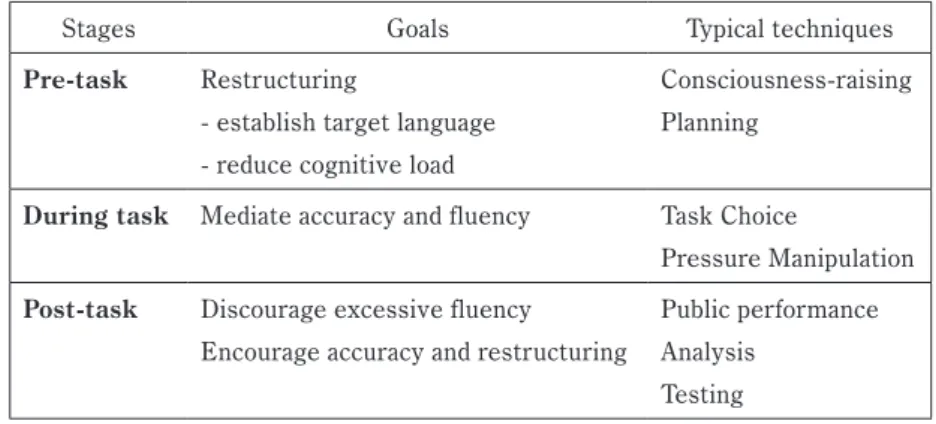
For phasing a task, Skehan (1996) recommends a certain sequence of pre-task, during-task and post-task stages (see Table 1). Through the sequence of these stages, conditions for successful learning can be created; after preparing for what and how to say something in the pre-task phase, learners experiment the language in a communicative situation in the task phase; finally in the post-task stage, they review and analyze their language use.
Although there is a rich accumulation of task-based research in the area of pre- and during task stages3), research on the post-task stage is fairly limited (though Skehan and Foster [1997] are notable
exceptions). One possible reason for this neglect is that task researchers are more performance-oriented, assuming that ‘creating beneficial performance conditions will lead to desirable performance change’ (Skehan, 2007: 63). Thus, if a condition eliciting successful performance is provided, the post-task phase is not needed. Even the post-post-task public performance given in Skehan and Foster (1997) aims to influence the performance within the task rather than the quality of the public performance.
Implementing the post-task phase
Despite a lack of attention to a post-task phase in task-based research, the provision of this may be a promising way to bridge the gap between TBLT and traditional, structure-based methodologies. From a pedagogical perspective, Willis (1996a) demonstrates that the post-task phase is necessary since in the task phase the main focus of learners is on getting their meaning across rather than on the form of the language itself. Willis (1996a) lists reasons why this final stage is important:
Table 1: Methodological stages in implementing tasks (based on Skehan, 1996)
Stages Goals Typical techniques
Pre-task Restructuring
- establish target language - reduce cognitive load
Consciousness-raising Planning
During task Mediate accuracy and fluency Task Choice
Pressure Manipulation Post-task Discourage excessive fluency
Encourage accuracy and restructuring
Public performance Analysis
• Some learners revert to mother tongue when things get difficult or if the group feels impatient. • Some individuals develop excellent communication strategies, e.g. miming and using gestures,
but get by using just odd words and phrases and let others supply the more challenging language they need.
• Some learners tend to get caught up in trying to find the right word, and do not worry over much about how it fits into the discourse.
• There is naturally more concern for use of lexis and lexical chunks than for grammar and grammatical accuracy.
Although the task is the crucial part of the whole lesson and all other steps are devised for successful completion of the task, there is always danger that the task ends just as a ‘game’ or ‘play’, which may be enjoyable but does not eventually lead to ‘language’ learning. Willis (2004) depicts that the task phase stimulates exploratory talk, encourages real-time composing and fluency and depends on a lexical mode of communication, while the processes involved in the post-task phase stimulates greater linguistic processing and syntactic development. Even if the pre-task planning time is given, learners (especially at elementary level) often bypass syntactic processing due to on-line processing pressure on-task (Nitta, 2007). That is, learners tend to focus only on fluency at the expense of accuracy and complexity of the language (Skehan, 1998). Therefore, to make learners aware of the language and consolidate linguistic forms, the post-task stage may play an important role without impairing the essential nature of the task. With regard to internal workings of learner’s mind, Skehan (2007: 63) explains that ‘the previous active communicative activity has prepared the ground for learners to reflect upon what they have done, and engage in analysis, reorganization of their language system, and consolidation of the progress they have made’. Reflection is key to the post-task phase. This can function as a powerful pedagogic tool to trigger deep level of processing (Craik & Lockhart, 1972), which is likely to influence learner’s interlanguage and encourage the restructuring of the system. It is at the post-task stage that language is in focus for the first and only time.
Focusing on form in the post-task phase
The provision of the post-task phase is also important in terms of clarifying the differences between traditional methodologies and TBLT. As suggested by Skehan (2007), the target structure is predetermined in the former, whereas learners have self-selected in the latter. In a structural syllabus, the target item is determined by a teacher or textbook, and this is not often in conformity with learner’s development of interlanguage. As suggested by SLA, learners often fail to learn the target structure, when they are not developmentally ready. Contrary to this structure-ready approach, TBLT can deal with grammar incidentally or proactively. Tasks may or may not involve specific
linguistic items, which will be the grammar of the day when learners need them to complete the task. In this perspective, the timing of the introduction of problematic forms is significant. Focus on form inductively after the task may be far more effective than before the task, because learners are more likely to notice the problematic items naturally arising from communication and are psycholinguistically ready to learn them. This is also pedagogically important because ‘[a]fter completing the task in small groups, there is usually a natural curiosity among students to discover how others achieved the same objectives’ (Willis, 1996a: 55).
Though there is wide agreement among researchers that some level of consciousness to form is necessary to L2 learning (e.g., Schmidt, 2001; Norris & Ortega, 2000; Ellis, 2001), and that the focus should be determined by learner’s developmental stage (e.g., Long & Robinson, 1998), there are varying views as to the degree of explicitness. Too explicit a focus on form is often regarded as one of the characteristics of traditional language teaching. This explicit type of focus-on-form is seen as problematic by some SLA researchers, since excessive explicitness may disrupt the natural process of L2 acquisition (Doughty, 2001). For Willis, however, the level of explicitness in the post-task has to be strong enough to draw learner’ attention in order to facilitate successful learning. Less explicit feedback elicited from interaction, e.g. recasts, may not be registered by the learner or else be quickly forgotten (Lyster & Ranta, 1997). Sustained attention to the form in focus is crucial to help learners reorganize their interlanguage systems.
The amount of time given to the post-task stage should be flexibly decided by the teacher. That is, if the teacher feels there is no necessity to focus-on-form, the post-task stage may even be optional. On the other hand, if learners’ understanding of a certain form seems insufficient, the role of the post-task stage becomes more important. How often and how much time the post-task reflection is given are all dependent on the context and the teacher needs to make a decision based on his/her observation, experience and expertise, though it is conceivable that EFL classrooms more often require this final stage than ESL classrooms due to its contextual limitations and learners’ expectations of language lessons involving grammar (Nitta & Gardner, 2005).
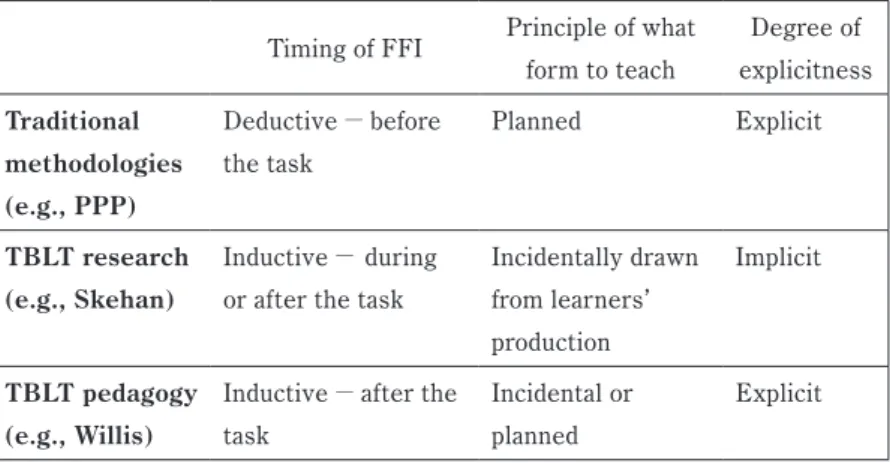
To sum up the major distinctions, Table 2 illustrates different perspectives on focus-on-form between traditional methodologies, task-based research and task-based pedagogy. Suggested by the table, a major difference between task-based research and pedagogy lies in the degree of explicitness of the problematic form. This distinction leads to the different principles of the target items; task-based researchers believe that the form in focus should be drawn from learner’s errors (Long & Robinson, 1998) whereas Willis deals with forms proactively as well as incidentally as long as this is inductively presented. It is possible to prepare a reading text, for example, involving a number of present perfect forms and drawing the attention of learners to them. Ideally, learners should wonder why the form is frequently used there and learn how they are used through being exposed to the text, but even if they do not notice for themselves, the teacher can take these grammatical items up again in the post-task
stage and explain the meanings and use of present perfect in order to facilitate a fuller understanding. The target item is planned in advance, but this is provided as if learners discover for themselves. This approach seems to answer prevailing concerns that learners may not learn any grammar in TBLT (Swan, 2005), because, whether or not learners successfully perform in the main task, linguistic items involved in the task can be returned to the post-task phase. This also allows the use of L1. Exclusive use of L2 is widely adored in terms of providing rich L2 input and output opportunities, but it is often too challenging and sometimes frustrating for learners, especially at beginner’s level. By reflecting on their own performances and identifying problematic linguistic structures, a solid understanding of the target item is more likely to be attained.
Methodological options in the post-task stage
If the usefulness of the post-task phase is accepted, then in what ways can this be maximized? Table 3 shows methodological options in the post-task phase collected from task-based literature. Formally explaining linguistic items as in 1 is possible, but it is probably more effective to apply different methods in combination. As the space limitations preclude a detailed explanation of all these options, I will only expand on option 2. The benefits of option 2 are spelt out by Johnston (2005): learners will seek greater accuracy and complexity due to the desire on their part to present a higher quality product. To be more precise, Willis (1996a) explains that when reporting learners naturally want to use their best language and avoid making mistakes that others might notice, so that they feel the need to organize more clearly what they want to say, use more appropriate language and reduce the errors that they produce. That is, reporting may motivate learners to upgrade their language by themselves. Reporting can be given either in a ‘private’ (in small groups) or ‘public’ setting (in whole class). The former is more suitable for less confident learners, while the latter increases the pressure to speak
Table 2: Focus on form distinctions in traditional and task-based approaches Timing of FFI Principle of what
form to teach Degree of explicitness Traditional methodologies (e.g., PPP) Deductive - before the task Planned Explicit TBLT research (e.g., Skehan) Inductive - during or after the task
Incidentally drawn from learners’ production Implicit TBLT pedagogy (e.g., Willis)
Inductive - after the task
Incidental or planned
accurately as well as fluently (Willis & Willis, 2007). There are also several methods for reporting such as: an oral presentation where the class is encouraged to take notes; and creating a text that is displayed or circulated (Willis, 1996a).
In either way, reporting creates focus-on-form conditions for both speakers (or writers) and listeners (or readers); that is, presenters feel the need to focus more on complexity and accuracy rather than on fluency in front of the audience, and listeners have a chance to compare their performance of the task with speaker’s in the act of reporting. This mental processing is likely to induce cognitive comparison of their performances.
Reporting is characterized by the following elements, which should be shared by other options to maximize the effect of learning.
• focus on language analysis • inducing reflection • a review of the main task
• a sharing of the language experience
• understanding rather than merely using the target language
Many of these elements are difficult to achieve only with the main task, while traditional methodologies often fail to develop a communicative use of L2. The two approaches have the reverse relationship -advantages in one are often disadvantages in the other. The provision of the post-task phase may
Table 3: Methodologies in the post-task phase
Methodological options Sources
1. Explicit explanation of form 2. Reporting; public performance 3. Transcribing a performance
4. Playing back a recorded performance 5. Task and task-type repetition 6. Analysis and focus on form 7. Consolidation
8. Making a brochure or advertisement - publishing a webpage
9. Studying a model 10. Evaluation by students
Willis & Willis (2007)
Skehan & Foster (1997); Willis (1996a); Johnston (2005)
Skehan & Foster (ms.) Nitta (2007) Bygate (2001) Willis (1996a) Willis (1996a) Willis (2004) Leedham (2005); Lopez (2004); Willis (2004)
Ozdeniz (1996); Leaver & Kaplan (2004)
contribute to filling the gap between them and a creation of acquisition rich environment by both meaning- and form-focused teaching.
Conclusion
This paper has considered the post-task phase as one possible way to compensate for the disadvantages of TBLT. If the post-task stage successfully makes up for the points missed in the main task and ensures the development of fluency, linguistic complexity and accuracy, the application of TBLT in EFL classrooms would be more promising. It should be stressed that my aim here is not to insist on the direct application of the approach developed in ESL to EFL classrooms, but to propose a better learning environment more appropriate to our own context. As I have argued, the provision of the post-task phase may be an effective way to overcome the methodological shortcomings of TBLT and the contextual limitations of EFL classrooms. This paper proposes the benefits of the post-task and related methodological options. The next important step is to investigate the effects of the post-task stage in an EFL classroom, which is still insufficiently attended to.
Note
1 )Traditional teaching is often realized in a form of PPP - presentation, controlled practice and free production practice of a target structure in a relatively communicative setting. The final ‘P’ is communicative, but this is still within the realm of ‘traditional’ because this limits learners to use the structure imposed by a teacher or material. 2 )Examples are consciousness-raising tasks (Fotos & Ellis, 1990), interpretation tasks (Ellis, 1997) and structured
communication tasks (Loschky & Bley-Vroman, 1991).
3 )In the pre-task stage, one example is a teacher rehearsing or demonstrating the task (Willis, 2004). In so doing, learners understand exactly what to do and prepare for the task. In task-based literature, pre-task planning as one of the pre-task activities is the most actively and widely researched area (see Ellis 2005 for a collection of related recent studies), assuming that this would ease the processing load that learners will encounter when actually doing a task, releasing more attention to form (Skehan 1996). However, it is also possible to claim that there is always some sort of planning process involved ‘during’ the task such as constructing a message and/or selecting an appropriate expression (Ellis 2005), which can be manipulated by encouraging careful monitoring (Yuan & Ellis, 2003) or giving a surprise element during the task (Skehan & Foster, 2005).
References
Brown, G., Anderson, A., Shillcock, R. and Yule, G. 1984. Teaching Talk: Strategies for production and assessment. Cambridge: Cambridge University Press.
Bygate, M. 1999. Task as context for the framing, reframing and unframing of language. System, 27: 33―48. Bygate, M. 2000. Introduction. Language Teaching Research, 4/3: 185―192.
Bygate, M. Skehan, P. and Swain, M. (eds.), 2001. Researching Pedagogic Tasks Second Language Learning, Teaching and
Testing. Harlow: Pearson Education.
Candlin, C. 1987. Towards task-based language learning. In C. Candlin & D. Murphy (eds.), Language Learning Tasks. Englewood Cliffs, N.J.: Prentice Hall.
Craik, F. I. M and Lockhart, R. S. 1972. Levels of processing: A framework for memory research. Journal of Verbal
Learning and Verbal Behavior, 11: 671―84.
Doughty, C. 2001. Cognitive underpinnings of focus on form. In P. Robinson (ed.), Cognition and Second Language
Instruction. Cambridge: Cambridge University Press.
Edwards, C. and Willis, J. (eds.) 2005. Teachers Exploring Tasks in English Language Teaching. Basingstoke, Hampshire: Palgrave Macmillan.
Ellis, R. 1997. SLA Research and Language Teaching. Oxford: Oxford University Press.
Ellis, R. 2000. Task-based research and language pedagogy. Language Teaching Research, 4/3: 193―220. Ellis, R. 2001. Introduction: Investigating form-focused instruction. Language Learning, 51/Supplement: 1―46. Ellis, R (ed.), 2005 Planning and Task Performance in a Second Language. Amsterdam: John Benjamins.
Fotos, S. and Ellis, R. 1990. Communicating about grammar: A task-based approach. TESOL Quarterly, 25: 605―28. García Mayo, M.P. and Pica, T. 2000 L2 learner interaction in a foreign language setting: Are learning needs addressed?
International Review of Applied Linguistics 38/1: 35―58.
Johnson, K. 2001. An Introduction to Foreign Language Learning and Teaching. Harlow: Longman.
Johnston, C. 2005. Fighting fossilization: Language at the task versus report stages. In C. Edwards & J. Willis (eds.). Krashen, S. 1982. Principles and Practice in Second Language Acquisition. Oxford: Pergamon Press.
Kumaravadivelu, B. 1994. The postmethod condition: meaning strategies for second/foreign language teaching. TESOL
Quarterly, 28: 27―48.
Leaver, B. L. and Kaplan, M. A. 2004. Task-based instruction in U.S. Government Slavic Language Programs. In B. L. Leaver & J. Willis (eds.).
Leaver, B. L. and Willis, J. 2004. (eds.), Task-Based Instruction in Foreign Language Education. Washington: Georgetown University Press.
Leedham, M. 2005. Exam-oriented tasks: Transcripts, turn-taking and backchanelling. In C. Edwards & J. Willis (eds.). Long, M. H. 1989. Task, group, and task-group interaction. University of Hawaii Working Papers in English as a Second
Language 8, 1―26.
Long, M. H. 1996. The role of linguistic environment in second language acquisition. In W.C. Ritchie & T.K. Bhatia (eds.),
Handbook of Second Language Acquisition. San Diego: Academic Press.
Long, M. H. 2000. Focus on form in task-based language teaching. In R. D. Lambert & E. Shohamy (eds.), Language
Policy and Pedagogy: Essays in honour of A. Ronald Walton. Amsterdam: John Benjamins.
Long, M. H. 2007. Problems in SLA. NY: Lawrence Erlbaum.
Long, M. H. and Crookes, G. 1992. Three approaches to task-based syllabus design. TESOL Quarterly, 26/1: 27―47. Long, M. H. and Robinson, P. 1998. Focus on form: Theory, research, and practice. In C. Doughty and J. Williams (eds.),
Focus on Form in Classroom Second Language Acquisition. NY: Cambridge University Press.
Lopez, J. 2004. Introducing TBI for teaching English in Brazil: Learning how to leap the hurdles. In B. L. Leaver & J. Willis (eds.).
Loschky, L. and Bley-Vroman, R. 1991. Grammar and task-based methodology. In G. Crookes & S. M. Gass (eds.), Tasks
Lyster, R. and Ranta, L. 1997. Corrective feedback and learner uptake: Negotiation of form in communicative classrooms. Studies in Second Language Acquisition, 19: 37―66.
Nitta, R. 2007. The Focus-on-Form Effects of Strategic and On-Line Planning: An analysis of Japanese oral performance
and verbal reports. Unpublished PhD thesis, the University of Warwick.
Nitta, R. and Gardner, S. 2005. Consciousness-raising and practice in ELT coursebooks. ELT Journal, 59/1: 3―13. Norris, J. and Ortega, L. 2000. Effectiveness of L2 instruction: A research synthesis and quantitative meta-analysis.
Language Learning, 50/3: 417―528.
Nunan, D. 1989. Designing Tasks for the Communicative Classroom. Cambridge: Cambridge University Press. Nunan, D. 2005. Task-Based Language Teaching. Cambridge: Cambridge University Press.
Ortega, L. 2007. Meaningful L2 practice in foreign language classrooms: A cognitive-interactionist SLA perspective. In R. DeKeyser (ed.), Practice in a Second Language: Perspectives from applied linguistics and cognitive psychology. Cambridge: Cambridge University Press.
Ozdeniz, D. 1996. Introducing innovations into your teaching. In D. Willis & J. Willis (eds.), Challenge and Change in
Language Teaching. Oxford: Macmillan Heinemann.
Prahbu, N. S. 1987. Second Language Pedagogy. Oxford: Oxford University Press.
Robinson, P. 2001. Task complexity, task difficulty, and task production: Exploring interaction in a componential framework. Applied Linguistics, 22/1: 27―57.
Schmidt, R. 2001. Attention. In P. Robinson (ed.), Cognition and Second Language Instruction. Cambridge: Cambridge University Press.
Shehadeh, A. 2005. Task-based language learning and teaching: Theories and applications. In C. Edwards & J. Willis (eds.).
Skehan, P. 1996. A framework for the implementation of task-based instruction. Applied Linguistics, 17: 38―62. Skehan, P. 1998. A Cognitive Approach to Language Learning. Oxford: Oxford University Press.
Skehan, P. 2003. Review article: Task-based instruction. Language Teaching, 36: 1―14.
Skehan, P. 2007. Task research and language teaching: Reciprocal relationships. In S. Fotos & H. Nassaji (eds.),
Form-Focused Instruction and Teacher Education Studies in Honour of Rod Ellis. Oxford: Oxford University Press.
Skehan, P. and Foster, P. 1997. Task type and task processing conditions as influences on foreign language performance.
Language Teaching Research, 1/3: 185―211.
Skehan, P. and Foster, P. 2005. Strategic and on-line planning: The influence of surprise information and task time on second language performance’. In R. Ellis (ed.).
Skehan, P. and Foster, P. Manuscript. The effects of post-task activities on the accuracy of language during task performance. English Department, Chinese University of Hong Kong.
Swain, M. 1985. Communicative competence: Some roles of comprehensible input and comprehensible output in its development. In S. Gass & C. Madden (eds.), Input in Second Language Acquisition. Rowley, Mass.: Newbury House.
Swan, M. 2005. Legislation by hypothesis: The case of task-based instruction. Applied Linguistics, 26/3: 376―401. Yuan, F. and Ellis, R. 2003. The effects of pre-task planning and on-line planning on fluency, complexity and accuracy in
L2 monologic oral production. Applied Linguistics, 24: 1―27.
Van den Branden, K. (ed.) 2006. Task-Based Language Education: From theory to practice. Cambridge: Cambridge University Press.
Practice in a Second Language: Perspectives from applied linguistics and cognitive psychology. Cambridge: Cambridge
University Press.
Willis, J. 1996a. A Framework for Task-Based Learning. Harlow: Pearson Education.
Willis, J. 1996b. A flexible framework for task-based learning. In D. Willis & J. Willis (eds.), Challenge and Change in
Language Teaching. Oxford: Macmillan Heinemann.
Willis, J. 2004. Perspectives on task-based instruction: Understanding our practices, acknowledging different practitioners. In B.L. Leaver & J. Willis (eds.).