
Deep Convolutional Neural Network, Minorization-Maximization Algorithm, and Monte Carlo Tree Search on Block Go
4
0
0
全文
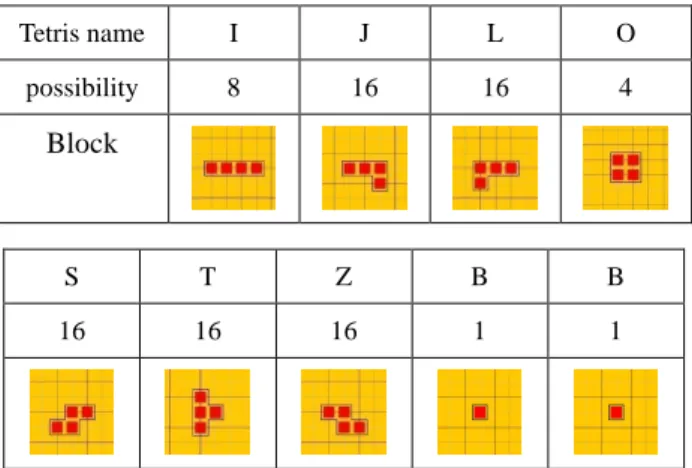
(2) The 21st Game Programming Workshop 2016. 3.. Figure 3. Legal positions... For the forth ply, the player can play only on the gray area in Figure 5(c).. Figure 5. (a) Heuristic rule 1 (b) Heuristic rule 2 (c) Heuristic rule 3.. 4. Machine Learning on Block Go The MM pattern database is used for expansion and simulation. The MM algorithm is an iterative optimization method that exploits the convexity of a function in order to find their maximum or minimum. Remi Coulom applied MM algorithm on the Go move patterns [2]. Our MM pattern size is from 3 to 9. We collect 36,000 games from a Block Go APP. The strength of those games is between beginner and Go Pro. Table 1 shows the prediction rate with respect to the number of the training games. The prediction rate is not high. One of the reasons is the quality of the training games is not good enough.. Figure 4. Illegal moves.. The complexity of Block Go is estimated as follows: (77 × 4) × (77 × 3) × ((66 × 10)2 ) × ((55 × 17)2 ) × ((44 × 22)2 ) × ((33 × 26)2 ) × ((22 × 30)2 ) × ((11 × 33)2 ) × ((34)2 ) × ((35)2 ) = 1045 .. Table 1. The prediction rate with respect to the number of training games. For the first ply, the number of possible moves is 77, which is the possible block-placement method on one legal position for the nine blocks. Initially, there are 4 legal positions. Thus, the possibility of the first ply is 77 × 4. In the following plies, when a block is placed, the number of legal positions increases, but the number of the remaining blocks decreases. The complexity of Block Go is 1045 that is close to Nine Men’s Morris (1050 ) and Othello (1058 ) [3].. Games Rate. MCTS has four stages that are selection, expansion, simulation and backpropagation [1]. We use two machine learning techniques: minorizationmaximization (MM) pattern database and deep learning on the expansion stage.. Programs DBH_MC DB_MC H_MC MC Rand. 30000 11.28. 36000 12.572. pattern Yes Yes No No No. Heuristic Yes No Yes No No. Table 3. The result of the five programs with different seetings. DBHr _MC DBHr_MC DB_MC Heur_MC MC Rand. For the first and second plies, they only play on the star positions, as shown in Figure 5(a). For the third ply, the player can play only on the gray area in Figure 5(b).. © 2016 Information Processing Society of Japan. 25000 10.861. Table 2. Five programs with different settings.. One of the differences between Block Go and Go is that only 18 plies in Block Go. Thus, the quality of the simulation is important. A bad simulation may not make any territory, because there are not enough moves to form the boundary. To solve this problem, we use MM patterns on the simulation stage. Furthermore, we also use three heuristic progressivewidening rules on the expansion stage:. 2.. 19000 9.872. For studying the performance of MCTS Block Go programs. We use different settings for five Block Go programs as shown in Table 2. For example, DBH_MC is a MCTS program with MM pattern database and the three heuristic progressive-widening rules. Table 3 shows the competition results among the five programs.. 3. A MCTS Block Go program. 1.. 13000 8.391. - 70 -. DB _MC 53.5%. H_MC. MC. Rand. 68.5% 60.25%. 73.75% 68.5% 59.5%. 87.5% 87.5% 92.75% 91.25%.
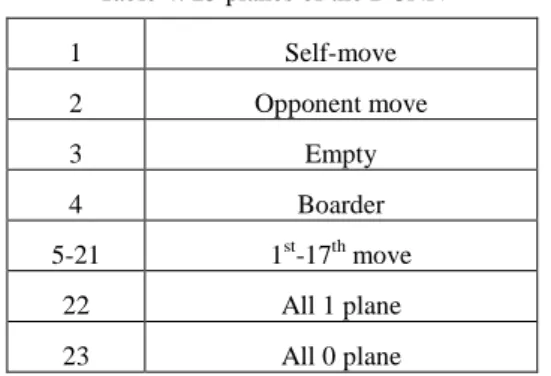
(3) The 21st Game Programming Workshop 2016. it is possible to develop a strong Block Go program.. 5. DCNN for Block Go DCNN is very useful in computer Go. [8][9][10][11] This section describes a DCNN experiment on Block Go. Figure 6 is the DCNN for Block Go. The network architecture is similar to [8], but the input size is 13x13 with 23 planes instead of 19x19 with 26 planes. The K parallel softmax changes to 4 parallel softmax. A Block Go move is considered as 4 moves. For the ‘B’ move in Figure 2, we consider the other 3 moves as empty move. There are 23 planes as shown in Table 4.. ACKNOWLEDGMENT The authors would like to thank anonymous referees for their valuable comments in improving the overall quality of this paper, and Ministry of Science and Technology of Taiwan for financial support of this research under the contract numbers 104-2221-E259 -009 -MY2.. References [1]. Chaslot, G.M.J.-B., Winands, M.H.M., Uiterwijk, J.W.H.M., van den Herik, H.J., and Bouzy, B., "Progressive strategies for Monte-Carlo Tree Search," New Mathematics and Natural Computation, vol.4, no. 3, pp. 343–357, 2008. [2] R. Coulom, "Computing Elo Ratings of Move Patterns in the Game of Go," ICGA Journal, vol. 30, 2007 [3] H. Jaap van den Herik, Jos W.H.M. Uiterwijk, Jack van Rinswijck, "Games solved: Now and in the future," Artificial Intelligence, vol. 134, pp. 277-311, 2002. [4] Edward J. Powley, Peter I. Cowling, Daniel Whitehouse, "Information capture and reuse strategies in Monte Carlo Tree Search with applications to games of hidden information," Artificial Intelligence, vol. 217, pp. 92-116, 2014. [5] Shi-Jim Yen, Cheng-Wei Chou, Jr-Chang Chen, I-Chen Wu, and Kuo-Yuan Kao, "Design and Implementation of Chinese Dark Chess Programs," IEEE Transactions on Computational Intelligence and AI in Games, vol. 7, issue 1, pp 66-74, 2015. [6] Shi-Jim Yen, Tsan-Cheng Su and I-Chen Wu, "The TCGA 2011 Computer-Games Tournament," ICGA Journal, vol. 34, no. 2, 2011, pp. 108–110. [7] Russell, S. and Norvig, P., Artificial Intelligence: A Modern Approach 2/e, Prentice Hall, 2003. [8] Yuandong Tian and Yan Zhu, ”Better Computer Go Player with Neural Network and Long-term Prediction”, ICLR, 2016. [9] David Silver, Aja Huang, Christopher J. Maddison, Arthur Guez, Laurent Sifre, George van den Driessche, Julian Schrittwieser, Ioannis Antonoglou, Veda Panneershelvam, Marc Lanctot, Sander Dieleman, Dominik Grewe, John Nham, Nal Kalchbrenner, Ilya Sutskever, Timothy Lillicrap, Madeleine Leach, Koray Kavukcuoglu, Thore Graepel and Demis Hassabis, ”Mastering the game of Go with deep neural networks and tree search”, Nature, 2016, Pages 484503, Vol. 529. [10] Chang-Shing Lee, Mei-Hui Wang, Shi-Jim Yen, Ting-Han Wei, I-Chen Wu, Ping-Chiang Chou, Chun-Hsun Chou, Ming-Wan Wang, and Tai-Hsiung Yang, "Human vs. Computer Go: Review and Prospect", IEEE Computational Intelligence Magazine (IEEE CIM), Vol. 11, No. 3, pp. :6772, August 2016. [11] Chris J Maddison, Aja Huang, Ilya Sutskever, and David Silver, “Move evaluation in go using deep convolutional neural networks”, In International Conference on Learning Representations, 2015.. Table 4. 23 planes of the DCNN 1. Self-move. 2. Opponent move. 3. Empty. 4. Boarder st. 5-21. 1 -17th move. 22. All 1 plane. 23. All 0 plane. We collect 30000 Block Go games from internet. There are 18 positions in one game. Each position is processed with data augmentation with rotation at 90degree intervals and horizontal/vertical flipping. We also delete some noise positions. Finally, there are 3680010 the train data positions and 129609 test data positions. We used Sigmoid Cross-Entropy as the loss function in DCNN. After 16 epoches, the best loss so far is 0.977121.. 6. Conclusion In this paper, we describe the rule of Block Go and introduce the complexity of Block Go. The rule is very simple, even simpler than the game of Go. The complexity is around 1045 , which is between checker and Othello. Thus, Block Go may be a good testbed for computer games. We develop a MCTS Block Go program with MM pattern database. The experimental results show that the MM pattern is useful. We also implement DCNN on Block Go. Because there are not many high quality pro Block Go game records, in the future, we will apply transfer learning to improve the DCNN of Block Go, based on the numerous 19×19 pro Go game records. Then. © 2016 Information Processing Society of Japan. - 71 -.
(4) The 21st Game Programming Workshop 2016. Figure 6. DCNN for Block Go. © 2016 Information Processing Society of Japan. - 72 -.
(5)
図


関連したドキュメント
In the present paper, the methods of independent component analysis ICA and principal component analysis PCA are integrated into BP neural network for forecasting financial time
Keywords: generalized Fokker – Planck; deterministic method; radiotherapy; particle transport; Boltzmann equation; Monte Carlo.. AMS Subject Classification: 35Q20; 35Q84; 65C05;
In Section 3 we study the current time correlations for stationary lattice gases and in Section 4 we report on Monte-Carlo simulations of the TASEP in support of our
Proof of Theorem 2: The Push-and-Pull algorithm consists of the Initialization phase to generate an initial tableau that contains some basic variables, followed by the Push and
Proof of Theorem 2: The Push-and-Pull algorithm consists of the Initialization phase to generate an initial tableau that contains some basic variables, followed by the Push and
The (GA) performed just the random search ((GA)’s initial population giving the best solution), but even in this case it generated satisfactory results (the gap between the
In a previous paper [1] we have shown that the Steiner tree problem for 3 points with one point being constrained on a straight line, referred to as two-point-and-one-line Steiner
In the previous discussions, we have found necessary and sufficient conditions for the existence of traveling waves with arbitrarily given least spatial periods and least temporal
