E15
The Spatio-Temporal Predictions of Rainfall-Sediment-Runoff Based On
A Physically Process Model
A P I P,
○
Kaoru TAKARA, Takahiro SAYAMA, and Yasuto TACHIKAWA Estimates of total runoff and sediment yield incatchment scale are required for solution of a number of problems. Design of dams and reservoirs, design of soil conservation, land-use planning, and water quality management are some of the examples. Researches have shown that the annual sediment yield was correlated highly with sediment transported during the flood events. Therefore a heavy rainfall event-based sediment-runoff estimation approach is necessary to dynamic modelling of runoff and sediment yield.
The lumped model derived from the kinematic wave equation considering spatial distribution of topographic information and water content of slope systems has developed to simulate runoff processes and to reduce computational burden required in a long-term runoff simulation (Ichikawa and Shiiba, 2002). To develop lumped rainfall-sediment-runoff model, we have been adopted and extended the lumping method which used in that model to include sediment transport processes and to explore how sediment yield is related to hydrological response, erosion source and depositional processes.
A Physically Based Distributed Rainfall-Sediment-Runoff Model
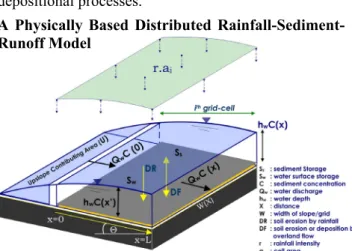
Fig. 1. Schematic of the physically based rainfall-sediment-runoff variables at grid-cell scale.
A physically based distributed rainfall-sediment-runoff model deriving from the integration in space of the kinematic wave model was developed by authors. The concept of sediment transport algorithm consi-dering the sediment movement on a catchment scale by combining erosion, deposition, and transportation processes with the grid-cell based Kinematic Wave Runoff (KWR) model. The concept of spatially distributed modeling is shown in Figure 1. The simulation area is divided into an orthogonal matrix of square cells, assumed to represent homogenous conditions; runoff generation (Qw) and soil erosion-deposition (net erosion) are computed for each grid-cell. The net erosion is calculated by adding DR+DF.
From observation of rainfall characteristic in our study area (Lesti river-Indonesia), the empirical equation for DR (kg/h) expressed as a linear function :
i i
i ra
DR =56.48
DF (kg/h) is simulated as a result of Qw, following the sediment Transport Capacity of water (TC): if C<TC erosion occurs, otherwise excess soil deposition (Govers, 1990). The equation is :
) 98 . 0 ( ) ( − → = =
α
i i i iα
i TC C ha DFLumping of The Distributed Model
Based on the assumption of steady state conditions of rainfall-runoff, the relationship between total storage of water in the ith grid-cell (Swi) and the discharge flow the ith grid-cell (Qwi) can be theore-tically derived. Flux of Qwi is expressed as the product of
r
and U. U can be calculated from a DEM from each grid-cell. The storage of water in catchment scale (Sw) can be calculated by adding up the Swi from each grid-cell as a function of the topographic variables. Furthermore, sediment transport scheme have been included. TC is function of topographic variables and hydrological responses in each cell-grid. C is assumed to be uniform over the catchment and this is the variable of sediment continuity. The maximum sediment storage of the catchment ( maxs
S
) can be cal-culated from each grid-cell based on Swi and TCi which are mathematically derived from Sw. Finally, the continuity equations of Sw and Ss on a catchment scale are presented as follows :w w
rA
Q
dt
S
d
−
=
where m q p S Q q i w w 1 , = ⎟⎟ ⎠ ⎞ ⎜⎜ ⎝ ⎛ = n w U L m A w p m z i m i i m i m i θ α α sin , 1 1 1 1 1 1 1 1 1 ⎟⎟ = ⎟ ⎠ ⎞ ⎜⎜ ⎜ ⎝ ⎛ ⎟ ⎠ ⎞ ⎜ ⎝ ⎛ + ⎟⎟ ⎠ ⎞ ⎜⎜ ⎝ ⎛ + =∑
= + w s v w s S S C e C Q DF DR dt S d = + − (1− ) , =(
)
(1 ) 98 . 0 48 . 56 max v w s w w s e S S Q S C S rA+ − − − =In which A: catchment area, ev: trapping efficiency by land
cover, m: constant, i: index of a cell, and z: total of grid-cell, n : roughness coefficient, and Q : outlet discharge. w
Reference
Ichikawa, Y. & Shiiba, M. 2002. Lumping of Kinematic Wave Equation Considering Field Capacity. Third International Conference on Water Resources and Environmental Research. 22nd-25th of July 2002 at