Open-system Magma Chamber Processes under
Equilibrium Crystallization Conditions
その他(別言語等)
のタイトル
平衡結晶作用の条件下における開放系マグマ溜まり
プロセスの化学質量保存式
著者
西村 光史
著者別名
NISHIMURA, K.
journal or
publication title
JOURNAL OF TOYO UNIVERSITY NATURAL SCIENCE
volume
64
page range
33-51
year
2020-03
URL
http://doi.org/10.34428/00011481
Creative Commons : 表示 - 非営利 - 改変禁止 http://creativecommons.org/licenses/by-nc-nd/3.0/deed.jaAbstract
A mass balance model is developed to describe the behavior of trace elements and isotopes during open-system magma chamber processes under equilibrium crystallization conditions. The model incorporates the effects of melt influx (recharge or mixing), equilibrium crystallization, magma extraction, assimilation of anatectic wall-rock melt, and partial settling of crystals. The analytical solution of the mass-balance differential equations gives a quantitative account of the evolution of trace elements and isotopes. The chemical trends of the magma differ markedly from those predicted by a recently developed open-system magma chamber model under disequilibrium crystallization (crystal zoning) conditions. These two end-member models provide the upper and lower limits for the compositional variations expected during open-system magma chamber processes under natural conditions.
Keywords:open-system magmatic process, geochemical modeling, crystal isotope
stratigraphy, Sr isotopes, mamga chamber
₁. Introduction
Recent remarkable advances in micro-analytical techniques have revealed that isotopic variations recorded from core to rim of a single mineral grain reflect progressive changes in the composition of the liquid from which the mineral crystallized (e.g., Feldstein et al., 1994; Davidson and Tepley, 1997; Davidson et al., 1998, 2001, 2007; Knesel et al., 1999; Tepley et al., 1999, 2000; Waight et al., 2000; Ramos et al., 2005; Charlier et al., 2006, 2008). Consequently, isotope ratios of the liquid and of integrated (bulk) crystals are inevitably different in an open-system magma chamber. Nishimura (2019) recently developed a geochemical model that describes the chemical zoning of
Chemical mass balance equations for open-system
magma chamber processes under equilibrium
crystallization conditions
Koshi N
isihmura*crystals in an open-system magma chamber, assuming that each increment of crystal growth perfectly seals off the previous zone and prevents it from re-equilibrating with the evolving liquid. However, chemical gradients that define crystal zoning are rarely perfectly stable, and they tend to destabilize due to the kinetic process of diffusion (e.g., Costa et al., 2003, 2010; Saunders et al., 2010; Druitt et al., 2012; Moore et al., 2014; Till et al., 2015; Singer et al., 2016). This study seeks to develop a mass balance model for perfect equilibrium crystallization in an open-system magma chamber as a model representing an end-member scenario to complement the model proposed by Nishimura (2019).
₂. Model
This study develops a geochemical model for equilibrium crystallization in an open-system magma chamber, following the method of Nishimura (2019). Figure 1 is a schematic illustration of open-system magma chamber processes, including melt influx (recharge or mixing), the growth of homogeneous crystals, magma extraction,
Fig. 1:Schematic illustration of an open-system magma chamber model
incorporat-ing the effects of simultaneous melt influx (subscript ‘i’ in the figure) (recharge or mixing), equilibrium crystallization, magma extraction (e), assimilation (a), and the partial settling (s) of crystals. M = Mass; subscripts indicate the applicable process.
Assimilation of anatectic wall-rock melt Ma Crystal separation Ms Zoned crystal (model of Nishimura 2019) Cumulate pile Magma extraction Me Melt influx Mi Homogeneous crystal (model of this study)
assimilation of anatectic wall-rock melt, and partial settling of crystals. Crystals are assumed to be homogeneously distributed by vigorous convection in a magma chamber. The extracted (erupted) magma is therefore composed of liquid and suspended crystals. The crystals are partially segregated from the magma body to the cumulate pile at the base of the magma chamber due to gravity, even if the convective velocity is much greater than the crystal settling velocity (Martin and Nokes, 1988). The mass balance differential equations for an element’s concentration and its isotopic ratio in the magma can be respectively expressed as
( 1 )
( 2 )
where M4
a is the mass assimilation rate (mass/unit time), Ca is the element’s
concentra-tion in the melt (liquid) derived from wall-rock melting, M4
i is the mass influx rate (mass/
unit time), Ci is the element’s concentration in the injected liquid, D is the bulk crystal/ liquid partition coefficient for the element, Cl is the element’s concentration in the liquid
in the magma chamber, M4
e is the mass extraction rate (mass/unit time), φ is the weight
fraction of the suspended crystals in the magma chamber relative to the total mass of magma, Ml is the mass of the liquid in the magma chamber, εa is the isotope ratio of
the wall-rock, εi is the isotope ratio of the injected liquid, εl is the isotope ratio of the liquid in the magma chamber, and M4
s is the rate of gravitational separation of crystals
from magma (mass/unit time) (see Table 1 ). Fractional crystallization due to gravita-tional crystal settling is imperfect if a certain proportion of crystals is suspended for a duration that is sufficient to enable re-equilibration with the surrounding liquid (Fig. 1 ). This case is based on the assumption that equilibrium is always maintained between the liquid and the suspended crystals. The trace element concentration in the liquid can therefore be expressed as follows:
( 3 )
The isotopic ratio in the crystallizing phases is assumed to always be the same as that of the magma. Incorporating Eq. ( 3 ) into Eqs. ( 1 ) and ( 2 ), the mass balance differential equations for an element’s concentration in a magma and the isotopic ratio of that mag-ma can be respectively rewritten as
( 4 )
( 5 ) where D* is the effective distribution coefficient (O’Hara, 1993; O’Hara and Fry, 1996; Nishimura, 2009), which can be expressed as
( 6 )
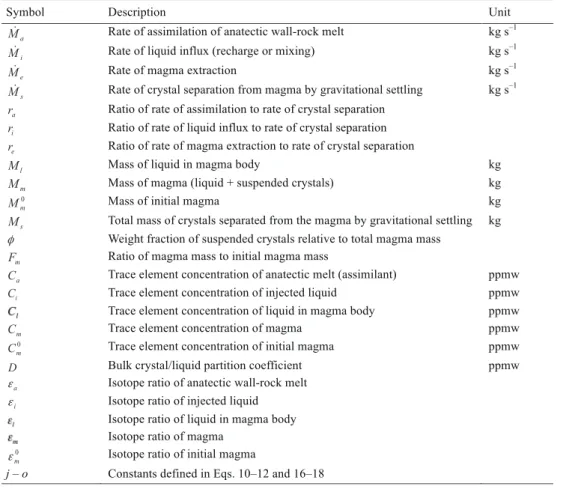
DePaolo (1981) defined the constant ratio of the rate of assimilation to the rate of crystal separation (ra=M4
a/M
4
s) in order to analytically solve the differential equations for
simultaneous assimilation and fractional crystallization (AFC). Similarly, this study defines the constant ratio of the rate of liquid influx to the rate of crystal separation (ri=M
4
i/M
4
s) and that of the rate of magma (liquid + suspended crystals) extraction to the
rate of crystal separation (re=M
4
e/M
4
s). It should be noted that the ratios ra, ri, and re can
vary during the open-system evolution of a magma body; e.g., Bohrson and Spera (2001) reported temporal variations in ra. However, these constant ratios could be used for approximation, at least for a short crystallization period, and could be estimated from the variation trends of trace elements and isotopes, as was done for the AFC model (e.g., Powell, 1984; Mantovani and Hawkesworth, 1990; Young et al., 1992; Aitcheson and Forrest, 1994; Roberts and Clemens, 1995; Caffe et al., 2002). The instantaneous rate of change in the mass of a magma body, affected simultaneously by assimilation, liquid magma influx, magma (liquid + suspended crystals) extraction, and gravitational separation of crystals, is given as
( 7 )
where Mm is the mass of the magma body. When ra + ri – re = 1 (i.e., M
4 a + M 4 i = M 4 s + M 4 e),
added material (assimilant + injected liquid) is balanced by an equivalent mass of sub-tracted material (gravitationally segregated crystals + exsub-tracted magma), meaning that the magma mass remains constant. The analytical solutions to the system of differential equations (Eqs. 3 and 4) for an element can be separated conveniently into two cases: one for ra + ri – re ≠ 1, and another for ra + ri – re = 1. Assuming that φ, D, Ca, εa, Ci,
and εi are constant, the solutions can be written as follows:
For ra + ri – re ≠ 1 (general case),
( 8 )
( 9 ) where Cl0 is the initial concentration of the element in the liquid, εl0 is the initial
iso-tope ratio of the liquid, Cx 0
is the initial concentration of the element in the suspended crystals, εx0 is the initial isotope ratio of the suspended crystals, F
m is the ratio of
mag-ma mag-mass to the initial mag-magmag-ma mag-mass (Fm≡Mm/Mm0), and
(10) (11) (12) For (13) and (14) where (15) (16) (17) and (18)
Table 1 Symbols used in the formulation
Symbol Description Unit
a
M! Rate of assimilation of anatectic wall-rock melt kg s–1
i
M! Rate of liquid influx (recharge or mixing) kg s–1
e
M! Rate of magma extraction kg s–1
s
M! Rate of crystal separation from magma by gravitational settling kg s–1 a
r Ratio of rate of assimilation to rate of crystal separation i
r Ratio of rate of liquid influx to rate of crystal separation e
r Ratio of rate of magma extraction to rate of crystal separation l
M Mass of liquid in magma body kg
m
M Mass of magma (liquid + suspended crystals) kg
0
m
M Mass of initial magma kg
s
M Total mass of crystals separated from the magma by gravitational settling kg φ Weight fraction of suspended crystals relative to total magma mass
m
F Ratio of magma mass to initial magma mass a
C Trace element concentration of anatectic melt (assimilant) ppmw i
C Trace element concentration of injected liquid ppmw
Trace element concentration of liquid in magma body ppmw m
C Trace element concentration of magma ppmw
0
m
C Trace element concentration of initial magma ppmw
D Bulk crystal/liquid partition coefficient ppmw
a
ε Isotope ratio of anatectic wall-rock melt i
ε Isotope ratio of injected liquid Isotope ratio of liquid in magma body Isotope ratio of magma
0
m
ε Isotope ratio of initial magma
j – o Constants defined in Eqs. 10–12 and 16–18
Table 1:Symbols used in the formulation
₃. Results
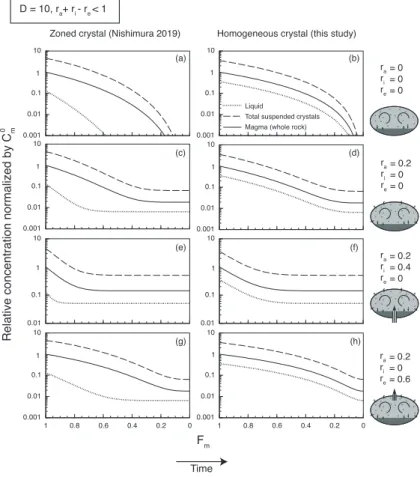
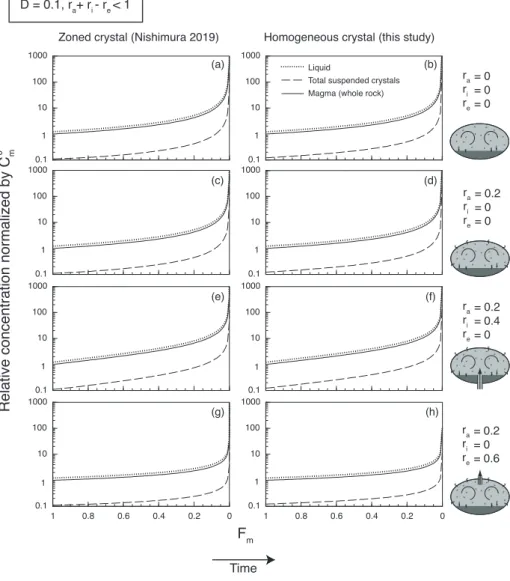
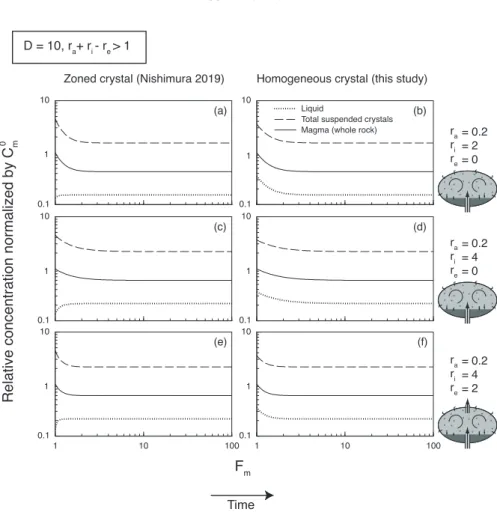
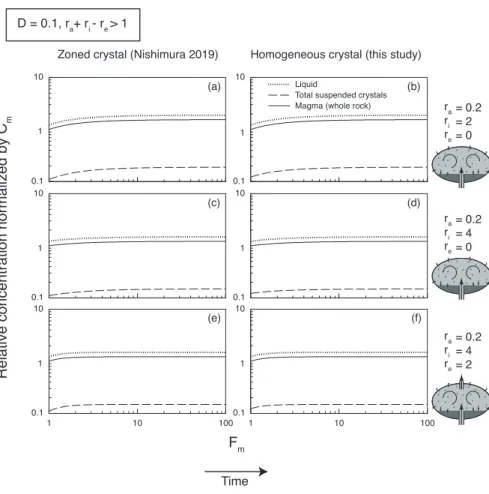
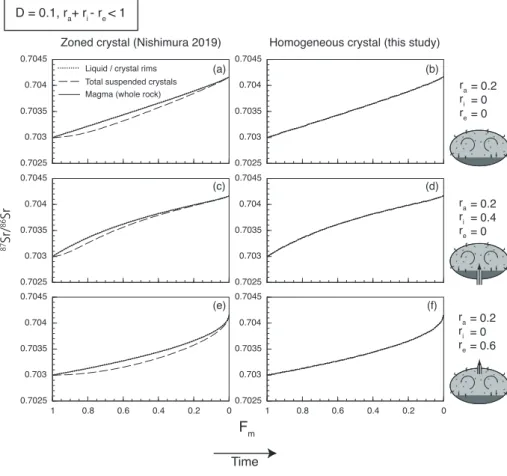
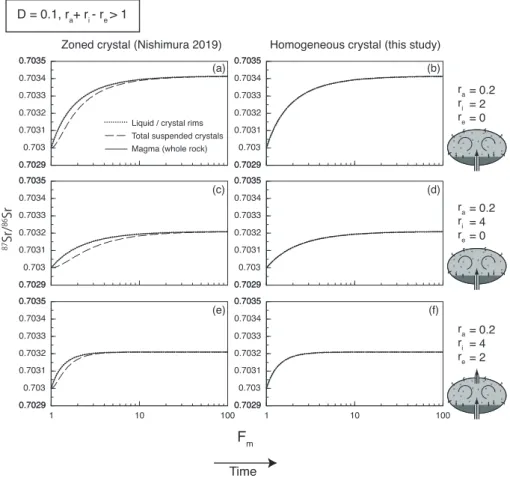
Figures 2 – 9 present examples of the evolution of the trace element concentration and isotope ratio (87Sr/86Sr) of the liquid, total suspended crystals, magma (whole rock),
and crystal rims for several values of ra, ri re, and D. The results in the case of crystal
zoning (Nishimura, 2019) are also shown for comparison (left panels in Figs. 2 – 9 ). The weight fraction of suspended crystals (φ) is assumed to be 0.2 for all cases. Under the assumption of constant φ, an increment of crystals greater than φ is separated from convecting magma to the cumulate pile throughout the crystallization process. The crystals being separated are assumed to have the same composition as those remaining in suspension. The relative trace element concentration of the anatectic wall-rock melt, normalized by that of the initial magma Ca/Cm0, is assumed to be 0.25 for all cases. For
simplicity, the recharged magma is assumed to have the same composition as the origi-nal unfractionated magma. The proportion of magma mass remaining (Fm) for ra + ri –
re < 1 decreases as the open-system process proceeds (Figs. 2 and 3 ), whereas Fm for ra + ri – re > 1 increases as the process proceeds (Figs. 4 and 5 ). This is because
when ra + ri – re < 1 (i.e., M 4 a + M 4 i < M 4 s + M 4
e), the mass of added material (assimilant
+ injected liquid) is smaller than the mass of subtracted material (gravitationally sepa-rated crystals + extracted magma), meaning that the magma mass decreases, and when ra + ri – re > 1 (i.e., M4 a + M 4 i > M 4 s + M 4
e), the mass of added material is greater than the
mass of subtracted material, so the magma mass increases.
For the cases of both homogeneous and zoned crystals, and for a given compatible trace element (e.g., D = 10), the evolution paths of the bulk rock are strongly affected by suspended crystals and are therefore nearly parallel to those of the latter (Figs. 2 and 4 ). For an incompatible trace element (e.g., D = 0.1), the evolution paths of the bulk rock become similar to those of the liquid (Figs. 3 and 5 ). The results of simple frac-tional crystallization (ra = ri = re = 0 ) in the case of zoned crystals suspended in the
liquid are compared with the results for homogeneous crystals (Figs. 2a and b; see also Nishimura, 2009). The homogenization (equilibration) of suspended crystals suppresses the depletion of compatible elements in liquid more effectively than in the zoned-crystal case. The compatible trace element concentrations of liquid, total suspended crystals, and whole rock decrease continuously with decreasing Fm (Fig. 2 a, b). When
assimila-tion occurs and ra + ri – re < 1, the compatible trace element concentrations of liquid,
total suspended crystals, and whole rock reach a compositional steady state (Fig. 2 c–h). In contrast, incompatible trace element concentrations never reach a steady state re-gardless of whether assimilation occurs (Fig. 3 ). When ra + ri – re > 1 and
assimila-tion does occur, both compatible and incompatible elements attain a steady state (Figs. 4 and 5 ). In the case of no recharge and no extraction (Fig.2c, d), the evolution paths of liquid, total suspended crystals, and whole rock are identical to those obtained from the revised AFC (AIFC) model (Nishimura, 2012).
The addition of magma recharge affects the steady state concentrations of liquid, to-tal suspended crysto-tals, and whole rock (Fig. 2 e and f), whereas magma extraction does not (Fig. 2 g and h, Fig. 3 g and h). The value of DSr for tholeiitic-type basaltic magma
may be much less than 1 unless plagioclase is the main crystallizing phase, in which case the value of DSr for silicic magma may be much larger than 1 because Sr enters
sodic plagioclase and/or sanidine. The modeling results of 87Sr/86Sr variations for cases
with DSr = 0.1 and DSr = 10 are shown in Figs. 4 and 5 to emphasize the difference
between the trajectories for incompatible and compatible elements. The initial magma was assumed to have Sr = 400 ppm and 87Sr/86Sr = 0.7030; the assimilant (anatectic
wall-rock melt) was assumed to have Sr = 100 ppm and 87Sr/86Sr = 0.7200. These values
are identical to those in fig. 3 of DePaolo (1981).
When DSr = 10 and crystals are zoned, the 87Sr/86Sr paths of whole rock are close to
and crystals are zoned, the 87Sr/86Sr paths of whole rock become almost identical to
those of liquid or crystal rims (left panels in Figs. 7 and 9 ). When homogeneous crys-tals are grown under equilibrium conditions, the 87Sr/86Sr paths of whole rock, liquid,
and suspended crystals are identical (right panels in Figs. 6 – 9 ). For both homoge-neous and zoned crystal cases, and for ra + ri – re < 1, the 87Sr/86Sr ratios of liquid (or
crystal rims), total suspended crystals, and whole rock reach steady states only when DSr is large (Figs. 6 and 7 ). For r
a + ri – re > 1, the 87Sr/86Sr ratios of liquid (or crystal
rim), total suspended crystals, and whole rock reach steady states regardless of the DSr
value (Figs. 8 and 9 ).
The steady-state trace element concentrations and isotopic ratios of magma with ho-mogeneous crystals for ra + ri – re ≠ 1 can be expressed as
0.001 0.01 0.1 10 0.01 0.1 10 0.001 0.01 0.1 10 0.001 0.01 0.1 10 1 0.8 0.6 0.4 0.2 0 0.01 0.1 10 0.001 0.01 0.1 10 1 0.8 0.6 0.4 0.2 0 1 1 1 1 1 1 0.001 0.01 0.1 10 1 1 0.001 0.01 0.1 10
Zoned crystal (Nishimura 2019) Homogeneous crystal (this study)
ra ri re = 0.2 = 0 = 0 ra ri re = 0.2 = 0.4 = 0 ra ri re = 0.2 = 0 = 0.6 Fm Rela
tive concentration normalized by C
m 0 ra ri re = 0 = 0 = 0 Time Liquid
Total suspended crystals Magma (whole rock)
(a) (b)
(c) (d)
(e) (f)
(g) (h)
D = 10, ra+ ri - re < 1
Fig. 2:Evolution of trace element concentrations in liquid, total suspended crystals, and
magma (whole rock) for the cases of zoned (left panels) and homogeneous (right panels) crystals when D = 10 and ra + ri – re < 1. Each concentration is normalized to the initial
concentration in the magma, Cm0. Trajectories are shown for φ = 0.2, Ca/Cm0 = 0.25, ra = 0.2
0.1 10 100 1000 0.1 10 100 1000 0.1 10 100 10000.1 10 100 1000 0.1 10 100 1000 1 0.8 0.6 0.4 0.2 0 0.1 10 100 1000 0.1 10 100 1000 1 0.8 0.6 0.4 0.2 0 1 1 1 1 1 1 0.1 10 100 1000 1 1 ra ri re = 0.2 = 0 = 0 ra ri re = 0.2 = 0.4 = 0 ra ri re = 0.2 = 0 = 0.6 Fm Rela
tive concentration normalized by C
m 0 ra ri re = 0 = 0 = 0 Time Liquid
Total suspended crystals Magma (whole rock)
(a) (b)
(c) (d)
(e) (f)
(g) (h)
Zoned crystal (Nishimura 2019) Homogeneous crystal (this study)
D = 0.1, ra+ ri - re < 1
0.1 10 0.1 10 1 10 1000.1 10 1 10 100 1 1 1 1 1 1 0.1 10 0.1 10 0.1 10 ra ri re = 0.2 = 2 = 0 ra ri re = 0.2 = 4 = 0 ra ri re = 0.2 = 4 = 2 Rela
tive concentration normalized by C
m
0
Liquid
Total suspended crystals Magma (whole rock)
(a) (b)
(c) (d)
(e) (f)
Time Fm
Zoned crystal (Nishimura 2019) Homogeneous crystal (this study)
D = 10, ra+ ri - re > 1
0.1 10 0.1 10 1 10 1000.1 10 1 10 100 1 1 1 1 1 1 0.1 10 0.1 10 0.1 10 ra ri re = 0.2 = 2 = 0 ra ri re = 0.2 = 4 = 0 ra ri re = 0.2 = 4 = 2 Rela
tive concentration normalized by C
m
0
Liquid
Total suspended crystals Magma (whole rock)
(a) (b)
(c) (d)
(e) (f)
Time Fm
Zoned crystal (Nishimura 2019) Homogeneous crystal (this study)
D = 0.1, ra+ ri - re > 1
ra ri re = 0.2 = 0 = 0 ra ri re = 0.2 = 0.4 = 0 ra ri re = 0.2 = 0 = 0.6 87Sr/ 86Sr
Zoned crystal (Nishimura 2019) Homogeneous crystal (this study)
0.7 0.705 0.71 0.715 0.72 0.725 0.7 0.705 0.71 0.715 0.72 0.725 0.7 0.705 0.71 0.715 0.72 0.725 1 0.8 0.6 0.4 0.2 0 0.7 0.705 0.71 0.715 0.72 0.725 0.7 0.705 0.71 0.715 0.72 0.725 0.7 0.705 0.71 0.715 0.72 0.725 1 0.8 0.6 0.4 0.2 0 Time Fm (a) (b) (c) (d) (e) (f)
Liquid / crystal rims Total suspended crystals Magma (whole rock)
D = 10, ra+ ri - re < 1
Fig. 6:Evolution of the 87Sr/86Sr isotope ratio of liquid, crystal rims, total suspended crystals, and
magma (whole rock) for the cases of zoned crystals (left panels) and homogeneous crystals (right panels) when D = 10 and ra + ri – re < 1. Trajectories are shown for φ = 0.2, Ca/Cm0 = 0.25, ra = 0.2, and
ra ri re = 0.2 = 0 = 0 ra ri re = 0.2 = 0.4 = 0 ra ri re = 0.2 = 0 = 0.6 87Sr/ 86Sr
Zoned crystal (Nishimura 2019) Homogeneous crystal (this study)
0.7025 0.703 0.7035 0.704 0.7045 0.7025 0.703 0.7035 0.704 0.7045 0.7025 0.703 0.7035 0.704 0.7045 1 0.8 0.6 0.4 0.2 0 0.7025 0.703 0.7035 0.704 0.7045 0.7025 0.703 0.7035 0.704 0.7045 0.7025 0.703 0.7035 0.704 0.7045 1 0.8 0.6 0.4 0.2 0 Time Fm (a) (b) (c) (d) (e) (f)
Liquid / crystal rims Total suspended crystals Magma (whole rock)
D = 0.1, ra+ ri - re < 1
87Sr/ 86Sr ra ri re = 0.2 = 2 = 0 ra ri re = 0.2 = 4 = 0 ra ri re = 0.2 = 4 = 2 Zoned crystal (Nishimura 2019) Homogeneous crystal (this study)
0.7029 0.7029 0.703 0.7031 0.7032 0.7033 0.7034 0.7035 0.7035 0.7029 0.7029 0.703 0.7031 0.7032 0.7033 0.7034 0.7035 0.7035 0.7029 0.7029 0.703 0.7031 0.7032 0.7033 0.7034 0.7035 0.7035 1 10 100 0.7029 0.7029 0.703 0.7031 0.7032 0.7033 0.7034 0.7035 0.7035 0.7029 0.7029 0.703 0.7031 0.7032 0.7033 0.7034 0.7035 0.7035 1 10 100 0.7029 0.7029 0.703 0.7031 0.7032 0.7033 0.7034 0.7035 0.7035 (a) (b) (c) (d) (e) (f)
Liquid / crystal rims Total suspended crystals Magma (whole rock)
Time Fm
D = 10, ra+ ri - re > 1
87Sr/ 86Sr ra ri re = 0.2 = 2 = 0 ra ri re = 0.2 = 4 = 0 ra ri re = 0.2 = 4 = 2 Zoned crystal (Nishimura 2019) Homogeneous crystal (this study)
0.7029 0.7029 0.703 0.7031 0.7032 0.7033 0.7034 0.7035 0.7035 0.7029 0.7029 0.703 0.7031 0.7032 0.7033 0.7034 0.7035 0.7035 0.7029 0.7029 0.703 0.7031 0.7032 0.7033 0.7034 0.7035 0.7035 1 10 100 0.7029 0.7029 0.703 0.7031 0.7032 0.7033 0.7034 0.7035 0.7035 0.7029 0.7029 0.703 0.7031 0.7032 0.7033 0.7034 0.7035 0.7035 1 10 100 0.7029 0.7029 0.703 0.7031 0.7032 0.7033 0.7034 0.7035 0.7035 (a) (b) (c) (d) (e) (f)
Liquid / crystal rims Total suspended crystals Magma (whole rock)
Time Fm
D = 0.1, ra+ ri - re > 1
(19) and
(20)
In the case that ra + ri – re < 1 and D is large, k (Eq. 11) may have a negative value. In this case, Fm -i in Eqs. (6)–(9) and Fm -k in Eqs. (8) and (9) show rapid reductions with
decreasing Fm, and the steady state compositions are described by Eqs. (19) and (20).
When ra + ri – re > 1, then k may have a positive value regardless of D, and Fm
increas-es as the procincreas-ess advancincreas-es. In this case, Fm -k shows a rapid reduction with increasing
Fm, and the steady state compositions become identical to those described by Eqs. (19)
and (20), which can also be expressed as
(21)
and
(22)
These steady state trace element and isotopic compositions are derived for the cases of both homogeneous and zoned crystals (Nishimura, 2019). The two end-member models (i.e., the models of this study and of Nishimura, 2019) provide upper and lower limits for the compositional variations caused by various degrees of solid-state equilibration during open-system magma chamber processes.
References
Aitcheson, S.J., Forrest, A.H., 1994. Quantification of crustal contamination in open mag-matic systems. J. Petrol. 35: 461–488
Bohrson,W.A., Spera, F.J. 2001. Energy-constrained open-system magmatic processes II: Application of energy-constrained assimilation–fractional crystallization (EC-AFC) model to magmatic systems. J. Petrol. 42: 1019–1041.
Caffe, P.J., Trumbull, R.B., Coira, B.L., Romer, R.L. 2002. Petrogenesis of early Neogene magmatism in the northern Puna; implications for magma genesis and crustal pro-cesses in the central Andean Plateau. J. Petrol. 43: 907–942.
Charlier, B.L.A., Ginibre, C., Morgan, D., Nowell, G.M., Pearson, D.G., Davidson, J.P., Ot-tley, C.J. 2006. Methods for the microsampling and high-precision analysis of stron-tium and rubidium isotopes at single crystal scale for petrological and
geochronologi-cal applications. Chem. Geol. 232: 114–133.
Charlier, B.L.A., Wilson, C.J.N., Davidson, J.P. 2008. Rapid open-system assembly of a large silicic magma body: time-resolved evidence from cored plagioclase crystals in the Oruanui eruption deposits, New Zealand. Contrib. Mineral. Petrol. 156: 799–813. Costa, F., Chakraborty, S., Dohmen, R. 2003. Diffusion coupling between trace and major
elements and a model for calculation of magma residence times using plagioclase. Geochim. Cosmochim. Acta 67: 2189–2200.
Costa, F., Coogan, L.A., Chakraborty, S. 2010. The time scales of magma mixing and mingling involving primitive melts and melt–mush interaction at mid-ocean ridges. Contrib. Mineral. Petrol. 159, 371–387.
Davidson, J.P., Tepley, F.J. III 1997. Recharge in volcanic systems: evidence from isotope profiles of phenocrysts. Science 275: 826–829.
Davidson, J.P., Tepley, F.J. III, Knesel, K.M. 1998. Isotopic fingerprinting may provide in-sights into evolution of magmatic systems. EOS Trans Am Geophys Union 79: 185, 189, 193
Davidson, J.P., Tepley, F.J. III, Palacz, Z., Meffan-Main, S. 2001. Magma recharge, con-tamination and residence times revealed by in situ laser ablation isotopic analysis of feldspar in volcanic rocks. Earth Planet. Sci, Lett. 184: 427–442.
Davidson, J.P., Morgan, D.J., Charlier, B.L.A., Harlou, R., Hora, J.M. 2007. Microsampling and isotopic analysis of igneous rocks: implications for the study of magmatic systems. Ann. Rev. Earth Planet. Sci. 35: 273–311.
DePaolo, D.J. 1981. Trace element and isotopic effects of combined wallrock assimilation and fractional crystallization. Earth Planet. Sci. Lett. 53: 189–202.
Druitt, T.H., Costa, F., Deloule, E., Dungan, M., Scaillet, B. 2012. Decadal to monthly timescales of magma transfer and reservoir growth at a caldera volcano. Nature 482: 77–80.
Feldstein, S.N., Halliday, A.N., Davies, G.R., Hall, C.M. 1994. Isotope and chemical micro-sampling: constraints on the history of an S-type rhyolite, San Vincenzo, Tuscany, Ita-ly. Geochim. Cosmochim. Acta 58: 943–958.
Knesel, K.M., Davidson, J.P., Duffield, W.A. 1999. Evolution of silicic magma through as-similation and subsequent recharge: evidence from Sr isotopes in sanidine phe-nocrysts, Taylor Creek Rhyolite, NM. J. Petrol. 40: 773–786.
Mantovani, M.S.M., Hawkesworth, C.J. 1990. An inversion approach to assimilation and fractional crystallisation processes. Contrib. Mineral. Petrol. 105: 289–302.
Martin, D., Nokes, R. 1988. Crystal settling in a vigorously convecting magma chamber. Nature 332: 534–536.
Moore A., Coogan, L.A., Costa, F., Perfit, M.R. 2014. Primitive melt replenishment and crystal-mush disaggregation in the weeks preceding the 2005–2006 eruption 9º 50´N, EPR. Earth Planet. Sci. Lett. 403: 15–26.
Nishimura, K. 2009. A trace-element geochemical model for imperfect fractional crystal-lization associated with the development of crystal zoning. Geochim. Cosmochim. Acta 73: 2142–2149.
Nishimura, K. 2012. A mathematical model of trace element and isotopic behavior during simultaneous assimilation and imperfect fractional crystallization. Contrib. Min-eral. Petrol. 164: 427–440.
Nishimura, K. 2019. Chemical mass balance equations for open-system magma chamber processes that result in crystal zoning. J. Volcanol. Geotherm. Res. 374: 181–196 O’Hara, M. J. 1993. Trace element geochemical effects of imperfect crystal-liquid
separa-tion. In Magmatic Processes and Plate Tectonics (eds. H. M. Prichard, T. Alabaster, N. B. W. Harris and C. R. Neary). Special Publication of the Geological Society, London. pp. 39–59.
O’Hara, M. J., Fry N. 1996. The highly compatible trace element paradox–fractional crys-tallization revisited. J. Petrol. 37: 859–890.
Powell, R. 1984. Inversion of the assimilation and fractional crystallization (AFC) equa-tions; characterization of contaminants from isotope and trace element relationships in volcanic suites. J. Geol. Soc. London 141: 447–452.
Ramos, F.C., Wolff, J.A., Tollstrup, D.L. 2005. Sr isotope disequilibrium in Columbia River flood basalts: Evidence for rapid shallow-level open-system processes. Geology 33: 457–460.
Roberts, M.P., Clemens, J.D. 1995. Feasibility of AFC models for the petrogenesis of calk-alkaline magma series. Contrib. Mineral. Petrol. 121: 139–147.
Saunders, K.E., Morgan, D.J., Baker, J.A., Wysoczanski, R.J. 2010. The magmatic evolu-tion of the Whakamaru supererupevolu-tion, New Zealand, constrained by a microanalytical study of plagioclase and quartz. J. Petrol. 51: 2465–2488.
Singer, B.S., Costa, F., Herrin, J.S., Hildreth, W., Fierstein, J. 2016. The timing of composi-tionally-zoned magma reservoirs and mafic ‘priming’ weeks before the 1912 Novarup-ta-Katmai rhyolite eruption. Earth Planet. Sci. Lett. 451: 125–137.
Tepley, F.J. III, Davidson, J.P., Clynne, M.A. 1999. Magmatic interactions as recorded in plagioclase phenocrysts of Chaos Crags, Lassen Volcanic Center, California. J. Petrol. 40: 787–806.
Tepley, F.J. III, Davidson, J.P., Tilling, R.I., Arth, J.G. 2000. Magma mixing, recharge and eruption histories recorded in plagioclase phenocrysts from EL Chichón Volcano, Mexico. J. Petrol. 41: 1397–1411.
Till, C.B., Vazquez, J.A., Boyce, J.W. 2015. Months between rejuvenation and volcanic eruption at Yellowstone caldera, Wyoming. Geology 43: 695–698.
Waight, T.E., Maas, R., Nicholls, I.A. 2000. Fingerprinting feldspar phenocrysts using crystal isotopic composition stratigraphy: implications for crystal transfer and magma mingling in S-type granites. Contrib. Mineral. Petrol. 139: 227–239.
Young, E.D., Wooden, J.L., Shieh, Y-N., Farber, D. 1992. Geochemical evolution of Jurassic diorites from the Bristol Lake region, California, USA, and the role of assimilation. Contrib. Mineral. Petrol. 110: 68–86.