
Geographical Factors in the Development of the Mobile Phone Market and Services in Japan
13
0
0
全文
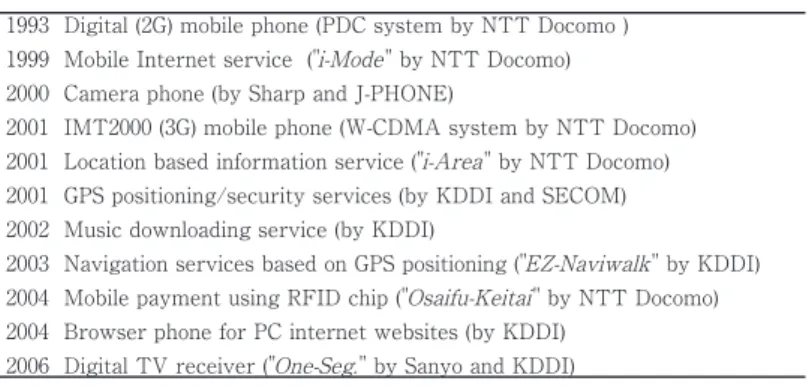
(2) Table 1. Developments of innovative mobile phone services in Japan 1993 Digital (2G) mobile phone (PDC system by NTT Docomo ) 1999 Mobile Internet service ("i-Mode " by NTT Docomo) 2000 Camera phone (by Sharp and J-PHONE) 2001 IMT2000 (3G) mobile phone (W-CDMA system by NTT Docomo) 2001 Location based information service ("i-Area " by NTT Docomo) 2001 GPS positioning/security services (by KDDI and SECOM) 2002 Music downloading service (by KDDI) 2003 Navigation services based on GPS positioning ("EZ-Naviwalk " by KDDI) 2004 Mobile payment using RFID chip ("Osaifu-Keitai " by NTT Docomo) 2004 Browser phone for PC internet websites (by KDDI) 2006 Digital TV receiver ("One-Seg. " by Sanyo and KDDI). Japanese mobile phone services. However, they. phone services started in 2001 and boosted. have less competitiveness in the current world. the development of new services that require. market.. high-speed data transmission; e.g., online music. Why has the development of these various. downloading. Because mobile phones with. mobile phone services progressed rapidly in. GPS devices became widely used earlier in. Japan? In addition, what factors have hindered. Japan, location search services and location-. the expansion of the various mobile phone uses. based security services (LBSSs) using GPS. outside of Japan? In this paper, the geographical. positioning technologies were launched. Mobile. factors affecting these issues will be discussed.. phone handsets with the addition of a variety of devices have also been developed. Camera. II The mobile phone market and services. phones, mobile phone payment systems using. in Japan. a Radio Frequency Identification (RFID) chip called "Osaifu-Keitai", and digital TV receiver. Japanese mobile phone companies were the first in the world to develop a number of. phones called "One-Seg" have also recently become very popular.. commercial services (Table 1). For example,. The use of these services has spread. NTT Docomo started the first digital mobile. rapidly in Japan. For example, subscribers of. phone service (Second Generation: 2G) in 1993.. 3G mobile phones account for nearly 90% of. The digitalized networks of mobile phone. all mobile phone subscribers (Figure 1). The. systems made it possible to develop the "i-. average revenue per user (ARPU) in Japan is. Mode" service and various services using. higher than in other advanced countries, and one. mobile phones. Third Generation (3G) mobile. of the reasons for this is that data transmission. ̶ 18 ̶.
(3) 100. 120. 80 Mobile phone total. 70. 80. 60 60. 50 40. Percentage of 3G handsets 40. 30 3G handsets total 20. 20. Percentage of 3G handsets. Total number of handsets (million). 90 100. 10 0 2002 7 9 11 2003 3 5 7 9 11 2004 3 5 7 9 11 2005 3 5 7 9 11 2006 3 5 7 9 11 2007 3 5 7 9 11 2008 3 5. 0. Figure 1. Percentage of 3G mobile phone handsets in Japan Source: Telecommunication Carriers Association.. fee is higher than in other countries. This. sold in Japan commonly correspond to almost all. fact suggests that the large volume of data. of the new services provided. On the other hand,. transmissions corresponds to the penetration of. the major price zone of handsets sold in Japan. various mobile phone services (Table 2, Table. corresponds to the "middle-range" or "low-end". 3).. segments in the world market (Table 5). In fact, Osaki (2008) pointed out that the recent. very-low-price handsets are sold in Japanese. world market for mobile phones is divided. mobile phone shops, and even campaigns for. into five segments, as shown in Table 4. The. "free" handsets are frequently found.. share of the "high-end" segment, which contains. Market share by handset manufacturer is. mainly 3G handsets, is less than 20% of the. also distinctive. Almost all handset manufacturers. world market. The "middle range" is the core. supplying the Japanese market are Japanese. segment of the market in advanced countries.. companies, and very few handsets made by. However, almost all handsets sold in Japan can. foreign manufacturers are sold. On the other. be categorized in the "high-end" segment, and. hand, the presence of Japanese manufacturers. these characteristics of the Japanese market. in the world mobile phone market is very. relate to the fact that mobile phone handsets. limited, although Japanese manufacturers have. ̶ 19 ̶.
(4) Table 2. The average revenue per user (ARPU) in selected countries, 2003. Table 3. Service composition of Vodafone's ARPU in selected countries, 2005 (%). Country ARPU (US$) Japan 940 United State 560 Australia 440 Korea 405 France 370 Germany 360 Italy 330 United Kingdom 320 Source: Ministry of Internal Affairs and Communications.. Country Voice Message Data Japan 70.1 6.6 23.3 United Kingdom 79.3 15.7 5.0 Germany 79.6 15.7 4.7 Spain 85.2 11.9 2.9 Italy 82.6 14.9 2.5 Source: Ministry of Internal Affairs and Communications.. Table 4. Segments of mobile phone handset in the world market Segment Market share High-end 15 - 17% Middle-range 38 - 40% Low-end 35 - 37% Super-low-end 10% After: Ohsaki (2008).. Price zone over $300 $100 - 300 $60 - 100 $30. Features mainly 3G 2 - 2.5G only voice and SMS. Table 5. Price zones of mobile phone handset sold in Japan, 2006 Price Zone in Yen more than 20,000 10,000 - 20,000 5,000 - 10,000 1,000 - 5,000 less than 1,000. in US $ more than 200 100 - 200 50 - 100 10 - 50 less than 10. Market share 17.6% 35.6% 34.1% 9.2% 3.5%. Source: Communications and Information Network Association of Japan.. Table 6. Market share by mobile phone handset manufacturer, 2007. Rank 1 2 3 4 5 Others Total. World market Number of Manufacturer handsets (million) Nokia 437 Samsung 161 Motorola 159 Sony-Ericsson 103 LG 80 204 1,144. Share (%) 38.2 14.1 13.9 9.0 7.0 17.8 100.0. Rank 1 2 3 4 5 Others Total. Source: IDC, Gartner Japan.. ̶ 20 ̶. Japanese market Number of Manufacturer handsets (thousand) Sharp 127,334 Panasonic 6,484 Fujitsu 5,811 Toshiba 5,193 NEC 3,940 17,180 52,342. Share (%) 24.3 12.4 11.1 9.9 9.4 32.8 100.0.
(5) develop the handsets based on the specifications. Handset manufacturers. planned by the mobile phone company and mass-produce the developed handsets. For this. Order based on the own specifications. Supply. phone company cannot be connected to other. Mobile phone company Sales incentives Wholesale Discount. Retailer. reason, a handset developed for one mobile. Payment for subscription. Retail. mobile phone companies' networks. A mobile phone company usually offers. Users. significant sales incentives to retailers with. Payment for handset. its handsets. A retailer discounts the final price of handsets utilizing the sales incentives. Figure 2. Business model of Japanese mobile phone. from the mobile phone company. Although the amount of sales incentives differs among mobile phone companies and among handset models,. exported handsets in large quantities since the. the average amount is estimated at 40,000. beginning of the 1990s (Table 6).. yen, or approximately 400 US dollars. If it is assumed that the average actual cost of a "high-. III The business model in the Japanese. end" handset is 60,000 yen and that all sales. mobile phone market. incentives are used for the discount, the final price can be reduced to 20,000 yen, or 200 US. These peculiarities of the Japanese mobile. dollars. Because a retailer offers an additional. phone market relate to the characteristics of the. discount for an old model to decrease dead. business model found in the market (Ministry. stock, "free" handsets are often sold in shops. of Internal Affairs and Communications 2007a;. (Figure 3).. Taniwaki 2008). The outline of this business model is summarized in Figure 2.. The cost of sales incentives is transferred to the subscription fee paid monthly by. A Japanese mobile phone company procures. subscribers. However, the amount of the. all handsets for its mobile phone network from. additional fee is not linked to the handset price.. the manufacturers on an Original Equipment. A subscriber pays the same additional cost for. Manufacturing (OEM) basis and wholesales. the sales incentives regardless of the price of. to handset retailers. The manufacturers are. his/her handset.. large electronic manufacturers such as Sharp,. In European countries and the United. Panasonic, and Fujitsu. The manufacturers. States, discounted handset pricing for long-term. ̶ 21 ̶.
(6) Old model. New model. original price Yen60,000 incentives Yen40,000 Yen20,000 discount final price Yen0 ($0). original price Yen60,000 Yen40,000 incentives final price Yen20,000 ($200). Average incentives offered by Japanese mobile phone companies, 2005 DoCoMo : Yen36,000 ($360) KDDI : Yen37,000 ($370) SoftBank: Yen45,000 ($450) Figure 3. A rough estimation of handset price Source: Ministry of Internal Affairs and Communications.. subscribers has become popular in recent years.. In this relationship, the mobile phone. In Japan, however, discounted handset pricing. company maintains a strong initiative.. using sales incentives without restricting the. c.. High sales incentives from mobile phone. subscription period has been common policy. companies make it possible for handset. from the early stages of the growth of mobile. retailers to keep final prices lower than. phone businesses. This distinctive price system. actual costs.. encourages. the. frequent. replacement. of. d.. the. above. observations,. e.. phone. companies. specifications. handsets. A mobile phone company can provide. with handset manufacturers.. Japanese. f.. Relatively high shipment prices of handsets. the. make it possible for handset manufacturers. procured handsets to retailers with sales. to keep their business profitable in spite. incentives.. of the enormous development costs for. The relationship between a mobile phone. handsets.. manufacturers.. b.. from. "high-end". market. developments given the close relationships. procure. handsets developed according to their own. the. new services based on rapid and frequent. market can be summarized as follows. Mobile. on. of. because of the relatively low retail price.. the. characteristics of the Japanese mobile phone. a.. segmentation. concentrates. handsets. From. The. They. wholesale. company and a manufacturer is close.. g.. ̶ 22 ̶. Severe. competition. among. mobile.
(7) phone companies and among handset manufacturers boosts the development of. Table 7. Number of mobile phone subscribers in selected countries, 2005. new services.. Subscribers (million). Country China United States Russia Japan India Brazil Germany Italy United Kingdom France Korea Spain Sweden Finland. IV Geographical factors in the development of new mobile phone services in Japan. These characteristics of the Japanese mobile phone market affect the rapid growth of the various mobile phone services. However, our hypothesis is that some geographical factors. Subscribers per 100 inhabitants. 393.4 213.0 120.0 96.5 90.1 86.2 79.3 71.5 65.6 48.1 38.3 42.7 9.1 5.3. 30.2 71.9 83.8 75.5 8.2 46.8 96.2 122.0 109.0 78.9 79.3 98.4 100.8 101.9. Source: WTI.. stimulate the development of new mobile phone services in Japan, and this topic will be. new handset models corresponding to new. examined here from three perspectives: 1. the. services in Japan. If the volume of domestic. size of domestic demand for mobile phones, 2.. demand is limited, the frequent development. the distinctive relationships historically formed. of new models leads to a decrease in business. between telecom carriers and manufacturers,. profitability due to the small production volume.. and 3. the territorial synergies among the. Although the penetration rate of Japanese. various business fields in the domestic industries. mobile phone subscribers is equal to or slightly. and markets.. lower than that in European countries, the total number of subscriptions, fourth in the world. 1. The size of domestic demand for mobile. in 2005, is far larger (Table 7). The size of the. phones. domestic market must be a prerequisite for. Because written Japanese contains both. the active development of new handset models. Kanji (Chinese characters) and Kana (Japan's. by Japanese manufacturers corresponding to. indigenous alphabet), there are some very. requests from mobile phone companies.. specific ways to input and display e-mails and other content for mobile phones. For this reason,. 2. The distinctive relationships historically. handset models sold in Japan must be developed. formed. exclusively for the Japanese market. A sufficient. manufacturers. volume of domestic demand is therefore. From. necessary for the frequent development of. between. the. telecom. beginning. carriers. of. and. Japanese. telecommunication services to the middle of the. ̶ 23 ̶.
(8) 1980s, the services were substantially operated. mass-produced handsets of Docomo's brand. by the national government. Denden Kosha. according to Docomo specifications and Docomo. (NTT Public Corp.), which had a monopoly in. wholesaled the handsets to retailers. New. Japan's domestic telecommunication business. companies entering the mobile phone business,. from the end of World War II to 1985, provided. which had no capabilities for core-technology. research. development like Docomo, adopted very similar. and. development. for. the. core. technologies of telecommunication systems. business models.. and equipment. However, Denden Kosha had. Despite the entry of new mobile phone. no manufacturing department for telecom. companies, NTT Docomo has consistently. equipment, and it procured equipment from. maintained more than 50% share of the domestic. private manufacturing companies following. mobile phone market. This competitive strength. Denden Kosha's specifications. All telephone. ensures the strong position in its relationships. handsets. with manufacturers.. produced. by. the. manufacturer. were bought by Denden Kosha and leased to. NTT Docomo adopted the Personal Digital. telephone users. Because the customers of. Cellular (PDC) system, which was developed. telecom equipment manufacturers were mainly. by Docomo itself to digitalize its mobile phone. limited to Denden Kosha, close relationships. network. This decision caused the Japanese. between Denden Kosha and the manufacturers. mobile phone market to become quite distinctive. were built up under the strong initiative of. compared with other advanced countries. The. Denden Kosha. In spite of the privatization of. PDC system has no compatibility with the GSM. Denden Kosha as NTT and the permission for. system developed in Europe or the "cdmaOne. new companies to enter telecom businesses in. system" developed in the United States and. 1985, the close relationships between telecom. was introduced only in Japan. Consequently,. companies. in the telecom and handset markets, Japanese. and. manufacturers. have. been. mobile phones have become isolated from the. maintained. At the time when commercial mobile. global market and have only been developed. phone services started up in the 1980s, Denden. domestically. Japanese journalists refer to this. Kosha was the sole operator of these services.. as the "Galapagos phenomenon".. After the separation of the mobile phone division of NTT into NTT Docomo in 1992, these. 3. Territorial synergies among manifold business. relationships were maintained. Docomo built a. fields in the domestic industries and markets. business model in which the manufacturers ̶ 24 ̶. For the start-up of a new mobile phone.
(9) service as a viable business, various supporting. commercial digital camera in 1988, and Casio, a. businesses as well as hardware manufacturing. leading electronic calculator manufacturer, put. are needed. Not all necessary businesses can be. the first compact digital camera for personal. supplied from within the narrow mobile phone. use on the market in 1995. Because the first. industry, and various technologies and expertise. digital camera was developed by a Japanese. developed in industrial sectors other than in. company,. mobile phone businesses should be utilized and. maintained the highest share of world digital. applied in the new services. In Japan, there are. camera production. Advanced digital camera. heavy accumulations of advanced electronic and. technologies are commonly owned by a number. precision manufacturing. In addition, various. of component suppliers as well as the final. businesses in fields other than manufacturing. product manufacturers, and these technologies. can be utilized for mobile phone services. These. are very useful in the development processes of. characteristics of the economic geography of. camera phones. 2). Japan create the positive conditions for the rapid progress of mobile phone services. Two. Japanese. manufacturers. have. Location-based services: synergies. among various business fields. cases, the developments of 1) the camera phone. The possibility of LBSs using geographical. and 2) LBSs, will be examined in the following. positioning data acquired by the mobile phone. subsections.. system was suggested in the literature at the. 1) The camera phone: synergies among. beginning of the 2000s (Adams et al 2003). However, in Japan, some nationwide services. domestic manufacturing industries The camera phone, which has become. using mobile phones in the LBS field were. was. actually launched around 2000 or earlier: a. first developed by J-PHONE (now SoftBank). location search service for personal use using. and Sharp in 2000. The camera phone was. the Personal Handy-phone System (PHS) in 1998,. developed based on digital camera technologies,. location search and security services based. but because these technologies are quite. on GPS technologies in 2001, and GPS-based. different from telecom technologies, a certain. pedestrian navigation services in 2003. Because. level of expertise in digital camera production. these services cannot be developed solely. was needed for the development of the camera. based on telecommunication and geographical. phone.. positioning technologies, various supporting. widely. used. in. advanced. countries,. film. businesses are needed to provide these services.. manufacturer in Japan, developed the first. Car navigation system manufacturers, map. Fuji. Film,. a. leading. photo. ̶ 25 ̶.
(10) publishers, and security companies are typical. digital map business. These companies possess. of the supporting businesses required for LBSs. the appropriate skills and maintenance systems. in mobile telephony.. for the production of large-scale printed maps. Honda developed the first car navigation. covering the whole of Japan. Because map. system in 1981. Although this system did not use. publishers' expertise and mapmaking materials. GPS-based but gyrocompass-based positioning,. can easily be utilized to build digital map. Japanese automobile-related companies showed. databases, from the early stages of digital. great interest in the future possibilities of car. map expansion, they have been able to publish. navigation services. An organization, named. detailed, low-price digital maps covering almost. the. Researchers'. all of the country. They supply the digital maps. Association (Navi-Ken), was formed with the. for LBSs to mobile phone companies. Pedestrian. aim of developing standards for digital maps. navigation services, such as "Ez Navi-Walk" by. to promote the penetration of car navigation. KDDI, were developed using high-resolution. services throughout the nation. An experimental. town map data and pedestrian network data. GPS-based car navigation system was first. provided by Zenrin and Shobunsha. They. developed in 1990, and after a GPS-based car. provide also application service provider (ASP). navigation system for general use was put on. solution services for digital map handling. A. sale in 1992 by Pioneer, a Japanese electronics. content provider for mobile phones can easily. manufacturer, car navigation services began. develop new content using these services.. IT. Navigation. System. to be widely expanded. Almost all major. As reported in Arai and Naganuma (2007),. electronics manufacturers in Japan entered. LBSSs were developed by Japanese security. the car navigation business. The world share. companies and mobile phone companies in. of Japanese manufacturers exceeded 50% in. the beginning of the 2000s. SECOM, a leading. the late 1990s. The technologies related to car. security service company, was the first to. navigation systems progressed rapidly in Japan. build new security services using GPS-based. because of the wide diffusion of car navigation. positioning. equipment and the preparation of digital maps. mobile. throughout the nation. The technologies of car. provided by security companies, emergency. navigation systems were transferred to LBSs in. dispatch services utilizing the dense networks. mobile telephony.. of emergency depots illustrate one result of the. Some Japanese printed map publishers, such as Zenrin and Shobunsha, entered the. technologies. phone. based. networks.. on. KDDI's. Among. LBSSs. synergy between mobile phone and security service sectors.. ̶ 26 ̶.
(11) The existence of territorial synergies. of handset and the subscription fee (Ministry. among manifold business fields not only in. of Internal Affairs and Communications 2007b).. the manufacturing sector, e.g., car-navigation. In accordance with this request, mobile phone. systems, map publishing and security services,. companies introduced new price systems from. is a significant factor in the rapid progress of. November 2007, under which the final price of. mobile phone services in Japan.. a handset increases to about three times the previous price. On the other hand, subscription. V The recent competition-promotion policy of. fees are largely reduced. Based on the result. the Japanese government. of a Japanese government survey, a newspaper report argued that the average monthly fee in. Japanese mobile phone services have developed rapidly under the geographical. Tokyo in 2008 has been reduced by 30% to date (Asahi Shinbun, July 31, 2008).. conditions discussed above. However, some. Although the impact of these new price. recent changes are evident in the structure of. systems is not yet clear, the large rise in handset. the Japanese mobile phone market. The most. prices may cause changes in market structure,. significant issue is a new Japanese governmental. such as an increase of "low-end" handset models. policy to promote competition in mobile phone. with fewer functions and a decrease in handset. businesses. This policy targets the abolition of. replacement. A recent newspaper reported. sales incentives paid by mobile phone companies. that the number of handsets sold since the start. to handset retailers. As mentioned above, the. of the new pricing has decreased around 20%. cost of sales incentives raises subscription. on average (NTT Docomo, 21%; KDDI, 19%;. fees and is ultimately transferred to mobile. SoftBank, 23%) (Nippon Keizai Shinbun, August. phone subscribers. The Japanese government. 6, 2008). Consequently, these structural changes. argues that the details of the transfer from. in the market may in fact hinder the previously. subscription fees to handset prices are quite. active development of new services.. opaque and that there is the possibility of obstruction of fair competition for mobile phone. VI Conclusion. businesses. In September 2007, the government requested mobile phone companies to introduce the. "decoupling". business. model.. In. Japanese mobile phone companies were. this. the first in the world to develop a variety of. business model, sales incentives are abolished. commercial services. These services have. to remove the linkage between the final price. rapidly developed under a distinctive business. ̶ 27 ̶.
(12) model in Japanese mobile phone industries.. domestic manufacturing industries, and LBSs,. Under this business model, the price of a mobile. which represent synergy among a variety of. phone handset is restrained because of high. business fields.. sales incentives from mobile phone companies. However, a recent Japanese government. to handset retailers. Because the final handset. policy to abolish sales incentives from mobile. price is kept low relative to actual production. phone companies to handset retailers and to. costs, the segmentation of the Japanese mobile. promote competition in mobile phone businesses. phone market has concentrated on "high-. has affected the structure of the Japanese mobile. end" handsets. Mobile phone companies can. phone market. These structural changes in the. provide new advanced services resulting from. market may hinder the previously frequent. rapid and frequent development under close. development of new services.. relationships. with. handset. SoftBank started to sell the "i-Phone. manufacturers. phone. 3G" developed by Apple in July 2008. Many. companies and among handset manufacturers. journalists reported that Apple, which maintains. encourages the development of new services.. competitive. Severe. competition. among. mobile. In addition, some geographical factors. brand. power,. takes. stronger. initiatives with mobile phone companies than. stimulate the development of new mobile. do. phone services in Japan. First, the size of. entry of Apple into the Japanese mobile phone. the domestic market must be a prerequisite. market may trigger the transformation of the. for the active development of new handset. structure of the Japanese mobile phone market. models by Japanese manufacturers following. constructed under the strong initiatives of. requests from mobile phone companies. Second,. mobile phone companies.. distinctive. relationships. between. telecom. Japanese. The. handset. development. manufacturers.. and. progress. The. of. carriers and manufacturers, which have been. mobile phone services in Japan, influenced. formed. monopolistic. by its distinctive geographical conditions and. industries,. historical industrial institutions, is now at a. structure. within. the. historical. of. Japanese. telecom. enable the active development of new mobile phone services. Third, the economic geography of Japan creates territorial synergies for the. Acknowledgment. rapid progress of mobile phone services. These synergies can be found in the case of the camera phone, which is an example of synergy among. An early version of this paper was presented at the 31st International Geographical Congress, Tunis, 12th-15th, August 2008. This investigation was founded by the Grant-in-Aid for. ̶ 28 ̶.
(13) and Communications. (J). Scientific Research (No. 19520669) of the Japan Society for the Promotion of Science.. Ministry of Internal Affairs and Communications 2007a.. Mobairu bijinesu kenkyukai hohkokusho: Ohpun gata. References. mobairu bijinesu kankyo no jitsugen ni mukete (Report of the Mobile Business Conference: Toward the Open Business-environments).. Adams, P.M., Ashwell, G.W.B., and Baxter, R. 2003. Locationbased services: An overview of the standards. BT. Technology Journal 21(1): 34‒43.. http://www.soumu.go.jp/s-. news/2007/070920_5.html. (J) Ministry of Internal Affairs and Communications 2007b.. Mobairu bijinesu kasseika puran (Plan for the Activation. Arai, Y. 2006. Geolocation technologies and local information in mobile telephony. NETCOM 20(1-2): 9‒25.. of. Arai, Y. 2007. Mobile internet and local information: A case in Japan. Komaba Studies in Human Geography 18: 44‒54.. Mobile. Business).. http://www.soumu.go.jp/s-. news/2007/pdf/070921_1_bs2.pdf. (J) Osaki, T. 2008. Nihon no keitai denwa tanmatsu to kokusai. shijo (Japanese mobile phone handsets and the global. Arai, Y. and Naganuma, S. 2007. Security services based on. market). Tokyo: Souseisha. (J). mobile phone networks: Cases in Japan. Paper for the. Taniwaki, Y. 2008. Sekai ichi fushigina nihon no ketai. Digital Communities 2007 at Tallinn, Estonia. Nomura Research Institute. 2007. Shogaikoku ni okeru keitai. (Mysterious Japanese mobile phone). Tokyo: Impress. denwa hanbai no genjo to wagakuni eno shisa (Mobile phone retailing in foreign countries and its implications. R&D. (J) (J): written in Japanese. for Japan). Document for the Ministry of Internal Affairs. ̶ 29 ̶.
(14)
図


関連したドキュメント
Fujino, “Ef- fect of dimension of conducting box on radiation pattern of a monopole antenna for portable tele- phone,”
This paper aims to study the history of Chinese educational migration and state policies which influence overseas Chinese students, to explore the mobility tendency of
The GDS algorithm reduces the computing power approximately to 7% comparing with the conventional full search method, and produces higher picture quality than the other fast
The Family Van は、The Mobile Healthcare Association(移動クリニック協会)と組んで WEB サイ ト「Mobile
旧バージョンの Sierra Wireless Mobile Broadband Driver Package のアンインス
The commutative case is treated in chapter I, where we recall the notions of a privileged exponent of a polynomial or a power series with respect to a convenient ordering,
Then it follows immediately from a suitable version of “Hensel’s Lemma” [cf., e.g., the argument of [4], Lemma 2.1] that S may be obtained, as the notation suggests, as the m A
Internet Fraud by Fake Warnings 6 Business Service Outage Caused by Denial of Service Attacks Unauthorized Use of Internet Banking. Credentials 7 User Information Leakage from
