Journal of the Operations Research Society of Japan
Vo!. 36, No. 1, March 1993
ON THE QUEUE WITH PH-MARKOV RENEWAL PREEMPTIONS
Fumiaki Machihara NTT Labomtories
(Received January 24, 1992: Revised September 7, 1992)
Abstract Analysis of the completion time of a service unit with PH-Markov renewal preemptions are presented for several preemptive disciplines. Applying the results of these analysis and the theory of queues with semi-Markov service times, a PH-M R, M/Cl, Cdl queue is analyzed and the effect of preemptions is discussed. A non-preemptive queue is also analyzed.
1. Introduction
The completion time of a service unit is defined as the duration of the period that begins from the instant its service starts and ends at the instant the server becomes free to take the next service unit of that class [6]. This time is important in the analysis of preemptive priority queueing models. Gaver [3], Keilson [7] and Avi-Itzhak-Naor
[1]
have studied completion time for the case of service times interrupted by Poisson customers with general service times. In this paper, their results are extended to an MIC/I type queue whose services are interrupted by a stream of P H-Markov renewal (P H-M R) customers. In the P H-Markov renewal process proposed by this author [8, 9], each element of the semi-Markov kernel of this process has a phase structure.The fundamental period (or busy period) of the PH-MRIC/1 queue plays an essential role in analyzing the completion time. The fundamental period was proposed by Neuts [11, 12, 13] and has been analyzed by several authors for various queueing models. The busy period can be represented easily through the fundamental period [8, 9]. Completion time dis-tributions for both the preemptive resume and preemptive repeat disciplines are represented by the busy period distribution. In particular, the fundamental period is a special case of the completion time for the preemptive resume discipline. The completion time distributions have matrix structures, and the Laplace-Stieltje:; transforms of these distribution mat.rices are explicitly provided.
These results are applied to the analysis of a P H-M R, M I Cl, C2/1 queue with preemp-tive discipline, in which priority and non-priority customer arrival processes are P H-Markov renewal and Poissonian, respectively. Distribution of the number of customers in the system at the service completion epoch of a non-priori1;y customer is analyzed by the embedded Markov chain method. In addition, sojourn times, waiting times and output processes for priority and non-priority customers are derived. Note that the waiting time of non-priority customers in the preemptive-resume queue has an essential role in the analysis of the non-preemptive priority queue, because the waiting time of the non-preemptive-resume queue is iden-tical to that of the non-preemptive one [17, 18]. The preemptive PH-MR,MIC1,C2/1 queueing process is very similar to the M
I
S M11
queueing process with semi- Markovian ser-vices[10],
when the service time process is considered as a completion time process. The main difference between the two queueing processes is in the idle period. The idle period process of the former model is far more complex than that of the latter model in which13
14 F. Machihara
the idle time distribution is exponential. New results for stationary state distribution and waiting time distribution of the preemptive queue are derived.
The models discussed in this paper are important, especially in the telecommunications field, because their results make it possible to analyze statistical multiplexers for packetized voice and data [5, 16]. It is well known that voice packet arrival processes are often modeled as Markov modulated Poisson processes [4, 5], which are special cases of the PH -Markov renewal process
[8, 9].
Several service disciplines such as voice-packet preemptive priority may be considered. These systems are generalized models of the PH -M R, M / G /1 with theF I FO discipline analyzed by Heffes et al.[5] and Sriram et al.[16]. Specifically, since voice
traffic should suffer only very short and infrequent delays to avoid clipping
[2],
a system in which voice traffic has some priority over data traffic will become more dominant in the near future.2. Completion time
Consider the service time of a non-priority customer whose service time distribution is denoted by Hz(x). We will study the completion time of a service which is preempted by priority customers whose arrival process is a PH-Markov renewal one with representation
(ex, T, TO)
[8, 9]
and service time distribution H(x) is general. Suppose that the service process of a non-priority customer begins at 0 and ends at epoch S in (x, x+dx). Completion time density C(x) consists of elementscij(x)dx := P[x <: S
<
x+
dx, J(S) = jI
J(O) =i],
i,j
= 1"", rn,where
J(x)
is the arrival phase state at timex.
Theorem 2.1 Laplace transform C*(s) for Re(s) ~ 0 of completion time density
C(t)
:=(cij(t))(i,j
= 1,···, rn)is represen ted by
C*(s) = H2(sl - T - TOBi(s, 1)) (2.1 )
for Preemptive Resume Discipline; by
C*(s) =
10
00
[1 -
{I -
exp(-x(sl - T))}(sl - T)-lToBi(s,l)r
1. exp(
-x(sl - T))dH
2(x)
(2.2)
for Preemptive Repeat Identical Discipline; and by
for Preemptive Repeat Different Discipline.
Here Bi(s,z) for Re(s) ~ 0 and Izl
:S
1 is the double transform of the joint density of the busy period length and the number of customers served during this period for a PH-MR/G/l with arrival process representation (ex, T, TO) and service time distribution H(x),
and it satisfies the following functional equation [8, 9, 15].
Queue with Markov Renewal Preemptions
Proof: Equation (2.1) for the preemptive resume discipline can be proved in a similar manner as Theorem
3.1
in Machihara[9],
because we only need to change the preempted service time distribution fromH(x)
toH2(X)
and setBi(s,z)
=oG*(s,z).
In order to prove (2.2), we consider a completion time having service time requirement
z.
Under the preemptive repeat identical discipline, each time a non-priority customer enters service, it will require service time Z. The completion time process, therefore, ends when this customer finds an uninterrupted time duration of length Z. We introduce densityC(t
I
Z =z)
:=(Cij(t
I
Z =:z))(i,j
= 1,···, m) of completion time length5,
that is,Cij(t
I
Z =z)dt
:=P[t
<
5<
t
+
dt,
J(5) = jI
J(O) = i, Z =z].
and define the Laplace transform
C*(s
I
Z =z)
ofC(t
I
Z =z).
To get
C*(s
I
Z =z),
there are two possibilities: either there are no arrivals during (O,z] or there is at least one arrival during (O,z]. Routine conditioning arguments lead to the equationC*(s
I
Z=
z)
=
exp(-z(sI--
T))+
(foz
e-SXexp(Tx)Todx)Bi(s, l)C*(s
I
Z =z)
= exp(
-z(sI -
T))+
{I -
exp(-z(sI -
T))}. (sI - T)-lToBi(s,
l)C'(s
I
Z =z)
Therefore, we obtain
C*(s
I
z
=z)
=[I - {I -
exp(-z(sI -- T))}(sl - T)-lToBi(s, 1)]-1
. exp(
-z(sl -
T)).Since the distribution of Z is
H2(Z),
we finally get (2.2).To prove (2.3), we observe that under the preemptive repeat different discipline, each time a non-priority customer enters service, it will require a service time underlying distribution
H2(X).
Let us introduce joint densityC(t),
as in the case of preemptive repeat identical discipline, that is,C(t)dt
=(cjj(t)dt)
=(P[t
<
5< t
+
dt,
J(5) = jI
J(O) =i])(i,j
= 1,···,m).
To get the Laplace transform
C*(s)
ofC(t),
there are two possibilities: either there are no arrivals during the first customer's service period or there is at least one arrival during this period. Then, we obtainC*(s)
=Hi(sl - T)
+
Hz*(sl - T)ToBi(s, l)C*(s),
where
Hfj*(s)
is the Laplace-Stieltjes transform of 1 -H2(X)
which is the complement ofH2(x). Hfj*(sI - T)TO
corresponds to the case in which a new priority customer arrives before the first customer's service ends.Since
Hz*(sI - T)
=(I -
Hi(sI - T))(sl - T)-l,
16 F. Machihara
we obtain (2.3).
o
Remark: It can easily be proved that (2.1) is identical to(2.3) when H2(t) is an expo-nential distribution, and that (2.2) is identical to (2.3) when Hz(t) is the unit distribution.
3. Application: The Priority Queue with PH-Markov Preemption and its Related Models
A queueing model PH-MR,M/G1,G
z
/1 will now be studied in which the priorityP H-Markov renewal customers preempt non-priority Poissonian customer services. Let (a, T, TO) and
h(X)
= )'2exp(-A2X) denote the representation of the preemptive PH-Markov renewal arrival process and interarrival time density of the non-priority Poissonian customers, respectively. LetH(x)
andHz(x)
denote the service time distribution of thePH -Markov renewal customers and that of the Poissonian customers, respectively.
Since the arrival and service processes for the priority customers are not influenced by those for the non-priority customers, the characteristics of the priority customers can be analyzed by the N/G/1 queue theory [14].
Now let us study the characteristics of non-priority customers. Let Zl, Z2,'" denote successive service completion epochs of the Poissonian customers. We define Ni. as the number of Poissonian customers at epoch Zk
+
0 immediately after Zk( k = 1,2",,), The utilization factor p is given bywhere e is a column vector with all elements equal to 1, q is the invariant probability vector for
a(
-T)-lTO, J-ll is the service rate of the priority customers, and J-lz is the service rate of the non-priority customers. For p<
1, we define the stationary probabilities and the associated generating function as?rj := (7ri(l), ... , 7ri(m)) = lim (P[Ni. = i, Ji. = 1]' ... , P[Ni. = i, Ji. =
m])
k-oo and
00
g(z) :=
L
Zi?ri for Izl :::; 1, i=Owhere Ji. is the arrival phase state at Zk
+
O.In particular, in order to get ?ro, we will introduce the following random variable Tt :
Suppose that 0 is the service completion epoch for a Poisson customer who leaves the system empty. Consider the first passage time
Tt = inf{Zk : N*(Zk
+
0) = 0I
N*(O) = O}, (3.1 ) whereN*(x)
denotes the number of Poisson customers atx.
Let us consider the joint density A(
x, n)
of Tt and the number Nq of Poissonian customersserved during (0, Tt). That is,
A(x, n)dx := (P{x
<
TJ<
x + dx, Nq = n, J(Tt) = jI
J(O) = i}), (1 :::; i,j :::; m). (3.2)The double transform is written as
A*(s,z) =
laX!
e- sxf=
znA(x,n)dx, for Re(s)2':
0 and Izl:::; 1. (3.3)Queue with Markov Remwal Preemptions 17
In addition, we introduce the joint density of the busy period length and the number of customers served during this period for a semi-Markovian service system M/SM/1 [10) in which the Poissonian arrival is
A2
and service time density is C(x),
and its double transformBSM(s,z)
forRe(s)
20 and Izl :S 1 given byBSM(S,
z)
=z
~
{(1oooe-SXexp( -),2
X )(A~)n
C(x)dx)Bs'M(s, z)}
=z
10
00
C(x)exp{(
-(s
+ A2)I + A2BSM(s,z))x }dx.
(3.4)
Theorem 3.1 The generating function g(z) for Izl :S I is given by g(;;)(zI -
C*(A2(1- z)))
= 11"0 [)12,I - T - TOBi(A2' 1)rl. [A2zI -
A2I + T + TOBi(A2( L -z), 1)))C*(A2(1 - z)),
where 11"0 is given by
qo
11"0 = .
qo(dA*(O, z)/dz Iz::de Here qo is the invariant probability vector of
A*(O, 1)
=
{A2I - T - TOB~(A2' 1)}-I[A2BsM(0, 1)(3.5)
(3.6)
+ TO{1ooo Bl(X, 1)exp{(-A2I + AzBsM(O,
1))}dx -
Bi(A2' In]' (3.7) whereBSM(o,l) =
10
00
C(x)exp{(-'\2I+A2BsM(0,I))x}dx and Bl(X, 1) is the Laplace inverse transform of Bi(s, 1).
Also, for the invariant probability vector bSM of BSM(O, 1),
dA
~~' z~
Iz=1 e=
{A2I _ T _ T OBi(.\2, 1)}-1. [A2(I - BSM(O, 1) + ebSMHI - C*(O) + (e + A2C·'(0)e)bsM}-1 + TO{Bi(O, 1) - Bi(A2, 1)
- 10
00Bl
(x,
1 )exp{( -A2I + A2BSM(0.,l))x }dx
+ Bi(A2,
1) ('c»+
A2(1
0
XBl(X, l)dx)ebsM}{I -
C*(O) + (e + A2C·'(0)e)bsM}-1}e.(3.8)
(3.9)
Proof: Let us consider the transition probability between epochs Zk and Zk+l, that IS,
Pij := (Pij(l, I'))
=
(P[Nk
+
1=
j, Jk
+
1=
I'I
Nk
=
i, Jk
=
ID
(1
:S
I, /':S
m), O:S i,j<
00.When
NZ =
i>
0, the completion time process begins at Zk + o. Thus,{ l
oo exp(
-A2
X)(A2
X)j-i+l . . .(. . 1)1
-C(x)dx,
J = l -I,l,···,Pij ::=
°
J - Z+ .
0, otherwise.
18 F Machihara
When Ni. = 0, the random variable Ib is the number of successive busy periods for the priority customers before the arrival of non-priority customers after Zk. Then, we obtain the equation P{Ni.+1 = j,
h
= nI
Ni. =O}
= {(A2I-T)-lTo10
00 exp(-A2 X)B1(x,1)dx}np2 I - T)-1fn
oo
(A2X)i. (A2 exp( -A2X)-.,-C(x)dx)
o
J.+
{(A21 - T)-lTo10
00 exp(-A2X)Bl(X, 1)dx}np21 - T)-lTo j+1loo
P2
X )j1L
(10
exp(-A2X) . , Bl(X,l)dx)) j1=1 0 J1·loo
(A2X )j-j1+1·(10
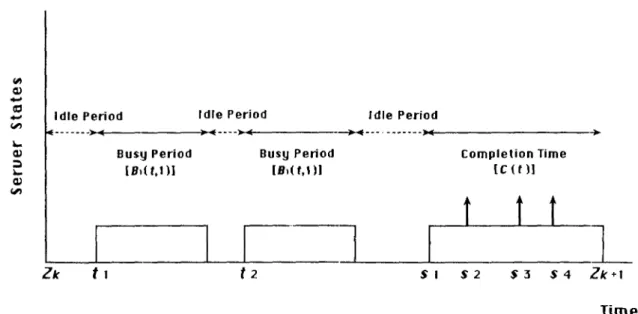
exp(-A2X)(j_j1+1)!C(x)dx). (3.11 )The first term on the right hand side of (3.11) implies that the first non-priority customer after Zk arrives during the idle period. The second term implies that this customer arrives during the busy period of the priority customers. See Figure 3.1. Summing (3.11) over all n
yields
00
POj =
L
P{Nk+1 =j,h
= nI
Ni. =O}
n=OFrom their definitions, 1ri and P ij satisfiy the equation
Thus, we obtain Equation (3.10) gives Equation (3.12) gives 00 00 1rj =
L
1riPij. i=O 00 00 g(z) =L L
zj1riP;j. i=O j=O 00L
zjP;j = zi-1C*(A2(1- z)) for i>
O. j=OL
zjPOj = (.>-21 - T - TOBi(A2' 1))-1 j=O (3.12) (3.13) (3.14 ) (3.15)~
Q,)
-
(Cl-Vl
Queue with Markov Renewal PreemptiollS 19
Idle Period Idle Period Idle Period
---)o~+c--·---_
...
""----)o~+.---~------)0..-.1---+
t 1 Busy Period (Bl0,1)) Busy Period (81(f,l))C
J
t 2 SI Completion Time [C(f))t
t t
S2 S3 S4 Zk+1L
Time(a) Case in which Poisson customer arriues during idle period
Idle Period Idle Period Idle Period
---)O>-+c---> .. <E- .. > .. c - - - l > ... 'c->_""---_.· .. C l - - - -_ _ » Zk t 1 Busy Period (Bd f,1)) Busy Period [BI (t, 1)] Busy Period (Bl( t, 1 1I t2 t3S1 S2
I
t
Completion Time (CUllt t
L
S:3 S 4 SS b( +1 Time(b) Case in which Poisson customer arriues during busy period
ti: Rrriual time of PH-Markou renewal customer si: Rrrival time of Poisson customer
20 F. Machihara Substituting (3.14) and (3.15) into (3.13), we obtain
(3.,5).
Now, let us consider 1ro A"'(s, z) is given by
A*(s, z)
=
P'21 - T - TOBi(A2' 1)}-1[A2BSM(S, z)+
TOE
{(fooo e-SXexp(-A2X)(A~~)n
B1(x, l)dx)BsMn(S,Z)}]= {A21 - T·- TOBi(A2' 1)}-1[A2BsM(S, z)
+ TO(fooo BJ (x, l)exp{(-(s + A2)1 + A2BSM(s,Z))x}dx
- Bi(s + A2, 1))]. (3.16)
Equation (3.16) can be derived in a manner similar to (3.12). Equation (3.6) can be obtained in the following manner:
qo is equivalent to the stationary arrival phase state probability vector at the service completion epoch for a non-priority customer who leaves the system empty. Therefore, we can write
1ro = ]{ qo for some ]{
>
O.Let ZI (0), Z2(O), ... denote the successive service completion epochs for non-priority cus-tomers who leave the server idle. The ratio of 1 to 1roe is identical to the mean number of non-priority customers who complete their services between Zk(O) and Zk+l(O), that is,
1
]{ = 1roe = . ,
qo(dA*(O,z)/dz IZ=l)e
thus we obtain (3.6).
Equations (3.7) and (3.8) can be directly derived by (3.16) and (3.4). Let us consider (dA *(0, z )dz Iz=J)e. It is clear that
dA *(0, z)
I _
e = J,,\ 1- T _ TOB*("\ 1)}-1dz z-l 1 2 1 2,
dB*
(0
z) 00 [00 (A2X)n'[A2
S~z
' IZ=Ie+TOE(}o exp(-A2 X)----;;y-Bl(X,1)dx). (I:
BSMk(O,1))(dBS~(O,
z) Iz=l e)]. (3.17)k=O z
Substituting
00
[00
(A
xt n-lE()o eXP(-A2X
)7
B1(x, l)dx)(t; BSMk(O, 1)). (I -
BSM(O, 1) + ebSM)= Bi(O, 1) - Bi(A2, 1)
00 [00 (A2xt
- E(}o exp( -A2 X)----;;y-B1(x, l)dx)BsMn(O, 1)
+
"\2(lX) XBl(X, l)dx)ebsM (3.18)and
dBSM(O,
z)
'"
dz Iz=l e =
(I -
BSM(O, 1) + ebSM)Queue with Markov Renewal Preemptions 21
we obtain (3.9). See Neuts [12] for (3.19). 0
The 1r0 obtained in Theorem 3.1 also gives interdeparture time distribution for
non-priority customers. That is, the LST
d* (s)
of the interdeparture time distribution is repre-sented byd*(s)
=
1ro{(s + A2)1 - T - TOB~(s+
A2,
1)}-1. [A21 + TO{Bi(s, 1) -
Bi
(A2, 1)}]C*(s)e
+
(g(l) -1ro)C*(s)e.
(a.20) See (3.28) for the realized form of g(l).As mentioned by Neuts
[l1J, A*(s,z)
and[dA*(s,z)/dzJe
may be computed by suc-cessive substitutions. Under preemptive resume discipline, A*(s, z),
in particular, can be transformed into a more suitable computational form. Under this work-c.onserving service discipline, the server is indifferent as to whether or not the PH-Markov renewal customers have priority. Therefore, joint distribution of the busy period length and the number of ser-vice completions during this period are independent of the serser-vice order. This implies thatBSM(s, z)
a n d ;{(looo e-SXexp( -A2X)
(A~~)n
Bl(X, 1)dx )BSMn(S, z)}
are independent of their service orders, and the following lemma is satisfied.and
Lemma 3.2 For the preemptive resume discipline, one obtains
A*(O, 1) = [A21 - T - TOB;
(A2' 1)t1[A2Bi(
-T - TOB:(O, 1))+
TO(B~(O, 1) - Bi(A2' 1))]dA
*(0,z)
I
=A2
[A
1 _ T _ TOB*(A 1)]-1
dz
z=1
e (1 _P2)
2 1 2,[I
\
_1 dBi(-T-TOB:(O,z))
I
_1TodB~(0,z)
I ]
. +
1\21-'1
dz
z=1 +1-'1
dz
z=1
e, (3.21) (3.22) whereBi(s)
forRe(s)
2:
0 is the Laplace-Stieltjes transform of theM(A2)/G(H2)/I
busy period length (arrival rate is '\2 and service time distribution is H2(x))
and satisfiesBi(s)
=Hi(s
+
A2 - A2B2(s)).
Also, B~(s,
z)
is the double transform of the length of theP H-M R/G/I
busy period, and the number of customers served during this period, where the arrival process is a PH -Markov renewal one with representation (a, T, TO) and service time distribution is general one whose LST forRe(s)
2:
0 isH;(s)
:=H*(s
+
A2 -- A2B2(s, 1)).
B~(s,z) for
Re(s)
2:
0 andIzl
S
1 satisfiesB~(s,
z)
=zaH;(sl -
T - TOB:(s,z)).
(3.23)Proof: Let us consider the other expression for B
SM ( s, z)
defined in (3.4). Note that thisM/SM/I
busy period is equivalent to the busy period of thePH-MR,M/G1,G2/I
considered in this section, when the busy period starts by the Poisson customer's arrival. Since this
M/SM/1
busy period distribution is independent of the service order, we may22 F. Machihara
consider the Poisson customers as having preemptive priority. Under this discipline, after the
M().,2)/G(H2)/1
busy period process, the PH-Markov renewal customers who have arrived during this busy period are served. Here, the services of thePH -
Markov renewal customers are preempted by the Poisson customers again. Therefore, the busy period of theM / S
M/I
can be decomposed into two parts. One is the
M().,2)/G(H2)/1
busy periodn,
whose LST is given byBi(s)
=H2(s
+).,2 -)"2BHs)).
The other is the n-th busy period of thePH-MR/G(He)/I,
wheren
is the number of PH-Markov renewal customers who arrive during theM().,2)/G(H2)/1
busy period, andHe
means that the service time distribution is identical to the completion time distributionHe(t)
whose LST satisfies H~(s) =H* (s
+).,2 -).,2BHs)).
Therefore, we can assume th at theM / S
M/I
busy period is identical to the completion time of service timeTb,
(underlying the distribution in which LST isBz(s)),
which is preempted by priority is customers whose arrival representation is (0,T, TO),
and service time density isHe(x).
Therefore, from (2.1) we obtainwhere a = (1 - P2)-1 and
BSM(s, z)
=za B
2
(sI -
T -TOB;(s,
i)),
b = ).,2{1l1(1- P2n- 1
B~(s,
z)
=
zoH;(sI -
T -TOB;(s, z)).
(3.24)
Here (1 - P2)-1 and ).,2{1l1(1 - P2n- 1 are the mean number of Poisson customers served during the
M().,2)/G(H2)/1
busy period and the mean number of Poisson customers served during the service time underlying the distributionHe( x),
respectively.Since
~
{(fooo
c-sx
().,2xte:~(
-).,2X
) Bl(X, l)dx)BsMn(S,
In
is identical to the LST of the
P H-M R/G(He)/1
busy period length, it follows thatE
{(fooo
t~-sx
().,2X
)ne:~(
-).,2X
) B
1(x,
1)dx
)BSMn(s,
1n
=
B~(s,l)- Bi(s
+
).,2,1).
Now, we obtain (3.21) from (3.16).From (3.24), we obtain
dBsM(O,z)
1dz
z=1 e=
[_1 __
+
).,2dBi( -T -
TOB~(O,
z))
Iz=l)e
1 - P2 1l1(1 - P2)dz
and
~(fooo
_sx().,2x)nexp(-).,2X)B (
)d )dBsMn(O,z)
1~ e , I X , 1 x d z=l
n=1
°
n. z).,2 dB~(O,
z)
Iz-l .
III(1 --
P2)dz
-Thus, we obtain (3.22) from (3.16). 0
Lemma 3.2 gives a computational method for
A*(O,
1) anddA*(O, z)/dz
Iz=1 e.
It is well known that the LST of busy period distribution B~(O, 1) can be computed by the following iterative substitutions (11):Queue with Markov Renewal Preemptions 23
B~(n+I)(O,
1) =aH;(
-T - TOB:(n)(O, 1)), n = 0,1,···.If T +
TOB~(n\O,
1) is diagonizable, then H:( -T -TOB~(n)(O,
1)) can be transformed byH;(
-T - TOB:(n)(O, 1))=
/0'.)0
p(n)diag[exp( _/~n)X),. ..
,exp(-/~)x)lP(n)-ldHc(x)
= p(n)diag[H;{/~n»), ... , H;{/~;»)lP(n)-1
for p(n)-l( -T - TOB~(n)(O,
1))p(n)
= diagb~n), ... , I~)l.For a sufficiently large n = N, B~(O,
1)
can be determined asB~(O, 1) = B~(N+I)(O, 1) = ap(N)dia~;[H;{/~N),
... , H;(/}:»)W(N)-l
Without loss of generality, write ,; =
IJN)
and P =p(N).
Then, the following lemma holds. Lemma 3.3 For the preemptive resume discipline, if T +TOB~(n)(O,
1) isdiagoni:~able
for each n,B:i(
-T - TOB~(O,1))
= Pdiag(1, B:i{/2),···, B:i{/m))P-l,
(:3.25)dB~(O,z)
I
dz
z=l e=
{I _
aPdiag(-H;'
(0), 1 -H;{/2)., ... ,
1 -H;{/m)
)P-ITO} -le (:J.26)12
Im
anddBi(-T -
TOB~(O,z))I
dz
z=l e = Pdiag[-B2'(O), 1 -B2(/2), ... ,
1 -Bi{/m)jP-ITO
12Im
dB~(O,z)I
.
dz
z=l e, where*( )
1 d*'(
1 -He 0 = ( ) an -B2
0) = ( ). PI 1 - P2 P2 1 - P2Proof: Equation (3.25) is clear. Since (T
+
TOB~(O, 1))e=
0, we have thatdB~(O,z)
dz
I
z:~le=aHc *( -T-T Bc°
*( O,l)e '){lo
co~( n(T+ToB~(O,
l)t-l)dH (
)}TodB~(O,z)
I
+
a L...J x I C x d z=l e.°
n=ln.
z
Using -T - TOB~(O, 1) = Pdiag{/l,··· "m)p-Ibl = 0), simple calculus shows ~ n (T + TOB~(O, l))n-1 L...J x I n=l n. _ Pd. {
1 -
exp( -/2 X )1 -
exp(-,m
X ) }P-l - lag x, ,.", . 12Im
(:l.27)
24 F. Machihara
We, therefore, obtain
dB~(O,z)
I
dz z=1 e := e
+
aP. d·
{-H*(O)
1-H~('Y2) ...
1-H~bm)}p_lTodB~(O,z)
Ilag c ' " d z=l e.
/2 /m Z
Since the inverse of
exists from stationary condition, p
<
1, (3.26) is proved. Equation (3.27) can be similarly proved. 0If 1ro can be determined, then the n-th derivative g(n)(I) of the generating fuction
g(z)
at z
=
1 is given by the following theorem.Theorem 3.4 g(n) (1)( n = 0, 1,2, ... ) is obtained for the invariant probability vector 1r of C*(O) as
and
where
g(l) := g(O)(I) = 1r
+
U(I)(1 - C*(O)+
e1r)-l (3.28)Ln
=
[(n
+
1)(1+
>'21rC*'(0)e)t1. [(n
+
l)On
+
u(n+l)(l)e +E
((n:
1)
)g(n+l-k)(I)( ->'2)kC*(k)(0)e),
(3.30)
g(n)(1)
=
Ln1r
+
[u(n)(1)+
t
(n)g(n-k)(1)( ->'2)kC*(k)(0) - ng(n-1)(1)]
k=1 k
. (I -
C*(O) +e1r)-I,
n
=
1,2,···,u(n)(I) = 1ro{>.21 -- T - TOBi(>'2, 1)}-1
.
d~n
{>.2 z1 - >'21 + T+
TOBi(>'2(1 -z),
I)}C*(>'2(1 -z))
Iz=1 ,n = 1,2,···.
(3.31 )
(3.33) Proof: Using similar discussions to those in Neuts [12] (pp. 143-148), we have the theorem. 0
Queue with Markov Renewal Preemptions
Next, we will consider the waiting times for non-priority Poisson customers. Let w~(s)
for
Re(s)
~ 0 denote the LST of the distribution vector wN(t) of the waiting time for an arbitrary non-priority Poisson customer waiting in the queue for first-time service. The LST of the sojourn time distribution of this arbitrary cllstomer is given by h~(s)=
w~(s)C*(s).Theorem 3.5 We have
WN
*(s)[(s - )..2)1
+
)..2C*(S))
=: )..27ro[)..21 - T - TOBi()..z, n)-I[sl - T - TOBi(s, 1))) (3.34) and
(3.35) Proof: Using similar discussions to those in Neuts [12) (pp. 184-189), we have (3.34) and (3.35). 0
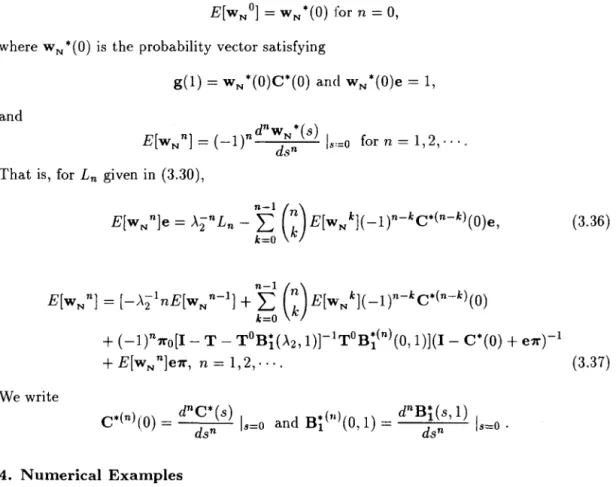
Using (3.34) and (3.35), we obtain the n-th moment of waiting times for non-priority Poisson customers as follows:
E[wN 0)
=
W N *(0) for n=
0,where W N *(0) is the probability vector satisfying
g(l)
= WN *(O)C*(O) and WN *(O)e =1,
and
That is, for Ln given in (3.30),
E[wNn)e =
)..2" nLn -
E
(~)E[WNk)(_1)n-kC*(n-k)(O)e,
k=oE[wN
n)
=[-/\2"lnE[wN n-l)
+
E
(~)E[WN
k)( _1)n-kc*(n-k)(O)
k=O
We write
+
(-lt7ro[1 - T - TOBi()..2, 1)t1TOB;(n)(0, 1))(1 - C*(O)
+
e7r)-1+
E[WN n)e7r, n=
1,2,···. C*(n)('O)
=
dnC*(s)
I _
d B*(n)(O 1) _d
n
Bi(s,l)
I
,
ds n
s-O an 1 , -ds n
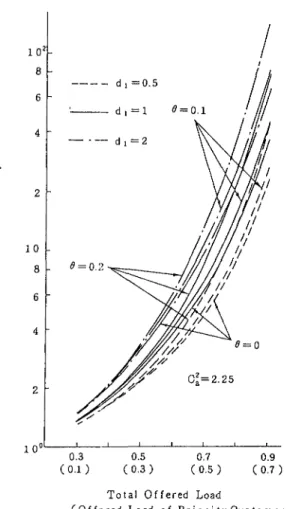
s=O . 4. Numerical Examples (3.36) (3.37)Figure 4.1 shows the mean sojourn time
E[hNl
of the non-priority Poissonian customers for aPH-MR,M/D1,D2/1
with preemptive resume discipline, where priority and non-priority customer service times have constants,111- 1
=d1
and112"1
=d2
= 1, respectively. The arrival process of the priority customers is a two-state Markov modulated Poisson process26 F. Machihara 102 8 d I =0.5 '" 6 ~ v
- - -
d I =1 8=0.1 E ~ 4 '"--
._- d I =2 c3 >. ~ '" c:: 2 ~ 0 '0"
10 E :;.. 8 8 = O.:~ c:: ~ 0 6 0 Cl) c:: 4"
8=0 <J :2; 2 10°L---~--·~--~---L---L---L--~--0.3 0.5 0.7 0.9 (0.1) (0.3) (0.5) ( 0.7 )Total Offered Load
(Offered Load of PriorityCustomers)
Fig. 4.1 Mean Sojourn Time
'"
E :::-' - - - - 8=0.2 t: 3 0 --..:--8=0 <:J Co E 0 C) 2 co <:J :2: 1 0.1 0.3 0.5 0.7Offered Load of Priori ty Oustomers
Queue with Markov Renewal Preemptions
(two-state
M M PP),
often called a switched Poisson process [19]. This is an important model for packet multiplexers handling voice and data [5]. A two-stateM M P P
is governed by~
- (1 0) T -(tll tt1222)
and TO =(t~ol
.... - 0 1 ' -
t21
t~
) ,22
The four parameters,
t;j(1
~ i,j ~ 2) are determined by arrival rare ).1, the squared coefficient of the variation for interarrival times c.~, the balanced condition and the auto cor-relation coefficient of a sequence of interarrival times () in the same manner as [19]. Poisson arrival rate ).2 = 0.2 and mean service time d2=
1 are fixed.The influence of () is very noticeable, which implies that it is inadvisabl~ to approximate the voice-packet arrival process with a renewal process. The influence of service time d1 is noticeable. Therefore, it is uncertain whether the priority
PH-MR,M/Gl,G2/1
queue can be closely approximated by the modelPH-MR,M/G/l.
With this model, the service time distribution is an appropriate mixture of the two customer classes. However, the FIFOqueue can be closely approximated [5].
The results mentioned above can be directly applied to a queue where the
P H-M R
customers have non-preemptive priority. This is because the waiting time distribution of the non-priority Poisson customers for the non-preemptive queue is identical to that for the preemptive queue
[17,
18]. Therefore, the LST, h~P)*(s), of the sojourn tome distribution of the non-priority customers is given by (WN *(s)e)Hi(s). In particular, mean sojourn time is given byE[h~P)]
= E[wN]e+
2-.
=
E[hN]-- (WN *(0)( -C*'(O))e -~).
(4.1)P2 P2
Figure 4.2 shows mean completion time wN *(0)( -C·'(O))e = E[hNl - E[h~P)l
+112"1.
The mean completion time with non-Poissonian preemption is generally different from the well-known result for Poissonian preemption, that is,
(4.2)
Acknowledgements
helpful comments.
The author would like to thank the anonymous referees for their
References
[1] Avi-Itzhak, B. and Naor, P., Some queueing problems with the service station subject to breakdown, Oper. Res., Vol. 11 (1963) pp. 303-320.
[2] Descloux, A., Models for switching networks with integrated voice and data traffic,
Tele-traffic Issues in an Advanced Information Society ITC-ll Part 1 (North-Holland, Am-sterdam, 1985) pp. 134-139.
[3] Gaver, D.P., Junior, A waiting line with interrupted service, including priorities, J. Roy.
Stat. Soc., Vol. B 24 (1962) pp. 73-90.
[4] Heffes, H., A class of data traffic processes -- Covariance function characterization and related queueing results, Bell Syst. Tech. J., Vo1. 59 (1980) pp. 897-929.
[5] Heffes, H. and Lucantoni, D.M., A Markov modulated characterization of packetized voice and data traffic and related statistical multiplexer performance, IEEE J. Selected Areas in Communications, Vol. SAC-4 (1986) pp. 856-868.
28 F. Machihara
[6J Jaiswal, N.K., Priority Queue.'}, Academic Press, New York, 1968.
[7J Keilson, J., Queues subject to service interruption, Ann. Math. Statist., Vol. 33 (1962) pp. 1314-1322.
[8J Machihara, F., Completion time of service unit interrupted by P H-Markov renewal customers and its application, Proc. of the 12th Intl. Teletraffic Congo in Torino, (1988)
5.4B 5.1-5.8.
[9J Machihara, F., A new approach to the fundamental period of a queue with phase-type Markov renewal arrivals, Comm. Statist. Stochastic Models, Vol. 6 (1990) pp. 551-560. [10] Neuts, M.F., Some explicit formulas for the steady-state behavior of the queue with
semi-Markovian service times, Adv. Appl. Prob., Vol. 9 (1977) pp. 141-157.
[11] Neuts, M.F., Matrix Geometric Solutions in Stochastic Models: An Algorithmic Ap-proach, Baltimore, The Johns Hopkins University Press, 1981.
[12] Neuts, M.F., Structured Stochastic Matrices of M/C/1 Type and Their Applications,
New York and Basel, Marcel Dekker, INC., 1989.
[13] Neuts, M.F., The fundamental period of the queue with Markov modulated arrivals, in
Probability, Statistics and Mathematics: Papers in Honor of Professor Samulel Karlin,
Academic Press, 1989.
[14] Ramaswami, V., The N/C/1 queue and its detailed analysis, Adv. Appl. Prob., Vol. 12 (1980) pp. 222-26l.
[15] Sengupta, B., Markov processes whose steady state distribution is matrix-exponential with an application to the CI/PH/l queue, Adv. Appl. Prob., Vol. 21 (1989) pp. 159-180.
[16] Sriram, K. and Whitt, W., Characterizing superposition arrival processed in packet multiplexers for voice and data, IEEE J. Selected Areas in Communication.~, Vol. SAC-4 (1986) pp. 833-8SAC-46.
[17] Sumita, S., Analysis of single server preemptive priority queues with renewal process as high-priority input stream, Electron. Comm. Japan, Vol. 67 (1986) pp. 10-19.
[18] Sumita, S., Studies on queueing models and their analysis methods for multiprocessor control system traffic design, Ph. D. Dissertation, Kyoto University (1987).
[19] Van Hoom, M.H., The SPP/C/1 queue: A single server queue with a switched Poisson process as input process, OR Spectrum Vol. 5 (1983) pp. 207-218.
Fumiaki Machihara NTT Laboratories
3-9-11 Midoricho, Musashino-shi Tokyo 180, Japan