NUE Journal of International Educational Cooperation, Volume 14, 31-39, 2020
Study Note
1. Introduction and Background Information The formal education system in Jamaica has undergone a series of transformation over the years with its latest being the introduction of the National Standards Curriculum (NSC) which is aligned with developing 21st century skills of communicating, collaborating, creating and critical thinking. This includes the integration of STEAM/STEM into the teaching and learning process. The National Standards Curriculum places great emphasis on developing competencies that will be applicable to function in society and the global world in solving real-life problems. The NSC’s objective for Mathematics of fostering key abilities/competencies: knowledge, skills and attitude strongly suggests that the central idea is to develop a way of thinking/reasoning. As stated in
the NSC, Mathematical competencies include conceptualizing spatial properties and the ability to count, measure, handle money and do straight forward calculations with confidence as well as be able to conceptualize spatial properties, gather and graphically represent data in different ways, manipulate mathematical ideas or apply mathematical knowledge to real-life situations and to communicate these effectively. Mathematics subject is an ideal context for the development of critical thinking and problem -solving skills and for making judgement (MoEYI, 2018). This led to the formation and introduction of the Primary Exist Profile (PEP), which replaced the previous GSAT assessment tool. PEP is aligned with the NSC teaching objectives and learning outcomes and is a series that are done at the upper primary level (grades 4-6). PEP creates an academic profile for
Possibility of Utilizing Inquiry-Based Learning as a Pedagogy to
Foster 5E Model in Mathematics Education in Jamaica
Sheena SUCKOO, Hiroki ISHIZAKA
Naruto University of Education
Abstract
This paper examines the development of Jamaica’s formal education system from when it was first established to its progression in the 21st century era. Since its first development, Jamaica has strived to provide quality education moving from a framework of segregated ideology to inclusiveness. However, further development for quality education is of great concern as over the years, many students have failed to meet the national standards and competencies for Mathematics; especially in reasoning. Reasoning comprises of critical thinking and problem -solving skills which are critical 21st century skills necessary for solving real-world situations. The major finding is that Jamaica has begun to utilize Inquiry-Based Learning (IBL) in its formal education system through the use of the 5E model as a means to achieve these key competencies. Examination of its use suggests a gap between the theory and its implementation which means there is a need for further development of contextualization of the model and continued evaluation of its use in order to enhance the possibility of achieving key competencies as well as logical reasoning and rational thinking learning outcomes. Keywords: Jamaica, National Standards Curriculum, Low Performance, Critical Thinking, Problem Solving.
students by highlighting all students’ strengths and weaknesses and evaluates their readiness for grade seven in secondary/high school. PEP’s structure is summarized in Table 1 below and shows that PEP entails three types of assessment, which are: Performance Task (PT)-multiple choices and solving real world problems, Curriculum Based Test (CBT) -selected and constructed responses, assess content knowledge and Ability Test (AT) -multiple choice test that assesses students’ aptitude in areas of numeracy, verbal and non-verbal abilities and abstract thinking by requiring students to read analytically and demonstrate quantitative reasoning skills.PT is administered at grades 4-6 but CBT and AT are administered only at the grade 6 level. PEP assessment is constructed from an Evidence Centred Design (ECD) and utilizes Norman Webb’s Depth of Knowledge (DOK) in order to evaluate the extent of precision that students display in cognitive skills and mathematical competencies at the primary level (MoEYI,2019).
2. Introduction of Inquiry-Based Learning (IBL) Approach
The NSC aims to guide students to communicate, collaborate, create and think critically and its goal is to create the understanding that “Mathematics contributes to the process of inquiry as a means of solving problems. The NSC is implemented through the utilization of a new model of teaching which is an Inquiry-Based Learning (IBL) approach. This approach is the 5 E teaching model that requires students to be active participants during the learning process as they go through the five cycles which are: Engage, Explore, Explain, Elaborate/Extend and Evaluate (MoEYI, 2019).
As depicted in Fig. 1 below, the first phase is the preparatory aspect of the model that allows the teacher to get the students emotionally, socially and intellectually ready for the learning process. It is also the phase that allows for the assessment of prior knowledge, skill, understandings and attitudes. Wonderment is encouraged during this phase as a means of catering to students’ curiosity with a great emphasis on helping students to make connections between prior and new knowledge. The purpose of the second phase is to guide students through a selected context to provide solutions for a problem. This allows students to work independently or in groups to investigate a problem and construct their own understandings and utilize their own skills and abilities to solve the problem. During this phase, students get the opportunities to formulate their own questions, ideas, hypothesis, research method and reflections as they test their own ideas and make conclusions individually and collectively. The third phase provides the opportunity for students to communicate their ideas with others and provide explanations and clarifications of these ideas, findings and or conclusions. This phase allows for the development of self-correction as students learn to clarify misconceptions and receive feedback. The fourth phase is two folds as students can either extend their knowledge or enter an elaboration section of the teaching and learning objective. This phase allows for the continuum of exploration as the students use their new knowledge to expand its principles and apply it in a variety of situations. The final phase is an opportunity for both students and facilitator (teacher) to assess the extent to which learning has been achieved with regards to the specific specified objectives as well as the objectives that may have emerged. Evaluation can occur at any time and it is a Table 1. Structure of PEP
PEP Assessment
Assessment Type Objective Question Features
Performance Task To evaluate students’ knowledge, skills and ability in real-world problem-solving situations. Multiple choice/Single Selected responses and real- world problem solving questions Curriculum Based Test To evaluate content knowledge of grade 6 students only in the areas of mathematics, Science, Social
Studies and Language Arts Selected and Constructed Responses
Ability Test
To evaluate students’ numeracy and communicative skills as well as to assess students’ abilities to make connections of their knowledge and the real-world at the grade 6 level only
process that is developmentally on-going. It provides the opportunity for students and facilitator to observe the potential gaps in the learning process as they evaluate the progress that has been made. Alternative formative assessment tools are used to assess progress made (MoEYI, 2019).
The NSC’s objective for Mathematics is to foster and develop key abilities/ competencies: knowledge, skills and attitude in Mathematics. The basis for which the MoEYI has implemented this standardized teaching and learning model is due to the fact that the 5E model is not only ideal for helping to foster the development of knowledge and skills in students but also helps in creating a systematic way of thinking that can lead to logical thinking and rational reasoning as depicted in Fig. 2 below. Logical thinking and rational reasoning are competencies that extend beyond knowledge skills and abilities because they allow learners to decipher unfamiliar situations, investigate them and continuously apply problem solving skills. This repeated pattern is ideally the foundation for which critical thinking and problem- solving skills can become the outcomes of learning
and the 5 E model can foster this development and create global citizens. The 5 E model is a constructivism ideology to learning and the MoEYI links this to Yelon’s (1996) establishment of learning activities. This theory suggests that the instructional plan in the teaching and learning process ought to entail certain learning activities which are motivation, orientation, information, application and evaluation. Motivation allows students to get ready for learning while orientation informs students of their learning objectives and roles. Information allows learners to manipulate existing knowledge and generative new ideas while Application allows learners to use knowledge and skills in unfamiliar situations. Evaluation allows students to adjust, correct misconceptions an observe progress made (MoEYI, 2019).
3. Low Performance in Mathematics Education Despite the numerous reforms of the Jamaican education system over the past seven decades, there is still growing concern in the area of Mathematics performance because a growing number of Jamaican students have been performing below average and just above average over the past decade.
Figure 3. Primary School Mathematics Performance for the Past Fifteen Years. Source: adopted from MoEYI (2019) as cited in Bourne (p.9)
Figure 1. The 5E Leaning Cycle. Source: MoEYI, (2019, A xi)
According to a review done by Bourne (2019), there has been a trend of below average and just above average performances in Mathematics during the time when the instrument of assessment was GSAT. As depicted in the figure, the average performance for Mathematics for more than a decade is 54.9%.
This summary illustrates that a high percent of students at the elementary lack basic problem solving, communicating and reasoning skills in Mathematics. In the problem- solving category, a total of 68 percent of students are ranked at the beginning and developing level. Additionally, in the communicating and reasoning category, combined total of 78 percent of the students are at the beginning and developing level. This means that only 32 and 22 percent of the nation’s students are performing at the proficient and highly proficient levels in both categories respectively. 4. Theoretical Discussion About the Inquiry Based
Learning (IBL)
Inquiry-Based Learning (IBL) is a method in teaching that is centred around guiding the learner to actively construct meaning by exploring and investing questions or problems (Lee, 2004, as cited in Qing & Dyjur, 2010). In addition, Staver and Bay (1987, as cited in Engeln, Euler & Maass, 2013) noted that the IBL learning process is centrally focused around guidance of discovery to construct knowledge for which this guidance has three levels: structured, guided and open inquiry. In the structured inquiry, students are given a problem and method of solving. In guided inquiry, students get to choose a method for solving a problem and in open inquiry, students create their own problems and investigate solutions. The key characteristics of IBL are summarized in Table 3 below.
This table summarizes key descriptors that are associated with IBL as a constructivist style of learning that allows the learner to construct knowledge by exploring and investigating problems or situations for self-discovery. There is a sense of motivational aspect as learners create their own solutions for these situations and problems and evaluate and self-correct these solutions in order to conclude their findings.
Inquiry-Based Learning differs from traditional methods of teaching and many teachers wonder about its effectiveness. However, educational experts and philosophers continue to stress the need for improving the mathematical literacy and competency of students in the 21st century era. As a result, many researchers have conducted studies on the implementation of IBL as a possible solution. Englen, Euler and Mass (2013) conducted a study in order to assess teachers’ perspective of IBL in the European context. They found that most teachers had a positive attitude towards IBL. However, they also discovered that the daily implementation of IBL varied among the teachers which led the researchers to conclude that this could be due to differences in school systems, school structure and school system restrictions. A research conducted by Qing & Dyjur tested the use of an IBL model in order to examine its impact on rural students’ learning in both Mathematics and Science. They found that students reported that they found the learning experience more applicable to their lives because it gave them a chance to express their ideas which increased their motivation for learning (Qing & Dyjur, 2010). A crucial assertion made about inquiry in Mathematics is that it must be fundamentally grounded on the problem -solving aspect of Mathematics (Hiebert et.al., 1996, as cited in Betts, McLarty & Dickson, 2017). However, Michelle and Krysta (n.d., as cited in Betts, McLarty & Dickson, 2017) highlighted that the theoretical aspect of inquiry and the practice of inquiry specific to Mathematics education, and by extension other subject areas, can be sometimes disconnected due to the varied Table 2. Student Performance in the different
Categories for Mathematics PEP
Mathematics
Category Beginning% Developing% Proficient% Proficient% Highly Problem Solving 19 49 26 6
Communicating
Reasoning 32 46 15 7
Source: MoEYI (2019, p.29)
Table 3. Main Characteristics of IBL.
IBL Descriptors
Knowledge
Construction Self- discovery Exploration Investigation Creative
definitions and understandings of inquiry. They assert that the inquiry process entails key characteristics summarized in Table. 3. Above. They also state that although the process of inquiry is centred around guiding the learner to construct knowledge which must be facilitated during the application process in a simple and structured yet open manner, a balance of meaningful curiosity and discovery linked to the curricula objectives, key competencies and content must be maintained. If this is not done, then too much open inquiry can result in chaotic and unfocused learning. For this reason, there is often a gap between the theoretical aspect of inquiry and the practical aspect of inquiry.
There are two primary theories that influence the development of IBL. According to McLeod (2015), psychologists Jerome Bruner further developed the existing theory of cognitive psychology which describes how people respond to stimuli into cognitive psychology of instruction which leads learners to construct knowledge and solve problems through a sequential step of instruction and exploration (Bruner, 1996). Lev Vygotsky was another psychologist who also agreed with Bruner’s theory of cognitive constructivism but he extended this ideology with his theory of social constructivism as he added that learners are social beings. This notion led to the development of social constructivism instruction which leads learners to share their thoughts, ideas and experiences with each other and others as they explore and construct solutions to problems (Vygotsky, 1978). Subsequently, a fusion of these theories led to the development of IBL and the 5E instructional model of engagement, exploration, explanation, elaboration/ extension and evaluation as explained in Fig.1, is a form of IBL that allows students to develop their ideas
and reorganize these ideas and self-reflect throughout the learning process (Bybee & Landess,1990). However, Allmond, Wells & Makar (2010), supports a 4 D phase plan of structuring inquiry in Mathematics. It begins with the discovery phase which introduces a question/ problem. In this phase, students use prior knowledge and develop an initial understanding. The next phase is the devise phase where students are introduced to the main requirements of the inquiry and are then motivated to plan for solving the question or addressing the problem. The third phase is to develop the plan, so learners now implement their plan using mathematical skills to solve the problem and make representation of their implementation. The next phase is the defend phase where learners prove an understanding of the relationship between the question and their solution. This means that they conclude, present and justify their implementations or findings. They also get explain how they created their solution and reflect on what they could have done differently and discover new inquiry questions that emerged from the initial inquiry and discuss opportunities to transfer to other contexts. A fifth stage is the diverge phase where learners get alternate or extend the direction of the inquiry.
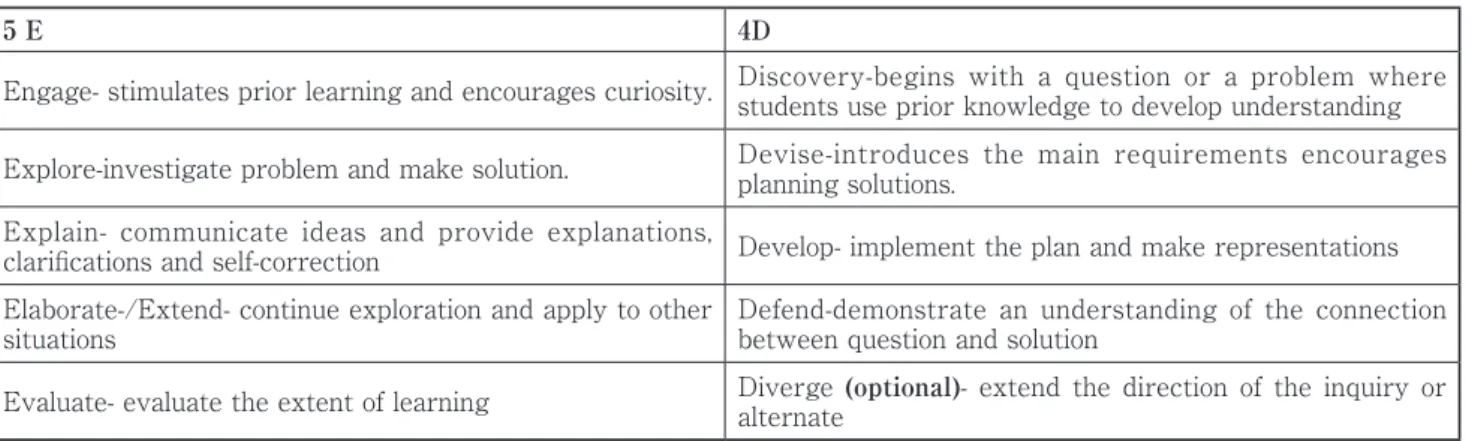
Both models stem from a constructivism theory and therefore share the same idea of knowledge construction However, the learning cycles differ and are summarized in Table 4 below.
This table shows that both models allow learners to investigate a problem, create solutions for that problem and evaluate and self-correct their solutions. The idea of knowledge construction is at the core of both learning models. However, both models differ in the number of learning cycles as the 4D model only has four phases with a fifth optional phase. However, Table 4. Similarities and Differences between 5E and 4D IBL Models
5 E 4D
Engage- stimulates prior learning and encourages curiosity. Discovery-begins with a question or a problem where students use prior knowledge to develop understanding
Explore-investigate problem and make solution. Devise-introduces the main requirements encourages planning solutions.
Explain- communicate ideas and provide explanations,
clarifications and self-correction Develop- implement the plan and make representations
Elaborate-/Extend- continue exploration and apply to other
situations Defend-demonstrate an understanding of the connection between question and solution
that fifth optional phase is the 4th phase of the 5E model; which is the phase where students continue to explore or extend the newly acquired knowledge to other situations. Continuum and expansion of knowledge in other situations is crucially linked to evaluation because this is where the students and teacher (facilitator) get to observe to what extend leaning has taken place. Therefore, this suggests that the 5E model enables learners to construct knowledge and extend that knowledge to new situations all within the 5 cycles of learning and is not dependent on the choice of the facilitator (teacher). This may be an indication as to why the 5E model is the selected model used to achieve IBL in the Jamaican context. 5. Interpretation of an example of an IBL lesson in
Jamaica
IBL in the Jamaican context is utilized through the use of the 5 E model of instruction. As shown in Fig.4 below, there are 5 cycles of instruction where students are required to be engaged in the learning process as they explore their solutions for solving a problem and evaluate. This lesson’s objectives are: ⃝ to write story problems to generate calculations
involving decimals using the four operations ⃝ identify hidden questions within a two -step
problem
⃝ write and solve mathematical sentences. The teaching and learning activities are as follows: ❖ In the engagement phase, students are given a
story problem for which they are being probed to make connections between prior knowledge and the existing story problem to formulate solutions (what operations and methods they would use as well as provide explanations for their ideas).
❖ The second phase allows students to explore a new problem in a new context (measurement) but requires similar solution as explored before after which exchange of ideas are done through proposed discussion.
❖ The next phase in this lesson allows students to continue exploration of new knowledge by applying it to new situations.
❖ The final stage allows students to continue to apply knowledge in a series of new situations. As can be seen in Fig. 4, the interpretation of IBL through the use of the 5 E model is to problematize the teaching and learning process so that students can explore their thoughts and formulate their own solutions. However, in this lesson, the objectives and actives within the learning cycle are not aligned. The engagement activity provides no guidance for students to identify the relationship between a single step problem and a two-step problem. This lesson indicates no linkage between the first objective and the story problem in the exploration phase. Additionally, the exploration phase doesn’t indicate whether the activity is to be done individually or collectively which is a critical aspect of the IBL theory because as stated by the MoEYI (2019), this is the phase which requires students to work individually or in teams to share and communicate their ideas which is an important aspect of the learning experience. Fig. 4 also shows that the story problem in the exploration phase seems isolated from the intended objective which builds a wide gap between the hidden problem and the two-step problem, which can be difficult for students to discover the ‘hidden problem’ of a two-step problem. This lesson provides descriptors of the expected solutions that students ought to be guided to realize. This helps to develop evaluation and self-correction skills as they make confirmations for their solutions, which is good. However, the elaboration phase aligns new situations with the first objective mentioned which seems to indicate that there is no connection between the story problem in the exploration and the story problems in the elaboration. Students are not guided through the learning cycles to uncover the sequential understanding for solving math problems (interpretation, choosing suitable operations, and explain reason) as introduced during the engagement in order independently create their own two-step problems. The evaluation phase also doesn’t provide any criteria for which students can do their own self-check as they evaluate upon completion of the tasks given. There is no observed differentiation in levels of questioning in order to assess all objectives and to foster the mixed ability reality in the Jamaican classroom. A summary of this analysis can be found in Table. 5 below.
Figure 4. Sample 5E Lesson plan for Mathematics in Jamaica. Source: extract from the Gleaner’s Children’s Own (2020, p.17).
Table 5. Summary of Analysis
Issues with 5E Components Analysis
Explore Not adequately linked to objectives and engagement. Needs to foster sequential understanding.
Explain Needs to develop independent and collaborative communication
Elaborate Needs to harmonize with objectives
linkage between objectives and problem, sequential understanding is not fostered, specific structure for independent and collaborative solving is not indicated and differentiated activities are not given to foster mixed abilities within the classroom. All of these components are crucial in order to achieve key competencies of knowledge, skills and abilities as well as to develop logical thinking and rational reasoning. 6. Conclusion
In conclusion, the 5E model appears to foster the development of knowledge, skills and ability during the teaching and learning process because it provides opportunities or learners to make linkage between prior knowledge and new data and encourages them to construct solutions to mathematical problems. In addition, the 5E model seems more appropriate for the Jamaican context than the 4 D model. Both models allow students to investigate a problem and construct and communicate their solutions to the problem. However, the 4D model doesn’t standardize extension of learning because this step is optional. As for the 5E model, this step is included as part of the learning cycle and this is a necessary step for developing key mathematical competencies, rational thinking and logical reasoning because it allows students to apply new knowledge to new situations. This will drive students to develop a sense of interpretation, construction, application and communication learning cycle for which will lead them to self-evaluate and self-correct their own understanding. As observed, Jamaica has already begun to utilize an IBL approach through the use of the 5E plan in hope to achieve mathematical and all other learning competencies and seeks to develop global citizens who are capable of thinking critically and reason logically as they make sense of the world and solve real-world problems. However, based on the theories associated with IBL and the interpretation of an example of IBL lesson in Jamaica as highlighted in Table 5, there seems to exist a type of misinterpretation of the theory and a lack of harmonization between the objectives and the inquiry cycles. Therefore, further development of a contextualized model of IBL needs to be done for Jamaica. One solution could be to restructure the 5E model so that it indicates not just criteria of each cycle in terms of knowledge construction but also
include criteria for connection among each cycle. This will better guide teachers on how to maintain connection among each cycle in relation to the teaching and learning objectives. Also, this restructuring could entail outlines within the 5 E lesson that indicates equal time for independent thinking (solving) as well as collaborative thinking (solving) so that each leaner’s individual idea is maintained prior to self-correcting. Additionally, this restructuring could also indicate how differentiated instruction, activities and evaluation are organized. References
Allmond, S., Wells, J., & Makar, K. (2010). Thinking through mathematics: Engaging students with inquiry based learning. Carlton South, Australia: Education Service Australia Limited. 104.pp. Betts, P., McLarty, M., & Dickson, K. (2017). An Action
Research Project by Teacher Candidates and their Instructor into using Math Inquiry: Learning about Relations between Theory and Practice. Networks: An Online Journal for Teacher Research, 19(1), pp.1–14. https://doi.org/10.4148/2470-6353.1011 Blake. A. (2020, May 11). Writing and solving problems.
A Gleaner Publication Children’s Own, 68(45), p.17. Bybee, R., & Landes, N. M. (1990). Science for life and
living: An elementary school science program from Biological Sciences Improvement Study (BSCS). The American Biology Teacher, 52(2), pp.92-98. Bourne. P. (2019). Mathematics performance in
Jamaica. International Journal of History and Scientific Studies, 1(4), pp.8-31. Retrieved from: http://www.researchgate.net/publication/333203993_
MATHEMATICS_PERFORMANCE_IN_JAMAICA Engeln, K., Euler, M., & Maass, K. (2013). Inquiry-based
learning in mathematics and science: a comparative baseline study of teachers’ beliefs and practices across 12 European countries. ZDM, 45(6), pp.823– 836. https://doi.org/10.1007/s11858-013-0507-5 Ministry of Education, Youth and Information (2018).
National Standards Curriculum. Retrieved from: https://www.moey.gov.jm/
Ministry of Education, Youth and Information (2019). Primary Exit Profile. Retrieved from: https://www. moey.gov.jm/
Qing Li, Moorman, L., & Dyjur, P. (2010). Inquiry-based learning and e-mentoring via videoconference: a
study of mathematics and science learning of Canadian rural students. Educational Technology Research & Development, 58(6), pp.729–753. https:// doi.org/10.1007/s11423-010-9156-3
McLeod, S. (2015). Jerome Bruner and the process of education. Retrieved from: http://infed.org/mobi/ jerome-bruner-and-theprocess-of-education/
Primary Education in Jamaica: From Common Entrance to GSAT to PEP (2017). diGJamaica. Retrieved from: http://digjamaica.com/m/blog/ from-common-entrance-nap-gsat-to-pep/
Revised Primary Curriculum, Grades 1-3 (1999). Ministry of Education and Culture. Retrieved from: https://moey.gov.jm/sites/default/files/GuideGrade1-3.
Seah, R., & Beencke, A. (2019). Developing critical thinking in the primary years. Australian Primary Mathematics Classroom, 24(3), pp.3–7.
Trines, S. (2019). Education in Jamaica. World Education News and Reviews. Retrieved from: https://wenr.wes.org/2019/09/education-in-jamaica#: ~:text=In%20Brief%3A%20The%20Education%20 System%20of%20Jamaica&text=Following%20 the%20establishment%20of%20UWI,in%20the%20 1960s%20and%201970s
Vgotsky, L. S. (1978). Mind in society. Cambridge: Harvard University Press. 159.pp.