
トップページ - 横浜国立大学学術情報リポジトリ
15
0
0
全文
(2) 1: Introduction In the current focus on internationalization, high-level English proficiency and language performance are expected of English learners, and writing is a key skill in the academic arena in this global context. Japanese universities are now encouraging more students to study abroad. Under this mandate, writing skill has begun to draw attention and has revealed its key role in academic English proficiency.. However, writing poses particular challenges. One difficulty is. that writing requires productive vocabulary and “craft skill” (a term used in carpentry to describe skills to produce things with care). Another difficulty is that writing calls for academic knowledge across disciplines. An experienced ESL instructor and researcher says, “Unlike reading and listening, writing is a productive activity that requires comprehensive linguistic, rhetorical, and cultural as well as metalinguistic ability” (Kim, 2012). Another researcher introduces the idea that writing is a complex cognitive process requiring appropriate strategies (Connor, 1996). However, the reality reveals a shortage of well-trained writing teachers, whether they are native speakers (NSs) or non-native speakers (NNSs) of English. Therefore, when they study abroad, Japanese students often find that they do not know how to produce even basic academic writing. For example, Gosden (1996) introduced an example of Japanese doctoral students who had not been formally taught English academic composition until they had to write their first academic research articles. In this paper, I attempted to look at issues in Japanese students’ written English based on several features. First, I conducted a comparative corpus analysis of students’ essays and TOEFL sample essays to reveal several features of students’ writing. Second, I analyzed each feature and attempted an explanation of its application in writing. 2: Case study It is not surprising that written work by Japanese EFL students often has some flaws. 2.
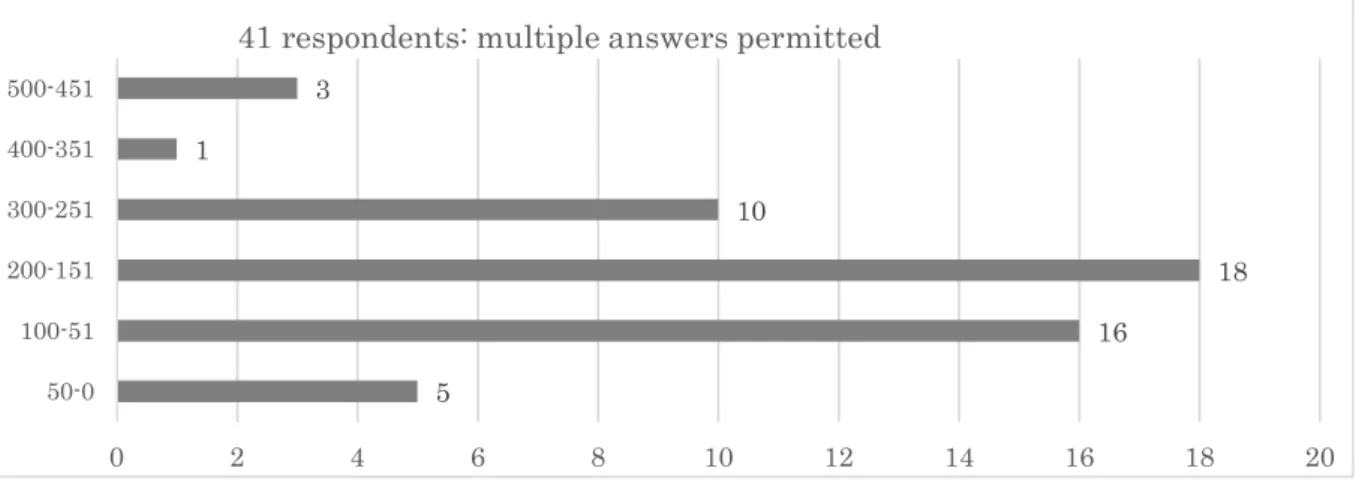
(3) Incorrect syntax is common, and lexical problems such as excessive word repetition, the overuse of expressions, and a few others are easily found.. Kim (2012) mentions that the native language. still controls the writing activity to a large extent and learner language makes for semantic anomalies. Thus, students’ writing is marked most prominently by first-language interference that can cause weakness in their writing. To clarify where the problems come from, this case study examines students’ written work, extracts some features, and analyzes the features following the approach below. 2-1: Students This case study used 43 short essays written by students in two introductory writing classes at a Japanese national university.. The number of students was originally 48.. However, 5. students were eliminated. Those students included one sophomore repeater of the same level writing class, two students whose essays failed to follow the rules for submission, and two students who were unable to finish their essay assignments.. All 43 students had taken the TOEFL-ITP. 1. test. to assess their English level one week after university matriculation. Their scores ranged from 453 to 463 points.. This score range corresponds very closely to 456.7, the average TOEFL-ITP score. taken by Japanese university students in 2011-2012 academic year according to a report by CIEE. 2 Therefore, the academic English proficiency of these 43 students is labeled “intermediate-level” within the population of Japanese university students. Figure 1 displays the 43 students’ writing experience in English.. About four out of five. students (83%) had written in English from 100 to 300 words in length before coming to university, but in many cases that writing was English translation of Japanese texts. This translation-type of. 1. TOEFL-ITP (Test of English as a Foreign Language, Institutional Testing Program). 2. CIEE(Council on International Educational Exchange 国際教育交換協議会) 3.
(4) writing aims to prepare students for the second-stage entrance exam at many highly-ranked private universities and national universities. According to information from several cram schools, the successful strategy is to demonstrate proper choice of English words and expressions, and grammatical accuracy within the sentence-level translation. This suggests English teachers should be aware that the majority of students at university are novice writers in academic writing that requires to write paragraph and essay level writing in a coherent manner. Figure 1 Students’ writing experiences 41 respondents: multiple answers permitted 3. 500-451. 1. 400-351. 10. 300-251. 18. 200-151. 16. 100-51. 5. 50-0. 0. 2. 4. 6. 8. 10. 12. 14. 16. 18. 20. ※ X axis: no. of words written; Y axis: no. of students responding. 2-2 Materials, corpus, and tools Two kinds of data were used in this case study.. One type was short essays written by the. 43 students. These essays were the third writing assignments in the final project in 2017 spring semester classes. The course syllabus instructed that the students could choose one essay topic and the number of words from each three options in their writing assignments. Table 1 shows the topics and the total number of words appearing in the 43 essays they wrote. Table 1 Topics and the number of words appearing in 43 essays Number of words. 800 to 700. 699 to 600. 599 to 500. Total. 2. 3. 4. 9. Topic A university/college education is necessary 4.
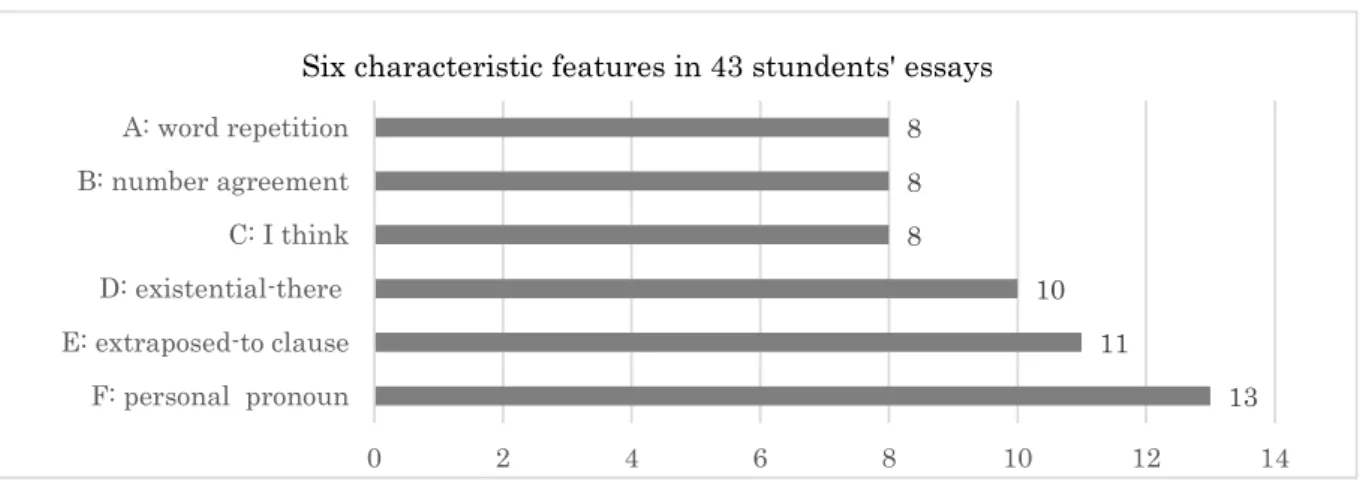
(5) Priority seating is beneficial/valuable. 3. 9. 5. 17. 24/7 convenience stores are. 8. 2. 7. 17. 13. 14. 16. 43. beneficial/valuable. The other kind of data is sample essays taken from a TOEFL writing book. Every sample essay has a full score of 6 points on a 6-point scale. That is, each essay is a perfect model for English learners. 70 persuasive essays were chosen from the book to create the equivalent size of corpus to compare with the 43 student essays. As it turned out, the topic of “A university/college education is necessary” was coincidentally an option both for the TOEFL sample essays and students’ essays in 2017 spring term. Table 2 Material and corpus material. number. Freshmen’s essays. 43. TOEFL sample essays. 70. essay type persuasive. corpus 27,841 words 24,630 words. 2-3: Six features Four steps were taken before examining the students’ essays. Step 1: Take notes with a focus on problematic features while grading students’ short essays Step 2: Create Excel spreadsheet A from all the notes in Step 1 above. The sheet has students’ names in the leftmost row and the features in the right rows. Students’ names have been changed to protect their identity. Step 3: Make Excel spreadsheet B for selected features on spreadsheet A. Spreadsheet B shows who used which feature in his or her writing. Step 4: Choose several features with high frequencies. Step 1. Step 2. Step 3. Step 4. Identify Features. 5.
(6) Six items were chosen as characteristic features based on the idea that a characteristic feature should appear in at least in one essay out of five. Figure 2 shows the six features. Figure 2: Six characteristic features in 43 students’ essays Six characteristic features in 43 stundents' essays A: word repetition. 8. B: number agreement. 8. C: I think. 8. D: existential-there. 10. E: extraposed-to clause. 11. F: personal pronoun. 13 0. 2. 4. 6. 8. 10. 12. 14. 2-4: Corpus tools Two corpora in Table 3 and two free-online tool kits in Table 4 were used for examination and analysis. The editing function of Microsoft Word's word processing software was also used for searching for word repetition and grammatical mistakes as necessary. Table 4 shows the combinations of tools and six features in the examination. Table 3 Tools used in comparative analysis Corpus analysis toolkit. Creator. Purpose of use. AntConc (3.4.4). Laurence Anthony. Word search and word frequency. Word Level Checker (WLC). Yasumasa Someya. Vocabulary level check and word frequency. Table 4 Tools in analysis Features A. Word repetition. B. Number agreement. C. “I think”. D. Existential “there”. E. Extraposition. WLC. AntConc. Microsoft Word’s editing function. ○. ○ ○ ○ ○ ○. ○ ○ ○ ○ ○. ○ 6.
(7) and “it” cleft F. Personal pronouns. ○. ○. ○. 3 Discussion This section discusses six features in descendant order from A to F as seen in Table 4 above. All samples appearing in this article are portions of the students’ original essays reproduced without modification. 3-1 Feature A: Word repetition Excessive word repetition is very common in students’ writing.. In contrast, constant. repetition of the same words is not found in TOEFL sample essays. Samples A and B from students’ essays each show typical cases of word repetition in one short paragraph. Academic writing textbooks often indicate students that they can repeat key nouns or key verbs in creating a coherent text. However, the overuse of the same words is not a good strategy in writing. Avoiding word repetition is a major obstacle that teachers and students struggle with in writing. Sample A (as it appears in the original essay) It is very kind action to give up seat to other people. To make it more smooth to give up seat, it is not effective to provide priority seats in one section of the train or bus. Various measures have already been taken. For example, in Yokohama city subway, all seats can exchange without setting priority seats. This system makes people feel more considerate by eliminating the concept of priority seat.. As you. can see from these examples, the concept of priority seats is no longer necessary. As a result, I disagree with priority seat system in order to make priority people live more comfortable.. Sample B (as it appears in the original essay) If you are hungry at night, you can eat foods at a family restaurant or get them at a convenience store. Suddenly when you need something, you can get it at convenience stores soon. I often use a convenience store to buy foods and drinks when I got back late. According to a survey on convenience stores that targeted 7.
(8) college students in 2005, 24% people use convenience stores between 22 o'clock and 6 o'clock, which is called the late night band. It is also said that about 5 million people use convenience stores during that time per a day. These statistics and my experiment show the importance and the necessity of stores opened 24 hours in our lives. 3-2: Feature B Number agreement Students’ samples showed 26 cases of number disagreement between singular / plural subjects (S). and present-tense verbs (V), while the TOEFL sample essays had no such basic. grammatical mistakes. The Japanese language does not require number agreement between a subject and a verb.. Students often claim that they “know” about S-V agreement in English. However,. student samples C and D show typical cases of S-V number disagreement found in students’ writing, which occur more commonly, but not exclusively, when a subject and a verb have a distance between them. Sample C In fact, abolishing overnight shop have some advantage, but that have some disadvantage, too. Sample D In Japan, people who is more than 65 years old is called senior people. 3-3 Feature C. I think. I think was a unique feature found in this research. Table 5 shows a significant difference in the frequency of I think between the two groups of esssays . Table 5. The use of I think Frequency Students’ essays. 108. TOEFL sample essays. 8. Persuasive essays have to convince readers of the writer’s opinion based on facts. The writer’s personal feelings and ideas are not expected in this type of essay in English. According to linguistic 8.
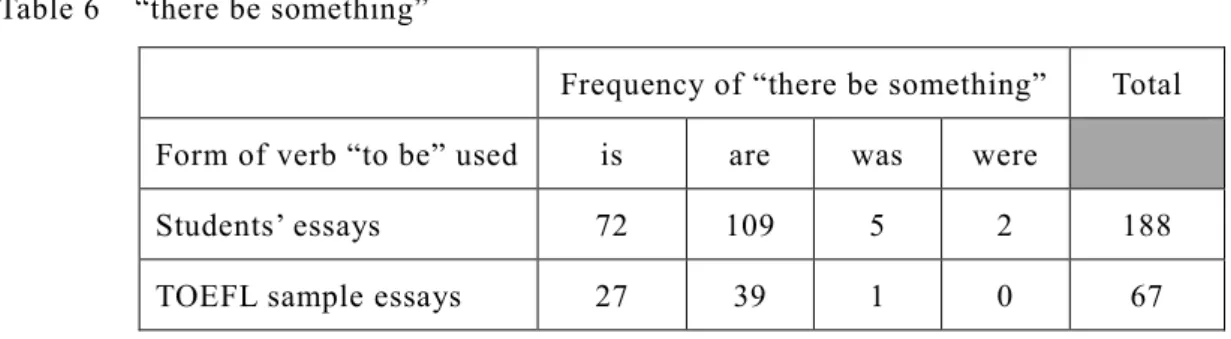
(9) dictionaries, personal feelings, attitudes, value judgment, and assessment are a matter of stance. Moreover, Biber (2006) suggests that the verb think plus that-clauses are used in spoken English registers, but rare in the written registers. In Japanese, on the other hand, “I think” occurs quite frequently in formal essays. To summarise these points, the frequent occurrence of I think is considered to be a misuse of stance and register in persuasive writing. Therefore, a high frequency of I think suggests that writing teachers have to be conscious of stylistic devices as well as grammatical accuracy in writing. 3-4. Feature D. Existential “there”. Another frequent construction was “there be something” sentences. Table 6 shows the result of the comparative analysis. Interestingly, the result suggests that both types of essays use this sentence pattern more in present tense than in past tense. Table 6. “there be something” Frequency of “there be something”. Total. Form of verb “to be” used. is. are. was. were. Students’ essays. 72. 109. 5. 2. 188. TOEFL sample essays. 27. 39. 1. 0. 67. This “there be something” sentence is syntactically referred to as “existential there”. “there be something” affirms that something is, or exists (Kollin, 2007).. The use of. “There be something”. in student sample E suggests the existence of demerits of overnaight shops.. However, by. switching “ there be something” to “have something” in possession, sample E becomes more concise and sounds more natural since “have” and “demerit” can go together naturally in English. Many similar cases are found in students’ writing and idicate that they do not think of using “have something” even when they can use it for expressing possession. 9.
(10) Sample E [T]here are more demerits of overnight shop. ⇒. Overnight shops have more demerits. (existence) (possession). Sample E indicates a significant difference between English and Japanese discourse.. Ikegami. (1981, 2006) insightfully introduces the argument that Japanese is a “be” language while English is a “have” language: in the expression of possession, Japanese tends to use existence verbs such as the verb “to be” while English tends to use possession verbs such as the verb “to have.”. Hinds. (1986) also observes the same two different discourse contexts as Ikegami suggests. Both researchers explain that English expressions tend to clarify an actor in a possessive expression, while Japanese is likely to put more focus on a situation than an actor. According to Hinds (1986), existential expressions and possessive expressions exemplify this difference. These two expressions do not overlap in English, but they can be blended in Japanese (Figure 2). One test can illustrate this difference.. If Japanese students are asked to translate “2 つ の 質 問 が あ り ま す ”. (Futatsu no shitsumon ga arimasu) into English, some students may say “there are two questions” using an existential expression. English native speakers, on the other hand, will say, “I have two questions” using a possessive expression with an actor.. This example shows the overlap between. existential expression and possessive expression in Japanese language, and suggests that writing teachers need to raise rhetorical awareness on the overuse of “there be something” sentences in students’ writing. Figure 2 English (person-focused) existential. Japanese (situation-focused). There + be + something. ~がいる、ある. Something(S) + be + preposition. ( ~ga iru / aru). Somebody’s something possession. Something of somebody. ~を持っている 10.
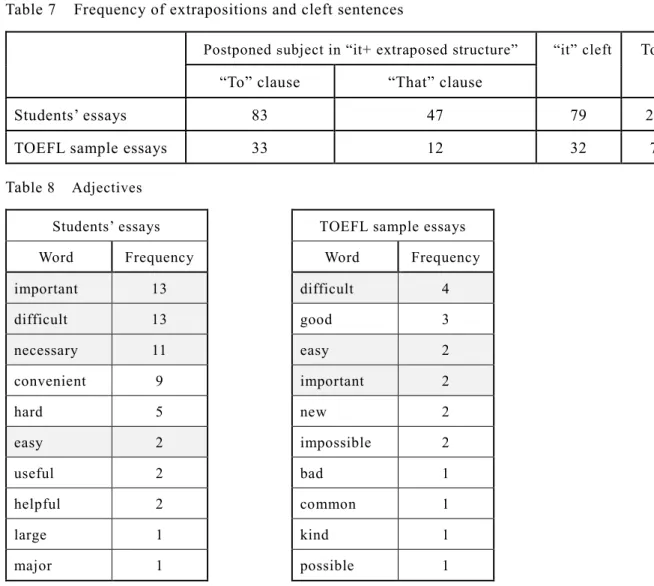
(11) Somebody(S) + have + something. 3-5 Feature E. (~wo motte iru ). Extraposition and “it”-cleft structures. “It be something” sentences presented the second highest frequency in this case study. These include extraposed structures and “it”-cleft structures. “To” clauses and “that” clauses are the most common type of postponed subjects in an extraposed structur, and they work as a logical subject. Adjectives often come after “It be.”. Table 7 shows the frequencies in three types of sentence. pattern, and Table 8 shows frequencies for adjectives used after “It be.” Table 7. Frequency of extrapositions and cleft sentences Postponed s ubject in “it+ extraposed structure”. “it” cleft. Total. “To” clause. “That” clause. Students’ essays. 83. 47. 79. 209. TOEFL sample essays. 33. 12. 32. 77. Tab le 8. Adjectives. Students’ essays Word. TOEFL sample essays. Frequency. Word. Frequency. important. 13. difficult. 4. difficult. 13. good. 3. necessary. 11. easy. 2. convenient. 9. important. 2. hard. 5. new. 2. easy. 2. impossible. 2. useful. 2. bad. 1. helpful. 2. common. 1. large. 1. kind. 1. major. 1. possible. 1. *Eleven other adjectives appeared once each.. *Seven other adjectives appeared once each.. The reason why students’ essays had many extraposed sentence patterns may go back to their 11.
(12) English education in middle school. This structure is one of the target structures that junior high students must learn for the high school entrance exam, according to the Course of Study English junior high school. Presumably this sentence pattern is simple enough for them to acquire and produce successfully. I assume this situation may explain its high frequency in students’ essays. This sentence pattern is most common in academic prose (Biber et.al., 2002). Therefore, using this sentence pattern is appropriate in essay writing. The issue, as writing textbooks often warn, is its overuse and resulting wordiness. Kolln (2007) says, however, “When they are used in the right place and for the right reason, they are not redundant, unnecessary words; they are, in fact, doing an important job.” He argues that writers should pay more attention to proper and effective use of these two sentence patterns. Here, he means rhetorical appropriateness and effectiveness. Teachers need to increase their awareness of the extent to which students gravitate towards using the “it be something” pattern in order to enable students to avoid its overuse. 3-6. Feature F. Two generic personal pronouns. Personal pronouns are an important tool in writing for coherence.. Since the first-person. pronoun I was already introduced in the section on I think (Feature C) with a discussion of the aspect of stance and register, this last part focuses on the plural subject personal pronouns we and you.. Third-person they is another plural subject pronoun; it was eliminated from this discussion. for simplification. As Table 9 shows, we and you were examined for this study. Table 9. Usage of “we” and “you” Subject pronoun. we. you. Students’ essays. 161. 146. TOEFL sample essays. 168. 150. The two essay groups showed very similar frequencies in the generic. use of we and you. In spite. of this result, these two pronouns are often the source of some flaws in students’ writing. If the 12.
(13) differences between the two groups are not a matter of frequency, then what can be the issue of we and you in students’ writing?. To clarify the point, students’ essays were re-examined with a focus. on the locations of these two pronouns. One interesting discovery was inconsistency. In the TOEFL sample essays, once a writer started to use we or you for generic pronoun in the essay, the writer used the same we or you consistently until the end of the essay. On the other hand, there was a good deal of switching back and forth in students’ essay. Samples F and G show sentences in two students’ essays. Sample F In transport facilities, such as trains and bus, we usually see priority seats that person injured or elder can sit on preferentially.------ For example, if you sit on the priority seat and an elderly woman searching for a vacant seat stands in front of you, you should stand up and let her sit down. Sample G In addition, by doing a part-time job, you can accumulate various experiences before saving to society by saving money for the future or going abroad with friends. By going to the university like this, it is necessary as we can secure time for yourself. The pronoun we has two types, inclusive and exclusive. While inclusive we refers to the writer and reader together, exclusive we refers solely to the writer and other persons associated with the writer (Hardwood, 2005). Thus we always includes the writer, whether the usage be inclusive or exclusive. On the other hand, you refers directly to the reader, or the reader and people in general. That is to say, we and you are markers to cast the writer’s perspective towards the reader.. The reader has to. catch these perspective markers while reading. If the writer’s perspective often changes, this inconsistency makes for confusion. As a matter of style, Biber and other researchers (2002) mention that “We is typical of written style in English, and you is typical spoken English.” When taken together, teachers can advise students that they should avoid a mixed use of generic we and you in 13.
(14) one writing discourse, and that we may be a better choice in academic writing. 4. Summary and conclusion This paper demonstrated six characteristic features found in students’ essays using comparative. corpus analysis. Each feature suggests that teaching writing should include more linguistic and rhetorical perspectives, along with a focus on cultural style as mentioned at the beginning of this paper. Japanese English education has focused more attention on speaking skills since communicative competence gained prominence in the 1990s. At the same time, writing has found itself taking the lowest priority in schools. This circumstance resulted in the weakness of English writing education in the Japanese EFL context. In many cases, Japanese teachers have an even greater burden in teaching academic writing since they themselves were not trained in writing during their schooling. The case study in this paper has limitations in the size of corpus, the method for listing features, and the use of analytical tools. It is hoped, however, that several findings from this study will provide useful information to further research and classroom application in teaching writing. References Anthony, L. (2012). AntConc (Version 3.3.4) [Computer Software]. Waseda University. Available from http://www/laurenceanthony.net/software/antoconc/ Biber, D. (2006). Stance in spoken and written university register. Journal of English for Academic Purposes, 5, 97-116. Biber, D., Conrad, S., & Leech, G. (2002). Longman Student Grammar of Spoken and Written English. London: Pearson Education. Connor, U. (1996). Contrastive Rhetoric: Cross-cultural aspects of second-language writing. New York: Cambridge University Press. Gosden, H. (1996). Verbal Reports of Japanese Novices' Reserach Writing Practices in English. Journal of Second Language Writing, 5(2), 109-126 Hinds, J. (2006). Situation vs. Person Focus: Nihongo rashisa to Eigo rashisa [Situation vs. Person Focus: Characteristics of the Japanese and English languages] (14th ed.). Tokyo: 14.
(15) Kuroshio Shuppan. Ikegami, Y. (1981). Suru to naru no gengogaku: Gengo to bunka no taipolojii e-no shiron [The linguistics of “suru” and “naru”: A historical review leading towards typlogies of language and culture]. Tokyo: Taishukan. Ikegami, Y. (2006). Eigo no kankaku, Nihongo no kankaku: Kotoba no Imi no Shikumi [English sensibilities, Japanese sensibilities: The mechanism of the meanings of words]. Tokyo: NHK Books. Japan, Ministry of Education, Culture, Sports, Science and Technology (2011). Course of Study of English in Junior High Schools. Retrieved February 18th, 2018, from: http://www.mext.go.jp/component/a_menu/education/micro_detail/__icsFiles/afieldfile/ 2011/04/11/1298356_10.pdf Kolln, M. (2007). Rhetorical Grammar: Grammatical Choices, Rhetorical Effects. London: Pearson Education. Someya, Y. (2009). Word Level Checker, English vocabulary level analysis program [Computer Software].Aoyama Gakuin University. Available from http://someyanet.com/wlc/index_J.html. 15.
(16)
図

+3

関連したドキュメント
As in the previous case, their definition was couched in terms of Gelfand patterns, and in the equivalent language of tableaux it reads as follows... Chen and Louck remark ([CL], p.
In the previous section, we revisited the problem of the American put close to expiry and used an asymptotic expansion of the Black-Scholes-Merton PDE to find expressions for
The simplest model developed here depends on only three independent parameters: the number of ordered mutations necessary for a cell to become cancerous, the fraction of the
S., Oxford Advanced Learner's Dictionary of Current English, Oxford University Press, Oxford
Due to Kondratiev [12], one of the appropriate functional spaces for the boundary value problems of the type (1.4) are the weighted Sobolev space V β l,2.. Such spaces can be defined
I think that ALTs are an important part of English education in Japan as it not only allows Japanese students to hear and learn from a native-speaker of English, but it
More recently, Hajdu and Szikszai [12] have investigated the original problem of Pillai when applied to sets of consecutive terms of Lucas and Lehmer sequences.. It is easy to see
But in fact we can very quickly bound the axial elbows by the simple center-line method and so, in the vanilla algorithm, we will work only with upper bounds on the axial elbows..
