
近畿大学学術情報リポジトリ
5
0
0
全文
(2) driving-point impedance in the form shown in Fig.1 are that (1) zit,(pi is positive real (not reactance). (2) Let g(p1,p2)=n(pi,P2)m(P1,—P2) +n(-p1,-p2)m(pl, P2). where Ai(pi) and Ai(pi ) are real polynomials, and e, v = 0 or 1 and sets in which these are allowable are (e, v) = (1, 0) , (0,0) or (0,1). To obtain zin(pi, p2) of eq.(2), we assume that polynomials m(p1ip2) f m(—p1, p2) and n(pl, p2) + n(—piip2) are generally decomposed as follows: m(pi, P2)+m(—Pi,P2) =Ai (pi )A2(p2)q5(p1, P2)a1(Pi)m2(P2). then g(pi, p2) is decomposedas. m(pl,P2)—m(—Pi,P2) = A1(pi)h2(p2)0(Pi,p2)b1(pi)n2(p2) n(pl, p2) —n(-p1,p2) =1 1(P1)I2(P2)(41,P2)c1(Pi)m2(P2) n(pl, p2) +n(—p1,p2). g(p1ip2)=+2f1(pi)f1(—pl)f2(p2)f2(—p2) (1) where f k (pk) (k = 1, 2) are polynomials with real coefficients. (3) Rational functions m(231,P2) +m(-pl,P2) m(p1,P2) ±m(-p1,P2). (P1)1112(p2)4 (P1,P2)di (Pi)n2(P2) We also assume that 15031, p2) and cp(pl,p2) are polynomials which cannot be decomposedto polynomials of pi-variable only or of p2-variable only. Thus two polynomials m(p1,p2) and n(p1,p2) can be expressed as follows:. and. 74P P2) ±n(—P1,P2) 71(1)1, P2) +n(_P1,P2) are product separable as. 2m(pl, P2) = h1(Pi)A2(p2)15(p1,P2). m(p1,P2) +m(-pi,P2) _r1 (pi )z2(p2) m(P1,P2) ± m(-pi, P2). x [ai(p1)m2(p2)+ bi(pi)n2(p2)I (3). and 2n(p1,P2) = ft1(Pi)/-i2(p2)cP(pl, P2) x [ci(Pi)m2(p2) + d1(p1)n2(p2)} (4). n(pl,P2) ±n(-p1,P2) _h1(p1)z2(P2) n(pi,p2) +n(i1,P2) where r1(p1) and h1(p1) are reactance functions in p1 and z2(p2) is a positive real function in p2.. (4) degp1zin = Max (deg r1sdeg h1) degp2zin= degp2n = degp2m = deg z2.. However,. we see that. 2m(pl,P2)=)1(pl) [al (p1)m2(P2)+b1(pi )n2(P2)] (5) and. 2n(pl,P2)=. Proof: The necessity of the conditions can be easily demonstrated by analyzing the circuit of Fig.l. Hence we proceed with the proof of the sufficiency.. Let us denote r1(p1), h1(p1) and z2(p2) by. (Pi) [ci(Pi )m2(p2)+di (Pi)n2(p2)J• (6) This means that )12(p2)q5(p1,p2) and 11,2(p2)'(p1,p2) are constants, or that there does not exist such factors. In fact, from eqs.(3) and (4), the followingare obtained:. rl(P1) (pi) l~' =a1 1(Pi). degp2m = deg A2+deg/32qi+deg z2 degr2n= degµ2 +degp2 c'+deg z2. hi(pi) = di(p1) ci. The condition (4) yields. and. deg A2= degp2qi= deg 112= degp2co=0. z2(2)2)=(p2) m2. in which (ai, b1), (c1,di) and (m2, n2) are tively prime real polynomials.. rela. From the conditions of Theorem, zin(p1,232)can be written in the form: zin(P1,P2)—i4(Pi) el (P1)m2(P2)+d1(pi )n2(p2) ~ 1(Pl)al(pl) m2(p2)+bi (Pi)T12 (P2) (2). Next, we shall consider A1(pi ) and /c1(p1). Polynomials m(p1,P2) (—P1,P2) and m(pl,P2)—m,-271, P2) are an even- and an odd-polynomial in p1, respectively. Hence, if ai(pi) is even, then A1(p1)must be even. Conversely,if a1(p1) is odd, then Ai(pi ) is odd. Similarly, when c1(p1) is even, then 1t1(p1)is odd, and when c1(p1) is odd, then ,c1(p1)is even. Now, we shall first consider the case of degpi zin = deg r1.(7).
(3) and hereafterthe caseof degp,zin= deghi.. (8). However, thelaterwillbe omitted,becausethiscase is the sameto argumentsofthe former. Eq.(7)means degp1 m=--deg r1.(9) Since,forp2 beingRep2> 0, zjn(P1,P2) = n(P1,P2) /m(pi,p2)is a positivefunctionin pi,. degp1m=degp1n+k(10) wherek=0 or 1.Furthermore, fromeqs.(5)and (6) wehavethe following: (11) (12). Eqs.(9)and (11)yield degAi=0.(13). which is decomposed as the product of two onevariable polynomials. Hence, according to the condition (2), we can have the following decomposition:. ai(P1)61(Pi )+N1(Pi )'Yl(Pi )=±2f1 (PiVI.(-pi) (19). zl (PI)—n1(Pi) _ 71030+61(PI) mi(Pi) ai(p1)+01(P1).. =[ Xi(Pi) (14). Fromtheassumption ofeq.(7),thereexistsan integer 1(> 0) suchthat degri = deghi +1.(16) Thus,fromeqs.(14),(15)and (16),wehave degµi=1 —k > 0 . Sincen(pi,p2)is a 2-variable strictHurwitzpolynomialand, as stated already,Ai(p1)is the even-or the odd-polynomial, the zerosof tci(p1)(degAi 0) lieon the imaginaryaxisofpi-complex plane.Thus it is seenthat zin(pi,P2)has to take the following form: zin(P1,P2)-4(p1) [C1(P 1)m2(P2)+ dl(P1)112 (P2)I a1(P1)m2(P2)+bi (Pi)n2(P2) The remaining workis the caseof eq.(8).However, as statedalready,thiscaseis omitted,andthe result onlyis shownbelow. (Pi)n2(p2) zin(P1,P2)= A1(c1(pi)m2(P2)+di Pi) [al(p1)m2(P2)+bi(Pi)n2(P2)] Now,westandat the positionofrealizingzin(P1,P2). Forthispurposeandforbrevityofnotation,weshall rewritezin(Pi,P2)of eq.(2)as. (21). This is the function whichcan be obtained by replacing n2(P2)/m2(P2)or m2(p2)/n2(P2) in zin(P1,P2) by unity. Thus zi (p1) is a positive real function satisfying eq.(19). Assemble the following2 x 2 matrix Z1(pi) from zi(Pi)• Zi(Pi .) I. Fromeqs.(10),(12)and (13), degp1n = degp, m—k= degri —k = deg,ui+deghi.(15). 9(731,P2)= {ai(p11 x{m2(p2)n2(-p2)+m2(—P2)n2(P2) „)61(p1)+/31(p1)71(p1)} } (18). m2(P2)n2(—P2)+m2(—P2)~2(P2) =±2f2(P2)f2(—p2) (20) Define zi (pi ) by. Idegp,m—degp1 nl < 1. Dueto eq.(7),. degp,m= degA1+degr1 degp,n= degp 1+deghi. and consider realizing this impedance function. Eq.(17) substituted into eq.(1) yield. ni(pi) + ni(—pi)2fi. (Pi ). 2fi(—Pi)ml(Pi)Rm1(—Pi). where xi (pi) = mi (pi ) ± mi (—p1) . According to the result in the one-variablecircuit theory, Zi (pi) is the reactance. matrix. in pi.. Thus zin(pi, p2) is realized as the form of a pivariable lossless 2-port network terminated by a positive real impedance z2(p2) in p2-variable. This proves the sufficiency. Q.E.D.. Corollary 1: The necessary and sufficient conditions for zi,,,(pi, p2), a 2-variable positive real function, to be a driving-point impedance realizableby a pi-variable lossless2-port with a p2-variabledrivingpoint impedance termination are that zin(p1,232)is expressible in the form zin(pl, p2) =71(P1)m2(p2)+81(p1)n2(p2) al (Pi)m2(P2) + Q1(Pi)n2(p2) where al (pi) and 6i (pi) are even (odd)* and 01(pi ) and 'yi (pi) are odd(even)* polynomialsin pi-variable with the followingconditions("* note that parentheses correspond mutually"): (1) The rational function z1(p1)defined by. zi(pi)=ai0109i) Yi(P1)+bl(PI) is positive real. (2) The rational function z2(p2) defined by. zin(p1,P21=71(p1)~n2(P2)+SI(pI)n2(p2)(17) z2(p2) = c1(Pi)2(P2)01(P1)2(P2) 1nn2(P2) 2(P).
(4) is positive. Thusthe polynomial g(pi,p2) is decomposed as. real.. Proof: The necessary is obvious. Hence, only the sufficiencyis proved here. According to the assumption for al (pi), - - - , (pr), we can have the decomposition shown in eq.(18). Furthermore, the positive real function z1(p1) always has the decomposition such as is shown in eq.(19). Of course, the case of z2(p2)answers in the affirmative, as shownin eq.(20). Q.E.D. The positive real function z2(p2) is always realizable as a driving-point impedance of resistivelyterminated lossless 2-port in p2-variable. Hence we can have the followingcorollary. Corollary 2: The necessary and sufficient conditions for a 2-variable rational function zin(pl, P2) to be realizable as the driving-point impedance of a resistively-terminated cascade of p1- and p2-variable lossless 2-port networks (Fig.2) are that zin(pi,P2) satisfies all of necessary and sufficient conditions of Theorem. 3. Illustrative. Furthermore,. with. m2(p2)n2(--P2)+m2(--P2)n2(p2)=8 (p3+1)2. The. degree. requirements. yield. the following:. degp2 n = degp2 m=. deg z2 =. degp i zin = deg hi = deg ri + 2= 4. Thus, zin (p1, P2) satisfies the conditions of Theorem.. Examples. In this section the realization. two examples procedure.. are shown. Example function:. Synthesis. 2-variable. 1:. g(pi,p2)=8(8p1+1)2(2p1+3)2(P2+1)2•. the. to illustrate. positive. real. =2 (874+1)`(2p1+3)`. zin(P1,P2)=. E2k=02-k (P1 )P3~. From the above,. 2. we can get the 2 x 2 reactance. '7rrti_1r4p1. bk/{Pl)prz. matrix. 01. where. ao(pi)= 32p1+ 112p1 +32p1+60p1+3 ai (pi) = 64p1+28pi+64p1+ 15pi+6 a2(pi)=2 (32/4+28A+32p4+ 15pi+3) bo(pi)= (8/4+1) (4pr+p1+12) bI(pi)=(8p?+1) (pi+2pi+3) b2(pl)=2(Vi +1) (p2+pi+3).. The. complete. Example function. realization. 2: Synthesis given below:. Zin(Pi,P2)=. is shown the. in Fig.3.. 2-variable. positive. real. (pi+p7+2pi+l)P2 +p3+4p4+2p1+4. -.244'21. Fig.2. A doubly-terminated p2-variable. lossless. cascades 2-ports.. of p1- and Fig.3. The. complete. realization. of Example. 1..
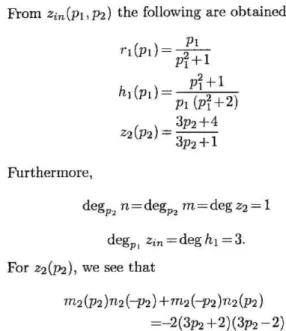
(5) From zin (P1sP2). the following. 1) W.K. Chen, "Broadband matching, theory and implementation", World Scientific Publishing Co., London, Hong Kong. 1988. 2) D.C.Youla, "A newtheory of broad-band matching", IEEE Trans.'on Circuit Theory, vol.CT11,pp.30-50,1964. 3) H.Ozaki and T.Kasami, "Positive real functions of several variables and their application to variable networks", IRE Trans. on Circuit Theory, vol.CT-7, No.10, pp.251-260, 1960. 4) H.G.Ansell, "On certain two-variable generalizations of circuit theory, with applications to networks of transmission lines and lumped reactances", IEEE Trans. on Circuit Theory, vol.CT-11, No.6, pp.214223, 1964. 5) M.Saito, "Synthesis of transmission line networks by multivariable techniques", in Generalized Networks, Polytechnic Institute of Brooklyn, NY, AIRI Symposia Series, pp.353-392, 1966. 6) J.O.Scanlan and J.D.Rhodes, "Realizability of a resistively terminated cascade of lumped, two-port networks separated by noncommensurate transmission lines", IEEE Trans. on Circuit Theory, vol.CT14, No.7, pp.388-394, 1967. 7) T.Koga, "Synthesis of finite passive n-ports with prescribed positive real matrices of several variables", IEEE Trans. on Circuit Theory, vol.CT-15, No.1, pp.2-22, 1968. 8) H.Fujimoto, "Cascade synthesis of a two-variable positive real function", Trans. IEICE, vol.59-A, No.5, pp.409-416, 1976 (In Japanese). 9) H.Fujimoto and J.Ishii, "Synthesis of a resistively terminated cascade of lumped lossless sections and ue sections", Trans. IEICE, vol.59-A, No.11, pp.994999, 1976 (In Japanese). 10) H.Fujimoto and H.Ozaki, "Separation of twovariable reactance sections in the cascade synthesis of multi-variable positive real functions", IEICE Trans., vol.E61, No.6, pp.433-440, 1978. 11) H.Fujimoto, J.Ishii and H.Ozaki, "Multi-variable Richards transformations", Trans. IEICE, vol.E62, No.8, pp.529-535, 1979. 12) H.Fujimoto, "Cascade realization of a class of two-variable transfer functions", IEEE Trans. on Circuits and Systems, vol.38, No.12, pp.1451-1459, 1991. 13) H.Fujimoto, "Reciprocal realization of a class of two-variable cascaded transmission line networks", International Journal of Electronics, vol.78, No.6, pp.1127-1138, 1995. 14) H.Fujimoto, "A class of two-variable transfer functions and its application to the design of microwave filter networks", IEEE Trans. Circuits and Systems Fundamental, vol.45, No.7, pp.769-775, 1998. 15) H.Fujimoto, "An extension of the complex normalized scattering matrix", J. School Sei, Eng., Kinki Univ. Vol.28, pp.383-392, 1992.. are obtained:. Furthermore, degp2 n = degp2 m= deg z2 =1 degpi zin= deg hi=3. For z2(p2), we see that m2(P2)n2(—p2)+m2(-p2)n2(p2) =-2(3p2 +2) (3p2 —2). From ri(pl) and hi(pi), function is obtained as. the. following. positive. real. PI1P11-I which satisfies nil (PI )nl(-p1)+in1(--P1)ni(p1)=2. Thus, the following 2 x 2 reactance matrix yields:. L. Fig.4. shows. Fig.. .1. the realization. 4 The. complete. t'1. L. -. of Example. realization. -. J. 2.. of Exampl. e 2.. Conclusions This paper has given the necessary and sufficient conditions for the realization of a 2-variable positive real function as a driving-point impedance function of pivariable lossless 2-port network is terminated by a p2-variable. positive. real impedance. function.. References. —5.
(6)
図
関連したドキュメント
W ang , Global bifurcation and exact multiplicity of positive solu- tions for a positone problem with cubic nonlinearity and their applications Trans.. H uang , Classification
Let X be a smooth projective variety defined over an algebraically closed field k of positive characteristic.. By our assumption the image of f contains
Making use, from the preceding paper, of the affirmative solution of the Spectral Conjecture, it is shown here that the general boundaries, of the minimal Gerschgorin sets for
We show that a discrete fixed point theorem of Eilenberg is equivalent to the restriction of the contraction principle to the class of non-Archimedean bounded metric spaces.. We
The theory of generalized ordinary differential equations enables one to inves- tigate ordinary differential, difference and impulsive equations from the unified standpoint...
In [9] a free energy encoding marked length spectra of closed geodesics was introduced, thus our objective is to analyze facts of the free energy of herein comparing with the
There are many exciting results concerned with the exis- tence of positive solutions of boundary-value problems of second or higher order differential equations with or
Thus, we use the results both to prove existence and uniqueness of exponentially asymptotically stable periodic orbits and to determine a part of their basin of attraction.. Let
