Carotenoids in Wild and Cultured, Red Sea
Bream, Pagrus major TEMMINCK & SCHLEGEL and
Prawn, Penaeus japonicus BATE.
著者
TANAKA Yoshito, KATAYAMA Teruhisa
journal or
publication title
鹿児島大学水産学部紀要=Memoirs of Faculty of
Fisheries Kagoshima University
volume
28
page range
1-7
別言語のタイトル
天然, 養殖マダイおよびクルマエビにおけるカロテ
ノイドの比較
Mem. Fac. Fish., Kagoshima Univ. Vol. 28 pp. 1-7 (1979)
Carotenoids in Wild and Cultured, Red Sea
Bream, Pagrus major Temminck & Schlegel
and Prawn, Penaeus japonicus Bate.
Yoshito Tanaka and Teruhisa Katayama*
Abstract
In order to improve red color tone of cultured aquatic animals, the carotenoids in wild and cultured red sea bream, Pagrus major Temminck & Schlegel and prawn,
Penaeus japonicus Bate were compared. The main carotenoid in both red sea bream and prawn was astaxanthin and its amounts were conspicuously different between wild and cultured animals.
In order to improve the red color of red sea bream, a feeding experiment of spheroidenone producing bacteria and sea mussel was performed. The color of red sea bream was not improved by feeding spheroidenone, but red sea bream fed on sea mussel demonstrated fairly improved coloration and the carotenoids in sea mussel were deposited in the integuments of red sea bream.
The constituents of the carotenoids in marine red fish such as sea bream
were reported, and the main carotenoid of these fish is astaxanthin1*. The feeding experiment of /9-carotene, canthaxanthin and zeaxanthin shows that the fish could not convert these carotenoids to astaxanthin. In other words, sea bream cannot oxidize the 3,3' and 4,4' positions of the ^-ionone rings".
^•Carotene
\
?Y^^^^^
Canthaxanthin,
Fig. 1 Precursor of astaxanthin in tigar prawn, Penaeu japonicus Bate.
* Laboratory of Marine Resource Biochemistry, Faculty of Fisheries, University of Kagos hima.
Mem. Fac. Fish., Kagoshima Univ. Vol. 28 (1979)
The relative abundances of the carotenoids obtained a number of species of
Crustacea were reported by the authors", astaxanthin was by far the most pro minent carotenoid and the most important pigment like the case of sea bream. It was clarified, however that prawn could convert y?-carotene, canthaxanthin and zeaxanthin to astaxanthin". (Fig. 1). In other words, prawn can oxidize the 3, 3' and 4, 4' positions of the /?-ionone rings.
In this experiment, the contents of wild prawn and red sea bream were com
pared with those of faded, cultured sea bream and prawn. Spheroidenone pro ducing bacteria and sea mussel were fed to sea bream in order to improve
their color.
Materials and Methods
1. Comparison of carotenoids in wild and cultured, prawn and red sea bream: Wild prawn, Penaeus japonicus Bate were purchased at a local fish market and cultured prawn were obtained from the Mitsui Norin prawn farm. Wild red sea bream, Pagrus major Temminck & Schlegel were purchased at a local fish mar
ket and culturd sea bream were obtained from the Nagashima Marine Labora
tory Fisheries Science of our Faculty.
In this experiment, the integuments of red sea bream were extracted with acetone in a Waring blender until no further pigments were obtained. The acetone solutions were combined, transferred to petroleum ether by addition of water and washed repeatedly with water to remove traces of acetone. The
Y
MgO column 0-30*acetone in petroleum ether Astacene Sugar column Petroleum etherV
petroleum etherAlumina G-IIcolumn Petroleumether
Tanaka-Katayama: Carotenoids in Sea bream and Prawn
petroleum ether solution of the pigments was dried over anhydrous sulphate
and concentrated under vacuum. Thus obtained crude carotenoids were saponi
fied by dissolving it in 20cc of absolute ethyl alcohol, adding 10cc of 60per cent
aqueous potassium hydroxide (w/v) and leaving it overnight under nitrogen at
room temperature.
The saponified pigments were transferred to petroleum
ether with water, dried with anhydrous sodium sulphate and chromatographed.
The carotenoids in red sea bream were initially separated on a column of
magnesium oxide as shown in Fig. 2. The carotenoid pigments of each band
were purified on magnesium oxide, alumina and sugar columns.
The carotenoi
ds were characterized by their behaviors on the columns, their absorption spe
ctra and co-chromatography with authentic samples.
The quantitative determi
nation was carried out mathematically by extinction value at the maximum
absorption.
The whole body of prawn were extracted with acetone.
The separation
procedure of the carotenoids in prawn is shown in Fig. 3. Identification and
quatitative determination of the carotenoids in prawn are similar to those in
red sea bream.MgOcolumn 0-30% Acetonein petroleum ether Unidentified Astacene Phoeniconone Sugar Column Petroleum ether ESS Tunaxanthin Canthaxanthin MgO''column 20-30*acetonein petroleum ether ZEE Unidentified '|3"Carotene
V
Alumina G-II column
Petroleum ether
Fig. 3 Separation of carotenoids in tigar prawn.
2.
Feeding experiment of spheroidenone producing bacteria to red sea bream:
Alive and healthy red sea bream were obtained from the Nagashima Marine
Laboratory for Fisheries Science of our Faculty.
Two aquaria were prepared.
acclima-Mem. Fac. Fish.. Kagoshima Univ. Vol. 28 (1979)
ted for two weeks to the artificial diet4). The fish in the two tanks were fed
every day for 32 days as follows: Tank 1-artificial diet (control); Tank 2-con-trol diet +20% spheroidenone producing bacteria. The constituents of the carotenoids in the spheroidenone producing bacteria is shown in Table 1.
Table 1. Relative abundance of the caro tenoids in spheroidenone producing bacteria.
Carotenoids
Relative^abundance
Spheroidenone 96.5
Spheroidene 1.4
Unknown 2.1
3. Feeding experiment of sea mussel to red sea bream:
The constituents of the carotenoids in sea mussel is shown in Table 2. Sea
bream were separated into two groups. Thirty each of one group was fed with
artificial diet and thirty each of the other group was fed with artificial diet -f-50 96 sea mussel every day for 32 days. The separation and identification of
the carotenoids in this test fish were carried out as the same way already
stated.
Table 2. Relative abundance of the caro tenoids in Mytilus edulis.
Carotenoids
Relativejbundance
^-Carotene 10.1 Lutein 5.2 Zeaxanthin 10.9 Isomytiloxanthin 34.7 Mytiloxanthin 26.6 P-451 5.0 Unknown 5.0Results and Discussion
1. Comparison of the carotenoids in wild and cultured, prawn and red sea
bream:
The contents of the carotenoids in wild and cultured prawn are shown in Table 3. As shown in Table 3, total carotenoids in wild prawn are quadruple
as much as those in cultured ones and the amounts of astaxanthin in wild
prawn are three times as much as those of cultured ones. From the external
Tanaka«•Katayama: Carotenoids in Sea bream and Prawn 5
Table 3. Amounts prawn.
and relative abundances of carotenoids in wild and cultured
Carotenoids Wild jug/s % Cultured jug/g %
Total carotenoid Astaxanthin Canthaxanthin Phoenicbxanthin Zeaxanthin Tunaxanthin Lutein ^-carotene Other carotenoids 81.93 21.62 60.30 73.6 19.63 90.8 10.08 12.3 0.56 2.6 7.29 8.9 — 0.90 1.1 0.35 1.6 0.82 1.0 — 0.49 0.6 0.26 1.2 0.25 0.3 0.24 1.1 1.80 2.2 0.58 2.7
Ten prawns (25-35 g) were used for each analysis.
assume rather blue color. The major cause for this difference of color tones comes from the contents of astaxanthin. As already stated, /9-carotene, echi-nenone, canthaxanthin and zeaxanthin can be metabolized to astaxanthin. Therefore, those carotenoids are now being used as the sources of astaxanthin in order to improve their color at some prawn farms.
The contents of carotenoids and their constituents in wild and cultured red
sea bream are shown in Table 4. As shown in Table 4, the contents of total carotenoids, especially the contents of astaxanthin in wild red sea bream are overwhelmingly much more than those in cultured ones. From the external
observation, wild red sea bream appear bright red, but cultured ones appear
grey black. It is assumed that this grey black color is attributable to melano-phore. In this experiment, the existence of astaxanthin in cultured red sea bream was confirmed, but sometimes it is difficult to find it. As already stated, sea bream cannot convert /9-carotene, canthaxanthin and zeaxanthin to astax anthin, but they can deposit them in their integuments without modification. Therefore, in order to improve their color, if sea bream are to be cultured in
Table 4. Amounts and relative abundances of carotenoids in wild and cultured, red sea bream.
Carotenoids Wild iigjg % Cultured vg/g %
Total carotenoid 3.34 0.73 Astaxanthin 2.32 69.5 0.07 9.6 Tunaxanthin 0.64 19.2 0.61 83.6 Lutein 0.19 5.7 0.02 2.8 Zeaxanthin 0.11 3.3 — y?-carotene 0.02 0.6 — Other carotenoids 0.06 1.8 0.03 4.1
6 Mem. Fac. Fish., Kagoshima Univ. Vol. 28 (1979)
an aquaculture program, astaxanthin or similar carotenoids must be included in
the diet.
2. Feeding experiment of spheroidenone producing bacteria:
Table 5 lists the results of feeding red sea bream on an artificial diet supple
mented with spheroidenone producing bacteria. As shown in Table 5, spheroi
denone was not found in the integuments of the test red sea bream and the amo
unts of astaxanthin in the integuments were decreased. From external obser
vation, there was no difference between the control group and the test one as
far as color concerns.
Table 5. Amounts of the carotenoids in red sea bream fream fed on the diet containing spheroidenone producing bacteria.
Diet Pigments
Astaxanthin found 0*g/g body wt.) Lutein found 0*g/g body wt.) Tunaxanthin found (ug/g body wt.)
Control diet
0.074 0.053 0.357
Diet containing 20 % sphe roidenone producing bacteria
0.044 0.044 0.530
3. Feeding experiment of sea mussel:
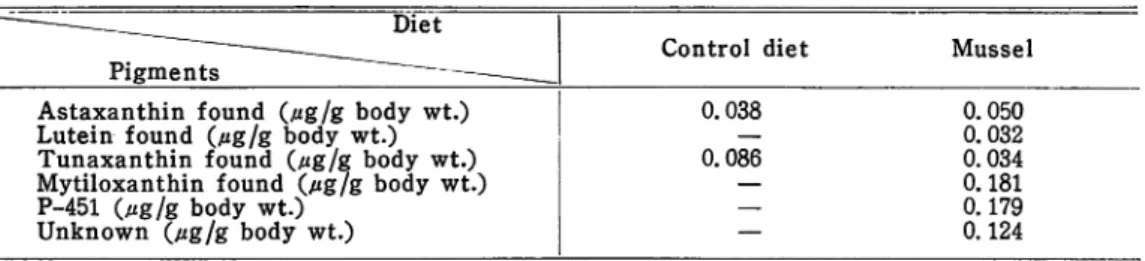
Table 6 records the results of feeding red sea bream on an artificial diet
supplemented with sea mussel. This results show that mytiloxanthin and p-451
were found in the integuments of the test red sea bream. From external ob
servation, the test group assumes bright orange-red color.
These results and those of previous studies show that sea bream cannot
convert any carotenoid in diet to astaxanthin, but they can transfer those
carotenoids whose end group is ^-ionone ring, can be deposited in their inte guments without modification.
Table 6. Amounts of the carotenoids in red sea bream fed on Mussel.
~~—— ___^ Diet
•— . Control diet Mussel
Pigments ~— —-—____
Astaxanthin found (#g/g body wt.) 0.038 0.050
Lutein found (jig/g body wt.) — 0.032
Tunaxanthin found (tig/g body wt.) 0.086 0.034
Mytiloxanthin found 0*g/g body wt.) — 0.181
P-451 (tig/g body wt.) — 0.179
Unknown (vg/g body wt.) — 0.124
Acknowledgements
The authors wish to express sincere thanks to Oh-hara Fisheries Co. Ltd. for
the gift of sea mussel and also to Mr. S. Kadowaki at the Nagashima Labora
tory for Fisheries Science of our Faculty for supplying alive sea bream.
Our sincere thanks are also due to the Mitsui Norin prawn farm for supply
Tanaka«Katayama: Carotenoids in Sea bream and Prawn
Referances
1) Y. Tanaka, T. Katayama, K. L. Simpson and C. 0. Chichester: The biosynthesis
of astaxanthin-XX, The carotenoids in marine red fish and the metabolism of the carotenoids in red sea bream, Chrysophrys major Temminck and Schlegel ., Bull Jap,
Soc. Sci. Fish., 42, 1177-1182, 1976.
2) Y. Tanaka, H. Matsugchi, T. Katayama, K. L. Simpson and C. 0. Chichester:
The biosynthesis of astaxanthin-XVI, The carotenoids in Crustacea., Comp. Biochem.
Physiol., 42 B, 263-264, 1972.
3) Y. Tanaka, H. Matsuguchi, T. Katayama, K. L. Simpson andC. 0. Chichester:
The biosynthesis-XVIII, The metabolism of the carotenoids in the prawn, Penaeus
japonicus Bate, Bull. Jap. Soc. Sci. Fish., 42, 197-202, 1976.
4) T. Katayama, T. Kamata, M. Shimaya, 0. Deshimaru and C. 0. Chichester: The
biosynthesis of astaxanthin-VIII, The conversion of labelled £-carotene-15, 15-3H2 into
astaxanthin in prawn, Penaeus japonicus Bate., Bull. Jap. Soc. Sci. Fish., 38: 1171-1175,