The Mechanics of Mass Occurrence and
Recruitment Strategy of Milkfish Chanos chanos
(FORSSKAL) Fry in the Philippines
著者
BURI Prasit, KAWAMURA Gunzo
journal or
publication title
南海研紀要
volume
3
number
2
page range
33-55
URL
http://hdl.handle.net/10232/15617
Mem.Kagoshima Univ. Res.Center S. Pac, Vol. 3, No. 2, 1983 33
The Mechanics of Mass Occurrence and
Recruitment Strategy of Milkfish Chanos
chanos (Forsskal) Fry in the Philippines*1
Prasit BURP2 and Gunzo KAWAMURA*3
Abstract
The daily and hourly catch of milkfish Chanos chanos (FORSSKAL) fry in the
coast of Hamtic, Panay Island in the Philippines was recorded over a period of 16
weeks, and correlated with time, location, types of gear, and lunar and tidal variations.
About 4000 fry were marked and released, scanning electronmicroscopy was employed
to examine the feeding habit of the fish.
The results obtained suggest an active pro
cess governing the occurrence and movement of fry in coastal waters. The appearance
of the fry is related to the developmental stage of the fry and is subject to lunar
modulation. Interaction with predators in coastal waters has produced diverse and selective antipredator adaptations, such as body transparency, the use of timing (seaso
nality, tidal conditions), and distribution patterns. The maximization of resource utili
zation and minimization of resource sharing also occurs in a seasonal basis. Hight
mortality rate in shallw coastal waters is counteracted by high recruitment rate and spe
cific behavioural and physiological adaptations to ensure successful and fast colonization
of backwaters. It is suggested that higher food availability in the nursery ground ex
erts a stronger selective pressure over predation, and act as the major force in the
migration from offshore to shore waters.
INTRODUCTION
The milkfish Chanos chanos (FORSSKAL) fry form extremely dense and large aggre
gations along certain coastal areas, a behaviour that has a dramatic significance to
aquaculture in the Philippines. The fry, about 2-3 weeks old (LlAO et al, 1979) are the result of schools of adult milkfish spawning somewhere over offshore reefs or around coastal islets (SENTA et al, 1980a). The predictability of the mass occurrence of milk
fish fry in time and location renders the terms fry season and fry ground appropriate.
The natural occurrence of the fry in shore waters and shallow backwater environments
(together with many other animals) and the fact that juveniles feed low in the food chain have largely been responsible for the success of centuries-old milkfish culture in
the Philippines and other Southeast Asian countries.
Up to the present date milkfish culture still depends totally on the natural fry * 1 Contribution No. 107 of the Aquaculture Department, SEAFDEC
* 2 Inst. Meereskunde. Kiel, Dusternbrooker Weg 20, D-2300 Kiel, Germany
34 Buri and Kawamura: The mechanics of mass occurrence of milkfish fry
resources collected with the use of specially designed fishing gear (KAWAMURA and BAGARINAO, 1980 ; KUMAGAI et al, 1980; MOTOH, 1980) wich are constantly being deve
loped, and can be considered as highly effective. The commercial success of fry colle
ction and pond culture depends on considerable experience and knowledge of the
animal's biology, as much as on the reliability of fry appearance. Milkfish fry collection
is characterized by low investment, low risk, and high flexibility of both gear and man
power. Due to this opportunistic character of the enterprise, signs of overexploitation
are reflected in the overwhelming total catch figures which has been steadily increasing
to hundreds of millions. It can be anticipated that in view of the present exploitation
pressure and the widespread degradation of marine and coastal environments in the
Philippines, the natural supply of milkfish fry will become a serious problem confronting
resource management and aquaculture industries. Although much hope and effort has
recently been focused on the artificial propagation of seed, natural seed will remain for
a long time as a valuable commodity, fry collection will remain an important economic and social activity. As demand and exploitation pressure increase, the need to under
stand the biology of the fry becomes acute.
In this study the mechanics of fry occurrence are investigated from a number of
angles. The ecological significane of this phenomenon to the milkfish population is dis
cussed broadly. By the nature of this ecological study it is inevitable that some extra polation of the results and observations are made.
Acknowledgements: The authors would like to thank Dr. H. MoTOH, Dr. C. LlM,
Mr. A. TRINO, Mr. V. BANADA, and the staff of the ecology project of SEAFDEC Aqua
culture Department, Philippines for their support and assistance throughout the study.
Special gratitude is owed to Mr. T. KAMISASANUKI of Kagoshima University, Japan for
his help in operating the scanning electronmicroscope.
This study was supported in
part by a grant to the SEAFDEC Aquaculture Department by the International Develop
ment Research Center of Canada, under Project No. 3-P-74-0033. The Japan Inter
national Cooperation Agency provided financial support to the second author.
STUDY AREA
The investigation was conducted in 1979-1980 in various locations described by BURI (1980). The most intensive study was conducted during the fry collection season in March-August, 1980, at Hamtic, Panay Island, one of the most productive fry grounds in the Philippines. The Hamtic coast is a narrow strip of shallow water and mainly
sandy bottom bordering the deep water of Cuyo East Pass. A few kilometers inland,
a chain of mountains parallel to the coast, giving rise to numerous streams which supply the vast area of swamps and low wetlands with water thoughout the year. The Hamtic shore waters are subjected to seasonal variations (e. g. turbidity, salinity) caused mainly
by the high water discharge during the S. W, monsoon. The intensity of flood runoff
is such that freshwater species (fishes, amphibians, insect larvae etc.) are flushed out in
Mem. Kagoshima Univ. Res. Center S. Pac, Vol. 3, No. 2, 1983 35
MATERIALS AND METHODS
Specimens of fry were mostly obtained from Hamtic, and some from Naburut Island and Busuanga, Palawan Island.
Daily and periodic occurrence :
The daily occurrence of fry was monitored over a 17-week period (April-August, 1980) at Hamtic through a detailed record of catch. This included the following information ; number of fry captured, number of collectors, area of operation, duration and time of operation, and type of fishing gear used.
Morphometric measurements:
Milkfish fry were sampled daily from Hamtic. Sampling was divided into three
intervals; 5-600 h, 12-1300h, and 18-1900h local time. Most specimens were used for morphometric measurements and ossification studies (alizarin red staining).
Vertical distribution of fry:
Two types of fixed filter nets were used. SALURAN is a device designed primarily for collecting shrimp fry and is operated from subsurface water to the bottom ; TANGAB is a collecting device designed especially for milkfish fry and is operated in about 20 cm of surface water. Both were operated during the incoming tides across the river mouth at Hamtic (KAWAMURA and BAGARINAO, 1980;KUMAGA1 et al, 1980;MOTOH,
1980).
A small filter net was constructed in order to achieve higher mobility during
operation. The net was mounted on an iron frame fixed to a pair of "sledge" such
that towing and "fixed in" position were possible.
The net had a mouth opening of
about 0.5 m2, 1 mm mesh and a total bag-length of 4 m. A current meter was attached
to the frame in some of the operations.
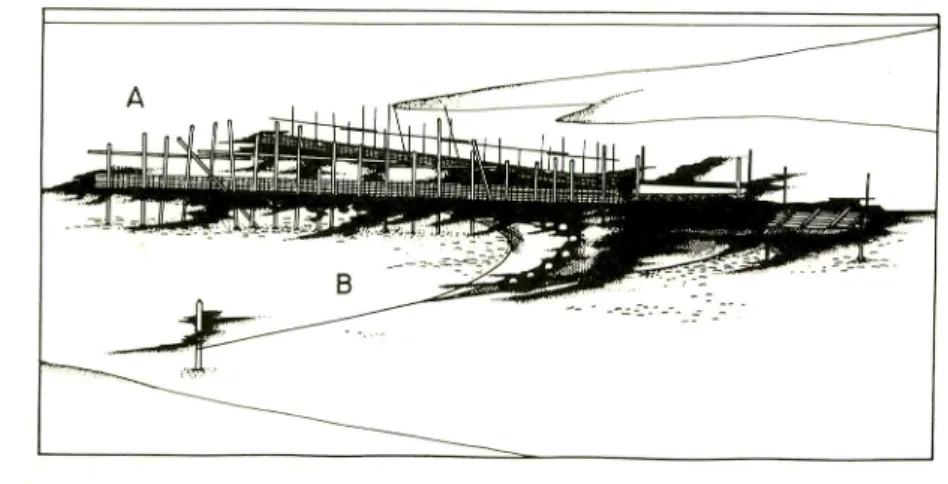
The SALURAN was set either directly beside, behind or at some distance from the TANGAB. Fig. 1 shows schematically how the two devices were operated. The
SALURAN was set farther inside the river to avoid the immense force of inrushing
current. Large number of fry and juveniles of other species were caught with milkfish fry, but it was not possible to record the exact catch data for these, and weights were
Fig. 1. Illustration comparing the operation of fixed filter nets TANGAB (A)
36 nd Kaa w a m u r a: The mechanics of mass occurrence of milkfish fry
considered sufficient for the study.
Fry movement in relation to tide:
The number of fry captured was related to time and tidal condition. The most precise data was obtained from the fixed filter net TANGAB over several consecutive catch periods. Milkfish and other finfish species were indentified and counted.
Marking experiments:
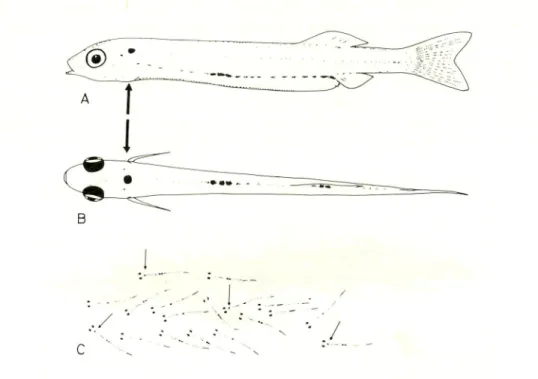
The purpose of marking the fry was to follow the movement of the fish in coastal waters. From the preliminary experiments with a number of dyes, it was found that food coloring (Acid red 106, San-ei Chemical Industries, Japan) was the most suitable for this experiment. At a concentration raging from 3-5 % dye solution, live milkfish fry could be marked within 30 min without mortalities. However, the dye solution should be well aerated and crowding should be avoided. This is achieved by adjusting the amount of water-dye solution to the number of fry. Higher dye concentration reduced staining time, but resulted in faster fading of color from organs. Using red food coloring, the fry retained a rose-red color for 2-3 hours after transfer into sea water. Deep red was found along the upper and lower jaws, at the spleen, the fins, and as a relatively large red spot in the head slightly behind the eyes. The marked fry were easily recognizable from those unmarked. The spot in the head remained visible up to 48 hours, and after some practice it was possible to detect these marked fry with unaided eyes (Fig. 2). Marked fry showed no sign of impaired swimming activity, and moved normally among the unmarked fry.
Prior to the experiment at Hamtic, leaflets containing information about the purpose
/
C
Fig. 2. The lateral view (A) and dorsal view (B) of milkfish fry showing
natural pigmentation pattern and spot marked (indicated by arrow)
by vital color. Illustration showing impression of marked fry (arrow) as seen among unmarked ones (C).
Mem. Kagoshima Univ. Res. Center S. Pac, Vol. 3, No. 2, 1983 37
and procedure of the marking experiment were distributed to the fry collectors. The leaflets, written in the local dialect, requested their cooperation and offered a reward for each recaptured fry. Since the fry collection area covered nearly 3 km of coastline with more than 70 fishing gears in operation at one time, 10 highschool students were asked to assist in the experiment. They were shown the entire procedure of staining and were acquainted especially with the detection of marked fry among numerous un marked ones. They were positioned at some distance from each other along the entire fry collection area. As soon as the catch was brought ashore, marked fry were counted
and the time recorded.
The milkfish fry used for the experiment were freshly captured from the same area, counted and allowed to stay in a container overnight or for several hours. Dead or injured fry could be replaced during this period. Dye was added 30 minutes before
release and the batch of fry was brought by boat to the release point 4-5 m deep
approximately 150-160 m from the shore. The fry released were observed and followed
by skin and SCUBA diving. Current was observed underwater. A total of 4060 fry were marked and released at Hamtic and another 200 fry at Busuanga, Palawan Island.
Stomach content analysis:
Scanning electronmicroscopy (SEM) was employed for the investigation of the feed ing habits of the milkfish fry since lightmicroscopy could not render insights to the
question of extremely low feeding incidence in fry.
Care was taken to ensure a quick but gentle collection of fry by means of a towed
seine (SAGYAP).
In order to avoid or minimize any possible regurgitation during
handling, the entire catch was immediately poured through a sieve and dipped into
10 % BouiN's solution. The samples were fixed in 5 % formalin, were dissected and
the whole intestinal tract removed, dehydrated through an ethanol series, cut open at
different positions, dried, and then sputtered with gold. The scanning eclectronmicroscope
used was an ARL Shimazu EMX SM of Kagoshima University, Japan.
RESULTS AND DISCUSSION
It is necessary to describe the conditions under which the data were collected. It
is assumed that the intense fishing effort during the fry season produces result reflective
of actual fry abundance. However, it may also disturb the natural distribution and
movement pattern of the fry along the coast. The prevailing conditions may have been conducive only to certain specific questions under investigation. Along the 3 km coastline representing the core area of Hamtic fry ground, an average of 96 fishing operations per day, each lasting about 3 hours was recorded over the entire period of the fry
season. An average of 180 fry per hour or 540 fry per operation were caught. Fish
ing operations were stopped when catches dropped to less than 40 fish per hour. Nearly 200 mobile gear of different types were available and ready for use during the peak months. About 50 % of these gear were in constant operation. Several large
filter nets (TANGAB) were used at the mouth of the Malandog/Bocboc River (see Fig.
17) but the average catches represented only 6.3 % of the total catch due to the very high fishing intensity by mobile gear. Fishing effort fluctuated according to the daily
38 Buri and Kawamura : The mechanics of mass occurrence of milkfish fry Moonphase • 3 x 10 0—, 1980
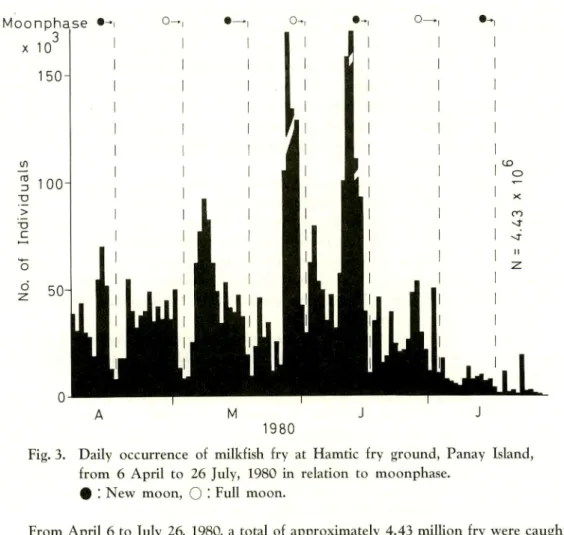
Fig. 3. Daily occurrence of milkfish fry at Hamtic fry ground, Panay Island, from 6 April to 26 July, 1980 in relation to moonphase.
# ! New moon, O • Full moon.
From April 6 to July 26, 1980, a total of approximately 4.43 million fry were caught by all fry collectors along the coast and at the mouth of the Malandoc/Bocboc River
of Hamtic. Fig. 3 shows that fry abundance follows the general seasonal pattern, i. e.
high peaks in May and June and lower abundance in the preceding and following months
(SCHMITTOU, 1977). The daily fluctuation of fry abundance partly reflects the varying wind and wave conditions. However, this fluctuation is probably due to unresolved
patterns in the spawning activity of the adults. Owing to lack of evidence this matter
cannot be discussed at this stage.
The block diagrams in Figs. 3 and 4 indicate an increase of fry one or two days before and during the new and full moon period. This phenomenon is well known to
fry collectors and well documented (SCHUSTER, 1960). However, 2-3 days after the full
and new moon there is an abrupt and significant drop of fry abundance (=disappea
rance of fry from coastal waters). This trend occurred consistently from the beginning
to the end of the fry season. In several marine invertebrates and vertebrates the lunar
periodicity is most directly concerned with reproduction (ENRIGHT, 1974; DECOURSEY
et al, 1976). The disappearance of milkfish fry in a synodic mooncycle of about 15
days does not directly concern with reproduction, since it has been observed that spawning takes place everyday, i. e. eggs had been collected by plankton net every day for more than a month (KUMAGAI, unpublished). This sudden disappearance may be
Mem. Kasoshima Univ. Res. Center S. Pac, Vol.3, No2, 1983 % Total Catch 15H 0
g
Moonphase
6 I 7 DaysFig. 4. The percentage of fry abundance in relation to lunarphase. # ! New moon, O '- Full moon, 3 ; First quarter, O • Last quarter.
Corresponding tidal fluctuation (amplitude) is shown below.
a kind of recruitment strategy. The synchronisation of disappearance suggests not a
passive distributional pattern but rather an active response to certain environmental
conditions.
The lunar periodic character of tidal fluctuations (height and duration of flood
or ebb tide) seems to control the appearance of fry in coastal waters, and the amount of catch by certain gear. Fig. 4 shows that, 2-3 days after the new and full moon, fry catch in shore waters is lowest (expressed as a percentage of the total catch) when tidal fluctuations are greatest. However, the fry catch in the fixed filter nets indicates a closer relationship between the duration, not the hight, of tidal flood and catch. Inspite of the neap tide condition around the first and last quarter moon phases, peak catches by fixed filter net TANGAB were obtained during this period of relatively long duration of flood tide (Fig. 5).
Field observation indicated that shoreward wind could increase the duration as
well as the height of tidal flood, enhancing the fry catch. The reason for higher catch could partly be due to the increase in the volume of surface water bringing fry to shore (SCHMITTOU, 1977). However, the authors believe that this passive factor of wind or wave transport is not the primary factor controlling fry abundance. In
view of the disappearance of fry 2-3 days after the new or full moon, it is suggested
40 Buri and Kawamura: The mechanics of mass occurrence of milkfish fry
Moonphase
30.A 31.5 10.6.1980
Fig. 5. Relationship between percentage of total catch (shaded area) of milkfish fry by fixed filter net TANGAB, and duration of flood tides. Arrows indicate approximate peaks. Corresponding tidal range is indicated
below.
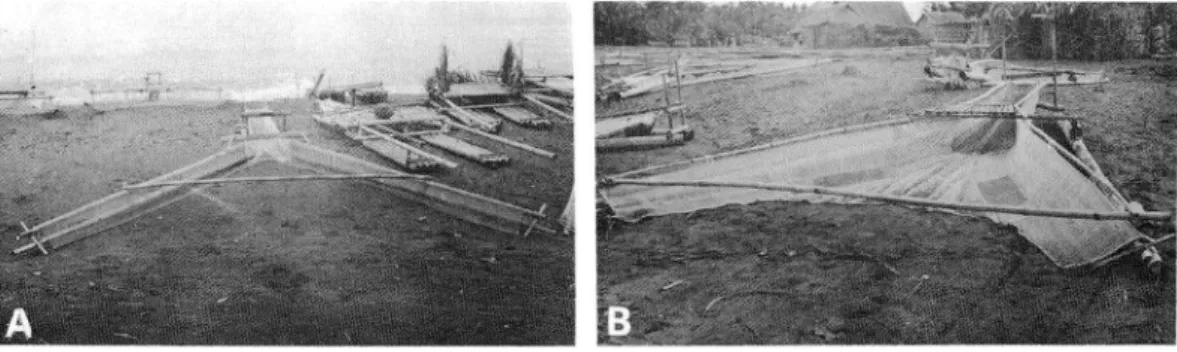
Fig. 6. Two variations of mobile fry collection gear BAKA-BAKA (fry sweeper) (A) with broader but shallower wings for the use in calm days and (B) with narrower but deeper wings for rough days.
that milkfish fry actively avoid coastal waters when hydrographic conditions are such that the seaward transport of the ebb-tide overrides the landward transport of the
flood tide.
BURI (1980) observed that milkfish fry move in the upper superficial surface layer
along the shallow portion of the lagoon and river bank. That the fry also occupy
Mem. Kagoshima Univ. Res. Center S. Pac, Vol. 3, No. 2, 1983 41
gear. Fig. 6 a shows one of the latest developments of mobile fry collecting gear BAKA-BAKA. The depth of the wings was reduced to minimize drag and wing span increased for driving effect or filtration of larger surface area. Even during rough sea conditions, relatively shallow gear (Fig. 6B) could still be used. BuRl(1980) postulated that the ecological significance of surface swimming was to avoid contact with the bottom (injuries) and to minimize predation.
Catch comparison between the two types of fixed filter nets, TANGAB and SALURAN, showed that milkfish fry also exibit a marked preference for the upper surface layer during movement in the river. Less than 0.1 % of the fry was found below 5 cm. However, large numbers of fish and prawn fry and juveniles were captured below this surface layer.
The occupation of surface water and the avoidance of shore waters at certain tidal conditions suggest an adaptive behavioural pattern and could be explained as follows : During the 2-3 days after the new and full moon the incoming high tide results in transport through river inlets to backwaters. Milkfish fry entering the backwater
environment are subjected to
a) the danger of being flushed back into the sea (unsuccessful entry). Current meter measurements showed that the highest speed of current was attained approxi mately at the beginning third of the flood and that speed reached zero both at the beginning and at the end of the flood. This implies that as the duration of the flood tide decreases only limited time for optimal and successful entry exists.
b) the danger of being entrapped in high level tide pools when high tides recede.
3 - 1 5 . 5 . 1 9 8 0
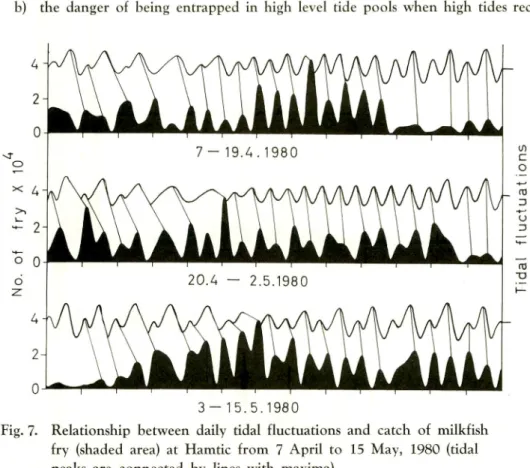
Fig. 7. Relationship between daily tidal fluctuations and catch of milkfish fry (shaded area) at Hamtic from 7 April to 15 May, 1980 (tidal peaks are connected by lines with maxima).
42 Buri and Kawamura : The mechanics of mass occurrence of milkfish fry
A considerable number of milkfish fry can be collected after such hightides from small pools situated in higher levels of the swamps and mangrove forests.
The behaviour of milkfish fry can be better understood when compared with
that of penaeid fry which react differently to the vertical distribution and tidal conditions,
i.e. do not show a drop in abundance after the new and full moon (MOTOH, 1981),
even though they enter backwater sedimentary environments like milkfish. Milkfish fry appear to actively avoid ebb transport, while penaeid fry actively resist. Penaeid fry caught in shore waters already have well developed and full functional pereiopods, which allow them to cling onto objects. MOTOH (pers. comm.) believed that penaeid fry cling to objects on the shore bottom or river beds during ebb tide to resist the current but swim or drift with the current during flood transport. The first author observed penaeid fry clinging to submerged rocks and branches in the clear calm portion of the swamp during low tide. The calcified shell of the shrimp fry makes it more resistant to injuries from bewhirling particles than the unprotected milkfish fry. The mortality of penaeid postlarvae is very low compared with that of milkfish fry. Although the biology of milkfish fry is not well known and understood, it is believed that the movement of this animal is governed by both active as well as passive factors, which combine to achieve a difinite goal i. e. the successful colonization
J Month
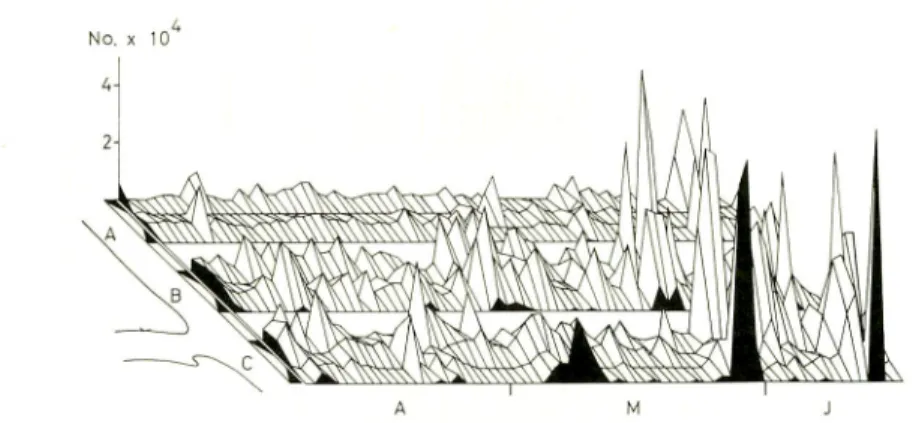
Milkfish fry catch at three adjacent areas of operation (A, B, C) in Hamtic in April-June 1980, broken down to four time periods of the day.
Mem. Kagoshima Univ. Res. Center S. Pac, Vol. 3, No. 2, 1983 43
of nursery grounds with the minimum energy expenditure and risk.
Several environmental conditions affect milkfish fry abundance at a given location, time of day and tidal condition. Fig. 7 shows the relationship between the daily tidal fluctuations and the fry catch (shaded area). Lines connecting daily high tide peaks and catch maxima serve as visual aids for the "distorted" relationship. At Hamtic the geomorphological condition of the coast is such that the operational area for mobile gear during low tide is many times that during high tide. Since fishing effort was very intense, a higher catch was still obtained at low tide. The data in Figs. 3 and 7, show parallel rhythms, both subject to lunar modulation with strongest effect during
flood tides.
Assuming that fishing effort is a function of fry abundance, catch data reflect hourly fluctuations of fry abundace. Daily catch was divided into periods as follows : from 2400-600h, 600-1200h, 1200-1800h, and from 1800-2400h. The fry collection area was divided into three : Area C from the middle of the Malandog/Bocboc River about 800 m to the north, Area B from the middle of the river about 800 m to the south,
and Area A further 1000 m to the south from the end of Area B.
Fig. 8 shows that in all three areas (A, B, and C) the lowest catches were obtained during the first half of the night (from 1800-2400h) and larger catches were taken during the second half of the night (from 2400-600h). There are some indications of afternoon peaks (from 1200-1800h) during the day. The lack of supporting environmental data does not allow any interpretation of this result. However, it is evident that most of the catch was taken from Area B and C flanking Malandog River (Fig. 9). Catches in Area B (39.5%) and Area C (44.5%) are significantly higher than that obtained from Area A (16.0%), that is, fry are more concentrated around river mouths or lagoon outlets. This distributional pattern supports the view that there is active migration of fry into depositional backwaters. At Hamtic the catch of fry within the river mouth by TANGAB usually accounts for only 10% of the total catch because of the overwhelming number of mobile gear used. When the operation of mobile gear is hampered by rough seas, however, the TANGAB could account for over 74% of the catch. In fry grounds where fishing competition is very low (Palawan Islands), fixed
Fig. 9. Three dimensionl diagram of milkfish fry catch in three areas of operation A, B, and C in Hamtic in April-June 1980, showing relation to the Malandog River mouth between B and C.
44 Buri and Kawamura: The mechanics of mass occurrence of milkfish fry
filter nets mounted across inlets or river were the most successful and often the only
gear for collecting milkfish fry. This indicates that a very high percentage of fry arrives within a certain radius of the river mouth.
Results of marking experiments conducted at Hamtic as well as in Busuanga, Palawan,
showed that upon release, fry headed immediately towards the shore. At a depth of 4-5 m most of fry dived to the bottom and headed towards shallow waters. On the
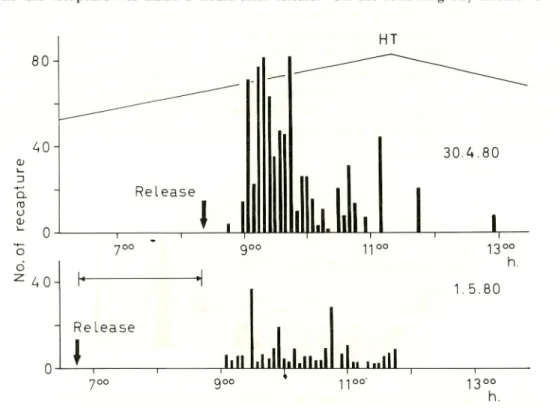
other hand, fry released 10-20 m from shore and in 60 cm water depth remained at the surface. Fig. 10 shows the results of two marking experiments at Hamtic. The first batch (2060 fry) was released approximately 3 hours before high tide HT and the second batch (2000 fry) was released on the following day about 5 hours before high tide. At the time of release, water current 150 m from shore was negligible, and towards the river mouth, it gradually increased. The surface current along the shore indicated a
slow northward flow as LLORCA (1974) found from isohaline curves.
From the first batch a total of 767 marked fry or 37.2% were recaptured. Fry were recaptured near the river mouth by mobile gear 25 min after release. This was followed by a series of recaptures by mobile and fixed gear, majority of which were made 1.5-2 hours before high tide. Recaptures were made during or after high tide by mobile gear as far as 2 km from the release point. Marked fry were last taken 4.5 hours after release.
From the second batch a total of 207 marked fry or 10% were recaptured. The first was caught 2 hours and 20 min after release. Recaptures were made by fixed filter nets and mobile gear, near the mouth of the river 1-2 hours before high tide. The last recapture was made 5 hours after release. On the following day another 500
80-40 D ro <J O 6 40-Release Release JjII 7C HT
ill
11'liillhlilliil
f
ll
Ill
30.4.80 13°° h. 1.5.80 13°° h.Fig. 10. Recapture of marked milkfish fry from the first release (upper, 30 Aplil,
Mem. Kagoshima Univ. Res. Center S. Pac, Vol. 3, No. 2, 1983 45
marked fry were recaptured by fixed filter net 1.5-2 hours before high tide. It was assumed that these fry belonged to the second batch because color of marked fry from the first batch would already have faded. Overall a total of 1474 fry out of 4060 were recaptured (about 36%). It is interesting to not that the first recaptured
fry covered the distance of 150 m in 25 min or at an average speed of 10 cm/s. KUMAGAI
(unpublished data) found from laboratory experiments that the cruising speed of milkfish
fry was 9 cm/s.
Recapture data indicated scattering of fry over a large area. This indirectly con firms the non-schooling behaviour of milkfish fry in a tank as reported by KAWAMURA
and SfflNODA (1980). However, the catch of fry by mobile gear often shows periods of zero, and periods of very high numbers. Fry probably form loose or dense aggre
gations for short periods of time when moving in and out of coastal waters.
The most interesting finding of these marking experiments was that, regardless of the time of release, the fry arrived on the shore at the same phase of the tide (Fig. 10). Fry movement towards the shore as well as the time of entry into backwaters appear to be regulated by tidal conditions. The fry from the second batch took 2 hours longer than those of the first batch to arrive on the shore. This may be reflection of different levels of swimming activity (exitability), with high levels near high tide and low levels
during low tide.
The recapture of 500 fry the day after the second release shows an adaptive behavi
our : entrance into backwaters only on suitable flood tides. Fig. 11 shows the catch data
from TANGAB operated on the same day as that of the marking experiments. The catch curve confirms that peak acitivity, i.e. entry of fry into backwaters occurred 1-3 hours before high tide (800-ll30), with an intensity such that several thousands of milk fish fry were collected within only a few minutes. This suggests movement of an active
rather than a passive character.
Results of three consecutive days of intense fishing with a large TANGAB showed that different species of finfishes had different patterns of abundance with tidal condi tions. Milkfish fry and the juveniles of Therapon jarbua showed similar patterns (Fig. 12). The fry of Elops hcuvaiensis showed a distinct delay in the period of abundance.
-.2
No. of fry caught
by fixed filter net
Fig. 11. Catch of milkfish fry by fixed filter net TANGAB at Malandog/
46 Buri and Kawamura : The mechanics of mass occurrence of milkfish fry
No,
] C. chanos
j T. jarbua
J E. hawaiensis
300
200
2 4
Hours after LT
Fig. 12. Catch relationships of milkfish fry, Chanos chanos, Therapon jarbua,
and Elops hawaiensis by TANGAB during consective flood tides.
Since E. haivaiensis is heavily preyed on by T. jarbua, among others, this delay suggests
a way to minimize predation.
Peak occurrence of milkfish fry is from May to June, of penaeid postlarvae (P.
monodon) from June to July (MOTOH, 1981), and gobiid fry from July to August.
During the fry stage of these species, some overlapping of food and feeding habits
exist. Competition could be severe, considering the mass recruitment of gobiid fry,
which can be many times bigger than milkfish fry. We suggest that seasonality of abundance may be a strategy to maximize resource utilization and minimize competition
and resource sharing.
BURI (1980) believes that shore waters represent a kind transitional environment for
milkfish fry and that high mortality occurs in this habitat as well as in the nursery
backwaters. The high recruitment rate of milkfish fry estimated at about 120 million for the coast of Panay only and yet the low numbers which successfully enter and
colonize the limited depositional environments of Panay Island suggests a very high
mortality rate. Intense predation and absence of food seem to be responsible for fry mortality. This "second" critical period seems comparable to that mentioned by MAY (1974). Many fish species constitute a community with milkfish fry. Most of these species are much larger in size and of more advance developmental stage than milkfish
fry (Fig. 13). The majority of these species (a and b) cause injuries, or prey on the milkfish fry (BURI, 1980). Although it is not possible to quantify the mortality rate,
predation pressure is probably very high. We postulate that this high mortality rate is counteracted by fry seasonality, fry behaviour, and high recruitment rate. If this
Mem. Kagoshima Univ. Res. Center S. Pac, Vol.3, No. 2, 1983
2cm
Fig. 13. Illustrations of fry and juveniles of finfishes associated with milkfish fry (indicated far right by an arrow). Size relationships
and shaded contours are drawn to exact scale and show fish
species which prey on milkfish (a), those which cause injuries (b), and those which do not attack milkfish at this stage(c). hypothesis holds true, the reproductive strategy of milkfish may be resolved.
BURI (1980) observed low feeding incidence in milkfish fry but found no evidence
of starvation or weakness. It was suggested that this voluntary low feeding level repre
sents a species specific adaptation during the migration from offshore to coastal back
waters. Stomach analysis by scanning electronmicroscopy provided further supporting
evidence for this temporal non-feeding activity. The intestinal tract of milkfish fry forms a single straight tube connecting the oesophagus to anus. Externally the intestinal tract can be divided into anterior and posterior portions. The latter portion which starts at about the midpoint is 3 times larger in diameter. Laboratory and field obser
vation showed that ingested food normally passed quickly through the anterior portion
to be digested in the posterior portion.
Fig. 14(A) shows the interior view of the anterior portion with numerous wall folds and (B) the posterior portion covered with mucal glands. Both photos represent the general impression of the nearly completely empty intestinal tract of milkfish fry
48 Buri and Kawamura : The mechanics of mass occurrence of milkfish try
Fig. 14. Scanning electronmicrographs of (A) interior view of anterior and (B) posterior portion of the intestinal tract of milkfish fry. C, D, E, F, and G, remains of food particles found in the intestinal tract. Scale, 10 ^m for A, B, D-F, 3 ^m for C and G.
Mem. Kagoshima Univ. Res. Center S. Pac, Vol. 3, No. 2, 1983
caught in shore waters. Out of 20 tracts examined very few particles were found mostly in the posterior portion. These particles have been identified as calcium fragments as checked by an X-ray micro-analyser, SHIMAZU. Photos C and D show these calcified pieces, presumably structures of as yet unidentified prey. These indigestible "food residues" are of definite form and are found scattered in the intestinal tract. Only a few strands of organic fiber probably of terrestrial plants (E), plant pollen (F) and colonies of non marine bacteria (G) could
be detected.
From the lack of stomach content and the fact that
the calcified remains are devoid of any trace of digestible tissue, it is concluded that the milkfish fry had not fed for a considerable period of time when caught in shore waters. The materials of terrestrial origin seem to be of insignificant nutritive value ; these were carried to shore waters by river runoff and probably ingested accidentally. SEM results, therefore, support the light microscopy findings of non-feeding activity of milkfish fry during their stay,
as well as before their arrival, in coastal waters. At this
early developmental stage and during the migration, the need for food must be very high. However, milkfish fry show low sensitivity to food deprivation.
Inspite of this high tolerance to starvation, it is important that this "unfavorable" condition should be
overcome within the shortest period. The avoidance of Fig. 15. Daily length
Size to Q O co CT> O
coastal waters at certain moon phases, and the selection of the best tidal conditions by the fry as discussed before support this view. Morpometric measurements strengthen this hypothesis, showing that preparation for migration takes place before the fry reach shore waters and that migration commences only at a definite developmental
stage.
The length frequency distribution of 1864 fry captured
on 6-30 April 1980 shows that the size of all shore-caught fry remains within the relatively narrow range of 10-15 mm FL (Fig. 15). Milkfish fry caught in other areas or years
were of similar size (KUMAGAI et al, 1976; LlAO et al, 1977 ; SENTA et al, 1980 b).
A comparable size variation is shown by laboratory-reared fry of the same age group (LlAO et al, 1979). It thus seems that wild fry within the size range of 10-15 mm Fl, belong to a limited age group. That this holds true for millions of fry year after year speaks against passive drift. Although methods to determine the exact age of fry are still lacking, it is possible to determine with considerable accuracy their various developmental stages. The ossification pattern in milkfish shows very rapid development of a skeletal system in the early life stages (BURI, in preparation). The ossification pattern is sufficiently sensitive to study the developmental stage and relative age of
mm FL 11 13 15 49
I 50 7.
CD co frequency represen tation of milkfishfry caught at Hamtic from 6 April to 30
April, 1980. Lines connecting peaks
50 Buri and Kawamura : The mechanics of mass occurrence of milkfish fry
2 mm
Fig. 16. Ossification pateern of milkfish : (A) larval stage (9.3mm FL,
oceanic habitat), (B) fry stage (12.8 mm FL, coastal habitat), and (C) juvenile stage (13.2 mm FL, backwater habitat).
milkfish fry. About 3000 milkfish larvae caught during the study period were stained with alizarin red and analyzed with a profile projecor. Fig. 16 shows roughly three
consecutive ossification stages ; (A) shortly before fry stage, (B) fry stage and (C) early juvenile stage shortly after metamorphosis. With slight and insignificant variations, the stage of ossification of fry caught in shore waters could only and clearly be
designated as B regardless of size. LlAO et al (1977) found the same ossification
pattern in milkfish fry caught from the coast of South Taiwan. This strictly uniform developmental stage of the skeletal system of all fry is probably related to changing
physiological requirements and the subsequent migration into coastal depositional
environments.
BURI (1978) observed some reduction of body pigmentation during, the fry stage.
This may allow the transparent fry to optically disappear from predators under the diffuse illumination that preveils in turbid shore waters. The above observations show that interaction of milkfish with predators in shore waters had produced diverse and selective antipredator adaptations such as body transparency, the use of timing (seaso
nality), and spacing (vertical distribution). These factors show an active process which minimizes susceptibility to predation. It is interesting to note that milkfish fry do not exhibit noctural habits to avoid predation, as do penaeid fry. This is probably due to the overriding pressure of limited optimal condition of flood transport.
KAWAMURA and HARA (1980a, b) reported that the optomotor reaction (OMR) of shore-caught fry was weak but develops rapidly during metamorphosis and becomes almost perfect in the juvenile. However, since particulate feeding on zooplankton occurs early in the larval stage, indicating a certain degree of OMR, KAWAMURA and HARA (1980b) concluded that this low OMR cannot be attributed only to the develop ment of the retina. We here suggest that the weak OMR in milkfish fry may be an adaptation related to the shorward migration and the shift from clear oceanic waters
Mem. Kagoshima Univ. Res. Center S. Pac, Vol. 3, No. 2, 1983 51
to turbid coastal habitats. A weak OMR would allow the fry to drift with the current, which may be of net advantage during the stay in turbid coastal waters.
BURI (1980) and BURI et al. (1980) stressed that milkfish fry grounds are not dis tributed randomly but are adjacent to or near coastal depositional environments with rich bottom deposits. In the case of milkfish this includes fresh, brackish and marine habitats. Salinity gradients from river runoff have been speculated to be the cause of fry abundance (LlN, 1969; SCHUSTER, 1960). A number of laboratory experiments (JUL1ANO and RABANAL, 1963 ; JUARIO and VANSTONE, 1976; PAN1KKAR, 1953) as well as aquaculture practice show high tolerance of fry to low salinity.
River systems do not necessarily imply the existence of depositional habitats, and care should be taken in relating them to fry grounds. This discrepancy is shown in Fig. 17. Hamtic is a very productive fry ground with extensive mangrove and nipa swamps (shaded black) fringing the Malandog/Bocboc river system. Only 15km north of Hamtic is the Sibalom River, a larger system with more runoff, however, the river flows over rock and sand beds with only few locations of marine and terrestrial deposits. The catch of milkfish fry from Sibalom is practically insignificant compared with that of Hamtic. The marked difference in fry abundance within this short distance of 15 km probably due to difference in water chemistry does not support the idea of passive drift. The authors believe that potential fry grounds are to a certain extent predictable, given sufficient information on the geomorphological condition of the coast.
The authors were able to travel in many parts of the Philippines and observe numerous types of coastal environment. It was evident that very few coastal areas,
Sibalom River Mangrove/ Nipa- swamp Depth ( fathoms ) 1 Km A B
Fig. 17. Map of Hamtic fry ground (A) showing extensive mangrove and nipa swamps (shaded black) fringing Malandog/Bocboc River and (B)
Sibalom River without any depositional habitat(redrawn after Philippine
52 Buri and Kawamura : The mechanics of mass occurrence of milkfish fry
Nipa, Mangrove
Fry nursery ground
Fry fishery Spawning ground
Stream, River Coral reef
Fig. 18. A typical milkfish fry ground in the Philippines showing major ecosystems which directly and indirectly influence fry abundance.
especially riverine, swamp and lagoon systems, still remain in their natural condition. Fig. 18 shows a typical coastal environment representing an ideal milkfish fry ground.
The fry ground of Hamtic, although much altered by human activities, shows conditions favorable for milkfish fry. Four major ecosystems directly or indirectly affect this fry
ground are highland forest, nipa and mangrove swamps, streams and river (inlets), and
coral reefs. The forests are the watersheds which help to make the low wet coastal areas through deposits and runoffs. Connections of backwaters with the sea are
permanently maintained through the river or stream outlets, or seasonally restored
(semi-closed lagoon) through floods. Nipa and mangrove swamps among other depositional environments form the nursery grounds for fry and juveniles, providing food and shelter. The river and stream systems represent transitional environments used by the fry as passages for entering the nursery grounds. Lastly the coral reef ecosystem re
presents the spawning ground of milkfish (SENTA et al, 1980a). The importance of
these ecosystems for the milkfish need not be discussed in detail. There is no doubt
that alteration or utilization of one of the first three ecosystems, to some extent will
change the physico-chemical conditions of the fry ground. River and stream inlets are an "environmental bottle neck". Migrating fry, juveniles, and subadults are most vulner able to destructive exploitation methods like TANGAB and fish corrals. Destruction and utilization of coral reef communities directly affect the survival of fry.
Forest Watershed
CONCLUSIONS
govern-Mem. Kagoshima Univ. Res. Center S. Pac, Vol. 3, No. 2, 1983 53
ing the occurrence and movement pattern of fry in coastal waters. The movement of scattered fry at a definite developmental stage from offshore waters and the formation of high density aggregations in coastal waters can be considered as a feeding migration coupled with metamorphosis. The mechanics and the timing of the movement are the result of evolutionary adaptation and are the main components of recruitment
strategy. We found that:
1) all fry caught in coastal waters are of a similar developmental stage
2) fry grounds are coastal waters with connection to depositional environments
3) fry show definite physiologcal, behavioural, and morphological adaptation dur
ing migration
4) fry show rhythmic activities which are subjected to lunar variations.
Milkfish fry are subject to high mortality during this migration period which seems comparable to that during the early larval stage. The evolutionary response to this intense predation pressure in coastal and backwater habitats is the seasonal high recruit ment rate (mass appearance). It is suggested that higher food availability in these environments exerts a stronger selective pressure over predation.
REFERENCES
Buri, P., 1978, Notes on the pigmentation pattern in the larval developmental stages of laboratory-reared milkfish. Aquaculture Dept., SEAFDEC, Quarterly Res.
Rep., 2(3), 26-32.
, 1980, Ecology on the feeding of milkfish fry and juveniles, Chanos chanos (Forsskal) in the Philippines. Mem. Kagoshima Univ. Res. Center S. Pac, 1(1),
25-42.
, Kumagai, S., Banada, V., Trino, A. and Castillo, N., 1980, Developmental and ecological stages in the life history of milkfish, Chanos chanos (Forsskal).
Aquaculture Dept., SEAFDEC, Quarterly Res. Rep., 4(1), 5-10.
DeCoursey, P. J. (ed.), 1976, Biological Rhythms in the Marine Environment. Univ.
South Carolina Press.
Enright, J. T., 1975, Orientation in time: Endogenous clocks, in "Marine Ecology" Voll. 2, Part 2, (ed. by KlNNE, O.), Wiley, London, 917-944.
Juario, J. V. and Vanstone, W. E., 1976, Preliminary notes on salinity preference of milkfish, Chanos chanos fry. Internat. Milkfish Whorkshop Conf. May 19-22, 1976, Tigbauan, Iloilo, Philippines.
Juliano, R. O. and Rabanal, R. H., 1963, The tolerance of milkfish fingerlings and fry, Chanos chanos (Forskal) to decreases in salinity. Copeia, 1, 180- 181.
Kawamura, G. and Bagarinao, T., 1980, Fishing methods and gears in Panay Island,
Philippines. Mem. Fac. Fish., Kagoshima Univ., 29, 81-121.
, Hara, S. and Bagarinao, T., 1980, A fundamental study on the behaviour
of milkfish fry for improving the efficiency of traditional fry collecting gear in the Philippines. Mem. Kagoshima Univ. Res. Center S. Pac, 1(1), 65-74.
and Hara, S., 1980 (a), The optomotor reaction of milkfish larvae and juveniles. Bidl Japan. Soc. Sci. Fish., 46, 929-932.
54 Buri and Kawamura : The mechanics of mass occurrence of milkfish fry
juveniles in captivity, ibid., 1297-1300.
and Shinoda, Y., 1980, Change in phototactic behaviour with growth of milk fish, Chanos chanos (Forsskal). Mem. Kagoshima Univ. Res. Center S. Pac, 1(1), 75-87.
Kumagai, S., Bagarinao, T. and Unggui, A., 1980, A study on the milkfish fry fishing
gears in Panay Island, Philippines. Aquaculture Dept. SEAFDEC, Technical Rep.,
6, 34 p.
, Villaluz, A. C, Tiro, L. B. and Vanstone, W E., 1976, The occurrence of
milkfish, Chanos chanos, fry in Pandan Bay, Antique, from 21 May to 25 June,
1975. Internat. Milkfish Workshop Con/., Tigbauan, Iloilo, Philippines, May 19-22, 1976. 8 p.
LlAO, I-Chiu, Juario, J. V., Kumagai, S., Nakajima, H, Natividad, M. and Buri, P., 1979, On the induced spawning and larval rearing of milkfish, Chanos chanos (Forskal). Aquaculture, 18, 75-93.
, Yan, H. Y. and Su, M. S., 1977, On the morphology and its related problems of milkfish fry from the coast of Tungkang, Taiwan. J. Fish. Soc Taiwan,
6(1), 73-83.
Lin, H. S., 1969, Some aspects of milkfish ecology. Report of Fishculture Research,
Joint Chinese-American Rural Reconstruction Fisheris Service, 68-90.
Llorca, M. N., 1974, Physico-chemical observations in some pilot areas during the peak season of Bangus fry, Chanos chanos in Visayan province. PCARR Project,
2, 236-257.
May, R. C, 1974, Larval mortality in marine fishes and the critical period concept, in "The Early Life History of Fish" (ed. by Blaxter, J. H. S.), Springer Verlag,
Berlin, Heidelberg, N. Y., 3-19.
MOTOH, H, 1980, Fishing gear for prawn and shrimp used in the Philippines today.
Aquaculture Dept., SEAFDEC Technical Rep., 5, 43 p.
, 1981, Studies on the fisheries biology of the giant tiger prawn, Penaeus monodon, in the Philippines, ibid., 7, 128 p.
PANIKKAR, N. K., 1953, Some aspects of adaptation in Chanos chanos (FORSKAL). Proc
Indian Acad. Set., 37, 203-313.
SCHMITTOU, H. R., 1977, A study to determine the spawning grounds of milkfish and the environmental conditions thet influence fry abundance and collection along
the Antique coast of Panay Island, Philippines. Proc 8 th. Ann. Meet. World Marie Soc, Sna Jose, Costa Rica, Jan. 9-13, 1977, 91-105.
SCHUSTER, W. H, 1960, Synopsis of biological data on milkfish, Chanos chanos (FORSKAL), 1775. FAO Fish. Biol. Synop., 4, 57 p.
SENTA, T., KUMAGAI, S.and CASTILLO, N.M., 1980a, Occurrence of milkfish, Chanos
chanos (Forsskal) eggs around Panay Island, Philippines. Bull. Fac Fish.
Nagasaki Univ., 48, 1-11.
, Hirai, A, Kanashiro, K. and Komaki, H, 1980 b, Geographical occurrence
of milkfish, Chanos chanos (Forsskal) fry in southern Japan. Bull Fac Fish., Nagasaki Univ., 48, 19-26.
Smith, I. R., 1978, An economic analysis of the structure and performance of the milkfish (Chanos chanos) fry industry in the Philippines and related aquaculture development policies. Ph. D. dissertation, Univ. of Hawaii, 307 p.
Mem. Kagoshima Univ. Res. Center S. Pac, Vol.3, No. 2, 1983 55