Report of the Second Seminar on Malignant
Lymphoma
著者
SATO Eiichi, HASUI Kazuhisa
journal or
publication title
鹿児島大学医学雑誌=Medical journal of
Kagoshima University
volume
47
number
Suppl. 2
page range
1-6
URL
http://hdl.handle.net/10232/18307
Report
Report of the Second Seminar on Malignant Lymphoma
Eiichi SATO and Kazuhisa HASUIOragnizing Committee
Second Department of Pathology, Faculty of Medicine
Kagoshima University, Kagoshima, Japan
The first seminar in Japan was held in Fukuoka in
1991 to focus the introduction of the Kiel classification
of nodal lymphomas to Japanese hematopathologists. The second seminar was planned in 1993 to discuss the ideas based on cases of extranodal malignant lympho mas and the new technology applied to hematopatholo-gy under the courtesy of Prof. M. Kikuchi and according to the advice of Dr. T. Suchi. The purposes of this seminar will be understood by the greetings of Prof. M. Kikuchi, the organizer of the first seminar and of Prof. E. Sato, the organizer of this seminar.
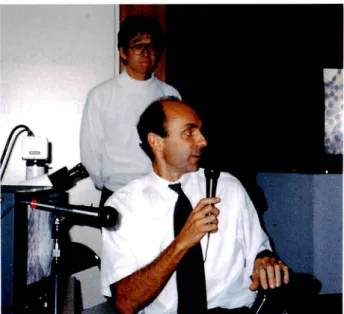
The second seminar was held in April 13-15, 1994 in the Hall of Imakyure General Hospital in Kagoshi ma,inviting Prof. K. Lennert (Fig. 1, Fig. 3) and Prof.
A. C. Feller (Fig. 4). Many Japanese hematopatholog
ists attended this seminar. The program of the seminar and the list of the participants were follows.
Fig. 2. Dr. T. Suchi, Aiichi Cancer Center Address for Correspondence: Eiichi SATO,
Second Department of Parthology, Faculty of Medicine Kagoshima University, Sakuragaoka 8-35-1,
890 Kagoshima, Japan
Fig. 1. Prof. K. Lennert, Kiel University, Germany
Fig. 3. Prof. K. Lennerl commented on the case presented by Dr. K. Sueyoshi (Kagoshima University).
( 2 ] Med. J. Kagoshima Univ., Vol. 47, Suppl. 2, November, 1995
We could have fruitful discussion in the papers and the cases of extranodal lymphomas. In the lecture of Prof. K. Lennert the newer concept of the Kiel classification was included, depending on the new data about lymphomas. Dr. T. Suchi (Fig. 2) reported a new idea on gastric lymphomas. Prof. A. C. Feller introduced new antigen-retrieval paraffin-immunohis-tochemistry. Prof. S. Mori introduced a new strategy to detect phosphorylation concerning oncogenesis of lymphomas. Prof. K. Nanba adressed his idea about
the difference in occurrence of malignant lymphomas
between Japanese and people in western countries. Dr. M. Tokunaga and Dr. M. Ohsawa presented their studies of Epstrin-Barr virus infection in malignant
lymphomas. Dr. M. Takeshita presented his study of
marginal zone lymphoma in Japan. Dr. R. Ichinohasa-ma introduced 3-colored flow-cytometry applied to a series of phenotype examination of malignant lympho mas in Tohoku University Hospital. Dr. K Ohshima reported an application of polymerase chain reaction (PCR) to hematopathology. Prof. S. Izumo introduced
their in-situ-PCR method for human T-cell leukemia
virus-related disease. And there were many discussion from several different standpoints in hematopathology in the case presentation (Fig. 3 and 4). Then, we thought that we have to make the proceeding of the seminar and the proceeding must be an important textbook for hematopathology. We contacted the authors of papers and the presenters of the cases to ask to write their articles for this supplement.
The Japanese hematopathologists who attended the seminar are in a sense fellow pupils and followers of
Prof. K. Lennert. We heard that the Institute of
Pathology of Kiel University has received many Japanese hematopathologists to learn and to study hematopathology and some of them founded Kiel Japanese Association. Prof. Y. Mori reported on the Kiel Japanese Association in this supplement.
This seminar could be held in the Hall of Imakyure
general Hospital by the courtesy of Shouwakai Foundation (President Dr. M. Imakyure, Fig. 5). And this seminar and the proceeding were supported financially in part by the Shouwakai Foundation and Kagoshima Institute of Preventive Medicine (Director Dr. T. Nakamura, KML Inc.).
Now, Prof. A. C. Feller is planning the third seminar in Liibeck 1996 June. We wish this seminar grows into the Japanese-German Lymphoreticular Workshop.
(by Hasui, K.)
Fig. 4. Prof. A. C. Feller showed his specimen treated by antigen-retrieval paraffin-immunhistochemistry of CD5 by a microscope-TV system.
Fig. 5. Committee of Shouwakai Foundation. From the right side of this figure,
the second person is President of the foundation Dr. Mitsuyuki IMAKYURE,
the first, Director of the foundation
Dr. Kazunori IMAKYURE, the third, Vice-director of the foundation
Dr. Takanori IMAKYURE,
the left-sided, Secretary-general of the Hospital
Greeting of the Organizer of the First Seminar, Greeting of the Organizer of the Seminar,
Prof. M. Kikuchi Prof. E. Sato
Fig. 6. Prof. M. Kikuchi, Fukuoka University
Good afternoon. It is our great pleasure that we could have the second seminar on updated Kiel classification here in Kagoshima. Three years ago, the
first seminar was held in Fukuoka. At that time, our
Japanese facilities were not accustomed to the classi fication and conception. For these three years, the classifications has gotten rapid distribution not only in Europe and United States of America but also in Japan. From today for three days, we could discuss and exchange our opinion with Prof. Lennert and Prof. Feller on extranodal lymphoma using slides in detail concerning this classification. I think we could get a lot
of fruitful results during these three days. Thank you.
Fig. 7. Prof. E. Sato, Kagoshima University
Good afternoon, ladies and gentlemen. Thank you
very much for your joining this seminar on extranodal malignant lymphoma. It has elapsed over three years since we had the first seminar on lymphoma with advice of Prof. Lennert in Fukuoka by the courtesy of Prof. Kikuchi. The purpose of the seminar is first of all to learn updated Kiel classification,because many of the tumor classification is based on the cytological recognition of normal counterpart, and in this sense, the Kiel classification is based on the cytological features of several components of non-neoplastic lymph nodes, namely cytic and blastic cells. We, Japanese, formerly have used the histomorphologic nomenclature for the lymphoma classification. The concept, however, has been tremendously changed. Therefore, we need a new prospect to recognize cytological features of lymphoma cells. Of course, it is an adventure for us to apply the Kiel classification to extranodal lymphomas. Nevertheless, wc dare to plan this seminar, because wc Japanese pathologists in terested in lymphoma studies seldom use the Kiel classification even for nodal lymphomas, despite that many pathologists in Japan have studied in Kiel under the guidance of Prof. Lennert. Furthermore, the Kiel classification is becoming to be used world wide, even
in the United States. Is it a difficult classification to
use? The answer will be given at the end of the seminar. We hope that every participants enjoy the seminar and arc interested in Kiel classification, getting an idea to approach the histogensis or etiology of extranodal lymphomas. Thank you.
(4) Med. J. Kagoshima Univ., Vol. 47, Suppl. 2, November, 1995
Program of the Second Seminar on Malignant Lymphoma:
Application of the updated Kiel classification to extranodal malignant lymphomas
1994. 4. 13-15. Kagoshima
Greeting of the Organizer of the First Seminar Greeting of the Organizer of this Seminar
Closing of the Second Seminar of malignant lymphoma
Opening Kikuchi M. remarks Sato E. Closing Sato E remark Lecture Lennert K. Papers Paper 1 Takeshita S. Paper 2 Feller A. C. Paper 3 Suchi T. Paper 4 Takahashi H Paper 5 Nanba K. Paper 6 Nakamine H. Paper 7 Ohzawa M. an Paper 8 Paper 9 Paper 10 Paper 11 Paper 12 Paper 13 Chairman: Suchi T.
The concept of "-cytic and -Mastic" in non-Hodgkin's malignant lymphoma
Chairman: Kikuchi M.
Centrocytic (Mantle cell) lymphoma of the lymph node
Chairman: Kikuchi M.
Centrocytoid centroblastic lymphoma - borderline between centrocytic and
centroblastic lymphomas?
Chairman: Lennert K.
Malignant lymphoma of the stomach - Our experience.
Chairman: Mohri N.
Salivary gland lymphoma
Chairman: Tokunaga M. Characteristics of extranodal malignant lymphomas in Japan
Chairman: Nanba K.
"MALT lymphoma" and monocytoid B-cell lymphomaq Are they independent?
i Aozasa K. Chairman: Takahashi H.
Malignant lymphoma developing from long-standing inflammation and MALT lymphoma.
Feller A. C. Chairman: Mori S.
Large cell anaplastic lymphomas of the skin (Ki-1 lymphomas) and lymphomatoid
papulosis) - a clinically based study and experiments of cytokine expression in Hodgkin's disease and large cell anaplastic lymphoma
Mori S., Shiota M., Kasajima Y. and Izumo T Chairman: Mori Y. Kinase protein specific for anaplastic large cell lymphoma
Feller A. C. Chairman: Sato E.
New immunohistochemical methods for visualization of formalin sensitive antigens in routinely processed paraffin embedded material
Uemura Y. and Tokunaga M. Chairman: Lennert K.
Epstein-Barr virus in situ hybridization in malignant lymphomas
Ohshima K. Chairman: Feller A. C.
PCR technique in the study of malignant lymphoma
Izumo S., KashioN., Hashimoto K. andOsameM. Chairman: SatoE.
Case presentation of gastrointestinal tract lymphomas 1
Case 1 Nomoto M., Shirahama H., Hasui K. and Sato E. Case 2 Nomoto M., Shirahama H., Hasui K. and Sato E.
Case 3 Takahashi H., Fujita S. and Shibata K. Case 4 Ono N., Tominaga K. and Wakasa H.
Case presentation of gastrointestinal tract lymphomas 2
Case 5 Ono N., Tominaga K. and Wakasa H. Case 6 Ono N., Tominaga K. and Wakasa H.
Case 7 Shamoto M. Case 8 Shamoto M. Chairman: Shamoto M. Casa K. F (93-0993), Stomach Casa TY (93-0995), Stomach Casa K. U. (48SM1227), Stomach No. 196, Stomach Chairman: Mori S. No. 501, Stomach No. 732, Stomach
24-year-old man, Intestine 65-year-old man, Stomach
Case presentation of gastrointestinal tract lymphomas 3
Case 9 Hasui K., Tashiro Y., Shimizu T. and Tanaka. S. 56-year-old male, Stomach Case 25 Matsuda M., Maeda K., Nagashima R. and Imai Y. 63-year-old male, Stomach
Chairman: Imai Y.
Case Presentation of malignant lymphomas in the lung
Case 10 Akamatsu M., Shibata T., Ohshima K., Takeshita S. and Kikuchi M.
Case (LN6777) 64-year-old male Case 11 Wakimoto J. and Hasui K. Case (88493). 44-year-old male Case 12 Wakimoto J. and Hasui K. Case (88048). 65-year-old female
Chairman: Aozasa K.
Case presentation of extranodal malignant lymphomas 1
Case 13 Nakamine H.
Case 14 Kitajima S., Nomoto M., Goto M. and Sato E.
Case 15 Hasui K. and Sato E.
Case 16 Sueyoshi K. and Sato E.
Chairman: Yamabe H.
WLR-1273A, Intraorbital mass
WLR-1273B, Oral (buccal) mass Case (P-93-21985), CNS
78-year-old female, Thymus 66-year-old female, Breast
Case Presentation of extranodal malignant lymphomas 2 Chairman: Shamoto M.
Case 17
Yamabe H., Haga H., Kobashi Y. and Gashu I.
57-year-old female, Liver
Case 18 Uemura Y., Yamamoto N. and Tokunaga M. 24-year-old male, Spleen
Case 26 Matsuda M., Maede K., Nagashima R. and Imai Y. 58-year-old male, Bone marrow Spleen and
Liver
Sakuma T., Takeda R. and Satodate R. File No. Rlll/90, Testis
Case 19
Case presentation of extranodal malignant lymphomas 3
Case 20 Mimura R. and Mori Y.
Case 21 Yamabe H., Haga H., Kobashi Case 22 Ichinohasama R., Shigihara Y.,
Chairman: Kikuchi M.
Cutaneous T-cell lymphoma with monoclonal plasmacytosis, Skin
Y. and Gashu I.
44-year-old female Slide: #933125-1
Imaizumi M., Sawada T. and Nagura H.
A case of malignant lymphoma of the skin
with difficulty in morphological subclassifica-tion
Case Presentation of extranodal malignant lymphomas 4 Chairman: Mori S. Case 23 Nakamura S., Koshikawa T., Kojima K., Motoori T. and Suchi T.
Case, 1. T. male, 57 y.o. Case 24 Akamatsu M., Shibata T., Ohshima K., Takeshita S. and Kikuchi M.
LN6801 A subcutaneous tumor on the chest
[6] Med. J. Kagoshima Univ., Vol. 47, Suppl. 2, November, 1995
List of the participants
Guest participants Lennert K. Participants Akamatsu M. Arikawa J. Kashu I. Haga H. Hozumi H. Imai Y. Izumo S.
Jia Hong Mei
Kikuchi M. Kitze AB. Kojima M. Matsuda M. Matsushita Y. Mori S. Nagashima R. Nakamine H. Nanba K. Nozaki K. Ohshima K. Ono N. Sakuma T. Senba I. Shibata Y. Suchi T. Sumiyoshi Y. Takeshita M. Tominaga K. Utsunomiya T. Yamabe H. Yatabe Y. Kiel Univ. Fukuoka Univ.
Kagoshima City Hosp. Kyoto Univ. Kyoto Univ. Kagoshima Univ. Yamagata Univ. Kagoshima Univ. Kagoshima Univ. Fukuoka Univ. Kagoshima Univ.
Ashikage Red Cross Hosp. Yamagata Univ.
Kagoshima Univ. Tokyo Univ. Yamagata Univ.
Wakayama Medical Univ.
Hiroshima Univ.
Kagoshima Seikyou Hosp.
Fukuoka Univ.
Fukushima Medical Univ. Iwate Medical Univ. Kagoshima Univ. Nagasaki Univ.
Aiichi Cancer Center
Fukuoka Univ. Fukuoka Univ.
Fukushima Medical Univ.
Kagoshima Univ. Kyoto Univ. Nagoya Univ.
Feller A. C. Lubeck Univ.
Aozasa K Osaka Univ.
Fujita S. Nagasaki Univ.
Goto M. National Leprosarium Keiaien Hasui K. Kagoshima Univ.
Ichinohasama R. Tohoku Univ.
Itoh T. Kagoshima Ciyt Hosp
Izumo T Saitama Cancer Center Jia Xin Shan China Medical Univ.
Kitajima S. National Leprosarium Keiaien Kobashi Y. Tennri Yorozu Hosp.
Maeda K. Yamagata Univ. Matsukida S Kagoshima Univ. Mohri N. Kyourin Univ. Mori Y. Hyogo Medical Univ. Nagata K. Kagoshima Univ.
Nakamura S. Aiichi Cancer Center
Nomoto M. Kagoshima Univ.
Ohsawa M. Osaka Univ.
Okumura T. Kagoshima Seikyou Hosp.
Ryu Kyou Fukuoka Univ. Sato E. Kagoshima Univ. Shamoto M. Fujita Health Univ. Shirahama H. Kagoshima Univ. Sueyoshi K. Kagoshima Univ. Takahashi H. Nagasaki Univ.
Tokunaga M. Kagoshima City Hosp. Uemura Y. Kagoshima City Hosp. Wakimoto J. Nat. Minami Kyushu Hosp. Yamamoto N. Kagoshima City Hosp.