
第 55 卷 第 6 期
2020 年 12 月
JOURNAL OF SOUTHWEST JIAOTONG UNIVERSITY
Vol. 55 No. 6
Dec. 2020
ISSN: 0258-2724 DOI:10.35741/issn.0258-2724.55.6.20
Research article Education
G
AMIFICATION AS A
T
OOL FOR
E
NHANCING
S
TUDENT
U
NDERSTANDING IN
B
USINESS
P
ROCESSES
:
AN
E
XPERIMENTAL
R
ESEARCH
游戏化作为增强学生对业务流程理解的工具:一项实验研究
Nitaya Wongpinunwatana a, Urairat Maneerattanasak ba Department of Management Information System, Faculty of Commerce and Accountancy, Thammasat University
Bangkok, Thailand, [email protected]
b
Department of Accounting, Faculty of Business Administration, Mahanakorn University of Technology Bangkok, Thailand
Received: December 1, 2020 ▪ Review: December 15, 2020 ▪ Accepted: December 23, 2020
This article is an open-access article distributed under the terms and conditions of the Creative Commons Attribution License (http://creativecommons.org/licenses/by/4.0)
Abstract
The aim of this study is to investigate the effect of gamification on the improvement of students’ knowledge in business processes. Special consideration is given to the modulation effect of task complexity on knowledge in business processes. A total of 96 undergraduate students majoring in management information systems at a large public university in Thailand participated in the experiment. This research is based on one-short design to gather the data. The data were analyzed by using a paired-samples t-test and multiple regression. The results of this study are that students’ perceptions of enjoyment in learning, reality of business processes in daily life, engagement in learning, and knowledge in business processes from gamification are higher at posttest stage than pretest stage. In addition, students’ perception of engagement in learning is positively correlated with perceived knowledge in business processes. Furthermore, students’ perceived knowledge in business processes is slightly negatively affected by the modulation effect of perceived task complexity on perceived engagement in learning. However, the perceived enjoyment in learning, reality of business processes in daily life, and the modulation effect of task complexity do not affect perceived knowledge in business processes. This study will help teachers and companies, often facing challenges in business process training, by showing them how to design and use gamification.
Keywords: Gamification, Enjoyment in Learning, Engagement in Learning, Task Complexity, Knowledge in
Business Processes
业务流程中知识的调节作用。泰国一所大型公立大学的管理信息系统专业的 96 名本科生参加了该 实验。这项研究基于一个短设计来收集数据。通过使用配对样本 t 检验和多元回归分析数据。这 项研究的结果是,在测试后阶段,学生对学习的乐趣,日常生活中业务流程的现实性,参与学习 以及游戏化产生的业务流程中的知识的认知要高于测验前阶段。此外,学生对学习投入的感知与 业务流程中的感知知识正相关。此外,学生在业务流程中的感知知识会因感知的任务复杂性对感 知的学习参与度的调节效应而受到负面影响。但是,学习中的感知乐趣,日常生活中业务流程的 真实性以及任务复杂性的调节效应不会影响业务流程中的感知知识。这项研究将向他们展示如何 设计和使用游戏化方法,从而帮助经常在业务流程培训中面临挑战的教师和公司。 关键词: 游戏化,学习中的乐趣,学习中的参与,任务复杂性,业务流程中的知识
I. INTRODUCTION
A lack of understanding business is classed, by many professionals, as one of the underlying causes of students’ failure in future jobs. Typically, employers expect business students to possess basic knowledge of business since this is a key requirement for undergraduate and graduate students who want to be information technology (IT) auditors or consultants [1].
The business process consists of several cycles: revenue, expenditure, production, human resources and payroll, and a general ledger/reporting system [2], [3]. First, the revenue cycle consists of all activities associated with the selling of goods or services and collecting cash from customers in exchange. Next, the expenditure cycle involves acquiring and paying for goods and services. The production cycle refers to all labor and equipment used to transform raw materials into finished goods. The human resources and payroll cycle addresses issues associated with the effective development and management of employees and their skills. Lastly, the general ledger/reporting system provides management with timely and accurate financial and nonfinancial information regarding the effectiveness and efficiency of various business activities.
Traditional, instructor-led teaching methods in the classroom are, for some students, considered difficult and boring. Therefore, instructors should adopt teaching methods that motivate students to learn [1], [2], [3], [4]. Nowadays, teachers must engage with students in Generation Z, which contains young people born between 1996 and 2014 (the age range in 2020 is between six and 24 years). Most undergraduate and graduate students in Thailand are aged between 18–24 years. Generation Z traits differ from those of Generations Y and X. Many teachers who previously taught Generations Y or X may therefore need to change their teaching methods to conform with Generation Z, who have been
growing up with technology such as mobile applications and internet information search sites [5], [6]. Additionally, their keenness on using modern technology shapes the way members of Generation Z learn and means they favor game-based learning [7].
Teachers should consider redesigning teaching methods in a way that can attract and engage with Generation Z students and ensure that learning objectives are reached. Gamification—i.e., the use of games to encourage participation—focuses on enabling people to apply their skills, and can help attract Generation Z students as they might feel compelled to finish any games they are assigned. Students learn much more from games than from other forms of learning [8]. However, more research is needed to know when and how gamification can benefit most in an educational setting [9]. According to a peer-reviewed study on gamification by Hamari et al. [10], all results showed an increase in motivation, engagement in the learning process, and enjoyment. Nevertheless, some past studies on gamification have yielded mixed results. Some studies suggest that gamification improve students' learning outcome, e.g., [11], [12]. Other studies indicate that the students' learning outcomes are partly supported, e.g., [13], [14]. One of the reasons for mixed results is gamification activity use without a careful concentration of the gamification task complexity [9]. This study aims to extend previous research on the effect of gamification on improving students' knowledge in business processes. It also determines whether task complexity modulates students' learning outcomes. The business processes in this study are revenue, expenditure, production, and inventory cycles.
A. Gamification
Gamification is the use of games in non-entertainment contexts such as education [15]. The concept of gamification is not restricted to computer-based games [9]. Gamification is related to game-based learning. Gamification is the use of game design elements in non-game contexts, while game-based learning uses actual games to enhance skills or knowledge [9], [16]. Both have been shown to have positive effects on students. These effects are working as a team, enhancing decision-making skills, increasing decision-making accuracy, and developing cognitive skills by solving real-life issues [17]. Moreover, gamification and game-based learning also show diminished boredom and anxiety in the students and increased learning achievement [15], [18]. However, to get these outcomes, gamification must be designed by incorporating elements strongly supported by research in cognitive science [15].
Appropriately designed gamification has well-thought-out characteristics that serve to stimulate learning outcomes. A game's characteristics consist of the number of players, rules, skills needed, and reward/effort ratio [19]. The game-based learning may incorporate role play or real cases. Real cases usually are based on a real-life situation. Besides, the cases help to raise student interest and can be used to help students analyze and solve the problems at hand [20], [21]. As this study applied real cases in gamification, the terms "gamification" and "game-based learning" are used interchangeably in this paper.
A game that incorporates clear goals, teamwork, a collaboration of each role in the team, and real life will help to develop better ideas and even improve participant engagement [9], [15], [22], [23]. Engagement is the state of enthusiasm and the drive to take positive action to further reputation and interest. Engaged participants who are happy and committed to their roles in an organization will invest in the work, commit to organization goals, and contribute to their outcomes [24]. Additionally, Ellis et al. [25] and Benhadj et al. [26] state that game-based learning results are students' knowledge development and engagement.
B. Task Complexity
Task complexity is the degree of complicated actions required to complete a task [27]. Besides, many researchers, e.g., Latham and Yukl [28], Terborg and Miller [29], also have defined task complexity in terms of (1) existence of several ways for accomplishing the task, (2) existence of multiple desired outcomes, (3) existence of
conflicting interdependence among paths to multiple outcomes, (4) existence of uncertain links among paths and outcomes, and (5) existence of several subtasks. This study follows the definition from Campbell and Gingrich [30]. Thus task complexity is the existence of multiple subtasks to accomplish the outcomes. These subtasks place high cognitive demands on an individual.
Campbell [31] classifies tasks into two types: decision tasks and judgment tasks. Decision tasks are complex tasks because of multiple desired outcomes, conflict interdependence among paths to multiple outcomes, and uncertain links among paths and outcomes. Examples of decision tasks are choosing a house or selecting a building site.
Judgment tasks are complex tasks because of conflict interdependence among paths to multiple outcomes and uncertainty and the number of desired outcomes. An example of a judgment task is stock market analysis. Prior research in understanding the effects of simple and complex tasks is insufficient [27], [31]. However, games can be designed to increase an activity's difficulty to match the player's growth in skills [32], [33]. Additionally, the task complexity will affect players' performance [9], [32], [33], [34].
III. RESEARCH MODEL AND
HYPOTHESES
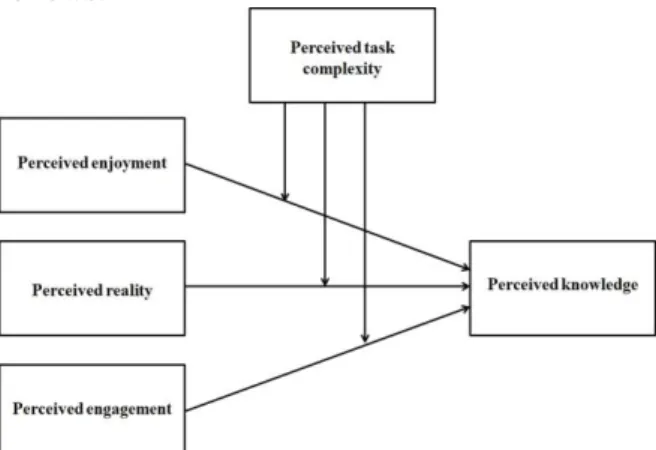
Figure 1 illustrates the model of the impact of characteristics of gamification on perceived knowledge in business processes with perceived task complexity as a modulator. The characteristics of gamification consist of perceived enjoyment in learning, the perceived reality of business processes in daily life, and perceived engagement in learning. Hypotheses developed from this model are discussed as follows.
Figure 1. Model of the impact of characteristics of gamification on perceived knowledge in business processes
To gain insight into students' opinions, pretest and post-test opinions should be compared [15].
Additionally, player enjoyment is central to playing games. Enjoyment describes and explains positive and negative reactions derived from games [18]. The outcomes of gamification are mostly found to be positive in the forms of increased performance, motivation, engagement, and enjoyment [9], [15], [18]. Besides, the elements in games adapted from real cases will promote the perception of personal real-life experience [17], [20], [21], [25]. Thus, this study hypothesizes that:
H1a: Students' mean scores of perceived enjoyment in learning are higher at the post-test stage than the pretest stage after participating in a game emphasizing business processes.
H1b: Students' mean scores of perceived
reality of business processes in daily life are higher at the post-test stage than the pretest stage, after participating in a game emphasizing business processes.
H1c: Students' mean scores of perceived engagement in learning are higher at the post-test stage than the pretest stage after participating in a game emphasizing business processes.
H1d: Students' mean scores of perceived
knowledge in business processes are higher at the post-test stage than the pretest stage after participating in a game emphasizing business processes.
Certain types of skills may be developed during gamification since the subject is exposed to various situations [16]. Welbers et al. [9] observed that game players tend to quickly solve problems and achieve learning goals when the appropriate type and amount of engagement is created. In addition, real cases will promote students' skills in solving problems [15], [20], [21], [25], [26]. The challenges presented in a game contribute to enjoyment, which enhances knowledge [15], [18]. Thus, this study hypothesizes that:
H2a: Perceived enjoyment of learning after
participating in a game emphasizing business processes is positively correlated with perceived knowledge in business processes.
H2b: After participating in a game emphasizing business processes, the perceived reality of business processes in daily life is positively correlated with perceived knowledge in business processes.
H2c: Perceived engagement in learning after
participating in a game emphasizing business processes is positively correlated with perceived knowledge in business processes.
Perceived task complexity can also influence perceived knowledge in business processes. Wood [34] discussed the relationship between task complexity and task performance. Task complexity negatively affects task performance. Games can be designed to increase the difficulty of tasks. If tasks in games are too easy or too difficult, the players will get demotivated, which in turn impacts the players' performance [9], [32], [33]. Thus, this study hypothesizes that:
H3a: Students' perceived task complexity will
moderate the relationship between perceived enjoyment in learning and perceived knowledge in business processes; students with more perceived task complexity will have less perceived knowledge in business processes.
H3b: Students' perceived task complexity will
moderate the relationship between the perceived reality of business processes in daily life and perceived knowledge in business processes; students with more perceived task complexity will have less perceived knowledge in the business process.
H3c: Students' perceived task complexity will
moderate the relationship between perceived engagement in learning and perceived knowledge in business processes; students with more perceived task complexity will have less perceived knowledge in business processes.
IV. RESEARCH METHODS
A. Construction of the Research Instruments Four instruments for this gamification exercise were created. First, blank forms for revenue, expenditure, production, and inventory cycles were adapted from Hall [2] and Romney and Steinbart [3]. The blank forms consist of: a stock card, sales order, packing slip, bill of lading, sales invoice, cash receipt, purchase order, receiving report, supplier invoice, cash payment, production order, materials requisition, bill of material, move ticket, and cash inflow and outflow. Figure 2 shows the example of a blank form of a sales invoice.
Figure 2. Example of sales invoice form [3]
Second, a partial organization chart was created with job descriptions of employees involved in business processes. The employees are engaged in stocking, purchasing, sales, production, accounting (accounts payable and accounts receivable) and cash handling (cashier or treasurer).
Third, document flowcharts showing the revenue, expenditure, and production cycles were also created. Figure 3 shows a flowchart example of part of the expenditure cycle. The above three instruments were provided to students before starting the gamification exercise.
Figure 3. Partial document flow of the expenditure cycle [3]
Fourth, a questionnaire using a five-point Likert scale for collecting data was created. The scale ranges from 1 for “strongly disagree” to 5 for “strongly agree.” This scale was used to collect data through a pretest and a post-test, to
quantify whether students perceived increased knowledge in business processes after the gamification.
Questions in the participant survey were adapted from Welbers [9], Fang et al. [18], Chen et al. [21], Siantz and Pugh [22], Clarke [23], Bonner [35], and Bonner [36]. In order to measure perceived knowledge of business processes, two items were included. These items were “I have gained knowledge in business processes through the gamification” and “I have gained knowledge necessary for performing business process tasks through the gamification”. With regard to perceived enjoyment in learning, three items were included. These items were: “I forgot about the time passing while playing this business game”, “I enjoy studying business processes by gamification”, and “I felt emotionally involved in this business game”. In order to measure the perceived reality of business processes in daily life, two categories of items were included. These items were: “I could imagine the process of sales, purchases, and production of a company in real life from this gamification” and “I could learn the actual business processes of sales, purchases, and production from this gamification”. For perceived engagement in learning, two items were included. These were “I felt emotionally involved in this gamification” and “I did my best for the outcome quality of this gamification”. The last variable, perceived task complexity, was measured by “I felt that this gamification required me to fill in too many items on the business forms” and “This gamification is quite complex because of various business forms I needed to complete”.
B. Research Design and Procedures
The gamification of this study is a business game. This business game focuses on business processes emphasizing the revenue, expenditure, production, and inventory cycles. The same instructor conducted this game during the teaching of an enterprise resource planning (ERP) course at a large public university in Thailand for over two years. There were two classes in each academic year, with around 24 students per class. The participants were 96 undergraduate students majoring in management information systems. ERP is a compulsory subject required to receive an undergraduate business degree. The gamification takes place in a classroom.
For playing the game, students were asked to form into four groups. Students had the freedom to select members in their group. Each group
incorporated approximately six members. Each group had to assign a role for each member. The roles are stocking, purchasing, sales, production, accounting (accounts payable and accounts receivable), and cash handling (cashier or treasurer). Each role player was required to complete several forms related to the cycles' business activities and his/her specific role. The instructor provided all forms to each group at the beginning of the game.
Each group had to act as a coffee shop that sells two types of brewed beverages. These drinks are based on ingredients provided by the instructor at the beginning of the game. All groups had to create their own delicious, tempting recipe. Examples of ingredients provided are matcha green tea powder, lemon tea powder, hot water, ice, sugar, and several milk favors. At the beginning of the game, all groups had to complete a stock card to get raw materials from the instructor.
The game attempts to be a simulation of real-world events. The game goals are to enhance students' business process knowledge and make a profit for their teams' coffee shops. Each group had a coffee shop that produces, stores, and buys and sells products to and from its suppliers and customers. A pair of teams was required to buy and sell two cups of brewed drinks to and from each other and complete forms related to these transactions, such as a purchase order and sales order. The group also needed to complete the forms related to finished goods, such as a bill of material and a stock card. At the end of the game, each group handed in to the instructor all completed forms. The game takes three hours.
For judging whether gamification can enhance perceived outcomes, the students were asked to complete a survey instrument to record their perceptions before and after gamification in enjoyment, reality, engagement, task complexity, and knowledge in business processes. A one-group pretest-posttest research design was used to test the effectiveness of the learning program [37].
V. RESULTS
This section reviews the assessed variables' results relating to the assumptions underlying the statistical tests and research findings. A statistical package was used to evaluate the assumptions before proceeding with a paired-sample t-test and multiple regression. A p-value of 0.05 was used as the significance level in the statistical tests. A p-value between 0.05 and 0.10 is deemed marginally significant.
A. Evaluation of Assumptions
Ninety-two students studying an ERP subject participated in this study. Responses from three of the participants were not included in the analysis because of incomplete data. Deletion of this unusable data reduced the sample size to 89 participants. The remaining participants did not differ significantly in demographics and study habits. Participants between the ages of 19 to 21 were 75.30% of the respondents, while those between the ages of 22 and 23 were 24.70%. Overall, there were more females (79.80%) than males (20.20%). Results of evaluating assumptions of normality, homogeneity of variance, linearity, and multicollinearity of each dependent variable are satisfactory.
B. Analysis of the Results and Discussion For investigating whether students' mean scores of perceptions of enjoyment in learning, business processes, engagement in learning, and knowledge in business processes from gamification are higher at the post-test stage than pretest stage (H1a, H1b, H1c, and H1d), this study analyzed data by a paired-samples t-test. The results of a paired-samples t-test in Table 1 indicate significance for the effect of characteristics of the game as follows. First, perceived enjoyment in learning (t = 11.501, p < 0.001). The mean value of perceived enjoyment in learning at the pretest stage is 2.990. The mean value of perceived enjoyment in learning at the post-test stage is 4.160. Second, perceived reality of business processes in daily life (t = 9.812, p < 0.001). The mean value of business processes' perceived reality in daily life at the pretest stage is 3.030. The mean value of business processes' perceived reality in daily life at the post-test stage is 4.030. Third, perceived engagement in learning (t = 11.847, p < 0.001). The mean value of perceived engagement in learning at the pretest stage is 3.000. The mean value of perceived engagement in learning at the post-test stage is 4.200. Fourth, perceived knowledge in business processes (t = 18.673, p < 0.001). The mean value of perceived knowledge in business processes at the pretest stage is 2.873. The mean value of perceived knowledge in business processes at the post-test stage is 4.131. Thus, H1a, H1b, H1c, and H1d are supported. These results are consistent with previous studies, e.g., Welbers [9], Papp [15], Khan [17], and Clarke [23], and Benhadj et al. [26], who found that gamification promotes perceived enjoyment in learning, perceived reality of business processes in daily life, perceived engagement in learning, and perceived knowledge in business processes.
Additionally, this study also analyzed the perceived task complexity. The statistically significant difference shows that the mean value of perceived task complexity at the post-test
(3.955) is greater than perceived task complexity at the pretest stage (2.973). The modulation effect of perceived task complexity is described below.
Table 1.
Summary table of paired-samples t-test for the questionnaire
Variables Pretest (Before gamification) Posttest (After gamification) t Mean S.D. Mean S.D. Perceived knowledge in business processes 2.873 0.694 4.131 0.552 18.673 a
Perceived enjoyment in learning 2.990 1.050 4.160 0.782 11.501 a
Perceived reality of business processes in daily life
3.030 0.947 4.030 0.775 9.812 a
Perceived engagement in learning
3.000 0.798 4.200 0.677 11.847 a
Perceived task complexity 3.371 1.004 3.955 0.825 5.016 a
a
p < 0.001
To investigate whether perceptions of enjoyment in learning, the reality of business processes in daily life, and engagement in learning from gamification are positively correlated with perceived knowledge in business processes (H2a, H2b, and H2c), this study analyzed data by multiple regression. Statistically significant support is obtained for the effects of gamification on perceived knowledge in business processes with a p-value 0.000 (Table 2). Detailed information of the t-test on perceived engagement in learning shows a statistical significance with p = 0.014. Thus, H2c is supported. This result is consistent with previous studies, e.g., Welbers [9], Clarke [23], Socialchorus [24]. Students with a high perceived engagement in learning will have a high perception of knowledge in business processes. However, the statistics do not support H2a and H2b. There are no effects of perceived enjoyment in learning and perceived reality of business processes in daily life on perceived knowledge in business processes. These results are inconsistent with previous studies, e.g., Welbers et al. [9], Jang and Ryu [16], Laney [20], Chen et al. [21], who found that perceived enjoyment in learning and perceived reality of business processes in daily life affected perceived knowledge.
Table 2.
Summary table of effects of characteristics of gamification on perceived knowledge in business processes
Source Sum of df Mean F Sig.
Squares Square Value
Regression 6.780 6 1.130 4.627 0.000 a Residual 20.024 82 0.244
Total 26.804 88
a
p < 0.001, R2 = 0.253
Additionally, to test the modulation effect of perceived task complexity on perceived knowledge in business processes (H3a, H3b, H3c), the value of perceived task complexity is multiplied by perceived enjoyment in learning, the perceived reality of business processes in daily life, and perceived engagement in learning. These values were then analyzed by multiple regression. The statistical results in Table 3 indicate that perceived knowledge in business processes is negatively affected by the modulation effect of perceived task complexity on perceived engagement in learning with marginal significance (p = .103). Thus, H3c is partly supported. This result also is partly consistent with previous studies, e.g., Welbers [9], Garris et al. [32], Barata et al. [33]. Therefore, students with more perceived task complexity will have less perceived knowledge in business processes. However, perceived knowledge in business processes is not affected by the modulation of perceived task complexity on perceived enjoyment in learning and the perceived reality of business processes in daily life. These results are inconsistent with those obtained by Welbers et al. [9] and Wood [34].
Table 3.
*
p < 0.001 ** p < 0.05 *** p < 0.10
The reason for inconsistent results is that gamification for learning can only be successful when students participate in games for an extended amount of time [9]. The learning will be more effective if the gamification is held in short time intervals spread over several days rather than in one long session [9], [38], [39].
VI. CONCLUSION
This research is one of only a few papers to discuss gamification that effectively equips learners with the business process of four cycles (revenue cycle, expenditure cycle, production cycle, and inventory cycle). This study examines the effectiveness of gamification on enhancing students' ability to acquire knowledge in business processes by introducing the model of the impact of gamification characteristics on perceived knowledge in business processes. This model posits that the gamification characteristics (perceived enjoyment in learning, business processes, and engagement in learning) increase perceived knowledge in business processes and decrease perceived knowledge in business processes by the modulation effect of perceived task complexity.
The analysis results are as follows: Firstly, students perceive that enjoyment of learning, the presence of business processes in daily life, engagement in learning, and knowledge in business processes from gamification are higher following the test stage than before. Secondly,
students’ perception of engagement in learning from gamification is positively correlated with their perceived knowledge of business processes. The results of this research are inconsistent with those of previous studies, namely that students’ perception of enjoyment of learning and presence of business processes in daily life do not affect their perceived knowledge of business processes. However, McGonical [40] states that gamification does not need to be focused on entertainment; rather, it should focus on promoting skills to solve real-life problems. Additionally, Morschheuser et al. [41] summarized seven essential requirements for successful gamification, which are: understanding the user, clear objectives, testing of gamification ideas as early as possible, using simplistic gamification mechanics, understanding of gamification by stakeholders, controlling and curbing for cheating the system, continuous monitoring, and optimization of gamification projects.
To summarize, the findings of this study suggest that gamification should be implemented by teachers to increase student engagement, resulting in greater commitment and contribution to their learning outcomes, which in turn will increase students’ knowledge of business processes. However, teachers need to pay attention to task complexity in gamification as increased complexity can impact the potential positive outcomes of the strategy.
Although this study followed the above requirements for successful gamification design there were also several limitations: Firstly, the sample size was small due to the small number of students enrolled in the ERP class each semester. Secondly, our gamification process takes three continuous hours within one day; however, Welbers et al. [9] suggests distributed learning, which spaces the gamification into three one-hour sessions over several days or weeks to improve long-term recall. Finally, while the quantitative, closed-end question structure of this study allows for statistical analysis, it also limits the availability of qualitative data. Action research (or action learning) may help gain a deeper insight into how well the students perform as a result of gamification whilst also achieving one of the seven essential requirements for successful gamification, which is continuous monitoring and optimization of gamification projects.
As well as distributed learning, future studies should also simplify games by dividing the tasks in them into smaller parts, e.g. one hour in the first week for the inventory cycle, one hour in the second week for the expenditure cycle, one hour in the third week for the production cycle, and one hour in the fourth week for revenue cycle. However, the integrated business processes (inventory, expenditure, production, and revenue cycles) make this gamification a complex exercise, which may impede students’ acquisition of knowledge. Finally, to gain more insight into the inconsistency of our results compared to previous studies, qualitative data from in-depth interviews and focus groups should be used.
![Figure 2. Example of sales invoice form [3]](https://thumb-ap.123doks.com/thumbv2/123deta/8043539.1254762/5.892.116.426.98.484/figure-example-sales-invoice-form.webp)
