INTRODUCTION
Tumors angiogenesis is aberrant regulation of angiogenesis in solid cancers. It is an important process required for invasion and metastasis (1 - 4). Although it is not completely clarified, the com-plex process of tumor angiogenesis is regulated by multiple signal-ing pathways. The proangiogenic multiple pathways include VEGF and VEGF receptor (VEGF - R), FGF and FGF receptor (FGF - R), and PDGF and PDGF receptor (PDGF - R) pathways in vascular endothelial cells (5). In addition to endothelial cells, tumor cells not only produce VEGF, FGF and PDGF, but also express VEGF - R, FGF - R and PDGF - R, suggesting roles for autocrine and paracrine activation of those signaling pathways in cancer cells (5).
In the advanced solid tumors, recent antiangiogenic chemo-therapies have focused on blocking simultaneously the multiple proangiogenic signaling pathways. Several currently available antiangiogenic treatments aim to inhibit VEGF/VEGF R, FGF/FGF -R and PDGF/PDGF - -R pathways. For example, regorafenib is a multiple receptor tyrosine kinase inhibitor (RTKI) that simultane-ously inhibits the VEGF - R, FGF - R and PDGF - R (6, 7), suggesting that the multiple RTKIs affect not only vascular endothelial cells but also cancer cells. However, direct effects of the RTKIs on tumor cells remain unclear.
Regorafenib was approved by the FDA in 2012 for the second
-line treatment of metastatic colorectal cancer patients. In a pivotal randomized phase III study of regorafenib treatment, a statistically significant prolongation in overall survival was observed in patients with colorectal cancer who received regorafenib therapy (6, 7). Despite the survival benefit of regorafenib for metastatic colorectal cancer patients, its overall clinical efficacy remains quite limited. Unfortunately, the vast majority of patients who initially respond to the agent will develop resistance (8 - 10).
The central mechanism of the resistance to multiple RTKIs is considered to be hypoxic stress induced by disruption of tumor angiogenesis (10 - 12). In addition to hypoxia, we previously dem-onstrated that regorafenib directly acted on colorectal cancer cells and accelerated their malignant phenotypes, including apoptosis resistance and migration activation, in a hypoxia- independent manner (13).
Thus, the aim of this study is to elucidate how regorafenib in-duced the malignant phenotypes in colorectal cancer cells. By using a potent selective inhibitor for VEGF - R, FGF - R or PDGF - R, we clarified that blockade of VEGF - R, but not FGF - R and PDGF - R, expressed on colorectal cancer cells induced apoptosis resistance and migration activation.
MATERIALS AND METHODS
Cell culture and treatmentHuman colorectal cancer cell line (HCT116) was maintained in RPMI1640 medium with 5% fetal bovine serum and antibiotics. Based on our previous reports (13, 14), in order to inhibit angio-genic receptors, cells were continuously treated for 14 days with a
ORIGINAL
Regorafenib induces adaptive resistance of
colorectal cancer cells via inhibition of
vascular endothelial growth factor receptor
Chisato Tomida1, Hikaru Nagano1, Naoko Yamagishi2, Takayuki Uchida1, Ayako Ohno1, Katsuya Hirasaka3,
Takeshi Nikawa1, and Shigetada Teshima - Kondo1
1Department of Physiological Nutrition, Institute of Medical Nutrition, University of Tokushima Graduate School, Tokushima, Japan.
2Department of Anatomy and Cell Biology, School of Medicine, Wakayama Medical University, 811 - 1 Kimiidera, Wakayama, Japan3Graduate
school of Fisheries Science and Environmental Studies, Nagasaki University, Nagasaki, Japan.
Abstract : Recently, inhibition of tumor angiogenesis has become an important anti -cancer therapy. Tumor angiogenesis is regulated by multiple signaling pathways, including VEGF and VEGF receptor (VEGF -R), FGF and FGF receptor (FGF -R), and PDGF and PDGF receptor (PDGF -R) pathways. Thus, the antiangiogenic agents, such as regorafenib, simultaneously target those receptors on vascular endothelial cells. In addition to endothelial cells, cancer cells express the three receptors, suggesting that the antiangiogenic inhibitors affect tumor cells. In fact, we previously demonstrated that regorafenib directly acted on human colorectal cancer cells and acceler-ated their apoptosis resistance and migration capability. Thus, we here elucidacceler-ated how regorafenib induced the malignant phenotypes in colorectal cancer cells. To identify the responsible receptor among the regorafenib -targeting proangiogenic receptors, we examined the effects of a potent selective inhibitor for VEGF -R, FGF -R or PDGF -R on apoptosis resistance and migration capability. We clarified that blockade of VEGF -R, but not FGF -R and PDGF -R, induced the malignant phenotypes. We confirmed that blocking of VEGF ligands derived from colorectal cancer cells also induced the phenotypes. These results suggest that regorafenib progressed the malignancy via prevention of autocrine and paracrine VEGF signaling in colorectal cancer cells. J. Med. Invest. 64 : 262-265, August, 2017
Keywords : angiogenesis inhibitor, regorafenib, VEGF-R, tumor cell aggressiveness
Received for publication May 14, 2017 ; accepted May 27, 2017. Address correspondence and reprint requests to Shigetada Teshima -Kondo, Department of Physiological Nutrition, Institute of Medical Nutri-tion, University of Tokushima Graduate School, Tokushima 770 - 8503, Japan and Fax : +81 - 72 - 950 - 2841.
The Journal of Medical Investigation Vol. 64 2017
migrated cells per
HPF
vehicle VEGF-R
inhibitor inhibitorFGF-R PDGF-Rinhibitor
*
#
#
Hy
pox
ia-induced apoptosis
(%)
vehicle VEGF-Rinhibitor inhibitorFGF-R PDGF-Rinhibitor
*
#
potent selective inhibitor of VEGF - R (KRN633, Selleckchem) at 40 nM, FGF R (AZD4547, Selleckchem) at 1 nM, PDGF R (CP -673451, Selleckchem) at 10 nM or vehicle DMSO (0.01%). In order to block VEGF ligands, cells were continuously treated with recombinant soluble VEGF - R1 protein plus soluble VEGF - R3 pro-teins (250 ng/ml each) (R&D Biosystems) or control bovine serum albumin (500 ng/ml) for 7 days.
For hypoxic culture conditions, cells were incubated at low con-fluence and 37"!in RPMI1640 medium supplemented with HEPES buffer (pH 7.4) using an AnaeroPack - Kenki 5% anaerobic system in which O2was ~0.2% (Sugiyamagen, Japan).
Cell migration assay
Equal numbers (50,000 cells per well) of cells were suspended in 0.25 ml of 1% RPMI1640!FBS without or with regorafenib and placed in the top compartment of a 8 µm pore membrane chambers (BD Biosciences) ; 0.75 ml of 10% RPMI1640!FBS was added to the bottom compartment. Following 24 - h incubation under stan-dard conditions (37"!/5% CO2), non - migrating cells were scraped
from the top compartment, and cells that had migrated to the bottom compartment were fixed and stained using the Hemacolor Rapid staining of blood smear (Merck). Membranes were excised and mounted on a standard microscope slide. The numbers of migrated cells were determined from ten random high - power fields (HPF) visualized at × 200 magnification.
Assessment of apoptosis
Apoptotic cells were assessed by imaging of activated caspase 3/7 using CellEvent caspase - 3/7 green detection reagent (Molecular probes), according to the manufacturer’s instruction.
Statistical analysis
Results are expressed as means"S.D. Statistical analyses of data were done using ANOVA and the Scheffé’s test. P values!0.05 was considered significant.
RESULTS
Effect of inhibition of regorafenib -targeting proangiogenic re-ceptors on migration ability
In order to elucidate how a multiple RTKI regorafenib, which inhibits simultaneously VEGF - R, FGF - R and PDGF - R, induced activation of colorectal cancer cell migration (13), we first exam-ined the effect of a single inhibition of the respective receptors on cellular motility. We used a small molecule agent targeting tyrosine kinase of VEGF R (KRN633), FGF R (AZD4547) or PDGF R (CP -673451). As shown in Figure 1, inhibition of VEGF - R markedly activated the migration ability, compared to the DMSO- treated control cells. By contrast, blockade of FGF - R and PDGF - R signifi-cantly decreased the ability (Fig. 1).
Effect of inhibition of regorafenib -targeting proangiogenic re-ceptors on apoptosis under hypoxic conditions
We then examined the effect of the single inhibition of VEGF - R, FGF - R or PDGF - R on apoptosis under hypoxic conditions. We chose hypoxic stress, since angiogenic inhibitors induce hypoxia within tumor microenvironment via disruption of tumor neoangio-genesis (1). Inhibition of VEGF - R induced apoptosis resistance, compared to the DMSO- treated control cells (Fig. 2). Blockade of FGF - R significantly increased apoptosis rate, compared to the DMSO- treated control cells (Fig. 2). Under PDGF - R inhibited conditions, the apoptosis rate was similar to the control (Fig. 2).
Effect of blocking of autocrine/paracrine VEGF signals on the malignant phenotypes of colorectal cancer cells
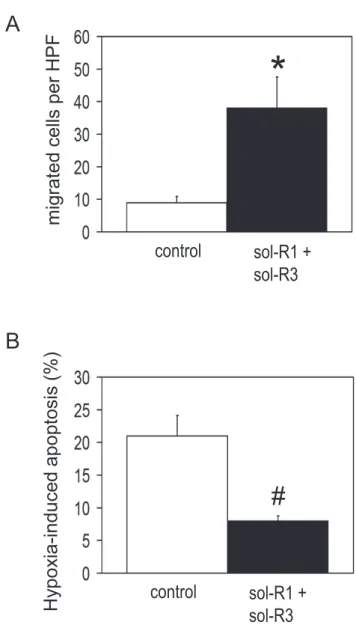
It is previously reported that HCT116 cells express VEGF ligands (VEGF, PlGF, VEGF - B, VEGF - C and VEGF - D) (14, 18). To dem-onstrate whether blocking of autocrine and paracrine VEGF signal-ing pathway induced the migration activation and apoptosis resis-tance in colorectal cancer cells, we blocked all of VEGF ligands using recombinant proteins of soluble VEGF - R1 and soluble VEGF - R3. Soluble VEGF - R1 protein captures VEGF, PlGF and VEGF B, and soluble VEGF R3 protein traps VEGF C and VEGF -D, thus leading to prevention of all VEGF - R activation. As similarly to inhibition of VEGF - R by KRN633 (Fig. 1 and 2), neutralization of Figure 1. Effect of inhibition of regorafenib - targeting proangiogenic receptors on migration ability of colorectal cancer cells
Cells were treated with a VEGF - R inhibitor (KRN633), FGF - R inhibitor (AZD4547), PDGF - R inhibitor (CP - 673451) or vehicle (DMSO). Then cells were used for transwell migration assay in the presence of the
re-spective inhibitor (n=4, means"SD). *P!0.01 indicates the increased
migration activity compared with the DMSO - treated control cells
(vehicle).#P!0.01 indicates the decreased migration activity compared
with the DMSO - treated control cells (vehicle). HPF, high power field.
Figure 2. Effect of inhibition of regorafenib - targeting proangiogenic receptors on apoptosis under hypoxic conditions
Cells were treated with a VEGF - R inhibitor (KRN633), FGF - R inhibitor (AZD4547), PDGF - R inhibitor (CP - 673451) or vehicle (DMSO). Then
cells were exposed to hypoxia (# 0.2% O2) for additional 24 h in the
presence of the respective inhibitor. Apoptotic cells were determined by
measuring of activated caspase 3/7 (n=4, means"SD). *P!0.01
indi-cates the increased apoptosis rate compared with the DMSO - treated
control cells (vehicle).#P!0.01 indicates the decreased apoptosis rate
compared with the DMSO - treated control cells (vehicle).
A
B
mig
rated cells
per
HPF
control
sol-R1 +
sol-R3
*
Hy
pox
ia-induce
d
apopto
sis (
%
)
control
sol-R1 +
sol-R3
#
VEGF ligands induced the migration activation and the apoptosis resistance (Fig. 3A and B).
DISCUSSION
In this study, we revealed how a multiple RTKI regorafenib accelerated the malignant phenotypes in colorectal cancer cells. Our results show that inhibition of autocrine and paracrine VEGF/
VEGF - R signaling pathway in colorectal cancer cells induced the phenotypes. By contrast, blockade of FGF - R and PDGF - R re-pressed the phenotypes, consistent with previous reports (15, 16).
Our results are supported by several reports using VEGF and VEGF - R blockers (14, 17 - 22). Recently, there is accumulating evi-dence that several VEGF/VEGF - R targeting antiangiogenic agents act not only on vascular endothelial cells, but also on tumor cells, as cancer cells also express VEGF - R (17). When the agents act on endothelial cells, tumor vascularization is significantly inhibited, leading to tumor regression. By contrast, when act on tumor cells, the aggressiveness of cancer cells is increased (17). For example, a neutralizing anti - VEGF monoclonal antibody (bevacizumab) has been shown to stimulate the expression of tumor invasion associ-ated factors, such as matrix metalloproteases and promoting inva-siveness both in vitro and in vivo in glioblastoma, renal cell carci-noma and colorectal cancer models (14, 18, 19). VEGF - R inhibitors stimulate the expression of genesassociated with invasion and me-tastasis, such as Snail, Slug, Fak and Axl, leading to local invasion and distant metastasis (20 - 22). By contrast, inhibition of FGF - R and PDGF - R expressed on several cancer cells suppresses the evasive phenotypes of them (15, 16). These reports support our finding that blockade of tumor cell VEGF - R, but not FGF - R and PDGF - R, accelerated aggressiveness of cancer cells. In addition, these results suggest that it might be better not to block the VEGF/ VEGF - R signaling in several cancer cells.
Collectively, we conclude that multi RTKI regorafenib induced the malignant phenotypes of colorectal cancer cells via inhibiting of VEGF/VEGF - R pathway. Currently, nine antiangiogenic multiple RTKIs (regorafenib, lenvatinib, nintedanib, cabozantinib, axitinib, vandetanib, sunitinib, sorafenib and pazopanib) are approved by FDA for treatment of patients with several advanced cancers, in-cluding colorectal cancer (5). Importantly, all of these approved RTKIs have an inhibitory activity of VEGF - R, suggesting that all the RTKIs possibly activate cancer cell aggressiveness. Thus, it will be needed to clarify precise molecular mechanisms and a complete understanding of the direct effects of the antiangiogenic RTKIs on tumor cells. The elucidation can bring insights into counteracting tumor adaptive refractoriness to the antiangiogenic drugs.
COMPETING INTERESTS-DISCLOSURE
The authors declare no competing interests.ACKNOWLEDGEMENTS
This work was supported in parts by grants from Grants - in - Aid for Scientific Research (no. 15H04931 to STK) from JSPS, the Princess Takamatsu Cancer Research Fund (no. 14 - 24611 ; to STK).
REFERENCES
1. Bergers G, Hanahan D : Modes of resistance to anti - angio-genic therapy. Nat Rev Cancer 8 : 592 - 603, 2008
2. Ellis LM, Reardon DA : Is there really a yin and yang to VEGF -targeted therapies? Lancet Oncol 11 : 809 - 811, 2010 3. Jayson GC, Kerbel R, Ellis LM, Harris AL : Antiangiogenic
therapy in oncology : current status and future directions. Lancet 388 : 518 - 529, 2016
4. Meadows KL, Hurwitz HI : Anti - VEGF therapies in the clinic. Cold Spring Harb Perspect Med 2 : a006577, 2012
5. Zhao Y, Adjei AA : Targeting Angiogenesis in Cancer Ther-apy : Moving Beyond Vascular Endothelial Growth Factor. Figure 3. Effect of blocking of autocrine/paracrine VEGF signals on
migration ability and on hypoxia - induced apoptosis
Cells were treated with soluble VEGF - R1 and VEGF - R3 recombinant proteins (sol - R1 + sol - R3) or control albumin (control). (A) Then cells
were used for transwell migration assay (n=4, means!SD). *P!0.01
indicates the increased migration activity compared with the albumin -treated control cells (control). HPF, high power field. (B) The cells were
exposed to hypoxia ("0.2% O2) for additional 48 h in the presence of the
respective blocker. Apoptotic cells were determined by measuring of
activated caspase 3/7 (n = 4, means!SD).#P!0.01 indicates the
de-creased apoptosis rate compared with the albumin - treated control cells (control).
Oncologist 20 : 660 - 673, 2015
6. Sartore - Bianchi A,Zeppellini A, Amatu A, Ricotta R, Bencardino K, Siena S : Regorafenib in metastatic colorectal cancer. Ex-pert Rev Anticancer Ther 14 : 255 - 265, 2014
7. Grothey A, Van Cutsem E, Sobrero A, Siena S, Falcone A, Ychou M, Humblet Y, Bouché O, Mineur L, Barone C, Adenis A, Tabernero J, Yoshino T, Lenz HJ, Goldberg RM, Sargent DJ, Cihon F, Cupit L, Wagner A, Laurent D ; CORRECT Study Group. Regorafenib monotherapy for previously treated me-tastatic colorectal cancer (CORRECT) : an international, multi-centre, randomised, placebo - controlled, phase 3 trial. Lancet 381 : 303 - 312, 2013
8. Bottsford - Miller JN, Coleman RL, Sood AK : Resistance and escape from antiangiogenesis therapy : clinical implications and future strategies. J Clin Oncol 30 : 4026 - 4034, 2012 9. Ebos JM, Kerbel RS : Antiangiogenic therapy : impact on
invasion, disease progression, and metastasis. Nat Rev Clin Oncol 8 : 210 - 221, 2011
10. Ribatti D : Tumor refractoriness to anti - VEGF therapy. On-cotarget 19 : 46668 - 46677, 2016
11. Ebos JM, Lee CR, Cruz - Munoz W, Bjarnason GA, Christensen JG, Kerbel RS : Accelerated metastasis after short- term treat-ment with a potent inhibitor of tumor angiogenesis. Cancer
Cell 15 : 232 - 239, 2009
12. Pàez - Ribes M, Allen E, Hudock J, Takeda T, Okuyama H, Viñals F, Inoue M, Bergers G, Hanahan D, Casanovas O : Antiangiogenic therapy elicits malignant progression of tumors to increased local invasion and distant metastasis. Cancer Cell 15 : 220 - 231, 2009
13. Tomida C, Yamagishi N, Aibara K, Yano C, Uchida T, Abe T, Ohno A, Hirasaka K, Nikawa T, Teshi Kondo S : The ma-lignant progression effects of regorafenib in human colon cancer cells. J Med Invest 62 : 195 - 198, 2015
14. Yamagishi N, Kondo TS, Masuda K, Nishida K, Kuwano Y, Dang DT, Dang LH, Nikawa T, Rokutan K : Chronic inhibi-tion of tumor cell - derived VEGF enhances the malignant
phe-notype of colorectal cancer cells. BMC Cancer 13 : 229, 2013 15. Appiah - Kubi K, Wang Y, Qian H, Wu M, Yao X, Wu Y, Chen
Y : Platelet- derived growth factor receptor/platelet- derived growth factor (PDGFR/PDGF) system is a prognostic and treatment response biomarker with multifarious therapeutic targets in cancers. Tumour Biol 37 : 10053 - 10066, 2016 16. Katoh M, Nakagama H : FGF receptors : cancer biology and
therapeutics. Med Res Rev 34 : 280 - 300, 2014
17. Simon T, Gagliano T, Giamas G : Direct Effects of Anti- Angi-ogenic Therapies on Tumor Cells : VEGF Signaling. Trends Mol Med 23 : 282 - 292, 2017
18. Fan F, Samuel S, Gaur P, Lu J, Dallas NA, Xia L, Bose D, Ramachandran V, Ellis LM : Chronic exposure of colorectal cancer cells to anti - VEGF mAb promotes compensatory path-ways that mediate tumor cell migration. British J Cancer
104 : 1270 - 1277, 2011
19. Lucio - Eterovic AK, Piao Y, de Groot JF : Mediators of glioblas-toma resistance and invasion during antivascular endothelial growth factor therapy. Clin Cancer Res 15 : 4589 - 4599, 2009 20. Huang D, Ding Y, Li Y, Luo WM, Zhang ZF, Snider J, Vandenbeldt K, Qian CN, The BT : Sunitinib acts primarily on tumor endothelium rather than tumor cells to inhibit the growth of renal cell carcinoma. Cancer Res 70 : 1053 - 1062, 2010
21. Lu KV, Chang JP, Parachoniak MM, Aghi MK, Meyronet D, Isachenko N, Fouse SD, Philips JJ, Cheresh DA, Park M, Bergers G : VEGF inhibits Tumor Cell Invasion and Mesen-chymal Transition through a MET/VEGFR2 Complex. Can-cer Cell 22 : 21 - 35, 2012
22. Han KS, Raven PA, Frees S, Gust K, Fazli L, Ettinger S, Hong SJ, Kollmannsberger C, Gleave ME, So AI : Cellular Adapta-tion to VEGF - Targeted Antiangiogenic Therapy Induces Evasive Resistance by Overproduction of Alternative Endo-thelial Cell Growth Factors in Renal Cell Carcinoma. Neopla-sia 17 : 805 - 816, 2015