1. Introduction
Curriculum has been considered as the most important factor by the Vietnamese Ministry of Education (MOET)to implement and manage training courses at all levels in the national education system.By 2005, most of the universities and colleges in Vietnam had been followed the curriculum which had been developed and conducted following academic year.So that,it had been compulsory for all the learners to follow subjects which had been arranged into orders by academic years.If a learner couldn t have been able to pass some of the subjects in the academic year,she/he would have been failed and restart.
Since 1993,the first university in Vietnam,called Hochiminh Polytechnic University has been developing and implementing accreditation system in training courses.Since then,just only5-7universities had been to conduct accreditation system in trainings up to 2005. However, accreditation system was passed in the Vietnamese Education Law 2005. In the school year of 2005-2006, MOET started piloting modality of accreditation system in trainings in some universities. Vietnamese Government and MOET have tried to direct all of the universities and colleges to implement this training modality by the school year of 2010.
The modality of accreditation system in trainings makes big differences in the role of learners during training process.Self-study,self-research makes up a big density of the curriculum and teaching plan in the whole training course and units.Just make a comparison between the school year and the accreditation system in training: 1unit equal to 15teaching hours in the classroom,plus 15hours for students to prepare the lesson in advance,meanwhile,1credit equal to 15 teaching hours in the classroom, plus 30 hours for students to prepare the lesson in advance (1credit equal to 1.5unit).Therefore,teaching materials and other learning supplies will make an important role to ensure success of conducting accreditation system in training.
Developing training curriculum towards accreditation system has been getting involvements of all
Abstract
Developing Training Curriculum of Specializations in Social Sciences
and Humanities Towards Accreditation System
at University Level in Vietnam
Received October 16, 2019
The article can be helpful for readers who are related to the field of education as well as education training to have a thorough knowledge of Vietnamese Curriculum Development as: 1) Curriculums in Vietnam as definition,kinds and components of a curriculum; 2)Curriculum development as two points of view to design training curriculum: Open or Narrow; Design training curriculum following two kinds of specific majors; Design components (adaptable kind) of the training curriculum; 3) The reality of implementing training curriculums at university level in Vietnam as (i) An evaluation on the reality of implementing training curriculum at university level in Vietnam; (ii) University Training Curriculum Framework on Special Education of Hanoi National University of Education.The article also introduces a concrete reference of a training curriculum development of special education at Hanoi National University of Education following trend of renovation of education in Vietnam based on accreditation system with a set of standards of a special teachers competency that will be used at HNUE s training program and courses including 6standards with 18indicators manifested in 18professional knowledge.
Key words:Curriculum,program,special education,training,university.
NGUYEN Xuan Hai
EDA Yusuke
Hanoi National University of Education,Vietnam
Wakayama University,Japan
universities and colleges in Vietnam, especially just after the Resolution No 29 dated November 11 , 2013 enacted by the Vietnam Communist Party.
The article would show a picture of process of developing training curriculum towards accreditation system for specializations in Social Sciences and Humanities in general and with a concrete reference of a training curriculum development of special education at HNUE in particular.
2. Training curriculum at university level in Vietnam . .
As for Vietnamese experts (Chau Nguyen Huu,2005),some definitions of curriculum can be considered following different perspectives.
a) As for perspective of content with the conception that education is the process of transferring knowledge from a generation to a later one, curriculum can be seen as a sketch of training contents and through that the learners would know what they need to get in their mind.
b) As for perspective of target approach with the conception that education is the tool to make products which those standards have been identified,curriculum can be seen as a training plan which reflects goals to follow and reach by the school. The curriculum will tell necessary contents and methods of teaching and learning to reach the expected goals (White,1995).
c) As for perspective of development with the conception that education is a development and curriculum is a process,curriculum can be seen as an overall design for a training activity which can be lasted one or some hours,a day,a week or even some years.The design shows all the training contents,expected outcomes of the learner after a course, outline necessary procedure of implementing the training contents, training methods,how to monitor and evaluate the achievements of students.All these issues are arranged in a strict schedule (Tim L.Wentling,Kah Khee Lai,1993).
. .
Some kinds of curriculum are popularly known as followings:
a) Curriculum Framework: it s a legal document which set a minimum knowledge and its allocation of knowledge blocks. Curriculum framework specifies the differences between correlative curriculums at different training levels and majors.
b) Curriculum standard: It s a legal document which approves specific major. Curriculum standard set framework of a unit,training schedule,rate of allocation between general basic units and majors,theory and practice.Curriculum standard composes curriculum framework as well as core,standardized and sustainable contents which are compulsory in all of the training curriculums of universities and colleges.
c) Syllabus: It s a specific subject curriculum which presents detailed levels of knowledge, skills and attitude for students to reach,order of themes in its content.A syllabus composes as: 1)Specific objectives on knowledge,skills and attitude; 2)Core contents as knowledge lines,concepts,categories,time amount of each chapter; 3) Teaching and learning methods and forms; 4) Teaching and learning materials; 5) Criteria and methods of evaluating student s achievements; 6)References.Based on syllabus,textbooks can be developed.One syllabus can be developed in variety of textbooks up to different writers.
d) Textbooks: They are formal documents using with different subjects which set in training curriculums at general education as primary,lower and higher secondary schools.Up to present,each subject has just only one textbook in Vietnam.As for the Vietnam Education Law 2005,Article 29.3: “Minister of the Ministry of Education and Training passes the general education curriculums,approves textbooks based on the National Appraisal Council on General Education Curriculums and Textbooks”.
e) Course/Subject curriculum: Courses which have been developed by internal professionals are using and considering as general documents in more and more universities in Vietnam.However,some of the courses are just copyrights of a few universities,especially of unique majors.In general,there is just only one course or few courses for a syllabus which have been developed by one or some professionals in the field.
conferences, thesis, dissertations, compositions, etc. They help lecturers and students expand, dig deeply knowledge in a specific professional,penetrate further into a part of the training curriculum or just for doing a research.
. .
A training curriculum often has 4components as the followings:
(1)Training Goal which can be divided into two categories: 1)Long -term objective: It mentions to a sustainable goal and only change following the socio-economic changes; 2)Specific objectives: It often changes to adapt and meet the needs of society.
In general, training goals or objectives shows three learning objectives which are compulsory for all students to graduate as:
-Student must achieve basic skills required in any curriculum
-Student must achieve general skills in the major which related to the part of education overall (it often mentions to humanism,sociology,natural sciences)
- Student must have specific skill in the major which related closely to the major requirements, and selective subjects
(2) Training contents: Meanwhile, training curriculum and its components are rarely changed, the training contents are changed quite often,may be annually.
(3)Training methodology or strategies: It relates to how to transfer the training curriculum to student most effectively.
(4)Assessment and evaluation to learning outcomes: This includes assessment of student s achievements and training curriculum s implementation
3. Training curriculum development of Specializations in Social Sciences and Humanities at university level in Vietnam
. .
The first point: The training curriculum aims at directing students to be trained in a specific occupation. However,being trained in a specific occupation can help students develop their majors capacities,but it is easily leading to put them under constraint in their own major as well as weaken their abilities to update the knowledge while trained contents have been out of date.
The second point: The training curriculum aims at providing students a background of comprehensive knowledge in order to reach two purposes at the same time: a professional with high academic level.
. .
a)Design training curriculums according to going into depth and trait scope of a major
b)Design training curriculums according to it can be exchanged between two majors
Diagram 2.The exchange of two majors . .
- Marks:
“+” Compulsory Knowledge in the training curriculum “-” Not compulsory knowledge in the training curriculum
-Curriculum Standard approval by MOET just only implies knowledge of columns N 2,4,6
(iv) Knowledge of the pedagogic major in the training curriculum is arranged into the specific part Table 1.Components of a training curriculum of Specializations in Social Sciences
and Humanities at university level in Vietnam
+ − − − + − + + + 2 Diplomas + − − − + − + + + Parallel Majors + − − − + − + + + Main and Secondary − + + + + Single Major (11) (10) (9) (8) (7) (6) (5) (4) (3) (2) (1) Main 45 units Secondar y 25 units (iii) Selective in the major Selective but not compulsory Knowledge of the second major Selective but not compulsory Major knowledge (selective in the designed) Core knowledge (compulsory) or the supporting major or the first major
Supporting knowledge (iv) Major knowledge
( 45 units) Basic knowledge of
the Major (ii)
Selective (designed by university) Core knowledge (compulsory) Knowledge of Major Knowledge of
education overall (i) Kind of curriculum (selected by university or students) − + + + + +
(included in the part of major knowledge)or into the supporting knowledge (as the second major)
-Single Major: A student can be only trained in a major and get diploma of that major.After graduation, he/she can be able to do in the trained major.
- Main and Secondary: A student can be trained two majors called main and secondary ones. After graduation, he/she can be able to work in his/her main or secondary trained major or both majors. For example,a person is trained in Math as main major,but in the end of university he/she can be trained one more major related closely to the main on.So that he/she can do his/her job in Math or Informatics as well. -Parallel Majors: A student is allowed to be trained two majors at the same time and get two diplomas in two different majors.He/she can study in one or two universities at the same time.
-Two diplomas: A student can be trained two majors at the same time.For example,a student is trained in Economics but the lecturers use English in teaching.After graduation,he/she will receive two diplomas (economic and English ones).
4. The reality of implementing training curriculum of Specializations in Social Sciences and Humanities at university level in Vietnam
. .
Training at university level following accreditation system is considered as one of the seven steps of renewing university education itinerary for the period of2006-2020which is stated in the Education Law2005, adapted in 2009, now the latest one in 219 and enacted in July, 2020 and Instructions N 296 on Renewing University Education for the period of 2010-2012dated February 27 ,2010by the Minister of Vietnamese Government.
As for the Report on Under grade Education in Some Universities of Vietnam, Vietnam Education Foundation,the National Academies,USA-Vietnam (2006),some issues of training curriculum at university level are exposed to the contents, structure, methods, etc. There are so many subjects in the curriculum. Most of the subjects compose a lot of leitmotivs and are often out of date.Some of the subjects, excepted political ones, are even not related directly to the major. As the results, teaching and learning have been ineffective,students after university haven t been prepared as well as those in comparison with international universities.
Some concerns and problems are listed as follows:
1. Training curriculum at university level has too much subjects (6-8) and credits (about 20-25) which students have to take in a semester.These works are too hard not only for students but also for lecturers to take.As results,students can t be able to study and get deep knowledge of their major as well as to absorb concepts,contents of the curriculum or syllabus,not to complete their homework.Lecturers have only little time to prepare their teaching and feedbacks to their students.
2.In most cases of leading universities over the world,their training curriculums often have less than 120 credits which students have to accumulate. MOET takes control too much the contents of the training curriculum, especially for the first two years. Besides some compulsory subjects as Politics, Physical Education, Defense Education, General Principles of Marxism, Ho Chi Minh Ideology, etc, take drawing subject for instance, it is compulsory for technical students to take, it means that, students want to enter university and study in the major of technology,they must have technical skills in advance.It is better if this requirement is not considered as a subject and included in the training curriculum.
3. Subjects are often not related closely with each others as well as not in clear orders in the training curriculum.
4.Some of the subjects are even not related to the major of the training curriculum (these subjects are developed based on the available lecturers majors,not based on the goals of the curriculum and the needs of the students).
5. Subject and curriculum contents are not very up to date and far away from these of other leading universities in the world,not focused very well on concepts,principles but on skills and theories.
6.Applications of the training curriculum are often for doing exercises at a low taxonomy as finding the right answer rather than requiring students to analyze,synthesize,evaluate and solve problems.
7. Not well-proportion between theoretical and practical subjects because of the lack of practical requirements and equipment s as well in the laboratory
8. Lack of preparation for popular and professional skills as spoken and written communications, presentation,group working,problem solving,project managing,critical thinking,and self-confident
9. Sole nature of a training curriculum to its own major is main obstacle for students to be able to transfer to an other major.
10. A few opportunities for students to assess their own learning achievements and the whole training curriculum.
. .
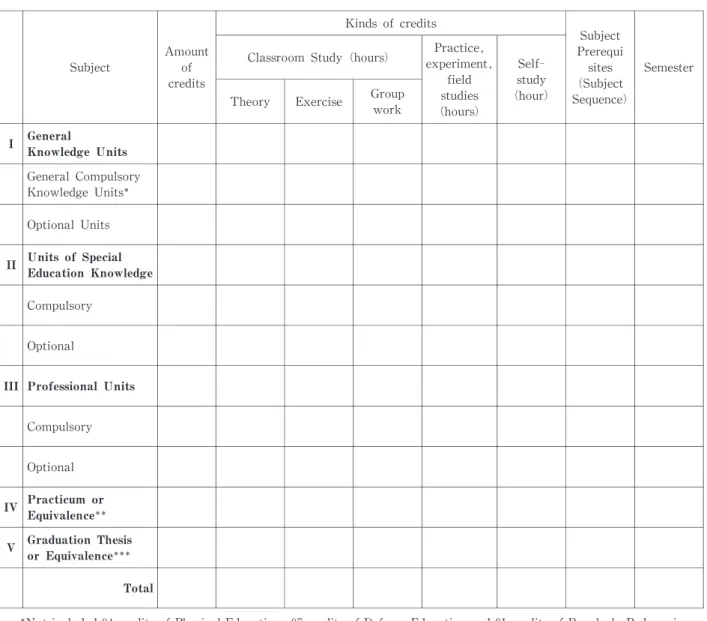
Hanoi National University of Education (HNUE)is one of the core point of the Pedagogic Universities system in Vietnam. Towards accreditation system, HNUE have designed training curriculums for over 40 specializations in the field of education as the followings in Table 2.
Total Graduation Thesis or Equivalence V Practicum or Equivalence IV Optional Compulsory Professional Units III Optional Compulsory Units of Special Education Knowledge II Optional Units General Compulsory Knowledge Units General Knowledge Units I Group work Exercise Theory Self-study (hour) Practice, experiment, field studies (hours) Classroom Study (hours)
Semester Subject Prerequi sites (Subject Sequence) Kinds of credits Amount of credits Subject
Not included 04credits of Physical Education,07credits of Defense Education and 01credits of Regularly Pedagogic Practice.
Students do their practice at suitable place with their professionals. Students do their graduation thesis only after they pass the practicum.
Some principles of the training curriculum as table 1are: (i)General Compulsory Knowledge Units of number I.General Knowledge Units: developed by the Ministry of Education and Training.Its means all the training institutions have to follow; (ii)Each part should include both compulsory and optional subjects, but mainly compulsory ones; (iii)One hour learning in class is equal to two hour practice,experiment,field studies and three hour self-study; (iv)One credit count for 15hour learning in class.Although,the training program/curriculum is considered as towards accreditation system but it still needs a subject division of semesters as clarified in the last column of the table 1.
. .
a) Training curriculum frameworks of special education in 2009 and adapted 2015
A comparison between training curriculum frameworks of special education in 2009and adapted 2015as below:
b) Directions to develop new training curriculum on special education following trend of renovation of education in Vietnam based on accreditation system at present
Vietnam has been implementing the comprehensive renovation of education and training following the Resolution No 29dated November 11 , 2013 enacted by the Vietnam Communist Party. This progress has been significantly urges for 3three years recently with the latest process as: 1)applying the curriculum and its syllabus for grade 1since school year of 2020-2021,the one for grade 6since school year of2021-2022and the one for grade 10since school year of 2002-2003; 2)the process will complete for all the 12school years in 2025.
One of the key point of this renovation is to change Vietnamese education system towards meeting fully student s competencies as well as other Vietnamese moral qualities. As the result, renovation of teacher training program is so urgent and compulsory for training institutions to meet the needs of teacher resources of the renovation.
Faculty of Special Education (FSE)was established under the Decision N 3760dated on 19/06/2001by the Minister of MOET.The former facility of FSE is the Section of Special Education,Faculty of Educational Psychology,Hanoi National University of Education (HNUE).
Table 3. Training curriculum frameworks of special education in 2009 and adapted 2015
135 130
Total
Students do their graduation thesis only after they pass the practicum
10 Graduation Thesis or Equivalence
V
6 Practicum or Equivalence
IV
Select 20 from 36 designed credits; Select 32 from 90 designed credits 32/90
20/36 Optional
Including Graduation Thesis or Equivalence 49 Compulsory 81 65 Professional Units III
Select 2 from 6 designed credits; Select 3 from 9 designed credits 3/9 2/6 Optional 31 12 Compulsory 34 14
Units of Special Education Knowledge II
Select 9 from 27 designed credits 27-Sep
Optional Units
Not included 4credits of Physical Education,7credits of Defense Education and 1credits of Regularly Pedagogic Practice
11 General Compulsory Knowledge Units
20 35
General Knowledge Units I Notes 2015 2009 School year Training frameworks N
The faculty has 04 professional training programs as: (i) Education for Children with Visual Impairment; (ii) Education for Children with Hearing Impairment; (iii) Education for Children with Intellectual Disability; (iv) Education for Autism Spectrum Disorder; (v) a very new one is Support for Education for Persons with Disabilities (since June, 2019); (vi) Sub-training programs as Education for Children with Language Problems and Education for Children with Learning Difficulties.
Teacher training program in Special Education is the one of HNUEs.The program has been developing since May,2019and will complete in the end of 2019so that it can be utilized since school year of2020-2021.
In general,the new training program is following the format of the formers and contents of I.General Knowledge Units and II.Units of Special Education Knowledge but significant changes in III.Professional Units.Core standards with indicators of a special teachers competency should be as followings:
Table 4. Standards of a special teachers competency developed by HNUE
1.4.1.Define and use checklists of formative and informative assessments to diagnose and assess strengths,weakness,interests and learning styles of children with disabilities
1.4.2.Synthesize information and data from multi professional group 1.4.3.Develop suitable objectives of intervention and these objectives can be evaluated.
1.4.Make Individual Education Plan/IEP which is suitable with capacities, needs of children with disabilities
1.3.1.Assess educational environments of children with disabilities 1.3.2.Arrange educational environments with some criteria as suitable,friendly,structural,etc to meet the needs of participation of children with disabilities
1.3.3.Addapt,rearrange environments to support children s participation and living independence
1.3.Arrange educational environments to meet suitably with the needs of children with disabilities
1.2.1.Detect and assess capacities and needs of children with disabilities
1.2.2.Analyze results of assessment and affected factors to the development of the child (education,health,social benefits,etc) 1.2.3.Describe and explain special needs of children with disabilities 1.2.Define capacities,needs
of children with disabilities and effected factors to the development of the child with disability
1.1.1.Identify physiological characteristics of children, characteristics of sensory neurophysics
1.1.2.Analyze psychological characteristics of child s and children with disabilities development in stages
1.1.3.Define disorders which combined with disabilities 1.1.Identify physiological
characteristics and other related issues to the development of children with disabilities Standard 1: Competency of Special Education Science (5indicators) Knowledge Indicators Standards
1.5.1.Gather information and data of the child
1.5.2.Monitoring process of the child with disabilities in different environments
1.5.3.Write report of the child s development and recommendations to next steps of education for the child
1.5.Conduct assessments, evaluations and monitoring of education for children with disabilities.
2.1.1.Implement educational programs to assist children with disabilities have accordant behaviors in situations and social relationships.
2.1.2.Carry out educational programs in different areas of the child with disabilitys developments (movement and senses,cognition, communication,language,life skills,etc)
2.1.3.Analyze special education programs to design activities of caring and educating,practicing,experiencing and vocational directions to help children with disabilities live independently 2.1.Make overviews to
special education programs (educational programs in special schools) Standard 2: Competency of applying general and special education knowledge
to carry out syllabus for children with disabilities (4indicators)
Standard 2: Competency of applying general and special education knowledge
to carry out syllabus for children with disabilities (4indicators)
3.3.1.List and understand some regulations which related closely to children as Law on Children,Law on Persons with Disabilities, Decrees or Circulars on policies of supporting persons with disabilities, etc
3.3.2.List and understand international papers related to perons with disabilities which Vietnam Government commit to carry out 3.3.3.Explain and utilize legal documents in consulting,supporting children with disabilities and their families
3.3.4.Analyze and have overview to the latest trends and issues in the field of educational justice for children with disabilities in the world and in Vietnam
3.1.Explain legal documents and the latest updates of trends related to special education Standard 3: Competency of applying general and special education knowledge to develop relationships with community, social forces in education for children with disabilities (3 indicators)
2.4.1.Select methods,equipment and other conditions of the class, school which base on strengths,needs,interests and learning styles of children with disabilities
2.4.2.Use flexible and collaboratively educational methods but clearly and concretely,and towards focusing of manifesting new skills 2.4.3.Solving tasks as for the forms of individual,small and big groups to meet the strengths and needs of children with disabilities 2.4.Apply principles,
methods of special education to manage effective lessons
2.3.1.Select accordant activities to develop living skills,social skills for children with disabilities
2.3.2.Integrate individual objectives into organizing education activities of the class
2.3.Combine living skills, social skills effectively into other educational contents
2.2.1.Analyze education programs in inclusive pre and general schools
2.2.2.Adapt pre educational program and general education programs to meet the needs of learning of children with disabilities 2.2.3.Evaluate suitability of adapted programs to the child with disability and the other class students
2.2Make overviews inclusive education programs in mainstreaming pre and general schools
3.3.1.Understand and analyze documents,assessment reports,health resumes of children with disabilities in order to work effectively with different expertise in the field of special education
3.3.2.Use effective communication styles in cooperative groups as total communication,verbal and non verbal communication,sign language,etc.
3.3.3.Appraise available resources in community,connect and mobilize these resources for education of children with disabilities 3.3.Implement the
collaboration with multi professional group and mobilize resources for education of children with disabilities
3.2.1.Analyze results of assessments and feedbacks to support parents of children with disabilities
3.2.2.Cooperate with families,teachers in protection and exculpation of the rights of the person with disability
3.2.3.Find and explain,consult families on factors that effect to changes in behaviors,emotions and development of children with disabilities
3.2.Consult and support families to assist the development of children with disabilities
4.1.1.Identify issues of education and teaching children with disabilities
4.1.2.Make research proposals to solve these issues in reality of education for children with disabilities
4.1.Define raising scientific issues of special education Standard 4:
Competency of conducting
research on special education science
(2 indicators) 4.2.1.Use scientific methods of education and special education to conduct researches and solve the proposed research issues
4.2.2.Write reports,share scientific information about special education
4.2.3.Publish research results in different ways to meets the needs of reality of education for children with disabilities
4.2.Carry out and publish research results of special education
5.Conclusion
Developing training curriculums at university level in Vietnam have made a remarkable progress following process of integrating into labor markets of the region and the world. Developing training curriculums towards accreditation system and implementing them broadly in all the Vietnamese universities and colleges are clear evidences for the integration.
However,conducting the implementation of training curriculums towards accreditation system is just a starting point for the requirements of changing basically the training modality,especially for the point of view on “student -centered approach” in Vietnamese Education System in general and in University Education System in particular.
In order to implement effectively training curriculums towards accreditation in Vietnam, it is clear to make sure of a prerequisite for qualified lecturers, facilities and other teaching and learning materials. Besides,it is useful and necessary for education leaders in the field of developing curriculums to have study tours abroad to take the advantages of modernized education systems in the world like United State of America, Australia, Singapore, etc and then to adapt and accommodate to the reality of Vietnamese University Education.
Training special teachers to meet the needs of human resources as for requirements of the renovation of education in Vietnam now is considered as an urge in particular. In order to meet the changes and requirements of the progress,we have developed a set of standards of a special teachers competency that all the HNUE s training program and courses should base on and follow.
References:
1. Hien Bui Minh and Hai Nguyen Xuan (Oct,2008),“Approaches to Develop Curriculum at University Level”,The Review of Scientific Education,Vietnam Institute of Scientific Education,N 37,pp.5-6-7.
2. Ngoc Le Duc (2009),Developing Curriculum Based on CDIO approach,Hanoi.
3. Chau Nguyen Huu (2005), Basical Issues of Educational Programs and Teaching Process, Educational Publishing House, Hanoi,Vietnam.
4. Socialist and Republic of Vietnam (2005),The Vietnam Education Law,2005 and Adapted in 2009 ,The Publishing House of National Politics,Vietnam.
5. Socialist and Republic of Vietnam (2019),The Vietnam Education Law,2019 ,The Publishing House of National Politics, Vietnam.
6. Stephen W., Philip Doughty, Peter J. Gray, TS. John E. Hopcroft, Isaac F. Silvera (August, 2006), Observations on Higher Education in Informatics Technologies - Electronics - Telecommunications and Physics in Some Universities of Vietnam,Report of the USA National Academies,Advisers to the Nation on Science,Engineering,and Medicine to The
6.2.1.Design,adapt suitable ICT in education,intervention for children with disabilities
6.2.2.Apply devices,equipment in intervention,supports and teaching creatively and effectively based on capacity and needs of children with disabilities as well as real conditions like economics, attention,etc of their families
6.2.Apply ICT to support children with disabilities and their families
6.1.1.Use basic software to make teaching plans and prepare materials and teaching equipment for children with disabilities 6.1.2.Sort devices,ICT and resources to support children with disabilities and their families
6.1.Use popular software in teaching and researching in special education Standard 6: Competency of using ICT in professional activities (2 indicators)
5.2.1.Make full use of foreign language documents which related closely to special education and other expertise
5.2.2.Utilize and manage resources of foreign language information 5.2.Use foreign language
effectively in professional activities and apply it in reality of teaching and activities of special education
5.1.1.Use foreign language in the learning progress at university as requirements
5.1.2.Use foreign language in the practical and professional activities 5.1.Use foreign language
fluently and effectively Standard 5: Competency of using foreign language in professional activities (2 indicators)
Vietnam Education Foundation.
7. The Ministry of Education and Training (MOET), Decision N 43 dated August 15 , 2007 to Approve Regulations on Conducting Training at University Level following Accreditation System by The Minister of MOET,Vietnam.
8. The Ministry of Education and Training (MOET),Instructions N 296/CT -TTg on Renewing University Education for the period of 2010 -2012 dated February 27 ,2010 by the Minister of Vietnamese Government.
9. Tim L.Wentling,Kah Khee Lai (1993),Planning for Effective Training: A Guide to Curriculum Development,Food and Agriculture Organization of the United Nations
Ⓒ 2020 Faculty of Education,Wakayama University
NGUYEN Xuan Hai EDA Yusuke
AUTHORS
Dean of the Faculty of Special Education, Hanoi National University of Education Mailing Address:136 Xuan Thuy Street, Cau Giay District, Hanoi, Vietnam Website:http://hnue.edu.vn
http://gddb.edu.vn
Professor at the Faculty of Education, Wakayama University
Mailing Address:930 Sakaedani, Wakayama City 640-8510, Japan Website:http://www.wakayama-u.ac.jp/en
930Sakaedani,Wakayama City 640-8510,Japan http://www.wakayama-u.ac.jp/edu